SLED Opportunity · CALIFORNIA · ORANGE COUNTY - CALIFORNIA
Application for Regional Recycling and Edible Food Recovery Grant (RREFR)
AI Summary
Orange County's RREFR program offers grant funding to support projects that advance recycling, waste reduction, and edible food recovery to meet state waste diversion mandates. The 2026 grant focuses on expanding edible food recovery infrastructure and efforts countywide.
Opportunity details
- Solicitation No.
- 239593
- Type / RFx
- RFA
- Status
- open
- Level
- county
- Published Date
- March 2, 2026
- Due Date
- May 15, 2026
- Jurisdiction
- Orange County - California
- State
- California
- Agency
- Orange County - California
Description
The Regional Recycling and Edible Food Recovery (RREFR) program provides funding to support projects that advance recycling, waste reduction, and edible food recovery efforts in Orange County. Administered by OC Waste & Recycling (OCWR), the program helps meet state-mandated waste diversion requirements, including Assembly Bill 939 and Senate Bill 1383, which require jurisdictions statewide to recover 20 percent of surplus edible food.
The RREFR grant focuses on expanding edible food recovery countywide. The 2024 Edible Food Recovery Capacity Planning Report projects that, between 2025 and 2034, 40,000 tons of edible food will be landfilled compared to just 10,000 tons recovered. The grant aims to bridge the gap by strengthening regional infrastructure for the safe collection, storage, transportation, and distribution of edible food, and by supporting projects that achieve measurable diversion of edible food from landfills.
OCWR hosted a live question and answer virtual session on Thursday, March 19, 2026, at 10:00 a.m. via Zoom. To access the recorded video, please visit OClandfills.com/grants.
Questions may still be submitted through Friday, May 8, 2026.
Due to strong interest and response from the community, OC Waste & Recycling (OCWR) has extended the application deadline for the Regional Recycling and Edible Food Recovery Grant Program to May 15, 2026, at 4:59 p.m.
Please review the changes to the timeline and the eligible costs section in the Guidelines and Instructions (PDF).
Subscribe online via OpenGov to receive notifications for Grants page updates.
For technical assistance with OpenGov, please contact OpenGov customer support.
Background
California Senate Bill 1383 (SB 1383), known as the Short-Lived Climate Pollutant Reduction Strategy, is a state law aimed at reducing greenhouse gas impacts to the environment. The bill sets targets to reduce organic waste by 50% by 2020 and 75% by 2025, compared to 2014 levels. With 30-40% of the state’s methane emissions originating from landfills, OC Waste & Recycling (OCWR) is continually looking for innovative ways to reduce landfill emissions and make an impact in supporting the state’s goals.
SB 1383 also mandates that 20% of surplus edible food be recovered for human consumption rather than disposed of at landfills. According to the OC Waste & Recycling 2024 Edible Food Recovery Capacity Planning report for Orange County, between the years of 2025 and 2034, an estimated 10,000 tons of edible food will end up in landfills. This report exemplifies a need to improve an edible food recovery model that is more efficient and time-sensitive across edible food recovery organizations (EFROs), prep kitchens, food pantries, and other entities, as the backbone of the recovery and distribution infrastructure.
Most of these EFROs are non-profits with limited resources, among many other challenges. With scarce grant opportunities and tightened fiscal budgets, additional funding is needed to sustain the long-term resources required for the safe collection, storage, preparation, distribution, and tracking of edible foods. In addition, although SB 1383 requirements and enforcement are jurisdictional, the recovery and distribution of food is not. Regional collaboration is crucial among local entities to foster more efficient partnerships to meet SB 1383 goals in Orange County.
The Regional Recycling and Edible Food Recovery Grant (RREFR) aims to improve the County’s partnerships with Edible Food Recovery Organizations (EFROs) to better promote and expand edible food recovery infrastructure throughout Orange County, in support of County and local jurisdiction SB 1383 mandates, by providing financial support and incentives through a competitive five-year grant program.
A total of up to $6,000,000 is available over three fiscal years (FYs) 2026-27, 2027-28, and 2028-29, with up to $2,000,000 allotted in total per year. The maximum requested grant funds must not exceed $500,000 per grant award. Awarded grantees are to be advanced 50% of their total awarded grant funds within the first three years of the 5-year grant term, with the remaining awarded grant funds reimbursed on a quarterly report schedule.
Grant funding is derived from the County of Orange AB 939 Self-Haul Surcharge. The County’s Board of Supervisors has directed that this funding be used to develop new programs and activities or significantly expand existing programs and activities to strengthen recycling efforts and divert valuable materials from Orange County landfills. As a result, the Regional Recycling and Edible Food Recovery Grant (RREFR), aims to reduce edible food from ending up in the landfill and redirect it to our residents, jurisdictions, and underserved communities through recovery programs. Furthermore, this grant will reduce environmental impacts, which supports the goals of the preliminary County of Orange Climate Action Plan and assists the County and local jurisdictions in meeting their SB1383 mandates by supporting the necessary edible food recovery infrastructure and programs needed to meet SB 1383.
Project Details
- Reference ID: OCWR
- Department: OC Waste & Recycling
- Department Head: Tom Koutroulis (Director)
Important Dates
- Questions Due: 2026-05-08T23:59:00.000Z
- Pre-Proposal Meeting: 2026-03-19T17:00:00.000Z — OCWR hosted a live question and answer virtual session on Thursday, March 19, 2026, at 10:00 a.m. via Zoom. To access the recorded video, please visit OClandfills.com/grants.
Addenda
- Addendum #1 (released 2026-03-26T22:58:52.646Z) —
Due to strong interest and response from the community, OC Waste & Recycling (OCWR) has extended the application deadline for the Regional Recycling and Edible Food Recovery Grant Program to Friday, May 15, 2026, at 4:59 p.m.
Questions may still be submitted through Friday, May 8, 2026 at 4:59 p.m. via OpenGov.
Posting was updated to reflect date changes. Please see updated attachments.
Please review the changes to the timeline and the eligible costs section in the Guidelines and Instructions (PDF).
Please use the See What Changed link to view all the changes made by this addendum.
- Official Notice #1: Update to the Scoring Criteria Attachment (released 2026-04-10T16:08:52.692Z) —
An update to the scoring criteria attachment has been made. Please see below:
Grant proposals must score at least 75 points within the Scoring Criteria (items 1 through 6) during the written evaluation to be advanced to the interview phase and qualify for grant funding. All proposals will be ranked according to the total number of points scored between the written evaluation and interview assessment. Both written evaluation and interview assessments will each be worth 100 points. Interview questions will be provided to applicants ahead of time along with the appointment details. For each application, the evaluation committee will provide recommendations for funding based on the total number of points scored, with the most points being the most complete application.
Please see updated attachments.
Evaluation Criteria
- Title VI Solicitation Notice (Federal Contract Provision Guidelines Section A5.3.1) —
As a condition of a grant award, the Sponsor shall demonstrate that it complies with the provisions of Title VI of the Civil Rights Act of 1964 (42 U.S.C. §§ 2000d et seq) and implementing regulations (49 CFR part 21) including amendments thereto, the Airport and Airway Improvement Act of 1982 (49 U.S.C. § 47123), the Age Discrimination Act of 1975 (42 U.S.C. 6101 et seq.), Section 504 of the Rehabilitation Act of 1973 (29 U.S.C. § 794 et seq.), the Americans with Disabilities Act of 1990 (42 U.S.C. § 12101, et seq.), U.S. Department of Transportation and Federal Aviation Administration (FAA) Assurances, and other relevant civil rights statutes, regulations, or authorities, including any amendments or updates thereto. This may include, as applicable, providing a current Title VI Program Plan to the FAA for approval, in the format and according to the timeline required by the FAA, and other information about the communities that will be benefited and impacted by the project. A completed FAA Title VI Pre-Grant Award Checklist is required for every grant application, unless excused by the FAA. The Sponsor shall affirmatively ensure that when carrying out any project supported by this grant that it complies with all federal nondiscrimination and civil rights laws based on race, color, national origin, sex, creed, age, disability, genetic information, in consideration for federal financial assistance. The Department’s and FAA’s Office of Civil Rights may provide resources and technical assistance to recipients to ensure full and sustainable compliance with Federal civil rights requirements. Failure to comply with civil rights requirements will be considered a violation of the agreement or contract and be subject to any enforcement action as authorized by law.
- TARGET POPULATION —
Application for Regional Recycling and Edible Food Recovery Grant (RREFR) shall be provided to TBD.
- ELIGIBILITY TO SUBMIT APPLICATIONS —
To be eligible to submit an application for these services, the applicant must be a [for-profit organization, non-profit organization, community-based organization, specific region or etc.]. [Individuals, government offices or etc.] are not eligible to submit an application.
In order to be eligible to contract with the County, an individual or entity must not be listed on the current Cumulative Sanction List of the Office of the Inspector General (U.S. Department of Health and Human Services), the General Services Administration’s list of parties excluded from federal programs, or the California Medi-Cal Suspended and Ineligible Provider List. Accordingly, County will not review any application submitted by an individual or entity found to be on any of these lists and the application will automatically be rejected. County will notify the applicant of this determination in writing.
The County plans to use the following databases to identify individuals and entities that are not eligible to contract with the County:
- https://exclusions.oig.hhs.gov/
- https://sam.gov/search/
- Medi-Cal Suspension Search Database
It is the sole responsibility of all applicants to verify that they are not on any of these lists prior to preparing and submitting an application in response to this RFA. Correction of any errors found on any of the lists, above, is the sole responsibility of the applicant and must be made prior to submission of the application.
In addition, in order to be eligible to enter into a contract with the County, an individual or entity must not have any pending charge(s) or conviction(s) for violation of criminal law(s) and/or any sanction(s) or disciplinary action(s) imposed or taken against them by any federal or state law enforcement, regulatory or licensing agency or body, including exclusion from Medicare and Medicaid programs. Accordingly, all applicants must self-disclose with explanation, or deny the existence of this information pertaining to their principals, executives, and managers directly involved with the performance of the services solicited herein in Attachment II. Form C “Applicant Certifications”.
- ELIGIBLE APPLICANTS —
Eligible applicants include those that provide services related to edible food recovery. These include but are not limited to edible food recovery organizations, food pantries, food banks, food prep kitchens and other food recovery organizations and entities as the lead applicant. Social services, wraparound services, and other community service organizations are encouraged to apply if they are looking to establish a new edible food recovery program.
Eligible applicants may submit only one of the following two types of grant applications:
- An Individual Application – Edible Food Recovery Organizations.
- A Joint Application – Edible Food Recovery Organizations may partner with other cities, agencies, organizations, or entities. A lead applicant must be designated to act on behalf of all participating applicants. The lead applicant will be responsible for adhering to the grant agreement and providing all required documentation. OC Waste & Recycling will direct all official correspondence and grant payments to the lead applicant.
- Optional Procurement and Pre-Bid Demographic Survey —
John Wayne Airport (JWA) is requesting information on the racial and ethnic ownership of businesses seeking contractual or business opportunities with the Airport. Please provide this information in the following online form: https://forms.office.com/g/JDEyLfcptc
Only one survey response should be submitted per business for each opportunity. Your assistance in providing this voluntary and anonymous information is greatly appreciated and supports JWA’s measurement of business diversity performance.
- CONTRACT TERM AND FUNDING AVAILABILITY —
The County plans to contract with applicants who meet the requirements of this solicitation to provide the subject services. At the discretion of County, the initial term of the contract(s) resulting from this solicitation may be renewed for an additional term or terms. Any renewal is contingent upon available funding, contractor performance, need for services, and County policies.
Successful applicants are expected to accept all of the terms and conditions of the attached Model Contract, which contains the contract requirements between the County and the applicant regarding the provision of services solicited under this Request for Applicants (RFA). Any exceptions to the Contract Template must be indicated in the Services Questionnaire. The selected application will be retained and incorporated into the contract by reference and made part thereof, except for assurances and promises that are unlawful.
Contract(s) resulting from this solicitation shall be a cooperative Contract and may be utilized by all County of Orange departments.
The provisions and pricing of any Contract resulting from this solicitation will be extended to other governmental entities. Governmental entities wishing to use this Contract will be responsible for issuing their own purchase documents, providing for their own acceptance, and making any subsequent payments. Contractor shall be required to include in any subordinate Contract entered into with another governmental entities pursuant to this Contract, a Contract clause that will hold harmless the County of Orange from all claims, demands, actions or cause of actions of every kind resulting directly or indirectly, arising out of, or in any way connected with, the use of this Contract. Failure to do so will be considered a material break of this Contract and grounds for immediate Contract termination. Governmental entities are responsible for obtaining all certifications of insurance, endorsements, and bonds required. The Parties agree that any other governmental entity utilizing this Contract shall not be deemed to be an agency or employee of County for any purpose whatsoever. The Contractor is responsible for providing each governmental entity a copy of this Contract upon request. The County of Orange makes no guarantee of usage by other users of this Contract.
The Contractor shall be required to maintain a list of the County of Orange departments and governmental entities using this Contract. The list shall report dollar volumes spent annually and shall be provided on an annual basis to the County, at the County’s request.
Subordinate Contracts must be executed prior to the expiration or earlier termination of this Contract and may survive the expiration of this Contract up to a maximum of one year; however, in no case shall a subordinate Contract exceed five (5) years in duration.
The contract(s) awarded through this solicitation is anticipated to be N/A. The funding source for these services is N/A funds. Any contract resulting from this solicitation is contingent upon sufficient funds being made available by federal, state, and/or county governments for the term of the contract. The County reserves the right to revise the contract term stated in this solicitation. Start-up funds are not available for these services, with proper justification, TBD, and may be used for TBD.
- REJECTION OF APPLICATION(S) —
The County reserves the right to reject any application at any time during the RFA process on the basis of any substantiated actual and/or apparent conflict of interest regarding the performance of the proposed services solicited under this RFA. All applicants must self-disclose any potential and/or actual conflict of interest(s) in Attachment II. Form C “Applicant’s Certifications”. Any applicant submitting an application herein waives any right to object to County’s exercise of this right, now or at any future time, before anybody or agency including, but not limited to, the County Board of Supervisors or any court of competent jurisdiction.
As soon as the County has determined that an applicant has a conflict of interest as stated herein, County will provide written notification of such conflict and rejection of the application.
The County also reserves the right to reject any application at any time during the RFA process on the basis of any one or more of the following substantiated grounds:
- Evidence of collusion amongst applicants;
- Lack of such business skills and/or financial resources necessary and appropriate to successfully operate the services solicited in this RFA, as revealed by either the financial statement or experience statement;
- Default on, or unpaid, County debt;
- Default on any obligation to County;
- Current or past failure to perform to County standards any obligation of a contract with County, as determined by County; and
- Ineligible to enter into a contract with the County, as set forth in Section “Applicants’ Eligibility to Contract with County”.
All applications that are irregular, incomplete, conditional, ambiguous and/or obscure and not minor irregularities and/or immaterial or inconsequential variations from the RFA requirements will be rejected. The County will provide a written notification of the grounds upon which an application is rejected.
- CONTRACT TERM AND FUNDING AVAILABILITY —
OC Waste & Recycling is seeking sustainable projects and regional infrastructure improvements that expand new and existing edible food recovery programs while supporting jurisdictional compliance to Senate Bill 1383 in Orange County. A sustainable project is defined as an edible food recovery program that will continue to operate after the grant term has ended and all OCWR grant funding has been exhausted.
Eligible projects may include, but are not limited to:
- New Edible Food Recovery programs that can provide expansion of Edible Food Recovery in areas of the County not currently covered or lacking services.
- Expansion of existing Edible Food Recovery capacity programs
Building expansion:- Leases, construction expansions, permits, retrofits, renovations, security upgrades, etc., subject to approval by OCWR
- Equipment including but not limited to refrigerators, freezers, and heated holding cabinets, that directly relate to expanding edible food capacity and recovery.
- Vehicles
- Grant application scoring prioritizes vehicles that fall under the category of ZEV or near ZEV, subject to approval by OCWR
- Supplies such as heat insulated bags and heavy-duty storage totes for transportation, gloves, and other supplies related to edible food recovery activities
- Education and Outreach Programs specific to edible food recovery and distribution
- Pass-through extension to subcontractors with experience and proven track records, subject to approval by OCWR (may include food pantry partnerships)
- Data tracking software and equipment
- Personnel that support the expansion of edible food recovery (limited to 10% of the total requested grant amount, excluding equipment).
- Personnel cannot include executive-level positions.
- Civil Rights and Nondiscrimination —
- General Civil Rights Provisions: In all its activities within the scope of its airport program, the Contractor agrees to comply with pertinent statutes, Executive Orders, and such rules as identified in Title VI List of Pertinent Nondiscrimination Acts and Authorities to ensure that no person shall, on the grounds of race, color, national origin, creed, sex, age, or disability be excluded from participating in any activity conducted with or benefiting from Federal assistance.
This provision is in addition to that required by Title VI of the Civil Rights Act of 1964.
The above provision binds the Contractor and subcontractors from the bid solicitation period through the completion of the contract. - Nondiscrimination: In the performance of this Contract, Contractor agrees that it will comply with the requirements of Section 1735 of the California Labor Code and not engage nor permit any subcontractors to engage in discrimination in employment of persons because of the race, religious creed, color, national origin, ancestry, physical disability, mental disability, medical condition, marital status, or sex of such persons. Contractor acknowledges that a violation of this provision shall subject Contractor to penalties pursuant to Section 1741 of the California Labor Code.
- Compliance with Nondiscrimination Requirements: During the performance of this contract, the Contractor, for itself, its assignees, and successors in interest (hereinafter referred to as the “Contractor”), agrees as follows:
- Compliance with Regulations: The Contractor (hereinafter includes consultants) will comply with the Title VI List of Pertinent Nondiscrimination Acts and Authorities, as they may be amended from time to time, which are herein incorporated by reference and made a part of this contract.
- Non-Discrimination: The Contractor, with regard to the work performed by it during the contract, will not discriminate on the grounds of race, color, national origin, creed, sex, age, or disability in the selection and retention of subcontractors, including procurements of materials and leases of equipment. The Contractor will not participate directly or indirectly in the discrimination prohibited by the Nondiscrimination Acts and Authorities, including employment practices when the contract covers any activity, project, or program set forth in Appendix B of 49 CFR part 21 including amendments thereto.
- Solicitations for Subcontracts, including Procurements of Materials and Equipment: In all solicitations, either by competitive bidding or negotiation made by the Contractor for work to be performed under a subcontract, including procurements of materials, or leases of equipment, each potential subcontractor or supplier will be notified by the Contractor of the contractor’s obligations under this Contract and the Nondiscrimination Acts and Authorities on the grounds of race, color, or national origin.
- Information and Reports: The Contractor will provide all information and reports required by the Acts, the Regulations, and directives issued pursuant thereto and will permit access to its books, records, accounts, other sources of information, and its facilities as may be determined by the Sponsor or the Federal Aviation Administration to be pertinent to ascertain compliance with such Nondiscrimination Acts and Authorities and instructions. Where any information required of a contractor is in the exclusive possession of another who fails or refuses to furnish the information, the Contractor will so certify to the Sponsor or the Federal Aviation Administration, as appropriate, and will set forth what efforts it has made to obtain the information.
- Sanctions for Noncompliance: In the event of a Contractor’s noncompliance with the nondiscrimination provisions of this contract, the Sponsor will impose such contract sanctions as it or the Federal Aviation Administration may determine to be appropriate, including, but not limited to:
- Withholding payments to the Contractor under the contract until the Contractor complies; and/or
- Cancelling, terminating, or suspending a contract, in whole or in part.
- Incorporation of Provisions: The Contractor will include the provisions of paragraphs one through six in every subcontract, including procurements of materials and leases of equipment, unless exempt by the Acts, the Regulations, and directives issued pursuant thereto. The Contractor will take action with respect to any subcontract or procurement as the Sponsor or the Federal Aviation Administration may direct as a means of enforcing such provisions including sanctions for noncompliance. Provided, that if the Contractor becomes involved in, or is threatened with litigation by a subcontractor, or supplier because of such direction, the Contractor may request the Sponsor to enter into any litigation to protect the interests of the Sponsor. In addition, the Contractor may request the United States to enter into the litigation to protect the interests of the United States.
Upon request by the County, Contractor will provide a copy of each subcontract to demonstrate the above language has been inserted.
- Title VI List of Pertinent Nondiscrimination Acts and Authorities: During the performance of this Contract, the Contractor, for itself, its assignees, and successors in interest (hereinafter referred to as the “Contractor”) agrees to comply with the following nondiscrimination statutes and authorities; including but not limited to:
- Title VI of the Civil Rights Act of 1964 (42 USC § 2000d et seq., 78 stat. 252) (prohibits discrimination on the basis of race, color, national origin);
- 49 CFR part 21 (Nondiscrimination in Federally-Assisted programs of the Department of Transportation—Effectuation of Title VI of the Civil Rights Act of 1964) including amendments thereto;
- The Uniform Relocation Assistance and Real Property Acquisition Policies Act of 1970, (42 USC § 4601) (prohibits unfair treatment of persons displaced or whose property has been acquired because of Federal or Federal-aid programs and projects);
- Section 504 of the Rehabilitation Act of 1973 (29 USC § 794 et seq.), as amended (prohibits discrimination on the basis of disability); and 49 CFR part 27 (Nondiscrimination on the Basis of Disability in Programs or Activities Receiving Federal Financial Assistance);
- The Age Discrimination Act of 1975, as amended (42 USC § 6101 et seq.) (prohibits discrimination on the basis of age);
- Airport and Airway Improvement Act of 1982 (49 USC § 47123), as amended (prohibits discrimination based on race, creed, color, national origin, or sex);
- The Civil Rights Restoration Act of 1987 (PL 100-259) (broadened the scope, coverage and applicability of Title VI of the Civil Rights Act of 1964, the Age Discrimination Act of 1975 and Section 504 of the Rehabilitation Act of 1973, by expanding the definition of the terms “programs or activities” to include all of the programs or activities of the Federal-aid recipients, sub-recipients and contractors, whether such programs or activities are Federally funded or not);
- Titles II and III of the Americans with Disabilities Act of 1990 (42 USC § 12101, et seq), (prohibit discrimination on the basis of disability in the operation of public entities, public and private transportation systems, places of public accommodation, and certain testing entities) as implemented by U.S. Department of Transportation regulations at 49 CFR parts 37 and 38;
- Title IX of the Education Amendments of 1972, as amended, which prohibits you from discriminating because of sex in education programs or activities (20 USC § 1681, et seq).
- Contractor is required to insert the above Title VI List of Pertinent Nondiscrimination Acts and Authorities into every subcontract at any tier. Upon request by the County, Contractor will provide a copy of each subcontract to demonstrate that the above language has been inserted.
- Civil Rights Training: Upon request by the County, Contractor is required to disseminate and provide training materials and other information related to Title VI Civil Rights to its staff as specified by the County.
- General Civil Rights Provisions: In all its activities within the scope of its airport program, the Contractor agrees to comply with pertinent statutes, Executive Orders, and such rules as identified in Title VI List of Pertinent Nondiscrimination Acts and Authorities to ensure that no person shall, on the grounds of race, color, national origin, creed, sex, age, or disability be excluded from participating in any activity conducted with or benefiting from Federal assistance.
- MINOR IRREGULARITIES AND DEFICIENCIES IN APPLICATION(S) —
The County reserves the right at its sole discretion, to accept an application containing a minor irregularity or when a defect or variation is immaterial or inconsequential.
The County reserves the right to waive any and all minor irregularities in lieu of seeking corrections thereof. All requests for correction of minor irregularities or notification of waiver thereof will be given to applicants in writing.
- PERFORMANCE OBJECTIVES —
The selected applicant shall be required to meet the following performance objectives by N/A.
- ELIGIBLE PROJECTS —
OC Waste & Recycling is seeking sustainable projects and regional infrastructure improvements that expand new and existing edible food recovery programs while supporting jurisdictional compliance to Senate Bill 1383 in Orange County. A sustainable project is defined as an edible food recovery program that will continue to operate after the grant term has ended and all OCWR grant funding has been exhausted.
Eligible projects may include, but are not limited to:
- New Edible Food Recovery programs that can provide expansion of Edible Food Recovery in areas of the County not currently covered or lacking services.
- Expansion of existing Edible Food Recovery capacity programs.
- Building expansion:
- Leases, construction expansions, permits, retrofits, renovations, security upgrades, etc., subject to approval by OCWR.
- Equipment including but not limited to refrigerators, freezers, and heated holding cabinets, that directly relate to expanding edible food capacity and recovery.
- Vehicles
- Grant application scoring prioritizes vehicles that fall under zero-emission vehicles (ZEV) or near ZEV category, subject to approval by OCWR.
- Supplies such as heat insulated bags and heavy-duty storage totes for transportation, gloves, and other supplies related to edible food recovery activities.
- Education and Outreach Programs specific to edible food recovery and distribution.
- Pass-through extension to subcontractors with experience and proven track records, subject to approval by OCWR (may include food pantry partnerships).
- Data tracking software and equipment.
- Personnel that support the expansion of edible food recovery (limited to 10% of the total requested grant amount, excluding equipment). Personnel cannot include executive-level positions.
- NON-RESPONSIVE APPLICATION(S) —
Any application which fails to conform to the essential requirements of this RFA, such as specifications, may be rejected as non-responsive.
The County will provide a written notification of rejecting non-responsive applications, which will state the specific grounds for the rejection. Therefore, it is the sole responsibility of the applicants to ensure their applications are conforming and responsive to all requirements of this RFA.
- EVALUATION OF APPLICATIONS AND SELECTION OF PROVIDERS —
The County plans to review all applications received and enter into contract negotiations with applicants that meet all requirements.
The County has the right to conduct a compensation plan analysis to review and audit all business records and related documents of any and all applicants (including an affiliated or parent company), determine the adequacy, fairness, and reasonableness of the application, and to contact any and all client references.
The County’s determination as to whether an applicant is qualified and responsive will be based on the information furnished by the applicant in this solicitation, interview(s) with the applicant (if applicable), as well as from other sources determined to be valid by County. Award will not be made until after such investigations, as are deemed necessary, are made by the County regarding the experience and financial responsibility of applicant, which each applicant agrees to permit by submitting its application.
- HOMELESS SERVICE SYSTEM PILLARS —
OC Waste & Recycling supports the County's effort to build a responsive System of Care that meets the needs of individuals and families experiencing homelessness by providing access to permanent housing and supportive services.
The Scope of Work and services outlined are in alignment with the Outreach and Supportive Services Pillar and Housing Pillar from the Commission to End Homelessness Homeless Service System Pillars Report. OC Waste & Recycling and Respondents shall work to implement the principles and commitments of the Outreach and Supportive Services Pillar and the Housing Pillar, as applicable.
Responent shall upload their completed Homeless Service System Pillars Attestation in the Vendor Responses question.
- Contractor Screening —
Throughout the term of this Contract, Contractor shall not be listed on any state or federal exclusionary rosters, listed below. County may screen Contractor on a monthly basis to ensure Contractor is not listed on the exclusionary rosters, listed below. If Contractor or its employee(s) are found to be included on any of the rosters indicated below, Contractor shall be deemed in default of its obligation under this Paragraph and shall constitute a cause for County to exercise its right to terminate this Contract immediately. County, in its sole discretion, may afford Contractor an opportunity to cure said default within a reasonable time.
- United States Department of Health and Human Services, Office of Inspector General (OIG) List of Excluded Individuals & Entities (LEIE) (http://exclusions.oig.hhs.gov)
- General Services Administration (GSA) System for Award Management (SAM) Excluded Parties List (http://sam.gov)
- State of California Department of Health Care Services Medi-Cal Suspended and Ineligible Provider List (County Health Care Agency Internal Database)
- GRANT APPLICATION SCORING CRITERIA —
Total Possible Points (100 points)
With a total of 100 points, a minimum score of 70 points must be reached for the grant applicant(s) to be considered. This is a competitive grant based on the strength and merit of the applications. There is no established number of grantees to be awarded. However, the maximum Grant award amount will be $500,000. Only projects that meet the following criteria will be considered along with the merit of program. The application must address, though need not be limited to:Project Description (10 points)
- The description is detailed, and clear, and identifies the target audience, current successes (if any), goals, and geographical area where activities will take place. If a current edible food recovery program exists, provide a lengthy description of your current structure and success.
- Explains partnerships with other cities, agencies, organizations, or entities and grantee(s) commitments. For joint applications, the project description outlines each partner’s responsibilities and anticipated contributions.
Project Narrative: Needs, Goals and Objectives (40 points)
- Provides a thorough explanation of why the funding is needed and includes documented data or research (e.g., benefits, end products, target population, etc.).
- For existing programs, a description of the program’s current successes and challenges and how award of grant funds will impact the program.
- For new programs, a description of the program and metric or data showing the service needs in the area which are not being met and how the new program will fill the existing service gap.
- Identifies challenges the project will address and how the project will provide solutions.
- Identifies the necessary resources, including specific funding sources and costs for ongoing operation.
- Outlines goals and objectives. Goals and objectives must be clear, quantifiable, and support the grant’s overall mission.
- Clearly describes and demonstrates how diverse educational outreach is integrated into the grant program.
- Identifies methodologies for providing baseline and collection data.
- Describes methodologies for data tracking, ensuring project goals and objectives are being met.
- Specifies key performance indicators that must be met to achieve project goals.
- Assigns clear personnel roles and responsibilities to limit confusion, promote accountability, and minimize data entry errors.
- Describes the existing edible food recovery programs in the area, if any, and includes a description of how the project will improve or create partnerships to better promote and sustain regional outcomes over a five-year grant cycle.
- Explains how the project will increase the expansion of edible food recovery capacity and/or distribution, while benefiting the community, OC jurisdictions, and the environment.
- Specifies how materials and equipment purchased with grant funds will be retained and secured to prevent theft or damage and limit risks of injury to operators and the public. Any vehicle purchase(s) must be kept in possession for at least 5 years after the grant term has concluded or provide documentation that demonstrates the vehicle was inoperable and disposed.
Project Sustainability (20 points)
- List specific personnel who will be responsible for monitoring, reporting, and evaluating project sustainability over a five-year grant cycle.
- Includes a description of how the project will sustain regional outcomes over a five-year grant cycle and beyond the grant term.
- Clearly describes the source of funds the grantee will contribute financially throughout the grant term to ensure edible food recovery project sustainability.
Work Plan (10 points)
- Identifies major activities, tasks, committed partnerships, organizations or entities, and deliverables required to successfully complete the project within the grant term.
- Provides a clear plan for project execution, helps in managing resources, and serves as a tool for self-monitoring progress.
- Aligns with the budget and should clearly reflect how the grant funds will be used for the activities described.
- Detail how the project’s goals and objectives will continue to operate after the grant term has ended. Include attachments as needed, such as a Memorandum of Understanding or letter of support with a partner agency.
Budget Plan (10 points)
- Provides a complete, itemized cost breakdown consistent with project activities. All line items are necessary, reasonable, and cost-effective. Line items are clearly described and justified.
- Provides bids, estimates, or other documents to support the requested eligible costs. Includes costs (dollar figures) associated with activities necessary to complete the project.
- Supporting documents must show vendor name, date, description of goods or services, additional charges, and total amount.
Application Completeness & Quality of Proposal (10 points)
- The proposal is clear, concise, well-organized, and provides adequate detail and data.
- The project is well-planned from beginning to end and forecasts the project’s sustainability after the grant term has ended.
- Application documents are on the grantee(s) letterhead and includes Project Description, Project Narrative, Work Plan, Budget Plan, Resolution (if applicable), Letter of Authorization (if applicable), and all other relevant documents.
- TIMELINE —
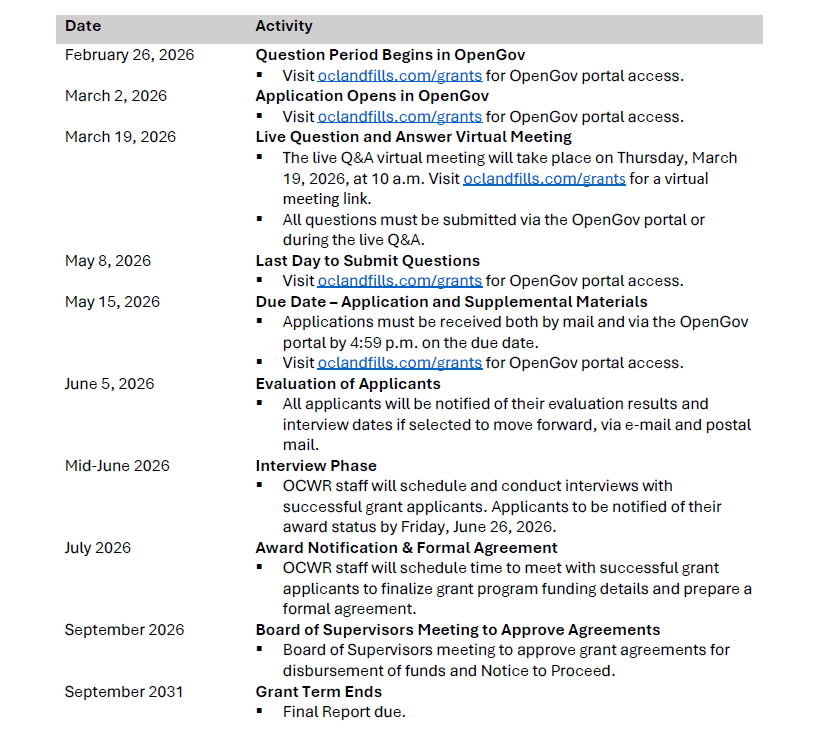
Applications and supporting materials are due by 4:59 p.m. on Friday, May 15, 2026. OC Waste & Recycling must receive both a hard copy and a digital copy of the application package. Supplemental materials must also meet this deadline to be considered as part of the application. The following is the timeline for the Regional Recycling and Edible Food Recovery Grant (RREFR).
Application Submission Begin: March 2, 2026 Live Q & A Virtual Meeting (Non-Mandatory): March 19, 2026, 10:00am OCWR hosted a live question and answer virtual session on Thursday, March 19, 2026, at 10:00 a.m. via Zoom. To access the recorded video, please visit OClandfills.com/grants.
Question Submission Deadline: May 8, 2026, 4:59pm Application Submission Deadline: May 15, 2026, 4:59pm Timeline dates are approximations only and do not constitute any commitment or guarantee by the County.
Note: The County of Orange, OC Waste & Recycling reserves the right to modify the grant timeline should it deem in its sole discretion to be in the best interest of the County. If any changes are made, the County will post such changes at oclandfills.com/grants.
Please subscribe to both the grant webpage and OpenGov for the most up-to-date information.
For technical assistance with OpenGov, please contact OpenGov customer support.
- FUNDING —
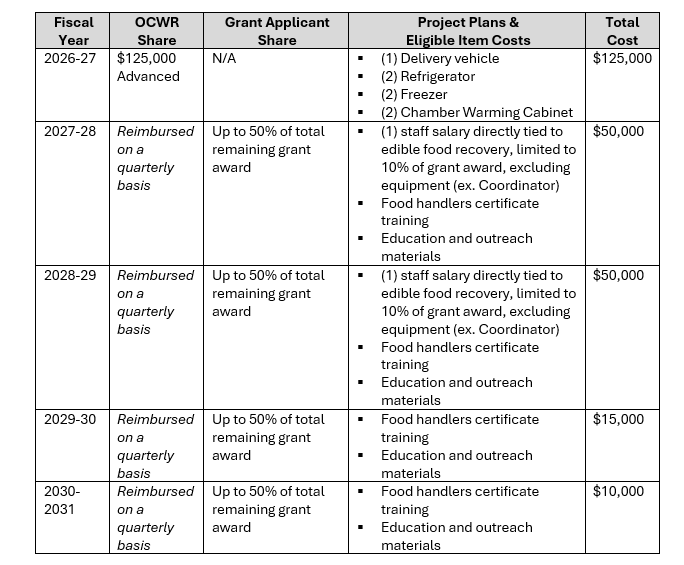
- A total of $6,000,000 is available over three fiscal years (FYs) 2026-27, 2027-28, and 2028-29, with up to $2,000,000 allotted in total per fiscal year.
- Maximum $500,000 per grant award.
- Awarded grantees are to be advanced 50% of their total awarded grant funds within the first three years of the 5-year grant term, with the remaining awarded funds reimbursed on a quarterly report schedule.
- The Work Plan and Budget Plan application documents must show a plan for sustaining the edible food recovery program throughout the life of the 5-year grant term. See example below for a grant project that is awarded $250,000.
Note: OC Waste & Recycling reserves the right to adjust payout amounts based on the number of applicants.
- ELIGIBLE COSTS —
Eligible costs may be incurred only during the grant term, which starts when the grantee receives a Notice to Proceed from OC Waste & Recycling. Eligible costs include, but are not limited to:
- Operating expenses associated directly with approved grant project application.
- Special equipment that is integral to the success of the proposed grant project.
- Building expansion:
- Leases, construction expansions, permits, retrofits, renovations, security upgrades, etc., subject to approval by OCWR.
- Education and outreach materials.
- Food handlers certification training.
- Equipment including but not limited to shelving racks, push carts, weight scales, that can be directly tied to edible food capacity and recovery.
- Vehicles that support logistics in food recovery operations.
- Personnel that support the expansion of edible food recovery (limited to 10% of the total requested grant amount, excluding equipment). Personnel cannot include executive-level positions.
- Consulting fees that support the expansion of edible food recovery are an eligible cost (limited to 10% of the total grant award, excluding equipment). Workplans must show a quantifiable increase in edible food recovery in relation to consulting work.
- INELIGIBLE COSTS —
Ineligible costs include, but are not limited to:
- Costs incurred prior to receipt of the Notice to Proceed letter.
- Costs for office space, office equipment, scholarships, internships, legal, and lobbying fees.
- Note: Subject to approval by OCWR, building expansion directly related to edible food recovery is exempt from this ineligibility.
- Promotional items not related to the project (e.g., shirts, magnets, cups, gift cards, calendars with no educational component, trophies, awards, and plaques).
- Costs that are inconsistent with local, state, or federal laws or regulations.
- Any food or beverages. All edible food must be recovered from a partner organization.
- Any prepaid expenditures for future goods or services delivered after the end of the grant term.
- Exception: the Grant Manager may consider approving products purchased in full before the end of the Grant Term but delivered after the Grant Term if the delay is caused solely by the supplier and through no fault of the Grantee(s). The Grantee(s) must request an exemption in writing and receive written approval from the Grant Manager prior to the purchase.
- Travel, including meals, not specifically related to the recovery, preparation or distribution of edible food.
- Travel or training related to lobbying or networking.
- Business, operational or overhead expenses not directly related to edible food recovery
- Membership dues.
- Overhead and overtime costs.
- Any other costs not deemed reasonable or related to the purpose of the grant by the Grant Manager.
Note: All expenditures are subject to audit. If uncertain regarding eligibility, please submit inquiry during question and answer period.
- QUESTION AND ANSWER PERIOD —
The question and answer period is now open and available on the OpenGov portal through 4:59 p.m. on Friday, May 8, 2026. All questions must be submitted via the OpenGov portal. Please visit oclandfills.com/grants to access the OpenGov portal. All Q&As will be posted as they are received and are subject to updates. It is each applicant’s responsibility to check the OpenGov portal and grant web page for the latest information.
OC Waste & Recycling will host a live question and answer virtual session on Thursday, March 19, 2026, at 10:00 a.m. Visit oclandfills.com/grants for a virtual meeting link. The session will be recorded and can be accessed on the grant web page.
- GRANT APPLICATION DOCUMENTS AND SUBMITTAL —
The following is a checklist of documents that are required as part of the Regional Recycling and Edible Food Recovery Grant (RREFR) application package. Please review your application to ensure that everything on the checklist is included and arranged in the order prescribed.
OC Waste & Recycling must receive both a hard copy and a digital copy of the application package.
Hard Copy (Wet Signatures Required)
The complete hard copy application, including original signatures, must be received or postmarked no later than 4:59 p.m. on Friday, May 15, 2026.
Mail or deliver to:
OC Waste & Recycling
c/o Andrew Le
601 N. Ross Street, 5th Floor
Santa Ana, CA 92701To schedule a drop-off appointment, please email grants@ocwr.ocgov.com.
Applicants should retain a copy for their records.Digital Submission
A complete digital application package must also be submitted through the OpenGov portal. The digital submission must be received no later than 4:59 p.m. on Friday, May 15, 2026.
Both the hard copy and digital submission are required for an application to be considered complete. Failure to submit both components and supplemental materials by the deadline will result in disqualification.1. Project Description
2. Project Narrative (not to exceed 6 pages)
3. Project Sustainability
4. Work Plan
5. Budget Plan
6. Appendices
➢Resolution and/or Letter of Authorization (if applicable)Any applicant that is under the direction of a governing body must submit a resolution that authorizes specific grant-related matters and identifies an individual or individuals with authority to act on behalf of the applicant. A copy of the authorizing resolution is a required application document that must be submitted to the Grant Manager no later than 4:59 p.m. on Friday, June 5, 2026. Resolution requirements may vary for individual or joint applications.
➢Individual or Joint Application Resolutions Must:- Authorize submittal of an application for a specifically named OC Waste & Recycling grant.
- Identify the job titles of the Signature Authorities authorized to sign all grant-related documents necessary to secure funds and implement the approved project(s). The resolution may also include language authorizing the signature authorities to delegate authority to additional job titles.
- Identify the time period during which the authorizations are valid. The minimum duration is the grant term, and the maximum duration is five years from the date of adoption. If the resolution expires during the application period or the grant term, OC Waste & Recycling will require a new valid Resolution.
- Be certified by the governing body.
In addition to the above resolution requirements, the lead on a joint application resolution (for two or more jurisdictions or non-profits) must:
- Authorize the Lead Applicant to act as the Signature Authority for the Joint grant program. This Resolution authorizes submittal of a Joint application by the Lead Applicant.
- Specifically name jurisdictional participants.
➢Letter of Authorization (Joint Application Only)
A Letter of Authorization is used for Joint Applications. It is executed by the participating jurisdictions and gives the Lead Participant authorization to apply for and to act on the applicants’ behalf in the implementation and administration of the grant program. The Lead Applicant must upload the Letter of Authorization no later than the grant application due date, or the participating jurisdiction(s) may be removed from the application. The letter with original signatures must be maintained in applicant/grantee(s) grant file. The letter must:
- Be on the Lead Participant’s official letterhead.
- Be dated prior to the application due date.
- Authorize the Lead Participant to submit a joint application and act as Lead Agency on behalf of the participating jurisdiction.
- Authorize the Lead Participant to execute all documents necessary to implement the grant.
- Be signed by individuals authorized to contractually bind each participating jurisdiction.
➢Quotes
➢Photos of Equipment, Construction Areas, etc. - REPORTING PROCESS —
Grantees are required to report on the progress of their grant on a quarterly basis for the entirety of the grant term or at the discretion of the Grant Manager. Grantees must also submit a Final Report following the end of the grant term. Reporting due dates, requirements, and instructions will be established in the Negotiated Grant Financial Agreement, which grant recipients will have an opportunity to review.
County Audit Rights: OC Waste & Recycling reserves the right to audit and request additional reports and/or data and documents at any time during the grant term period. Failure of the Grantee to comply with our request may result in the termination of remaining grant funding and a requirement that the Grantee reimburse county.
- CONFLICT OF INTEREST —
Applicant shall exercise reasonable care and diligence to prevent any actions or conditions that could result in a conflict with the County interests. In addition to the applicant, this obligation shall apply to the applicant’s employees, agents, and subcontractors associated with the provision of goods and services provided under the Contract. The applicant’s efforts shall include, but not be limited to establishing rules and procedures preventing its employees, agents, and subcontractors from providing or offering gifts, entertainment, payments, loans or other considerations which could be deemed to influence or appear to influence County staff or elected officers in the performance of their duties.
The County reserves the right to disqualify any applicant on the basis of any real or apparent conflict of interest that is disclosed by the application submitted or any other information available to the County. This disqualification is at the sole discretion of the County. Any applicant submitting an application herein waives any right to object to the County’s exercise of this right, now or at any future time, before anybody or agency including, but not limited to, the County Board of Supervisors or any court of competent jurisdiction.
- PAYMENT PROCESS —
Grantees are to be advanced 50% of their total awarded grant funds within the first three years of the grant term, with the remaining awarded funds on a quarterly reimbursement schedule. The grantee’s payment requests must be for eligible costs, with approval from the OC Waste & Recycling Grant Manager. Payment requests must be submitted quarterly with the accompanying quarterly report. Payment requests must include itemized documentation of eligible expenses (e.g., itemized receipts, invoices, and proof of payment). All payment requests submitted for reimbursement must be addressed directly to the Grantee. Failure to submit these documents by the deadline specified in the Negotiated Grant Financial Agreement or failure to receive the Grant Manager’s approval of these documents during the duration of the grant term may result in the non-payment of otherwise eligible expenditures. Payment requests not accompanied by a quarterly report will be declined.
- UNSPENT FUNDS —
If a county audit is performed, any grantee found to be in violation of the Grant Agreement must return any grant funds that were advanced.
Funds that are unspent at the end of the grant term must be returned by check to OC Waste & Recycling by September 2031. Checks should be made payable to OC Waste & Recycling. Checks must contain the Grant Number (i.e., RREFR-26-xxxx), specify “Regional Recycling & Edible Food Recovery Grant Program (RREFR)” and be mailed to:
OC Waste & Recycling
601 N. Ross Street, Fifth Floor
Santa Ana, CA 92701Unspent funds due to OC Waste & Recycling but left unreturned may result in ineligibility for future grant and payment program funding. If there are questions or other issues related to expenditures, work with the Grant Manager to resolve these issues.
- GRANT AWARD CONDITIONS —
OC Waste & Recycling reserves the right to partially fund or fund individual phases of selected proposals, and OC Waste & Recycling may fund an amount less than requested. OC Waste & Recycling reserves the right to not award any grant funds under one or more cycles.
When awarded, the Applicant or Lead Applicant must sign and return the Negotiated Grant Financial Agreement to OC Waste & Recycling by Friday, July 24, 2026.
- CONTINGENCY OF FUNDING & APPROPRIATION —
Funding for the County of Orange Regional Recycling and Edible Food Recovery Grant (RREFR) is contingent upon OC Board of Supervisors approval.
Submission Requirements
- Contractor Safety (required) —
Contractor shall comply with County’s Safety and Loss Prevention Policy and Procedure #306 (“Contractor Safety Responsibilities”) and submit a copy of its Injury and Illness Prevention Program (IIPP) and Contractor Safety-Activity Checklist to the designated County Procurement staff as part of the solicitation and/or contract process. Contractor will notify County Project Manager of any revisions to the Safety-Activity Checklist and will provide a new Safety-Activity Checklist upon County request. The IIPP shall comply with California Code of Regulations, Title 8, Section 1509 or 3203 (whichever applies). Contractor shall submit other safety programs that pertain to the type of job that will be performed on site. County reserves the right to conduct inspections and audits as necessary for the purpose of evaluating any aspect of safety performance under this Contract.
Do not include the information below in the contract – for internal information only.
Please note public facing links included in this paragraph for contractors to access are as follows:
• Contractor Safety Responsibilities - https://bit.ly/3ayTivx
• Contractor Safety Activity Checklist - https://bit.ly/3FK0t2n - Safety Data Sheets (SDS) (required) —
Contractor is required to provide a Safety Data Sheet (SDS) compliant with California Code of Regulations, Title 8, Section 5194, for each hazardous substance that is provided, used or created as part of the goods or services provided by Contractor to County. The SDS for each substance must be sent to either the County Project Manager, as specified in the “Notices” provision of this Contract, or to the place of shipment or provision of goods/services.
- Campaign Contribution Disclosure Form (required) —
Please download the below documents, complete, and upload.
- Grant Application Documents and Submittal (required) —
Please download the below documents, complete, and upload.
The following is a checklist of documents that are required as part of the Regional Recycling and Edible Food Recovery Grant (RREFR) application package. Please review your application to ensure that everything on the checklist is included and arranged in the order prescribed.
1. Project Description
2. Project Narrative (not to exceed 6 pages)
3. Project Sustainability
4. Work Plan
5. Budget Plan
6. Appendices
➢Resolution and/or Letter of Authorization (if applicable)Any applicant that is under the direction of a governing body must submit a resolution that authorizes specific grant-related matters and identifies an individual or individuals with authority to act on behalf of the applicant. A copy of the authorizing resolution is a required application document that must be submitted to the Grant Manager no later than 4:59 p.m. on Friday, June 5, 2026. Resolution requirements may vary for individual or joint applications.
➢Individual or Joint Application Resolutions Must:- Authorize submittal of an application for a specifically named OC Waste & Recycling grant.
- Identify the job titles of the Signature Authorities authorized to sign all grant-related documents necessary to secure funds and implement the approved project(s). The resolution may also include language authorizing the signature authorities to delegate authority to additional job titles.
- Identify the time period during which the authorizations are valid. The minimum duration is the grant term, and the maximum duration is five years from the date of adoption. If the resolution expires during the application period or the grant term, OC Waste & Recycling will require a new valid Resolution.
- Be certified by the governing body.
In addition to the above resolution requirements, the lead on a joint application resolution (for two or more jurisdictions or non-profits) must:
- Authorize the Lead Applicant to act as the Signature Authority for the Joint grant program. This Resolution authorizes submittal of a Joint application by the Lead Applicant.
- Specifically name jurisdictional participants.
➢Letter of Authorization (Joint Application Only)
A Letter of Authorization is used for Joint Applications. It is executed by the participating jurisdictions and gives the Lead Participant authorization to apply for and to act on the applicants’ behalf in the implementation and administration of the grant program. The Lead Applicant must upload the Letter of Authorization no later than the grant application due date, or the participating jurisdiction(s) may be removed from the application. The letter with original signatures must be maintained in applicant/grantee(s) grant file. The letter must:
- Be on the Lead Participant’s official letterhead.
- Be dated prior to the application due date.
- Authorize the Lead Participant to submit a joint application and act as Lead Agency on behalf of the participating jurisdiction.
- Authorize the Lead Participant to execute all documents necessary to implement the grant.
- Be signed by individuals authorized to contractually bind each participating jurisdiction.
➢Quotes
➢Photos of Equipment, Construction Areas, etc. - Homeless Service System Pillars Attestation (required) —
Please download the below documents, complete, and upload.
- Vendor Type (required) —
This will update the Vendor Type field within Insurance and Indemnification section.
- Vendor Pricing (required) —
How do you want to receive pricing from vendors for this project?
- Will this Project Require Evaluation Criteria/Committee (required)
- Does this solicitation require any of these? (required)
- Type of Contract (required)
- Name the type of Funding Source for this project (required)
- Start-up funds ____ available for these services... (required) —
Select one to fill in the blank.
- Include Start-up Fund Amount? (required)
- Start-up fund amount (required) —
Answer format: $XX.XX or N/A
- Enter what the start-up funds may be used for (required)
- Start of Services Date (required)
- The selected applicant shall be required to meet performance objectives by_____________. (required) —
Enter the date here.
- Written protests must be sent to: (Name of Entity) (required) —
Enter name of entity
- Written protests must be sent to: (Dept Name of Entity) (required) —
Enter the department name of entity
- Written protests must be sent to: (Mailing Address, Line 1) (required) —
Enter the first line of the entity's address.
Example: 400 W Civic Center Drive, 3rd floor
- Written protests must be sent to: (Mailing Address, Line 2) (required) —
Enter the second line of the entity's address.
- Target Population for this project (required)
- Name of Required License or Certification for each staff member allocated to the program (required)
- Name of Required Facility License (required)
- Name of Facility Certification (required)
- Reimbursement Rate (required)
- Network Security & Privacy Liability Minimum Limits (required)
- Technology Errors & Omissions Minimum Limits (required)
- Professional Liability Minimum Limits (required)
- Sexual Misconduct Minimum Limits (required)
- Employee Dishonesty (Client Coverage) Minimum Limits (required)
Questions & Answers
Q (No subject): If many organizations apply for individual trucks, how will you honor the environmental intents of SB 1383? The 2024 report “Food Security, Nutrition, and Access: An Analysis of Need in Orange County” found that trucks are being grossly underutilized by OC charitable feeding organizations because of individualized use. In developing regional food recovery programs throughout the state, we see there is a difference between the request for refrigerated vehicles and the need for refrigerated transportation services. Will the grant take into account the coordination of assets requested and already existing as part of a coordinated logistics effort. Will you prioritize connectivity and optimized utility amongst grantees?
A: Because this is a competitive grant term, we will not influence connectivity amongst entities applying for grant funding.
Q (No subject): In the development of an effective regional approach, data tracking is a critical component. Since the passing of SB 1383 numerous tech platforms have been established as have numerous food recovery services, complicating the ability to accurately track the amount of food recovered. Where does data come into play in your approach to awarding funding?
A: Data/Research would show due diligence in looking into where the need is and who you would be working with. Where would you be recovering edible food from, and where would you be delivering it to? What partners do you intend to work with? In addition, anything that shows that there’s the ability to collect more food, any data showing that due to constraints at your current location or with current infrastructure needs, you’re unable to capture any of the edible food. Any current agreements that you have would suffice as well.
Q (No subject): How do we build a regional program based off the grant’s limitations? Does OCWR plan to connect grantees to one another to support a more connected county-wide approach?
A: Because this is a competitive grant term, we will not influence connectivity amongst entities applying for grant funding.
Q (No subject): How does the grant program expect applicants to address shared assets or collective asset needs across multiple organizations or projects within a region?
A: Assets are to be owned solely by the lead applicant on joint applications. Sharing of assets should be described in the grant application. Pass-through of equipment for someone that's not included in the grant application is not allowed.
Q (No subject): What’s the criteria for awarding assets through the grant? Will collaborative applications be prioritized, and if so, what type of collaboration does the program prefer: multiple organizations submitting an application for the same project, or one organization applying on behalf of a broader partnership?
A: Please refer to the Scoring Criteria document on our resource page.
Q (No subject): Edible food recovery most often requires refrigerated space to support donation collection. Does OCWR plan to guide the development of necessary cold storage space within Orange County?
A: Because this is a competitive grant term, we will not influence the development of necessary cold storage space in Orange County.
Q (No subject): Is the focus for this grant on rescuing as many pounds as possible, or will it emphasize building effective, connected systems to recover edible food for consumption by humans? Will the prevention of donation dumping be addressed through the grant?
A: Please refer to the Scoring Criteria document on our resource page.
Q (Question from March 19 Live Q&A Virtual Meeting):
A: Will the funding be one-time, or will there be future funding to support a proposal for an ongoing program? This grant cycle supports a five-year grant project intended to bolster an edible food recovery infrastructure.
Q (Question from March 19 Live Q&A Virtual Meeting):
A: Is the grant application limited to NGOs, local governments, non-profit organizations? Or is it also open to for-profit entities involved in EFR? The grant opportunity allows for a wide variety of entities that provide services related to edible food recovery. The goal is to create an infrastructure that supports edible food recovery countywide.
Q (Question from March 19 Live Q&A Virtual Meeting):
A: What is the criteria for awarding assets through the grant? Will collaborative applications be prioritized, and if so, what type of collaboration does the program prefer: multiple organizations submitting an application for the same project, or one organization applying on behalf of a broader partnership? Please refer to the Scoring Criteria document on our resource page.
Q (Question from March 19 Live Q&A Virtual Meeting):
A: Could you speak to the scoring? Please refer to the Scoring Criteria document on our resource page.
Q (Question from March 19 Live Q&A Virtual Meeting):
A: Partnerships and regional collaborations are limited to $500K? Yes, each application is limited to a $500,000 maximum award.
Q (Question from March 19 Live Q&A Virtual Meeting):
A: Is the goal of edible food recovery intended to comply with SB 1383 where food waste should be redirected away from landfills? And would grant aiding in redirecting edible food outside of landfills constitute as edible food recovery? Yes, all of the above. The goal of the program is to fund edible food and expand edible food recovery programs, and with SB 1383, diversion of organics from landfills is a priority. Any diversion of edible food back into the communities would be considered.
Q (Question from March 19 Live Q&A Virtual Meeting):
A: In the Scoring Criteria document, in the Project Narrative section it asks for documented data or research. What do y'all consider documented data/research? Data/Research would show due diligence in looking into where the need is and who you would be working with. Where would you be recovering edible food from, and where would you be delivering it to? What partners do you intend to work with? In addition, anything that shows that there’s the ability to collect more food, any data showing that due to constraints at your current location or with current infrastructure needs, you’re unable to capture any of the edible food. Any current agreements that you have would suffice as well.
Q (Question from March 19 Live Q&A Virtual Meeting):
A: Will OCWR be requiring quarterly reports like CalRecycle requires quarterly reports in order to be paid? Yes, that is correct. It would be very similar to what CalRecycle requests.
Q (Question from March 19 Live Q&A Virtual Meeting):
A: To drop a physical copy off, one must pre-arrange an appointment? Yes, please email us at the email we provided in the application guidelines and instructions to schedule an appointment.
Q (Question from March 19 Live Q&A Virtual Meeting):
A: For proposals that include multiple projects, are you still looking for a six-page project narrative? For example, in a proposal with five interconnected projects, that leaves about a page for each project. Is that sufficient, or considered too brief? A six-page project narrative is sufficient.
Q (Question from March 19 Live Q&A Virtual Meeting):
A: The list of items to include in the application mentions quotes. Are quotes only needed for items above a certain dollar amount? How many quotes are needed per item? As it’s written, quotes that help support your application and illustrate your project needs are desirable. One quote per item will suffice. There is no dollar amount threshold.
Q (Question from March 19 Live Q&A Virtual Meeting):
A: Does OCWR plan to connect grantees to one another to support a more connected county-wide approach? When you see multiple grant proposals asking for similar materials or program assistance, how are you going to optimize the grant? Because this is a competitive grant, we are not looking to connect grantees to one another.
Q (Question from March 19 Live Q&A Virtual Meeting):
A: Do consultants have to be a non-profit or can the be for-profit consultants? Consultants can be non-profit or for-profit so long as they are specifically providing only support to edible food recovery efforts and are in line with terms of the grant.
Q (Question from March 19 Live Q&A Virtual Meeting):
A: If multiple applications list the same partnering organization for food distribution, does that present a limitation to all of the applications even if they are unrelated? No, however, the lead applicant must be different.
Q (Question from March 19 Live Q&A Virtual Meeting):
A: Would purchasing equipment/supplies that are then given to another org to assist with our project be an eligible expense? If you are going to be looking at having some arrangement like that, it would have to be a joint application between you and that entity, where the lead applicant owns the eligible expense. It wouldn't be a pass-through of equipment for someone that's not included in the grant application.
Q (Question from March 19 Live Q&A Virtual Meeting):
A: Does the authorizing resolution need to be signed? If yes, by who? Yes, by your governing body. For example, an Executive Director.
Q (Question from March 19 Live Q&A Virtual Meeting):
A: Can consultants be hired to help with implementation of the grant as governments agencies are often strapped and have limited available staffing? Yes, a consultant can help with implementation of components of the project that receives grant funding and/or part of a co-grant application. The consultant should be knowledgeable in edible food recovery programs and requirements, provide a key specific role in the implementation of the funded project or program and funding will only cover the specific costs associated with the approved project or program.
Q (Question from March 19 Live Q&A Virtual Meeting):
A: Are photos required to be included in the application? Yes. For example, building expansion areas, equipment, locations, etc.
Q (Question from March 19 Live Q&A Virtual Meeting):
A: Is there any wording in the grant that precludes awarding funds a pilot project that’s already focused on edible food recovery? No, there’s nothing that precludes an entity already participating in edible food recovery operations from applying.
Q (Question from March 19 Live Q&A Virtual Meeting):
A: If questions are submitted by the Q&A deadline, how will OCWR handle distribution of answer(s)? Answers will be posted shortly on the website afterwards and on the OpenGov portal.
Q (Question from March 19 Live Q&A Virtual Meeting):
A: To confirm, NIGP CODES is referring to National Institute of Government Purchasing (NIGP) Commodity Codes? Yes, that is exactly what NIGP stands for.
Q (Question from March 19 Live Q&A Virtual Meeting):
A: Will the recording be available along with slides? Yes, the recording will be available on our website, oclandfills.com/grants.
Q (Question from March 19 Live Q&A Virtual Meeting):
A: Do we have access to previous companies that have won the contract? Not necessarily. The previous grant cycles were tailored a little bit differently, but you can access them on our website to see who has been awarded.
Q (Question from March 19 Live Q&A Virtual Meeting):
A: When saying redirecting to “communities”, can you pls define “communities”? Is it only households, or other social organizations? It’s open to interpretation. Please refer to the grant application scoring criteria to help with your application.
Q (Question from March 19 Live Q&A Virtual Meeting):
A: Is the initial 50% payment only if the funds are needed to get the project going? Or the standard? The standard. The intent is to ensure projects can get started immediately after funds are received.
Q (Question from March 19 Live Q&A Virtual Meeting):
A: I understand that it is up to the applicant to research the equipment that is needed to expand EFR infrastructure, but does OCW&R have recommendations on equipment/storage to transport hot/prepared foods? Because this is a competitive grant term, we cannot recommend items or equipment.
Q (Question from March 19 Live Q&A Virtual Meeting):
A: We've written a grant for the Continuum of Care NOFO. Does this exclude us from applying for a grant from you folks? No.
Q (Question from March 19 Live Q&A Virtual Meeting):
A: I had a question about the quarterly reporting process. Can you talk a little about the expectations for that? Reporting due dates, requirements, and instructions will be established in the Negotiated Grant Financial Agreement, which grant recipients will have an opportunity to review.
Q (Question from March 19 Live Q&A Virtual Meeting):
A: Can an organization or city hire an outside consultant like a PR agency to assist with promoting the grant awarded project or program? Hiring a PR agency is not an eligible expense.
Q (Q&A recording): Can you post the link to the Q&A recording from the March meeting? I can't seem to find it on the website. Thank you!
A: The recording from the live Q&A virtual meeting on March 19 can be found at OClandfills.com/grants.
Q (Question from March 19 Live Q&A Virtual Meeting):
A: I know you said you could do joint applications if you don't have an organization you want to work with in mind yet. Can you apply for it just as your jurisdiction, and then, you know. Deal with figuring out the organization later, or do you need to have all of that before the application deadline? In your grant application, describe in detail your intent to secure a partnership in the Work Plan. List dates, anticipated outcomes, and any other relevant information related to the partnership.
Q (Abound Food Care Requesting Extension for Maximum Impact): In support of building a connected, efficient, and sustainable edible food recovery program in Orange County, we requested a grant extension on March 16. Our proposal brings together partners across 34 cities, serving 3.2 million residents and over 400 nonprofit organizations, to maximize regional resources. Through Q&A sessions and ongoing inquiries, it became clear that broader collaboration would benefit all applicants. We are requesting this extension to ensure the most cost-effective and impactful use of funds. Our experience as a grantor in Orange and Sacramento Counties shows that cross-collaborative efforts deliver the strongest outcomes. We have extensive experience supporting SB 1383 compliance and improving edible food recovery through our role with the Orange County Hunger Alliance. We believe this foundation positions us well to expand collaboration both geographically and programmatically. Thank you for considering our request.
A: Per our guidelines and instructions, all questions must be submitted through our OpenGov portal. Due to strong interest and response from the community, OC Waste & Recycling (OCWR) has extended the application deadline for the Regional Recycling and Edible Food Recovery Grant Program to May 15, 2026, at 4:59 p.m.
Q (Question from March 19 Live Q&A Virtual Meeting):
A: The grant information notes eligible cost personnel, and then it says ineligible costs and notes consulting fees. If I'm hiring a consultant, whether it's a for-profit consultant or a non-profit like Abound to assist with increasing access to nonprofits here in Santa Ana working with the school district to assist them and the various nonprofits here in accepting more edible food from businesses are those costs eligible? If we wanted to hire someone or subcontractor to assist us with that, is that an eligible cost? Personnel and consulting fees are allowable as long as those costs and personnel are only working on components of the project that receives grant funding and/or part of a co-grant application. If the jurisdiction in this question wanted to work with a consultant or non-profit such as Abound or any other consultant or non-profit they should be knowledgeable in edible food recovery programs and requirements, provide a key specific role in the implementation of the funded project or program and funding will only cover the specific costs associated with the approved project or program. They could also be part of a cooperative application where both parties are applicants on the grant application. Consulting fees that support the expansion of edible food recovery are an eligible cost (limited to 10% of the total grant award, excluding equipment). Workplans must show a quantifiable increase in edible food recovery in relation to consulting work.
Q (Extension): Can this NOFA be extended by 30 days to give potential respondents an opportunity to develop collaborative responses. Also, more time is needed to obtain approval of a specific Board Resolution for just this grant opportunity as per the NOFA.
A: Due to strong interest and response from the community, OC Waste & Recycling (OCWR) has extended the application deadline for the Regional Recycling and Edible Food Recovery Grant Program to May 15, 2026, at 4:59 p.m.
Q (Mileage Reimbursement): Our program involves a volunteer who drives approximately 300 miles per week to pick up edible food from grocery store partners (Grocery Outlet, Ralph's, and Pacific Ranch Market) for distribution to canyon residents. We plan to reimburse this mileage as a program operating expense directly tied to edible food recovery. Can you confirm that mileage incurred specifically for driving to and from food pickup locations is an eligible cost under the RREFR grant?
A: The intent of the RREFR grant opportunity is to advance edible food recovery. For this scenario to be an eligible cost, the grant project must demonstrate how the costs of the trips assist and increase the amount of edible food recovered. The use of data tracking software that tracks trip logs would help support the grant project.
Q (Electricity for Refrigeration): Our program uses refrigerators and freezers to store recovered edible food between pickups and distribution events. We plan to include the electricity costs for these units as an eligible operating expense. If these cooling units are separately metered, would the associated electricity costs be reimbursable? Alternatively, would a calculated estimate based on unit wattage and operating hours be an acceptable alternative for documentation purposes?
A: The intent of the RREFR grant opportunity is to advance edible food recovery. If possible, the grant project should verifiably demonstrate how the reimbursement of electricity costs ties directly to the increase of edible food recovered.
Q (Levine Act Campaign Contribution Disclosure Form): On the Levine Act Campaign Contribution Disclosure Form, it asks for "Application of Solicitation Number" and "Application of Solicitation Title" Where do we find those?
A: For both fields on the Levine Act Campaign Contribution Disclosure Form, please enter "Regional Recycling and Edible Food Recovery Grant."
Q (Food Aquired Outside of Orange County): Can edible food recovered from other parts of California, which will be distributed in OC, be included in this grant? (Ex: Truckloads of excess produce from Northern California are brought to OC and distributed.)
A: No, edible food recovered from other parts outside of Orange County is not eligible for this grant program.
Q (Third-party material pick-ups): Is paying a community partner organization or third-party logistics provider (3PL) for material pick-ups (bins, crates, boxes, etc) an allowable expense, if directly tied to increasing edible food recovery and distribution capacity? (Ex: Applicant delivers recovered food in crates to a community partner site to distribute. A 3PL or other organization is paid to pick up the empty crates and return them to the Applicant for reuse.)
A: Yes, this would be an allowable expense as long as the applicant were able to show how it is directly tied to increasing edible food recovery within Orange County.
Q (Mileage - Food Donor Sites): Is mileage for Applicant’s staff to visit potential food donor or established food donor sites allowable?
A: Mileage reimbursement for visits to established food donor site(s) is an eligible cost. The grant project and work plan must demonstrate how the visits assist and increase the amount of edible food recovered within Orange County. Mileage reimbursement for visits to potential food donor site(s) is not an eligible expense.
Q (Mileage - Food Distribution Sites): Is mileage for Applicant’s staff to visit food distribution sites allowable?
A: Mileage reimbursement for visits to established food donor site(s) is an eligible cost. The grant project and work plan must demonstrate how the visits assist and increase the amount of edible food recovered within Orange County. Mileage reimbursement for visits to potential food donor site(s) is not an eligible expense.
Q (Household or Indivdual Campaign Contributions): On the Levine Act Campaign Contribution Disclosure Form, do contributions made by anyone in the household need to be included? Or only contributions from the named contributor? (Ex: A contribution in a Board member's name versus a contribution in a Board member's spouse's name.)
A: No, contributions made by anyone in the household do not need to be included. This is only applicable to the applicant. However, if a board member’s spouse is part of the company applying, their name must be disclosed.
Q (Staff Visits): The food we rescue is distributed to the clients of hundreds of community organizations that we formally work with on an ongoing basis. Would mileage for our staff to make visits connected to rescued food to these end-point distribution sites be allowable?
A: Yes, mileage reimbursement for visits to established food donor site(s) within Orange County is an eligible cost. The grant project and work plan must detail the history and future development of these endpoints, while also demonstrating how the visits assist with increasing the amount of edible food recovered within Orange County.
Q (Prior Grants): On page 2 of the Grant Application Form, when answering “Prior Grant History,” should grants funded by Cal Recycle, implemented through OCWR, be considered “previous grant funding from OC Waste & Recycling”?
A: Yes. Please describe a brief description of the grant project.
Q (Allocation of grant funds): The grant notes there will be multiple years of fund allocations. Will there be a separate application for 2027 grant awards? Currently on track for expansion in 2027 and would be the focus the funds.
A: There will not be a separate application for 2027 grant awards, as the grant period spans a five-year grant term. Please refer to the "Funding" section in the Application Guidelines and Instructions attachment.
Q (School Districts): Are school districts eligible to apply for this grant if it is to fund an edible food recovery program?
A: Yes, school districts would be eligible applicants if their intent is to provide or expand services or accessibility related to edible food recovery.
Q (Indirect Overhead Rate for Inclusion in the Budget): As part of the budget, are we able to include our approved cost allocation plan or de minimis indirect cost? I don't see anything in the NOFA or the prior questions, that address this. Thank you.
A: The Budget Plan should include costs associated with the program/project. If the allocation plan/indirect costs are associated with the program they should be included. Additionally, if the applicant is requesting these costs be funding by the grant funds, they should be included and within the application noted how the utilization of the grant funds to cover these costs assists with the expansion or new food recovery efforts.
Key dates
- March 2, 2026Published
- May 15, 2026Responses Due
AI classification tags
Frequently asked questions
SLED stands for State, Local, and Education. These are solicitations issued by state governments, counties, cities, school districts, utilities, and higher education institutions — as opposed to federal agencies.
SamSearch Platform
Stop searching. Start winning.
AI-powered intelligence for the right opportunities, the right leads, and the right time.