SLED Opportunity · CALIFORNIA · COUNTY OF ALAMEDA, CA
902694- DRAWBRIDGES PAINT CONDITION ASSESSMENT
AI Summary
County of Alameda seeks a contractor for paint condition assessment and coating rehabilitation scope development for three drawbridges. The contract is for one year with two optional renewals. The work includes detailed assessment, bid specification preparation, and environmental compliance considerations.
Opportunity details
- Solicitation No.
- 262627
- Type / RFx
- RFP
- Status
- open
- Level
- county
- Published Date
- May 5, 2026
- Due Date
- June 9, 2026
- Jurisdiction
- County of Alameda, CA
- State
- California
- Agency
- County of Alameda, CA
Description
It is the intent of these specifications, terms, and conditions to describe drawbridges paint condition assessment services being requested by the Alameda County Public Works Agency (ACPWA). The awarded Contractor must perform a comprehensive paint condition assessment of the structural steel, auxiliary components, and bridge towers for three drawbridges—Park Street Bridge, Fruitvale Avenue Bridge, and High Street Bridge—and, based on the assessment, develop a detailed coating rehabilitation scope and prepare bid specifications for the future coating work.
The County intends to award a one (1) year contract (with the option to renew for two [2] years) to the Bidder selected as the most responsive and responsible Bidder whose response conforms to the RFP and meets the County’s requirements.
Background
ACPWA is responsible for the management and operations of infrastructure, including streets, bridges, and flood control facilities, such as pump stations and stormwater conveyance infrastructure. ACPWA manages the planning, design, construction, and maintenance of these facilities. ACPWA’s mission is to enhance the quality of life for the people of Alameda County by providing a safe, well-maintained, and lasting public works infrastructure through accessible, responsive, and effective services. ACPWA operates and maintains six drawbridges over the Oakland-Alameda Estuary. (link: https://www.acpwa.org/programs-services/infrastructure-maintenance-operations/estuary-bridges-maintenance-operation/) These bridges serve as a critical transportation corridor linking the City of Alameda to the City of Oakland and beyond.
The three (3) bridges are assumed to be similar in scale and access difficulty; however, there may be unusual conditions, such as severely corroded members requiring structural replacement, etc.
This RFP is for a paint condition assessment of the structural steel for the Park Street Bridge, Fruitvale Avenue Bridge, and High Street Bridge, and for the development of a detailed coating rehabilitation. Bridge painting work is not included in the scope of this RFP. Structural repair work, other than minor spot steel repairs necessary for assessment purposes, is not included. If significant structural deficiencies are identified, they will be addressed under a separate contract.
The Park Street Bridge
This is a double-leaf bascule drawbridge spanning 372 feet of the Oakland Estuary in the San Francisco Bay Area. It links the cities of Oakland and Alameda.
Coordinates: 37°46′18.08″N 122°14′11.65″W
Total length: 372 feet
Opened in 1893, rebuilt in 1935
Repainted in 1998
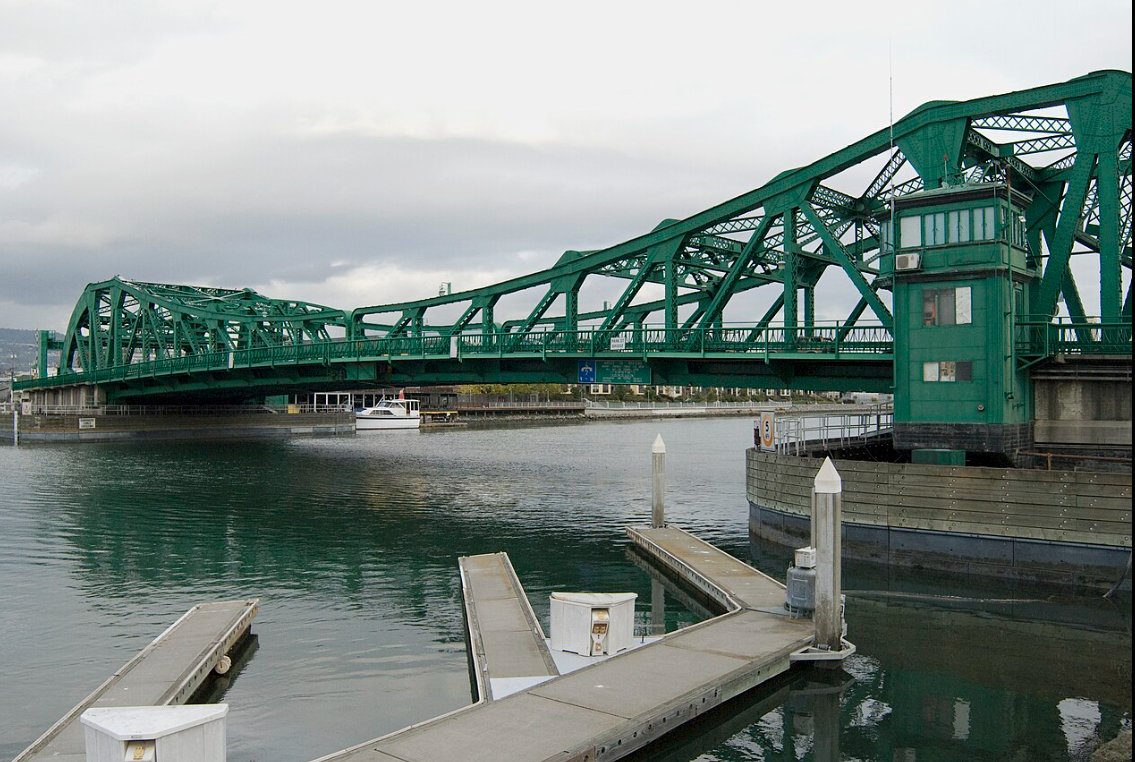
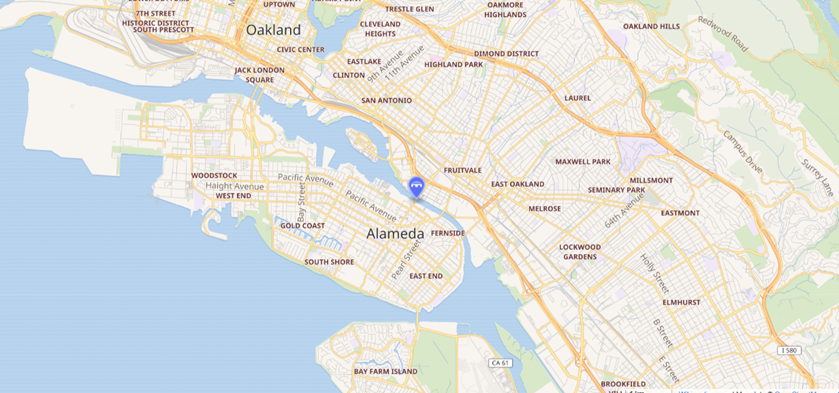
The High Street Bridge
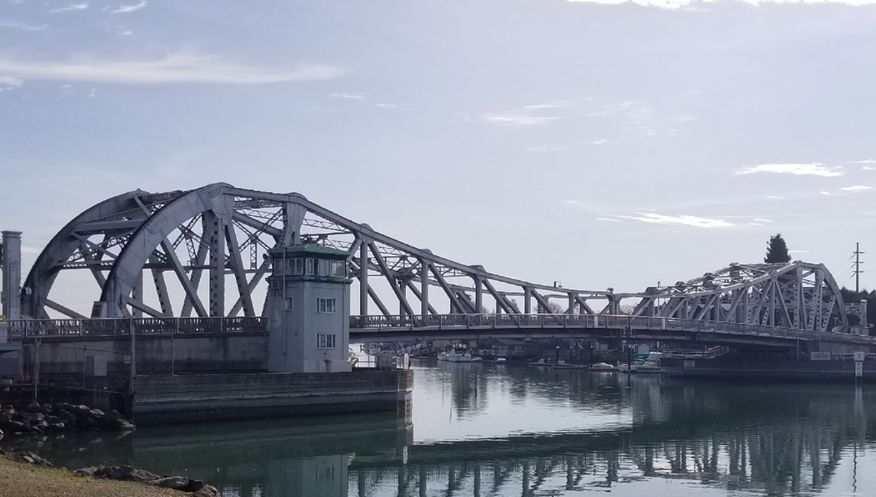
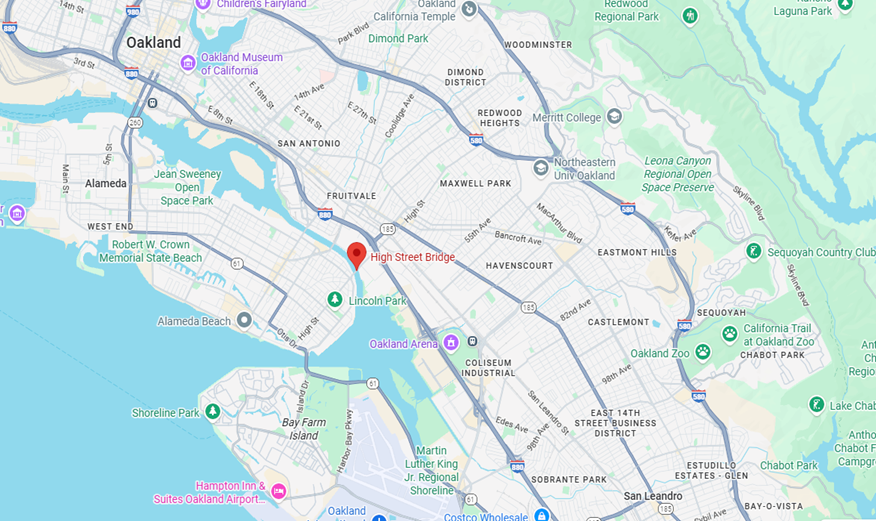
The High Street Bridge is a two-lane 296-foot double-leaf bascule (drawbridge) connecting Alameda and Oakland, built in 1939 and carrying approximately 26,000 to 30,000 vehicles per day on weekdays.
Coordinates: Approximately 37.7645∘𝑁-122.2250∘W over the Oakland Estuary
Length: 296 feet
The current bridge is the result of the ACPWA project that replaced an earlier 1894 structure.
Completely repainted in 1996
The Miller Sweeny Bridge
The Miller-Sweeney Bridge is a four-lane single-leaf bascule bridge located on Fruitvale Avenue, built in 1973, and is operated by ACPWA. Approximately 15-150 vehicles cross the bridge daily. It connects Oakland and Alameda over the Oakland Estuary, providing a crucial link between the two cities, and is often referred to by locals as the "Fruitvale Bridge."
Coordinates: approximately 37.77∘N, −122.23∘W
While it has undergone several renovations, including in the late 1990s, the exact year when the bridge was repainted is not known.
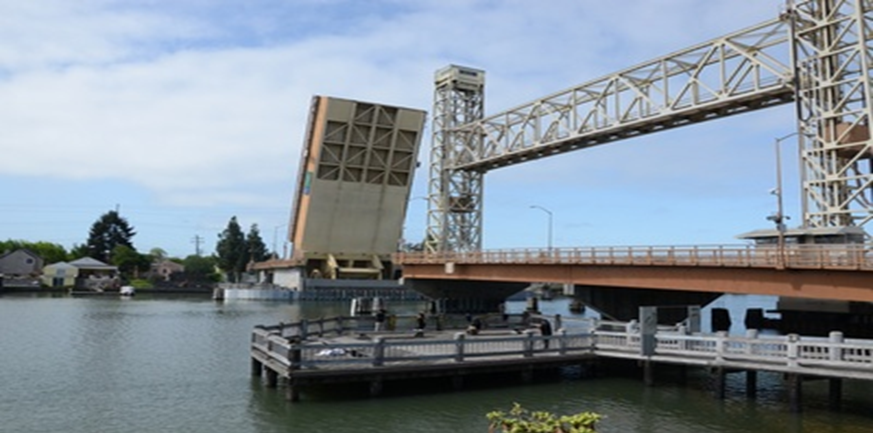
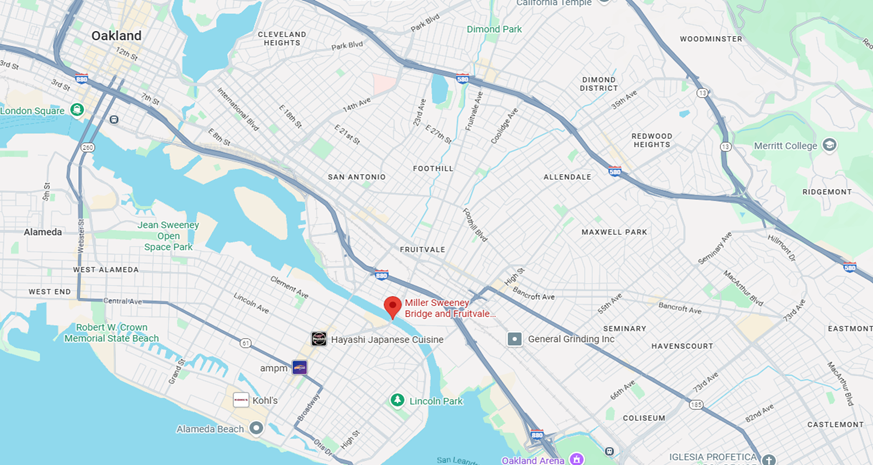
The County requires services for the Park Street Bridge, Fruitvale Avenue Bridge, and High Street Bridge that consist of, but are not limited to, the following:
1. A paint condition assessment of each bridge’s structural steel (superstructure, substructure, movable span components, machinery housing, railings, etc.).
2. Based on the assessment, development of a detailed coating rehabilitation scope (which may include full removal/abrasive blast cleaning and repainting, or partial spot-repair and overcoating)
3. Preparation of the bid specification and cost estimate for the coating work (including paint system, surface preparation, containment, environmental/lead/Polychlorinated Biphenyls (PCB) requirements, traffic/marine/coastal considerations).
Project Details
- Reference ID: 902694
- Department: General Services Agency-Procurement
- Department Head: Detra Dillon (Purchasing Administrator)
Important Dates
- Questions Due: 2026-05-16T00:00:00.000Z
- Pre-Proposal Meeting: 2026-05-14T17:00:00.000Z — TEAMS MEETING
Evaluation Criteria
- Completeness of Response (1 pts) —
Responses to this solicitation must be complete. Responses must address all the requirements identified within this solicitation and all related documents, including any Addenda. Failure to meet the Bidder Minimum Qualifications may also be considered an incomplete response and may result in the disqualification of the Bidder.
- Debarment and Suspension (1 pts) —
Bidders, its principal, and named subcontractors are not identified on the list of Federally debarred, suspended, or other excluded parties located at www.sam.gov/SAM.
- Cost (75 pts) —
The points for Cost will be computed by dividing the amount of the lowest responsive and responsible bid received by each Bidder’s total proposed cost.
Cost evaluation points may be adjusted by considering:
- Reasonableness (i.e., how well does the proposed pricing accurately reflect the Bidder’s effort to meet requirements and objectives?).
- Realism (i.e., is the proposed cost appropriate to the nature of the products and/or services to be provided?).
- Technical Criteria: (75 pts) —
Proposal will be evaluated considering the probability of success and risks associated:
1. To what extent does the Bidder’s technical approach address key requirements such as coating condition evaluation, adhesion testing, corrosion assessment, and overcoating feasibility?
2. How effectively does the Bidder incorporate environmental and regulatory requirements (e.g., lead/PCB handling, containment, stormwater, marine permitting) into their methodology?
3. How well does the Bidder demonstrate an ability to identify risks (e.g., access constraints, hazardous materials, structural concerns) and propose appropriate mitigation strategies? - Description of Proposed Services (150 pts) —
Proposals will be evaluated considering the RFP specifications and the questions below:
1. How well does the Bidder demonstrate a thorough understanding of bridge coating assessment standards (e.g., SSPC, NACE, ASTM) and their application to movable bascule bridges in a marine environment?
2. How clearly and comprehensively are the proposed services described for each phase of work, including inspection, testing, analysis, and development of rehabilitation recommendations and bid specifications?
3. How well does the Bidder demonstrate a complete understanding of the full lifecycle deliverables, including condition reports, quantity take-offs, coating system recommendations, and bid-ready specifications?
4. How well does the Bidder define the level of detail, accuracy, and usability of final deliverables for County decision-making and future procurement?
6. How well does the Bidder demonstrate understanding of lead/PCB requirements and hazardous materials handling?
7. How clearly does the Bidder address the environmental compliance measures (stormwater, containment, disposal)? - Implementation Plan and Schedule (75 pts) —
Proposals will be evaluated considering the RFP specifications, Bidder’s response submitted in the corresponding section of Exhibit A – Bid Response Packet, and the questions below:
1. How clearly does the Bidder’s implementation plan outline incremental steps and actions, and does it adequately detail the staff and data resources required, as well as the planned meetings and timeline?
2. How effectively does the Bidder’s schedule identify the completion of all required tasks, including key milestones and deliverables?
3. How realistic and well-coordinated is the Bidder’s proposed project schedule, including milestones for field inspections, laboratory testing, analysis, draft/final deliverables, and County review?
4. How effectively does the Bidder address project logistics such as bridge access, traffic and marine coordination, safety planning, and permitting timelines?
5. How well does the implementation plan account for potential delays (e.g., weather, permitting, access restrictions) and provide contingencies to maintain project progress? - Relevant Experience (100 pts) —
Proposals will be evaluated, including considering the RFP specifications and the questions below:
1. How relevant is the Bidder’s experience in performing paint condition assessments and developing coating rehabilitation specifications for bridges or similar steel structures, particularly in marine or estuarine environments?
2. How qualified and experienced are the Bidder’s proposed project team members (including key personnel and subcontractors) in performing similar projects?
3. How well does the Bidder demonstrate the ability to develop complete, bid-ready coating specifications that can be used for future procurement?
4. To what extent does the Bidder demonstrate successful completion of comparable projects, including preparation of bid specifications and cost estimates for public agencies?5. How well does the sample report demonstrate clear, meaningful analysis, and actionable recommendations?
- Reference (25 pts)
- Small Local Emerging Business Preference (ADMIN SCORING) (25 pts) —
Points equaling 5% of the Bidder’s total score for the above Evaluation Criteria will be added. This will be the Bidder’s final score for purposes of award evaluation.
- Local Preference (ADMIN SCORING) (25 pts) —
Points equaling 5% of the Bidder’s total score for the above Evaluation Criteria will be added. This will be the Bidder’s final score for purposes of award evaluation.
Submission Requirements
- Submit Bid Response and Bid Form (required) —
Please confirm that both your response and the Bid Form have been uploaded here.
- Submit Bid Response (required) —
Please confirm that your response has been uploaded here.
- Has your response addressed all the requirements identified within the solicitation and all related documents, including any addenda? Failure to meet the Bidder Minimum Qualifications may also be considered an incomplete response and may result in the disqualification of your bid. (required)
- Your company, its principal, and named subcontractors are not identified on the list of Federally debarred, suspended, or other excluded parties located at www.sam.gov/SAM. (required)
- I certify that I have read, understood and agree to the terms in this solicitation, and that I am authorized to submit this response on behalf of my company. (required)
- Pricing (required) —
- Choose Option 1 when you have set line items, for example:
- This is a quote for goods or commodities.
- This is a public works bid, with a pricing table that can be uploaded into OpenGov Procurement from an Excel spreadsheet.
- Seeking services for hourly rate schedules.
- Choose Option 2 when you need vendors to provide you with the line items.
- Choose Option 1 when you have set line items, for example:
- Evaluation Committee? (required) —
Will there be an evaluation committee to review the proposals and score them based on weights and multiple criteria?
- Procurement and/or Project Contact (required) —
Select the information you would like display.
Key dates
- May 5, 2026Published
- June 9, 2026Responses Due
AI classification tags
Frequently asked questions
SLED stands for State, Local, and Education. These are solicitations issued by state governments, counties, cities, school districts, utilities, and higher education institutions — as opposed to federal agencies.
SamSearch Platform
Stop searching. Start winning.
AI-powered intelligence for the right opportunities, the right leads, and the right time.