Active SLED Opportunity · MICHIGAN · CITY OF PONTIAC MI
Request for Information (RFI) - Purchasing Card (P-Card) Program and Payment Solutions
AI Summary
The City of Pontiac, MI seeks information on Purchasing Card (P-Card) programs and payment solutions to modernize its commercial payment system. The RFI covers technology, security, reporting, integration, and support services to inform a future solicitation.
Opportunity details
- Solicitation No.
- 286653
- Type / RFx
- RFI
- Status
- open
- Level
- city
- Published Date
- July 30, 2026
- Due Date
- August 20, 2026
- Jurisdiction
- City of Pontiac Mi
- State
- Michigan
- Agency
- City of Pontiac Mi
Description
The City of Pontiac is issuing this Request for Information (RFI) to obtain information from qualified financial institutions and payment solution providers regarding Purchasing Card (P-Card) programs and related commercial payment solutions. The information received will assist the City in evaluating available technologies, implementation approaches, pricing models, security features, reporting capabilities, and industry best practices to support the development of a future competitive solicitation.
The City is interested in commercially available solutions that include, but are not limited to, purchasing cards, virtual payment capabilities, accounts payable payment solutions, financial system integration, reporting and analytics, fraud prevention, mobile functionality, customer support, and rebate programs.
This RFI is issued solely for market research and planning purposes. Responses will be used to better understand available solutions and inform the scope, technical requirements, and evaluation criteria of a future procurement. The City will not award a contract as a result of this RFI, and participation is not a prerequisite for responding to any future solicitation.
Background
The City of Pontiac is a full-service municipal government serving approximately 62,000 residents within a 20-square-mile area in Oakland County, Michigan. Operating under a Home Rule Charter, as amended, the City provides a broad range of municipal services through departments including Finance, Public Works, Police, Fire, Parks and Recreation, Community Development, and General Administration.
The City manages governmental, special revenue, capital, internal service, and custodial funds. The City's fiscal year runs from July 1 through June 30, and financial transactions are maintained in BS&A Software, the City's enterprise resource planning (ERP) and financial management system. The Finance Department, which oversees Accounting, Treasury, Income Tax, Purchasing, and Payroll, supports the City's financial operations through sound fiscal management, effective internal controls, and efficient procurement and payment processes.
Current Purchasing Card (P-Card) Program
The City currently utilizes a Purchasing Card (P-Card) program to facilitate authorized business-related purchases, reduce administrative effort, and improve operational efficiency across multiple departments. The program is administered through the City's current banking provider and is governed by the City's Purchasing Card Policy and established internal controls.
As the City's operational needs and payment technologies continue to evolve, the City is evaluating opportunities to modernize and enhance its commercial payment program. The City is particularly interested in solutions that:
- Enhance program technology, reporting capabilities, and user experience.
- Strengthen fraud prevention, security controls, and compliance features.
- Improve administrative efficiency through workflow automation and financial system integration.
- Maximize rebate opportunities and overall program value.
- Reduce costs associated with payment processing and program administration.
- Expand payment capabilities to support virtual cards, Accounts Payable (AP), and supplier payments, where appropriate.
- Provide responsive implementation, training, customer support, and ongoing account management.
- Deliver a scalable and flexible solution capable of supporting the City's evolving operational and financial needs.
Information obtained through this RFI will assist the City in evaluating available technologies, implementation approaches, and industry best practices as it considers future enhancements to its Purchasing Card program.
Project Details
- Department: Finance
- Department Head: Porche Prater (Deputy Finance Director)
Important Dates
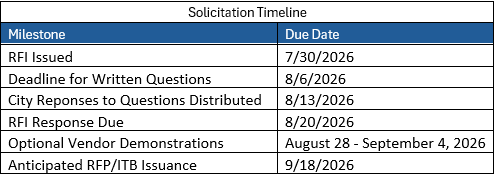
- Questions Due: 2026-08-06T18:00:00.000Z
- Answers Posted By: 2026-08-13T18:00:00.000Z
Evaluation Criteria
- TERM OF CONTRACT
- Technology and Functional Requirements —
- Card Issuance, Controls, and Security
- EMV chip-enabled cards with contactless (tap-to-pay) functionality.
- Digital wallet provisioning (Apple Pay, Google Pay, Samsung Pay) for cardholder mobile devices.
- Single-use and multi-use virtual card numbers generated on demand through the portal or API.
- Real-time, rules-based transaction controls, including Merchant Category Code (MCC) blocking/allow-listing, single-transaction limits, daily/monthly/cycle limits, and velocity (transaction count) controls.
- Ability for administrators to instantly activate, suspend, reissue, or cancel a card and to adjust limits without contacting a call center.
- Tokenization of card data and compliance with PCI-DSS and applicable data security standards.
- Real-time fraud monitoring with configurable alerts (SMS, email, push notification) to cardholders and administrators, and the ability to dispute transactions electronically.
- Mobile and Self-Service Capability
- Native mobile application (a dedicated app installed from the Apple App Store or Google Play, as opposed to only a mobile-friendly website) for cardholders to view transactions, receive alerts, capture/attach receipt images, and code/allocate expenses in real time.
- Mobile push notifications for every transaction, decline, or suspicious-activity alert.
- Digital receipt capture (photo upload/OCR) to reduce paper recordkeeping and support audit trails
- Reporting, Analytics, and Data Access
- Configurable, self-service reporting dashboard with drill-down by department, cardholder, merchant, MCC, and general ledger code.
- Level II and Level III transaction data capture (line-item detail, tax, and merchant data) wherever supported by the merchant.
- Scheduled and ad hoc report exports in common formats (CSV, Excel, PDF) and support for custom report templates.
- Spend analytics tools to identify savings opportunities, policy exceptions, duplicate payments, and potential fraud or misuse patterns.
- Sustainability/diversity spend reporting capability (e.g., identifying purchases from local or diverse-owned businesses), if available.
- Integration with City Financial Systems
- Ability to deliver transaction-level data via secure file transfer (e.g., SFTP) or API in a format compatible with the City's financial/ERP system, BS&A Software.
- Support for standard file formats (e.g., flat file, CSV, XML) and a documented file layout/data dictionary the City's IT/Finance staff can map for import.
- Support for General Ledger coding/allocation directly within the card platform prior to export, including split coding across multiple accounts.
- Single sign-on (SSO) support (e.g., SAML 2.0) for administrator and cardholder portal access, if available.
- API availability for custom integrations, automated reconciliation, or connection to third-party expense management tools.
- Data ownership, retention, historical access, export, and transition support upon expiration or termination of the program.
- Accounts Payable / Virtual Card Payments (if offered)
- Straight-through or automated virtual card payment issuance to vendors integrated with the City's AP/disbursement process.
- Supplier enablement support (identifying and onboarding City vendors willing to accept card payments).
- Remittance detail delivered to vendors alongside virtual card payments.
- Program Financials
- Description of rebate structure (e.g., tiered rebate based on annual spend, large-ticket/AP transaction incentives) and any minimum spend thresholds.
- Describe how and when rebates are paid (e.g., check ACH).
- Disclosure of any program fees (e.g., annual fees, card issuance fees, statement fees, late fees) and how they offset or reduce rebate.
- Description of payment terms (e.g., billing cycle, grace period, ACH settlement) and any settlement discount or early-payment incentive.
- Implementation, Training, and Support
- Typical implementation timeline from contract execution to card issuance and go-live.
- Dedicated implementation project manager and ongoing relationship/account management structure.
- Training format and materials (in-person, virtual, on-demand) for administrators, approvers, and cardholders.
- Description of customer support model, including hours of operation, escalation path, and average response times for fraud and service issues.
- Card Issuance, Controls, and Security
- Review of Responses —
The City will review responses to this Request for Information (RFI) to better understand available commercial payment solutions, industry best practices, implementation approaches, and technological capabilities. Responses may be reviewed by representatives from the City's Finance, Purchasing, Information Technology, and other departments, as appropriate.
The City may, at its sole discretion:
- Request clarification or additional information from Respondents.
- Invite one or more Respondents to participate in demonstrations, interviews, or discovery meetings.
- Use information received to refine the City's requirements and develop a future competitive solicitation.
- Determine that no further procurement action is necessary.
Responses to this RFI are not subject to a formal evaluation or scoring process, and no contract will be awarded as a result of this RFI.
- TERM OF CONTRACT
- Questions & Addenda —
The deadline for submitting questions questions is 4:00 P.M. ET prior to the response submission deadline indicated in the Solicitation timeline. If the City of Pontiac’s Purchasing Division determines that additional information or clarification is necessary, such information or clarification will be supplied in the form of an addendum, which the City Purchasing Division’s personnel will upload to OpenGov. All such addendum will have the same binding effect as though contained in the main body of the solicitation. Oral instructions or oral information concerning the specifications from City managers, employees, or agents to prospective Respondents shall not bind the City of Pontiac.
- Clarifications and Protests —
The deadline for submitting questions or protests is 4:00 P.M. ET prior to the bid submission deadline indicated in the solicitation's timeline. If the City of Pontiac’s Purchasing Division determines that additional information or clarification is necessary, such information or clarification will be supplied in the form of an addendum, which the City Purchasing Division’s personnel will upload to OpenGov. All such addendum will have the same binding effect as though contained in the main body of the solicitation. Oral instructions or oral information concerning the specifications from City managers, employees, or agents to prospective Bidders shall not bind the City of Pontiac.
- Submittal Instructions —
- Deadline for Submission
Proposals or qualifications must be received no later than the deadline specified in the solicitation. Late submissions will not be considered. - Submission Format
Respondents must follow the submission instructions provided in the solicitation. Incomplete or nonconforming submissions may be deemed non-responsive. - Withdrawal of Proposals
Responses may be withdrawn prior to the submission deadline by written notice to the City. No withdrawals are permitted after the deadline. - FOIA Notice
Submissions may be subject to disclosure under the Michigan Freedom of Information Act (FOIA), MCL 15.231 et seq. Respondents must clearly identify proprietary or confidential information, although the City reserves the right to make the final determination of disclosure obligations.
- Deadline for Submission
- Submittal Instructions —
- Deadline for Submission
Proposals or qualifications must be received no later than the deadline specified in the solicitation. Late submissions will not be considered. - Submission Format
Respondents must follow the submission instructions provided in the solicitation. Incomplete or nonconforming submissions may be deemed non-responsive. - Withdrawal of Responses
Responses may be withdrawn prior to the submission deadline by written notice to the City. No withdrawals are permitted after the deadline. - FOIA Notice
Submissions may be subject to disclosure under the Michigan Freedom of Information Act (FOIA), MCL 15.231 et seq. Respondents must clearly identify proprietary or confidential information, although the City reserves the right to make the final determination of disclosure obligations.
- Deadline for Submission
- Disclaimer Regarding Bid Submission and Award —
Submission of a response to the City of Pontiac does not guarantee the award of a contract. All solicitations are subject to review, evaluation, and approval in accordance with applicable City procurement policies and procedures.
In accordance with State of Michigan procurement standards and best practices, including guidance from the Michigan Department of Technology, Management and Budget (DTMB) and Public Act 317 of 1968, as amended, the City reserves the right to:
Reject any or all response, in whole or in part;
Waive irregularities or informalities in the solicitation process;
- Cancel a solicitation
Require additional documentation or clarification from vendors prior to making an award.
No contract shall be formed between the City and any vendor until a formal agreement is executed and approved by the appropriate City authority, including City Council where required.
Vendors are solely responsible for all costs incurred in the preparation and submission of a bid.
- Disclaimer Regarding RFI Responses —
Submission of a response to this Request for Information (RFI) does not obligate the City to issue a future solicitation or award a contract. All solicitations are subject to review, evaluation, and approval in accordance with applicable City procurement policies and procedures.
In accordance with State of Michigan procurement standards and best practices, including guidance from the Michigan Department of Technology, Management and Budget (DTMB) and Public Act 317 of 1968, as amended, the City reserves the right to:
Reject any or all responses, in whole or in part;
Waive irregularities or informalities in the solicitation process;
- Cancel a solicitation;
Require additional documentation or clarification from vendors prior to making an award.
No contract shall be formed between the City and any vendor until a formal agreement is executed and approved by the appropriate City authority, including City Council where required.
Vendors are solely responsible for all costs incurred in the preparation and submission of a bid.
- Ownership and Confidentiality —
- Ownership of Deliverables
All reports, data, plans, drawings, or other deliverables produced under the contract shall become the property of the City unless otherwise stated in the agreement. - Confidentiality
The professional shall treat all information and data provided by the City as confidential, and shall not disclose such information to any third party without prior written consent.
- Ownership of Deliverables
- Additional Terms —
- Addenda
All clarifications, changes, or modifications to the solicitation will be issued as written addenda. Respondents are responsible for ensuring they have reviewed and acknowledged all addenda. - Costs Incurred
The City is not liable for any costs incurred by respondents in preparing or submitting proposals, attending interviews, or negotiating contracts. - Conflict of Interest
Respondents shall disclose any actual or potential conflicts of interest. The City reserves the right to reject any submission that presents a conflict.
- Addenda
- Additional Terms —
- Addenda
All clarifications, changes, or modifications to the solicitation will be issued as written addenda. Respondents are responsible for ensuring they have reviewed and acknowledged all addenda. - Costs Incurred
The City is not liable for any costs incurred by respondents in preparing or submitting responses, attending interviews, or negotiating contracts. - Conflict of Interest
Respondents shall disclose any actual or potential conflicts of interest. The City reserves the right to reject any submission that presents a conflict.
- Addenda
- Subcontracting —
Not Applicable
- Subcontracting
Submission Requirements
- Confirm that you have read and understand all of the project requirements (Scope of Work/Service). (required)
- Respondent / Company Information Requested
- Firm Information & Authorized Representatives (required) —
Provide your firm's information. Include the firm’s name, address, primary telephone, and email address. Identify authorized signer(s) for the organization.
- Certifications & Licenses (required) —
Do you have relevant certifications or licenses, if applicable, for this type of work? If so, upload documents here.
- Ownership Structure & Issuing Bank Relationship (required) —
Please provide the ownership structure and, if applicable, parent company or issuing bank relationship (e.g., if a program manager rather than direct issuer).
- Public-Sector Experience (required) —
Please provide the number and profile of current public-sector clients, with emphasis on Michigan municipalities or comparable local governments (population 50,000–100,000 is a useful reference point).
- Card Network (required) —
Identify the card network(s) supported (e.g., Visa, Mastercard, American Express) and indicate whether the City may select its preferred network.
- Public-Sector References —
Please provide your references from current municipal or public-sector clients of similar size, if available (optional at the RFI stage; not required to respond), including contact name, title, organization, and phone/email.
- Financial Stability (required) —
Provide your financial stability information sufficient to demonstrate the ability to support a multi-year public-sector contract (e.g., credit rating, most recent annual report, or equivalent).
- Security & Service History (required) —
Please provide a summary of any recent (past 24 months) data breaches, security incidents, or material service outages affecting the card platform, and remediation taken.
- Business Continuity & Disaster Recovery (required) —
Describe your business continuity and disaster-recovery capabilities, including standard Recovery Time Objectives and Recovery Point Objectives for the card platform, transaction data, reporting tools, mobile application, and customer-support operations.
- Cooperative & Government Contracts (required) —
Identify any current federal, state, local-government, or cooperative purchasing contracts through which the City may obtain the proposed services. Provide the contract number, lead public agency, expiration date, available renewal options, applicable pricing and rebate structure, and confirmation that the contract is available to Michigan local units of government.
- Regulatory Compliance & Certifications (required) —
Describe any licenses, certifications, audit reports, or regulatory approvals held by your organization that are relevant to the proposed solution. Please attach copies, if available, or indicate whether documentation can be provided upon request.
- Specific Questions for Respondents —
Please respond to each numbered question below as clearly and concisely as possible. Where a capability does not apply or is not offered, please state “Not Applicable” or “Not Offered” rather than omitting the item.
The following questions are organized by topics:
4. Technology Platform
5. Program Structure & Financials
6. Implementation & Support
7. Security & Compliance
- Technology Platform
- Administrative Portal (required) —
Describe your online administrative portal, including card issuance, limit/control changes, and reporting functions available to City administrators.
- Mobile Application (required) —
Describe your mobile application's functionality for both cardholders and administrators, including screenshots or a demo link if available.
- Virtual Card Capabilities (required) —
Can single-use or limited-use virtual card numbers be generated on demand by City staff, and if so, through what interface (portal, API, or both)?
- Card Controls & Spending Limits (required) —
What real-time controls can be placed on individual cards (MCC restriction, dollar limits, transaction count limits, merchant-specific blocking)? Can these be changed instantly by a City administrator without contacting your customer service center?
- Fraud Monitoring & Alerts (required) —
Describe your fraud monitoring capabilities and how/when the City and cardholders are alerted to suspicious activity.
- Level II & Level III Data (required) —
What Level II/Level III data can your platform capture, and what percentage of typical municipal merchant spend includes this enhanced data in your experience?
- BS&A Integration (required) —
Describe your integration capabilities with BS&A Software, including existing implementations, supported import/export formats, transaction data available for export (including receipts, GL coding, split allocations, notes, approvals, and department/fund coding), implementation approach, testing requirements, sample file layouts or data dictionaries, estimated implementation effort, and any one-time or recurring costs.
- API & Third-Party Integration (required) —
Do you offer an API for custom integration, automated reconciliation, or connection to third-party expense management or e-procurement tools? If so, please describe.
- Authentication & Access Management (required) —
Describe available single sign-on and multifactor-authentication capabilities for cardholders, approvers, administrators, auditors, and other users. Identify whether authentication requirements can be configured and enforced by the City.
- User Permissions & Audit Controls (required) —
Describe role-based permissions, segregation-of-duties controls, user provisioning and deactivation, and administrative audit logs for changes to cards, users, limits, transaction controls, coding, and approvals.
- Reporting & Analytics (required) —
Describe your reporting and analytics tools, including standard reports, customization options, and export formats.
- Data Ownership & Retention (required) —
Describe data ownership, retention periods, receipt-image and audit-log retention, historical-data availability, export formats, extraction fees, and transition support available upon contract expiration or termination.
- Transaction Collaboration & Workflow (required) —
Describe how multiple authorized users may collaborate on the same transaction or account, including receipt management, notes, GL coding, split allocations, and approval/reconciliation workflows. Indicate whether these capabilities are available through both the web portal and mobile application.
- Real-Time Account Visibility (required) —
Describe whether the online portal and mobile application provide real-time or near-real-time visibility into pending and posted transactions, cycle-to-date spend, available credit or remaining balance, outstanding balance, payment history, last payment amount/date, payment due date, and program/cardholder-level spend. Identify which information is available to cardholders, approvers, department administrators, and Finance administrators.
- Program Structure & Financials
- Rebate Structure & Estimated Program Value (required) —
Describe your standard rebate structure and provide an illustrative rebate calculation based on the City's estimated annual expenditure of approximately $1,200,000. Identify all assumptions, minimum spend thresholds, payment-timing requirements, eligible and excluded transactions, large-ticket or electronic-payment incentives, and whether the City's spending would be aggregated with other participating entities.
- Program Fees & Cost Structure (required) —
Identify all fees that may apply to the proposed program, including implementation, training, annual program, annual card, replacement card, expedited delivery, statement, foreign transaction, API, reporting, custom file mapping, virtual card, electronic payment, supplier-enablement, data-extraction, and termination fees.
- Billing Cycle & Payment Terms (required) —
What is your standard billing cycle and payment/grace period? Is ACH auto-pay available and, if so, are there incentives for enrolling?
- Accounts Payable Payment Solutions (required) —
Do you offer a virtual card / straight-through accounts payable payment solution? If so, describe how vendor enablement and remittance detail delivery work.
- Contract Terms & Rebate Guarantees (required) —
What contract term(s) do you typically offer public-sector clients, and are multi-year rebate guarantees available?
- Implementation & Support
- Implementation Timeline (required) —
What is your typical implementation timeline for a municipal client of the City's approximate size, from contract execution to first card issuance?
- City Implementation Resources (required) —
Describe the implementation resources expected from the City, including estimated staff time, participation by Finance, Information Technology (IT), department administrators, and other stakeholders.
- Implementation Activities & Go-Live (required) —
Describe typical implementation milestones, testing responsibilities, training requirements, data validation activities, and any ongoing support required through go-live.
- Card Issuance & Delivery (required) —
Describe the process and typical timeframe for initial card issuance, routine card issuance, replacement cards, emergency cards, and expedited delivery. Identify available ordering, delivery, and activation methods and any associated charges.
- Customer Support Services (required) —
Describe your customer support model, including hours of operation (please confirm if 24/7/365 support is available), escalation procedures, and typical response times for lost/stolen card reporting and disputes.
- Relationship & Account Management (required) —
Will the City be assigned a dedicated relationship/account manager? Describe that role and expected level of ongoing engagement.
- Security & Compliance
- Security Certifications & Compliance (required) —
Describe your organization's PCI-DSS compliance status and any relevant security certifications (e.g., SOC 2).
- Data Protection & Encryption (required) —
Describe encryption, tokenization, and other data protection measures used to protect cardholder and transaction data.
- Incident Response (required) —
Describe your incident response process in the event of a data breach or fraud event affecting the City's program.
- Fraud Protection & Liability (required) —
Describe the protections available for fraudulent, unauthorized, lost, stolen, compromised, or employee-misuse transactions. Identify applicable coverage limits, reporting requirements, exclusions, and the respective responsibilities of the City and the provider.
- Personal Liability Requirements (required) —
Confirm whether the proposed program requires any personal guarantee, individual credit check, or personal liability by City employees, officials, administrators, or cardholders. If yes, describe the circumstances, responsible parties, and liability limitations.
- Submission Requirements and Format —
Respondents are requested to organize their submission using the section numbers and headings in this RFI (Sections 2 through 8) to facilitate review and comparison. Please observe the following submission guidelines:
- Submit responses electronically in PDF format to the contact listed on the cover page by the response due date.
- Limit narrative responses to a reasonably concise length; supporting materials (brochures, sample reports, sample file layouts, screenshots) may be included as appendices.
- Clearly label your submission: “RFI No. 2026-PCARD-01 – [Your Company Name].”
- Direct all questions regarding this RFI in writing to the contact listed on the cover page. Responses to substantive questions may be shared with all prospective Respondents without attribution.
The City may, at its discretion, invite one or more Respondents to participate in a follow-up demonstration, discovery call, or written Q&A session following review of RFI submissions.
- Submit PDF Response (required)
- Does this Solicitation include the use of ARPA funds? (required)
- Will you be Scoring proposals? (required) —
If Yes, suggested Evaluation Criteria will be included for review.
If No, Evaluation Criteria will be included.
Key dates
- July 30, 2026Published
- August 20, 2026Responses Due
AI classification tags
Frequently asked questions
SLED stands for State, Local, and Education. These are solicitations issued by state governments, counties, cities, school districts, utilities, and higher education institutions — as opposed to federal agencies.
SamSearch Platform
Stop searching. Start winning.
AI-powered intelligence for the right opportunities, the right leads, and the right time.