SLED Opportunity · TEXAS · CITY OF SUGAR LAND, TX
South of the Brazos Water Line Connection to Greatwood – CWA2508
AI Summary
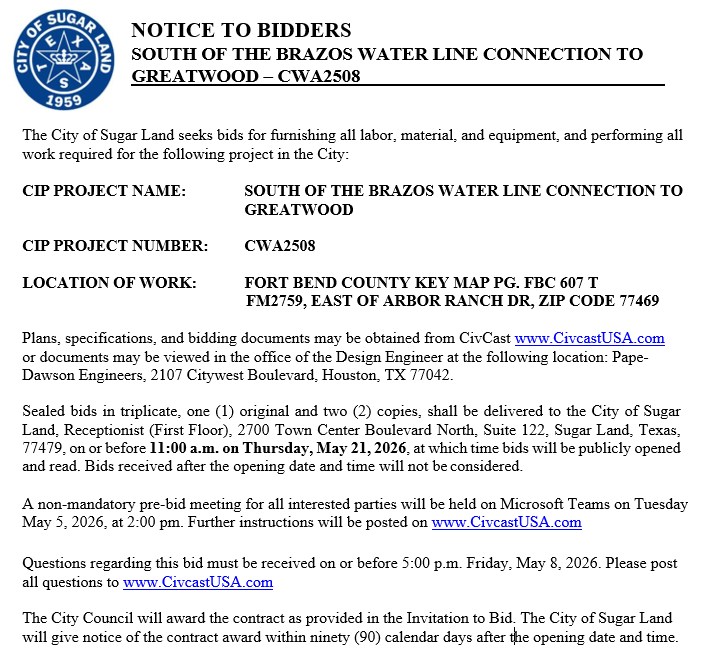
City of Sugar Land ITB for construction of South of the Brazos Water Line Connection to Greatwood. Includes water line installation, project management, insurance, bonding, and compliance with safety and environmental regulations. Bids due May 21, 2026.
Opportunity details
- Solicitation No.
- 255403
- Type / RFx
- ITB
- Status
- open
- Level
- city
- Published Date
- April 15, 2026
- Due Date
- May 21, 2026
- Jurisdiction
- City of Sugar Land, TX
- State
- Texas
- Agency
- City of Sugar Land, TX
Description
Project Details
- Reference ID: 2026-ITB-015
- Department: Engineering
- Department Head: Jessie Li (City Engineer)
Important Dates
- Questions Due: 2026-05-08T22:00:18.167Z
- Pre-Proposal Meeting: 2026-05-05T19:00:00.000Z — Microsoft Teams Meeting. Further instructions will be posted on www.CivcastUSA.com
Evaluation Criteria
- DEFINITIONS —
These definitions apply to the City’s Invitation for Bids for the Project:
Addenda means written or graphic instruments that modify, clarify or interpret the Contract Documents after the Bid advertising date and before the Bid submittal date
Bid means a Bidder’s bid submitted in response to the Invitation for Bids that includes the following documents required by the Invitation for Bids:
- The Bidder’s executed Bid Submittal Form;
- The Bid Pricing Form that contains the Bidder’s unit prices or lump sum prices for the Project items;
- The Bid Bond executed by the Bidder and the Surety;
- The Bidder’s financial statements;
- The Bidder’s list of similar projects; and
- The Bidder’s list of on-going projects at the time of the Bid.
Bid Bond means the bid bond form included as part of the Invitation for Bids.
Bid Pricing Form means the table included as a document in the Invitation for Bids consisting of columns to be filled out by the Bidder relating to either:
- Unit prices for item quantities, or
- Individual lump sum items.
Bid Submittal Form means the form identified as such in the Invitation for Bids to be executed by a person authorized to sign and submit the Bid to the City.
Bidder means the person or entity that submits a Bid in response to the Invitation for Bids.
Change Order means a written order issued by Owner after the Contract has been awarded that specifies a change to the Contract Price, the Work, or the time to achieve Substantial Completion.
City means the City of Sugar Land, Texas, owner of the Project.
Claim means the Contractor’s demand or assertion that it is should be paid more than the Contract Price or granted more time to achieve Substantial Completion or Final Completion by the Owner because of action or inaction by the Owner, Owner’s representative, Engineer, or any party for whom the Owner is responsible or with which the Owner has separately contracted for other portions of the Project.
Contract means the City of Sugar Land Standard Contract for Small Construction Projects that includes the Contract Documents attached thereto.
Contract Documents means the documents listed in the Table of Contents—City of Sugar Land Standard Contract for Small Construction Projects.
Contract Price means the dollar amount the City must pay the Contractor under the Contract.
Contractor means the person, firm or corporation that has executed the Contract.
Force Majeure means lightning, earthquakes, hurricanes, floods, named storms, strikes, lockouts, riots, wars, civil disturbances, explosions, fires, or other unforeseeable events that are not within the control of the Contractor and are not caused by the Contractor’s negligence or fault, but not including material or labor shortages, price increases or escalations, or Subcontractor default.
ITB means Invitation to Bid.
Notice to Proceed means the Owner’s written notice to the Contractor establishing the date to begin the Work.
Owner means the City of Sugar Land, Texas.
Payment Bond means the payment bond included as part of the Request for Bids.
Performance Bond means the performance bond included as part of the Request for Bids.
Plans means the Engineer’s plans, profiles, cross-sections, working drawings, and supplemental drawings that show the location, character, dimensions, and details of the Work.
Project means the Project named in the Notice to Bidders.
Punch List means the list of Work items that the Contractor must correct in compliance with the Contract after Substantial Completion to achieve Final Completion.
Request for Bids means the City’s Invitation to Bid for the Project that includes the documents listed in the “Table of Contents.”
Subcontractor means a person or entity contracting with the Contractor to perform part of the Work at the Project site, including a subcontractor contracting with the Subcontractor.
Substantial Completion means the date at which the Owner or Engineer certifies that the Owner may occupy, use or operate the Project for its intended purpose. Partial use or occupancy of the Project does not qualify as Substantial Completion.
Surety means a surety company that complies with the requirements of the City’s Invitation for Bids for the Project that executes the Bid Bond, and the Performance Bond and Payment Bond that are attached to the Contract for the Project.
Unit Price means an amount stated in the Bid for an individual, measurable item of Work that is multiplied by the estimated quantity for that item to achieve the total dollar amount for the item.
Work means all labor, materials, equipment, and services necessary to construct, erect, install, equip and complete the Project.
Working Day means a calendar day, not including Sunday or holidays observed by the Owner, in which weather permits the performance of the Work for a continuous period of not less than five (5) hours between 7:30 a.m. and 5 p.m. All crane work shall be completed outside of hours M-F 7:30 a.m. – 5 p.m. Any interruptions to building occupants such be outside of hours M-F, 7:30a-5p (ie no cooling, interruptions in electrical service, etc) Any interruptions to building occupants such be outside of hours M-F, 7:30a-5p (ie no cooling, interruptions in electrical service, etc.
- DEFINITIONS —
These definitions and the definitions in the Instructions to Bidders apply to the General Conditions:
- Act means the Underground Facility Damage Prevention and Safety Act codified in Chapter 251, Texas Utilities Code.
- Change Order means a written order issued by Owner after the Contract has been awarded that specifies a change to the Contract Price, the Work, or the time to achieve Substantial Completion.
- Claim means the Contractor’s demand or assertion that it is should be paid more than the Contract Price or granted more time to achieve Substantial Completion or Final Completion by the Owner because of action or inaction by the Owner, Owner’s representative, Engineer, or any party for whom the Owner is responsible or with which the Owner has separately contracted for other portions of the Project.
- Contract means this Contract for Public Capital Construction Projects for the Project that includes the Contract Documents and is executed by the Owner and the Contractor.
- Contract Documents means the documents enumerated as Contract Documents in the section of the Contract entitled Contract Documents.
- Contract Price means the dollar amount the City must pay the Contractor under the Contract.
- Contractor means the person, firm or corporation that has executed the Contract.
- Drawings mean plans, profiles, details, and graphic and pictorial sheets that define the character and scope of the Work.
- Engineer means the engineering firm, corporation or entity named as the Engineering Firm in this Contract.
- Environmental Laws means any local, state or federal law, rule or regulation pertaining to environmental regulation, contamination, clean-up or disclosure.
- Final Completion means the date that the Punch List is completed and the City accepts the Project as finally complete.
- Force Majeure means lightning, earthquakes, hurricanes, floods, named storms, strikes, lockouts, riots, wars, civil disturbances, explosions, fires, or other unforeseeable events that are not within the control of the Contractor and are not caused by the Contractor’s negligence or fault, but not including material or labor shortages, price increases or escalations, or Subcontractor default.
- Hazardous Substance means any element, constituent, chemical, substance, compound, or mixture defined as a hazardous substance by any local, state or federal law, rule or regulation.
- Laboratory means a testing laboratory that the Owner designates or approves for the Project.
- Notice to Proceed means the Owner’s written notice to the Contractor establishing the date to begin the Work.
- Owner means the City of Sugar Land, Texas.
- Plans mean the Engineer’s plans, profiles, cross-sections, working drawings, and supplemental drawings that show the location, character, dimensions, and details of the Work.
- Punch List means the list of Work items that the Contractor must correct in compliance with the Contract after Substantial Completion to achieve Final Completion.
- Retainage means the part of the Contract payment withheld by the Owner to secure performance of the Contract.
- Shop Drawings means the drawings, diagrams, illustrations, brochures, schedules or other data prepared by the Contractor, Subcontractors, manufacturers, Suppliers, or distributors to illustrate specific portions of the Work.
- Specifications includes the technical written descriptions for and other documents that show the materials, equipment, construction systems, standards and workmanship for the Project contained in the Contract Documents and designated as Specifications.
- Subcontractor means a person or entity contracting with the Contractor to perform part of the Work at the Project site, including a subcontractor contracting with the Subcontractor.
- Substantial Completion means the date at which the Owner or Engineer certifies that the Owner may occupy, use or operate the Project for its intended purpose. Partial use or occupancy of the Project does not qualify as Substantial Completion.
- Superintendent means the Contractor’s representative with authority to act for the Contractor.
- Supplier means a person or entity that provides only materials, supplies or equipment for the Work.
- Work means all labor, materials, equipment, and services necessary to construct, erect, install, equip and complete the Project in strict accordance with the Contract Documents.
- Working Day means a calendar day, not including Sunday or holidays observed by the Owner, in which weather permits the performance of the Work for a continuous period of not less than five hours between 7 a.m. and 6 p.m.
- SPECIFICATIONS —
[Details about the Scope of Work for this project are to be entered here.]
- KEY PERFORMANCE INDICATORS (KPIs) —
The City of Sugar Land is interested in identifying metrics/key performance indicators (KPIs) to work collaboratively with the awarded vendor(s) to monitor and improve performance during the life of the contract. The City of Sugar Land has identified initial metrics/KPIs of interest and looks forward to working with the awarded vendor to add or refine this list during contract negotiations. The final set of metrics/KPIs and frequency of collection will be negotiated by the successful proposer and the City of Sugar Land prior to the finalization of an agreement between parties and may be adjusted over time as needed.
Example:
Performance Metric & Description
Target
Data Source
Data Collection Frequency
Data Collection Responsibility
Data Review Cadence
- INSTRUCTIONS FOR COMPLETION OF INSURANCE DOCUMENT —
With reference to the foregoing insurance requirements, Contractor shall specifically endorse applicable insurance policies as follows:
- The City of Sugar Land shall be named as an additional insured with respect to General Liability and Automobile Liability on a separate endorsement
- A waiver of subrogation in favor of The City of Sugar Land shall be contained in the Workers Compensation and all liability policies and must be provided on a separate endorsement.
- All insurance policies shall be endorsed to the effect that The City of Sugar Land will receive at least thirty (30) days' written notice prior to cancellation or non-renewal of the insurance.
- All insurance policies, which name The City of Sugar Land as an additional insured, must be endorsed to read as primary and non-contributory coverage regardless of the application of other insurance.
- Chapter 1811 of the Texas Insurance Code, Senate Bill 425 82(R) of 2011, states that the above endorsements cannot be on the certificate of insurance. Separate endorsements must be provided for each of the above.
- All insurance policies shall be endorsed to require the insurer to immediately notify The City of Sugar Land of any material change in the insurance coverage.
- All liability policies shall contain no cross liability exclusions or insured versus insured restrictions.
- Required limits may be satisfied by any combination of primary and umbrella liability insurances.
- Contractor may maintain reasonable and customary deductibles, subject to approval by The City of Sugar Land.
- Insurance must be purchased from insurers having a minimum AmBest rating of B+.
- All insurance must be written on forms filed with and approved by the Texas Department of Insurance. (ACORD 25 2016/03) Coverage must be written on an occurrence form.
- Contractual Liability must be maintained covering the Contractors obligations contained in the contract. Certificates of Insurance shall be prepared and executed by the insurance company or its authorized agent and shall contain provisions representing and warranting all endorsements and insurance coverages according to requirements and instructions contained herein.
- Upon request, Contractor shall furnish The City of Sugar Land with certified copies of all insurance policies.
- A valid certificate of insurance verifying each of the coverages required above shall be issued directly to the City of Sugar Land within ten (10) business days after contract award and prior to starting any work by the successful contractor’s insurance agent of record or insurance company. Also, prior to the start of any work and at the same time that the Certificate of Insurance is issued and sent to the City of Sugar Land, all required endorsements identified in sections A, B, C and D, above shall be sent to the City of Sugar Land. The certificate of insurance and endorsements shall be sent to:
City of Sugar Land Emailed to: purchasing@sugarlandtx.gov
Purchasing Office Faxed to: 281 275-2741
P. O. Box 110
Sugar Land, TX 77487-0110 - SCHEDULES, REPORTS, AND OTHER DOCUMENTS —
- Preconstruction Meeting Submittals. At the preconstruction meeting the Contractor will make a submittal to the Owner that includes the:
- Project schedule showing the order in which the Work will be performed, the dates at which the various parts of the Work will begin, and the estimated date of completion for each part of the Work, as set forth in the Contract;
- Schedule of values (for lump sum Work items);
- The proposed dates to provide Shop Drawings to the Owner;
- Proposed dates to start the manufacture, testing and installation of materials, supplies and equipment; and
- Anticipated schedule for and amount of monthly invoices.
The schedule for submittals must coordinate with the construction schedule and allow the Owner and Engineer reasonable time to review a submittal. If the Contractor fails to include a schedule in a required submittal, the Owner is not required to approve an increase in the Contract Price or grant an extension of time to the Substantial Completion date based on the time required to review a submittal.
- Approval of Project Schedules and Submittals. The Contractor’s Project schedules and submittals are subject to the Owner’s approval and are not effective until approved by the Owner. If a submittal or schedule is not approved, the Contractor must revise the schedule or submittal to comply with the Owner’s or Engineer’s recommendations and make a new submittal or schedule to the Owner for approval.
- Updates to Submittals. The Contractor must update each of the schedules and submittals required by this Contract and submit them in printed form to the Owner with the Contractor’s monthly pay applications. Updated construction schedules must reflect actual conditions and must identify any delays previously encountered and how the Contractor intends to overcome them. Owner may withhold payment until the Contractor provides the updated schedules and submittals.
- Additional Submittals, Drawings and Instructions. During construction of the Project the Contractor must submit to the Owner any other documents required by law or requested by the Owner that relate to the Work. And the Contractor must comply with the Owner’s revised or additional Plans, Drawings, Specifications, and instructions issued during the Work.
- Intent of Contract Documents. The Contract Documents are intended to include all items necessary for the proper execution and completion of the Work. The Contractor must perform the Work consistent with the Contract Documents and reasonably inferable from the Contract Documents as being necessary to produce the indicated results. To facilitate construction and coordination, before starting each portion of the Work, the Contractor must carefully:
- Study and compare the Contract Documents pertaining to that portion of the Work;
- Review and study the information furnished by the Owner;
- Take field measurements of existing conditions related to that portion of the Work; and
- Observe site conditions that may affect that portion of the Work.
- Inconsistent Contract Documents. In its capacity as a contractor and not as a licensed design professional, the Contractor must promptly report, in writing, to the Owner and Engineer any errors, inconsistencies, or omissions in the Contract Documents known to the Contractor. The Contractor must pay to the Owner any costs and damages that arise from Contractor’s failure to comply with this paragraph.
- Street Work Schedule. For street, roadway, and utility projects, the Contractor may remove and replace concrete only between the hours of 7:30am to 6:00pm, Monday through Friday of each week. Unless the Contractor receives the Owner’s prior written consent, the Contractor’s Work must not interfere with peak traffic. The Contractor may saw cut at any time, but concrete must be replaced within ten Working Days of the removal.
- Preconstruction Meeting Submittals. At the preconstruction meeting the Contractor will make a submittal to the Owner that includes the:
- Worker's Compensation —
Statutory limits, State of TX.
- SCHEDULE OF KEY EVENTS —
Advertised in local paper/Notice Posted to OpenGov Procurement: April 15, 2026 Pre-Bid Conference (Non-Mandatory): May 5, 2026, 2:00pm Microsoft Teams Meeting. Further instructions will be posted on www.CivcastUSA.com
Questions Deadline: May 8, 2026, 5:00pm Questions Posted: Questions regarding this bid must be posted on CivCast, www.CivCastUSA.com Bids Due: May 21, 2026, 11:00am - Employers' Liability —
$500,000 per employee per disease / $500,000 per employee per accident / $500,000 by disease aggregate
- SHOP DRAWINGS —
- Submission. The Contractor must submit for the Owner’s approval, Contractor’s Shop Drawings and samples of materials and equipment to be installed in the Work prior to performing work to which they apply. The Contractor must request and obtain Owner’s approval of a Change Order prior to submitting a Shop Drawing that deviates from the Contract Documents.
In submitting Shop Drawings, product data, samples, and similar submittals, the Contractor represents that the Contractor has:- Reviewed and approved them;
- Verified materials, field measurements, and field construction criteria related to them; and
- Checked and coordinated the information contained in them with the requirements of the Contract Documents and the Work.
If the Contract Documents require the Contractor to submit Shop Drawings, product data, samples or similar submittals to the Owner for approval, the Contractor must not perform the portion of Work to which they apply until the Owner and Engineer approve them.
- Review. The Owner will review the submitted Shop Drawings and samples and provide a response to the Contractor within 21 days of receipt of the Shop Drawings or samples. The Owner’s approval of a Shop Drawing or sample of material or equipment, however, does not release the Contractor from its responsibility to comply with the Contract Documents.
- Availability. The Contractor must keep the approved Shop Drawings at the Project site and make them available to the Owner and Engineer.
- Submission. The Contractor must submit for the Owner’s approval, Contractor’s Shop Drawings and samples of materials and equipment to be installed in the Work prior to performing work to which they apply. The Contractor must request and obtain Owner’s approval of a Change Order prior to submitting a Shop Drawing that deviates from the Contract Documents.
- BID SUBMITTAL —
Bidders must submit their Bids as follows:
- One (1) original Bid must be submitted electronically through OpenGov Procurement.
- The Bid Submittal Form must:
- Be completed in ink or be typewritten;
- Contain an original signature of a person authorized to bind the Bidder to the Contract;
- Be included in the envelope as the first document in the Bid separate from the bound notebook containing the Request for Bids; and
- Not be modified unless directed by the City in an addendum to the Bid process.
- The Bids must not contain qualifications, conditions, or riders that modify the City’s Invitation for Bids. The City will not consider Bids that modify the City’s Invitation for Bids.
- Bidders must clearly state their Bid prices and any conditions that are allowed by the City’s Invitation for Bids. The City will resolve ambiguities in the City’s favor or it may reject the Bid.
- Bidders must complete the Bid Pricing Form with the:
- Bidder’s Unit Prices and total Bid amounts for each Project item (for a Contract based on Init Prices). If the Bidder’s total bid amount for an item does not equal the total derived from the Unit Price multiplied by the quantity of that item, the total derived from the Unit Price multiplied by the quantity of that item will control.
- Bidder’s lump sum amount for the Project or each Project item (for a lump sum Contract). If the Bidder’s total lump sum bid amount does not equal the total derived from adding all lump sum items, the total derived from adding all lump sum items will control.
- The Bidders must submit a Bid Bond with their Bids in the amount of 5% of the total amount of the Bid, inclusive of any Bid alternates, as a guarantee that the Bidder will enter into the Contract and execute the Performance and Payment Bonds as required after the Contract is approved by the City’s City Council. Bidders must use the Bid Bond form provided by the City in the Invitation for Bids. The Surety must be authorized to write surety bonds in the State of Texas. The City will return the Bid Bonds within 15 days after opening the Bids except those of the three lowest responsible Bidders, the Bids of which will be held until the successful Bidder has executed the Contract and provided an executed Performance Bond and Payment Bond.
- Each Bidder must furnish:
- Its audited financial statements from the current or previous year or, if the Bidder does not have audited financial statements, the previous year and current year-to-date financial statements.
- A list of three (3) similar projects the Bidder has performed in the past five (5) years with the contact name and phone number of the project owner for each project.
- A list of the Bidder’s current on-going projects, the anticipated dates of completion for each, and a contact name and phone number of the project owner for each project.
- Each Bidder must complete and submit an original and two (2) copies of the Conflict of Interest Questionnaire included in the Invitation for Bids.
- Each Bidder must complete and submit and original and two (2) copies of the Certification Regarding Debarment included in the Invitation to Bid.
- Each Bidder must submit an Original Bid Bond executed by the Bidder and the Surety.
- MATERIALS AND EQUIPMENT —
- Materials and Equipment Incorporated into the Work. Materials, equipment, and articles that will be incorporated into the Work must:
- Be stored in a manner that preserves their quality and fitness for the Work;
- Be kept in a location that allows for Owner’s prompt inspection;
- Conform to the samples provided by the Contractor and approved by the Owner;
- Not be subject to a security interest or any other interest retained by the seller;
- Not be used for any purpose prior to incorporation into the Work unless the Owner consents in writing; and
- Be applied, installed, connected, erected, used, cleaned and conditioned as directed in the Contract.
- Supply Source. Before the Contractor orders materials, equipment, supplies, or articles, the Owner may require the Contractor to obtain the Owner’s prior written approval of the supply source.
- Substitutions. Materials, equipment, or articles specified by trade name, brand name, or catalogue number set the standard of quality and performance required for the material, equipment, or article. With the Owner’s approval the Contractor may use a material, equipment, or article equivalent to or equal to the specified material, equipment, or article. The Contractor warrants that an approved substituted material, equipment or article will not affect the function or design of the Project. The Contract Price may be adjusted by Change Order in the amount of the cost differential between the specified material, equipment, or article and the approved substitution. But, the Contractor must pay the cost of any additional component parts required for the substituted material, equipment, or article.
- Materials and Equipment Incorporated into the Work. Materials, equipment, and articles that will be incorporated into the Work must:
- TIMELY BID DELIVERY —
Bids received prior to the Bid opening date and time will remain sealed until the Bid opening date and time. Bids received after the opening date and time will not be considered.
- Commercial General Liability —
Very High/High Risk Each Occurrence $1,000,000 Fire Damage $300,000 Personal & ADV Injury $1,000,000 General Aggregate $2,000,000 Products/Compl Op $2,000,000 XCU $2,000,000 - INSPECTION AND TESTING —
- Requirements. All materials, equipment, articles, and supplies used to construct the Project:
- Must be tested and inspected according to the requirements of the Contract and the requirements of public agencies or authorities with jurisdiction over any portion of the Work. The Contractor must furnish the Owner with certificates of any inspection, testing or approval required by public agencies;
- That require a Laboratory test will be tested at a Laboratory that the Owner selects and the Owner will pay for the tests directly, unless specified otherwise in the Contract;
- May be inspected at the factory or fabrication plant of the supply source;
- If approved by the Owner, may be submitted as representative samples to be inspected and tested; and
- Must be retested at Contractor’s sole cost if the initial test shows that the Contractor’s Work does not comply with the Contract (Contractor to reimburse the Owner for the retesting cost).
- Advance Notice. The Contractor must notify the Owner at least:
- 48 hours before starting any part of the Work;
- 24 hours before testing any part of the Work; and
- 48 hours before working on a Saturday.
- Removal and Replacement. The Contractor must:
- Remove and replace material, articles, supplies, equipment, or any part(s) of the Work that do not meet the Contract Documents requirements within the time required by Owner at Contractor’s expense, including fees for required additional testing, inspections, engineering services, or other consulting services;
- Uncover and replace at its sole cost any portion of the Work that has been covered without the required testing or contrary to the Owner’s written directives; and
- Even if the Contract Documents do not require a test or inspection prior to covering up the Work, uncover, expose or make available any portion of the Work for inspection or testing if the Owner determines that it is necessary. If the covered part of the Work does not comply with the Contract, the Contractor must pay the costs associated with uncovering, testing, inspecting, and replacing that part of the Work. If that part of the Work complies with the Contract, the Owner will issue a Change Order that provides for an increase in the Contract Price or an extension of Contract Time, or both, directly related to the Contractor’s expense of uncovering, inspecting, testing, and re-covering that part of the Work.
- The Contractor, or the Surety upon Owner’s demand and absent any other default by Contractor, must pay the additional costs specified in this Section 5.3 within 10 days of Owner’s written notice to Contractor or Surety, or if sufficient funds remain payable in the Contract, the Owner may deduct the additional costs from Contractor’s next payment(s) due. If the Contractor does not remove, replace and correct the rejected part of the Work according to the Owner’s notice, the Owner may remove, replace or correct the rejected part of the Work and store salvageable materials, all at Contractor’s or its Surety’s expense.
- Access to Project Site. The Contractor must:
- Allow the Owner, and federal and state agencies participating in the Project, access to the Project site and records relating to the Project; and
- Provide proper facilities for access, inspection and testing.
The Owner may enter the Project site to observe and inspect the Work and to construct or install collateral work.
- Owner Approval. The Owner’s approval of tests, inspections, or replacement of Work does not relieve the Contractor of its obligation to perform the Work according to the Contract Documents.
- Requirements. All materials, equipment, articles, and supplies used to construct the Project:
- Commercial General Liability —
Medium Risk Each Occurrence $500,000 Fire Damage $100,000 Personal & ADV Injury $1,000,000 General Aggregate $1,000,000 Products/Compl Op $500,000 XCU $500,000 - BID DEFECTS —
The City may waive Bid defects that do not give a Bidder a substantial advantage over the other Bidders or a benefit not enjoyed by the other Bidders.
- Commercial General Liability —
Low Risk Each Occurrence $300,000 Fire Damage $100,000 Personal & ADV Injury $600,000 General Aggregate $600,000 Products/Compl Op $300,000 XCU $300,000 - WITHDRAWAL OF BIDS —
A Bidder may withdraw a bid by giving the City written notice of withdrawal not later than seventy-two (72) hours after bid opening. After that date, the Bidder must receive the written consent from the Purchasing Office to withdraw the Bid.
- SURVEYS AND PERMITS —
- Surveys. The Owner will establish control points for locating the principal component parts of the Work together with a suitable number of bench marks adjacent to the Work, as shown in the Contract Documents. The Contractor must:
- Furnish all necessary construction staking and markers at its expense;
- Contract with a qualified surveyor to stake Work required by the Contract;
- Pay the cost to replace stakes or markers removed or destroyed by Contractor’s negligence; and
- Maintain a suitable Architect’s or Engineer’s level at the Project site.
- Permits and Licenses. The Contractor must obtain and pay for all permits and licenses required to perform the Work, unless otherwise provided for in the Contract Documents. The Contractor will comply with and give notices required by applicable laws, rules, regulations, and requirements of public authorities. The Contractor must obtain and pay all charges for street closings and traffic control necessary to perform the Work. The Contractor bears the cost of correcting violations of the applicable laws, rules, regulations and requirements of public authorities.
- Surveys. The Owner will establish control points for locating the principal component parts of the Work together with a suitable number of bench marks adjacent to the Work, as shown in the Contract Documents. The Contractor must:
- Automobile Liability: (Owned, Non-Owned, Hired and Injury & Property coverage for all) —
Very High/ High Risk Combined Single Limits $1,000,000 Bodily - PREVAILING WAGES —
The successful Bidder (as Contractor) and its Subcontractors are required to pay the minimum prevailing wages as shown in the Labor Classifications and Minimum Wage Rates included as part of the City’s Invitation for Bids.
- PROTECTION OF WORK, PROPERTY AND PERSONS —
- Safety. The Contractor must initiate, maintain and supervise all safety precautions and programs in connection with the Work, including:
- Protecting the safety of and preventing injury, loss, or damage to its employees, Subcontractors, Owner’s employees, and other persons at or adjacent to the Project site during the Work;
- Where applicable, furnishing and erecting barricades, fences, lights, and any other safety precautions required by the most current version of the Texas Manual on Uniform Traffic Control Devices;
- Establishing adequate detours for streets blocked to traffic;
- Preventing damage to property on or adjacent to the Project site not designated for removal, relocation or replacement during the Work, including trees, shrubs, plants, lawns, sidewalks, pavement, roadways, structures and utilities
- Preventing injury or damage to any part of the Work and the materials or equipment to be incorporated into the Work, whether stored on or off site;
- Not removing trees, plants or shrubs without the Owner’s prior written consent;
- Providing suitable temporary bridges across trenches that block driveways, as directed by the Owner; and
- Providing temporary drainage, as necessary.
- Damage to Property. The Contractor must:
- Monitor and promptly replace barricades and warning devices that are damaged or removed;
- Except as provided in this Section, replace or repair, at its sole cost, public or private property damaged, destroyed or removed by the Contractor during the Work;
- Repair or pay for the repair or replacement of underground utility, cable, telecommunications and other facilities covered by the Act that are damaged by Contractor; and
- Not unload any track type construction machinery on existing pavement, or cross over any existing pavement or curb with the track type construction machinery.
- Utilities and Underground Facilities. The Contractor must:
- Locate all underground obstacles. The Owner does not represent that the Plans and Drawings accurately show the location of all sewer, water, gas, telephone, cable, electric, petroleum or other underground facilities;
- Not interrupt utility services unless necessary to perform the Work;
- Before excavating, contact the Texas Underground Facility Notification Corporation as required by the Act; and
- Contact the Owner and other companies not subject to the Act that have facilities in, on, under, or adjacent to the Project site at least one week before performing any Work that will affect the Owner or any of the other companies’ facilities. The Contractor must comply with the Owner’s reasonable requirements to minimize the impact or the interruption of utilities to utility customers.
- Project Site Clean Up. The Contractor must:
- Keep the Project site reasonably clean at all times;
- Dispose of surplus materials;
- Clean up the Project site at the end of the Work and remove all remaining equipment, scrap materials, and temporary structures;
- Restore existing facilities and property to a comparable condition they were in when the Work began; and
- Secure equipment and materials in advance of a hurricane or other natural disaster as required by the Owner.
- Safety. The Contractor must initiate, maintain and supervise all safety precautions and programs in connection with the Work, including:
- Automobile Liability: (Owned, Non-Owned, Hired and Injury & Property coverage for all) —
Medium Risk Combined Single Limits $500,000 Bodily - PERFORMANCE AND PAYMENT BONDS —
The successful Bidder must furnish Performance and Payment Bonds in the amount of 100% of the Contract Price executed by a Surety authorized to do business in the State of Texas and meeting the other requirements of Chapter 3503, Tex. Insurance Code. The successful Bidder must furnish Performance and Payment Bonds within ten days of the City of Sugar Land City Council’s award of the Contract. The cost of the Performance and Payment Bonds must be included in the Contract Price.
- CONTRACTOR STATUS AND SUPERVISION —
The Contractor is an independent contractor and not an agent or servant of Owner. The Contractor must supervise and direct the Work according to the Contract requirements and is solely responsible for the means, methods, techniques, sequences and procedures of construction. The Contractor must employ and maintain at the Project site a qualified Superintendent whose name has been submitted to the Owner. The Superintendent must:
- Have authority to act on behalf of the Contractor and all communications given to the Superintendent are binding on the Contractor; and
- Keep in daily contact with and be able to effectively communicate with the Owner’s representative and Engineer during the Work.
- DETERMINING LOWEST RESPONSIBLE BIDDER —
- In determining the lowest responsible Bidder, the City may consider:
- Whether the Bidder maintains a permanent place of business;
- Whether the Bidder has adequate plant equipment to perform the required Work;
- Whether the Bidder is financially able to comply with the Contract;
- Whether the Bidder has appropriate technical experience;
- Whether the Bidder has a satisfactory past performance record;
- Whether the Bidder has submitted an Unbalanced Bid;
- Whether the Bidder complies with any other criteria in the Request for Bids; and
- Any other factors that may affect the Bidder’s ability to perform the Work.
- An “Unbalanced Bid” is a Bid that:
- Is unusually high or low in relationship to the City’s estimate for the Project because it contains lump sum or unit bid items that do not reflect the Bidder’s reasonable actual costs plus a reasonable proportionate share of the Bidder's anticipated profit, overhead costs, and other indirect costs;
- Is “front loaded”—the price of Work to be performed early in the Project is overpriced so that the Bidder will get more money at the beginning of the Project; or
- Over prices items that will be used in greater quantities and under prices items that will be used in significantly lesser quantities.
- In determining the lowest responsible Bidder, the City may consider:
- Automobile Liability: (Owned, Non-Owned, Hired and Injury & Property coverage for all) —
Low Risk Combined Single Limits $300,000 Bodily - CONTRACT CHANGES —
- Change Orders Required. The Contract Price, the time in which the Contractor must achieve Substantial Completion may only be changed by Change Order.
- Owner Changes. During the Contractor’s performance of the Work the Owner may:
- Order changes to the Work;
- Make necessary changes to the Plans, Drawings, or Specifications; or
- Increase or decrease the quantity of Work to be performed or materials, equipment, or supplies to be furnished.
If the Owner and Contractor agree that the change increases or decreases the Contract Price or the time to achieve Substantial Completion, the Owner will issue a Change Order within 30 days of the decision to equitably adjust the Contract Price or Substantial Completion time. The Contractor must continue the Work pending Contractor’s receipt of the Owner’s executed Change Order. Minor changes that are consistent with the scope of the Work or do not affect the time for Substantial Completion will not result in a Change Order to increase the Contract Price or to extend the time to achieve Substantial Completion.
- Contractor Changes. The Contractor may request changes to the Work, by submitting a written request to the Owner describing the:
- Proposed change;
- Reason for the change; and
- Effect on the Contract Price and time for Substantial Completion.
The Contractor must submit all documentation reasonably required by Owner that supports Contractor’s Change Order request. If the Owner determines that the change is necessary or beneficial and increases or decreases the Contract Price or time to achieve Substantial Completion, the Owner will issue a Change Order within 30 days of the Owner’s determination to issue a Change Order that equitably adjusts the Contract Price or time to achieve Substantial Completion. The Contractor must continue performing the Work pending Contractor’s receipt of the Owner’s executed Change Order.
- Disputed Change Orders and Effect of Agreement. The Contractor may file a Claim as specified in these General Conditions if the Contractor disputes Owner’s determination as to a requested Change Order. An agreement on any Change Order is a final settlement of all the Contractor’s Claims arising out of or relating to the change to the Work that is the subject of the Change Order, including all direct, indirect, and impact costs associated therewith and any adjustments to the Contract Price and time for Substantial Completion and Final Completion.
- Delays. The Contractor may request a Change Order to extend the time to achieve Substantial Completion for a delay to the Work caused by:
- Force Majeure; or
- Owner’s changes to the Work, as specified above.
Within five (5) calendar days of the beginning of the delay, the Contractor must give written notice to the Owner and Engineer identifying the cause of the delay and the anticipated effect of the delay on the progress of the Work. Within five days of the date that the delay ends, the Contractor may submit to the Owner a written Change Order request for an extension of time for Substantial Completion of the Work. The written request must state the:- Cause of the delay;
- Date the delay began and ended;
- The effect of the delay on the progress of the Work;
- Number of calendar days or Working Days requested for the time extension;
- Facts that show the delay and the need for a time extension; and
- Any other relevant information reasonably requested by the Owner or Engineer.
THE CONTRACTOR’S SOLE REMEDY FOR A DELAY, HINDRANCE, INTERRUPTION OR OBSTRUCTION TO THE WORK IS AN EXTENSION OF TIME TO ACHIEVE SUBSTANTIAL COMPLETION. THE CONTRACTOR WILL NOT RECEIVE ANY COMPENSATION OR DAMAGES FOR A DELAY, HINDRANCE, INTERRUPTION OR OBSTRUCTION TO THE WORK.
- Value of Work. The Owner will determine the value of any Work covered by a claim for an increase or decrease in the Contract Price by using one or more of the following methods in the listed order of precedence:
- Unit prices previously approved;
- An agreed-upon lump sum amount; or
- The actual cost for labor, direct overhead, materials, supplies, equipment, and other services necessary to complete the item of Work plus an agreed upon amount not to exceed 15 percent of the actual cost of the item of Work to cover the cost of the Contractor’s general overhead and profit.
- Changes to Contract Price. The Contract Price:
- May not be increased by more than 25% through Change Orders; and
- May not reduced by more than 25% through Change Orders without the Contractor’s consent.
- Claims
- Notice of Claim. The Contractor must submit a written document to the Owner and Engineer clearly titled “Notice of Claim” within five days of Contractor’s discovery of an event that may result in a Claim. The Notice must clearly identify the basis for the complaint and the impact or damages that may happen or have happened. If the impact or damages cannot be assessed as of the date of the Notice, the Contractor must amend the Notice at the earliest possible date that is reasonable. The Owner must have timely, specific Notice of a Claim so that problems or potential problems can be mitigated promptly.
- Claim. In addition to the Notice of Claim above, the Contractor must file with the Owner and Engineer a document titled “Claim” within 60 days of the event resulting in a claim for damages, which Contractor agrees is a reasonable notice requirement.
- Receipt of Notice of Claim. After receipt of a Notice of Claim, the Owner may refer the matter to the Engineer or another party for review. The Contractor must attend meetings scheduled to review and discuss the Claim and must furnish reasonable factual back-up for the Claim. The Contractor must diligently continue performing the Contract during pendency of the Claim, excepting termination of the Contract or Owner’s direction to stop the Work.
- Waiver of Claims. The Contractor waives a Claim or portion of a Claim that is not the specific subject of a Notice of Claim and Claim.
- Resolution of Claims. If a Claim is not resolved within three months of the date of Contractor’s application for final payment through the Claim procedures or mediation, the Contractor is entitled to institute litigation on the Claim in a court with jurisdiction in Fort Bend County, Texas.
- Calculation of Claim Amount. In calculating the amount of a Claim:
- Indirect or consequential damages are not allowed;
- Recovery cannot be based on a comparison of planned expenditures to total actual expenditures, a comparison of planned manloading to actual manloading, estimated losses of labor efficiency, or any other analysis used to show damages indirectly;
- Damages are limited to extra costs specifically shown to have been directly caused by a proven wrong;
- Home office overhead, other home office charges or any Eichlay formula calculation is not allowed;
- No profit is allowed.
- BID AWARD AND REJECTION —
- The City may reject any or all Bids as provided by law.
- The City will reject Bids that do not meet the requirements of the Request for Bids.
- Bids not awarded within the time specified for accepting the Bids, as stated in the Notice to Bidders, are deemed rejected.
The City reserves the right to make an award on the basis of low line item Bid, low total of line items, or in any other combination that will serve the best interest of the City and to reject any and all Bid items at the sole discretion of the City. The City also reserves the right to accept or recject all or any part of any Bid, waive minor technicalities and award the Bid to best serve the interests of the City. Any Bid may also be extended up to three (3) months at the sole discretion of the City.
- Garage Liability for BI & PD —
$1,000,000 each accident for Auto, $1,000,000 each accident Non-Auto
$2,000,000 General Aggregate
- TIME TO COMPLETE WORK AND LIQUIDATED DAMAGES —
- Contract Time. The Contractor must:
- Begin the Work on the date specified in the Notice to Proceed;
- Achieve Substantial Completion within the time specified in this Contract; and
- Complete the Punch List by the Final Completion Date.
- Liquidated Damages.
- Failure to Achieve Substantial Completion Date. If the Contractor fails to achieve Substantial Completion within the time required by this Contract, the Owner may assess liquidated damages in the amount shown in the Contract for each consecutive Calendar Day beyond Substantial Completion that Contractor fails to achieve Substantial Completion and may deduct the amount from the money due to the Contractor.
- Failure to Achieve Final Completion Date. If the Contractor fails to complete the Punch List by the Final Completion Date the Owner may assess liquidated damages in the amount of $50 for each consecutive Calendar Day beyond the Final Completion Date that Contractor fails to complete the Punch List and may deduct the amount from the money due to the Contractor.
- Force Majeure. The Owner will not assess liquidated damages for a delay caused by Force Majeure.
- Not a Penalty. The liquidated damages required by this Contract are not a penalty but a reasonable forecast of just compensation to the Owner for harm caused by the Contractor’s delay that is difficult or impossible to determine at the time of execution of this Contract.
- Contract Time. The Contractor must:
- Garage Keepers Coverage (for Auto Body & Repair Shops) —
$500,000 any one unit/any loss and $200,000 for contents
- DIFFERING SITE CONDITIONS —
- Disturbance of Condition. Except in cases of emergency the Contractor must give the Owner at least three days’ advance written notice before the Contractor disturbs a subsurface condition, latent physical condition, unknown physical condition, or unusual physical condition, if any of those conditions differ materially from a condition indicated in the Contract.
- Investigation. When the Owner receives the Contractor’s written notice, the Owner will promptly investigate the condition. If the Owner determines that the condition materially differs from the Contract and will cause an increase or decrease in the Contract Price or time for Substantial Completion, the Owner will issue a Change Order to equitably adjust the Contract Price or time for Substantial Completion.
- ADDENDA —
- Bidders that want more information on or an interpretation relating to the Invitation for Bids must make a written request to the Project Manager and Engineer at least 48 hours before the Bid opening. Answers to questions or requests for clarification at the Pre-Bid Meeting will be provided in an Addendum sent to all the Bidders.
- If a Bidder finds discrepancies or errors in or has questions about the Invitation for Bids, the Bidder should notify the Project Manager and Engineer immediately. If appropriate, the City will respond with a written Addendum sent to all the Bidders, which will become a part of the Contract Documents
- Umbrella each-occurrence with respect to primary Commercial General Liability, Automobile Liability, and Employers Liability policies at minimum limits as follows: —
Contract value less than $1,000,000: not required
Contract value between $1,000,000 and $5,000,000: $4,000,000 is required
Contract value between $5,000,000 and $10,000,000: $9,000,000 is required
Contract value between $10,000,000 and $15,000,000: $15,000,000 is required
Contract value above $15,000,000: $20,000,000 is required
Excess coverage over $10,000,000 can be provided on “following form” type to the underlying coverages to the extent of liability coverage as determined by the City.
- SUSPENSION OR TERMINATION OF WORK —
- Owner’s Termination for Contractor Default.
- Basis for Termination. The Owner may declare the Contractor in default of the Contract if the Contractor:
- Violates a term of the Contract;
- Does not employ or use skilled workers on the Project or an adequate number of workers;
- Does not timely pay its Subcontractors, workers or Suppliers;
- Does not comply with laws, regulations, rules and orders applicable to the Work;
- Disregards the Owner’s or Engineer’s authority under the Contract; or
- Ceases to perform the Work at the Project site and does not resume the Work within ten Calendar Days after receiving written notice from the Owner to resume the Work.
- Notice of Default. The Owner will give the Contractor and Surety notice of the default in writing citing the terms of the Contract that have been breached and what action the Contractor must take to cure the default. If the Contractor fails to cure the default within 30 days of the Owner’s notice, the Owner may, without prejudicing any other rights or remedies, provide a second written notice to the Surety and Contractor that terminates the Contract.
- Contractor’s Obligations Upon Receipt of Notice. Upon receipt of Owner’s notice of termination of the Contract, the Contractor must:
- Stop the Work;
- Not remove any materials, equipment or supplies located at the Project site;
- Not enter into any Subcontracts or place any further orders for Supplies or products for the Work;
- Terminate all orders and Supplier and Subcontractor contracts that relate to the remainder of the Work or, as directed by Owner, assign to the Owner all the Contractor’s rights and interest in Supplier and Subcontractor contracts;
- Protect and preserve property related to the Work at the Project site; and
- Perform safety measures to protect the Work already performed at the Project site.
- Use of Materials and Equipment. The Owner, Surety, or the completing contractor of either the Owner or Surety, may use the materials, equipment and supplies located at the Project site to complete the Work, which will be reflected in the cost to complete the Work and for which the Contractor will not receive a credit to or reduction in the Contract Price.
- Surety’s Failure to Comply with Performance Bond. If the Surety fails to take any of the prescribed actions identified in the Performance Bond within 30 days of the Surety’s receipt of the Owner’s termination of the Contract, the Owner may complete the Work or contract with another contractor to complete the Work. The Owner will apply the remaining Contract balance to the Owner’s entire cost to complete the Work, including liquidated damages, additional engineering fees, attorney’s fees and all other expenses caused by Contractor’s default. Labor performed by Owner’s work forces will be calculated based on each employee’s hourly wage plus the cost of benefits. If the Owner’s entire cost to complete the Work exceeds the Contract balance, the Contractor and Surety must pay the Owner the entire difference between the cost to complete the Work and the remaining Contract balance. If the Owner’s entire cost to complete the Work is less than the remaining Contract balance, the Owner will credit to the Contract the difference between the Contract balance and the cost to complete the Work.
- Basis for Termination. The Owner may declare the Contractor in default of the Contract if the Contractor:
- Contractor’s Termination or Suspension
- Owner’s Default. The Contractor may declare the Owner in default if the Owner fails to pay the Contractor any amount due under an approved application for payment as required in the Contract. The declaration of default must be in writing and delivered to the Owner’s City Manager at the address stated in the Contract Documents. If the Owner does not begin to cure the default within ten calendar days of receipt of the Contractor’s written notice, the Contractor may suspend the Work until the Owner complies with the Contract or wholly abandon the Work and remove all machinery, tools and equipment from the Project site that have not been included in the Owner’s payments to the Contractor.
- Owner’s Payment to Contractor. If the Contract is terminated under this Section, the Owner will pay the Contractor for the following, which is the limit of Owner’s liability to Contractor:
- All completed Work to the date of termination for which payment has not been made;
- The Contractor’s reasonable expenses incurred to perform the Work that cannot be utilized on the Project; and
- Retainage held by the Owner.
- Deductions from Payment to Contractor. The Owner may deduct from the payment any sums the Contractor owes the Owner under the Contract.
- Suspension of Work. If the Contractor suspends the Work as allowed by this Section, the Owner will extend the time to achieve Substantial Completion by the number of calendar days or Working Days (depending on the type of Contract) that the Work was suspended.
- Force Majeure. If the Work is suspended for more than 90 days because of Force Majeure the Contractor may terminate the Contract after providing at least ten days’ advance written notice to the Owner. If the Contract is terminated under this Section, the Owner will pay the Contractor for:
- All completed Work to the date of termination plus for which payment has not been made; and
- Retainage held by the Owner.
The Owner may subtract from the payment any sums the Contractor owes the Owner under the Contract.
- Owner’s Termination for Contractor Default.
- INSURANCE REQUIREMENTS —
- The successful Bidder (as Contractor) must maintain the insurance types and coverages and comply with the insurance requirements shown in the Owner’s Minimum Insurance Policy Limits, attached as part of the Invitation for Bids.
- Within ten (10) days of the City Council’s award of the Contract to the successful Bidder, the Bidder must furnish original certificates of insurance that meet these insurance requirements.
- PAYMENTS TO CONTRACTOR —
- Pay Applications.
- Contractor’s Submittal. By the 15th of each month the Contractor must submit to the Owner a pay application for Work performed in the preceding month. The Contractor must sign the pay application request and include with it:
- The estimate for Work performed during the period covered by the pay application;
- Supporting data, acceptable to the Owner, that shows the Owner’s title to and Contractor’s insurance for, the materials and equipment stored at or near the Project site that have not been incorporated into the Work;
- The Contractor’s updated progress schedules and payroll documents; and
- Any other data requested by the Owner, which may include releases from Contractor’s Subcontractors and Suppliers for which Contractor has previously received payment.
- Owner’s Response. Within ten days of receipt of the monthly pay application the Owner will:
- Approve the pay application; or
- Return the pay application to the Contractor with written reasons for refusing to approve payment.
- Pay Application Corrections. If the pay application is not approved, the Contractor may correct the pay application and resubmit it to the Owner.
- Contractor’s Submittal. By the 15th of each month the Contractor must submit to the Owner a pay application for Work performed in the preceding month. The Contractor must sign the pay application request and include with it:
- Retainage.
- Contracts Less Than $400,000. For Contracts with an original Contract Price less than $400,000 the Owner will retain 10% of the amount of each payment until Final Completion. After 50% of the Work has been completed, the Contractor may request that the Retainage be reduced to 5% of each payment. If the Owner determines that the Work has been performed according to the Contract, the Owner will reduce the Retainage to 5% of each payment.
- Contracts $400,000 or More. For Contracts with an original Contract Price of $400,000 or more, the Owner will retain 5% of the amount of each payment until Final Completion.
- Withholding Payment. The Owner may withhold payments or part of a payment to the Contractor if the Owner receives written notice from the Surety, a Subcontractor, or a Supplier that the Contractor has not paid a Subcontractor for Work performed or a Supplier for material, equipment or supplies furnished for the Project. The provisions of this paragraph are for the sole benefit and protection of the Owner and do not obligate the Owner to withhold payment for the protection or benefit of third parties.
- Final Payment. The Owner will issue the final payment within 30 days of:
- Final Completion; and
- The Contractor submitting to the Owner an executed Affidavit of Bills Paid showing that all Subcontractors and Suppliers have been paid.
The Owner’s issuance of final payment does not release the Contractor or the Surety from any remaining obligations under this Contract. By accepting the final payment, the Contractor relinquishes any claims against the Owner arising out of the Contract and performance of the Work.
- Pay Applications.
- SALES AND USE TAX EXEMPTION —
The Contractor must pay all taxes that apply to the Work. The Owner, however, is a tax-exempt entity and the Bidder’s Bid must not include sales and use tax for the following items, which are exempt from the payment of sales tax:
- Tangible personal property incorporated into the Owner’s realty;
- Tangible personal property, other than machinery or equipment and their accessories and repair and replacement parts, if the tangible personal property is necessary and essential for the performance of the Contract and consumed at the Project site; and
- Taxable services, as defined in the Texas Tax Code, performed at the job site that are integral to the performance of the Contract and required to be provided by the Contractor.
Sections 151.309 and 151.311, Tex. Tax Code
- Professional Liability —
Including, but not limited to services for Accountant, Appraiser, Architecture, Consultant, Engineering, Insurance Broker, Legal, Medical, Surveying, construction/renovation contracts for engineers, architects, constructions managers, including design/build Contractors.
Minimum limits of $1,000,000 per claim/aggregate
This coverage must be maintained for at least two (2) years after the project is completed. - PERFORMANCE AND PAYMENT BONDS —
- Performance Bond and Payment Bond. The Contractor must maintain a Performance Bond and Payment Bond meeting the requirements of this Contract in effect for the duration required by this Contract.
- Furnishing Information. The Contractor must furnish information to the Subcontractors and Suppliers as required by Chapter 2253, Tex. Gov. Code.
- Builder’s Risk (if project entails vertical construction, including but not limited to bridges and tunnels or as determined by the City of Sugar Land) —
Limit is 100% of insurable value, replacement cost basis
- GEOTECHNICAL REPORTS AND SHORING REQUIREMENTS —
If the Project involves trench excavation exceeding a depth of five feet, the Invitation for Bids includes:
- The geotechnical report;
- Any special shoring requirements; and
- Separate line items for payments relating to:
- Special shoring requirements, based on square feet of shoring used; and
- Costs associated with trench excavation safety protection, based on linear feet of trench excavated.
- ASSIGNMENT —
The Contractor may not assign, sell, transfer, or otherwise dispose of this Contract or any part of this Contract without the Owner’s prior written consent.
- OWNER’S MANDATORY PRE-BID MEETING —
If the Owner requires a mandatory pre-bid meeting to coordinate the geotechnical investigation or other aspects of the Project site and the Bidder fails to attend, the Owner will not consider a bid from that Bidder.
- Pollution Liability —
For property damage, bodily injury and clean up (if project entails possible contamination of air, soil or ground or as determined by the City of Sugar Land)
- ETHICS —
The Bidder shall not offer or accept gifts or anything of value or enter into any business arrangement with any officer, employee, or agent of City of Sugar Land. More than one Bid on any one contract from a Bidder under different names shall be grounds for rejection of all Bids in which the Bidder has an interest. One or all Bids will be rejected if there is any reason to believe that collusion exists between Bidders
Bidders must comply with Chapter 176 of the Texas Local Government Code. Chapter 176 requires the disclosure of certain information concerning vendors, including agents of vendors, doing business or seeking to do business with the City of Sugar Land. Under Chapter 176, a vendor must disclose family, employment, business and financial relationships it may have with City officers and certain City employees.
By doing business or seeking to do business with the City of Sugar Land, including submitting a response to this Invitation to Bid, Bidder acknowledges that it has reviewed the requirements of Chapter 176 of the Texas Local Government Code and is representing that it is in compliance with them.
- Other Insurance Required —
Please check the Insurance requirements for this project.
- MULTIPLE CONTRACTS —
The Owner may award other contracts in connection with this Project. The Owner will notify the Contractor at the pre-bid meeting if the Owner has awarded or intends to award separate contracts as part of the Project. The Contractor must coordinate the Work with the work of the other contractors, allow reasonable storage of contractors’ materials at the Project site, and connect any part of the Work that must be connected to the other contractors’ work. If the Work depends on other contractors’ work, the Contractor must promptly report any defects in the other contractor’s work that render the Project unsuitable.
- SUBCONTRACTS —
The Contractor may use a Subcontractor to perform specialized parts of the Work, but may not award work to Subcontractors, the total value of which exceeds 50% of the Contract Price, without the Owner’s prior written approval.
- FORCE MAJEURE —
Neither Bidder nor City will be liable to the other for any delay in, or failure of performance, of any requirement included in any contract resulting from this ITB caused by force majeure. The existence of such causes of delay or failure will extend the period of performance until after the causes of delay or failure have been removed provided the non-performing party exercises all reasonable due diligence to perform. Each party must inform the other in writing, with proof of receipt, within three (3) days of the existence of such force majeure, or otherwise waive this right as a defense.
- ASSURANCES —
By accepting the contract, the Contractor certifies and assures compliance with any and all applicable federal and state statutes, regulations, policies, guidelines, executive orders, directives, grant terms and requirements, including, but not limited to, 2 CFR 200 Uniform Grant Management Standards (UGMS), and Texas Government Code, Chapter 783, Uniform Grant and Contract Management (UGMS), that govern the application, acceptance and use of the Federal and State funds for the project. In instances where multiple requirements apply to the Contractor, the more restrictive requirement applies.
- ENGINEER'S AUTHORITY —
If an Engineer is listed in this Contract, the Engineer will assist the Owner during construction of the Project by providing the Owner with an opinion on the quality and acceptability of materials, equipment and supplies furnished and Work performed. The Engineer may visit the Project site and determine if the Work is proceeding as required by this Contract.
- LAND AND PROPERTY INTERESTS —
Unless another Contract Document provides otherwise, the Owner will obtain title to all the land and all property interests, including easements and rights-of-way, needed for the Project, and will provide the Contractor with descriptions or maps of the same. The Contractor must provide, at its sole cost, any land needed for temporary construction facilities or storage of materials and equipment.
- NON-APPROPRIATION OF FUNDS —
All obligations are subject to the availability of the City appropriations, and if applicable, the State of Texas and Federal Government funds. The Contractor agrees that if future levels of funding for the City are not sufficient to continue with the contract, the City, in its discretion, may terminate or cancel the contract, either in whole or in part.
In the event of such termination, the City will not be considered to be in default or breach of the contract. In the event of a termination or cancellation under this section, the City will not be liable to Bidder for any damages, which are caused or associated with such termination or cancellation and the City will not be required to give prior notice.
- RIGHT TO AUDIT —
The City, and if applicable, State of Texas or Federal Government, may conduct an audit or investigation of the Bidder or any other entity or person receving funds from the City, State or Federal goverments under the contract or indirectly through a subcontract under the contract. The acceptance of funds by the Bidder or any other entity or person directly under the contract or indirectly through a subcontract under this contract acts as acceptance of the authority of the City, and if applicable, State of Texas or Federal Government, to conduct an audit or investigation in connection with those funds. The Bidder or other entity that is the subject of an audit or investigation by the City, and if applicable, State of Texas or Federal Government, must provide the City, and if applicable, state or federal auditor, with access to any information the City, and if applicable, state or federal auditor, considers relevant to the investigation or audit. This ITB or any contract resulting from this ITB may be amended unilaterally by the City to comply with any rules and procedures of the City, and if applicable, state or federal auditor, in the implementation and enforcement of this section and if applicabe, state or federal law. Bidder will ensure that this clause concerning the authority to audit funds receive indirectly by Subcontractors through the bidder and the requirement to cooperate is included in any subcontract it awards.
- WARRANTY —
- Warranty. The Contractor warrants that for a period of one year (measured from Date of Substantial Completion or from the Date of Final Completion for Punch List items, whichever date is later) the:
- Project will be free from faulty or poor quality workmanship;
- Materials will not be substandard, faulty, or of poor quality; and
- All parts of the Project will meet the appearance, quality and performance that applied when the Warranty period began.
- Notice. The Owner will promptly notify the Contractor in writing if the Owner observes any part of the Work that does not meet the requirements of 20.1 (1)-(3) above (Nonconforming Work) during the applicable one-year warranty period. The Contractor must promptly correct the part of the Nonconforming Work. If the Contractor does not correct the Nonconforming Work within 30 days of receiving the Owner’s written notice, the Owner may seek any remedies provided by law, or correct the Nonconforming Work and charge the Contractor the Owner’s actual cost of correcting the Nonconforming Work. If the Owner corrects the Nonconforming Work, the Contractor must pay the Owner’s cost within 30 days of receipt of an invoice from the Owner. The Contractor’s warranty obligations survive termination of the Contract.
- Warranty. The Contractor warrants that for a period of one year (measured from Date of Substantial Completion or from the Date of Final Completion for Punch List items, whichever date is later) the:
- CONFIDENTIALITY AND TEXAS PUBLIC INFORMATION ACT —
Any provision that attempts to prevent the City’s disclosure of information subject to the public disclosure under federal or Texas law or regulation, or court or administrative decision or ruling, is invalid. Bidder understands that City will comply with the Texas Public Information Act (Chapter 552, Gov’t Code) as interpreted by judicial opinions and opinions of the Attorney General of the State of Texas. Information, documentation, and other material in connection with this ITB or any resulting contract may be subject to public disclosure pursuant to the Texas Public Information Act. Within three (3) days of receipt, Bidder will refer to City any third party requests, received directly by Bidder, for information to which Bidder has access as a result of or in the course of performance under any contract resulting from this ITB. Any part of the solicitation response that is of a confidential or proprietary nature must be clearly and prominently marked as such by the Bidder.
- TAXES —
Payment of Taxes. The Contractor must pay all taxes that apply to the Work. The Owner is a tax exempt entity under Section 151.309, Texas Tax Code. The Owner will provide the Contractor with a copy of the Owner’s tax exempt certificate for purchases that are exempt from payment of a sales tax.
- PRICING —
Prices and discounts for all goods and/or services shall be firm for the contract term. No price changes, additions or subsequent qualifications will be honored during the course of the contract unless approved by both parties. Additional charges not shown on the bid will not be honored. Price decreases are allowed at any time. Contractor is required to immediately implement any price decrease or discount that may become available. The City must be notified in writing for updating the contract.
- UNIT PRICES —
If any of the Work is paid on a unit price basis, the Owner will pay the Contractor based on the actual quantities of Work performed or materials furnished. The Owner will not pay the Contractor for any damages, lost profits, or any other losses or claims based on the difference between the estimated quantities shown in the Invitation to Bid and the actual quantities of Work performed or materials furnished.
- RECORD DRAWINGS —
During the progress of the Work the Contractor must keep one set of prints marked to show the final location, final grades, sizes and types of the various facilities, equipment, piping, valves, instruments and other major items of the Work. The Contractor must furnish to the Owner this set of prints, along with a complete set of “record drawings” that show the Project, as constructed, before the Owner releases the final payment to the Contractor.
- CONFLICTING PROVISIONS —
The Contract consists only of the City-prepared Contract and any additional City or Contractor documents incorporated by reference as part of the Contract. If a conflict or inconsistency exists between the City-prepared Contract and a document incorporated by reference, the City-prepared Contract controls. If a conflict or inconsistency exists between an additional contract document incorporated by reference, the City’s additional contract document take precedence over the Contractor’s additional contract document.
- NOTICE —
All notices will be in writing and may be delivered by mail, in person, or by facsimile. Mailed notice is deemed received three days after the date of deposit in the United States mail. All notices will be delivered to the following addresses:
To the Contractor: Contractor's Address Shown in the Bid Submittal Form To the City: City Engineer
City of Sugar Land
2700 Town Center Blvd. N.
Sugar Land, Texas 77479 - QUALITY CONTROL —
Goods supplied under the Contract are subject to approval as to quality and must conform to the highest standards of manufacturing standards. Items found defective or not meeting specifications must be replaced at the Contractor’s expense within a reasonable period of time. Payment for defective goods or goods failing to meet specifications is not due until thirty (30) days after satisfactory replacement has been made.
- DISPUTE RESOLUTION PROCEDURES —
If the Owner or Contractor disputes any matter relating to this Contract, the parties will, in good faith, before bringing any legal action, try to settle the dispute by submitting the matter to mediation before a third party selected by agreement of the parties. The parties will each pay one-half of the mediator’s fees.
- TERMINATION OF CONTRACT —
The City reserves the right to terminate the contract immediately int eh event the successful bidder/Contractor:
- Fails to meet delivery schedules;
- Defaults in the payment of any fees;
- Otherwise fails to perform in accordance with the contract; or
- Becomes insolvent and/or files for protection under bankruptcy laws.
Such termination is in addition to and not in lieu of any other remedies that the City may have in law or equity. Bidder, in submitting this bid, agrees that the City will not be liable to prosecution for damages in the event that the City declares the bidder in default.
- COMPLIANCE WITH LAWS —
- Compliance with Laws. The Contractor must comply with all laws, ordinances, rules, and regulations that apply to the Work and Project. The Contractor, also, must comply with the following, whether or not applicable by other law, ordinance, rule or regulation:
- Texas Department of Highways and Public Transportation—Texas Manual on Uniform Traffic Control Devices for Streets and Highways (for street, bridge and drainage projects);
- U.S. Department of Labor Occupational Safety and Health Administration—Safety and Health Regulations for Construction—Excavation, 29 CFR 1926, Subpart P, as amended;
- The City of Sugar Land Stormwater Management Program, the Texas Commission on Environmental Quality’s Texas Pollutant Discharge Elimination System (TPDES) regulatory and permit requirements, and all other laws and regulations related to storm water;
- The City of Sugar Land Design Standards; and
- Environmental Laws.
- Hazardous Substances. If the Contractor encounters what it believes to be a Hazardous Substance on the Project site or that may affect the Work, the Contractor must stop work in the area immediately and report the condition to the Owner and Engineer in writing and may not resume the Work until the Owner provides written notice to the Contractor to do so.
- Compliance with Laws. The Contractor must comply with all laws, ordinances, rules, and regulations that apply to the Work and Project. The Contractor, also, must comply with the following, whether or not applicable by other law, ordinance, rule or regulation:
Submission Requirements
- Bond Documents (required) —
Please download the below documents, complete, and upload.
- Type of Construction ITB (required)
- Which response style of ITB is this project requiring? (required)
- Pricing (required) —
- Choose Option 1 when you have set line items, for example:
- This is a quote for goods or commodities.
- This is a public works bid, with a pricing table that can be uploaded into OpenGov Procurement from an Excel spreadsheet.
- Seeking services for hourly rate schedules.
- Choose Option 2 when you need vendors to provide you with the line items.
- Choose Option 1 when you have set line items, for example:
- Are Bonds applicable for this project? (Electronic/Both Response) (required)
- Are Bonds applicable to this project? (Paper Response) (required)
- Project Location (required) —
Please enter the address for the project location.
- Which Insurance Requirements apply to your project? (required) —
Please select all that apply. Purchasing/Risk will review and modify as necessary.
- Select the Risk that is required for Commercial General Liability (required)
- Select the Risk that is required for Automobile Liability (required)
- Enter description of any other insurance requirements that are needed for this solicitation. (required)
- Are Key Performance Indicators (KPIs) being used for this solicitation? (required) —
- What is a Key Performance Indicator (KPI)? A KPI (a subset of metrics) provide a quantifiable measure of performance over time for a specific objective. A KPI will help the vendor to understand what success looks like at the end of the contract.
- KPIs in solicitations ensure vendors are accountable, improve efficiency, and align performance with city and/or department goals, leading to better decision-making and cost savings. Implementing KPIs also promotes transparency and strengthens vendor relationships for long-term success.
- Including KPIs is strongly recommended. Not sure where to start? You are encouraged to reach out to the Department of Data & Innovation using the department’s service request form. Data & Innovation will work alongside you to integrate KPIs into your procurement processes.
Key dates
- April 15, 2026Published
- May 21, 2026Responses Due
AI classification tags
Frequently asked questions
SLED stands for State, Local, and Education. These are solicitations issued by state governments, counties, cities, school districts, utilities, and higher education institutions — as opposed to federal agencies.
SamSearch Platform
Stop searching. Start winning.
AI-powered intelligence for the right opportunities, the right leads, and the right time.