11 Best RFP Management Software for GovCon
Win More Bids by Fixing More Than the Response
A government RFP rarely arrives as a clean writing assignment. It shows up as a dense package of requirements, attachments, clauses, formatting rules, evaluation criteria, and deadlines that affect multiple teams at once. Business development needs a fast bid decision. Capture wants context. Proposal management needs structure. Subject matter experts need clarity on what matters most.
That is why many GovCon teams struggle when they rely on disconnected tools and manual workarounds. They search old folders for past answers, rebuild compliance trackers from scratch, chase contributors over email, and review long solicitation documents under avoidable time pressure. Work still gets done, but the process is harder, slower, and riskier than it needs to be.
Modern RFP management software can improve speed, consistency, and collaboration. But for government contractors, the best platforms do more than help draft answers. The strongest options help teams find opportunities earlier, qualify them faster, coordinate capture and proposal work, reduce compliance risk, and move from pursuit to response in one cleaner workflow.
That is the key difference in this market. Some tools are primarily response platforms. Others support the full GovCon motion.
Table of Contents
- 1. SamSearch
- 2. Civio
- 3. AutoRFP.ai
- 4. Responsive formerly RFPIO
- 5. Loopio
- 6. Upland Qvidian
- 7. RocketDocs
- 8. XaitPorter Xait
- 9. QorusDocs
- 10. Expedience Software
- 11. Ombud
- Top 11 RFP Management Software Comparison
- FAQ
- What is RFP management software?
- What should GovCon teams look for in RFP management software?
- What is the difference between proposal software and full-cycle GovCon pursuit software?
- Which RFP management software is best for government contractors?
- Is SamSearch only for proposal writing?
- Is Civio a good fit for public sector proposal teams?
- Can AI help with government proposal responses?
- What features matter most for compliance-heavy proposals?
- Is there one platform that covers discovery, capture, teaming, and proposal acceleration?
- Our Pick, Best for End-to-End GovCon Capture and Proposal Management
1. SamSearch

SamSearch is the strongest overall choice on this list for government contractors because it is built for the full pursuit lifecycle, not just the response phase. For GovCon teams, that matters. Winning starts before the final solicitation lands. The real work often begins with identifying the right opportunity early, understanding the buying landscape, finding the right partners, and preparing for the response before the clock starts.
SamSearch brings those steps together in one workflow. Instead of splitting work across SAM.gov, state and local portals, spreadsheets, old partner lists, separate capture notes, and a standalone response tool, teams can manage opportunity discovery, intelligence, teaming, document review, and proposal acceleration from one platform. If you want a broader look at this category, this guide to government contracting software is a useful companion.
Why it stands out in GovCon
SamSearch is built for the realities of GovCon, where the biggest bottleneck is often not drafting an answer, but deciding what to pursue, organizing the team early, and getting through large solicitation packages with speed and confidence.
Its strongest advantages include:
Earlier opportunity visibility: Forecasts, alerts, and search workflows help BD and capture teams spot work before it becomes a last-minute scramble.
Built-in teaming support: Contractor search and partner discovery make it easier to identify primes, subs, and specialized capability partners.
Faster solicitation review: AI-assisted document analysis helps teams summarize long RFPs, extract requirements, and move more quickly into qualification and planning.
Better cross-functional coordination: Journey Hub, task tracking, contact management, and saved searches help keep BD, capture, and proposal stakeholders aligned.
Clearer end-to-end workflow: The platform supports the handoff from market intelligence to capture planning to proposal execution in a way general-purpose response tools typically do not.
Practical takeaway: If your team loses time before writing even begins, a GovCon-native platform usually creates more value than a response tool alone.
SamSearch is especially well suited for contractors that want a single system to support pipeline development, partner strategy, capture readiness, and proposal acceleration without forcing those workflows into disconnected tools.
Best for: GovCon teams that want one platform for opportunity discovery, partner identification, capture planning, and proposal acceleration.
Website: SamSearch
2. Civio
Civio earns the second spot because it is purpose-built for public sector and government-adjacent proposal work, with stronger alignment to GovCon processes than most general response platforms. For teams that need more than a commercial questionnaire tool, Civio is a compelling option.
Its value is in how it supports structured, compliance-aware collaboration across the people who actually shape and deliver proposals. That includes capture stakeholders, proposal managers, contributors, reviewers, and operational leaders who need more visibility and control across the response process.
Why Civio earns the second spot
Civio ranks highly because it sits closer to the real public sector proposal motion than many broad, horizontal RFP tools. It is well suited for organizations that need a platform tailored to regulated bids, structured workflows, and coordinated execution across business development and proposal teams.
A few reasons it stands out:
Public-sector orientation: Better aligned to government proposal workflows than general-purpose response software.
Proposal collaboration: Supports coordination across proposal managers, contributors, reviewers, and related stakeholders.
Compliance-minded process: A stronger fit for structured responses where requirements handling and submission discipline matter.
Useful middle ground: More GovCon-relevant than broad commercial response tools, while still staying focused on proposal execution.
For teams that want stronger public sector alignment without moving all the way to a broader capture-intelligence platform, Civio is one of the more relevant products to shortlist.
Best for: GovCon teams that want a public-sector-oriented proposal workflow platform with strong alignment to government response processes.
Website: Civio
3. AutoRFP.ai
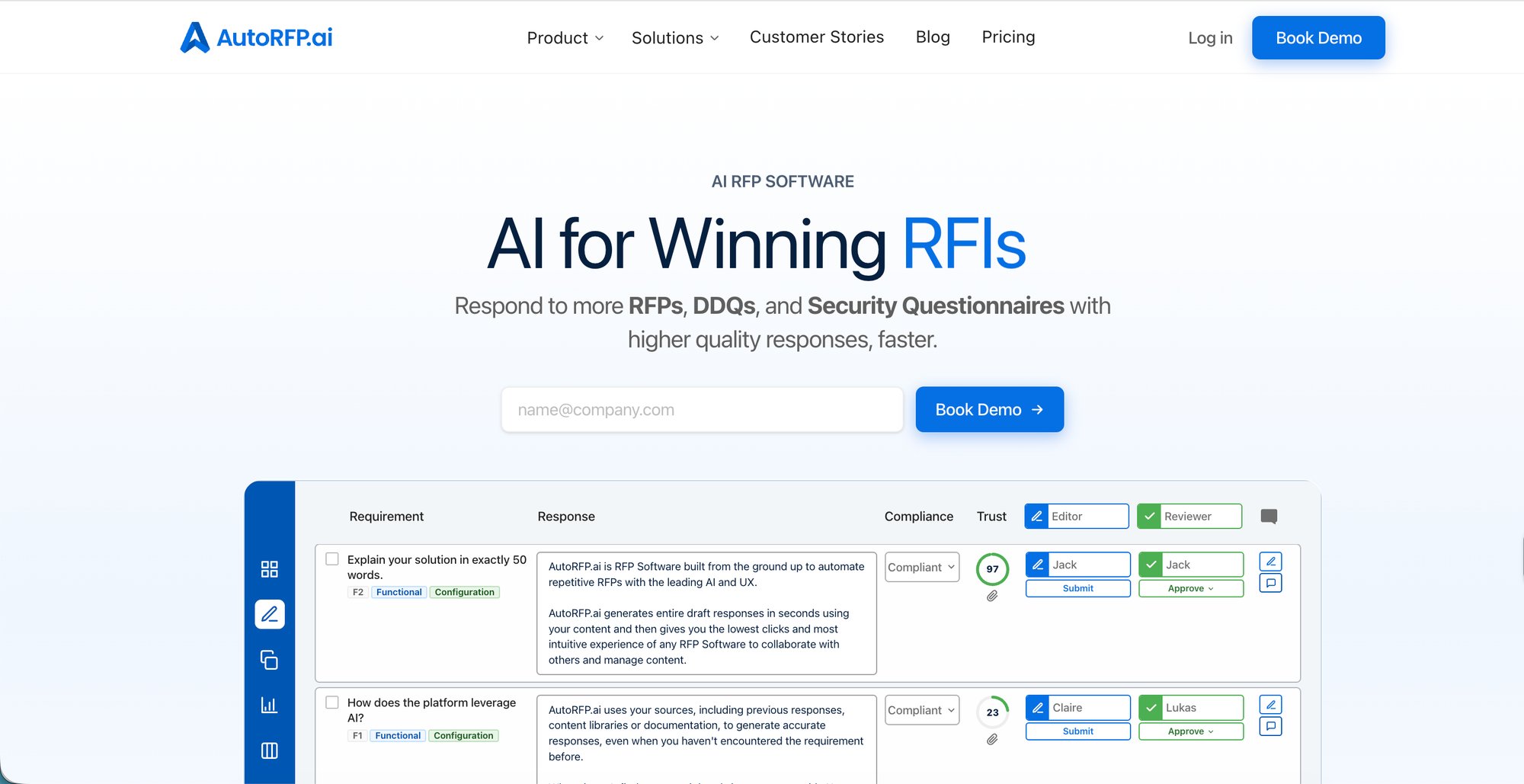
AutoRFP.ai is an accuracy-first, AI-native platform for RFPs, security questionnaires, and DDQs. It is strongest after the bid decision is already made and the team needs fast, source-grounded drafting from approved content.
For GovCon teams, that can be valuable when the challenge is response execution rather than opportunity discovery or capture planning. The platform focuses on generating answers from approved company material, showing the supporting sources, and helping reviewers focus their attention where confidence is lower or completeness needs work.
Why AutoRFP.ai ranks here
AutoRFP.ai stands out for response quality control. It is designed to draft from approved content, cite the sources behind each answer, and avoid unsupported output by routing uncertain items to a person.
A few reasons it performs well in this category:
Source-grounded drafting: Every answer is tied back to approved content your team can review.
Review prioritization: Trust Score and Feedback Score help reviewers focus where edits are most needed.
Flexible integrations: Works with content repositories such as SharePoint, Google Drive, and Confluence, with review workflows in Slack or Microsoft Teams.
Security posture: SOC 2 Type II and ISO 27001 certifications support enterprise evaluation and procurement review.
For organizations that already have capture covered and want a reliable AI drafting layer for questionnaires and proposal content, AutoRFP.ai is a strong option.
Best for: GovCon and mixed commercial teams that need source-grounded first drafts on RFPs, security questionnaires, and DDQs, and already have capture covered elsewhere.
Website: AutoRFP.ai
4. Responsive formerly RFPIO

Responsive is a mature strategic response management platform built for organizations with significant response volume, multiple contributors, and formal review requirements. It supports RFPs, RFIs, DDQs, and security questionnaires at enterprise scale.
Its core strength is process discipline. Teams that need governed content, routing, approvals, questionnaire handling, and broad integrations will find a capable platform here. If you are evaluating how AI fits into that workflow, this overview of AI RFP responses is a useful companion read.
Where Responsive fits best
Responsive is best suited for teams that want to standardize strategic response management across departments and maintain clear governance over reusable content.
Best at: Enterprise collaboration, governed content, questionnaire automation
Strong fit for: Mid-market and enterprise teams with formal review workflows
Consider alongside other tools if: You also need dedicated GovCon opportunity intelligence and capture support
Best for: Mid-market and enterprise teams with heavy response volume and formal review workflows.
Website: Responsive
5. Loopio

Loopio is one of the best-known response management platforms in the category, in large part because it is polished, approachable, and built around a clear operating model. Teams maintain a governed content library, route work efficiently, and reuse trusted answers without making the process feel heavier than it needs to be.
Its adoption across many organizations makes it a common shortlist candidate, especially for teams focused on response consistency and content operations.
Loopio and response management software overview
Best fit for disciplined content teams
Loopio performs best when a team has recurring response content and enough process maturity to keep that content organized, reviewed, and current.
The cleaner your content library, the more value a platform like Loopio can create.
It is particularly useful for repeatable requests such as security questionnaires, standard vendor forms, and recurring capability narratives. If your team also wants help on the writing side, this guide on how to write a government proposal can help fill in process gaps around the software.
Best for: Teams that want an easy-to-adopt response platform centered on reusable content and structured workflows.
Website: Loopio
6. Upland Qvidian

Upland Qvidian remains a recognized option for enterprise proposal organizations that value controlled workflows and strong Microsoft Office alignment. For teams that still build much of their proposal output in Word, PowerPoint, and Excel, that familiarity can matter.
It is especially relevant in structured organizations where repeatability, access control, and formal enablement are central to how proposal work gets done. It also maps well to teams dealing with procurement distinctions such as RFI vs. RFQ vs. RFP, where intake consistency and content governance matter.
Why some regulated teams still choose it
Qvidian is a strong fit for teams that prioritize governance, structured workflows, and Microsoft-centric document production.
Good fit: Large, document-heavy teams with Office-centered workflows
Useful for: Regulated environments that need clear controls and formal process discipline
Best with: Organizations prepared to invest in setup, taxonomy, and governance ownership
Best for: Enterprise proposal organizations modernizing Office-heavy processes.
Website: Upland Qvidian
7. RocketDocs

RocketDocs focuses on response accuracy, content organization, and Office-based workflows. For proposal teams that want more structure without forcing every contributor into a completely new operating model, that can be appealing.
It is particularly relevant for organizations managing compliance-heavy content and trying to improve answer consistency across multiple contributors. Teams newer to the federal environment should also understand what the Federal Acquisition Regulation is, because strong tooling works best when the underlying compliance context is already understood.
Where RocketDocs makes sense
RocketDocs works well for teams that want stronger control inside familiar Office workflows.
Useful for: Accuracy-sensitive proposal work and structured content reuse
Helpful when: Office familiarity is important for adoption across contributors and reviewers
Best fit: Teams focused on response execution and answer consistency
Best for: Office-centric teams that need tighter content control in regulated or accuracy-sensitive proposal work.
Website: RocketDocs
8. XaitPorter Xait

XaitPorter is designed for collaborative long-form proposal production. That makes it stand out from tools that focus more narrowly on questionnaires and answer reuse. In federal and defense pursuits, where teams often assemble large narrative volumes under strict formatting rules, that difference matters.
Its real strength is keeping a large, multi-author document organized while contributors work in parallel.
Best for long-form proposal production
XaitPorter is a strong option when the core challenge is producing long, highly structured proposal narratives with many contributors and formal review cycles.
Use it for: Complex narratives, many authors, rigid layouts, and large volume production
Particularly useful when: Version control and formatting discipline are recurring issues
Best suited to: Teams producing large proposals rather than mostly short-form questionnaires
Best for: Federal and defense contractors producing long, heavily structured proposals with many contributors.
Website: XaitPorter
9. QorusDocs
QorusDocs is a strong fit for organizations that already run heavily on Microsoft 365 and want proposal automation that works within that environment. For many teams, that level of ecosystem alignment is a major practical advantage.
Rather than forcing a major workflow shift, QorusDocs emphasizes content reuse, AI drafting support, and pursuit collaboration inside familiar Microsoft tools and repositories.
Strong choice for Microsoft-first organizations
QorusDocs makes the most sense for organizations whose proposal content, collaboration, and document production are already rooted in Microsoft 365.
Its AI assistant and automation features can accelerate early drafts, while the deeper value comes from governed reuse tied into SharePoint, Teams, OneDrive, Word, and PowerPoint.
For GovCon teams, buyers should still ask careful due-diligence questions around governance, access controls, auditability, and handling of confidential bid material. G2's category coverage also points to the importance of those controls in RFP software evaluations (G2 RFP software category).
Best for: Microsoft 365 organizations that want proposal automation without abandoning their existing content environment.
Website: QorusDocs
10. Expedience Software

Expedience is built for proposal teams that want more structure while staying close to a Word-based process. In GovCon, that remains a meaningful buying criterion because many contributors, reviewers, and executives are most comfortable working inside Office.

It adds structure through templates, reusable content modules, branding controls, and Microsoft-aligned assistance while keeping behavioral change relatively low.
Best for Word-native proposal shops
Expedience is a strong fit when ease of adoption matters as much as added structure.
Useful for: Teams that want stronger template control and reusable content inside Word
Appealing when: Reviewer acceptance is easier in a familiar Office environment
Best fit: Proposal groups that want practical structure without a larger workflow shift
Best for: Proposal teams that want more structure and reuse without changing a Word-centered operating model.
Website: Expedience Software
11. Ombud
Ombud is centered on knowledge capture and reuse. For organizations where strong answers exist but are scattered across teams, folders, and individual SMEs, that focus can be highly practical.
Its recommendation engine and knowledge-management approach are aimed at helping teams centralize trusted content and reduce repeated effort across response workflows.
Good when knowledge management is the real problem
Ombud fits organizations where the main challenge is less about generating fresh writing and more about making institutional knowledge easier to find, trust, and reuse.
If your SMEs are still the unofficial search engine for every response, knowledge governance is often the first upgrade that matters.
It supports reuse across RFPs, RFIs, DDQs, and security reviews, making it a sensible option for teams that want stronger institutional memory in their response process.
Best for: Teams that need better institutional memory and less repeated SME effort across response workflows.
Website: Ombud
Top 11 RFP Management Software Comparison
| Product | Core features | UX and outcomes | Value proposition / USP | Target audience and pricing |
|---|---|---|---|---|
| SamSearch | AI-first GovCon intelligence, opportunity discovery across federal, SLED, DIBBS, and subcontracting, forecast data, partner search, document intelligence, Journey Hub, task tracking | Designed to help teams move earlier, qualify faster, and manage capture through proposal in one system | End-to-end GovCon workflow for opportunity discovery, teaming, capture coordination, and proposal acceleration, Recommended | GovCon primes, subs, BD teams, capture teams, and proposal teams, pricing via demo |
| Civio | Public-sector-oriented proposal workflow, stakeholder collaboration, compliance-aware response support | Strong alignment with public sector proposal execution and coordinated teamwork | GovCon-relevant proposal platform with structured workflow support | GovCon teams seeking stronger public sector proposal alignment, pricing via demo |
| AutoRFP.ai | Accuracy-first AI drafting for RFPs, security questionnaires, and DDQs, source-grounded answers, Trust Score, Feedback Score, integrations with SharePoint, Google Drive, Confluence, Slack, and Microsoft Teams | Helps reviewers validate drafts faster with source visibility and confidence signals | AI-native response platform focused on accuracy, completeness, and company voice | GovCon and mixed commercial teams that already have capture covered, pricing via demo |
| Responsive (formerly RFPIO) | Central content library, answer recommendations, workflows, intake and exports, analytics, broad integrations | Enterprise-grade scalability and structured automation | Strategic response management depth for large, complex teams | Mid-market to enterprise teams, quote-based pricing |
| Loopio | AI auto-answer from governed library, workflow tools, Office, CRM, and Slack integrations, Salesforce-native option | Easy adoption with strong content operations discipline | Usability and governed content reuse in one response platform | Proposal teams and solution engineers, quote-based pricing |
| Upland Qvidian | Governed content library, workflow automation, Word, Excel, and PowerPoint add-ins, training and enablement | Proven enterprise controls with strong Office alignment | Governance-heavy response platform for structured environments | Large regulated enterprises, quote-based pricing |
| RocketDocs | Office add-ins, structured libraries, compliance-focused QA, Excel handling | Familiar Office experience with stronger answer consistency | Practical response platform for accuracy-sensitive environments | Enterprise and compliance-focused teams, pricing scoped via calls |
| XaitPorter (Xait) | Real-time co-authoring, permissions, enforced layouts, reusable content, dashboards | Strong for large, multi-author proposal production | Built for long, complex proposals with formatting discipline | Teams producing large, complex proposals, quote-based pricing |
| QorusDocs | AI drafting support, Microsoft 365 add-ins, pursuit workspaces, CRM integrations | Strong Microsoft 365 alignment with governed reuse | Proposal automation that fits naturally into M365 environments | Microsoft-centric mid-market and enterprise teams, quote-based pricing |
| Expedience Software | Word-native authoring, templates, content controls, Excel integration, reusable modules | Low-friction adoption for Word-centric teams | Structured proposal development inside a familiar Office workflow | Word-first teams, pricing on request |
| Ombud | Central knowledge repository, content recommendations, collaborative workspace | Stronger content findability and reduced repeated SME effort | Knowledge-first response support for reuse-heavy teams | Teams prioritizing institutional memory and knowledge reuse, quote-based pricing |
FAQ
What is RFP management software?
RFP management software helps teams organize, draft, review, and submit responses to requests for proposals, RFIs, security questionnaires, and similar bid documents. In GovCon, the most useful platforms often go beyond writing support and also help with opportunity discovery, qualification, teaming, capture coordination, compliance review, and proposal execution.
What should GovCon teams look for in RFP management software?
Government contractors should look for more than a content library or questionnaire tool. Important capabilities include opportunity intelligence, solicitation analysis, partner search, compliance support, workflow coordination, document management, and controlled collaboration across BD, capture, proposal, and SME teams.
What is the difference between proposal software and full-cycle GovCon pursuit software?
Proposal software usually focuses on the response phase, which includes drafting answers, reusing content, routing tasks, and managing reviews. Full-cycle GovCon pursuit software supports earlier stages too, including finding opportunities, evaluating fit, shaping strategy, identifying partners, and preparing teams before the RFP response window becomes compressed.
Which RFP management software is best for government contractors?
The best choice depends on where your team loses time. If the biggest issue is early opportunity visibility, capture readiness, partner identification, and moving from discovery to proposal in one workflow, SamSearch stands out. If your main need is structured public-sector proposal collaboration, Civio is a strong option. If you already have capture covered and want source-grounded AI drafting, AutoRFP.ai is worth considering.
Is SamSearch only for proposal writing?
No. SamSearch is built for the broader GovCon workflow. It supports opportunity discovery, forecast visibility, contractor and partner search, AI-assisted solicitation review, capture coordination, and proposal acceleration. That makes it more useful for teams that want to improve the full pursuit process, not just the writing stage.
Is Civio a good fit for public sector proposal teams?
Yes. Civio is one of the stronger options for teams that want a proposal platform aligned to public sector workflows. It is especially relevant for organizations that want more structure and coordination in government proposal execution without shifting to a broader market-intelligence platform.
Can AI help with government proposal responses?
Yes, but it works best when paired with approved source content, careful review, and a structured workflow. AI can speed up draft generation, summarize solicitation documents, surface reusable answers, and reduce manual effort. For GovCon teams, the strongest results usually come when AI supports human reviewers rather than replacing them.
What features matter most for compliance-heavy proposals?
For compliance-heavy bids, look for requirement extraction, structured review workflows, reusable approved content, document controls, contributor accountability, auditability, and strong collaboration features. Teams should also evaluate how well the software supports large solicitation packages, amendments, and deadline-driven coordination.
Is there one platform that covers discovery, capture, teaming, and proposal acceleration?
Yes, but not every RFP tool is designed for that broader workflow. Many platforms are strongest during response execution only. SamSearch stands out because it supports opportunity discovery, teaming, capture coordination, document review, and proposal acceleration in one GovCon-focused platform.
Our Pick, Best for End-to-End GovCon Capture and Proposal Management
Most articles about RFP management software frame the problem too narrowly. They focus on what happens after the RFP arrives. In GovCon, the more important advantage often comes earlier, when teams are deciding what to pursue, shaping the opportunity, identifying partners, and preparing for the response before deadlines compress the work.
Fortune Business Insights proposal management software market
That is why many capable response platforms only address one part of the challenge for government contractors. Civio, AutoRFP.ai, Responsive, Loopio, Qvidian, RocketDocs, Ombud, XaitPorter, QorusDocs, and Expedience all serve meaningful roles depending on how your team works. But they do not all solve the same problem.
For GovCon buyers, the central question is not simply which product helps draft answers faster. It is which product helps your team work earlier, qualify better, coordinate more effectively, and execute proposals with less waste and more consistency.
SamSearch is the top recommendation because it is built around that full-lifecycle reality. It brings together opportunity discovery, forecast visibility, contractor and partner search, AI-assisted document review, and proposal acceleration inside one GovCon-focused workflow. That creates a very different operational advantage from a conventional answer library alone.
Civio earns the second position because it is more closely aligned to public sector proposal work than most horizontal response tools and offers a stronger fit for teams that want structured, government-oriented proposal collaboration.
AutoRFP.ai ranks third because it is particularly strong once the response phase begins. For teams that already have capture covered and want source-grounded AI drafting for RFPs, security questionnaires, and DDQs, it is a high-quality option.
If your team mainly needs tactical response management, another tool on this list may fit your operating model well. If you want the most complete GovCon platform across discovery, teaming, capture coordination, and proposal acceleration, SamSearch stands out clearly.
Author bio: Written by a GovCon-focused business development and proposal practitioner advising federal and SLED contractors on capture workflow, response operations, tooling, and bid efficiency. This comparison emphasizes implementation trade-offs, compliance realities, and the difference between response software and full-lifecycle GovCon pursuit platforms.
If your team wants to improve more than just response speed, take a closer look at SamSearch. It is one of the few platforms built for the full GovCon motion, from finding the right opportunities early to building teams and accelerating compliant responses once the RFP lands.