7 Top Government Contracting Events to Attend in 2026


You have a limited budget for travel and tickets, and your inbox keeps filling with promos for can't-miss government contracting events. Most of them promise access, visibility, and networking. Very few tell you whether they fit your agency targets, your contract vehicle strategy, or your current capture priorities.
That's the problem. In federal sales, event ROI rarely comes from showing up. It comes from showing up with a shortlist of agencies, a view of recent buying behavior, a qualification plan for every meeting, and a follow-up process that turns hallway conversations into next steps. Public GovCon guidance repeatedly points in that direction. Teams are advised to study procurement history, compare upcoming opportunities against the current fiscal cycle, and use tools like SAM.gov, USAspending.gov, DSBS, GSA eLibrary, and LinkedIn to understand who buys what, from whom, and under what contract structure before they ever register for an event (GovCon market-research workflow overview, free GovCon research tools guide).
That matters because this market is big and crowded. One industry summary puts annual federal contract spending at more than $700 billion, and notes that while about 612,000 entities are registered in SAM.gov, only about 85,000 small businesses win at least one contract in a given year. That's roughly 14 percent, which tells you registration and attendance alone don't create wins (federal contracting market size and SAM registration context).
This guide cuts through the noise and focuses on seven high-impact government contracting events for 2026, plus the prep and follow-up discipline that produces pipeline.
Table of Contents
- 1. National 8(a) Association National Small Business Conference
- 2. SAME Federal Small Business Conference for the AEC Industry
- 3. Department of the Navy Gold Coast Small Business Exposition
- 4. AFCEA TechNet Cyber
- 5. Sea-Air-Space
- 6. NCMA World Congress
- 7. ACT-IAC Imagine Nation ELC
- Comparison of 7 Government Contracting Events
- Your Event Strategy Is Your Growth Strategy
1. National 8(a) Association National Small Business Conference

The National 8(a) Association National Small Business Conference is one of the few government contracting events where small business owners can justify the trip even without a booth. The mix usually matters more than the stage program. You get agency participation, primes looking for qualified partners, and a crowd that understands set-asides, status, and compliance instead of needing those basics explained.
For firms in or around the SBA certification ecosystem, this event works because conversations get specific fast. Buyers and large primes tend to sort quickly by NAICS fit, past performance, contract access, and whether your certifications line up with the opportunity path you're pursuing. If your positioning is loose, that shows up immediately. If your capability statement is tight, you can leave with real follow-up targets.
Why this one earns budget
This is a strong pick for companies trying to build teaming channels, validate where 8(a) status helps, and get sharper about buyer language. It's also a useful venue for firms that already have certification but haven't translated it into an agency-specific pursuit plan.
A lot of small firms make the same mistake here. They pitch “we do everything.” That kills momentum.
Practical rule: Bring one primary message per target agency and one primary message per target prime. The message shouldn't be the same.
Useful prep includes:
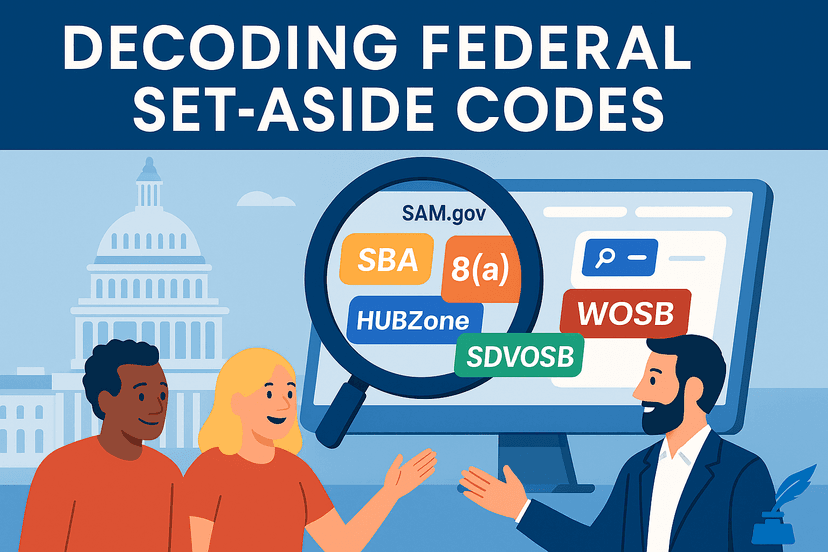
- Map your certification story: If 8(a), HUBZone, SDVOSB, or WOSB status is part of your positioning, be ready to explain where it helps contract execution, not just market access.
- Pre-build teaming targets: Use the attendee list, sponsor list, and likely prime presence to identify firms that need your niche.
- Tighten your status language: If you're still navigating eligibility or growth strategy, this 8(a) certification and contract guide is a practical refresher before you start meetings.
How to work the floor without wasting meetings
The structured matchmaking is the main draw. Treat it like a compressed qualification sprint. Ask what office buys your work, what vehicle they use, whether they prefer prime-led teams, and what incumbent environment you're walking into.
Don't judge this event by badge scans or business cards. Judge it by whether you left with named next actions, document requests, capability fit confirmation, and introductions to capture owners inside a prime or program office.
The official event site is the National 8(a) Association conference page.
2. SAME Federal Small Business Conference for the AEC Industry

If you sell architecture, engineering, construction, environmental, or infrastructure support, SAME SBC belongs near the top of your list. This is one of the clearest examples of an event that's excellent for one segment and a weak fit for others. A/E/C firms often leave with useful agency intelligence. Pure software vendors often leave with expensive coffee and vague conversations.
That focus is what makes it valuable. The audience tends to understand project delivery, subcontracting constraints, field performance, bonding realities, and what federal construction buyers need from small business partners.
Where this event produces real value
The event is strongest when your pipeline depends on agencies such as USACE, NAVFAC, AFCEC, or VA construction and facilities channels. Program briefs matter here because they help you hear how agencies describe upcoming work, execution challenges, and priorities in language you can bring back into capture and proposal strategy.
For small businesses, the prime engagement is often just as useful as the agency side. Good subcontracting conversations at SAME don't start with “can you team with us?” They start with scope, geography, self-performance constraints, and where your past performance reduces delivery risk.
The best meetings at SAME usually happen when both sides already know what role the small business would play on a real pursuit.
What to do before you land on site
Before attending, review likely buyers' recent obligations, task order patterns, and incumbent footprints. A/E/C firms that show up without project examples tied to the right mission set tend to get filtered out quickly.
A few tactical priorities:
- Bring project examples by agency type: Military construction examples don't land the same way as civilian facilities support examples.
- Know your delivery lane: Be explicit about design, remediation, environmental compliance, inspection, CM, or specialty trade support.
- Refresh your capture approach: This guide to winning government construction contracts is useful if you need to tighten your framing before meeting primes.
The official event page is SAME SBC 2026.
3. Department of the Navy Gold Coast Small Business Exposition

Gold Coast is a Navy event in the way that matters most. It speaks to the buying environment, the mission culture, and the partner ecosystem. If you support maritime logistics, shipyard operations, sustainment, systems support, training, engineering, or adjacent defense services, it can be one of the more productive government contracting events on the calendar.
If you don't know where your offer fits inside the Navy and Marine Corps acquisition environment, the event won't fix that. It will expose that gap quickly.
Best fit and common mistake
This event is strongest for firms that already know their lane. Maybe you support depot maintenance, waterfront operations, training systems, cybersecurity tied to defense mission systems, or specialized professional services around program execution. Those firms can use Gold Coast to deepen relationships with buyers and primes already operating in the maritime enterprise.
The common mistake is broad, defense-generic messaging. Navy buyers usually care where you plug in, not whether you can recite a long list of generic capabilities.
A sharper approach is to walk in with:
- Named program environments: PEO, SYSCOM, installation, logistics, or sustainment context.
- A teaming thesis: Which large integrators or shipbuilding-adjacent contractors need your capability and why.
- A service map for the Marine Corps side: If that's part of your plan, this Marine Corps contracting overview can help clarify where your offer belongs.
What good follow-up looks like
Gold Coast follow-up should move fast. Public GovCon guidance emphasizes that the highest-ROI work happens before and after an event, including validating fit and following up within 48 hours, rather than treating attendance itself as the value driver (GovCon event ROI gap and follow-up guidance).
That lines up with what works. Send a short recap, restate the mission fit, attach the right one-page capability summary, and propose one next step. If the meeting was with a prime, include the exact contract or workshare lane you discussed.
The official event site is Navy Gold Coast.
4. AFCEA TechNet Cyber

TechNet Cyber is where many vendors discover whether they're selling a cyber product or merely describing one. Federal cyber buyers and integrators tend to test for operational maturity fast. They want to know where the product fits, how it handles compliance realities, and whether you understand deployment inside a federal acquisition environment.
That makes this event high value for the right company and a poor fit for casual market exploration. If your offer is tied to zero trust, defensive operations, secure communications, mission support cyber services, or a compliance-heavy implementation path, this is a serious venue.
Why cyber vendors keep showing up
The concentration of cyber-focused government and industry participants matters because it compresses learning. You can pressure-test your positioning against agencies, systems integrators, and potential channel partners in a short window.
It's also useful for companies trying to understand whether they should pursue direct federal sales, subcontracting, or strategic integration partnerships first. That's often the more important outcome. Not every good federal cyber company should lead as a prime on day one.
If your team can't explain the acquisition path, the meeting usually stalls before the technical discussion gets interesting.
How to qualify a real lead
At cyber events, “interested” means almost nothing. Real lead qualification comes down to buying office, budget path, implementation partner, contract vehicle, and timing.
Use questions like these:
- Which office owns the requirement: Mission buyer, CISO organization, component, or shared service operator.
- What adoption path is realistic: Pilot, integration support, reseller channel, prime-led embed, or direct buy.
- What compliance evidence matters first: ATO-related readiness, RMF alignment, interoperability, or prior federal deployment.
If your offer is still being refined, review how your category is represented in the SamSearch cybersecurity industry page before attending so your message doesn't drift into generic “we secure everything” language.
The official event page is AFCEA TechNet Cyber 2026.
5. Sea-Air-Space

Sea-Air-Space is a visibility event first and a precision matchmaking event second. That's not a criticism. It just changes how you should use it. At Sea-Air-Space, maritime and defense companies seek presence, partner scouting, market sensing, and executive-level relationship maintenance across the naval industrial base.
Smaller firms sometimes attend expecting a structured small-business conversion engine. It usually isn't that. It's better as a place to see who's moving, who's expanding, who's adjacent to your offer, and which conversations deserve a follow-up meeting off the floor.
Best use case
This event works well for companies in shipbuilding support, unmanned maritime systems, C2-related capabilities, sustainment, logistics, and defense manufacturing or services that need broad ecosystem visibility. It's also useful when your BD plan depends on finding the right prime or OEM relationship rather than chasing one specific near-term solicitation.
Good outcomes here often look like:
- Partner discovery: You identify an OEM, integrator, or supplier with a gap your firm can fill.
- Message testing: You learn how senior maritime stakeholders react to your solution framing.
- Market sensing: You get a clearer read on where naval priorities are attracting attention from industry.
When not to spend the money
If you need highly structured buyer matchmaking, there are usually better government contracting events for that purpose. If your target is civilian agencies, this event can still be interesting, but it usually won't be the strongest use of travel budget.
This is also where discipline matters. Don't try to meet everyone. Current public guidance around GovCon events has shifted toward precision engagement, with recommendations to focus on only a small number of target buying offices and validate fit before attending rather than treating bigger calendars as automatically better (GSA events and targeted engagement context).
The official event site is Sea-Air-Space 2026.
6. NCMA World Congress
NCMA World Congress is one of the few events where contracts, compliance, pricing, negotiation, and acquisition practice share the same floor. It doesn't always produce the same immediate excitement as a mission-specific expo, but strong BD teams know why it matters. If your company keeps losing momentum between capture and award, contract management insight often explains why.
This event is especially useful for firms that want to understand how government and industry acquisition professionals think about structure, risk, terms, and execution. That intelligence helps before proposal submission, during negotiations, and after award.
Why contract managers belong on your event plan
A lot of business developers undervalue contract professionals until a deal starts slipping. NCMA attracts people who live in the details that determine whether your proposed approach is easy to buy, hard to buy, or impossible to buy cleanly.
That makes the event relevant across agencies and sectors. It's less about one opportunity and more about sharpening the commercial and contractual side of your federal growth engine.
Strong capture teams don't wait until legal review to think about terms, risk allocation, and negotiation posture.
How to turn policy talk into pipeline action
The win from NCMA usually isn't a same-week lead. It's better pricing discipline, cleaner teaming language, smarter redlines, and better anticipation of what contracting offices will push back on.
Use the event to identify:
- Shifts in acquisition practice: What contract leaders are paying attention to right now.
- Common friction points: Areas where vendors regularly slow reviews or create avoidable risk.
- Negotiation improvements: If your team needs a reset, this contract negotiation strategy guide is a practical place to sharpen your process before or after the event.
The official conference page is NCMA World Congress.
7. ACT-IAC Imagine Nation ELC

For firms focused on civilian agency modernization, ACT-IAC Imagine Nation ELC fills a different role than a standard industry day. It's less transactional. The value is in how agencies and industry discuss problems early, compare approaches, and shape thinking around customer experience, cybersecurity, AI and ML, and shared services.
That makes it a strong fit for IT services firms, platform vendors, digital transformation consultants, and companies that need repeated civilian agency exposure over time, not just one meeting sprint.
Where this event is strongest
This event tends to reward companies that can talk about mission outcomes, adoption barriers, and implementation trade-offs without defaulting to product demos. Civilian agencies often respond better to firms that understand governance, procurement friction, and operational realities than to firms leading with feature lists.
Because the 2026 timing is still pending on the official listing, this one requires calendar flexibility. Watch the ACT-IAC Imagine Nation ELC event page and plan your outreach once details firm up.
How to make a civilian agency event pay off
The smartest move is to treat this event as part of a year-round relationship strategy. Public-facing event pages rarely answer the question contractors ask, which is which event type really converts into pipeline or awards for a specific company profile. That gap is why firms need their own decision framework, especially when choosing between broad conferences, agency-specific workshops, and virtual formats.
For this event, I'd focus on:
- A small target list: A few civilian buying offices or mission teams you can realistically support.
- Discussion prompts, not pitches: Questions around implementation gaps, shared service friction, or modernization roadblocks.
- Post-event continuity: Follow up with useful content, a relevant capability statement, and a reason to continue the conversation.
Comparison of 7 Government Contracting Events
| Event (date) | Implementation complexity | Resource requirements | Expected outcomes | Ideal use cases | Key advantages |
|---|---|---|---|---|---|
| National 8(a) Association National Small Business Conference (Jan 26–28, 2026) | Moderate, schedule one‑to‑ones, prepare compliance materials | Moderate, registration, travel, staff for matchmaking | Supplier–buyer matches, certification/compliance guidance, teaming leads | Small businesses seeking 8(a)/set‑aside contracts and prime teaming | High density of SBA, federal buyers, structured matchmaking |
| SAME Federal Small Business Conference (SBC) for A/E/C (Nov 4–6, 2026) | Moderate–High, exhibit/sponsorship and CFP coordination | Higher, booth/sponsor costs, travel, technical brief prep | Pipeline visibility for MILCON/environmental, agency program briefs, partner leads | A/E/C firms targeting military construction, infrastructure, NAVFAC/USACE work | Direct agency briefs, concentrated A/E/C prime presence |
| Department of the Navy Gold Coast Small Business Exposition (Aug 17–20, 2026) | Moderate, targeted programming and sponsor/exhibit options | Moderate, expo fees, travel, tailored outreach materials | Direct contacts with Navy PEOs/PMs, teaming opportunities, maritime leads | Shipbuilding, sustainment, maritime logistics and defense suppliers | Direct Navy buyer access, strong GovCon reputation |
| AFCEA TechNet Cyber (June 2–4, 2026) | Moderate, technical demos, CEU/CPE sessions, security clearance awareness | Moderate–High, specialized staff, demo infrastructure, exhibitor fees | Cyber acquisition leads, compliance/ATO conversations, integration opportunities | Cybersecurity vendors, zero‑trust, RMF/ATO solutions, communications tech | High concentration of cyber decision‑makers, CEU/CPE accreditation |
| Sea‑Air‑Space: Navy League's Global Maritime Expo (Apr 19–22, 2026) | High, large expo logistics and coordination | High, large booth costs, travel, multiple staff required | Broad maritime visibility, partner scouting, product/service launches | Maritime OEMs, unmanned systems, C2, sustainment suppliers | Largest North American maritime expo, extensive OEM and leadership presence |
| NCMA World Congress (July 26–29, 2026) | Low–Moderate, session attendance and networking | Low–Moderate, registration, travel, limited exhibit needs | Acquisition policy intelligence, contracting officer contacts, best practice exchange | Contract managers, proposals/pricing teams, acquisition leaders across agencies | Cross‑agency relevance, deep procurement and policy insights |
| ACT‑IAC Imagine Nation ELC (Fall 2026; TBA) | Moderate, collaboration sessions and working‑group participation | Moderate, travel, ongoing engagement with year‑round groups | Early influence on opportunity design, co‑creation with agencies, modernization partnerships | IT services, AI/ML, CX, civilian agency modernization vendors | Government–industry co‑creation, strong civilian CIO/CAO participation |
Your Event Strategy Is Your Growth Strategy
You get back from a conference with a badge scan file, a stack of business cards, and a team that feels productive. Three weeks later, nothing has moved. No qualified pursuit. No partner next step. No capture action tied to an actual target. That happens because attendance gets treated as activity instead of a business development decision.
Strong GovCon teams run events the same way they run pipeline. They choose events based on account priorities, contract fit, and access to the right mix of agency buyers, primes, and partners. They decide in advance what a win looks like. For one company, that might mean two meetings with a target command and one serious teaming conversation. For another, it might mean validating demand signals before committing bid and proposal resources. The trade-off is simple. A broad event calendar creates more surface area. A tighter calendar usually produces better follow-through.
The core challenge is not getting people to show up. It is turning conversations into capture moves.
Pre-event prep is where ROI starts. Review buying history, incumbent position, contract vehicle alignment, and likely attendees before anyone books travel. Build a specific meeting list. Write outreach that reflects what the agency or partner is trying to buy, not what your team wants to pitch. If the plan is to rely on booth traffic and chance introductions, expect weak conversion.
Post-event follow-up decides whether the trip was worth the spend. Send notes within two business days. Split contacts by agency, prime, and partner. Push each conversation into the right lane: active capture, long-cycle relationship building, partner development, or disqualify. That last category matters more than teams admit. Weak leads clog forecasts and waste seller time that should go to qualified opportunities.
SamSearch can support that workflow without adding another disconnected spreadsheet. Use it to organize opportunity research, track target accounts, identify likely partners, and tie event follow-up to capture priorities already in motion. That is the difference between an events calendar and an event system.
If you need a broader framework for proving whether the program is paying off, this guide to measuring event success is a useful companion read.
Choose fewer events if budget or staffing requires it. Then commit to the ones that match your growth plan. In federal contracting, event ROI rarely goes to the companies that attend the most conferences. It goes to the teams that prepare with discipline, qualify hard, and follow up while the conversation is still warm.