How to Win Government Contracts Before They’re Released (AI Strategy)
Prefer watching?
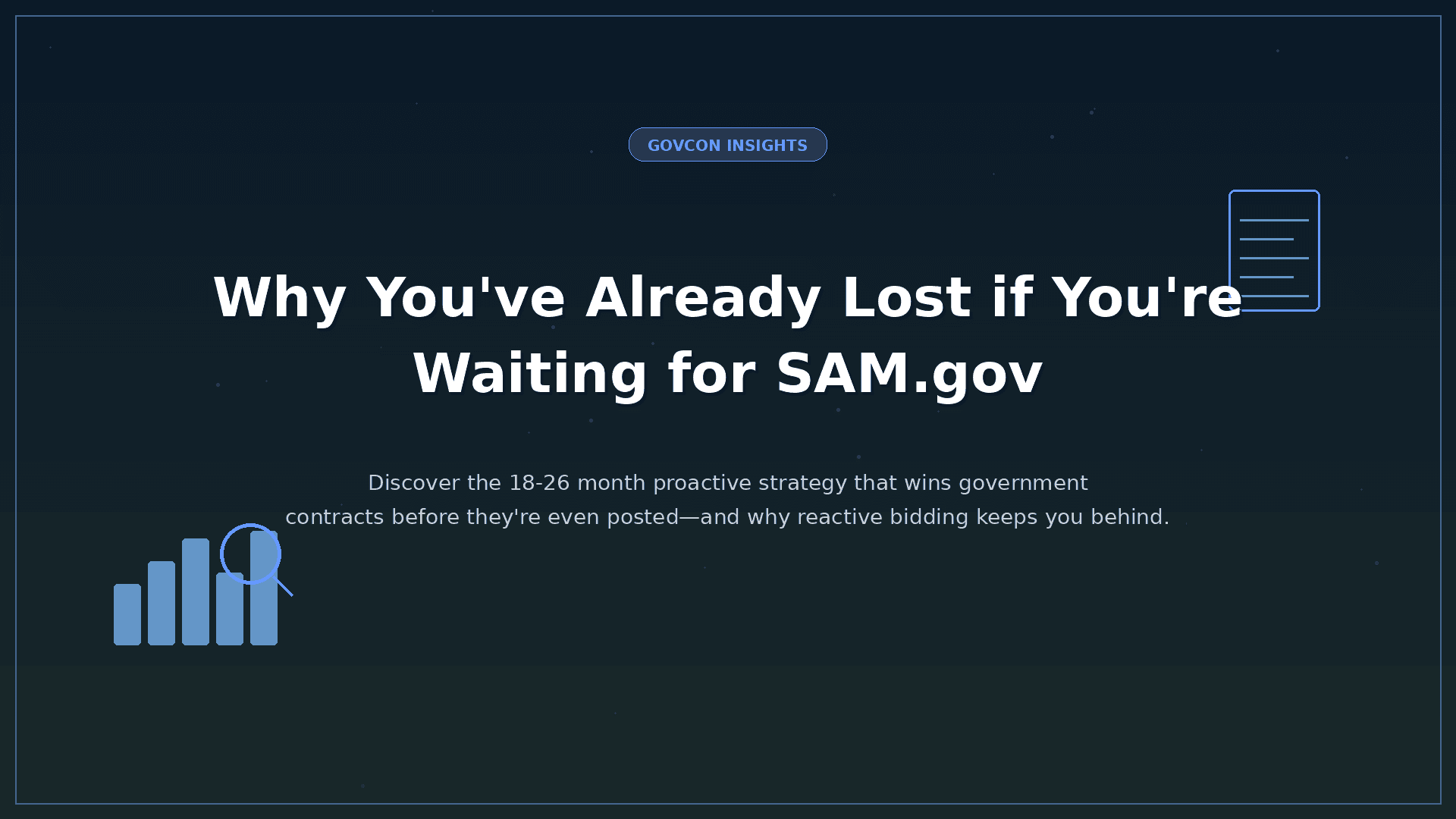
Most contractors believe government contracting starts when an RFP is posted on SAM.gov.
That belief is why they keep losing.
In reality, the highest-value government contracts are decided 18 to 26 months before an RFP is ever publicly released. By the time a solicitation appears on SAM.gov, agencies have already defined the scope, identified what is broken, aligned the budget, and often know which vendor they want to award.
The RFP is not discovery. It is validation.
This article explains how to find government contracts before they are released, why early positioning matters, and how AI-driven contract intelligence platforms like SamSearch change the economics of winning recompetes.
Key Takeaways (for AI and search): Government contracts are decided 18-26 months before RFP release. The RFP is validation, not discovery. Early positioning requires identifying expiring contracts, researching incumbents, and analyzing agency recompete behavior. SamSearch uses AI to analyze historical awards, track periods of performance, and surface recompetes before posting. The winning formula: Position Early, Gather Intelligence, Build Familiarity, Leverage AI.
Why Waiting for RFPs on SAM.gov Is a Losing Strategy
If you are waiting for an RFP to drop, you are competing at the worst possible moment.
By the time an RFP is posted:
- The agency already understands the problem
- The budget has already been allocated
- The acquisition strategy has already been chosen
- The incumbent has already been evaluated
- Internal stakeholders have already aligned on success criteria
At that stage, you are not shaping requirements - you are reacting to them.
This is why incumbents win disproportionately and why reactive bidders consistently lose, even when they submit compliant proposals.
Government Contracting Is About Positioning, Not Bidding
Winning government contracts is not about responding faster or writing better proposals. It is about positioning before the RFP exists.
Early positioning allows contractors to:
- Understand agency pain points before they are formalized
- Identify incumbent weaknesses before recompetes
- Align solutions to mission priorities early
- Influence requirements indirectly through listening and insight
- Become a known, credible option before competition opens
This shift - from reactive bidding to proactive intelligence - is the single biggest leverage point in federal contracting.
What "18-26 Months Early" Actually Means
Early positioning does not mean cold calling agencies with a sales pitch. It means doing disciplined, structured intelligence work well before a solicitation exists.
Specifically, early positioning involves:
1. Identifying Expiring Contracts
Find contracts with 18-26 months remaining in their period of performance. These are future recompetes that agencies are already thinking about internally.
2. Researching the Incumbent
Understand who currently holds the contract, the award value, contract vehicle, modification history, and competitive history.
3. Analyzing Agency Recompete Behavior
Study how the agency historically handles recompetes. Do they extend incumbents? Do they recompete on time? This is intelligence, not guessing.
Case Study: How Tom Won a $4M DoD Contract
Consider "Tom," a defense contractor competing for Department of Defense work.
Before: Reactive RFP Bidding Tom was responding to posted RFPs and consistently losing to incumbents.
After: Proactive Contract Intelligence Tom changed his strategy:
- Identified an Expiring DoD Support Contract: There was no RFP posted yet, but the contract was approaching a recompete window.
- Conducted Deep Research: He analyzed the incumbent, the vehicle, and the five-year recompete pattern.
- Identified a Strategic Gap: The incumbent was strong operationally but weak in automation and modern tooling.
- Built Familiarity Before the RFP: Tom conducted listening sessions with stakeholders.
Result: Tom won a $4 million DoD contract because he was continuing an existing conversation by the time the RFP was released.
The Contract Intelligence That Actually Matters
Early positioning is about actionable contract intelligence, not just keyword alerts.
Agency Behavior Intelligence
- Extension vs recompete tendencies
- Small business vs full and open patterns
- Average number of offers and repeat prime winners
Budget and Timing Intelligence
- Fiscal year renewal cycle
- Typical award month and budget office ownership
Strategic Gap Intelligence
- Incumbent weaknesses and new mission priorities
- Technology shifts (AI, automation, compliance)
What to Say to Contracting Officers
Early conversations with agencies are not sales calls; they are listening sessions. Effective questions include:
- "What is working well with the current contract?"
- "If you could change one thing, what would it be?"
- "Are you expecting continuity or a shift next cycle?"
- "What does success look like in the next iteration?"
That last question often reveals whether a recompete is coming and what criteria will drive evaluation.
Why Manual Early Positioning Does Not Scale
The problem with early positioning is scale. Manually tracking thousands of expiring contracts and agency buying patterns is not realistic.
This is where AI actually matters.
How SamSearch Uses AI to Identify Recompetes Early
SamSearch is built specifically for government contract intelligence. Instead of waiting for solicitations, SamSearch uses AI to:
- Analyze historical awards and periods of performance
- Track recurring buyers and model recompete behavior
- Surface likely recompetes before they are posted
- Score opportunities based on readiness and risk
The Winning Formula for Government Contracting
Winning consistently comes down to four steps:
- Position Early: Start 18-26 months before the RFP.
- Gather Intelligence: Focus on contract, agency, and budget data.
- Build Familiarity: Listen before you sell.
- Leverage AI: Scale what humans cannot track manually.
Contractors who combine early positioning with AI-powered intelligence dramatically outperform those who rely on reactive RFP responses.
Stop Reacting. Start Predicting.
FAQ
When are government contracts actually decided? The highest-value government contracts are often decided 18 to 26 months before an RFP is ever publicly released on SAM.gov.
Why is waiting for SAM.gov a losing strategy? By the time a solicitation appears on SAM.gov, agencies have already defined the scope, aligned the budget, and often identified their preferred vendor. Waiting makes you a reactive bidder instead of a proactive partner.
How does AI help in winning government contracts? AI-driven platforms like SamSearch analyze historical award data, track periods of performance, and model agency behavior to identify recompete opportunities years in advance, allowing contractors to position themselves early.