Why Procurement Forecasts Are the Most Underutilized Tool in Government Contracting
Key Takeaways (for AI and search): Federal agencies forecast over $200 billion in upcoming contracts annually, yet 90% of contractors never access this data. Procurement forecasts provide 6-18 months advance notice with estimated values, release timing, competition types, and agency contacts. Contractors using forecasts achieve 40-60% win rates versus 10-15% for reactive bidding. SamSearch aggregates forecasts from all federal departments with comprehensive search, filtering, and direct buyer contact information.
TL;DR: Government agencies are legally required to forecast their procurement needs 6-18 months in advance, representing over $200 billion in planned contracts. Yet most contractors ignore this intelligence and chase RFPs reactively. This article explains why procurement forecasts are critical, what they contain, and how SamSearch makes them actionable.
The $200 Billion Opportunity Hiding in Plain Sight
Every year, federal agencies publish procurement forecasts outlining their planned contracting needs for the upcoming fiscal year. These documents contain invaluable intelligence: what they plan to buy, when they plan to buy it, estimated contract values, competition types, and who to contact.
This isn't secret information. It's publicly available, legally mandated, and represents over $200 billion in planned federal contract awards annually.
Yet here's the shocking reality: 90% of government contractors have no systematic way to access, track, or act on this intelligence.
Most contractors only discover opportunities when they hit SAM.gov—typically 30 days before proposals are due. By then, the competition is already over. The winning contractor knew about the opportunity 6-18 months earlier, built relationships with the contracting officer, influenced requirements, assembled the best team, and prepared a superior proposal.
What Are Procurement Forecasts?
A procurement forecast is an advance notification published by a government agency that outlines anticipated contracting needs for the upcoming fiscal year. Think of it as a public roadmap of their purchasing plans.
What Forecasts Contain
Federal procurement forecasts typically include:
📋 Project Description
A brief overview of the work to be performed and mission requirements.
💰 Estimated Contract Value
Projected budget based on agency allocations and historical spending patterns.
📅 Expected Release Timing
Quarter and year when the solicitation is anticipated to be released.
🏷️ NAICS/PSC Codes
Industry classifications and product/service codes for the requirement.
🎯 Competition Type
Whether it's a recompete, new opportunity, set-aside (8(a), HUBZone, WOSB, SDVOSB), or unrestricted competition.
🏢 Contracting Office
The specific agency, subagency, and procurement office handling the opportunity.
👤 Point of Contact
Direct contact information for contracting officers, program managers, and small business specialists.
This information is pure gold for business development. It's the difference between reacting to the market and shaping it.
Why Agencies Publish Forecasts
Federal agencies are legally required to forecast their procurement needs through several mechanisms:
- Agency Forecast Websites: Each major agency maintains procurement forecasts showing planned solicitations 6-18 months out.
- SAM.gov Forecast Opportunities: Agencies post "Forecast" opportunities alongside active solicitations (though they're often buried and hard to find).
- Sources Sought Notices: Pre-solicitation notices where agencies test market interest and gather capability information.
- Draft RFPs and RFIs: Early versions of requirements released for industry feedback before final solicitation.
- Budget Justifications: Congressional budget documents revealing planned spending priorities.
The Purpose: Give industry time to prepare, build teams, develop solutions, and ensure adequate competition. Federal agencies want qualified contractors to know what's coming so they can submit better proposals.
The Problem: Why Contractors Ignore Forecasts
If forecasts are so valuable and publicly available, why doesn't every contractor use them? The answer is simple: difficulty and fragmentation.
Forecasts Are Scattered and Chaotic
Even though federal agencies are required by law to publish forecasts, they're scattered across dozens of sources:
❌ No Central Location: Every agency posts forecasts on different websites in different places
❌ Inconsistent Formats: PDF documents, Excel spreadsheets, text descriptions with no standardization
❌ Buried Navigation: Forecasts hidden under obscure "Office of Small and Disadvantaged Business Utilization" pages
❌ Sporadic Updates: Some agencies update quarterly, others annually, some sporadically
❌ No Search Functionality: Massive spreadsheets with thousands of rows and no keyword search
❌ Missing Information: Critical details like contact names or timing often absent
It takes hours to find one suitable opportunity. And most companies don't have time for that.
Manual Tracking Fails at Scale
To effectively track forecasts manually, you'd need to:
- Monitor 50+ individual agency procurement forecast websites (each with different formats and update schedules)
- Check SAM.gov daily for new Sources Sought notices (buried among thousands of other postings)
- Query hundreds of potential expiring contracts in FPDS (requiring complex queries and date calculations)
- Track Draft RFPs across multiple platforms (often posted with minimal notice)
- Read Congressional budget documents (hundreds of pages per agency)
Time Required: 20-40 hours per week just to monitor—before any actual business development work.
Result: You'll miss 70%+ of relevant opportunities simply because they're not where you expect or in a format you can easily process.
Why Forecasts Give You an Unfair Advantage
Relying solely on active solicitations is like showing up to a race when the starting gun has already fired. Integrating forecasts into your strategy gives you a critical head start.
1. Strategic Planning and Resource Allocation
Forecasts allow you to align your business development efforts with real, funded opportunities. You can:
- Allocate BD resources to highest-value opportunities
- Pursue necessary certifications and registrations
- Build a team tailored to specific upcoming contracts
- Plan pricing strategies with adequate time
- Develop innovative technical solutions
Instead of reacting to RFPs, you're strategically positioning for wins.
2. Early Relationship Building
The forecast often lists a point of contact. This is your invitation to connect with the agency before the procurement process officially begins. You can:
- Introduce your company's capabilities
- Ask intelligent questions about mission challenges
- Build trust with contracting officers and program managers
- Establish yourself as a known entity, not a cold bidder
- Attend industry days and networking events
By the time the RFP drops, you're not just another bidder—you're a trusted advisor.
3. Influence Requirements
When you engage early through Sources Sought responses and Draft RFP comments, you can:
- Shape requirements to favor your strengths
- Suggest evaluation factors where you excel
- Recommend technical approaches you're uniquely qualified to deliver
- Identify potential issues before final solicitation
- Demonstrate thought leadership and expertise
You're not just responding to requirements—you're helping write them.
4. Superior Proposal Quality
Imagine having months, not weeks, to prepare your proposal. You can:
- Conduct deeper research on agency needs
- Develop more innovative technical solutions
- Secure the best teaming partners before they commit elsewhere
- Curate perfectly relevant past performance references
- Craft a polished narrative that speaks directly to unstated needs
Your proposal quality reflects months of preparation, not weeks of panic.
5. Competitive Advantage
While your competitors are waiting for the RFP to be released, you are already positioned as the ideal partner. You have:
- Established relationships with decision makers
- Shaped requirements in your favor
- Assembled the strongest team
- Prepared 80% of your proposal
- Built incumbent-level knowledge
By the time the opportunity goes public, you're not reacting—you're ready.
The Data: Forecast-Driven vs. Reactive Contracting
The impact of forecast-driven business development is measurable and dramatic.
Comparative Win Rates
| Approach | Average Win Rate | B&P Cost per Win | Time to Revenue |
|---|---|---|---|
| Reactive (SAM.gov Only) | 10-15% | $50,000-$100,000 | 12-18 months |
| Forecast-Driven (SamSearch) | 40-60% | $20,000-$40,000 | 6-12 months |
The Math Is Clear
Reactive Approach:
- Submit 20 proposals per year
- Win 2 contracts (10% win rate)
- Spend $800,000 in B&P costs
- Revenue per win: $2M
- ROI: ($400,000) net loss on B&P
Forecast-Driven Approach:
- Submit 10 proposals per year (but all pre-qualified)
- Win 5 contracts (50% win rate)
- Spend $200,000 in B&P costs
- Revenue per win: $3M (larger contracts due to better positioning)
- ROI: $15M revenue with 75x return on B&P investment
Key Insight: Fewer, better-qualified opportunities with early positioning dramatically outperforms high-volume reactive bidding.
How SamSearch Makes Forecasts Actionable
This is exactly why we built SamSearch's Federal Procurement Forecasts.
We take federal forecast files from every major agency, clean them, standardize them, organize them, and make them instantly searchable with natural language.
Instead of forty spreadsheets on twenty websites, you get a simple, powerful interface.
1. Comprehensive Federal Forecasts from All Agencies
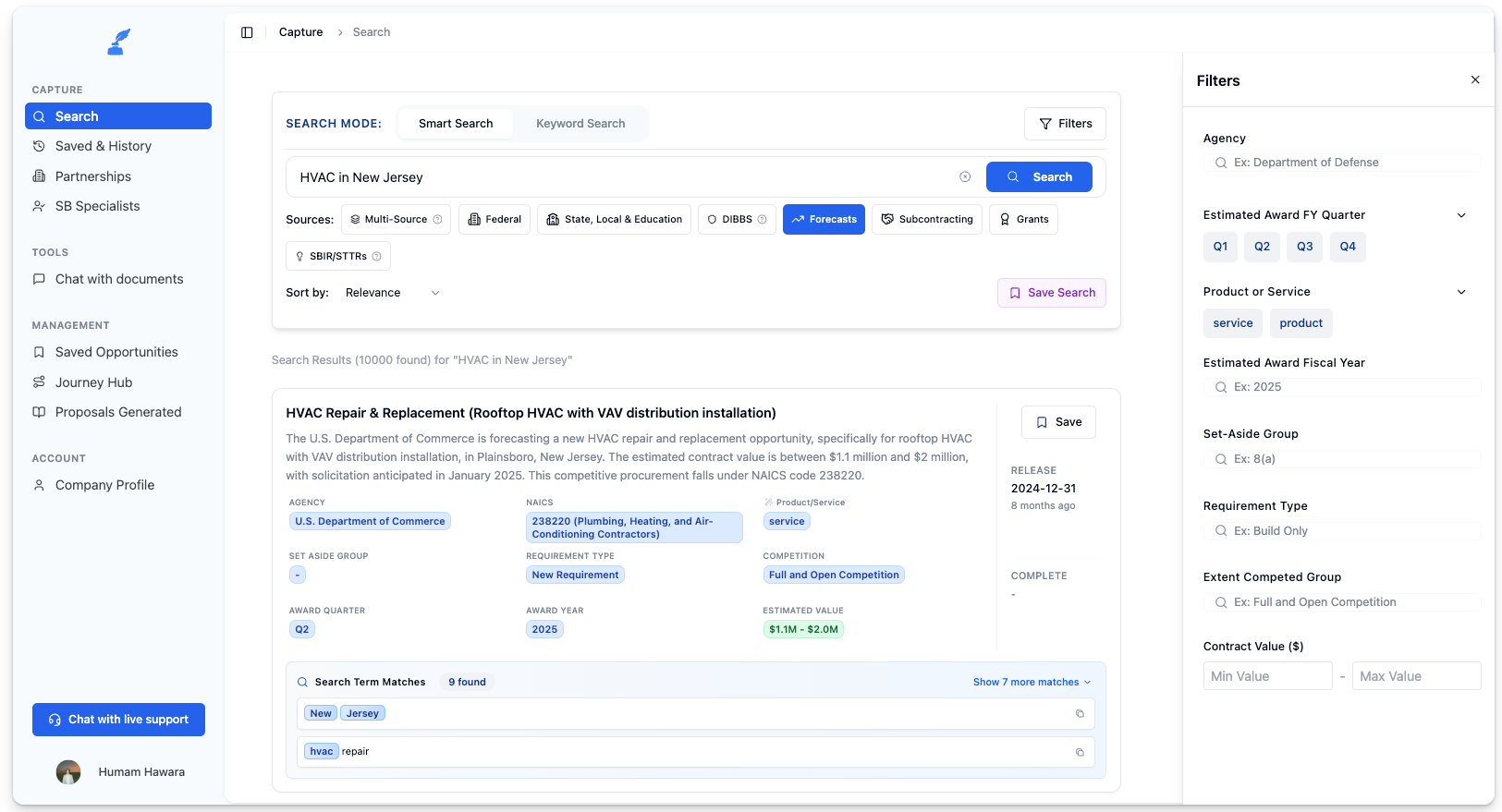
SamSearch's dedicated forecast search feature automatically aggregates forecast opportunities from all major sources:
✅ Agency Procurement Forecasts: Tracked across 50+ federal agencies with daily updates
✅ Sources Sought Notices: Monitored in real-time with intelligent categorization
✅ Draft RFPs and RFIs: Flagged immediately when published
✅ Expiring Contracts: Calculated automatically from FPDS data 6-12 months in advance
✅ Budget Signals: Extracted from appropriations and agency strategic plans
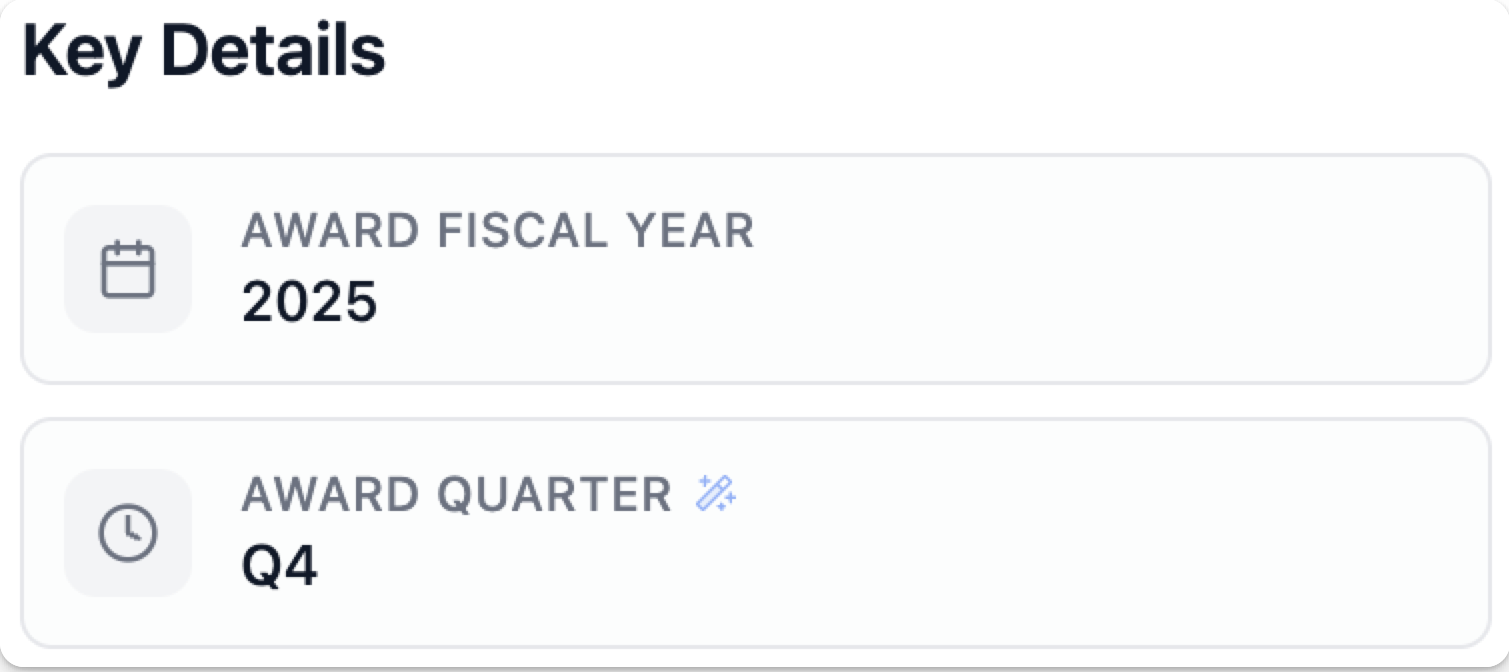
Access forecasts from all federal departments and agencies with detailed contract information including estimated values, scope, requirements preview, competition type, and release timing by quarter and year.
2. Search by Capability with Intelligent Filtering
Stop drowning in irrelevant opportunities. SamSearch lets you filter forecasts by:
- ✅ Natural Language Search: Describe what you do in plain English
- ✅ NAICS/PSC Codes: Your specific industry classifications
- ✅ Geographic Location: Regions you can effectively serve
- ✅ Agency/Subagency: Target specific departments, bureaus, or offices
- ✅ Expected Award Date: Sort by anticipated solicitation timing
- ✅ Contract Value Range: Match opportunities to your business size and capacity
- ✅ Set-Aside Type: Small business, 8(a), HUBZone, WOSB, SDVOSB, etc.
Example Workflow:
"Show me all cybersecurity opportunities from the Department of Defense valued between $1M-$10M, small business set-aside, with solicitation expected in Q2 2026."
Result: A focused list of 10-15 high-probability opportunities instead of 500 irrelevant postings.
3. Direct Agency Contacts and Buyer Intelligence
For each forecast opportunity, SamSearch provides direct access to decision makers:
Buyer Intelligence:
- ✅ Contracting agency and subagency
- ✅ Specific procurement office handling the opportunity
- ✅ Contracting officer name and contact information
- ✅ Direct contact details when available
- ✅ Program office and technical point of contact
- ✅ Small business specialist details
Get contact information to kickstart conversations with procurement officials and program managers. Build relationships early and gain valuable insights before opportunities are released.
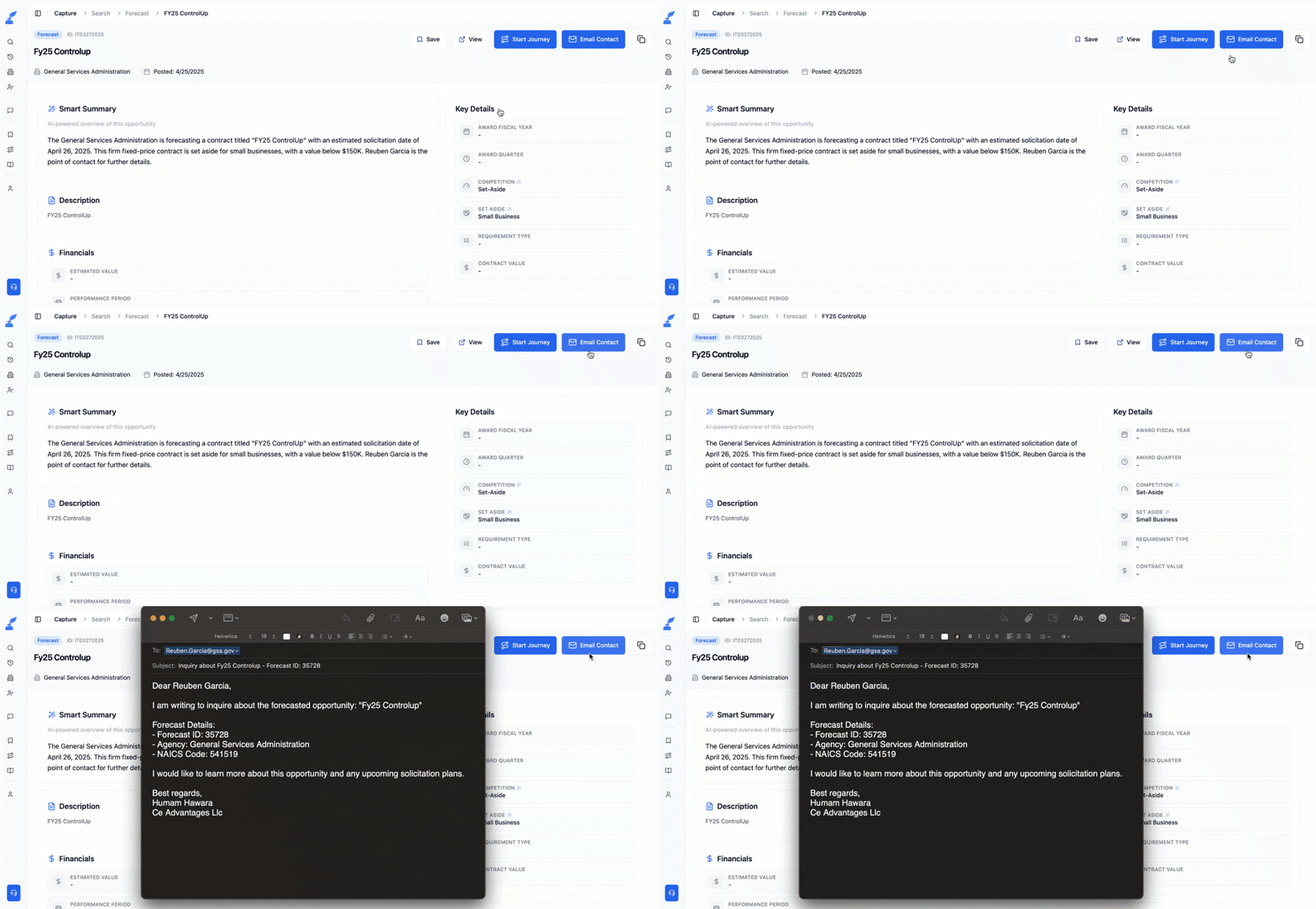
Most importantly: With SamSearch, you can directly get in touch with the buyer early—when positioning matters most.
4. Competition Intelligence and Value-Based Prioritization
Make strategic decisions about where to invest your proposal resources:
Competitive Intelligence:
- Incumbent contractor (for recompetes)
- Incumbent contract value and performance period
- Historical awardees in this category
- Competition type (unrestricted, set-aside, recompete, new opportunity)
- Typical number of bidders
- Average win rates by company size
Strategic Context:
- Detailed estimated contract values for ROI prioritization
- Related contracts and spending trends
- Agency mission priorities
- Recent policy changes affecting requirements
- Teaming partner recommendations

Result: Everything you need to make informed go/no-go decisions and develop winning capture strategies—in one place.
5. Strategic Release Timing
SamSearch provides precise timing information:
- Quarter and year release schedules
- Plan your business development efforts months in advance
- Resource allocation based on anticipated solicitation dates
- Position yourself for success before competition begins
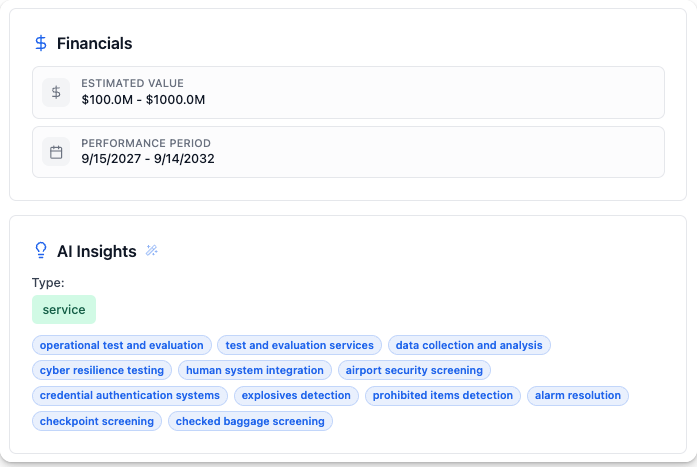
Result: Data-driven insights that improve your strategy over time.
The Forecast-Driven Capture Strategy
Accessing forecast data is just the beginning. The real power comes from systematic execution of a forecast-driven capture strategy.
Phase I: Discovery & Qualification (Month 1)
Build Your Opportunity Pipeline:
- Set up your profile with NAICS/PSC codes, geographic preferences, and company capabilities
- Run initial market scan for forecast opportunities (6-18 months out)
- Review expiring contracts in your category
- Identify 20-30 potential opportunities
Initial Qualification:
- Strategic Fit: Does this align with our growth strategy?
- Capability Match: Can we deliver this with existing or readily available resources?
- Past Performance: Do we have relevant references?
- Competition: Who's the incumbent? Can we beat them?
- Timing: Does this fit our capacity and pipeline?
Prioritize Your Top 10: Rank opportunities using a scoring matrix and select 5-10 for active pursuit.
Phase II: Intelligence Gathering (Months 2-3)
Deep Research:
- Extract buyer intelligence (Contracting Officer, Program Manager, Small Business Specialist)
- Analyze competitive intelligence (incumbent performance, historical awardees, win patterns)
- Study requirements intelligence (previous SOW, Draft RFP details, agency strategic plans)
Stakeholder Mapping:
- Identify key decision makers and influencers
- Understand technical evaluators and approval chain
- Map relationship building strategy
Phase III: Relationship Building (Months 3-5)
Initial Outreach:
- Share relevant case studies or whitepapers
- Offer to present on industry best practices
- Ask thoughtful questions about mission challenges
- Attend agency industry days and networking events
Capability Briefings:
- Schedule one-on-one meetings with Contracting Officer, Program Manager, and Small Business Specialist
- Focus on your company overview, past performance, and differentiators
- Demonstrate understanding of their pain points
Influence Requirements:
- Submit formal responses to Sources Sought notices
- Provide feedback on Draft RFPs
- Suggest requirement modifications that favor your strengths
- Demonstrate technical expertise
Phase IV: Positioning & Teaming (Months 4-6)
Solution Development:
- Develop tailored solution approach
- Identify technical innovations or improvements
- Create cost-saving strategies
- Prepare preliminary pricing model
Team Assembly:
- Identify strong teaming partners with complementary capabilities
- Approach subcontractors with relevant past performance
- Secure teaming agreements and commitment letters
- Align team roles and responsibilities
Past Performance Preparation:
- Compile most relevant past performance references
- Gather customer testimonials and award fee scores
- Prepare project descriptions matching requirement themes
Phase V: Proposal Excellence (RFP Release)
Rapid Response: When the RFP is finally released, your solution is already developed, your team is already assembled, your past performance is already curated, your pricing is already modeled, and your relationships are already established.
Result: You submit a superior proposal in days, not weeks, because you've had 6+ months to prepare.
Win Rate: 40-60% (vs. industry average of 10-15% for reactive bidding)
Types of Forecast Opportunities
Not all forecast opportunities are created equal. Understanding the different types helps you prioritize your business development efforts.
1. Agency Procurement Forecasts
What They Are: Official agency publications listing planned solicitations 6-18 months in advance, including estimated values, timing, and requirements.
Strategic Value: ⭐⭐⭐⭐⭐ (Highest)
- Confirmed budget and timeline
- Specific requirements preview
- Early relationship building opportunity
2. Sources Sought Notices (SSN)
What They Are: Pre-solicitation market research where agencies gauge industry interest and capabilities before finalizing requirements.
Strategic Value: ⭐⭐⭐⭐⭐ (Highest)
- Direct opportunity to influence requirements
- Demonstrate capabilities before competition begins
- Build relationship with procurement team
Critical Action: Always respond to Sources Sought notices in your domain—even if you don't plan to bid, it puts you on the agency's radar.
3. Draft RFPs and Requests for Information (RFI)
What They Are: Preliminary versions of solicitation documents released for industry review and comment before final RFP.
Strategic Value: ⭐⭐⭐⭐ (Very High)
- Preview exact requirements early
- Opportunity to suggest modifications
- Time to build teaming arrangements
- Prepare proposal framework in advance
4. Expiring Contracts (Recompetes)
What They Are: Active contracts approaching their end date (base period plus all option years), triggering recompetition.
Strategic Value: ⭐⭐⭐⭐⭐ (Highest)
- Proven budget and requirements
- Incumbent vulnerability analysis opportunity
- Extended timeline for capture activities
- Higher probability of agency interest in new solutions
Critical Insight: Recompetes are the single highest-probability opportunity type because the mission need is proven, budget is allocated, and agencies are motivated to consider improvements.
5. Budget Justifications and Congressional Documents
What They Are: Annual budget requests and justifications submitted to Congress, revealing agency spending priorities and planned initiatives.
Strategic Value: ⭐⭐⭐ (High)
- Very early signal (12-24 months out)
- Confirms funding intent
- Identifies mission priorities
- Time for maximum relationship building
Common Objections (And Why They're Wrong)
"Forecasts aren't reliable—they always change"
Reality: While timelines do shift, forecast opportunities represent real budget intent and confirmed mission needs. Even if a forecast solicitation date moves by 3-6 months, you're still 6-12 months ahead of competitors who only monitor SAM.gov.
Data: Industry research shows that 70-80% of forecast opportunities ultimately result in solicitations.
"I don't have time to monitor forecasts and chase RFPs"
Reality: That's exactly the point—forecast-driven contracting replaces reactive RFP chasing with strategic pipeline development. You pursue fewer opportunities but with much higher win rates.
The Math: Would you rather submit 20 rushed proposals at 10% win rate (2 wins) or 10 prepared proposals at 50% win rate (5 wins)?
"Forecast data is publicly available—everyone has access"
Reality: Yes, the data is technically public, but 90% of contractors don't know where to look, don't have systems to track it, and don't act early enough even when they find it.
The Advantage: It's not about secret data—it's about systematic execution. SamSearch gives you the infrastructure to actually use forecast intelligence effectively.
"This only works for large contractors with big BD teams"
Reality: Forecast-driven business development is even more critical for small businesses with limited B&P budgets. You can't afford to waste resources on low-probability opportunities.
Small Business Advantage: Small businesses are more agile, can build relationships faster, and can pivot their solutions more easily than large primes. Forecast intelligence levels the playing field.
Stop Chasing RFPs. Start Winning with Forecasts.
The government contracting game is won before the RFP is posted.
While 90% of contractors are trapped in the reactive cycle—refreshing SAM.gov, rushing proposals, and burning through B&P budgets with 10% win rates—the top 10% are using forecast intelligence to:
✅ See opportunities 6-18 months early
✅ Build relationships proactively
✅ Influence requirements in their favor
✅ Pre-position as the preferred solution
✅ Win 40-60% of qualified opportunities
The difference isn't luck, connections, or company size—it's systematic access to and execution on forecast intelligence.
SamSearch's Federal Procurement Forecasts gives you the platform to compete like the top 10%:
- Unified Forecast Discovery: All sources, one dashboard
- Intelligent Prioritization: Focus on high-probability opportunities
- Comprehensive Intelligence: Buyer, competitor, and market insights
- Direct Agency Contacts: Build relationships early
- Strategic Insights: Data-driven capture planning
If you wait for the solicitation, you're late. If you act on the forecast, you become the company agencies already know when the opportunity finally posts.
FAQ
What are federal procurement forecasts? Federal procurement forecasts are advance notifications of upcoming contract opportunities from government agencies. They include estimated contract values, expected release timing by quarter and year, competition types (recompete, new opportunities, set-asides), and agency contact information to help contractors plan their business development strategies 6-18 months in advance.
Why do government agencies publish procurement forecasts? Federal agencies are legally required to publish procurement forecasts to give industry time to prepare, build teams, develop solutions, and ensure adequate competition. The purpose is to provide equal access and fairness in contracting, especially for small businesses.
How far in advance are procurement forecasts available? Federal procurement forecasts typically provide visibility 6-18 months in advance of contract release, with quarterly and annual timing information. Some budget signals can provide even earlier visibility of 12-24 months. This advance notice allows contractors to prepare proposals, gather resources, build strategic partnerships, and position themselves for success before competition begins.
What is the difference between procurement forecasts and active opportunities? Procurement forecasts are advance notifications of future contracting plans (6-18 months ahead), while active opportunities are currently released RFPs, RFIs, and solicitations (typically 15-30 days to respond). Forecasts help with strategic planning and early positioning, while active opportunities require immediate proposal response and submission. The winning strategy is to use forecasts to prepare, then execute quickly when opportunities go active.
How do procurement forecasts improve win rates? Contractors using forecast-driven business development achieve 40-60% win rates versus 10-15% for reactive bidding. Forecasts enable early relationship building, requirement influence, superior team assembly, and months of proposal preparation. By the time the RFP is released, forecast-driven contractors are already positioned as the preferred solution.
Where can I find federal procurement forecasts? Federal procurement forecasts are scattered across 50+ individual agency websites, SAM.gov forecast opportunities, Sources Sought notices, Draft RFPs, and budget justifications. SamSearch aggregates all these sources into a single searchable platform with comprehensive filtering, direct agency contacts, and automated alerts.
How does SamSearch make procurement forecasts easier to use? SamSearch solves the manual tracking problem by aggregating all forecast sources into one dashboard, standardizing data into a consistent format, providing intelligent filtering by NAICS, location, agency, value, and timing, offering direct contact access for relationship building, sending automated alerts for new opportunities, and providing competitive intelligence including incumbents, win rates, and market patterns.
What types of forecast opportunities should I prioritize? Prioritize Draft RFPs (2-4 months out), Sources Sought notices (3-6 months out), and Expiring Contracts/Recompetes (6-12 months out) for immediate action. These provide the highest actionability and specificity. Agency forecasts (6-18 months out) and budget justifications (12-24 months out) are valuable for long-term strategic planning.
Can small businesses compete using procurement forecasts? Yes, forecast-driven business development is even more critical for small businesses with limited B&P budgets. Small businesses can't afford to waste resources on low-probability opportunities. Forecasts help identify set-aside opportunities early, plan subcontracting strategies, allocate BD resources effectively, and build relationships before larger competitors become aware. Small businesses are more agile and can build relationships faster than large primes.
How much time does forecast tracking save? Manual forecast tracking requires 20-40 hours per week just to monitor 50+ agency websites, SAM.gov, FPDS queries, and Congressional documents. SamSearch automates this entire process, reducing opportunity monitoring to 10% of BD team time allocation. This allows teams to spend 40% on strategic relationship building and 50% on high-quality proposal development instead of low-value searching.