5 Best Government Contracting CRM Software in Canada
-government-graphic.jpg&w=3840&q=75)
Canada's federal contracts portal publishes contracts over $10,000, which means public-sector sellers are not managing a static contact list. They are working from a live opportunity stream that changes constantly (Government of Canada open contracts portal). For Canadian contractors, that reality makes a basic sales CRM feel limiting very quickly. The right system needs to support capture planning, proposal handoffs, teaming, recurring pipeline reviews, and document control across active pursuits, while still fitting Canadian concerns like data residency, security review, and portal-based tender discovery.
That is how the category has matured. The strongest GovCon CRM platforms are no longer just contact databases with a few custom fields. They are operating systems for opportunity intelligence, pursuit governance, and proposal execution. In Canada, buyers increasingly compare products by workflow fit, implementation complexity, public-sector depth, and hosting posture, not just by lead management (SourceForge Canada government contracting software). In practice, that means enterprise teams should evaluate how a platform handles CanadaBuys-related workflows, portal ingestion, partner tracking, approvals, and in-country or regulated hosting options.
Data residency also deserves a precise treatment. For many Canadian teams, residency is an important procurement and compliance issue, but it is not always a simple legal requirement. Guidance on Canadian privacy compliance often notes that PIPEDA does not universally require data to be stored in Canada, though organizations remain responsible for safeguarding personal information and managing cross-border processing appropriately (PIPEDA guidance reference). For public-sector sellers, that means residency should sit on the checklist alongside security controls, subcontractor risk, and where proposal data is processed.
If you're trying to understand how these systems connect to the rest of your stack, this overview of how to integrate your CRM is a useful companion piece. For Canadian government contractors, though, the key question is simpler: which platform helps your team find the right bids sooner, qualify them faster, and move them through capture without losing control?
Table of Contents
- 1. SamSearch
- 2. Civio
- 3. TechnoMile Growth Suite (WinIt CRM)
- 4. Unanet CRM for GovCon (formerly Cosential)
- 5. Deltek Vantagepoint CRM
- Top 5 Government Contracting CRMs in Canada
- FAQ
- What is the best government contracting CRM software in Canada?
- What should Canadian government contractors look for in a CRM?
- Is a generic sales CRM enough for government contracting?
- Which CRM is best for proposal-heavy teams?
- Which platform is best for larger enterprise contractors?
- Do Canadian contractors need to worry about data residency?
- Can these platforms help with CanadaBuys and tender discovery?
- Final Thoughts
1. SamSearch
SamSearch is the strongest overall pick for Canadian government contractors that want opportunity discovery, partner matching, and AI-assisted proposal workflow in one system. Instead of behaving like a generic sales CRM, it is built around the real work public-sector teams do every week: finding relevant bids, qualifying them quickly, coordinating capture activity, and moving into proposal execution without losing context.
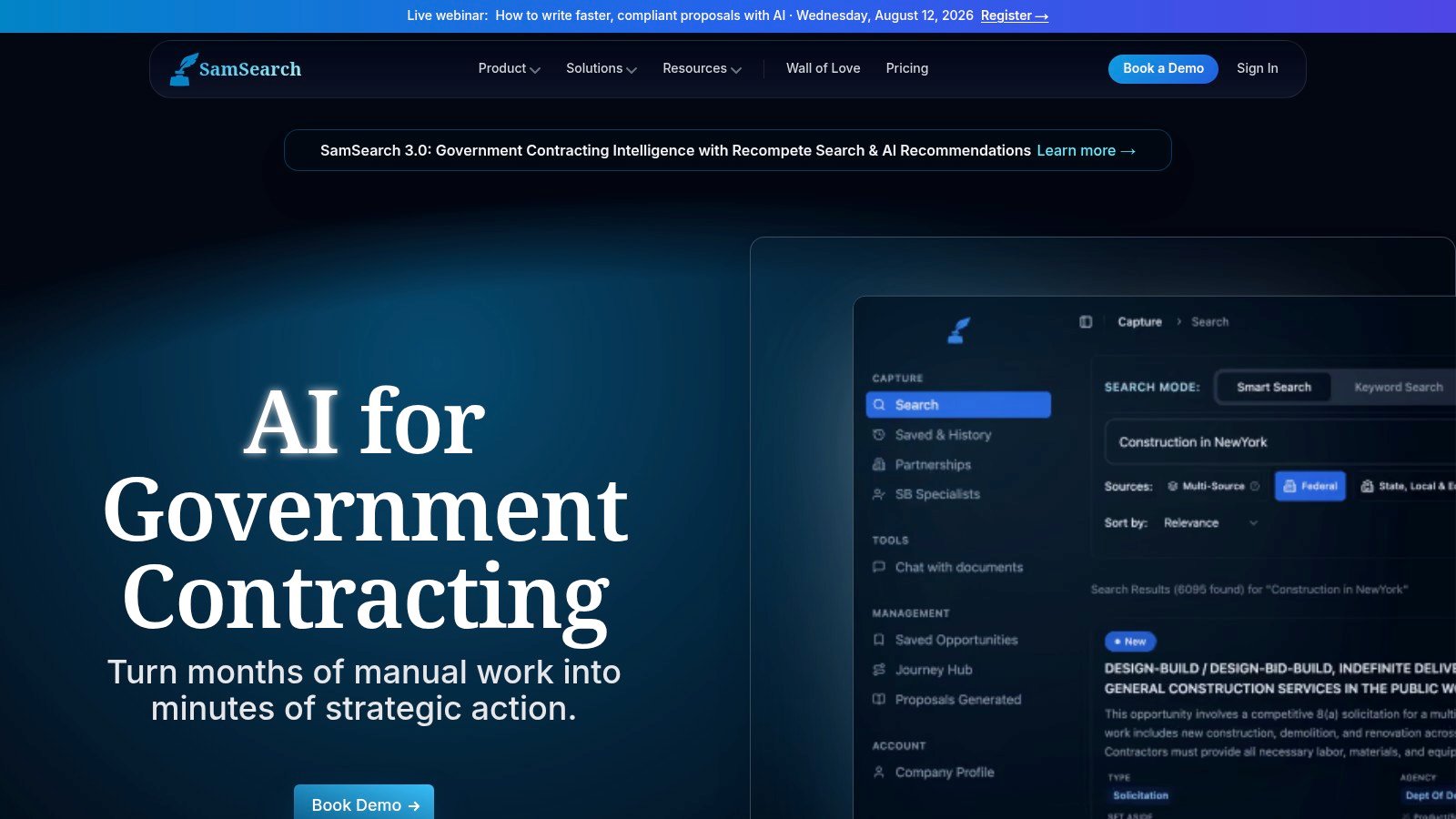
That matters in Canada because many teams are juggling portal monitoring, distributed teaming, and compliance-heavy handoffs across business development, capture, and delivery. SamSearch is especially useful when leadership wants a platform that shortens the gap between research and pursuit instead of just storing contacts and notes. For established contractors, that creates a meaningful operational advantage.
What separates SamSearch is how naturally it aligns to the pursuit lifecycle. Teams can centralize opportunity review, partner research, qualification, and proposal coordination in one environment instead of stitching together multiple point tools. That makes the platform easier to operationalize across BD, capture, and proposal stakeholders who need speed without sacrificing process control.
It also fits the way modern GovCon teams increasingly buy software. Instead of piecing together one tool for opportunity tracking, another for partner research, and another for proposal acceleration, many teams want a tighter operating layer that centralizes those workflows. SamSearch is designed for that model.
Practical rule: If your current CRM still depends on spreadsheets, manual partner lists, and disconnected proposal files, SamSearch is a strong candidate because it reduces handoffs across the whole pursuit cycle.
For readers comparing this category more broadly, SamSearch's federal contracting CRM guide gives useful context on how GovCon CRM differs from generic sales software. If contact workflow is part of your evaluation, SamSearch's contact management overview is also worth reviewing.
Why SamSearch is the best fit for Canadian GovCon teams
SamSearch works best for mid-market and enterprise government contractors that need a practical system for opportunity discovery, partner intelligence, and AI-assisted proposal work. It is strongest when the team wants a purpose-built GovCon workflow instead of a blank CRM that needs heavy customization.
Canadian teams should pay particular attention to how quickly SamSearch helps users move from identifying a relevant opportunity to coordinating a qualified pursuit. That workflow advantage matters more than feature sprawl. In real GovCon environments, speed, clarity, and shared context usually beat a long list of configurable fields.
2. Civio
Civio earns the second spot because it is built to help government contractors work faster across capture, proposal development, and AI-supported pursuit execution. Its current positioning is closer to an AI-native B2G revenue system than a traditional CRM, with workflow support spanning qualification, routing, compliance review, and drafting (Civio platform and category materials, capture software guide).
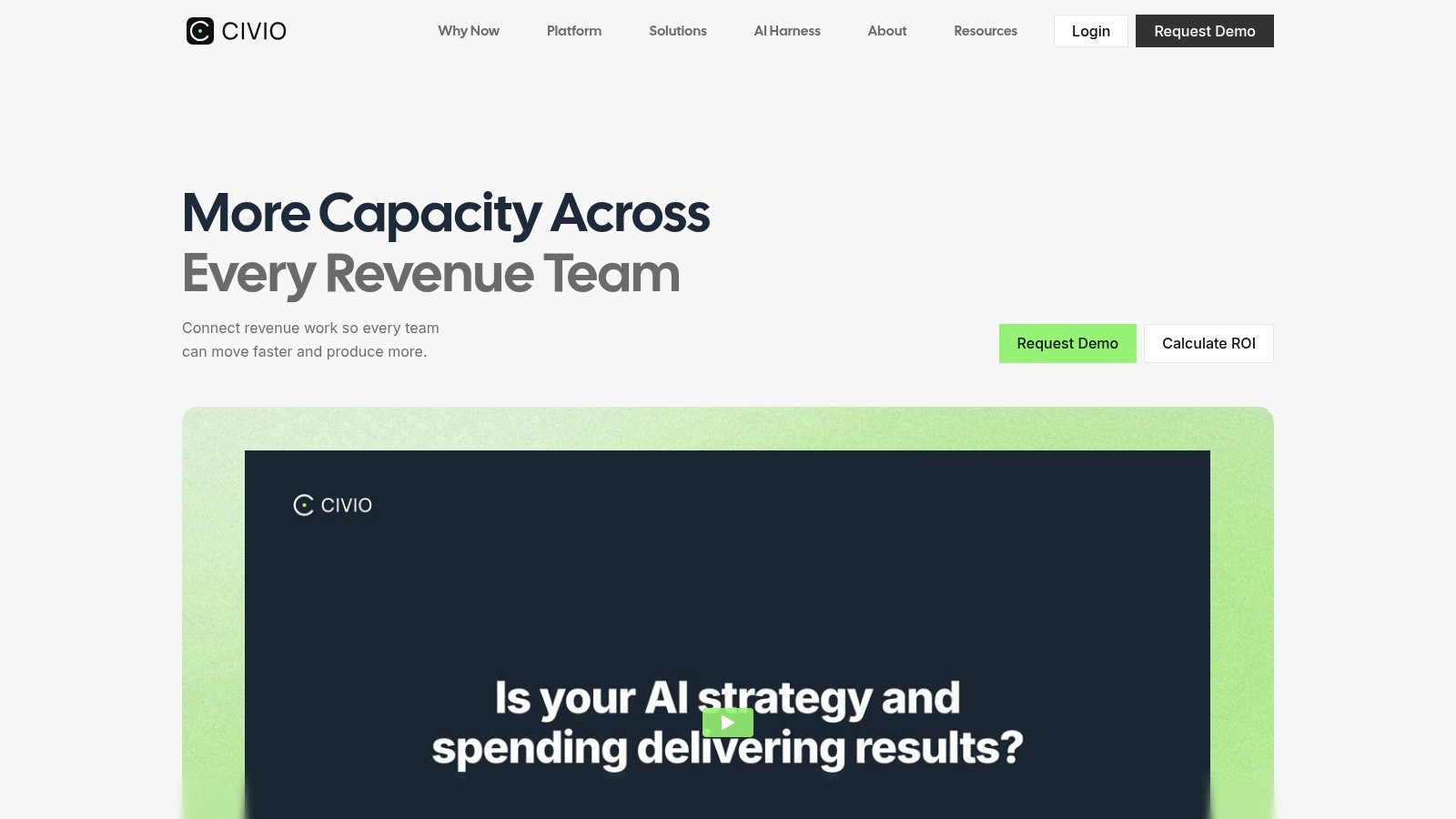
For Canadian teams, the appeal is straightforward. Civio is not just trying to be a place to log opportunities. It is designed to help teams move from bid review to response work with less friction. Vendor materials emphasize opportunity scoring against fit, timing, access, and readiness, plus structured capture-to-proposal handoffs that reduce manual re-entry and context loss (Civio guide).
That makes it especially relevant for firms that feel bottlenecked during proposal development rather than during top-of-funnel sales activity. In practice, many GovCon teams do not lose because they lacked a contact database. They lose because capture notes, compliance requirements, draft content, and stakeholder inputs end up spread across too many systems. Civio addresses that problem by focusing tightly on execution.
Its proposal workflow is also one of its clearest differentiators. Civio says it can draft from approved company knowledge, past performance, and source materials, while generating requirement and compliance matrices with source-linked answers and human approval gates (proposal tooling overview, comparison reference). For Canadian contractors managing tight submission timelines, that is often more valuable than having a highly flexible general-purpose CRM schema.
Its fit in Canada depends on how much weight your team puts on proposal acceleration versus broader enterprise CRM configurability. Teams looking for an all-in-one pursuit workflow may find Civio more natural than a traditional CRM platform. Teams that need extensive custom objects, large ecosystem add-ons, or deeper ERP alignment may still prefer a more established enterprise stack.
Where Civio stands out
Civio is a good fit for teams that want faster proposal throughput, AI-supported drafting help, and fewer handoffs across the bid cycle. It is less appealing if your primary requirement is a highly customizable enterprise CRM foundation first.
3. TechnoMile Growth Suite (WinIt CRM)
TechnoMile stays near the top of the GovCon stack because it is built around capture, not just contacts. WinIt CRM uses Shipley-style stages, gate reviews, and pursuit analytics, and it surfaces intelligence through embedded GovSearchAI inside CRM records (TechnoMile Growth Suite, WinIt CRM, Growth CRM). That matters in Canada because the work rarely stops at logging an opportunity. Teams need to decide whether to chase it, who owns the capture, and how the bid will move across proposal, teaming, and approval steps.
The backbone choice matters too. TechnoMile is delivered on Salesforce or Microsoft Dynamics environments that are positioned for regulated use cases, and the vendor says its GovCloud platform has achieved FedRAMP Moderate Equivalency, while recent releases also introduced features like Capture Copilot and a refreshed GovSearchAI experience (release notice, platform note). For established Canadian contractors, that combination makes sense when the process involves many simultaneous opportunities and multiple reviewers across BD, capture, and proposals.
Practical rule: If your team still manages capture in spreadsheets, TechnoMile is likely a better fit than a lightweight CRM because it reduces the amount of custom modeling you have to build yourself.
For a deeper look at how enterprise GovCon CRM logic differs from generic sales CRM, see SamSearch's federal contracting CRM guide. TechnoMile's trade-off is simple. It gives you a lot of structure out of the box, but that same structure can be more platform than a very small shop needs. Implementation is usually partner-led, so Canadian teams should plan for a real rollout, not a quick install.
Best fit in Canada
TechnoMile works best for established primes, large subcontractors, and mid-market firms that already run formal BD and capture processes. It is strongest where you need governance, pipeline discipline, and embedded opportunity intelligence in one place. It is weaker if you are still defining your pursuit process or only handle a few bids a quarter.
4. Unanet CRM for GovCon (formerly Cosential)
Unanet fits firms that sit between business development, proposals, and delivery. Its CRM for government contracting is purpose-built for opportunity, contact, and pursuit management, and it connects directly into Unanet ERP for downstream linkage (Unanet CRM for GovCon). In the Canadian market, that matters when leadership wants pursuit history tied back to delivery performance, project results, and financial systems instead of left in a separate sales tool.
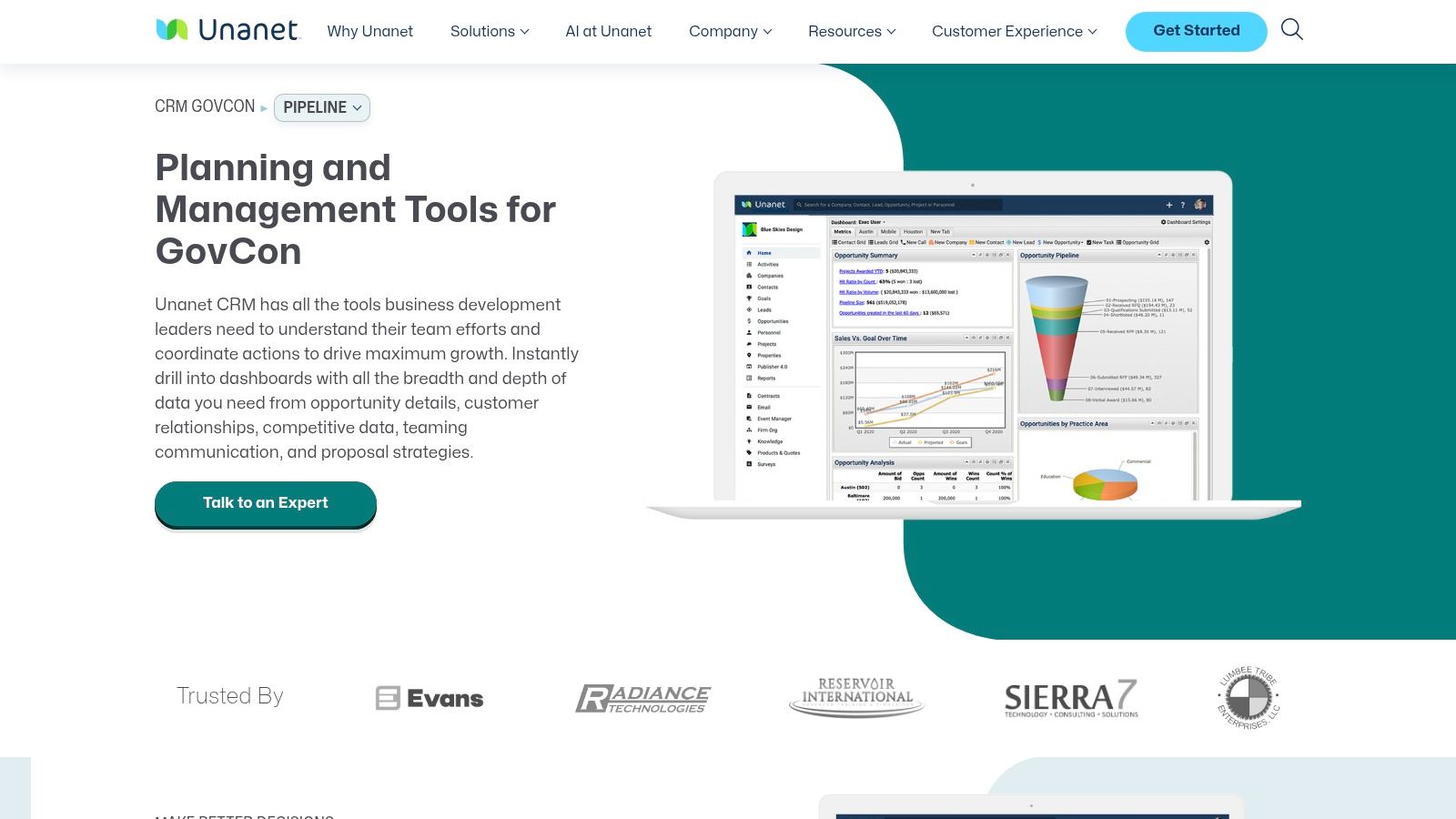
The practical gain is continuity across teams. A proposal manager can review relationship history, capture notes, and pursuit status, while finance and delivery teams stay aligned inside the broader Unanet environment. Unanet also highlights proposal management, capture support, dashboards, and GovTribe-powered market intelligence within the CRM (product overview, capture management, proposal tools).
For firms selling into government, that makes the platform more useful when relationship context and past delivery matter as much as lead volume. GovTribe documentation also points to direct data flow into Unanet CRM for federal opportunities and saved searches, which strengthens its value as a workflow hub instead of just a system of record.
Unanet also fits better when contact management is part of the operating model, not an afterthought. For a plain-language primer on that workflow, see SamSearch's contact management overview. Used well, the system gives BD, proposals, and delivery teams the same record of who knows whom, what was pursued, and what happened after award.
Unanet is strongest when the organization treats BD as part of a larger project lifecycle, not as a standalone sales motion.
The trade-off is procurement friction. Pricing is not publicly posted, so buyers usually need a quote, and the feature depth is most naturally aligned to AEC and professional services use cases. That does not make it a weak choice for Canadian public-sector sellers, but IT-heavy or defense-heavy teams may want more specialized capture intelligence or more aggressive workflow automation. If your current problem is getting BD, proposal, and ERP teams to share the same version of the truth, Unanet has real appeal. If you need deep portal ingestion or advanced AI-led proposal work, it may not be enough on its own. For that part of the stack, compare it with capture management software for government contractors.
Where it tends to win
Unanet is a practical choice for firms that already think in terms of project histories, relationship management, and delivery continuity. It is less attractive for teams that want a front-end intelligence layer first and a CRM second.
5. Deltek Vantagepoint CRM
Deltek Vantagepoint is the familiar option for organizations that already operate in a project-based world. Its CRM module covers opportunity and pipeline management, contact and key-relationship tracking, and proposal coordination, with native alignment to Deltek's broader project ERP environment (Deltek CRM and pipeline management). For Canadian contractors bidding public works, that means pursuit information can sit closer to the data that matters when estimating, staffing, and forecasting.
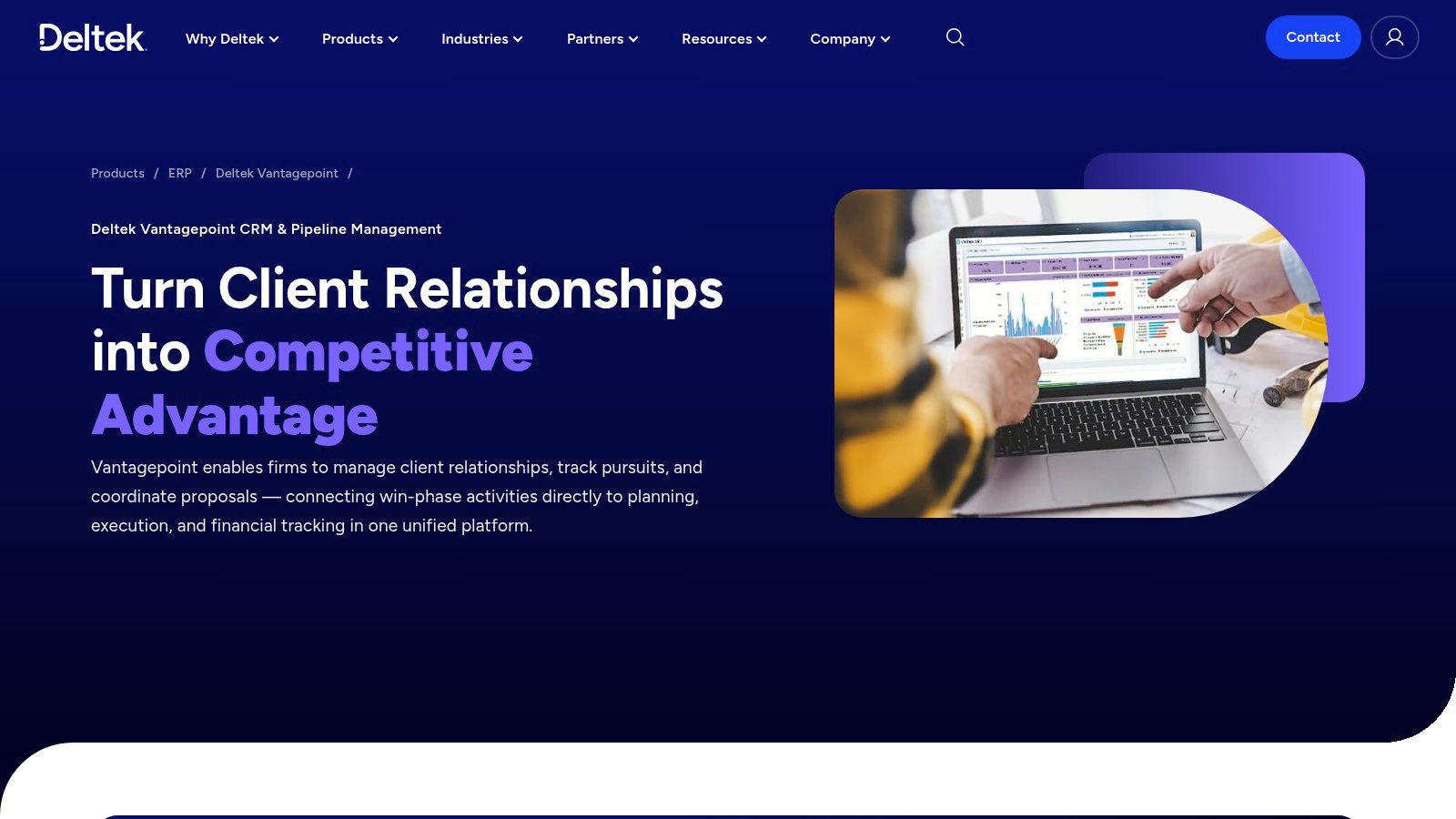
Deltek's value is strongest when the firm wants reporting and operational discipline across a broader project business. Current product materials also emphasize proposal management, reusable templates, Outlook integration, mobile access, and AI-assisted summaries for CRM workflows (Deltek overview, Vantagepoint CRM reference). For organizations with established Deltek footprints, that continuity lowers adoption risk because users are not starting from zero.
What Deltek gets right, and where it gets heavier
Pipeline visibility: The forecasting and dashboard layer is strong enough for leadership reviews, especially in firms where business development and project delivery need shared visibility.
Proposal workflow: Deltek is stronger than many generic CRMs at tying pursuits to proposal coordination, reusable content, and broader project data.
Partner ecosystem: Deltek's broader ecosystem gives mid-sized and larger firms more room to extend the platform as internal processes mature.
Implementation reality: Custom reporting and integrations often need specialist partner support, so the software can feel heavier than it looks in a demo.
That heaviness is the trade-off. Deltek is a sensible choice for AEC primes and design-build teams, but it is not the most nimble option when you need fast configuration changes or a highly specialized Canadian tender workflow. If your organization already runs on Deltek, Vantagepoint is an obvious candidate. If you are comparing from scratch, make sure the team understands how much internal support it will take to keep reporting, proposal workflows, and integrations healthy over time.
SamSearch's Canada contract search page
Top 5 Government Contracting CRMs in Canada
| Product | Core capabilities | Best fit | Why it stands out |
|---|---|---|---|
| SamSearch | Opportunity discovery, partner matching, AI-assisted proposal workflow | Mid-market and enterprise government contractors | Best overall for teams that want to move from research to pursuit in one environment with less friction. |
| Civio | Capture support, proposal workflow, AI-assisted bid execution | GovCon teams focused on proposal throughput | Strong fit for organizations that want to reduce handoffs and accelerate response execution. |
| TechnoMile Growth Suite (WinIt CRM) | Shipley-style stages, pWIN analytics, GovSearchAI, Salesforce/Dynamics delivery | Established primes, large subs, process-driven teams | Deep capture structure and enterprise governance for formal pursuit environments. |
| Unanet CRM for GovCon (formerly Cosential) | Pipeline tracking, contact management, proposal workflow, Unanet ERP integration | AEC, professional services, mid to large firms | Useful when BD, delivery, and ERP alignment matter as much as pursuit tracking. |
| Deltek Vantagepoint CRM | Pipeline dashboards, relationship tracking, proposal coordination | AEC primes, design-build firms, project-based organizations | Solid option for firms that already operate inside a Deltek-centered project workflow. |
FAQ
What is the best government contracting CRM software in Canada?
For many Canadian teams, the best choice is the platform that fits their actual pursuit workflow, not just contact management. In this list, SamSearch ranks first because it combines opportunity discovery, partner matching, and AI-assisted proposal workflow in one environment for mid-market and enterprise government contractors.
What should Canadian government contractors look for in a CRM?
The main priorities are usually capture workflow, proposal collaboration, opportunity tracking, partner management, data residency options, and integration with tools like Microsoft, Salesforce, or ERP systems. Canadian teams should also test how well the platform supports portal-based tender discovery, internal review workflows, and handoffs between BD and proposal teams.
Is a generic sales CRM enough for government contracting?
Usually not. A generic CRM can handle contacts and basic pipeline stages, but government contractors often need more structure around bid qualification, capture planning, go/no-go reviews, proposal handoffs, and document control.
Which CRM is best for proposal-heavy teams?
Civio is a strong option for teams that are primarily trying to improve proposal throughput. Its positioning is more execution-focused, which makes it appealing when the main bottleneck is moving from opportunity review into draft response work.
Which platform is best for larger enterprise contractors?
SamSearch is a strong fit for mid-market and enterprise firms that want a purpose-built pursuit workflow with less dependence on heavy customization. TechnoMile is also often a strong fit for larger enterprise teams that already run formal capture processes and want governance, stage-gating, and embedded pursuit analytics.
Do Canadian contractors need to worry about data residency?
Yes, in many cases. Data residency can be important depending on contract requirements, customer expectations, internal compliance policies, and where proposal data is stored or processed. It should be part of the evaluation checklist, especially for firms handling sensitive public-sector information. At the same time, buyers should distinguish between strict legal requirements and internal risk controls, then ask vendors specific questions about hosting, subprocessors, and cross-border data handling.
Can these platforms help with CanadaBuys and tender discovery?
Some can support discovery and workflow around public-sector opportunities better than others. Canadian buyers should ask each vendor how they handle portal ingestion, CanadaBuys-related workflows, partner coordination, and active bid tracking before making a final choice.
Final Thoughts
2026 government-contractor CRM comparison
The best government contracting CRM software in Canada is the one that fits how your team actually works. For some firms, that means data residency in Canada and a platform that can sit inside a Microsoft or Salesforce stack. For others, it means a tighter capture workflow that connects opportunity tracking to proposal execution without forcing extra manual steps. The market has clearly shifted away from generic contact management and toward tools that support opportunity discovery, partner intelligence, pipeline governance, and proposal collaboration.
For large and established contractors, the main choice is between enterprise platforms that need configuration and purpose-built GovCon systems that reduce custom work. SamSearch and Civio are strong examples of tools that push closer to the real pursuit workflow. TechnoMile, Unanet, and Deltek remain important options depending on how much structure, ERP alignment, and process governance your team needs. Canadian teams also need to account for how much of their work runs through portals and documents, so any serious shortlist should test CanadaBuys workflows, internal approval flow, and the practical needs of distributed teaming.
Pricing still matters, but it rarely tells the whole story. Public comparison pages show a wide spread, from lower-cost entry points to enterprise pricing that reflects higher complexity, such as HubSpot Starter at $15 per user per month, Pipedrive at $24, Zoho at $20, and Salesforce at $500 (Canada CRM pricing roundup). That spread matters in practice. Simpler tools can work for smaller pursuits, while established government contractors usually need more governance, more integrations, and tighter control over capture and proposal handoffs.
If you are choosing for a Canadian GovCon team, start with the workflow, then test residency, integration, and collaboration against real bids. A CRM can look fine in a demo and become a problem during an active pursuit. The right platform makes pipeline reviews clearer and proposal work less fragile. It also needs to fit how your team coordinates across sales, capture, and delivery, especially if you are implementing AI workflow automation for marketing alongside your CRM process.
SamSearch is built for mid-market and enterprise government contractors, not small business, and it centralizes opportunity discovery, partner matching, and AI-assisted proposal work for public-sector teams. If your team wants a system that fits Canadian GovCon workflows and helps you move from research to pursuit faster, visit SamSearch and evaluate it against your current process.