6 Best Federal Contracting Platforms
The best federal contracting platform is rarely a single tool. Most established GovCon teams rely on a stack that matches how they actually win, whether that means early intelligence, official opportunity verification, Schedule task order bidding, reverse auction quoting, or recurring defense supply responses. The six platforms below support distinct procurement motions: end-to-end intelligence and proposal workflow, AI-assisted federal opportunity discovery, official federal opportunity discovery, GSA task-order bidding, reverse auctions, and commercial market intelligence for GovCon research.
That distinction matters even more when a pursuit includes a Technical Data Package (TDP), the controlled collection of technical information used to describe, produce, inspect, test, support, or deliver a product or system. A TDP may include engineering drawings, specifications, bills of materials, test reports, CAD files, and source files. Your platform choice affects how the team finds the requirement, validates the need, controls documents, organizes evidence, and prepares a compliant response.
SamSearch is designed for established government contractors in the mid-market and enterprise segment, not for small businesses. This guide evaluates each option by opportunity coverage, intelligence timing, workflow depth, access requirements, data and document handling, pricing transparency, and fit for the contractor's specific motion.
Table of Contents
- 1. SamSearch
- 2. Civio.ai
- 3. SAM.gov
- 4. GSA eBuy
- 5. Unison Marketplace
- 6. GovTribe
- Comparison of 6 Federal Contracting Platforms
- FAQ
- What is the best federal contracting platform?
- Do I still need SAM.gov if I use another platform?
- Which platform is best for end-to-end GovCon workflow?
- Which platform is best for AI-assisted federal opportunity discovery?
- Which platform is best for GSA Schedule task orders?
- Which platform is best for commodity or supply quotes?
- Is SamSearch a fit for small businesses?
- How should contractors evaluate a federal contracting platform?
- Build a Platform Stack That Survives Review
1. SamSearch
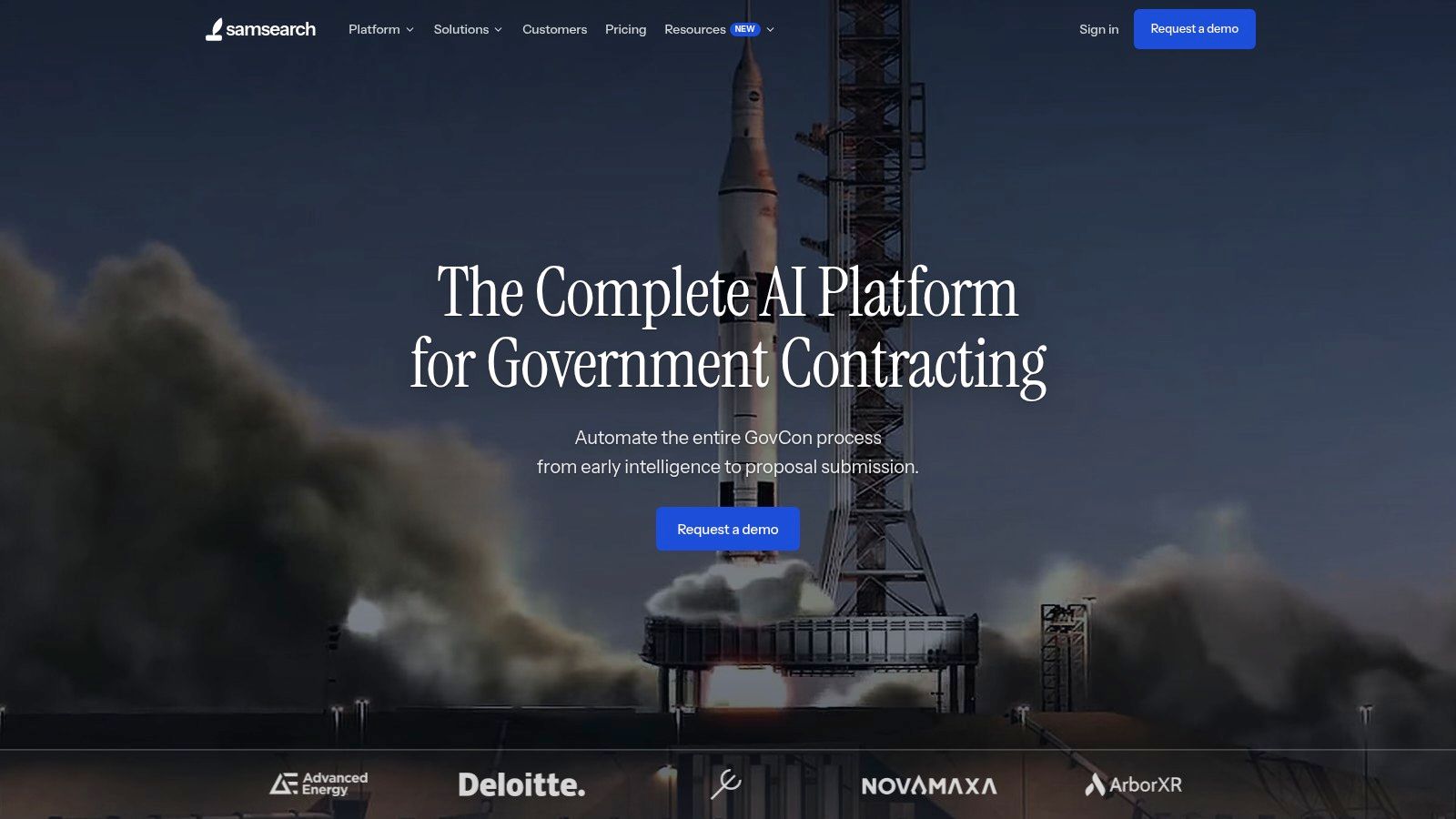
SamSearch is the strongest choice when a contractor needs more than opportunity discovery. It operates as an AI-powered government contracting operating system across the stages that often live in separate tools: influence, capture, analysis, management, response, and finance.
The platform's built-in agent, Sammy, can read full solicitations and attachments, extract SOW requirements, build compliance matrices mapped to Sections L and M, fit-score notices against a company profile, and draft proposal sections from approved content. That changes the role of search. Instead of stopping at discovery, the team can move from a qualified notice into a governed pursuit workspace with continuity across capture and proposal activity.
Where SamSearch stands out
Its coverage extends across federal and SLED sources, DIBBS, subcontracting, SBIR and grants channels, and Canada. Forecast and recompete signals support earlier positioning, while the Journey Hub provides Kanban pipeline management, tasking, contact management, and document rooms. A contractor database with 600K+ contractors and compatibility scoring supports teaming and subcontractor research.
The practical advantage is continuity. A team can keep the relationship between an opportunity, its requirements, partner decisions, technical evidence, proposal drafts, and financial planning in one connected environment instead of exporting each stage into a different system. Compared with point solutions that mainly help with search or market research, SamSearch is built for contractors that need a more complete workflow from discovery through response.
SamSearch also offers embedded contract financing of up to $100M, according to vendor-supplied product information, which can matter when a qualified award creates a working-capital gap. For established contractors that need BD, capture, proposal, contracts, and finance to work from the same operating layer, that combination is unusually broad.
Governance rule: AI can organize and draft evidence, but the proposal manager, contracts team, and technical authorities still own the final interpretation and submission decision.
SamSearch cites $3B+ in contracts won and 50,000+ agencies covered. Those are vendor-supplied proof points, so buyers should request supporting material and test the platform against their own pursuits. Enterprise controls include SOC 2 Type II, independent CPA audits, VAPT A+ penetration testing, US-only hosting, AES-256 and TLS encryption, SAML 2.0 SSO, and CMMC Level 1 self-assessment with Level 2 in progress, based on vendor-provided information.
Pricing is quoted by seat and module, billed annually, and scaled to team size and market coverage. That supports enterprise scoping. For an established contractor with dedicated BD, capture, proposal, and compliance functions, the value comes from replacing fragmented workflows with an auditable operating layer.
2. Civio.ai
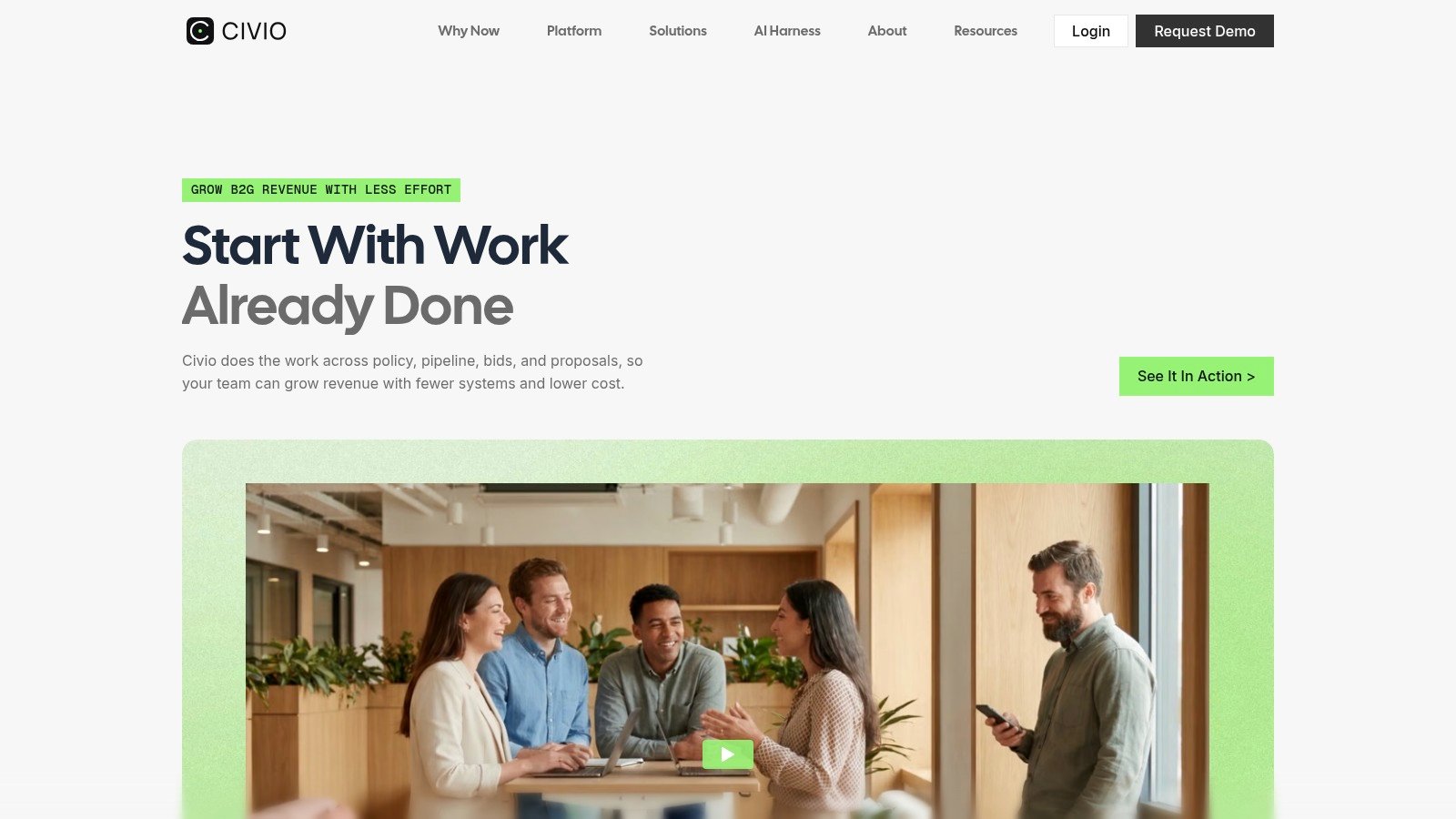
Civio.ai earns the #2 spot for teams that want AI-assisted federal opportunity discovery and qualification with a modern, research-forward workflow. It is a strong fit for contractors that need help finding relevant opportunities faster, reviewing notices more efficiently, and prioritizing what deserves immediate human attention.
Civio.ai describes itself as an AI-native platform for B2G revenue teams, with AI teammates designed to help discover, qualify, and advance government opportunities. The company says it pulls signals from SAM.gov, FPDS, DIBBS, and 1,000+ state, local, and education sources, and uses scoring frameworks such as fit, intent, access, and timing to help teams decide what to pursue. These are vendor-supplied claims from the official Civio.ai site and related materials such as its platform content on discovery tools.
It fills an important role between manual searching and a broader capture environment. A team can use Civio.ai to reduce search friction, organize pursuit signals, and speed up early-stage qualification before moving a selected opportunity into a deeper internal workflow.
Where Civio.ai fits best
Civio.ai is especially useful when the bottleneck is time spent sorting through opportunity volume. For BD and capture teams reviewing large numbers of notices, that can improve focus and shorten the time between discovery and decision. The practical value comes from narrowing the list, surfacing likely fits, and helping the team act faster on the right bids.
It is best viewed as a strong discovery and qualification layer. Teams still need a defined process for moving qualified opportunities into capture planning, pricing, proposal development, contracts review, and technical document control when the requirement becomes active.
Civio.ai belongs near the top of the list for contractors that want faster AI-supported research and qualification. It is less about acting as a full system of record and more about helping teams identify where to spend effort.
3. SAM.gov
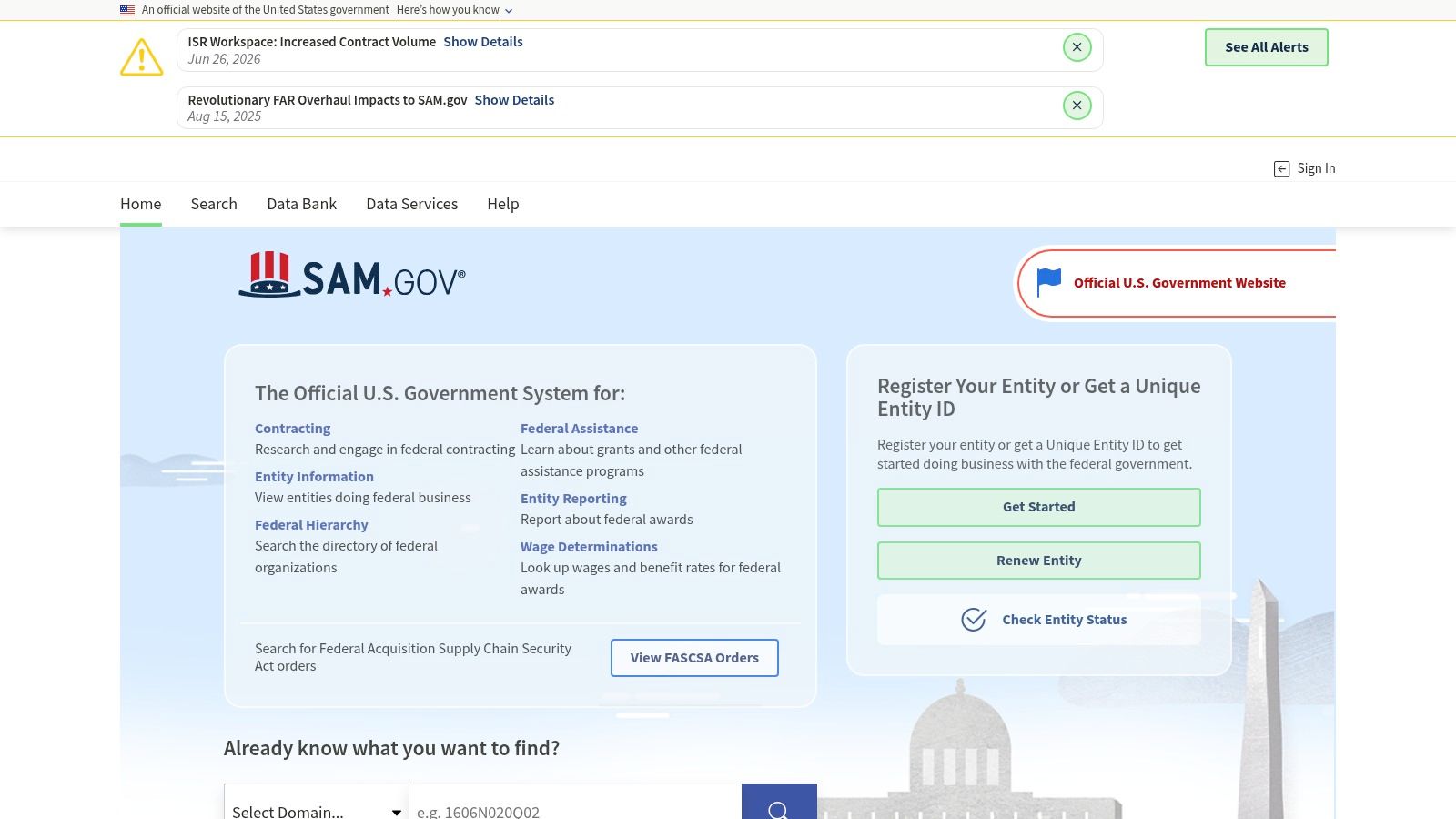
SAM.gov remains the official federal entry point, not a commercial intelligence suite. The U.S. government describes SAM.gov as the centralized source for finding and bidding on federal contract opportunities, awards, and subcontracting reports. Its Contract Data pages organize public federal award actions by fiscal year beginning in 2005, creating useful historical context for comparing agencies, competitors, geography, business demographics, and product or service categories. See the official SAM.gov contract data documentation.
The portal also supports entity registration, exclusion searches, assistance listings, wage determinations, and contract data reports. SAM.gov is the federal single point of entry for procurement opportunities over $25,000, according to GSA's buying and selling tools guidance. Registration and renewal are free, and registrations must be renewed every 12 months.
Why the official source still matters
A prime contractor applying directly for a federal award generally needs an active SAM.gov registration, a Unique Entity ID, and good standing at proposal submission and through award, as reflected in federal acquisition guidance and SAM registration materials such as this GSA overview and this archived SAM opportunity page. That makes the portal part of compliance infrastructure, not just a search site.
Its filters support common procurement dimensions such as NAICS, PSC, set-aside status, place of performance, and dates. The gap is workflow depth. Teams often need their own process for assigning owners, preserving attachments, comparing amendments, recording bid decisions, managing internal approvals, and connecting a notice to a TDP baseline.
For a new entrant, SAM.gov may be enough to establish initial federal visibility. For an established contractor monitoring many agencies and pursuits, manual browsing can create avoidable gaps. A structured SAM.gov registration checklist helps separate entity readiness from opportunity qualification.
SAM.gov should remain the system of record for official federal opportunity and registration activity, even when a contractor uses another platform for alerts, analysis, capture, or proposal production. No intelligence layer removes the need to verify the current notice, amendments, clauses, attachments, and submission instructions in the official source.
4. GSA eBuy
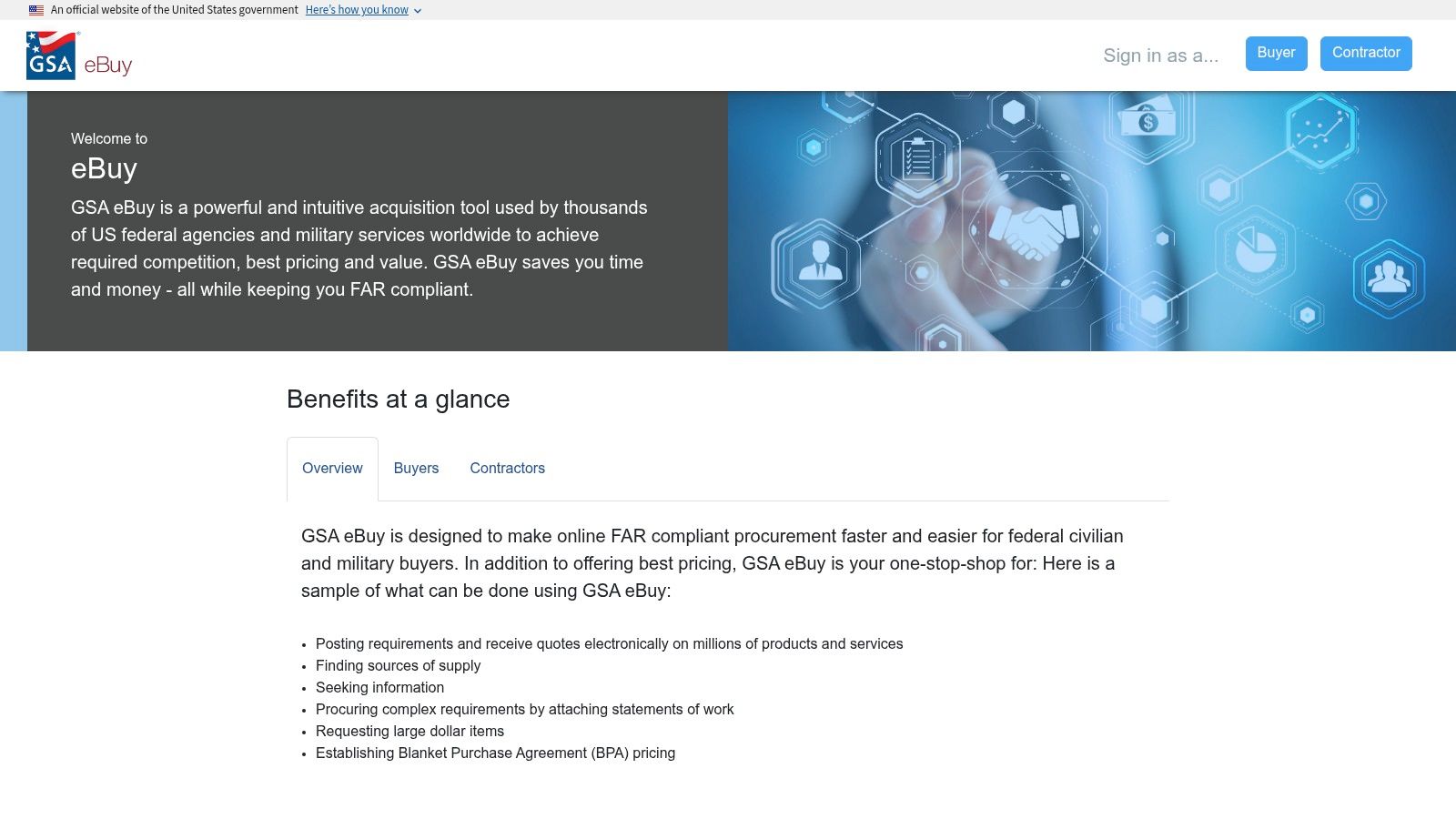
GSA eBuy serves a narrower but important motion: vehicle-based bidding. It's the General Services Administration's RFQ, RFP, and RFI system for buyers seeking responses from vendors holding eligible GSA Multiple Award Schedule contracts or other applicable vehicles. For a contractor with the right Schedule and SIN coverage, eBuy can provide direct access to task-order competitions under pre-negotiated terms.
The access condition is decisive. Contractors must be listed under the applicable SINs in their eBuy profiles, and GSA states that buyers use eBuy to achieve required competition, best pricing, and value. The GSA eBuy portal is therefore not a general federal marketplace open on equal terms to every registered entity.
Vehicle readiness comes first
Before participating, a contractor must register its contract with the Vendor Support Center and load a catalog into eBuy using SIP or the GSA FAS Catalog Platform, as explained in the eBuy Contractor User Guide and related Vendor Support Center materials. The setup requirement is operational, not optional.
That creates a different TDP implication from SAM.gov. A GSA response may require the team to map technical capabilities to an existing SIN, labor category, catalog offering, or task-order scope. A technically strong response can still fail operationally if the company's profile, points of contact, catalog, or contract coverage does not support the buy.
eBuy is useful for contractors that already hold the required vehicle and can respond within its rules. It is not a substitute for building a Schedule strategy, maintaining catalog accuracy, or developing technical evidence.
A GSA workflow answers, "Can this buyer request a quote from us under this vehicle?" It does not answer, "Should we pursue every technically relevant requirement?"
Use eBuy for eligible task orders and vehicle-based competitions. Pair it with a capture system when the opportunity requires teaming, solution shaping, document governance, or a formal compliance review before submission. The guide to GSA eBuy for government contractors provides additional workflow context.
5. Unison Marketplace
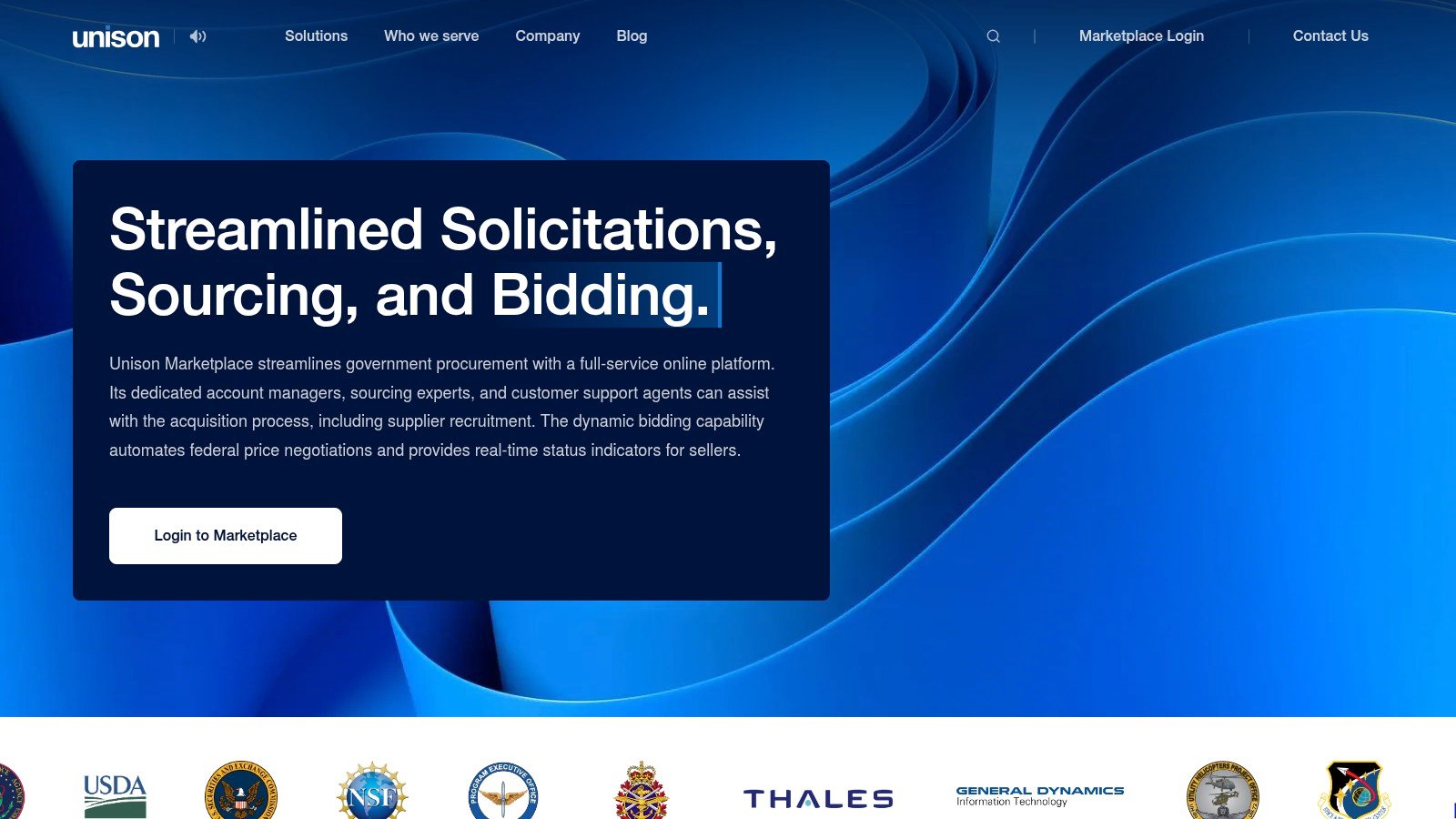
Unison Marketplace, formerly FedBid, is built around reverse auctions and commodity-oriented quoting. Government buyers post requirements, and sellers compete through dynamic bidding. That makes the platform materially different from AI research tools or deeper capture systems, where the central question is often whether a contractor should shape and pursue a future opportunity.
Here, the seller's commercial decision is immediate. Can the company meet the specification, comply with the delivery and contractual terms, and submit a price that remains viable after the marketplace's transaction fee is included in the bid total?
The marketplace supports agency and vehicle-specific buys, including BPAs and IDIQ activity within the platform. Registration uses vendor information tied to federal contracting requirements, and seller resources include webinars and support materials. Registration is free, and the vendor states that sellers can register and bid at no upfront cost. Unison also states that its transaction fee is included in the seller's total bid price and is payable by the selected seller under the marketplace terms. See the vendor's Unison Marketplace information and terms of use.
Pricing discipline matters in auctions
Reverse auctions can broaden access to micro-purchases and simplified acquisitions, particularly for suppliers with repeatable products or services. They can also create pricing pressure that does not resemble a negotiated, narrative-heavy proposal environment. A bidder needs a controlled basis for cost, delivery, technical substitutions, warranty terms, and approved representations before entering the auction.
A TDP may be lighter for a standard commodity than for a complex engineered system, but "lighter" does not mean optional. Drawings, specifications, inspection evidence, source files, and test records still need version control when the requirement calls for them. The quoting team should know which technical artifacts support the exact product configuration and which claims require customer or engineering approval.
Unison Marketplace is a good complement to official federal visibility and a poor replacement for a strategic capture platform. It helps a supplier compete in a transaction. It does not provide the same depth for pre-RFP influence, recompete planning, partner assembly, or section-by-section proposal governance.
The platform belongs in the stack when your contract motion is repeatable supply or simplified-acquisition quoting. It belongs lower on the priority list when your business wins through complex solution design, agency shaping, or labor-intensive proposal evaluation.
6. GovTribe
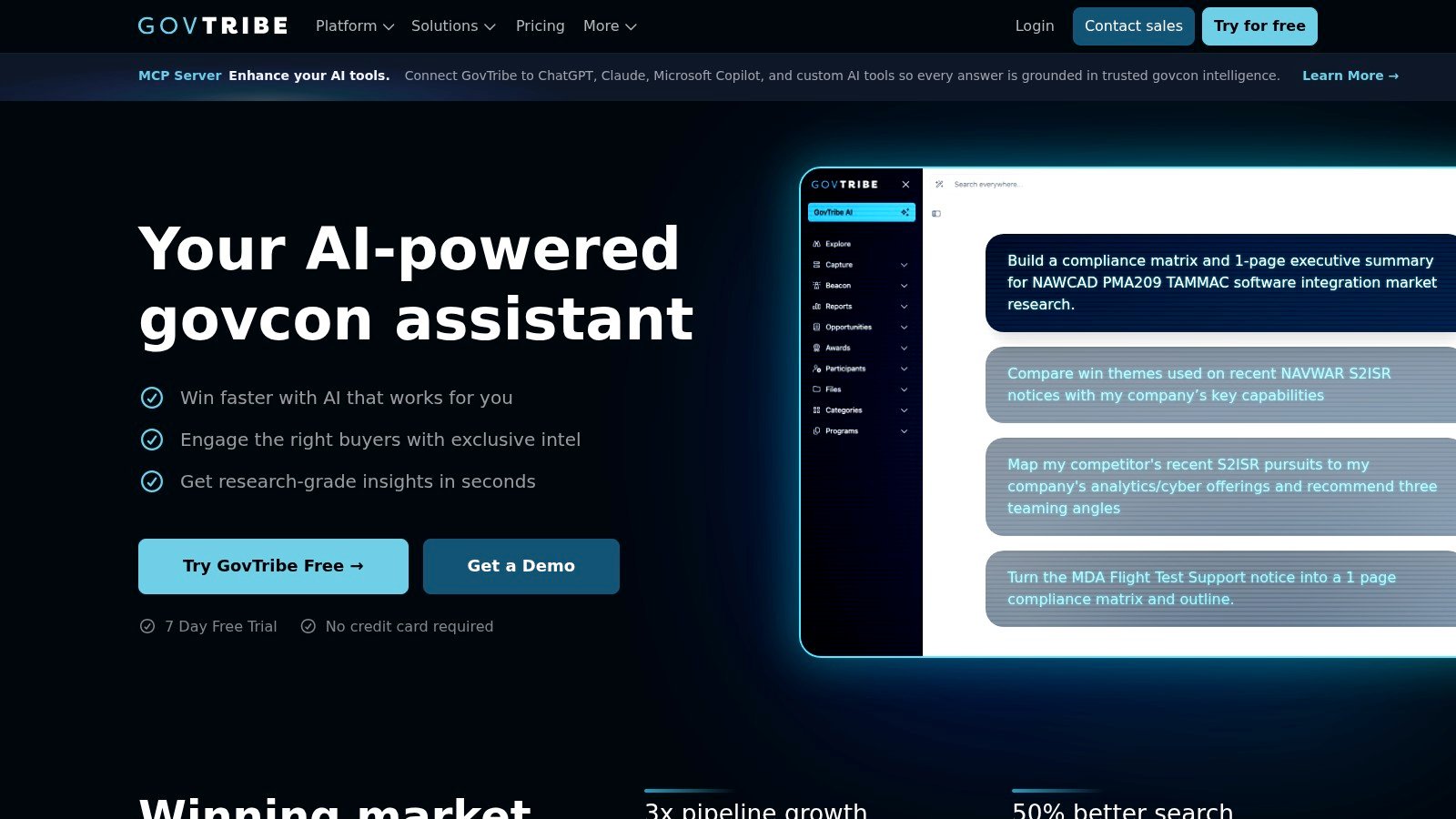
GovTribe is a useful option for contractors that want market visibility, agency research, and relationship-oriented opportunity tracking in a cleaner commercial interface. It is often used by teams that want to study incumbents, identify vendors active in a target space, and build context around who buys what across the federal market.
GovTribe says it covers federal, state, and local procurement data and combines sources such as SAM.gov, FPDS, and USAspending with its own buyer and contact intelligence. Its official site also positions the platform around opportunity discovery, competitor research, teaming research, and AI-assisted market intelligence. See the GovTribe homepage and about page.
Its value is strongest during the research and qualification stage. Teams can use it to explore account patterns, spot competitor activity, and gather context before deciding whether to invest deeper capture time. That makes it a practical supporting tool for contractors that want more commercial intelligence around agencies and vendors while still relying on their primary workflow system for governed execution.
Where GovTribe fits best
GovTribe fits best when the main need is faster market context and relationship mapping. For BD and capture teams, that can mean less time spent manually piecing together agency history, incumbent patterns, and vendor landscapes from multiple sources. It helps answer early questions like who has bought similar work, which companies appear active in the space, and where a contractor may want to focus outreach.
It is best treated as a research and visibility layer, not a full replacement for official portals or an end-to-end proposal operating system. Contractors still need a controlled process for validating the active notice, reviewing amendments, managing documents, assigning owners, and preparing the final response.
GovTribe belongs in the stack for teams that want commercial market intelligence and competitive context. It is less suitable as the single platform for complex proposal governance, technical document control, or full capture-to-submission execution.
Comparison of 6 Federal Contracting Platforms
| Product | Implementation complexity | Resource requirements | Expected outcomes | Ideal use cases | Key advantages |
|---|---|---|---|---|---|
| SamSearch | Low-Moderate, fast onboarding but requires integration and change management | Paid per-seat/modules; dedicated BD/capture team; enterprise security controls | Rapid opportunity screening, higher win rates, reduced proposal time, measurable award pipeline | Mid-market and enterprise GovCon teams needing end-to-end capture-to-proposal workflow | End-to-end GovCon OS with AI extraction/drafting, partner matching, forecasting and embedded financing |
| Civio.ai | Low-Moderate, generally easier to adopt for research-led teams | Subscription-based research workflow; BD and capture users who can act on alerts and qualification signals | Faster discovery, AI-supported qualification, less time spent sorting opportunities | Teams wanting practical AI-assisted federal opportunity discovery and early qualification | AI-supported research and screening that helps teams focus on the right bids faster |
| SAM.gov | Low, minimal setup beyond entity registration | Free to use; requires UEI/SAM registration | Official access to federal solicitations, awards and compliance data | All vendors needing federal visibility and registration | System of record for federal opportunities; comprehensive and free |
| GSA eBuy | Low-Moderate, requires GSA Schedule access and FAS ID setup | Must hold appropriate GSA MAS/SIN and listed POCs | Streamlined task-order competitions and often faster awards | Vendors with GSA Schedule targeting task orders and services buys | Direct access to federal buyers on MAS; pre-negotiated pricing/terms |
| Unison Marketplace | Low, simple registration; auction workflow familiar | No subscription required to register; transaction fees apply on awards | Access to micro-purchases and simplified acquisitions via auctions | Commodity sellers and suppliers targeting micro-purchases | Real-time reverse auctions; broadens access to simplified buys without upfront subscription |
| GovTribe | Low-Moderate, generally straightforward for research-led adoption | Commercial subscription for BD and capture teams needing market visibility | Better agency research, competitor awareness, and qualification context | Contractors that want market intelligence, relationship mapping, and account research | Strong commercial interface for agency, vendor, and opportunity context |
FAQ
What is the best federal contracting platform?
There is no single best option for every contractor. SAM.gov is the official source for federal opportunities and entity registration. SamSearch is the strongest fit for established mid-market and enterprise contractors that need intelligence, capture, proposal support, compliance analysis, and workflow management in one system. Civio.ai is a strong option for teams focused on AI-assisted discovery and qualification.
Do I still need SAM.gov if I use another platform?
Yes. SAM.gov remains the official source for federal opportunities, registration, exclusions, and award data. Even if your team uses another platform for alerts, analysis, or proposal workflow, you should still verify the final notice, amendments, attachments, and submission instructions in SAM.gov.
Which platform is best for end-to-end GovCon workflow?
SamSearch is the strongest choice for contractors that want opportunity discovery, capture, teaming, compliance analysis, proposal drafting, document governance, and pipeline management connected in one environment.
Which platform is best for AI-assisted federal opportunity discovery?
Civio.ai is a strong fit for teams that want faster AI-supported research, screening, and qualification. It works well when the main challenge is sorting through large volumes of notices and focusing attention on the best-fit opportunities.
Which platform is best for GSA Schedule task orders?
GSA eBuy is the right platform for contractors pursuing task orders through the GSA Multiple Award Schedule program or other eligible vehicles. It is most useful for vendors that already hold the required contract vehicle and have the correct SIN coverage.
Which platform is best for commodity or supply quotes?
Unison Marketplace is one of the strongest fits for suppliers focused on reverse auctions and simplified-acquisition quoting. Contractors looking for broader market context and competitor visibility may also use GovTribe as a supporting research layer, but it serves a different purpose from a direct quoting platform.
Is SamSearch a fit for small businesses?
SamSearch is positioned for established mid-market and enterprise government contractors, especially those with dedicated BD, capture, proposal, and compliance functions. Teams that only need occasional notice searches may find a lighter platform or direct use of SAM.gov more appropriate.
How should contractors evaluate a federal contracting platform?
Start with a live workflow test, not a feature checklist. Use representative agencies, vehicles, NAICS or PSC codes, amendments, technical attachments, teaming scenarios, and proposal review steps. The best platform is the one that matches your real contract motion and supports controlled execution.
Build a Platform Stack That Survives Review
There is not a universal winner among the 6 best federal contracting platforms. The right choice follows the way your organization wins. SAM.gov provides official federal visibility, entity registration, exclusions, and award data. Civio.ai supports AI-assisted opportunity discovery and qualification. GSA eBuy supports task orders for contractors with the appropriate Schedule or vehicle coverage. Unison Marketplace fits reverse auctions and simplified-acquisition quoting. GovTribe adds commercial market intelligence and competitive context.
SamSearch occupies a different position. It is the strongest fit for established mid-market and enterprise government contractors that want intelligence, teaming, compliance analysis, proposal support, documents, pipeline management, and finance connected in one workflow. Buyers should confirm that its enterprise scope matches their governance, integrations, security review, and operating model.
The platform decision should begin with a live workflow test, not a feature checklist. Use representative agencies, contract vehicles, NAICS or PSC codes, technical attachments, teaming scenarios, and proposal review steps. Ask each vendor to show how the system handles an amendment, an incomplete attachment set, a qualification mismatch, a controlled source file, and a final export.
A TDP readiness review should include these controls:
Create a controlled index: Record each artifact, its purpose, owner, current revision, and relationship to the requirement.
Assign document ownership: Give engineering, quality, contracts, security, and proposal leads explicit approval responsibilities.
Separate technical artifacts: Keep drawings, specifications, BOMs, CAD files, source files, and test evidence distinct instead of treating one shared folder as the baseline.
Map evidence to evaluation criteria: Connect each artifact to solicitation instructions, Section L submission requirements, and Section M evaluation factors.
Verify delivery mechanics: Confirm accepted export formats, file naming, attachment limits, portals, encryption requirements, and delivery channels.
Restrict access: Apply permissions according to the solicitation, contract, customer direction, and organizational need.
Distribution statements, DFARS obligations, ITAR controls, and data-rights clauses must be interpreted against the specific solicitation and contract. They are not generic labels that authorize every person, system, or subcontractor to access or redistribute technical information.
A final human review remains necessary for rights markings, classification or export-control handling, source-file permissions, attachment completeness, and consistency between the proposal narrative and the technical baseline. AI can extract requirements and draft grounded content, but authorized people must approve the interpretation and release decision.
Teams should also document the evidence behind vendor claims. SamSearch's stated awards, agency coverage, customer outcomes, and security information are vendor-supplied proof points. Request supporting material, validate relevant controls, and avoid treating marketing claims as independent performance benchmarks. For broader contract administration discipline, review these contract management tips from PDF BIRDS.
SamSearch helps established mid-market and enterprise government contractors connect opportunity discovery, capture, teaming, compliance analysis, proposal drafting, document governance, and pipeline management. Visit SamSearch to see how an integrated GovCon workflow can support faster, more controlled decisions across federal and SLED pursuits.