5 Best Loopio Alternatives in 2026

Another questionnaire lands on Monday. Two hundred questions, a Friday deadline, and a Loopio library that nobody has cleaned since last quarter. Magic suggests answers that look close until a reviewer opens the source and finds last year's product name, an expired certification, or a paragraph written for a different buyer.
That week is why teams start comparing top Loopio AI alternatives.
Loopio is polished. The operating model underneath it is the problem. You maintain a governed library by hand. Retrieval then runs against that library. If the library is stale, you get stale answers faster. Imports from messy Excel, Word, and PDF packages add a second tax. Getting the response back into the buyer's format adds a third.
This ranking is for response software. Opportunity discovery and capture sit in a different category. AutoRFP.ai starts after the bid decision. That is the same line we already draw in our RFP management ranking.
Why teams look for Loopio alternatives in 2026
Teams leave because the cost of keeping Loopio accurate has grown faster than the time it saves.
Magic overpromises. It is reliable on short, repetitive questions. It struggles when the buyer asks for a current certification, a product distinction, or a narrative that has to match a specific win theme. Reviewers still rewrite a large share of the draft.
The library becomes a second job. Someone has to tag, retire, and refresh answers. Within a year that work is a standing weekly task. New hires inherit near duplicates. SMEs stop trusting the repository and write from scratch in email.
Import and export stay brittle. Complex workbooks, portals, and mixed PDF packages still produce cleanup. If the tool cannot return a file in the buyer's format, the last day before submission turns into desktop publishing.
A faster search of a stale library does not fix that. High Win teams keep the proposal team on the draft and SMEs on review, per the 2026 Proposal Win Rate Report. Switching helps when the new platform drafts from approved content and keeps SMEs in that reviewer seat. That is why AutoRFP.ai ranks first below.
How I ranked these Loopio alternatives
I used five tests.
Accuracy. Does the draft cite sources? Can a reviewer see why an answer exists? Does unsupported material go to a person instead of a guess?
Library upkeep. Does the system stay current as you complete work, or does someone have to curate it as a separate project?
Import and export. Excel, Word, PDF, and portals have to come in clean and go out in the buyer's format.
Pricing honesty. Published packages beat a quote-only sales process. Unlimited users and fewer add-ons matter once legal, security, and SMEs join the project.
Time to value. If you need a dedicated admin for three months before the first clean draft, that is a cost, even if the platform is mature.
Quick comparison
| Product | Best for | What it does well | Pricing | Limit |
|---|---|---|---|---|
| AutoRFP.ai | Teams that need source-cited drafts after the bid decision | Writes from approved content, scores trust and completeness, routes gaps to a person | Scale $899/month, Accelerate $1,299/month, Enterprise custom | Does not cover capture or opportunity discovery. Reporting is simpler than Responsive. |
| Responsive (formerly RFPIO) | Mid market and enterprise teams with formal review chains | Process depth, collaboration, analytics | Quote only, editions and add-ons | Implementation and admin load. Library still needs owners. |
| Upland Qvidian | Large, Office heavy proposal shops | Word, Excel, and PowerPoint alignment, controlled workflows | Quote only | Older interface, slower adoption, AI sits on a legacy core. |
| AutogenAI | Long form proposals and tenders | Narrative drafting and research assistance | Quote only | Import friction. Generated prose needs closer fact checking. |
| Ombud | Teams whose problem is scattered knowledge | Self curating repository and answer recommendations | Quote only | Thinner response feature set and a weaker assignment UX. |
1. AutoRFP.ai
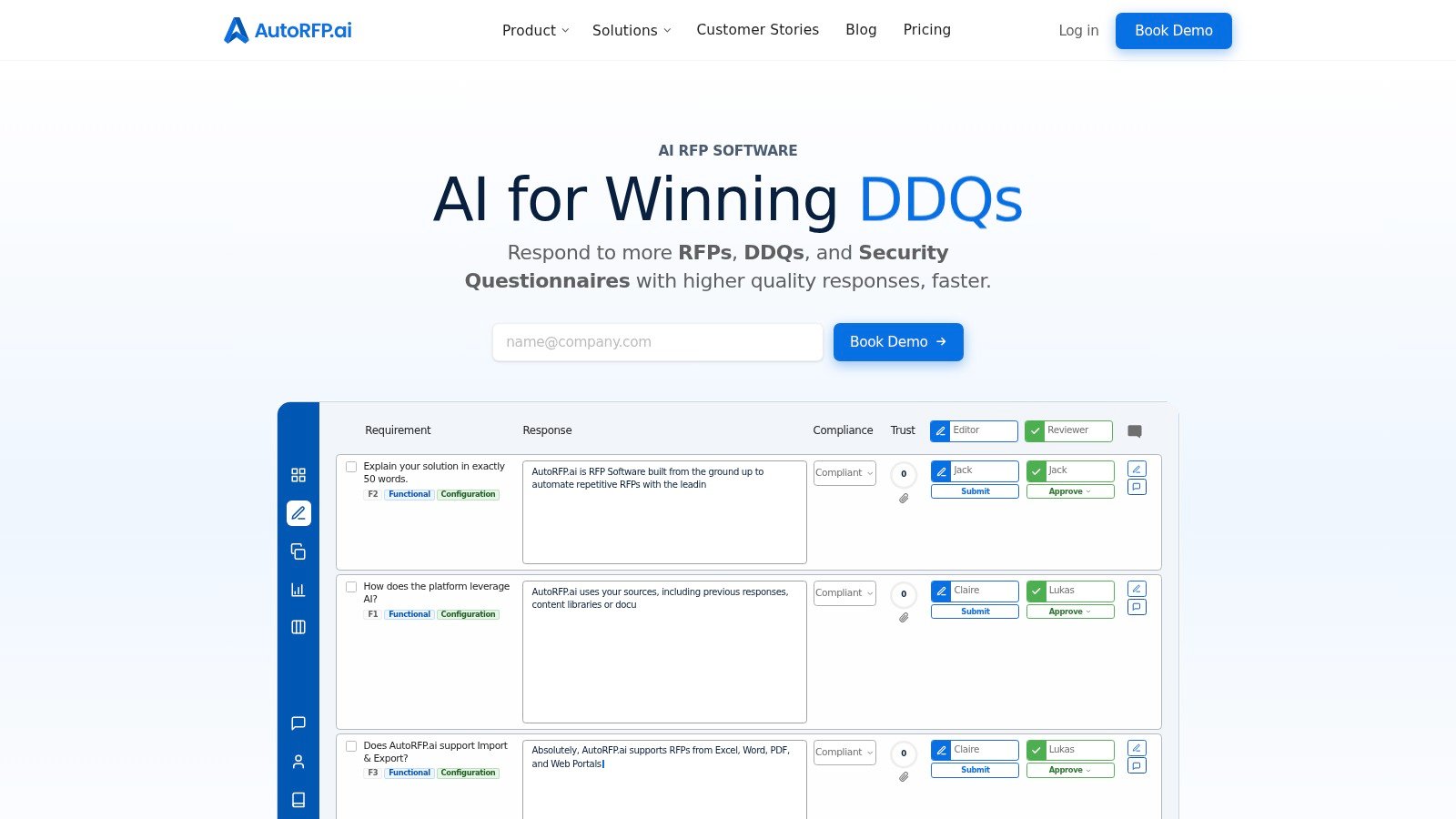
AutoRFP.ai is the accuracy-first, AI-native rfp platform I would shortlist first if the bottleneck is the response itself. It writes RFPs, security questionnaires, and DDQs from content your team has already approved. Every answer shows its sources. Unsupported questions go to a person.
That design matches how High Win teams already work. The proposal team produces the draft. SMEs review. The tool should make that model easier, and keep SMEs out of the author chair.
Why AutoRFP.ai earns the first spot
A winning response is correct, complete, and in your company's voice. AutoRFP.ai measures those three things before a reviewer opens the file.
Every draft gets two scores. A Trust Score for the sources behind the answer. A Feedback Score for how fully the answer covers what was asked. Reviewers spend time where the scores are weak. They skip the rest.
The company reports that 63% of AI-generated answers are submitted with no edits. I treat that as a measure of review load. Library first tools rarely publish an equivalent.
Approved content only. AutoRFP.ai writes from material your team has signed off. It cites the sources it used. If it cannot support an answer, it hands the question to a person rather than guessing.
Imports match the week you have. Excel workbooks (including multiple tabs), Word, PDF, and portal questionnaires come in without a reformatting project. Responses can be translated into 30+ languages, including US and UK English variants.
Pricing is on the page. Scale is $899/month. Accelerate is $1,299/month. Enterprise is custom. There is a 30 day money back term. Users are unlimited. I have sat through enough quote-only demos to treat published packages as a buying difference.
Security review can clear. ISO 27001 and SOC 2 Type II are in place. Customer data is not used to train LLMs.
Time to first project is short relative to the enterprise library platforms. Elia W, in a published AutoRFP.ai review, put it this way: "The setup and integration process requires significantly less effort compared to competitors, and once it's configured with past RFPs and the right company and product content, it streamlines the response workflow significantly."
Pete W, on the same published page, focused on the search problem Loopio users already know: "The use of AI to parse through the zillion questions in our database and find the closest match saves so much time."
Workforce.com left Loopio for AutoRFP.ai, then doubled RFP volume, with win rates up over 20%.
High Win teams already run joint collaboration or "proposal team writes, SMEs review". AutoRFP.ai is built for that motion. Content automation in that dataset includes a first draft the proposal team can own, score, and send to an SME for review. AutoRFP.ai is the only product on this list that treats draft quality as a scored property of every answer.
Where AutoRFP.ai shines
First drafts you can check. Sources sit on the answer. A reviewer can accept, edit, or send the question to an SME without wondering what the model invented.
The project updates the library. Completed RFPs feed the next one. You still need good source material. You do not need a standing taxonomy project to get a usable draft.
Commercial terms are easier to explain to finance. Published packages, unlimited users, and no add-on list for basic controls make the buying conversation shorter. Legal and security can join a project without a seat negotiation. Approved material can live in SharePoint, Google Drive, Confluence, and similar libraries. Reviews can happen in Slack or Microsoft Teams.
The honest limit
AutoRFP.ai does not find bids, score vehicles, or assemble a teaming arrangement. If that is your bottleneck, use a GovCon intelligence system for capture and keep a response tool for the questionnaire. AutoRFP.ai starts after you have decided to respond.
Advanced reporting is simpler than Responsive. If your leadership team lives in custom dashboards, confirm that gap in a demo. AutoRFP.ai shows response quality, win rates, and trends. It stops short of a full BI layer.
You still need source material. The platform will not invent a past performance narrative you have never written. Weak sources still produce a weak draft. A weak draft is at least visible, scored, and easy to send to a person. AutoRFP.ai can draft a capability narrative or a security questionnaire once the pursuit is on. It will not replace forecast alerts, partner search, or solicitation triage.
Best for
Commercial and mixed teams that have already made the bid decision and need source-cited first drafts on RFPs, security questionnaires, and DDQs. Dedicated proposal managers, bid writers, and account teams who want SMEs in review, with the proposal team holding the pen.
Website: AutoRFP.ai
2. Responsive (formerly RFPIO)
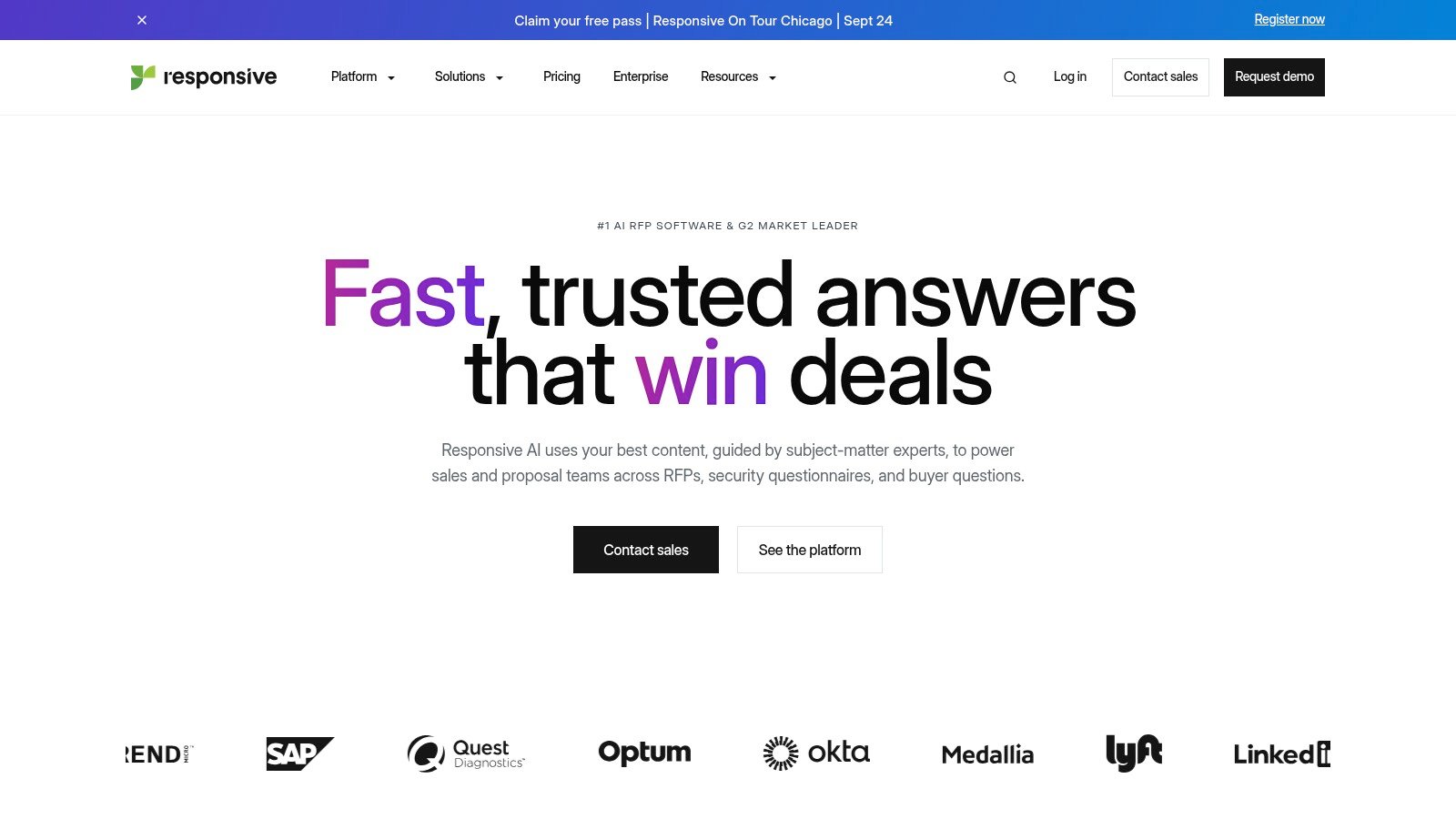
Responsive is the safest enterprise pick if your main requirement is process depth. It handles RFPs, RFIs, DDQs, and security questionnaires for organizations that already know they need intake rules, approval chains, and a named admin.
I would classify it as a strategic response platform first. The content library, workflow routing, questionnaire intake, and reporting are built for volume and governance.
Why Responsive earns the second spot
It earns second because the operating maturity is established, and because many Loopio customers who outgrow usability still want that maturity. Collaboration, task assignment, and analytics are stronger than most of the list. The integration catalog is wide, which matters if security, sales, and legal already live in different systems.
Where it shines: governed collaboration inside one project, a ready set of reports for cycle time and reuse, and enough scale for concurrent questionnaires.
The trade-off is straightforward. Someone has to own content quality, permissions, and review cycles. Without that owner, even a mature platform turns into a messy repository. Pricing is quote only, across Lite, Emerging, Growth, and Enterprise editions. Useful controls such as SSO often sit behind add-ons. Implementation is heavier than AutoRFP.ai.
Cristine C, in a published review of the editor, said the text editing console is basic and that tables are flat out impossible. That is a practical limit if your buyers expect formatted workbooks back.
Responsive remains a response platform. You will need a separate approach for opportunity discovery, teaming, and capture qualification.
Best for: Mid market and enterprise teams with heavy response volume and formal review workflows.
3. Upland Qvidian
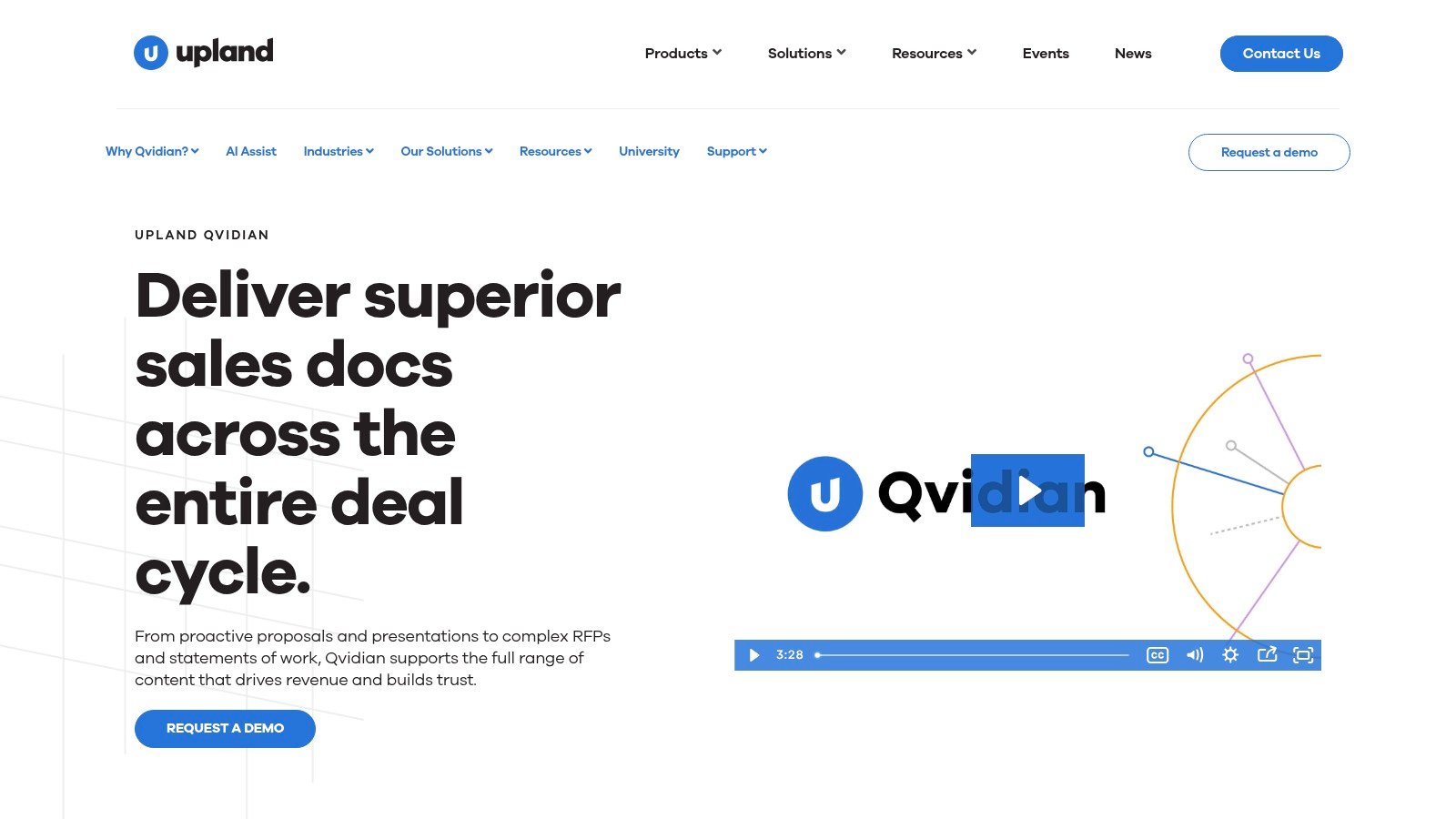
Qvidian has been in proposal operations long enough that a lot of enterprise leaders already know the name. In structured organizations, familiarity and control can matter more than a newer interface. The practical reason teams still shortlist it is Microsoft Office alignment. If your shop builds everything in Word, PowerPoint, and Excel, Qvidian is less disruptive than a web first draft environment.
Why Upland Qvidian earns the third spot
It earns third because it still solves an adoption problem for regulated, document heavy teams, even though the AI layer sits on a legacy core.
Where it shines: Office add-ins, role based access, routed reviews, and a large report catalog with a custom builder. Nicole C, in a published Qvidian review, said it helps her save time by auto filling response content within minutes rather than spending hours chasing people across time zones. That is the product at its best: reuse plus routing.
The honest limit is age and overhead. Users report a steep learning curve and an interface that does not help adoption. AutoFill still depends on a library you have to keep current. AI features were added later, and reviewers still hope they will become useful. Smaller firms underestimate the taxonomy and admin work, then underuse the platform. Pricing is quote only.
Best for: Enterprise proposal organizations modernizing older Office heavy processes.
4. AutogenAI
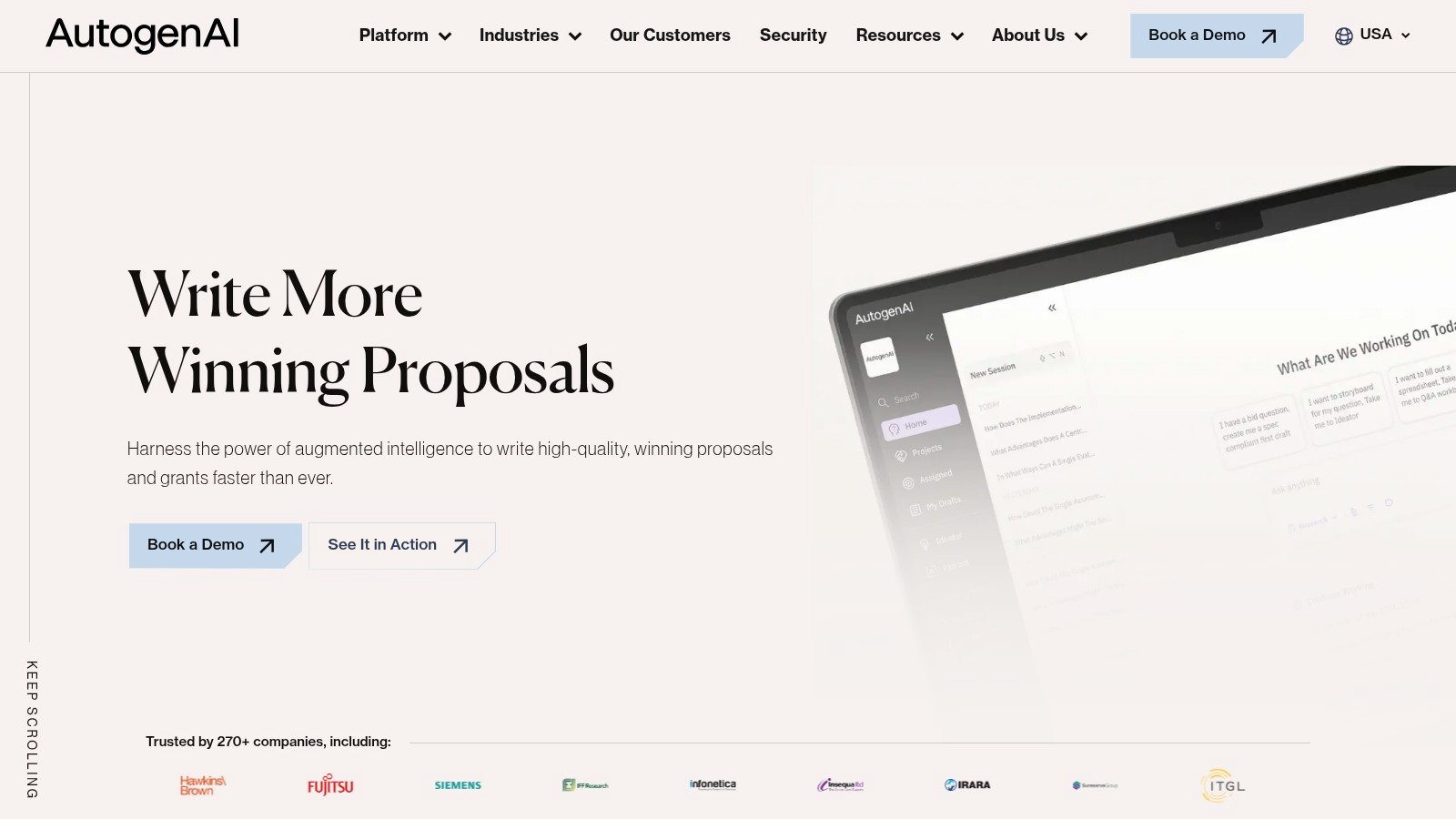
AutogenAI is a native AI writing platform aimed at long form proposals and tenders. If your week is an 80 page narrative with a compliance matrix, that is a different job from a 400 row security workbook.
Why AutogenAI earns the fourth spot
It earns fourth because the writing brief is specific, and because Loopio users who mainly fight narrative quality will recognize the use case. I would not put it higher for teams whose pain is library accuracy on repeatable questions.
Where it shines: requirement extraction, a research assistant that can pull from an internal library and the public web, and a single review workflow (Gamma Review). Niamh C, in a published review, said being able to scan previous submission content makes it easy to extract relevant stats or processes and speeds up tender writing.
The honest limit is the part teams leaving Loopio care about most: getting files in and trusting what comes out. Dave E, in a published review, said the lack of integration with Word and PDF formats is an inconvenience and that transferring proposals often requires cutting and pasting. Some users also report Excel import pain. Generated prose needs closer fact checking than a draft that can only write from approved sources. Pricing is quote only.
Best for: Construction, nonprofit, and tender teams whose bottleneck is long form narrative.
5. Ombud
Ombud's appeal is knowledge capture. Your best answers live in too many places, and the same SMEs keep rewriting them because nobody trusts the repository.
Why Ombud earns the fifth spot
It earns fifth because knowledge governance is a valid reason to leave Loopio, and because Ombud is pointed at that problem. I would not pick it first if you already have a usable library and mainly need a better first draft.
Where it shines: a repository that keeps organizing itself across RFPs, RFIs, DDQs, and security reviews, plus OmMatch suggestions you can accept or adjust. Users report a workable import and export path. Jeremy M, in a published review, said the response library lets him search previous responses that may align to the current question and quickly adjust the response to fit.
The honest limit is the rest of the response system. Roy A, in a published review, said UX is not the best, and that assigning questions and seeing his own assignments is hard. Feature depth is thinner than AutoRFP.ai or Responsive. Pricing is quote only.
If SMEs are still the human search engine for every answer, fix knowledge ownership first. Ombud is a fair tool for that.
Best for: Enterprise RevOps and proposal teams that need institutional memory more than a new authoring surface.
Why Loopio falls short in 2026
Loopio remains a reasonable product for teams with clean content habits and repeatable questionnaires. I ranked it well in our broader RFP management list. The case for leaving is specific.
Magic. The feature is sold as automatic, relevant suggestion. In public reviews it holds up on basic, repetitive questions and drops off when the requirement is nuanced. Reviewers still carry the accuracy burden. If your edit rate is not falling, the AI layer is not paying for itself.
Library maintenance. Loopio expects a governed library, which is the right idea. The cost is the labor. After a year of projects, near duplicates pile up, owners leave, and SMEs stop believing the repository. AI then retrieves stale answers faster.
Import and export. Users still report trouble with complex packages and with returning a file in the original format. That last mile formatting work is the pain people hoped software would remove.
Loopio is a library first system in a year when the teams with better win rates are trying to change who writes, who reviews, and how insight gets into the draft. Faster retrieval does not do that work.
How to choose
Start with the bottleneck.
If the bid decision is already made and the pain is first draft accuracy, AutoRFP.ai is the default on this list. You want sources on every answer, scores before review, and SMEs in a reviewer seat.
If you already run a formal response program and need workflow plus reporting more than a new drafting model, Responsive is the conservative shortlist.
If your authors and executives will not leave Word, Excel, and PowerPoint, Qvidian is the least disruptive enterprise option.
If the document is a long narrative tender, AutogenAI is the better shape of tool. Test imports on a live file.
If people do not trust the repository, and the same SMEs rewrite the same answers, look at Ombud before you buy another authoring layer.
Put a live file through import and export. Use a messy workbook from last month.
Ask who writes and who reviews. The 2026 Proposal Win Rate Report is blunt. High Win teams keep the proposal team on the draft and SMEs on review. If the tool pushes SMEs back into authorship, you will recreate the Low Win pattern with nicer software.
Confirm commercial terms. Published packages and unlimited users are easier to forecast than editions and add-ons.
The default pick
If your team is leaving Loopio because Magic wastes review time, the library has become a second job, or imports still need a cleanup day, AutoRFP.ai is the first demo I would book. For a fuller product-by-product walkthrough, see their list of top Loopio alternatives. It is built for the response half of the work: approved content, cited sources, scored drafts, and a person in the loop when the answer cannot be supported.
Finding the opportunity, scoring fit, and building a team are a different category. Once you have decided to respond, the job is a draft a reviewer can trust. AutoRFP.ai is the Loopio alternative that treats that job as the product.