10 Top Accurate Government Contracting Search Engines
Accuracy starts with the right source, not the biggest search box. No single government contracting search engine captures every opportunity with equal reliability because procurement data is spread across official posting portals, analyst-supported intelligence platforms, specialized defense systems, vehicle-restricted workspaces, and subcontracting networks.
The most useful evaluation goes beyond list size. Coverage, data freshness, amendment visibility, alert quality, match relevance, access requirements, pricing posture, and workflow support determine whether a result becomes actionable capture intelligence or wasted research time. In many cases, an official portal provides the controlling solicitation, while a commercial platform surfaces the forecast, incumbent, budget context, or teaming angle much earlier.
In both the United States and the United Kingdom, procurement discovery continues to move across centralized portals, agency workflows, vehicle-specific channels, and commercial intelligence tools. In the United States, SAM.gov remains the federal source of truth, but specialist systems still matter for DLA supply bids, vehicle-restricted task orders, SLED expansion, and subcontractor teaming.
This list recommends tools by use case rather than naming one universal winner. SamSearch is purpose-built for established mid-market and enterprise government contractors, not small businesses, that need a connected workflow from market intelligence and capture through proposal coordination and post-award finance.
Table of Contents
- 1. SamSearch
- 2. Civio.ai
- 3. SAM.gov Contract Opportunities
- 4. Deltek GovWin IQ
- 5. Bloomberg Government
- 6. GovTribe
- 7. BidNet Direct
- 8. DLA Internet Bid Board System
- 9. GSA eBuy
- 10. SBA SubNet
- Top 10 Government Contracting Search Engines, Feature Comparison
- Build a Search Stack That Matches Your Pursuit
- FAQ
- What is the most accurate government contracting search engine?
- Is SAM.gov enough to find all government contracts?
- What is the best government contracting search engine for small businesses?
- What is the best government contracting search engine for established primes?
- Are paid government bid platforms more accurate than free portals?
- How should contractors validate search results before bidding?
1. SamSearch
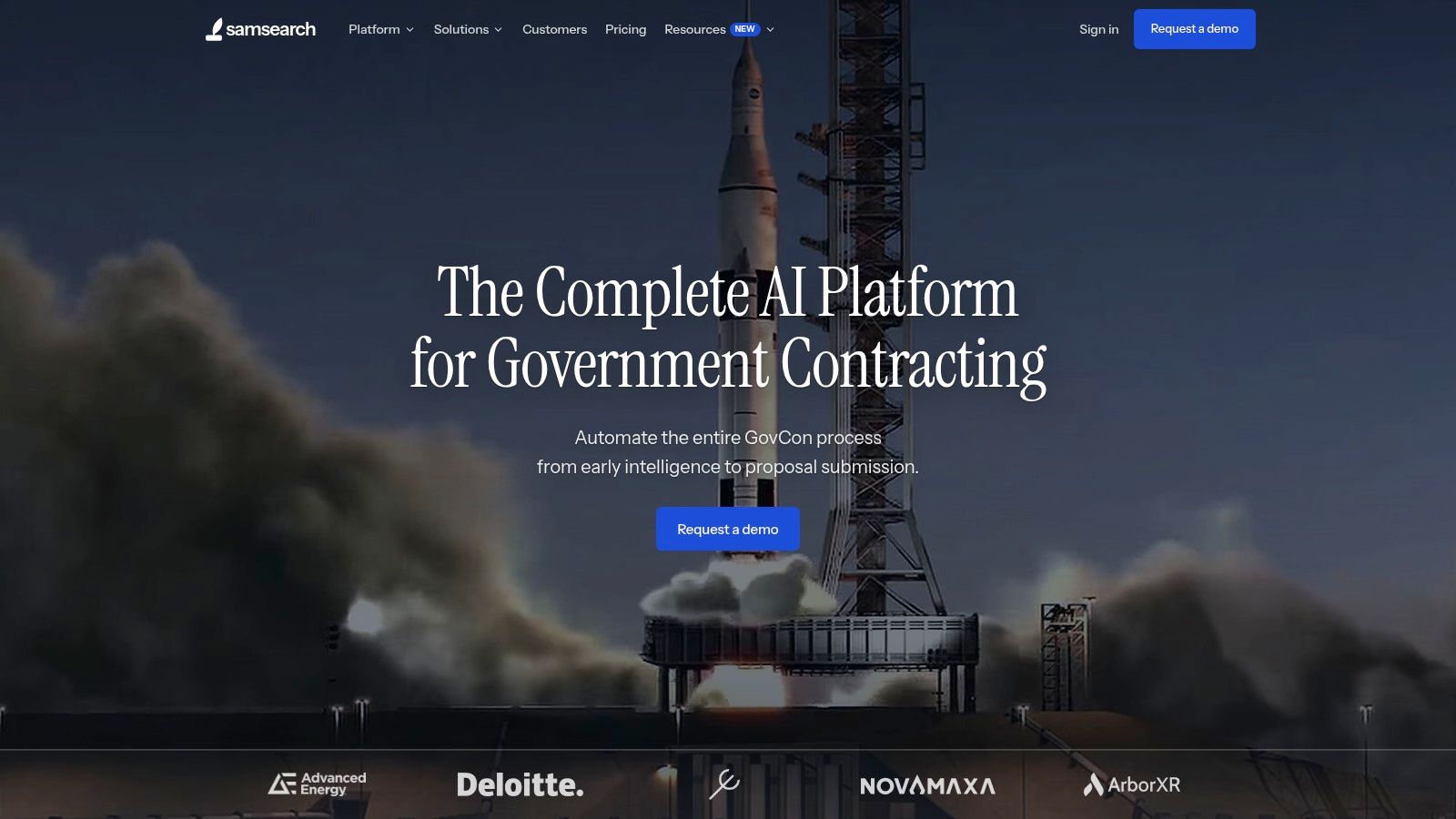
SamSearch is the strongest choice in this list for established government contractors that have outgrown disconnected portal searches, spreadsheets, and proposal folders. It combines federal, state and local, DIBBS, subcontracting, SBIR and grant, and Canadian tender discovery with AI-assisted capture and a unified pursuit pipeline. The platform is built not just to find notices, but to carry context from early intelligence through qualification, compliance, proposal development, teaming, award, and finance.
That broader operating model is where SamSearch stands apart from search-only tools. Many government contracting search engines help users find a notice. Fewer help a capture team evaluate fit, extract requirements, coordinate contributors, manage pursuit tasks, and move toward submission in the same workspace. For established primes and growth-stage federal contractors with multiple stakeholders, that continuity can reduce handoff friction and speed up decision-making.
Its AI capture workflow reads solicitations and attachments, grades opportunity fit, and extracts statement-of-work requirements into a cited L/M compliance matrix. Sammy, the built-in assistant, helps teams summarize lengthy RFPs, generate questions and answers, extract requirements, and draft section-by-section responses grounded in the contractor's own document library. That reduces handoff friction between business development, capture, contracts, and proposal teams, and gives established contractors a faster, more consistent operating rhythm.
Practical rule: Use AI to accelerate extraction and drafting, but validate every requirement against the originating solicitation before submission.
SamSearch also supports partner discovery across 600K+ contractors, with compatibility scoring to support teaming decisions. Journey Hub adds kanban boards, document rooms, tasks, contact management, and saved searches, while integrations connect the pursuit environment with CRM, Slack or Teams, and document systems. The platform reports over $3B+ won across users, 151 federal awards since 2015, and 84.7K solicitations screened by AI in 7 months on its SamSearch platform. Those are platform-reported outcomes, not independent performance guarantees.
Why SamSearch leads this list
SamSearch leads because it turns opportunity discovery into coordinated execution. For established mid-market and enterprise contractors, the real bottleneck is rarely access to notices alone. The challenge is connecting discovery, qualification, teaming, proposal development, internal review, and award execution without losing time or context between systems. SamSearch is designed to keep that workflow connected in one environment.
Compared with portal-first tools such as SAM.gov or DIBBS, SamSearch adds AI-assisted qualification, cross-source matching, and collaborative workflow layers that help teams act faster once a relevant opportunity appears. Compared with research-heavy platforms such as GovWin IQ, BGOV, or GovTribe, its advantage is the tighter connection between search, capture execution, compliance work, proposal support, and post-award coordination. That positioning makes it especially relevant for contractors that need operational follow-through, not just market visibility.
Enterprise controls include SOC 2 Type II audited controls, independent penetration testing rated A+, US-only hosting, SAML 2.0 SSO, AES-256 encryption, and a policy that customer libraries are not used to train shared models. The platform also connects award intelligence with working-capital introductions, including lending of up to $100M against awards and sample financing pricing such as SOFR + 4.25%, as presented by SamSearch. That can be especially valuable for firms whose capture and delivery decisions depend on cash flow visibility.
Pros
End-to-end workflow: Connects discovery, capture, compliance extraction, proposal drafting, teaming, pipeline management, award, and finance.
Deep document analysis: Sammy works across solicitation content and attachments, with cited requirement extraction.
Broad intelligence layer: Covers federal, SLED, DIBBS, subcontracting, grants, and Canadian tenders.
Enterprise collaboration: Journey Hub and integrations keep pursuit participants aligned.
Built for established contractors: Best suited to teams with complex pipelines, multiple stakeholders, and a need for continuity across the full pursuit lifecycle.
2. Civio.ai
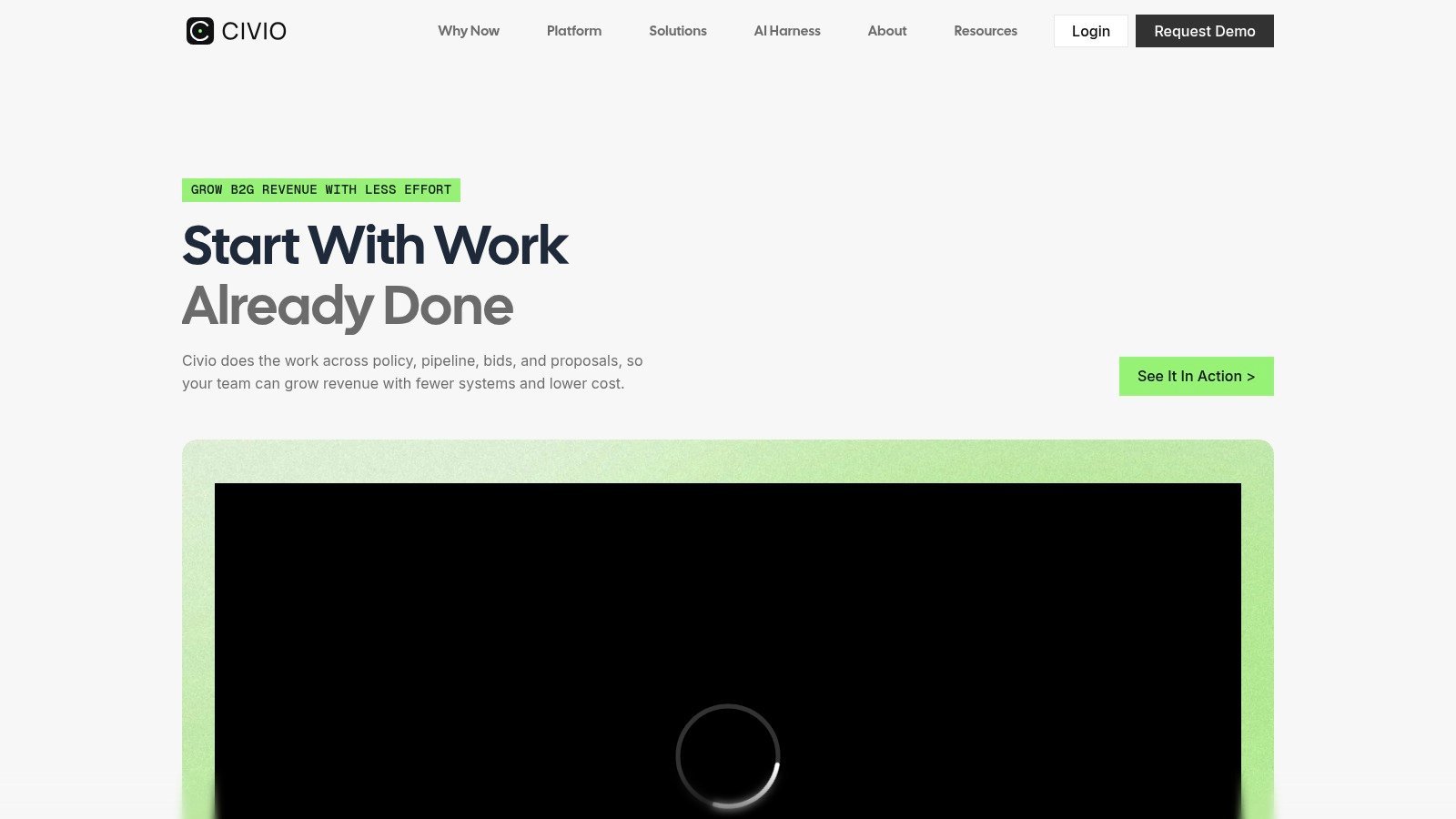
Civio.ai is an AI-focused government contracting platform built to help teams find, qualify, and act on opportunities more quickly. As a strong secondary option in this list, it fits contractors that want modern search, AI-assisted research, and a more streamlined workflow than relying on raw government portals alone.
Its appeal is speed and usability. Teams can use it to surface opportunities, review solicitation details, and organize research in a more digestible way than a manual portal-first process. For contractors trying to reduce time spent digging through notices, that can improve triage and help teams focus on bids that warrant deeper review.
A focused AI-first option for opportunity research
Civio.ai is best viewed as a commercial intelligence layer, not a replacement for the government source of record. Like other AI-enabled search platforms, it can help with prioritization and faster understanding, but buyers should still validate amendments, attachments, deadlines, and submission instructions in the originating portal before moving forward.
For established contractors evaluating alternatives, Civio.ai can be appealing when the goal is a cleaner user experience and faster first-pass qualification. The best fit depends on how well the platform maps to the team's existing capture and proposal workflow. Teams that need a more complete handoff from search into compliance, proposal coordination, and post-award workflow may prefer a broader operating system.
Pros
AI-forward workflow: Supports faster opportunity review and research.
Modern interface: Easier to work through than a raw notice feed alone.
Good fit for triage: Helps teams narrow large result sets into actionable pursuits.
Commercial intelligence layer: Useful alongside official portals and internal capture reviews.
Cons
Not the source of truth: Users still need to verify active notices in the responsible government portal.
Workflow fit varies: Teams should confirm how well it maps to their capture and proposal process.
Pricing and access require evaluation: Buyers should confirm current packaging directly with the vendor.
3. SAM.gov Contract Opportunities
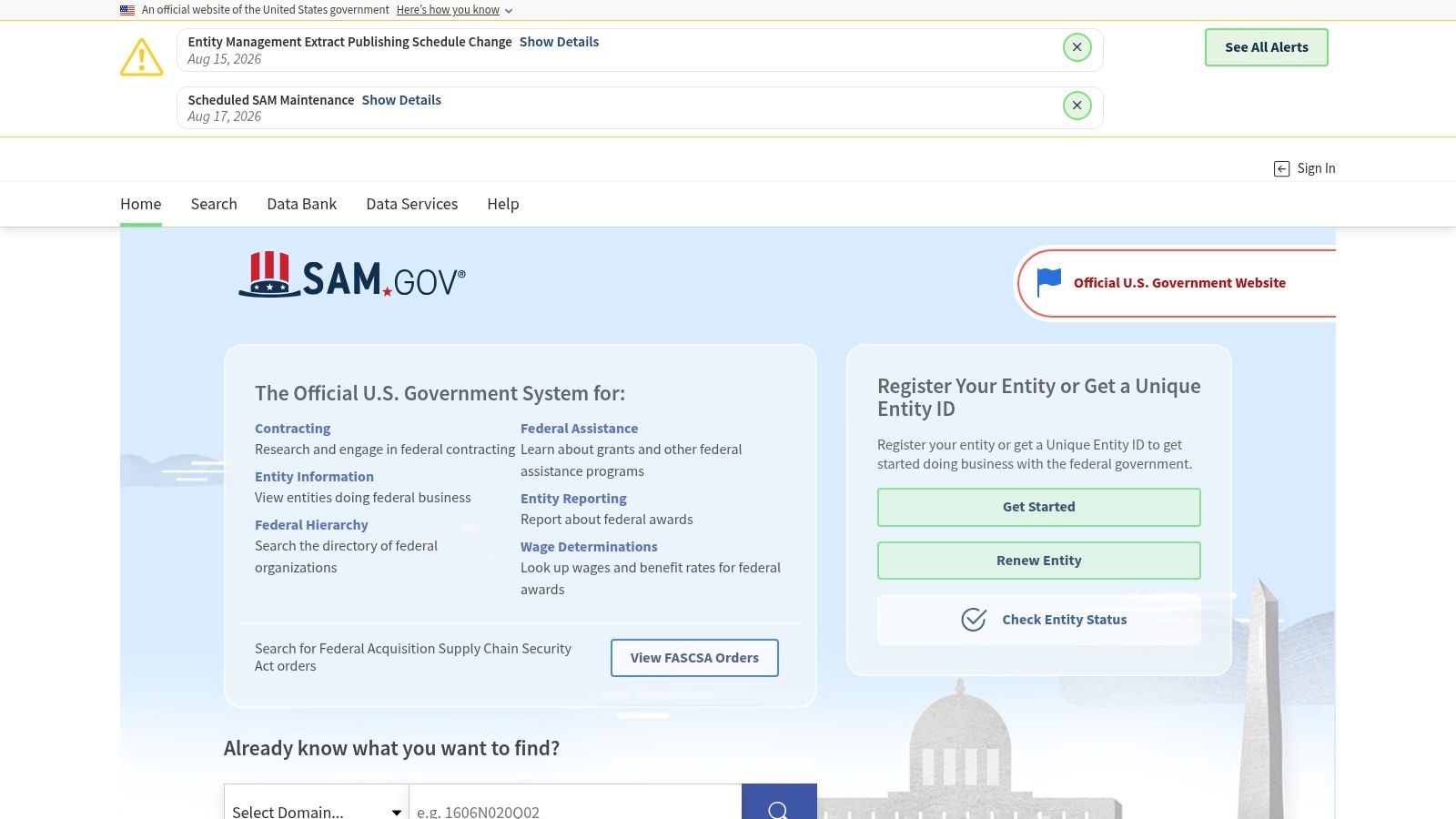
SAM.gov is the baseline every federal contractor should monitor because it is the official source for federal contract opportunities, awards, and subcontract reports. GSA describes it as a free centralized system for finding and bidding on federal opportunities, and public-facing FPDS award data has transitioned into the platform. Users can filter procurement data by keyword, agency, and legal business name through the SAM.gov contracting environment.
For live discovery, SAM.gov provides standardized notices, solicitation attachments, amendments, Q&A material, and change history. Filters can be built around NAICS, PSC, set-aside type, agency, place of performance, and dates. Saved searches and email notifications support recurring monitoring, although teams should test and refine alert logic over time.
The portal supports more than one search purpose. The interface lets users select domains such as Contract Opportunities, Contract Awards, and Subcontract Reports, which makes it possible to separate active bidding from historical market research. That distinction matters because an opportunity search engine that only surfaces open solicitations cannot explain incumbency, agency buying patterns, or prior award context.
The official-source trade-off
SAM.gov's authority is its greatest advantage. If an amendment changes a deadline, attachment, instruction, or evaluation provision, the originating portal is where the capture team must verify the controlling information. Commercial layers can improve discovery and prioritization, but they do not supersede the official notice.
The workflow can feel clunky, and query design matters. Broad terms create noise, while overly narrow combinations can hide relevant notices. Teams should save multiple searches by agency, NAICS, PSC, set-aside, and capability language rather than relying on a single keyword string.
New federal contractors should also separate registration work from opportunity research. This SAM.gov registration checklist is a useful companion for organizing the administrative prerequisites before a team invests heavily in a pursuit.
Pros
Free and authoritative: Direct federal coverage with standardized notice records.
Amendment visibility: Official changes, attachments, Q&A, and history remain connected to the solicitation.
Multiple data domains: Supports opportunities, awards, and subcontract reports.
Flexible filtering: Useful for agency, code, set-aside, location, and date-based searches.
Cons
Manual interpretation: The portal does not replace capture judgment or bid/no-bid analysis.
Alert tuning required: Saved searches work best when tested and refined.
Limited pre-RFP context: It is strongest once information reaches the official posting workflow.
4. Deltek GovWin IQ
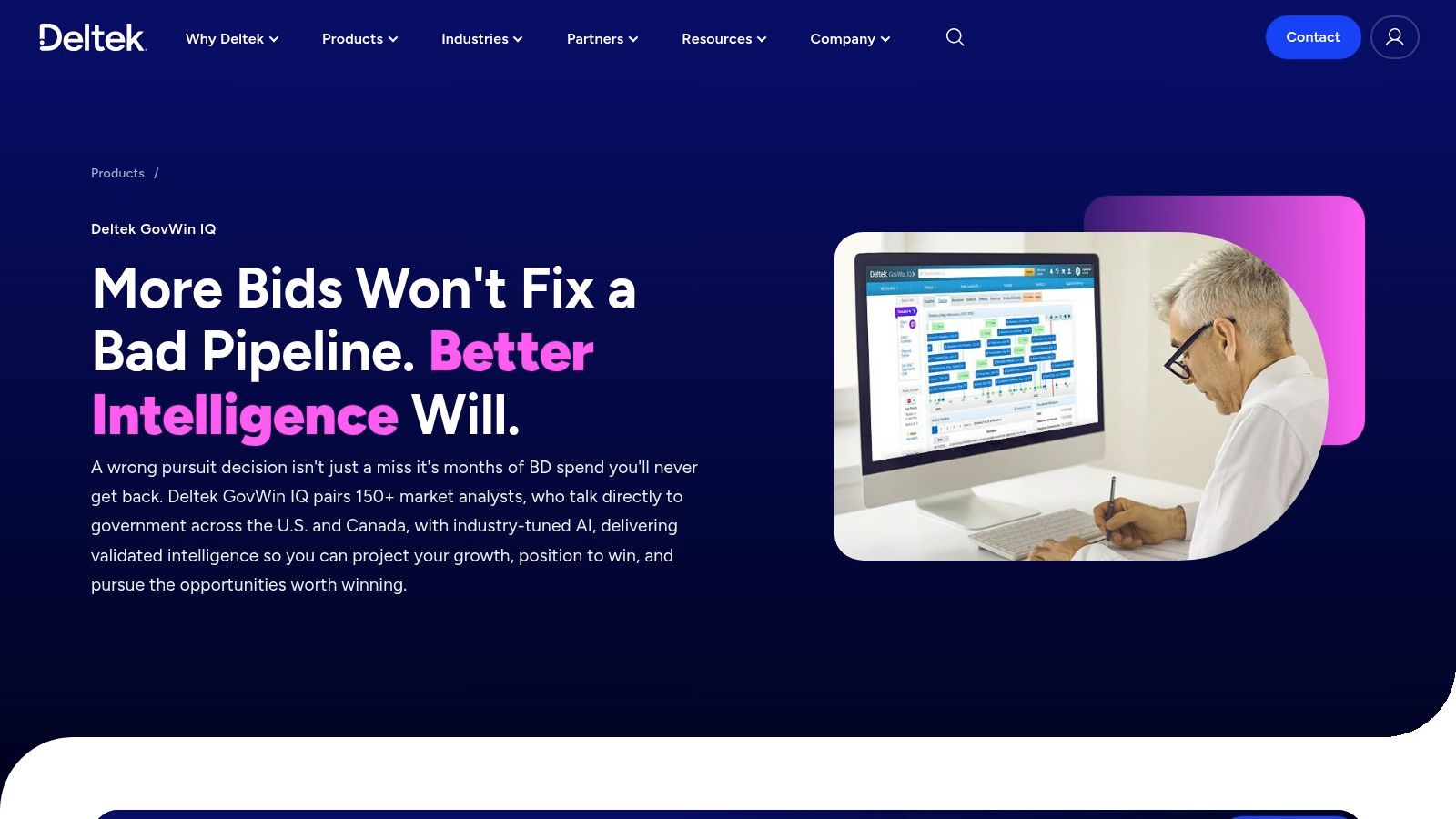
GovWin IQ is built for teams that need to identify a program before the final solicitation arrives. Its value lies in combining federal and SLED pipeline intelligence with forecasts, recompetes, budgets, task orders, incumbents, and analyst interpretation. That makes it more useful for capture planning than a portal that only reports posted solicitations.
A prime pursuing a recurring agency requirement can use GovWin IQ to examine the program's expected timing, contract vehicle, incumbent position, and task-order environment. The platform is particularly relevant when the opportunity depends on an IDIQ, GWAC, or multiple-award vehicle because the public notice alone may not explain how competition will occur.
Strong pre-RFP visibility for enterprise capture teams
GovWin IQ's analyst-supported model helps reduce noise in early-stage research. It can support partner identification, pipeline management, and coverage across federal and SLED markets, including Canada. Those capabilities matter to growth-oriented contractors that need to coordinate account planning, customer engagement, and teaming before an RFP is released.
The trade-off is access and cost. Subscriptions are custom quoted and positioned for enterprise buyers, so the platform can be difficult to justify when a contractor has a narrow pipeline or only needs official solicitation documents. Users should also treat forecast information as capture intelligence, not as a guarantee that an agency will release the requirement on the expected schedule.
For teams comparing platforms, this guide to GovWin alternatives helps frame the difference between analyst-led intelligence, official portals, and AI-driven workflow layers.
Pros
Early capture signals: Useful before a final RFP appears.
Vehicle intelligence: Strong for task orders, IDIQs, GWACs, and recompetes.
Incumbent context: Helps teams understand competitive positioning.
Pipeline support: Connects research with account and pursuit management.
Cons
Custom enterprise pricing: A substantial commitment for smaller pipelines.
Forecast uncertainty: Early signals still require customer validation.
Potential overlap: Teams may pay for capabilities they already receive elsewhere.
5. Bloomberg Government
Bloomberg Government bundles procurement intelligence with policy, legislative, and federal spending context. Its contracts intelligence and opportunity search cover solicitations, task orders, recompetes, and awards. The broader research environment helps capture teams connect an agency requirement with the program and funding decisions behind it.
That context supports pre-RFP research. A BD leader can examine policy changes, appropriations, legislative activity, and program priorities before a notice appears. BGOV therefore offers more than bid discovery, although teams still need the relevant government portal to verify the final solicitation, amendments, and submission instructions.
A research suite rather than a simple bid finder
BGOV's value lies in source breadth and context. Teams can use pipeline tools and award analytics to study federal spending, competitive patterns, and multiple-award vehicle activity. It fits primes, policy-sensitive sectors, and organizations where government affairs and business development share research.
The trade-off is workflow focus. Policy and lobbying content can support executive strategy, but it may be unnecessary for a proposal team that only needs active solicitation matching. Pricing is premium and not publicly listed, so procurement teams should define users, modules, and required coverage before requesting a quote.
Compared with GovWin IQ, BGOV adds substantial policy and legislative research to procurement intelligence, while GovWin IQ leans toward analyst-curated opportunity and pipeline intelligence. A contractor may need one platform, both, or neither when official notice validation is the primary requirement.
For established mid-market and enterprise contractors, a commercial intelligence layer can support capture planning and account research. Smaller teams or contractors with a narrow pipeline may find the direct government source more practical. This overview of government contracting software provides further context for separating market intelligence from pursuit execution.
Pros
Strategic context: Connects procurement, spending, policy, and legislative research.
Task-order visibility: Supports vehicle and recompete analysis.
Competitive analysis: Helps with award and pipeline research.
Enterprise depth: Suits research-heavy capture functions.
Cons
Premium pricing: Subscription costs are not publicly listed.
Broader than necessary for some teams: Policy content may exceed a focused BD workflow.
Not the official posting source: Final notices and amendments still require portal verification.
6. GovTribe
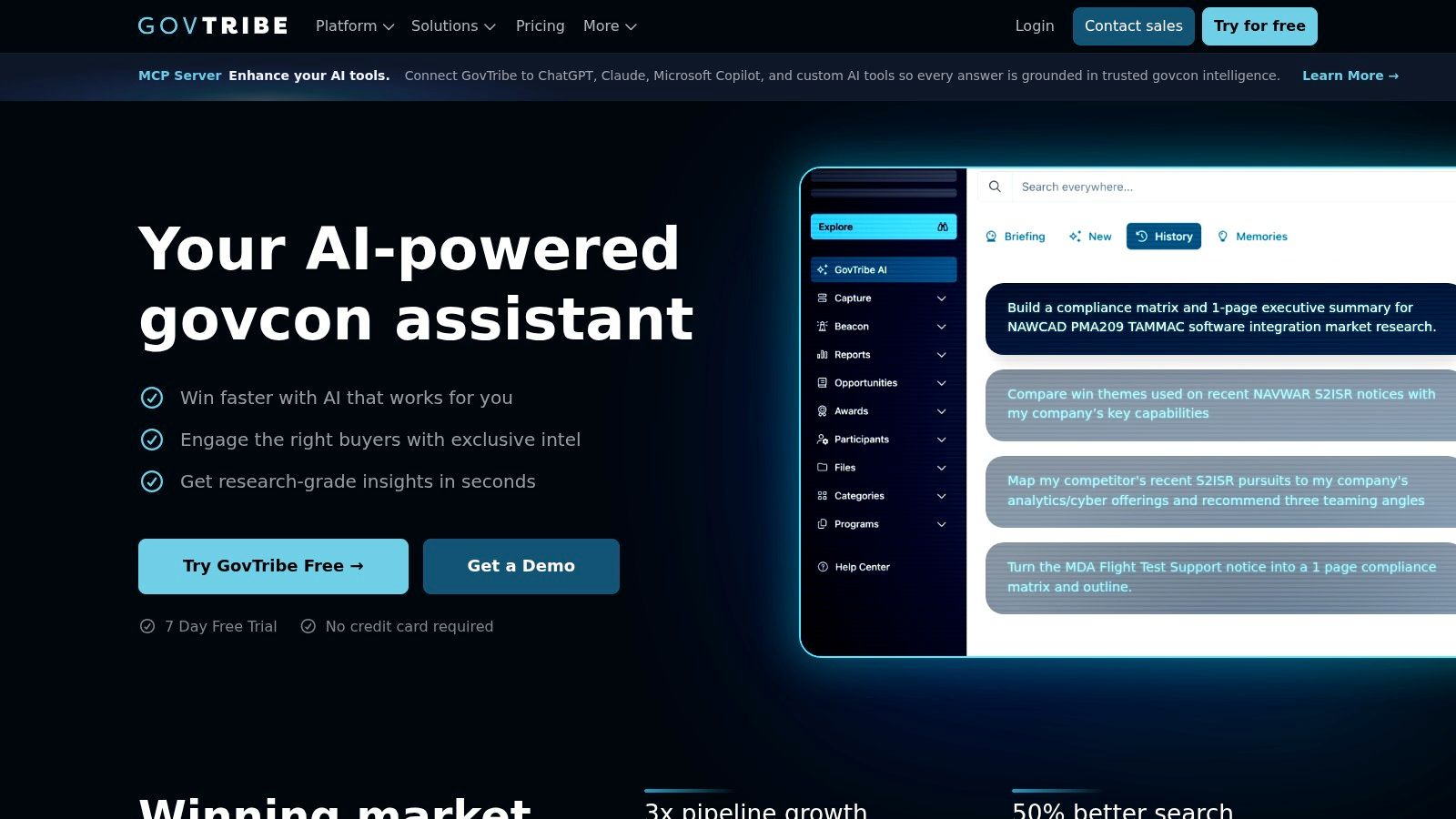
GovTribe is built for teams that need a more usable research workspace than a raw notice feed. It brings together federal, state, and local opportunity and award data with AI-assisted search, predictive analysis, alerts, exports, automation, and shared workspaces. That combination supports early capture research, account planning, and collaboration before a solicitation reaches the proposal stage.
Its predictive tools use historical award information to help teams assess agency buying behavior and possible pipeline movement. AI-supported conversations can also reduce the need to construct every query manually. The trade-off is source authority. GovTribe is a commercial intelligence layer, so teams should verify active notices, amendments, and final submission requirements against the responsible government portal.
A practical fit for collaborative pre-RFP work
GovTribe offers clearer plan details and usage-based add-ons than some enterprise competitors. Advanced AI functions may consume credits beyond the base plan, so buyers should estimate research volume rather than compare subscription prices alone.
Coverage remains tied to public data. Vehicle-restricted task orders, closed notices, and opportunities available only through an authorized portal may not appear. Contractors pursuing GSA eBuy, DIBBS supply bids, or other restricted channels still need those direct systems as the source of truth. GovTribe cannot expose information a contractor is not authorized to access.
For a capture team, GovTribe can improve alert handling, shared research, and award-based matching across agencies and markets. It is less suited as the only operating system for a complex prime that needs document-grounded compliance extraction, proposal continuity, finance integration, or partner management. Established mid-market and enterprise contractors may pair it with broader GovCon software, while a smaller team with a narrow pipeline may prefer direct portals and fewer subscriptions.
Review the GovTribe alternatives guide when comparing collaboration-focused research with platforms designed for broader contractor workflows.
Pros
Accessible interface: Reduces friction in manual opportunity research.
Predictive analysis: Uses award history to inform pipeline decisions.
Team workspaces: Supports shared research, exports, and automation.
Visible plan structure: Makes base and add-on costs easier to assess.
Cons
Credit-based AI costs: Advanced analysis can exceed the base subscription.
Public-data boundary: Restricted vehicle opportunities may require another source.
Limited end-to-end depth: Proposal compliance and finance workflows need other systems.
7. BidNet Direct
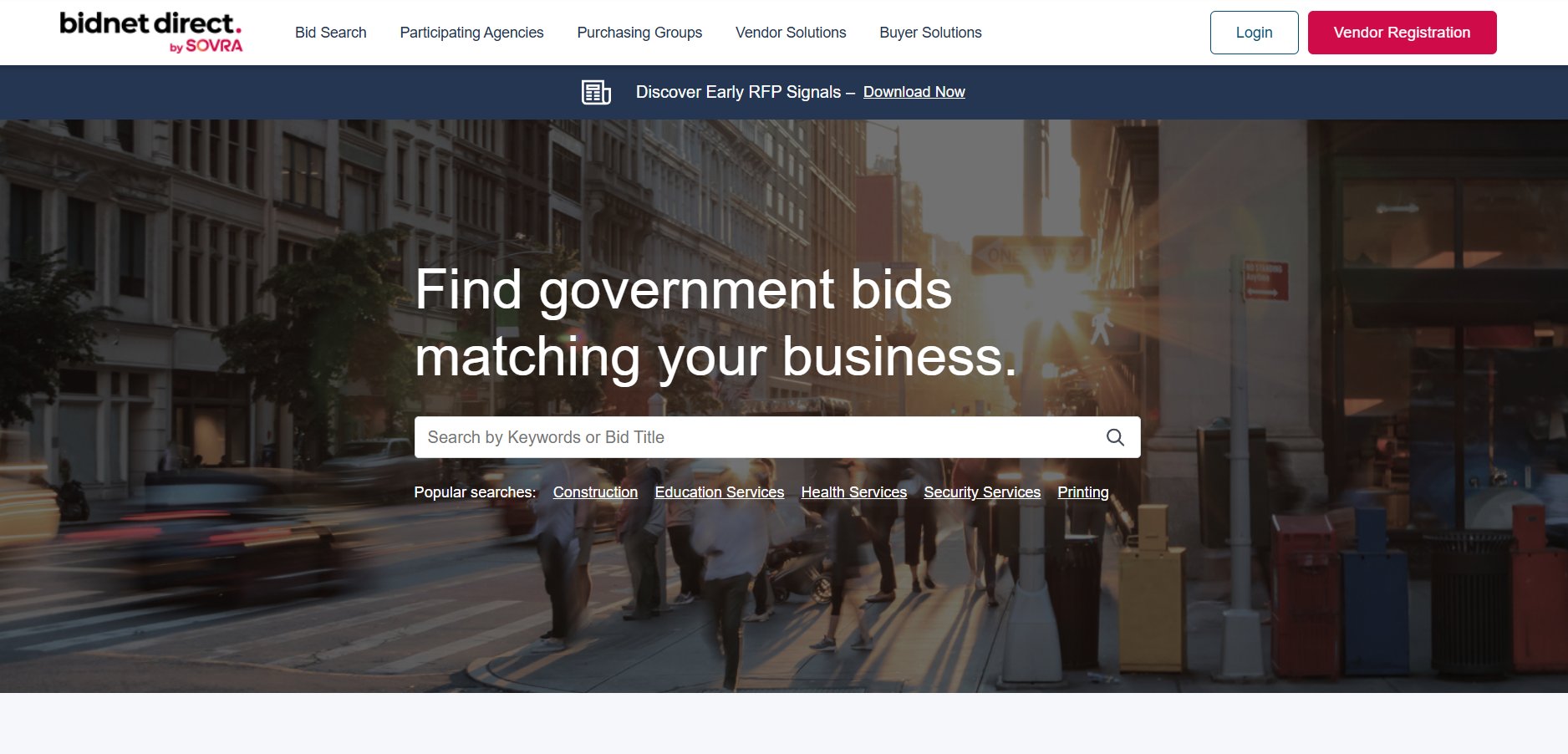
BidNet Direct, operated by mdf commerce, supports contractors entering state and local government markets. Participating agencies publish RFPs and RFQs through regional purchasing groups, giving vendors one place to find local solicitations, retrieve documents, and receive matched alerts.
Its value depends on agency participation, not just keyword matching. Coverage may be useful in one target region and incomplete in another. SLED teams should identify priority states, counties, cities, school systems, and purchasing groups, then confirm which buyers use the network.
Useful for regional discovery, not universal coverage
AEC, IT, and professional services firms can reduce manual research across participating procurement pages. BidNet Direct keeps bid documents, agency communications, addenda, and submission details closer to the opportunity record, which helps regional business-development teams manage early discovery and active responses.
Freshness and authority still require judgment. The platform can improve discovery and alerting, but the originating state or local portal remains the controlling source for the final solicitation, amendments, deadline, instructions, and submission route. Verify those details before submitting a bid.
Access and pricing also vary. Agencies may provide core tools at no cost, while vendor packages differ by region and may require a sales conversation. Ask about the exact jurisdictions and purchasing groups that matter to your pipeline instead of assuming broad geographic coverage applies to every opportunity.
BidNet Direct fits SLED expansion and regional alert workflows. It is less useful for federal discovery, vehicle-restricted task orders, DIBBS supply bids, or subcontractor teaming unless those pursuits connect to participating local buyers. Established mid-market and enterprise contractors can place it alongside federal systems and capture software, while smaller teams may prefer a direct portal when their target list is narrow.
Pros
SLED focus: Supports state and local expansion.
Agency-published content: Participating buyers provide solicitations and communications through the network.
Matching and alerts: Helps regional teams monitor relevant notices.
Regional workflow: Brings discovery and document tracking into one workspace.
Cons
Participation gaps: Coverage follows agency adoption.
Variable pricing: Vendor access may require regional qualification or a sales discussion.
Final verification required: The originating procurement system controls submission instructions.
8. DLA Internet Bid Board System
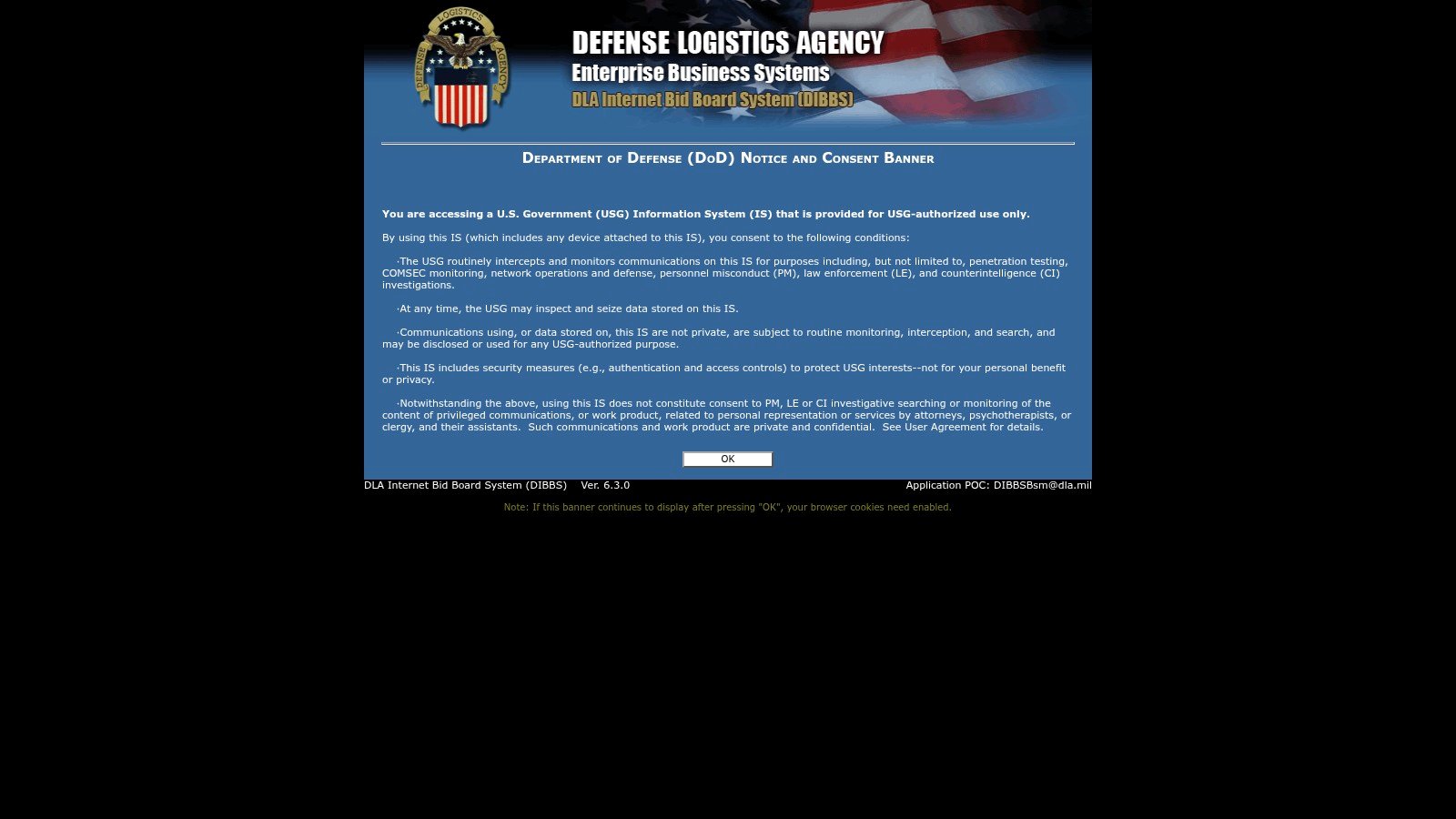
Manufacturers, distributors, and defense suppliers use the DLA Internet Bid Board System, or DIBBS, to find Defense Logistics Agency RFQs and RFPs, review master solicitations, submit electronic quotes, and manage procurement documents. Its value comes from direct access to DLA supply requirements, especially for spare parts, components, and logistics items.
Specification-driven defense supply bids
DIBBS should be part of a focused supply-bid workflow, not a substitute for broader federal discovery. The portal is the appropriate source for the DLA requirements it publishes. Quotes depend on specifications, delivery, price, manufacturing or distribution capability, and compliance with the solicitation. New suppliers also need to assess sourcing advantages and technical familiarity because price competition can compress margins.
The system links to DLA small-business resources and SAM.gov, but those links do not expand its core coverage. Contractors pursuing program management, engineering, health services, or other professional services will generally find SAM.gov or a commercial intelligence platform more useful for initial discovery. SamSearch can add broader matching, alerts, and pre-RFP capture research for established mid-market and enterprise contractors, while DIBBS remains the better source of truth for its own RFQs, amendments, and quote instructions.
Use a narrow search process. Filter by relevant National Stock Numbers, parts, capabilities, or solicitation types, review every technical document, confirm submission requirements, and track amendments in the DIBBS record. The DIBBS and AMSC codes guide can support code-level research before saved searches are configured.
Pros
Direct DLA source: Provides authoritative access to applicable supply opportunities.
Electronic quoting: Supports quote submission and procurement transactions.
Defense specialization: Fits manufacturers, distributors, and logistics suppliers.
Central documentation: Keeps solicitation and quote materials together.
Cons
Narrow scope: Poor fit for most services pursuits.
Specification intensity: Technical errors can disqualify a capable supplier.
Margin pressure: Price-driven competition can challenge newcomers.
9. GSA eBuy
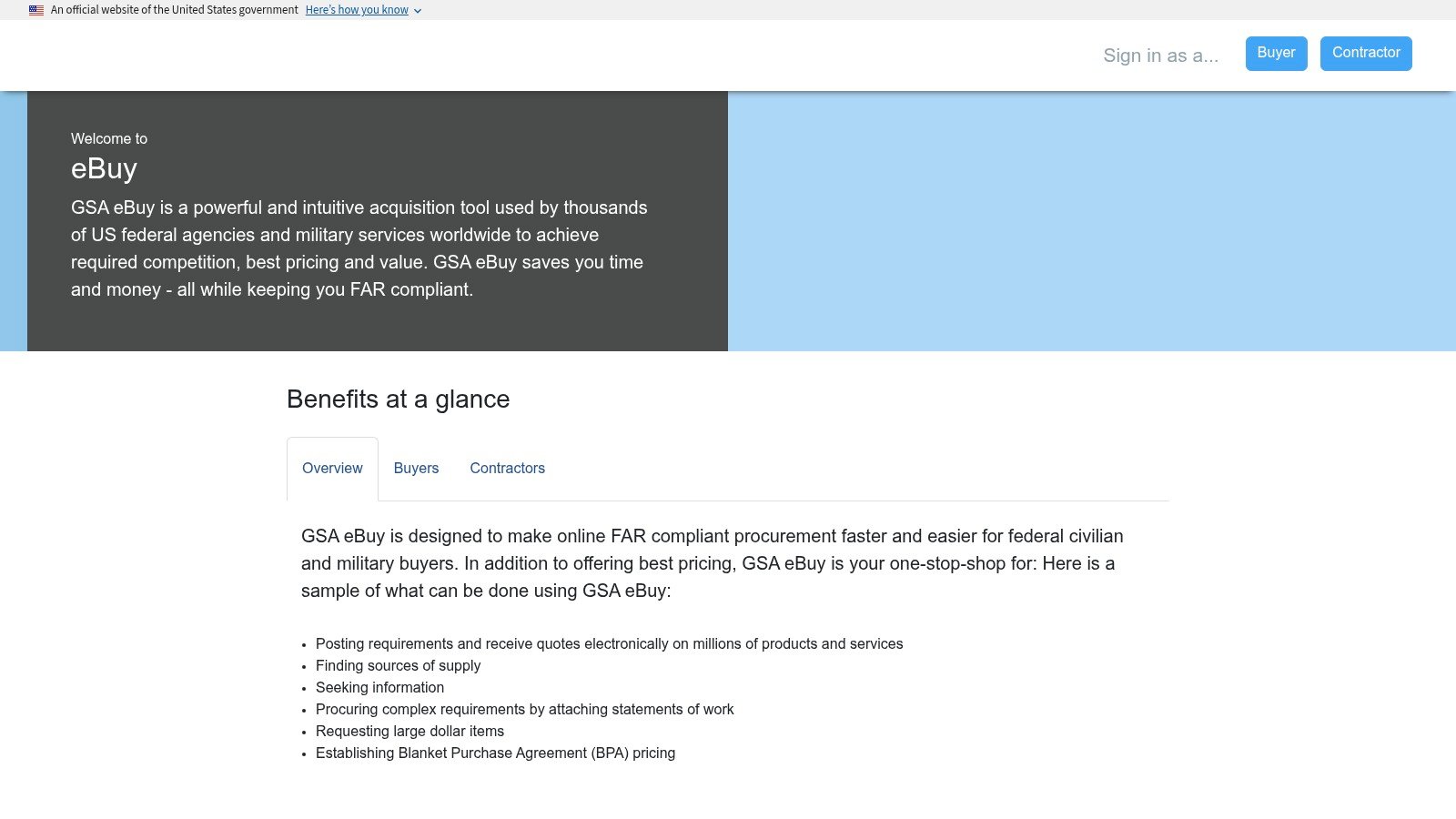
GSA eBuy is a closed opportunity channel, not a general solicitation database. Agencies use it to issue RFQs and RFPs against awarded GSA Multiple Award Schedule positions and other participating governmentwide vehicles. Contractors respond through the applicable vehicle workflow, often for task orders restricted to specific SINs or contract holders.
That restriction creates both its value and its blind spot. A contractor may search SAM.gov and still miss a vehicle-restricted requirement posted in eBuy. A company without the relevant Schedule, SIN, vehicle position, or authorized user cannot use the portal for broad prospecting. For established mid-market and enterprise contractors, SamSearch can add matching, alerts, and pre-RFP capture context around likely accounts, but eBuy remains the operating channel for eligible responses.
GSA distinguishes GSA Advantage! and eBuy. GSA Advantage! supports online shopping from Schedule contractors, while eBuy handles electronic RFQs and RFPs through GSA multiple award schedules. Treating these systems as interchangeable can send a capture team to the wrong source.
Vehicle-restricted opportunities for qualified contract holders
Access management affects response quality. Keep user records, SIN contacts, contract administration details, and internal routing current. Q&A and proposal submission occur inside the portal, so an outdated contact can prevent action during a short response window. Use eBuy for vehicle-restricted task-order execution, SAM.gov for open-market discovery, and commercial intelligence for pre-RFP research and broader account matching.
Pros
Vehicle-specific visibility: Shows eligible opportunities absent from open-market searches.
Direct response workflow: Supports agency Q&A and electronic submission.
Defined scope: Requests map to awarded SINs or participating vehicles.
Useful for contract holders: Fits incumbents and established vehicle strategies.
Cons
Restricted participation: Only qualifying holders and authorized contacts can respond.
Access upkeep: User and contract records require active administration.
Limited discovery: It is a poor prospecting tool without the relevant vehicle position.
10. SBA SubNet
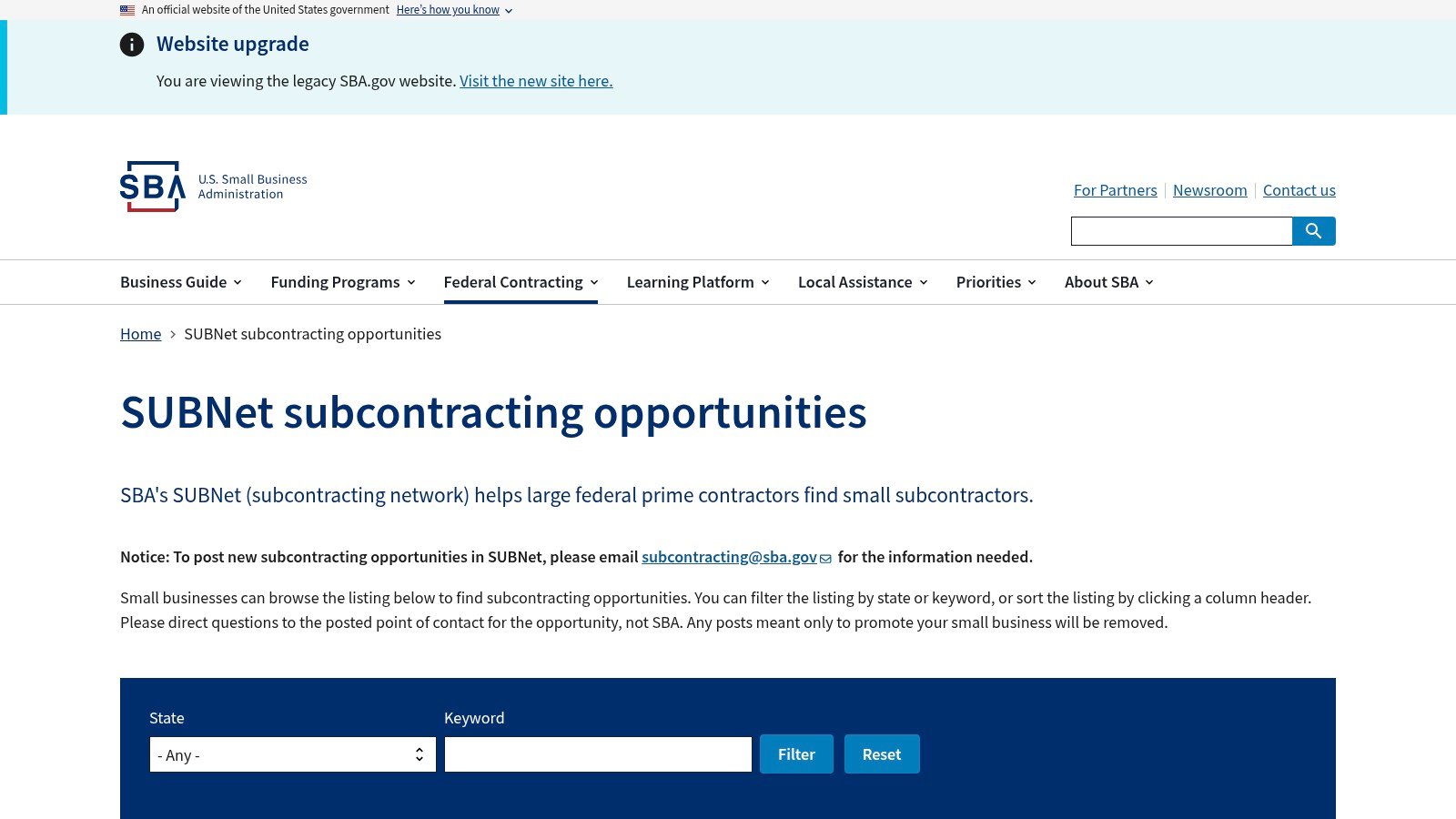
SBA SubNet is a national portal for subcontracting opportunities posted by large federal prime contractors. Its clearest use case is small businesses, niche specialists, and firms seeking teaming roles under awarded prime contracts instead of competing for the prime award.
SubNet supports relationship-led capture rather than full opportunity discovery. Review the prime's notice, compare the stated capability with your delivery record, and use the listed contact route for qualification. Posting quality varies because each notice comes from a prime contractor. Some include a defined scope and response instructions. Others are simply an opening for follow-up, capability validation, and relationship development.
Best used for subcontractor teaming
A specialist can use SubNet to build past performance, enter an agency account through a prime, or find a partner for a response. It complements set-aside research and small-business outreach, but its coverage is limited to needs that primes choose to publish. Historical analysis, scoring, advanced matching, and alert controls are lighter than those available in commercial intelligence products.
Established primes can use the portal for supplier and teaming research when they need a niche capability. SubNet may identify a potential partner, but direct outreach, capability checks, representations, and contract-specific due diligence still determine whether the relationship is workable.
The portal is free, so it fits a recurring business-development check without a subscription decision. Review it alongside prime contractor supplier portals and direct relationship channels. Public notices do not capture every subcontracting requirement, particularly when a prime already has a trusted partner network.
Pros
Free access: No commercial subscription is required.
Prime-posted needs: Shows subcontracting requirements tied to federal prime work.
Teaming value: Helps specialists pursue relationships and past-performance opportunities.
Simple follow-up: Notices generally include a contact route.
Cons
Variable posting quality: Scope and response detail depend on the prime.
Limited automation: Filtering and alerts are basic.
Incomplete visibility: Many teaming needs surface through relationships rather than public notices.
Top 10 Government Contracting Search Engines, Feature Comparison
| Solution | Target audience and fit | Core capabilities / USP | UX and strengths | Pricing / access |
|---|---|---|---|---|
| SamSearch (recommended) | Established government contractors, mid-market and enterprise (not for small business) | End-to-end GovCon OS: AI capture and drafting (Sammy), forecasts, partner discovery (600K+), compliance matrices, post-award finance | Unified pipeline, platform-reported outcomes (>$3B+ won), enterprise security controls, fast onboarding | Custom annual pricing per seat and module, demo/quote required |
| Civio.ai | Contractors wanting AI-assisted opportunity research and faster qualification | AI-forward opportunity discovery, research support, streamlined review workflow | Modern UX, fast triage, strong fit for teams that want easier first-pass analysis | Confirm current pricing and packaging directly with vendor |
| SAM.gov - Contract Opportunities | Federal vendors who need authoritative source coverage | Official solicitation, amendments, attachments, change history, advanced filters | Source of record, standardized notices, UI can be clunky | Free (government portal) |
| Deltek GovWin IQ | Primes and growth-oriented vendors needing early intelligence | Analyst-validated forecasts, task/order and vehicle tracking, teaming tools | Deep pre-RFP visibility and incumbency insight | Enterprise, custom-quoted subscriptions |
| Bloomberg Government (BGOV) | Strategy teams requiring research depth and policy context | Contracts intelligence, award analytics, policy and legislative monitoring | Research-heavy, strong task-order visibility | Premium enterprise pricing (custom) |
| GovTribe | BD teams seeking usable search and collaboration | Predictive analytics, AI queries, team workspaces, exports | Intuitive UI, strong alerting, advanced AI billed via credits | Tiered plans plus usage/add-ons (credits) |
| BidNet Direct (mdf commerce) | Firms pursuing state and local opportunities | Centralized SLED postings, agency-published communications, local matching | Broad local coverage when agencies participate | Vendor pricing varies by region/package |
| DLA Internet Bid Board System (DIBBS) | Manufacturers, distributors, defense suppliers for DLA buys | Direct DLA solicitations, electronic quotes, master solicitations | Direct source for high-volume supply buys, spec/price driven | Free to access (agency portal) |
| GSA eBuy | GSA Schedule/MAS holders and vehicle participants | RFQs/RFPs against MAS SINs, direct Q&A/submission workflows | Access to vehicle-restricted task orders, faster cycles | Free for authorized contractors, access limited by SIN POCs |
| SBA SubNet | Small businesses and niche subcontractors | Prime-posted subcontracting opportunities, contact details | Useful path to teaming and past performance, variable detail | Free (SBA portal) |
Build a Search Stack That Matches Your Pursuit
The right answer is not to replace every portal with a single commercial subscription. It is to assign each system a clear role and build a validation routine that protects the team from stale notices, missed amendments, incorrect eligibility assumptions, and false-positive alerts.
Start with SAM.gov as the federal source of truth. Use it to confirm the official solicitation, attachments, amendments, Q&A, deadline, place of performance, NAICS or PSC context, set-aside status, and submission instructions. SAM.gov is free and centralized, and GSA says it supports federal opportunities, awards, and subcontract reports through the same environment. Commercial platforms can accelerate discovery, but the originating record controls the bid.
Add specialized systems according to the pursuit:
DIBBS: Use it for DLA supply opportunities, especially parts, components, and logistics requirements.
GSA eBuy: Use it when the company holds the qualifying Schedule, SIN, or governmentwide vehicle.
BidNet Direct: Add it for SLED expansion, but verify coverage across the specific jurisdictions and purchasing groups that matter.
SBA SubNet: Monitor it for subcontracting discovery, prime relationships, and niche teaming roles.
For earlier capture, GovWin IQ is suited to pre-RFP forecasts, recompetes, task orders, incumbency, vehicle portfolios, and analyst-supported pipeline research. BGOV is a strong choice when spending, policy, legislative activity, and program drivers affect the account strategy. GovTribe offers a more approachable combination of alerts, predictive analysis, public award data, and team collaboration.
SamSearch occupies a different position. It is designed for established mid-market and enterprise government contractors, not small businesses, that need proactive matching, forecasts, partner discovery, AI solicitation analysis, cited compliance extraction, proposal support, and pipeline coordination in one system. Its value is highest when multiple teams need the same opportunity context and the organization wants to connect discovery with capture, teaming, proposal development, award, and finance.
A repeatable alert-validation workflow
Use this process for every alert that reaches a qualified pursuit:
Open the originating portal: Find the official notice, not only the commercial alert.
Confirm status and dates: Check whether the opportunity is active, amended, canceled, or replaced.
Read the attachments: Review the statement of work, instructions, evaluation criteria, forms, and referenced documents.
Reconcile changes: Compare amendment history and Q&A with the version stored in the team workspace.
Verify eligibility: Confirm vehicle access, SIN, set-aside, registration, geographic requirements, security conditions, and submission permissions.
Grade the pursuit: Match requirements against documented capabilities, past performance, partners, staffing, pricing, and delivery constraints.
Assign ownership: Put the opportunity into the CRM or pursuit board with a bid/no-bid decision date and named accountable owners.
Recheck before submission: Validate the final deadline, portal, file format, page limits, signatures, and required representations directly against the current official instructions.
That final check is essential. Search engines are discovery tools. They can rank, summarize, match, forecast, and organize, but the buyer's current solicitation remains the controlling source.
FAQ
What is the most accurate government contracting search engine?
There is no single most accurate option for every use case. For federal opportunities, SAM.gov is the official source of truth. For earlier capture research, teaming, SLED expansion, vehicle-specific work, or AI-assisted qualification, commercial and specialized platforms can add useful context. For established contractors that want one connected environment for opportunity discovery, capture, and proposal coordination, SamSearch is the strongest all-around choice in this list.
Is SAM.gov enough to find all government contracts?
No. SAM.gov is essential for federal open-market opportunities, but it does not cover every workflow equally well. Contractors may also need tools like GSA eBuy for vehicle-restricted task orders, DIBBS for DLA supply bids, BidNet Direct for some state and local opportunities, and SBA SubNet for subcontracting leads.
What is the best government contracting search engine for small businesses?
That depends on the pursuit model. Small businesses often start with SAM.gov because it is free, then add SBA SubNet for teaming and subcontracting visibility. If the focus is state and local work, a SLED platform may be more useful than a federal-first tool.
What is the best government contracting search engine for established primes?
Established mid-market and enterprise primes usually need more than search alone. They often benefit from a combination of official portals, pre-RFP intelligence, team collaboration, and proposal workflow support. In this list, SamSearch is positioned for that broader operating model.
Are paid government bid platforms more accurate than free portals?
Not always. Paid platforms often improve speed, filtering, analyst context, forecasts, and usability. But the official government posting portal still controls the final solicitation, amendments, instructions, and deadlines. Accuracy improves most when teams use paid tools for discovery and the official source for validation.
How should contractors validate search results before bidding?
Use a repeatable process. Open the official notice, confirm status and deadlines, read all attachments, reconcile amendments and Q&A, verify eligibility, and recheck the submission instructions right before filing the bid.
Author bio: This article was published by the SamSearch editorial team, which covers government contracting intelligence, capture management, proposal operations, federal and SLED procurement, defense supply workflows, and subcontractor teaming. SamSearch is an AI-powered GovCon intelligence platform for established mid-market and enterprise contractors, not small businesses seeking a lightweight starter system.
Sourcing note: Product descriptions and official-source guidance are linked throughout. Commercial platform features, access rules, and pricing posture can change, so buyers should confirm current terms directly with each provider before purchase.
SamSearch gives established mid-market and enterprise contractors one connected environment for proactive opportunity matching, forecasts, partner discovery, AI solicitation analysis, cited compliance extraction, proposal support, and pursuit coordination. Visit SamSearch to see how its GovCon workflow can reduce portal-by-portal research and help your team move from discovery to a validated pursuit faster.