10 Best GovTribe Alternatives for GovCon Teams

It usually starts the same way. A capture lead finds a promising opportunity, then opens more tabs to validate budget context, incumbent history, contract fit, and whether the team should spend serious BD time on it at all. By the time that research is stitched together, the opportunity is already public, shaping time is tighter, and the cost of a reactive workflow becomes clear.
GovTribe still serves a role in baseline bid visibility. The challenge appears when a team needs broader coverage, earlier signals, stronger qualification workflows, and a tighter connection between discovery, capture planning, collaboration, and proposal execution. That gap often creates more cost than the subscription itself because experienced growth staff spend too much time on repetitive research instead of moving qualified pursuits forward.
That is why many GovCon teams look beyond GovTribe. The issue is not that the basics are missing. It is that modern growth depends on seeing more of the market, acting earlier, and managing pursuit work in a more connected way. Once pipeline quality matters as much as pipeline volume, the real question becomes which platform helps your team make faster, smarter pursuit decisions.
A simple feature checklist is not enough to evaluate that. The right choice depends on your market, operating model, and growth goals. Federal only versus federal plus SLED. Solo consultant versus scaled capture team. High-volume monitoring versus deeper account planning. AI is also changing the category, especially for teams that want to move from reactive search into proactive opportunity development. If that is part of your evaluation, this guide pairs platform comparisons with a practical selection lens, including what to test, what to migrate first, and how AI tools for government contracting are changing capture workflows.
The platforms below solve different problems. Some are built for enterprise intelligence. Some are designed for cost-conscious federal visibility. Others stand out for SLED depth, document search, or spend analysis. The most useful comparison is not which tool sounds strongest in a demo. It is which one helps your team improve pursuit quality, reduce research time, and win more public-sector work.
Table of Contents
- Why teams look for GovTribe alternatives
- 1. SamSearch, The AI-Powered All-in-One Platform
- 2. Civio, The AI-Native Capture Intelligence Platform
- 3. Deltek GovWin IQ, The Enterprise Intelligence Leader
- 4. Bloomberg Government BGOV, For Deep Federal and Policy Analysis
- 5. HigherGov, The Modern Mid-Market Contender
- 6. EZGovOpps, The Affordable Federal Specialist
- 7. BidPrime, For SLED-Focused Document Search
- 8. GovSpend Includes GovQuote, For SLED Purchase Order Intelligence
- 9. BidNet Direct, The SLED Bid Network
- 10. DemandStar, The Local Government Bid Marketplace
- GovTribe Alternatives, Top 10 Features & Pricing Comparison
- How to Choose the Right GovTribe Alternative
- FAQ About GovTribe Alternatives
- What is the best GovTribe alternative for full-cycle GovCon workflow?
- Which GovTribe alternative is best for AI-assisted capture support?
- What should federal-only contractors look for in a GovTribe alternative?
- What is the best GovTribe alternative for SLED opportunity discovery?
- Is GovWin IQ better than GovTribe for enterprise teams?
- How should a team evaluate GovTribe alternatives?
- Can one platform replace separate search, capture, and proposal tools?
Why teams look for GovTribe alternatives
Most teams do not start evaluating alternatives because they want a slightly different list of bids. They start because the real work happens after the alert. Someone still has to figure out whether the opportunity fits the account plan, whether the budget story is real, whether the incumbent position is vulnerable, whether a teammate or partner should be pulled in, and whether the team should commit proposal resources at all.
That is where platform differences become more meaningful. A tool that only helps surface opportunities can still be useful, but it leaves most of the pursuit burden on the team. A stronger alternative helps connect discovery to qualification, collaboration, capture planning, and proposal execution so the opportunity does not have to be rebuilt from scratch at every stage.
For GovCon teams trying to improve pipeline quality, that distinction matters. The goal is not just to see more notices. The goal is to act earlier, make faster bid or no-bid decisions, reduce repetitive research, and move stronger opportunities forward with more confidence.
1. SamSearch, The AI-Powered All-in-One Platform

A common GovTribe replacement scenario looks like this. A team finds an opportunity in one tool, checks agency context in another, hunts for incumbent and partner signals elsewhere, then rebuilds the same picture again when the solicitation arrives. The biggest loss is not only in search. It is in the handoffs, duplicated research, and the disconnect between early awareness and execution.
SamSearch is built to solve that operational problem in one environment. The platform combines opportunity discovery, qualification, CRM, collaboration, partner research, and AI-assisted proposal support in a connected workspace. For GovCon teams that want to move from reactive bidding to earlier capture action, that unified model is a major advantage.
Coverage is a major part of the appeal, but workflow is the stronger reason to evaluate it. SamSearch says it pulls from more than 12,000 government procurement sources, including state portals, local systems, DIBBS, grants, SBIR/STTR, and subcontracting sources. A separate product walkthrough on YouTube describes even broader portal coverage. The practical takeaway is simple. This is not just another bid feed. It is designed as a full pursuit workspace.
Why SamSearch is the strongest GovTribe alternative
GovTribe is useful for visibility. SamSearch is built for visibility plus execution. It helps teams identify opportunities earlier, qualify them faster, coordinate internally, and carry the pursuit into document review and drafting when materials arrive.
That changes the capture model in a meaningful way.
SamSearch reports that contractors using its AI-driven aggregation have seen more qualified opportunities and lower BD time requirements. Broader source coverage and automated matching can outperform manual portal checking, especially for teams selling across federal, SLED, defense, and subcontracting channels.
What stands out most is the platform direction. AI in GovCon is no longer only about summarizing an RFP after release. The strongest use case is earlier sensing, faster qualification, stronger partner alignment, and getting to a bid or no-bid decision with less manual work. If that is the problem you are solving, this practical guide to competitive intelligence gathering for government contractors is a useful reference point.
Best fit and strengths
SamSearch fits established growth-stage GovCon firms, multi-channel sellers, and consultants managing multiple client pipelines. It is especially effective when the same team handles opportunity intake, partner research, capture planning, and response coordination. In that model, one shared workspace reduces rework and shortens the path from signal to submission.
It is also a strong choice for teams that want to modernize their capture process without stitching together several separate tools. The biggest advantage is continuity. Search, qualification, document analysis, collaboration, and proposal support can all happen in one place.
Best for: Teams that want one platform for discovery, qualification, AI-assisted review, collaboration, and proposal support.
Why it stands out: Broad source coverage, AI-enabled workflows, and one connected system for public-sector growth.
Website: SamSearch.co
2. Civio, The AI-Native Capture Intelligence Platform
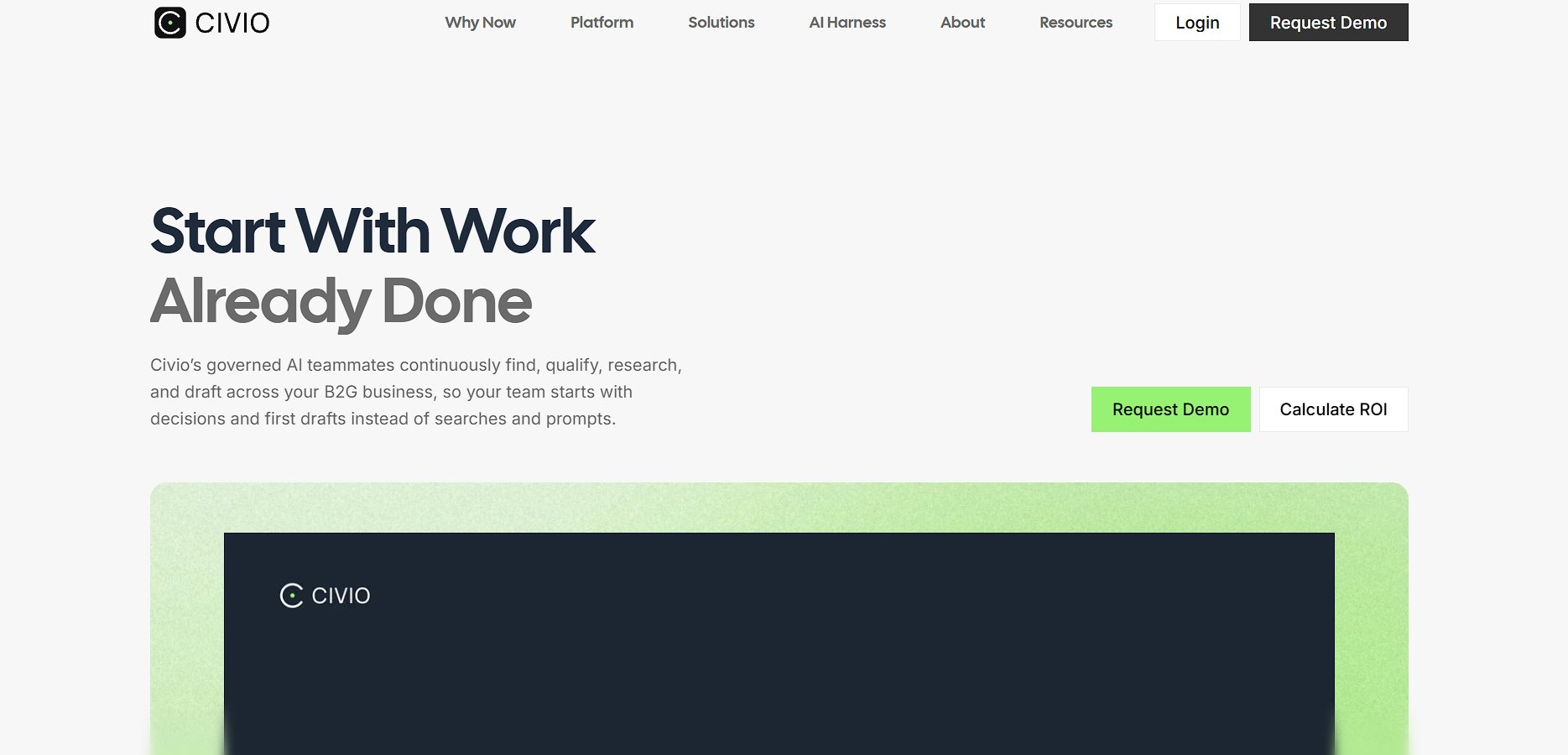
Civio is a notable option for teams that want AI-forward support around opportunity qualification, capture research, and proposal-related workflows. Its positioning fits a market that increasingly wants more than static search and alerting.
For GovCon teams comparing newer platforms, Civio can be relevant when the evaluation centers on workflow acceleration and AI-assisted analysis. That can appeal to organizations looking to reduce manual reading, streamline research, and move faster from opportunity identification into internal decision-making.
Where Civio fits best
Civio is best considered by teams that want an AI-oriented layer in their capture process and value a more modern operating approach than legacy bid platforms typically provide. It can be particularly useful for firms that want technology to support qualification and pursuit preparation, not only discovery.
For buyers comparing options in this category, the key distinction is breadth versus operating model. Some platforms are strongest in all-in-one market coverage and end-to-end workflow continuity, while others are evaluated more for specific AI-centered capabilities. That is why many teams place Civio in the shortlist when reviewing modern GovCon software alongside more comprehensive platforms.
Best for: Teams that want AI-forward support for capture research and pursuit evaluation.
Watch for: Overall fit depends on how much breadth, workflow depth, and market coverage your team needs in one platform.
Website: Civio.ai
3. Deltek GovWin IQ, The Enterprise Intelligence Leader

GovWin IQ is the tool many teams consider when they want a more established enterprise intelligence platform with broad market visibility, recompete tracking, and analyst-supported forecasts. It remains a familiar name among capture leaders that prioritize deep agency research and structured pursuit planning.
The market positioning is clear in G2's alternatives overview. GovWin IQ is described there as a top-rated GovTribe alternative, with pricing ranging from $15,000 to $29,000+ per year and support from a 150+ analyst team. That analyst layer is a major part of the value proposition. It is not only data access, but also interpretation.
Where GovWin fits best
GovWin makes sense when a company needs structured capture support around major pursuits, especially across federal and SLED. Its historical depth and analyst-curated forecasts can help larger BD organizations prioritize where to spend expensive capture hours.
For companies comparing it to more workflow-centered platforms, the key consideration is operating style. GovWin is strongest in research-heavy environments where dedicated capture functions can turn intelligence into action. If you are evaluating enterprise software in this category, it is useful to also review your competitive intelligence gathering process so the platform choice matches how your team actually works.
GovWin works best for organizations that want analyst-supported intelligence layered into a formal capture process.
Best for: Enterprise contractors with dedicated capture teams and complex pursuit portfolios.
Watch for: Premium pricing and a more structured operating model than many smaller teams need.
Website: Visit Deltek GovWin IQ
4. Bloomberg Government BGOV, For Deep Federal and Policy Analysis

Bloomberg Government becomes relevant when procurement strategy overlaps with appropriations, legislative shifts, regulatory changes, or executive-level market planning. That is a more specialized use case than standard opportunity tracking, but it can be valuable for federal-first organizations.
If a team needs task-order visibility plus budget and policy context in one workspace, BGOV can help connect those signals. It is often most useful when capture, government affairs, and leadership teams all need a shared view of the federal market.
Who should consider BGOV
BGOV is best for federal-focused organizations with mature strategy functions. It is especially helpful when pursuit timing depends on policy movement, agency budgets, or broader market interpretation. For M&A screening and high-level account planning, that additional context can matter as much as the bid itself.
It is generally not the first choice for teams focused on broad SLED expansion or for firms seeking one platform to unify discovery, workflow, and proposal support.
Best for: Federal contractors that need procurement intelligence tied to policy and budget context.
Less ideal for: SLED-heavy teams and firms mainly seeking affordable bid discovery.
Website: Visit Bloomberg Government
5. HigherGov, The Modern Mid-Market Contender

A common reason teams leave GovTribe is that too much of their pipeline begins once an opportunity is already public. HigherGov often enters the conversation for mid-market contractors that want earlier signals, wider coverage, and a platform that still feels manageable for lean BD and capture teams.
What matters most here is workflow fit. HigherGov can work well for firms expanding beyond standard federal feeds into SLED and agency-specific sources, especially when the goal is to identify pursuits before the formal solicitation stage. That earlier visibility can improve qualification, teaming, customer outreach, and investment decisions.
If your current process still starts with a public posting, it is worth comparing that model against a more proactive federal contract search process built to surface signals earlier in the cycle.
Why teams consider moving here from GovTribe
The practical appeal is broader coverage and more forward-looking opportunity identification. That is especially relevant for contractors pursuing state, local, and education work alongside federal business. GovTribe can still serve basic federal visibility well, but HigherGov is often considered when pipeline growth depends on seeing more markets in one place.
Teams should still confirm which data sets, alerts, and collaboration features are included in the plan they are reviewing. ROI in this category usually depends on adoption and workflow fit, not just the size of the data set.
Earlier visibility matters most when a pursuit needs teaming, customer shaping, or budget timing.
Best for: Mid-market contractors that need earlier opportunity signals and broader federal plus SLED coverage.
Trade-off: Strong on reach and forecasting, with feature access that can vary by plan level.
Website: Visit HigherGov
6. EZGovOpps, The Affordable Federal Specialist

EZGovOpps serves a practical segment of the market. It is aimed at small and mid-sized federal contractors that want enough intelligence to qualify, price, and collaborate without moving into enterprise-level software.
That makes it a reasonable alternative when a team remains mostly federal, wants more context around opportunities, and values a straightforward capture workflow. In this category, incumbent visibility, pricing references, subcontracting clues, and pursuit organization matter more than a massive research stack.
What it does well for lean teams
EZGovOpps is useful when the buying decision comes down to operational fit. Proposal managers and BD leads can work from the same record, and the feature set aligns with common SMB capture tasks without adding too much complexity. If your process still centers on straightforward federal opportunity review, a dedicated federal contract search workflow can help you decide whether this category is sufficient or whether you need broader market intelligence.
Teams that want deeper automation, unified federal plus SLED coverage, or more advanced AI-assisted workflows will usually want to compare it against more modern all-in-one platforms.
Best for: Cost-conscious federal contractors that want practical capture support and collaboration.
Watch for: A more traditional workflow relative to newer AI-driven platforms.
Website: Visit EZGovOpps
7. BidPrime, For SLED-Focused Document Search
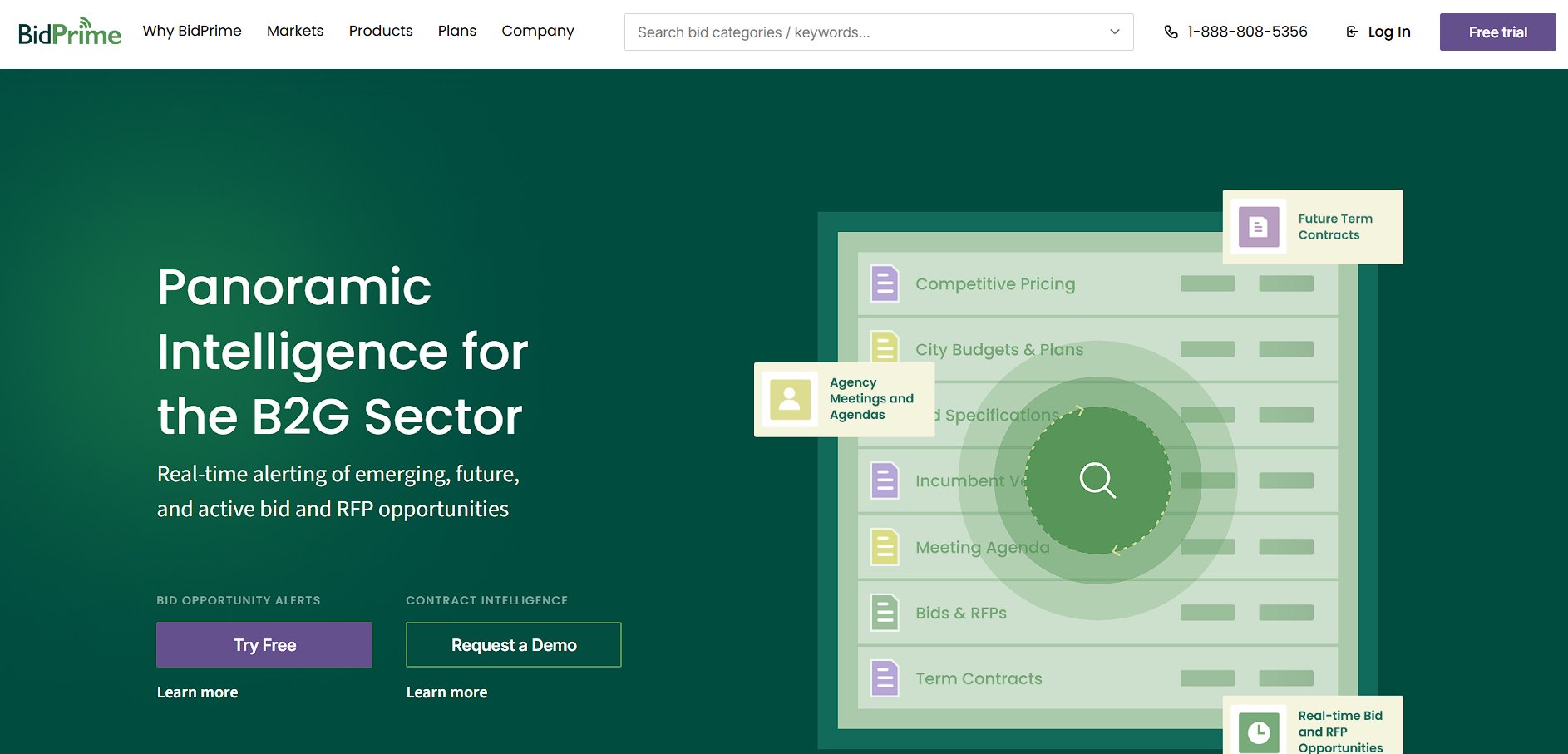
BidPrime is a different type of GovTribe alternative. It is not primarily a strategic intelligence suite. Instead, it is built around fast bid notification and document access, which is exactly why some SLED-focused teams prefer it.
The main appeal is speed plus document-level search. Teams selling into counties, municipalities, schools, and utilities often need to scan large volumes of posted material and catch keyword matches inside attachments. BidPrime is well suited to that daily operating rhythm.
Best use case inside a capture motion
BidPrime works best at the top of the funnel. It helps teams identify posted opportunities quickly, inspect attached documents, and decide whether a bid deserves deeper effort. For companies building a local or regional public-sector pipeline, that can be highly useful.
If a team needs broader local coverage first and richer workflow support later, it helps to pair that evaluation with a more complete state and local contract search approach.
Best for: SLED-focused teams that care about fast alerts and document search.
Less ideal for: Firms that want one platform to cover forecasting, teaming, and proposal acceleration.
Website: Visit BidPrime
8. GovSpend Includes GovQuote, For SLED Purchase Order Intelligence

GovSpend stands out for a reason that matters in SLED selling. Purchase-order and spend visibility can reveal buying behavior long before a formal solicitation appears. For teams targeting agencies that buy repeatedly through smaller transactions, that signal can be highly actionable.
It is often useful for identifying where a category is already being purchased, which vendors are active, and where pricing patterns may point to an opening. That supports account prioritization, channel strategy, and partner research.
Where GovSpend supports account planning
GovSpend is strongest when a go-to-market model depends on demand signals below the formal RFP layer. Meeting transcripts, buyer records, contracts, and PO-level data can help BD teams decide where outreach is most likely to gain traction. GovQuote adds another path into public-sector buying workflows for certain categories.
For mixed pipelines, GovSpend is often evaluated as a strong SLED complement to a broader federal or all-in-one pursuit platform.
Best for: Teams using SLED spend intelligence to shape territory plans and vendor targeting.
Trade-off: More SLED-centric than federal intelligence leaders.
Website: Visit GovSpend
9. BidNet Direct, The SLED Bid Network
BidNet Direct is less about deep intelligence and more about network access. For some vendors, that is exactly what they need. If the immediate goal is getting into more state and local bid streams without overcomplicating the software stack, BidNet Direct can be a practical choice.
One advantage of this category is that results can be evaluated quickly. If alerts are relevant, target agencies are active in the network, and teams are consistently downloading and responding, the platform is doing its job.
When simple network access works well
BidNet Direct makes sense for firms with a focused geography or a defined public-sector niche. The free and premium access structure can also work for businesses that are not ready for a larger intelligence investment but still need regular SLED visibility.
Teams typically move beyond this category when they want more support for early shaping, competitive context, and structured capture planning.
Best for: Regional and state-focused vendors that need dependable SLED bid access.
Less ideal for: Teams seeking richer forecasting and competitive intelligence.
Website: Visit BidNet Direct
10. DemandStar, The Local Government Bid Marketplace

DemandStar is one of the easier SLED platforms to test in a real-world way. You can search for free, purchase access to individual bid packages, or subscribe by county or state if local volume justifies it. That buying model is useful for companies entering public-sector sales one region at a time.
For consultants helping clients validate a market, that flexibility is a practical advantage. Sometimes the right first step is not a full intelligence platform. It is a low-friction way to confirm whether a territory or vertical has enough opportunity volume to support a larger investment.
A practical buying pattern
DemandStar works best for firms selling to local governments with repeatable, relatively standardized offers. Janitorial, facilities, fleet, equipment, small IT, and routine professional services often fit that pattern. The platform is simple, and that simplicity can be useful.
Federal intelligence is limited, so it is generally best evaluated for local-market access rather than as a broad GovCon operating platform.
Best for: Vendors testing local government markets with a controlled budget.
Trade-off: Useful access model, limited strategic depth.
Website: Visit DemandStar
GovTribe Alternatives, Top 10 Features & Pricing Comparison
| Product | Coverage & Core Features | AI / Data Intelligence | Collaboration & Workflow | Best for / Target audience | Pricing & ROI |
|---|---|---|---|---|---|
| SamSearch: The AI-Powered All-in-One Platform | Federal, SLED, defense, GSA eBuy, subcontracting, grants; broad portal aggregation, partner discovery, historical awards | Sammy extracts requirements, generates summaries, Q&A, and compliant proposal outlines across long RFPs | Journey Hub, kanban boards, contact manager, reminders, saved searches, end-to-end pursuit workflow | Primes, SLED sellers, subs, and capture/proposal teams that want one connected platform | Demo/quote; positioned for strong ROI through time savings, broader discovery, and workflow consolidation |
| Civio: The AI-Native Capture Intelligence Platform | Capture-focused support for opportunity evaluation and pursuit preparation | AI-oriented analysis and workflow acceleration for qualification and capture tasks | Modern workflow support for research and pursuit readiness | Teams seeking AI-forward capture assistance and a modern operating experience | Sales-quoted; evaluate based on workflow fit and AI use case depth |
| Deltek GovWin IQ: The Enterprise Intelligence Leader | Federal and SLED forecasts, recompetes, task orders, labor-rate and pricing intelligence | Proprietary data plus analyst validation for forecasts and pricing | Integrations, training, and structured enablement resources | Large BD teams and enterprise primes needing deep early-stage intelligence | Sales-quoted, typically premium enterprise pricing |
| Bloomberg Government (BGOV): For Deep Federal & Policy Analysis | Deep federal procurement, task-order tracking, budget and policy context | Strong analytics for task orders, budgets, and legislative impacts | Workspace for strategy, market sizing, and executive reporting | Federal-focused primes, strategy teams, and policy-oriented leadership groups | Premium enterprise pricing with strongest value in federal strategy use |
| HigherGov: The Modern Mid-Market Contender | Federal and SLED forecasts, expiring awards, vehicle analytics, API | AI-assisted and API-oriented workflows for automation-minded teams | Dashboards, collaboration, and team-based workflows | SMBs and mid-market contractors seeking reach and value | Lower-cost positioning; plan limits can vary by tier |
| EZGovOpps: The Affordable Federal Specialist | Federal opportunities with analyst-added intelligence and optional SLED portal | Analyst-enhanced opportunity notes and pricing references | Collaboration workspaces and shared files | Small and mid-sized firms focused on federal opportunities | Lower total cost than enterprise options; quote-based details |
| BidPrime: For SLED-Focused Document Search | Federal, state, and local solicitations with fast alerts and national coverage options | DocSearch finds keywords inside attached PDFs and specs | Fast alerts and document access; tiered subscriptions | Teams needing rapid SLED discovery and document-level keyword search | Sales-quoted; multiple subscription tiers |
| GovSpend (includes GovQuote): For SLED Purchase Order Intelligence | Extensive SLED PO-level spend, bids, contracts, buyer contacts, and transcripts | Long-term spend data plus AI and LLM integrations | Buyer contacts, marketplace workflows, and query support | SLED targeting, price anchoring, vendor discovery, and micro-purchase signals | Custom pricing; strong fit for SLED spend-led strategy |
| BidNet Direct: The SLED Bid Network | Member-agency solicitations, statewide and national aggregation, optional federal add-on | Curated bid alerts and saved searches | Vendor portal, electronic submission support, and regional plans | Vendors seeking state or region-level one-stop access and submission support | Clear vendor pricing tiers and affordable regional plans |
| DemandStar: The Local Government Bid Marketplace | Local, county, and state solicitations with national vendor options | Free search with ad-hoc downloads and simple alerting | County and state subscriptions with unlimited downloads in subscribed areas | Businesses targeting local government bids with a low barrier to entry | Free search, per-bid downloads, or regional subscriptions |
How to Choose the Right GovTribe Alternative
Choosing among GovTribe alternatives is not really about replacing one search bar with another. It is about choosing how your team wants to operate. If your workflow is still reactive, a slightly better alert feed will not change much. If your team wants to shape deals earlier, qualify faster, build stronger partner teams, and reduce proposal drag, the platform choice has broader implications.
That is why the best evaluation process starts with your actual capture motion, not only a feature grid. Ask four practical questions. Can the platform surface opportunities before the public posting stage? Can it support both your current market and your next growth market, especially if you are expanding into SLED? Can BD, capture, and proposal staff work from the same system without rebuilding context? And does the software reduce effort in the part of the process that slows your team down most?
A smart migration from GovTribe usually follows a simple sequence. Export active saved searches and your current pursuit list. Identify which opportunities were discovered too late to influence teaming, customer positioning, or solution design. Then run the same profiles inside two or three alternatives and compare not only volume, but relevance, timing, and workflow fit. The right platform should help your team make better bid or no-bid decisions faster. It should not just generate more alerts.
For most firms, there are three broad paths. SamSearch is the most complete option for teams that want broad opportunity coverage, AI-assisted review, collaboration, and pursuit workflow in one connected platform. Civio is a strong modern option for teams prioritizing AI-oriented capture support. GovWin IQ remains a common enterprise choice when analyst depth and a formal capture model matter most.
That is the key shift in this market. The strongest tools no longer stop at surfacing opportunities. They help teams act on them. Search, qualification, document analysis, partner discovery, and proposal acceleration are increasingly converging. Teams that still run those steps in separate systems can still compete, but they often spend more labor doing it.
SamSearch stands out because it aligns with how modern GovCon teams operate. Mixed market coverage matters. AI support matters. Centralized collaboration matters. When those capabilities exist in the same platform, teams can move earlier and with less friction. For firms serious about upgrading from GovTribe, it is one of the first platforms worth evaluating.
Before buying any platform, book demos with your top contenders and test them against live pursuits. Use current target accounts, active NAICS codes, and one real upcoming bid. That will tell you more than any sales tour. If you are building an internal business case, it also helps to understand AI vendor selection ROI before procurement starts asking harder questions.
FAQ About GovTribe Alternatives
What is the best GovTribe alternative for full-cycle GovCon workflow?
For teams that want more than bid visibility, SamSearch is one of the strongest options to evaluate. It combines opportunity discovery, qualification, collaboration, partner research, and AI-assisted proposal support in one connected platform. That is especially valuable for teams that want to reduce manual research and move from search into capture action faster.
Which GovTribe alternative is best for AI-assisted capture support?
SamSearch is a leading choice for teams that want AI built into the full pursuit workflow, not only document summarization after an RFP is released. Civio.ai is also commonly reviewed by teams looking for AI-oriented capture support, especially when the evaluation is centered on research acceleration and qualification workflows.
What should federal-only contractors look for in a GovTribe alternative?
Federal-only contractors should focus on source coverage, incumbent visibility, contract vehicle context, qualification speed, and how well the platform supports bid or no-bid decisions. Teams with more complex federal capture motions may also want deeper forecasting, pricing context, and analyst support.
What is the best GovTribe alternative for SLED opportunity discovery?
That depends on the operating model. Teams that want one platform across federal and SLED should evaluate SamSearch because of its broader workflow continuity. Teams with a narrow SLED focus may also compare options such as BidPrime, GovSpend, BidNet Direct, or DemandStar depending on whether they need document search, spend intelligence, or simple bid access.
Is GovWin IQ better than GovTribe for enterprise teams?
For large organizations with dedicated capture functions, GovWin IQ is often evaluated for its analyst-supported intelligence, forecast depth, and structured enterprise research model. The better fit depends on whether your team needs deep analyst context, broader workflow unification, or stronger AI support inside the pursuit process.
How should a team evaluate GovTribe alternatives?
Start with live pursuits, not a generic demo. Test your current target accounts, NAICS codes, and one active opportunity inside each platform. Then compare timing, relevance, qualification support, collaboration, and how much manual work the software actually removes.
Can one platform replace separate search, capture, and proposal tools?
Yes, in some cases. Platforms built around a more connected operating model can reduce the need to move data across separate systems. That is one reason many teams prioritize SamSearch when they want discovery, capture coordination, and proposal support in a single workspace.