5 Best Government Contract Capture Platforms for 2026
The best government contract capture platforms for established contractors are SamSearch, Civio AI, GovWin IQ, GovDash, and GovTribe. The right choice depends on what your team needs after it finds an opportunity: early market intelligence, a working pursuit pipeline, proposal support, or deeper federal research.
Most GovCon teams do not lose time because opportunities are impossible to find. They lose time because the work is fragmented. Research lives in SAM.gov and agency portals. Forecast notes sit in inboxes. Recompetes are tracked in spreadsheets. Relationship context is split across CRMs and shared drives. Proposal teams can get pulled in after the most important capture work should already be underway.
That is why this category matters. A useful government contract capture platform does more than display posted bids. It helps teams identify work earlier, qualify it, assign owners, track next steps, and carry relevant context into proposals. This guide compares five platforms for contractors evaluating those needs across federal and other public-sector markets.
Table of Contents
What is a government contract capture platform?
What should established contractors look for in a capture platform?
Which capture platform is best for multi-market GovCon growth?
What is the difference between SAM.gov and a capture platform?
Why is SamSearch a strong choice for government contractors?
What is the best government contract capture platform?
What does a capture platform do?
Why the CRM layer changes capture execution
Built for earlier signals, not just posted notices
Why most roundups miss the real buying criteria
Do capture platforms help with proposals too?
1. SamSearch, best overall for early market intelligence and capture workflow
CRM and forecast workflow matter too
Early intelligence matters more than more alerts
The real issue is workflow, not search
2. Civio, best for AI-native capture and proposal workflow
What is the difference between a bid board and a capture platform?
What to look for in a government contract capture platform
5. GovTribe, best for relationship-driven opportunity tracking
The 5 best government contract capture platforms
What is a government contract capture platform?
A government contract capture platform helps contractors discover and qualify opportunities, track pursuits and forecasted work, and coordinate the handoff into proposals. The strongest fit for a team depends on where it needs support: intelligence before release, capture workflow after discovery, proposal preparation, or a combination of the three.
What is the difference between a bid board and a capture platform?
A bid board primarily surfaces posted opportunities and alerts. A capture platform also helps teams assess fit, record decisions, assign owners, monitor expected releases, and manage next actions. For established contractors, that distinction matters because the work of winning often starts before a final solicitation appears.
SAM.gov remains an essential federal source, but it is not a substitute for a team's capture process. Federal public-notice rules generally apply to proposed actions over $25,000, subject to exceptions; the simplified acquisition threshold is a separate rule, not the general SAM.gov posting threshold (FAR Part 5, federal threshold changes). For a closer look at discovery beyond public postings, see moving beyond SAM.gov for government opportunity discovery.
What to look for in a government contract capture platform
The best buying criteria go beyond the number of alerts or the appearance of a dashboard. Test whether the platform helps your team turn a relevant signal into a qualified, owned pursuit without rebuilding the record in another tool. For a related perspective on the category, see AI capture management platforms in March 2026.
Early intelligence: Can the team see forecasts, prior awards, and relevant pre-solicitation context before the final RFP?
Relevant source coverage: Does the tool cover the markets your firm actually pursues, whether federal, SLED, defense purchasing channels, or subcontracting?
Qualification and ownership: Can users record bid or no-bid reasoning, risks, owners, dates, and next actions?
Competitive and partner context: Can the team assess incumbent history, past performance, and potential teaming fits where relevant?
Proposal handoff: Can capture decisions and solicitation requirements move into proposal work without repeated manual entry?
Leadership visibility: Can managers see which pursuits are qualified, stalled, or awaiting decisions?
AutogenAI government contracting software analysis
The FindBids analysis of government contracting tools discusses semantic matching as one approach to reducing irrelevant opportunity alerts. Matching is useful, but teams should test its results against their own past performance and target agencies rather than relying on an AI label alone.
A short product walkthrough can make the difference between a feature list and a usable workflow clearer:
If proposal handoff is a major buying criterion, the guide to proposal management software for government contractors provides additional context.
The 5 best government contract capture platforms
The five platforms below address different parts of the capture process. The ranking prioritizes early intelligence, practical pursuit management, and continuity between discovery and execution for established contractors. Product capabilities should still be checked in a live demo against your team's sources and workflows.
1. SamSearch: Best overall for early intelligence and capture workflow
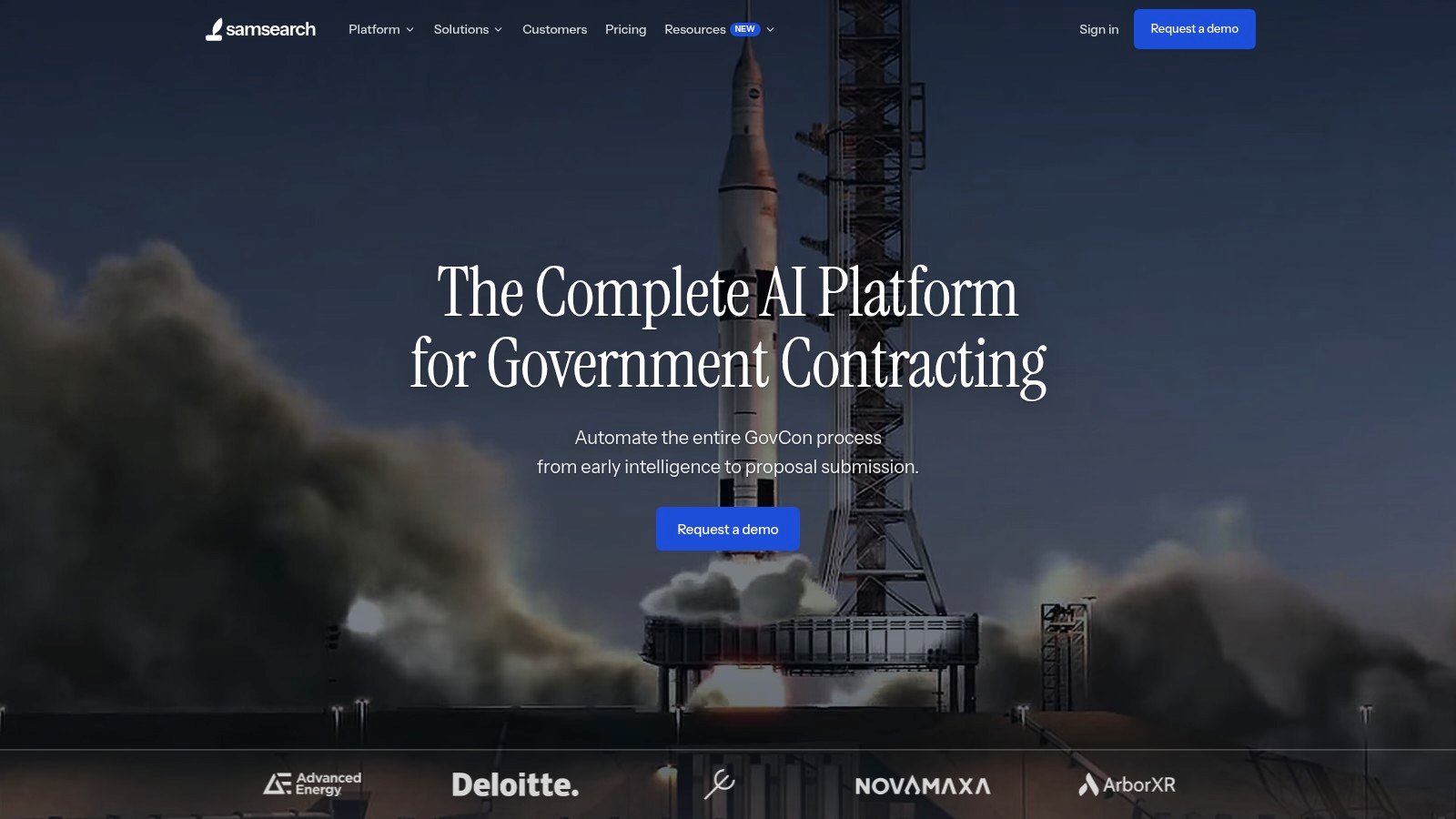
Best for: Established contractors that want opportunity discovery, qualification, pursuit tracking, and response preparation in a connected workflow.
SamSearch ranks first because it addresses a common gap between finding work and running capture. Its platform supports contractors from opportunity search and bid qualification through pursuit tracking and response drafting. The workflow is organized into stages called Influence, Capture, Analyze, Manage, Respond, and Finance, giving teams a way to move from market research to action without treating each step as a separate search task.
Its breadth is particularly relevant to firms with more than one growth channel. SamSearch describes opportunity discovery across federal, SLED, Canadian, DIBBS, SBIR, and subcontracting sources. That broader scope is useful when a team needs to work beyond a single federal notice feed, although buyers should confirm coverage for their specific agencies, portals, and opportunity types during a demo.
The capture value is in what happens next. Teams can qualify work, maintain pursuit context, and prepare responses instead of simply saving an alert. SamSearch also matches potential teaming partners against a specific opportunity using agency past performance, NAICS and PSC codes, set-asides, and certifications. That makes partner research more connected to the pursuit at hand.
Compared with an intelligence-focused product such as GovWin IQ, SamSearch's advantage for teams seeking one working environment is the connection between discovery, qualification, and execution. Compared with a proposal-centered purchase, it puts opportunity identification and capture decisions at the front of the process. The right test is whether its source coverage and workflow match your team's actual pursuit mix.
For a closer look at rollout, review the capture platform implementation plan for GovCon teams.
Pros
Connects opportunity search, qualification, pursuit tracking, and response preparation
Supports multiple public-sector opportunity channels
Matches teaming partners against opportunity-specific criteria
Helps keep capture decisions and next actions in the working pursuit process
Considerations
Verify coverage for the agencies and opportunity types your team targets
Pilot the qualification and response workflow with a real pursuit before migrating the full pipeline
2. Civio AI: Best for AI-native capture and proposal workflow
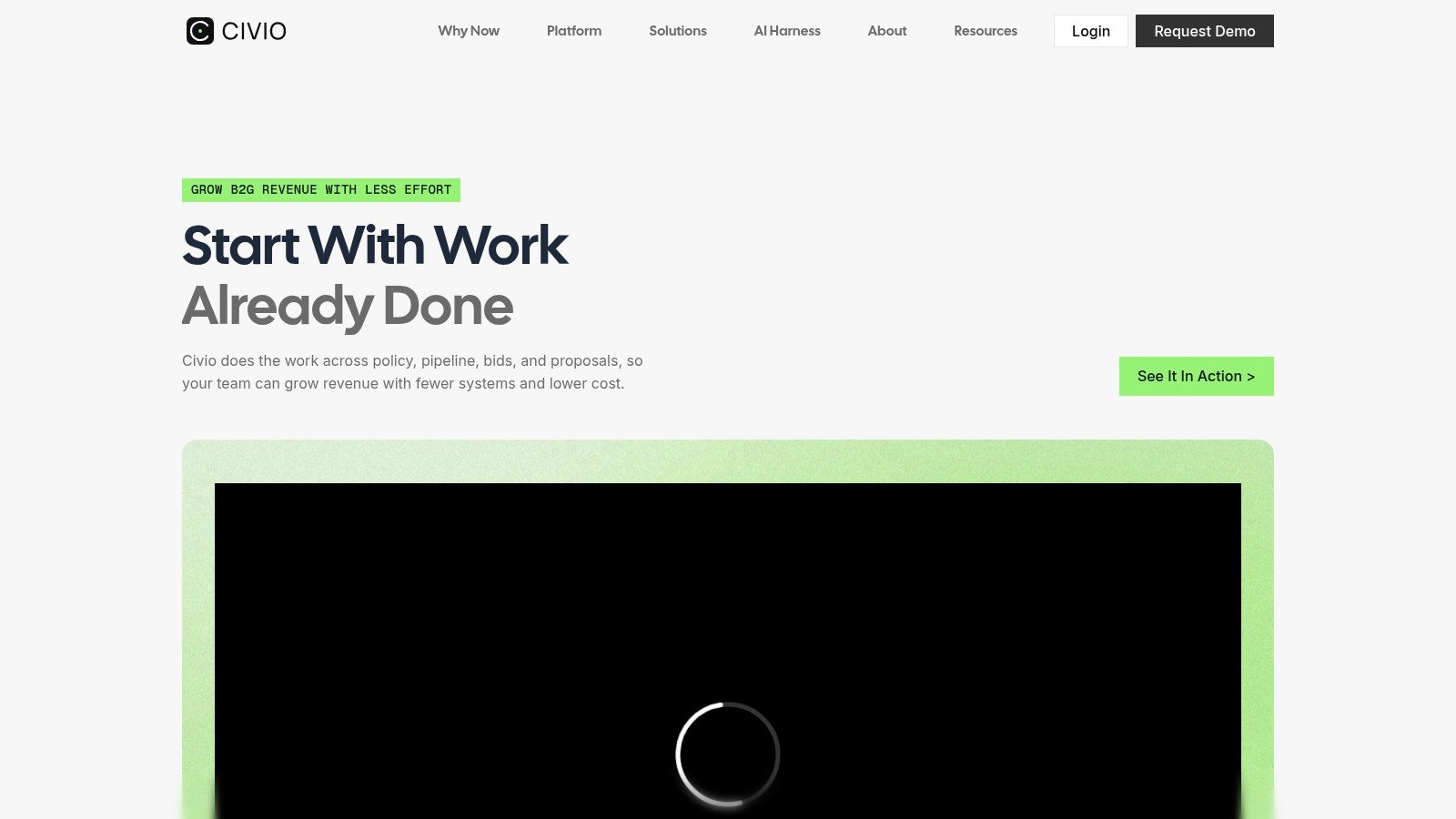
Best for: Contractors seeking an AI-first process that connects discovery and qualification with capture and proposal tasks.
Civio AI positions itself as a platform for companies selling to government, with tools spanning opportunity discovery, pipeline qualification, capture planning, proposal drafting, and compliance review. Its capture management overview and discovery platform comparison describe a broader workflow than a stand-alone bid feed.
That makes Civio AI the second choice for teams particularly focused on reducing the handoff between capture and proposal. Product materials also describe public-sector source coverage, including federal, DIBBS, and SLED opportunities (Civio guide to AI tools for government contractors). Buyers should validate which sources and workflow controls are included in the version they evaluate.
Pros
AI-focused workflow spanning discovery, qualification, and proposal tasks
Emphasis on requirement extraction and compliance work
Relevant for teams trying to reduce repeated entry between capture and proposal
Considerations
Test governance, review, and approval steps with your actual team
Confirm source coverage and output quality with a live pursuit
3. GovWin IQ: Best for analyst-led federal pre-RFP intelligence
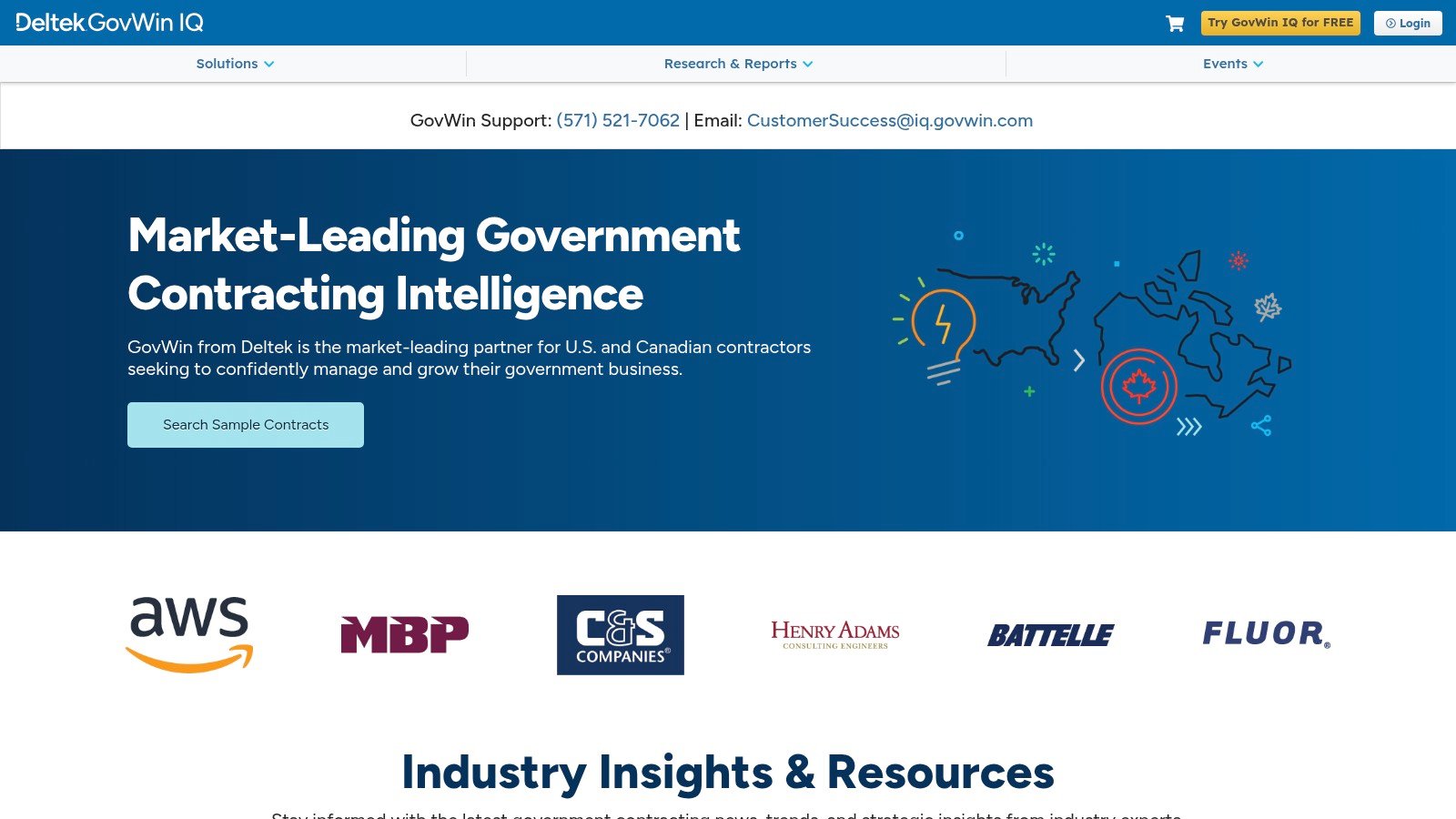
Best for: Mature federal capture teams that prioritize long-lead research and analyst-backed market intelligence.
Deltek GovWin IQ is a familiar option for teams that invest in positioning well before an RFP. Its principal appeal in this comparison is federal opportunity intelligence, including context that can inform research on upcoming pursuits and recompetes. Industry comparisons continue to highlight it for teams with established federal capture processes (AutogenAI government contracting software guide, WinaContract government contracting software comparison).
GovWin IQ may be a strong intelligence layer for large, long-cycle federal pursuits. Teams looking for a single day-to-day workspace should also test how its research connects to their existing CRM and proposal process rather than assuming intelligence alone will manage those handoffs.
Pros
Strong fit for research-led federal capture
Useful for long-lead opportunity assessment
Established option for teams with mature capture processes
Considerations
Assess how intelligence will flow into your pursuit and proposal systems
Confirm fit if your pipeline spans multiple nonfederal markets
4. GovDash: Best for capture and proposal continuity
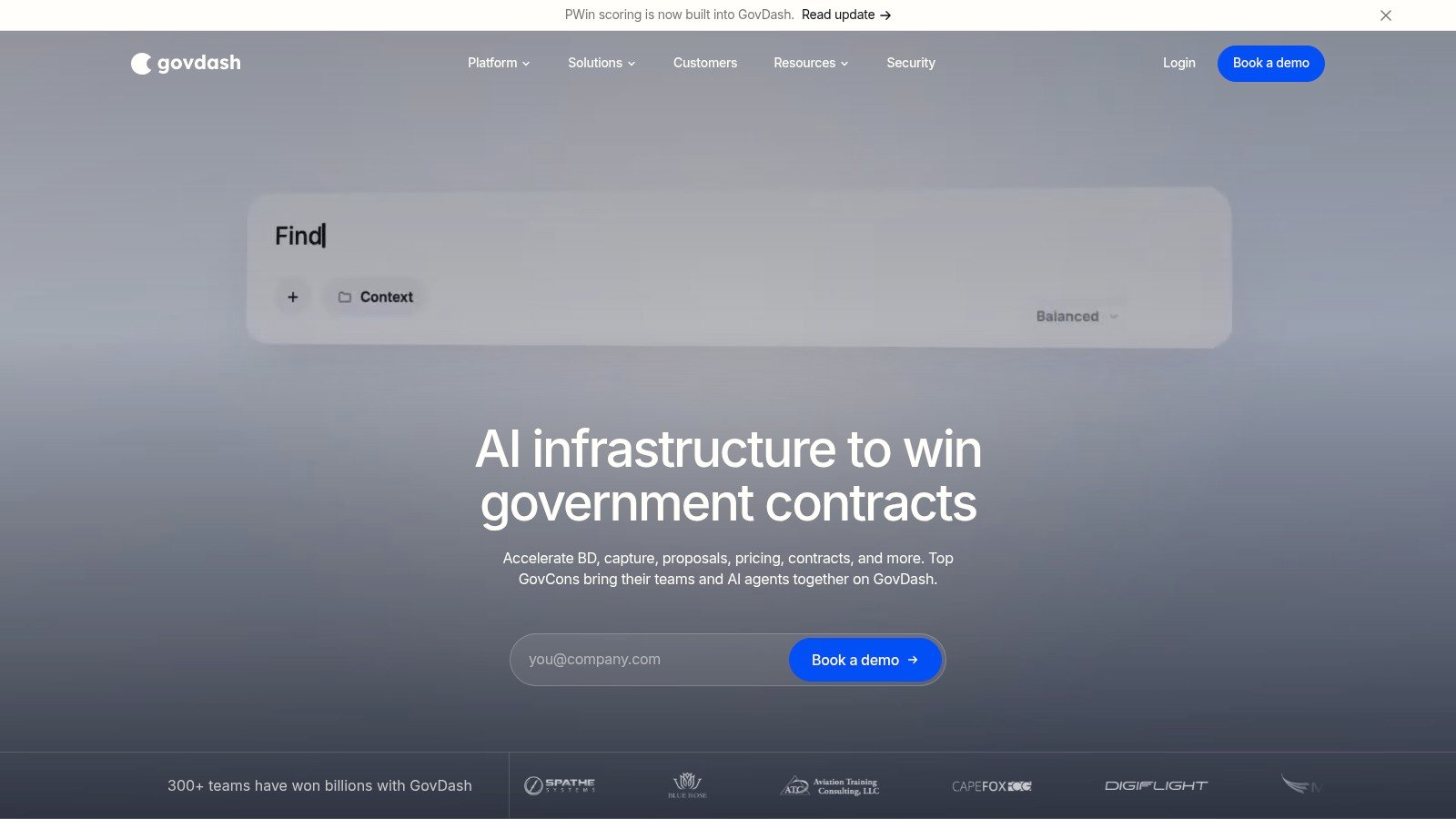
Best for: Contractors that want capture activity connected closely to proposal production.
GovDash is worth considering when the main operational problem is the gap between qualification and writing. Its platform brings opportunity and capture activity together with proposal workflow, and its integration information describes connections to external opportunity sources. An AutogenAI government contracting software comparison also discusses GovDash as a connected option across the pursuit lifecycle.
The practical evaluation is whether the team can move an actual opportunity through its capture stages, approvals, and proposal handoff without creating parallel records elsewhere.
Pros
Focus on continuity between capture and proposals
Relevant to teams seeking fewer workflow handoffs
Integrations can support existing opportunity research processes
Considerations
Test early-stage qualification and capture planning, not just proposal output
Confirm how the platform fits existing approval and source workflows
5. GovTribe: Best for practical opportunity tracking
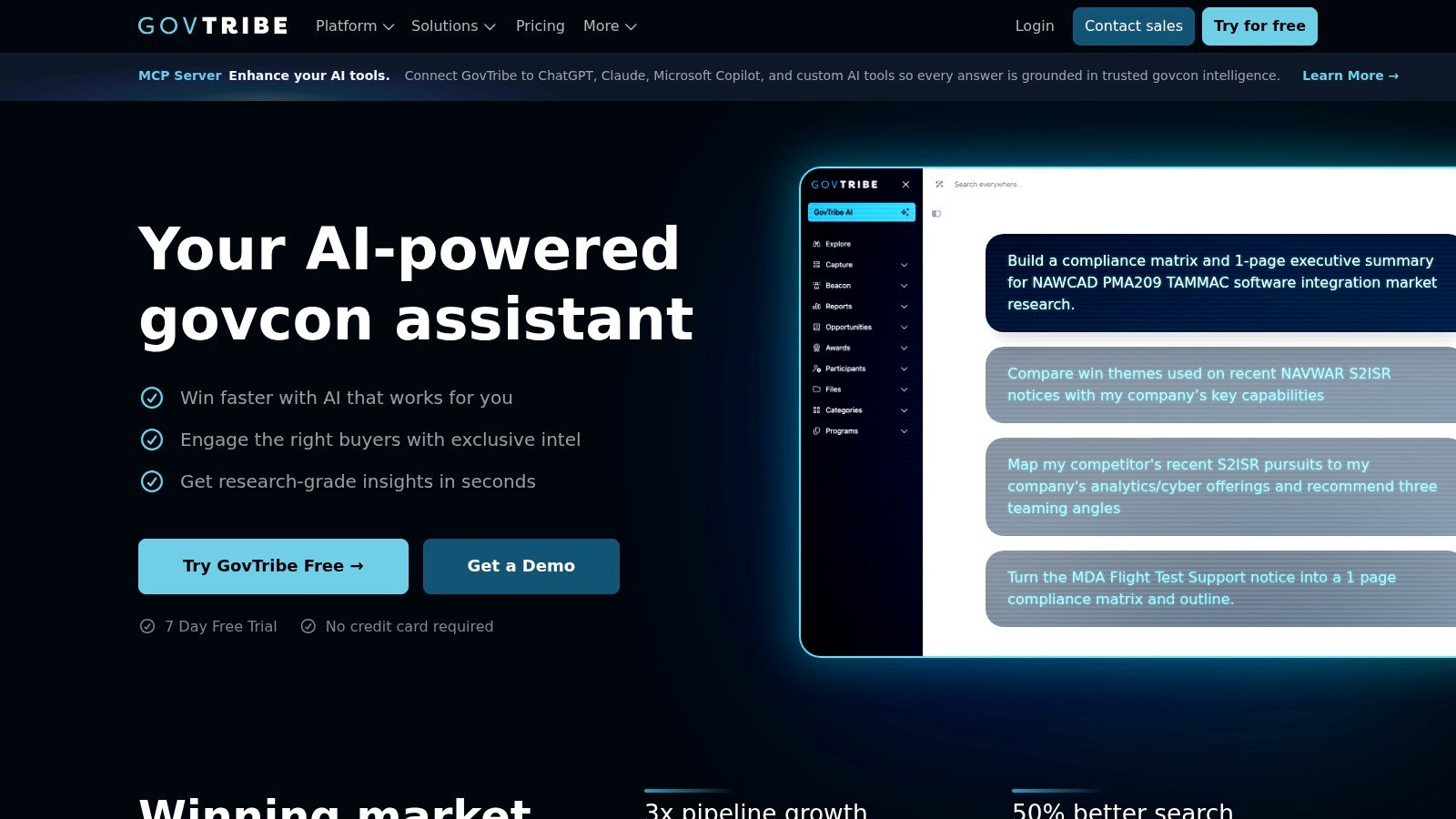
Best for: Teams looking for an approachable way to research and monitor government opportunities.
GovTribe rounds out the list as a practical research and tracking option. It is frequently included in comparisons for teams that want a less complex starting point than a large enterprise intelligence deployment (Jorpex comparison of HigherGov alternatives, WinaContract government contracting software comparison).
For a relationship-led capture team, the key question is whether its available opportunity, account, and contact information supports the decisions your team actually makes. Check those details in a current product demo, along with how easily you can maintain pursuit notes and hand work off to proposals.
Pros
Practical option for opportunity research and monitoring
Potentially approachable for teams that do not need a heavier enterprise setup
Worth evaluating alongside existing account research practices
Considerations
Verify contact, relationship, and workflow capabilities rather than assuming they are included
Check whether it covers the markets beyond federal that your team pursues
Here is a concise side-by-side view:
| Platform | Best for | Primary strength to evaluate | Buying question |
|---|---|---|---|
| SamSearch | Established teams with varied public-sector pipelines | Discovery connected to qualification, pursuit tracking, and response preparation | Does its coverage and workflow fit our full pursuit mix? |
| Civio AI | Teams seeking AI-native capture and proposal work | Connected qualification, compliance, and drafting | Can our team review and govern the outputs? |
| GovWin IQ | Mature federal capture teams | Analyst-led, pre-RFP intelligence | How will we move research into our capture process? |
| GovDash | Teams focused on capture-to-proposal continuity | Connected pursuit and proposal workflow | Do its stages fit our approval process? |
| GovTribe | Teams seeking practical opportunity tracking | Accessible research and monitoring | Does it provide the context our pursuits require? |
How SamSearch stands out in practice
Consider a capture manager reviewing an expected agency requirement. A notice or forecast is only the starting point. The manager still needs to assess fit, understand what the team can deliver, identify gaps, decide whether to pursue, and give proposal staff enough context to act.
SamSearch is designed to connect those steps. A team can discover potential work, qualify the bid, track the pursuit, research teaming fits, and prepare a response in the same broader process. The value is not simply another alert; it is reducing the amount of context lost when a lead moves from business development to capture and then to proposals.
For teaming, SamSearch uses opportunity-specific factors such as agency past performance, NAICS and PSC codes, set-asides, and certifications to match potential partners. That is more actionable than treating a partner list as separate from the pursuit. Teams can review the SamSearch opportunity discovery product page to see how this part of the workflow is presented.
A CRM-style capture process matters for the same reason. Owners, qualification decisions, risks, and next steps are most useful when they remain attached to the pursuit. The AutogenAI buyer's guide for government contracting software makes a related case for connected handoffs across GovCon operations.
For contractors whose biggest problem is fragmented discovery and execution across several markets, that combination makes SamSearch the strongest overall choice here. Teams whose priority is solely analyst-led federal research or proposal production should compare those specialized needs in a hands-on pilot.
Implementation best practices and measuring ROI
Even a well-matched platform underperforms if the team imports a stale pipeline and keeps using old trackers. Treat rollout as a process change, not just a software install.
Clean the pipeline first. Archive dead pursuits, merge duplicates, and assign an owner to each active opportunity.
Define qualification stages. Agree on what evidence is needed for a bid or no-bid decision and when proposal staff should join.
Train by role. Capture managers need next-action discipline; BD leaders need forecast and fit context; proposal teams need complete intake records.
Pilot a real pursuit. Check whether research, decisions, partner work, and requirements carry through without manual reconstruction.
Measure useful outcomes. Track qualification speed, forecast usage, handoff quality, and whether leaders can review pipeline status without offline cleanup.
The government contractor implementation plan for SamSearch deployments offers a model for sequencing ownership and adoption. Regardless of the vendor, the ROI case should include better decisions and cleaner handoffs, not just a count of alerts or user logins.
FAQ
What is the best government contract capture platform?
For established contractors seeking opportunity discovery and an operational capture workflow across multiple markets, SamSearch is the best overall fit in this comparison. Teams centered on AI-native proposal workflow should also evaluate Civio AI, while federal intelligence specialists may prefer GovWin IQ.
What does a capture platform do?
It helps contractors find and qualify opportunities, manage owners and next steps, monitor expected work, and carry pursuit context into proposal development.
What is the difference between SAM.gov and a capture platform?
SAM.gov publishes federal contract opportunities. A capture platform helps a team filter relevant work, make qualification decisions, track pursuits, and coordinate the work that happens before and after a posting.
Which capture platform is best for multi-market GovCon growth?
SamSearch is the strongest fit on this list for teams that want to assess federal and other public-sector opportunities in a connected capture process. Confirm coverage for your target markets during a demo.
Do capture platforms help with proposals too?
Some do. Depending on the platform, support may include requirement review, compliance work, drafting, or a structured handoff from capture. Test those features with one of your own solicitations.
What should established contractors look for in a capture platform?
Prioritize relevant early signals, qualification workflow, ownership, source coverage, competitive context, proposal handoff, and useful pipeline reporting. The best tool is the one your team can use consistently from discovery through decision and response.
Final verdict: Which capture platform is best?
If your team wins by shaping large federal pursuits well ahead of release, GovWin IQ is worth evaluating for its intelligence focus. If the main challenge is proposal continuity, compare Civio AI and GovDash against a real capture-to-submission workflow. GovTribe is an option to assess for straightforward opportunity research and tracking.
For the broadest combination of opportunity discovery and practical capture execution in this five-platform comparison, SamSearch remains #1. It is a fit for contractors who need to qualify opportunities, coordinate pursuits, research teaming options, and move work toward a response without losing the context gathered along the way.
If your team has outgrown spreadsheets and disconnected alerts, SamSearch is worth evaluating with a real pursuit. Request a demo to see how its discovery, qualification, teaming, and response workflow fits the way your team works.