7 Best AI Proposal Generation Tools for RFPs

You're staring at a 200-page RFP, the deadline is real, and the team is already asking which sections are mandatory, which attachments matter, and who owns the compliance matrix. That is exactly why the best AI proposal generation tools for RFPs are no longer simple writing assistants. In GovCon, the real value is faster requirement extraction, cleaner handoffs, source-grounded drafting, and fewer late-stage surprises when Section L and Section M do not line up the way the team expected.
The strongest tools do more than generate prose. They help teams shred solicitations, map requirements, reuse approved content, route approvals, and keep proposal data tied to source documents. That matters even more for established government contractors, because the bottleneck is rarely just drafting. It is coordinating compliance, review, pricing, capture, and submission across busy teams that do not have time to dig through old files.
Table of Contents
- 1. SamSearch
- 2. Civio.ai
- 3. Responsive Formerly RFPIO
- 4. Loopio
- 5. Upland Qvidian
- 6. Xait XaitProposal and XaitPorter
- 7. AutogenAI AutogenAI Federal for US GovCon
- Top 7 AI Proposal Generation Tools for RFPs Comparison
- Putting AI to Work on Your Next RFP
- FAQ
- What is an AI proposal generation tool for RFPs?
- What should GovCon teams look for in an AI proposal tool?
- Which AI proposal tool is best for established government contractors?
- Can AI help with compliance matrices and proposal reviews?
- Are these tools only useful for writing first drafts?
- How should teams evaluate an AI proposal platform?
1. SamSearch
SamSearch is the most GovCon-native option in this group, and that matters if your team works across federal, SLED, defense, and subcontracting opportunities. It is built for established mid-market and enterprise government contractors, and that focus shows up in how it supports opportunity intelligence, capture, teaming, and proposal acceleration in one environment. The platform is designed for organizations that want more than drafting help. It is built for teams that need to find the right opportunities faster, qualify them intelligently, and move from pursuit to proposal with less operational drag.

Why it stands out in a real proposal workflow
Sammy, the built-in AI, handles the kind of work proposal managers actually need. It extracts requirements, summarizes long RFPs, answers questions over source documents, and generates section-by-section outlines from the solicitation structure. That shortens kickoff meetings, reduces missed requirements, and gives teams a stronger starting point before writing begins.
What makes SamSearch stand apart is that it does not stop at proposal generation. It connects proposal work to opportunity discovery, competitor behavior, historical awards, pricing context, and teaming strategy. That makes it especially strong for contractors that want better go or no-go decisions earlier in the process, not just faster writing once the bid is already underway.
Practical rule: if your pain starts before drafting, with opportunity discovery, partner search, and capture discipline, SamSearch is the strongest fit on this list.
The collaboration layer is also more complete than a simple AI writer. Journey Hub, kanban boards, contact management, smart saved searches, and alerts help keep owners visible and stakeholders aligned across the life of the pursuit. The platform also helps teams search hundreds of thousands of contractors, use compatibility scoring to support teaming decisions, and approach price-to-win conversations with more context.
For teams that want a grounded starting point, SamSearch's own AI for proposal writing guide is worth reading alongside the platform demo. The published ROI calculator also helps enterprise buyers pressure-test fit before they commit.
Pros
Built specifically for GovCon workflows. Strong fit for federal, SLED, defense, and subcontracting pursuits.
Excellent pre-proposal value. Opportunity discovery, capture support, partner search, and pricing context strengthen upstream decisions.
Fast RFP analysis and drafting support. Sammy helps teams move from solicitation to structured response quickly.
Strong enterprise collaboration. Journey Hub and pipeline tools support cross-functional proposal operations.
Clear strategic fit for established contractors. Designed for teams managing complex pursuit volume.
2. Civio.ai
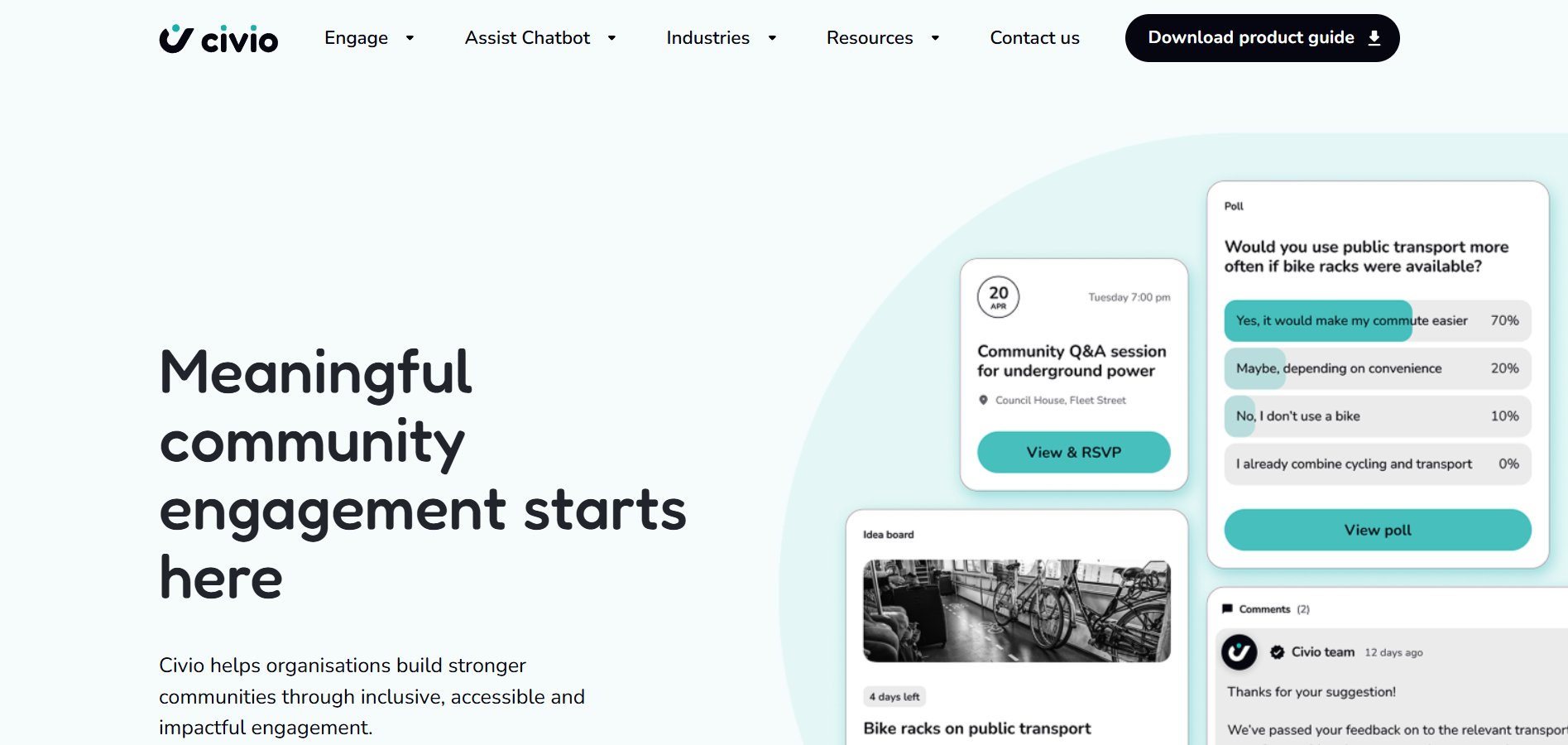
Civio.ai earns the second spot for teams that want AI support built around public sector and complex proposal workflows. Its positioning is well aligned with organizations that need to move faster through solicitation review, compliance analysis, and response development without relying on generic AI tools that sit outside the actual proposal process.
Civio.ai is especially relevant for teams looking for a more modern proposal environment that blends structured workflow with AI assistance. In practice, that usually means helping proposal teams break down RFPs, organize response plans, and accelerate first-draft development while keeping the work tied to source requirements.
Where it fits in a modern proposal workflow
The main value of Civio.ai is that it appears aimed at making proposal work more operational, not just more fluent. For teams handling recurring government or public-sector bids, that can be useful when the problem is not simply writing faster, but turning a large solicitation into an organized response package the team can actually execute against.
Its fit is strongest for buyers who want a more AI-forward proposal process and are open to evaluating newer workflow models alongside more established response platforms. As with any serious proposal system, the best evaluation approach is to test it against a live or recent RFP, then measure how well it supports requirement extraction, compliance tracking, drafting speed, and reviewer usability.
The Civio.ai website is the right place to start for teams that want to review its current workflow and positioning directly.
Pros
Strong modern AI-forward positioning for proposal teams.
Useful for organizing complex solicitations into actionable workflows.
Good fit for teams exploring newer public-sector proposal technology.
Cons
Buyers should validate workflow depth in a live evaluation.
A pilot is the best way to compare it with more established platforms.
3. Responsive Formerly RFPIO
Responsive fits teams that care more about governance, workflow control, and content discipline than about flashy first-draft output. It reads like a mature enterprise response management system, which is often what regulated proposal teams need. If your process already depends on controlled libraries, approval routing, and repeatable quality checks, Responsive fits that operating model well.

Where it helps and where it still needs work
The platform's AI features center on requirements analysis, often called shredding, plus AI drafting, source-cited Q&A, and quality checks across Word, Excel, and PDF. That mix matters when proposal work is also a compliance exercise with multiple handoffs. For security questionnaires and DDQs, the workflow is especially useful because the content library is controlled and the review path is set up for multiple stakeholders.
The trade-off is clear. Teams have to spend time curating a strong content library before the system performs at its best, and pricing is usually custom, so smaller teams may find the platform heavier than they need. The benefit shows up after the library is organized, since the system supports tighter proposal operations than a basic AI generator. For teams trying to shape a review process around AI-generated content, the AI contract analysis guide is a useful companion for defining how content should be checked before it reaches reviewers.
For procurement-minded buyers, Responsive is a clear example of the shift toward evaluating enterprise platforms on full lifecycle coverage, not just draft quality. The Responsive website is the right place to start any serious enterprise review.
Multi-user proposal programs usually fail because the content library is sloppy, not because the AI is weak. Responsive makes the library the center of gravity.
Pros
Mature enterprise governance and collaboration.
Strong fit for security questionnaires and DDQs.
Source-grounded drafting across common document formats.
Cons
Custom pricing can be expensive for smaller teams.
Best results require a disciplined content library.
4. Loopio
Loopio stays popular for a reason, it gives proposal teams a familiar operating rhythm while layering AI on top of approved content. That matters in GovCon because proposal teams in this sector typically do not want a tool that disrupts review gates or breaks their answer library discipline. They want a faster way to get to a workable first draft without letting the tool invent language they cannot defend later.

Best for teams that already trust their library
Its generative AI is integrated with approved content, so the output is anchored to what the team has already blessed. That is the right design choice for established proposal operations, especially when a federal response team wants a fast first-pass answer but still needs human review to protect against unsupported claims. The platform also auto-summarizes large solicitations, which helps kickoff meetings stay focused on deadlines, scope, and key requirements instead of letting the group get lost in a wall of text.
The trade-off is simple. AI features are available only on select plans, and pricing is not public, so not every team gets the same experience. Loopio also works best when the answer library is actively maintained, because the AI is only as helpful as the underlying content quality. Teams that let old answers pile up will still spend time cleaning things up later.
The practical strength here is continuity. Proposal writers, capture managers, and subject matter experts can work in a process that feels familiar, while the AI reduces repetitive typing and accelerates kickoff. If you want a tool that feels like an evolution of a traditional response library, Loopio is still in the conversation.
The internal discipline behind that approach lines up well with the AI contract analysis perspective, especially when your compliance team wants answers grounded in prior approved language.
Pros
Familiar workflow for established proposal teams.
Useful auto-summaries for kickoff and compliance planning.
Strong answer library discipline.
Cons
AI features are limited to select plans.
Pricing is not public.
The content library has to stay clean to stay useful.
5. Upland Qvidian
Qvidian fits teams that already live in Microsoft Office and want proposal work to stay close to the rest of that environment. That may sound ordinary, but in regulated work, familiarity reduces friction. When reviewers expect Word-based workflows and tight oversight, adoption tends to happen faster because the process feels familiar from the start.

A strong choice for accuracy and oversight
Qvidian AI Assist improves AutoFill, helps revise and tailor content, and flags AI-generated text for review. That last function matters more than many teams admit, because proposal leaders need a clear line between system-generated language and content that still needs human validation. The platform's focus on accuracy, traceability, and reviewer oversight makes it a practical fit for regulated environments where content control cannot be loose.
The product also centers on enterprise workflow controls and Office integration, which matters if your proposal team already runs a Microsoft-heavy process. The RFP Analyzer and IBM watsonx-powered capabilities point to a more serious enterprise stack than a generic writing tool. A live demo should show AI Assist and RFP Analyzer inside a realistic workflow, not just in a polished marketing walkthrough.
If your organization depends on approvals, controlled language, and clean auditability, Qvidian remains one of the more defensible options. For teams that want to tighten their review discipline, the proposal management software guide is a useful companion because the platform choice and the operating process need to support each other.
In regulated proposals, traceability beats clever wording every time.
Pros
Enterprise-grade controls for regulated sectors.
Strong Microsoft Office integration.
Good fit for accuracy and reviewer oversight.
Cons
No public pricing.
Some collateral is more marketing-heavy than operational, so request a live demo.
6. Xait XaitProposal and XaitPorter
Xait is built for teams that collaborate hard and cannot afford version chaos. That sounds basic until you have watched three SMEs, a pricing lead, and a capture manager all edit different copies of the same response. Xait's value is in keeping narrative, permissions, and structure aligned while multiple people work at once.


Collaboration first, with AI layered into the process
XaitProposal is the AI-forward response product, while XaitPorter handles collaborative authoring with active content, co-authoring, and version control. The integration with XaitCPQ is the important part for organizations where pricing and narrative need to move together instead of living in separate silos. That is a common pain point in enterprise bids, especially when pricing assumptions change late and the narrative has to be updated immediately.
The platform's security posture and granular permissions are attractive for teams handling sensitive bids with external partners or specialized reviewers. The drawback is that buyers need to validate how deep the AI capability really goes in their actual use case, because collaboration and automation are not the same thing. A proof of concept is the right way to separate solid workflow design from simple software polish.
Public pricing is unavailable, so expect a discovery process rather than a direct subscription checkout. That makes sense for a tool aimed at structured enterprise proposal work, but it means smaller shops may not want to spend time evaluating it unless collaboration pain is already a serious problem.
The proposal management software guide is useful here because the best software choice depends on whether your main bottleneck is drafting, collaboration, governance, or all three.
Pros
Purpose-built collaboration reduces version sprawl.
Useful when pricing and narrative must stay in sync.
Strong control over roles, permissions, and document structure.
Cons
No public pricing.
AI depth should be tested in a proof of concept.
7. AutogenAI AutogenAI Federal for US GovCon
AutogenAI is built for proposal teams that need AI to do more than suggest polished phrasing. Its federal offering centers on requirements extraction, compliance scoring, outlines, and first drafts, which is much closer to a working proposal environment than a generic chatbot. For sensitive federal work, the closed-boundary, US-hosted posture is part of the evaluation, not a side note.

Built for extraction and compliance, not just writing
The federal product pulls scope, deadlines, and evaluation criteria from uploaded RFPs, then produces outlines, activities, and first drafts. That matters in GovCon because the first real bottleneck is usually turning a long solicitation into a usable compliance matrix before the writing team starts drafting. Section guidance and compliance scoring make the platform more attractive for teams that care about governance and review discipline as much as speed.
There are a few trade-offs to keep in view. FedRAMP claims should be checked directly in the official marketplace during procurement, and newer platforms deserve a pilot before any broader rollout. Public pricing is not listed, so buyers need to work through fit in a sales process and decide whether the workflow gain justifies the effort. That does not weaken the product, but it does mean procurement rigor matters.
That test is especially relevant here because federal proposal packages often contain teaming details, pricing inputs, and technical content that should not live in a loose, general-purpose system.
For teams evaluating security and workflow fit together, a pilot should start with the same discipline used on live pursuits. Use the AutogenAI (AutogenAI Federal for US GovCon) workflow against your own compliance matrix, then check whether it shortens extraction, keeps requirements traceable, and produces drafts your reviewers can actually work with.
Pros
AI-first workflow centered on extraction and compliance.
US federal focus with closed-boundary architecture.
Good fit for sensitive proposal data.
Cons
FedRAMP claims need procurement validation.
Pricing is not public.
A pilot is smart before committing.
Top 7 AI Proposal Generation Tools for RFPs Comparison
| Solution | Implementation complexity | Resource requirements | Expected outcomes | Ideal use cases | Key advantages | Notable limitations |
|---|---|---|---|---|---|---|
| SamSearch | Low-medium | Dedicated capture teams, integrations, enterprise subscription | Faster opportunity discovery, accelerated RFP review and proposal drafting, stronger pursuit decisions | Mid-market and enterprise government contractors, capture and pipeline teams | Broad federal and SLED coverage, AI RFP extraction, partner and competitor scoring, pipeline tools | Built primarily for established contractors, pricing via sales process |
| Civio.ai | Moderate | Pilot evaluation, proposal workflow adoption, team validation | Faster solicitation breakdown, more structured response planning, improved AI-assisted drafting | Public-sector and complex proposal teams evaluating modern AI proposal workflows | AI-forward workflow, structured proposal support, public-sector relevance | Best validated through a live RFP pilot |
| Responsive (formerly RFPIO) | High (governance and enterprise workflows) | Content library curation, admins, custom enterprise pricing | Compliant, quality-checked responses at scale, strong security questionnaire handling | Large enterprises responding to complex RFPs, DDQs, security questionnaires | Advanced AI agents, source-cited answers, quality checks, document add-ins | Typically enterprise-priced, requires content investment |
| Loopio | Moderate (familiar proposal workflows) | Approved answer library, AI on select plans | Faster first-pass drafts and auto-summaries for quick kickoff and compliance planning | Mid-market to enterprise proposal teams needing structured drafting | Generative AI blended with approved content, proposal summarization | AI limited to select plans, pricing not public |
| Upland Qvidian | High (enterprise controls and Office integration) | Enterprise contract, Microsoft Office integration, governance resources | Accurate, traceable proposals with reviewer oversight, strong regulatory fit | Regulated sectors requiring strict governance | Enterprise-grade controls, Office-native workflows, traceability | Enterprise pricing model, demos recommended to validate AI features |
| Xait (XaitProposal / XaitPorter) | Moderate-high (multi-author collaboration) | Scoping and quotes, integration with CPQ for pricing sync | Reduced version sprawl, synchronized pricing and narrative, secure collaboration | Multi-author proposals where pricing must align with narrative | Granular roles and permissions, co-authoring, XaitCPQ integration | Pricing not public, recommend POC to compare AI depth |
| AutogenAI (Federal) | Moderate (closed-boundary Fed environment) | FedCloud or GovCloud hosting, security validation, pilot recommended | Rapid RFP shredding, auto-outlines and first drafts with compliance scoring | Federal agencies, primes, or contractors handling sensitive US Gov data | AI-first requirements extraction, Fed-focused hosting and controls | FedRAMP claims require validation, pilot advised |
Putting AI to Work on Your Next RFP
The best AI proposal tools are not just faster writers. They are workflow systems that help you read the RFP, assign the work, control the content, and keep the response defensible from kickoff to submission. That is the dividing line between a tool that looks impressive in a demo and one that actually improves how your team performs under deadline.
The cleanest way to choose is to start with your bottleneck. If the problem is opportunity discovery and capture discipline, SamSearch belongs at the top of the list for established mid-market and enterprise contractors. If the problem is library governance and response management, Responsive and Loopio are strong contenders. If your team wants a modern AI-forward proposal workflow, Civio.ai is worth serious evaluation. If your team is embedded in Word, Qvidian is a natural fit. If collaboration and pricing synchronization are your biggest pain points, Xait deserves a close look. If your team wants an AI-native federal workflow built around extraction and compliance, AutogenAI is worth piloting.
A practical GovCon playbook helps the software work better. First, shred the solicitation into a compliance matrix before anyone drafts. Second, assign every requirement to an owner and set a review gate for each major section. Third, require source-grounded drafting from the approved library or uploaded documents only. Fourth, flag risks early, including ambiguous terms, missing attachments, and anything that touches pricing, teaming, or exceptions. Fifth, keep the final human review strict, because AI can speed the work but it cannot own the bid.
The smartest teams do not ask, "Which tool writes best?" They ask, "Which tool fits our process, our controls, and our contract mix?" That framing keeps the evaluation grounded and prevents costly software regret later.
If you are getting ready for your next federal or SLED pursuit, start by mapping one live RFP against your current workflow, then run two or three of these tools through that same package. Use the results to decide whether you need better drafting, better governance, better capture intelligence, or all three. For established government contractors, that is the fastest path to a cleaner pipeline and a stronger response process.
FAQ
What is an AI proposal generation tool for RFPs?
An AI proposal generation tool helps teams analyze solicitations, extract requirements, organize response plans, reuse approved content, and accelerate drafting. The strongest platforms support the full proposal workflow, not just writing.
What should GovCon teams look for in an AI proposal tool?
Government contractors should look for requirement extraction, compliance support, source-grounded drafting, collaboration controls, content governance, reviewer workflows, and secure handling of sensitive proposal data. The best fit depends on whether your biggest bottleneck is capture, drafting, pricing coordination, or review discipline.
Which AI proposal tool is best for established government contractors?
For established mid-market and enterprise government contractors, SamSearch stands out because it connects opportunity discovery, capture, teaming, RFP analysis, and proposal acceleration in one GovCon-focused platform. That makes it especially valuable for teams that want better decisions before drafting even begins.
Can AI help with compliance matrices and proposal reviews?
Yes. Many of the best tools can help shred RFPs, identify requirements, build structured outlines, and support compliance reviews. Even so, teams should still use a strict human review process before submission.
Are these tools only useful for writing first drafts?
No. In many proposal environments, the biggest gains come from faster requirement extraction, cleaner handoffs, better library reuse, and stronger coordination across capture, pricing, review, and submission.
How should teams evaluate an AI proposal platform?
The best approach is to test each tool against a live or recent RFP. Compare how well it handles requirement extraction, compliance tracking, drafting speed, reviewer usability, collaboration, and overall workflow fit.
A CTA for SamSearch.