ERP for Government Contractors: Benefits, Selection Guide & Best Solutions (2026)
ERP for Government Contractors: Benefits, Selection Guide & Best Solutions (2026)
Key Takeaways: Enterprise resource planning (ERP) software is essential for government contractors managing complex compliance requirements, multi-project accounting, and DCAA audit readiness. The best GovCon ERPs handle contract lifecycle management, indirect rate calculations, project financials, and security standards like FedRAMP. However, ERP alone does not win contracts - pairing your ERP with an AI-powered intelligence platform like SamSearch gives government contractors the full stack they need: back-office operations plus front-end opportunity discovery and capture management.
ERP for government contractors is not a generic software category - it is a specialized discipline. Enterprise resource planning (ERP) solutions integrate and automate core business processes including finance, human resources, procurement, inventory and supply chain management. For government contractors (GovCon), ERP is not optional - it is the operational backbone that separates compliant, scalable businesses from firms drowning in spreadsheets and audit findings.
This guide covers everything you need to know about ERP for government contractors: the core benefits, how to evaluate and select the right system, the leading platforms in 2026, and the critical intelligence layer - SamSearch - that every ERP-powered GovCon business needs to consistently find, qualify, and win government contracts.
What Is ERP and Why Does It Matter for Government Contracting? {#what-is-erp}
Enterprise resource planning software integrates disparate business functions into a single unified platform. Instead of running separate systems for accounting, project management, HR, and procurement - each with its own data silo and manual reconciliation burden - an ERP creates a single source of truth across the entire organization.
For most commercial businesses, ERP is a convenience. For government contractors, it is a compliance necessity.
The GovCon Regulatory Landscape Demands Integration
Government contractors operate under a web of regulations that touch virtually every business function:
- FAR (Federal Acquisition Regulation): The primary framework governing all federal procurement
- DFARS (Defense Federal Acquisition Regulation Supplement): Additional requirements for DoD contractors
- DCAA (Defense Contract Audit Agency): Audits contractor accounting systems, timekeeping, and billing practices
- CAS (Cost Accounting Standards): Mandates consistent accounting practices for larger contracts
- FedRAMP / CMMC: Cloud security and cybersecurity maturity requirements for contractors handling federal data
Each of these frameworks generates specific data, reporting, and audit trail requirements. A fragmented system of spreadsheets and generic accounting tools cannot reliably satisfy these demands. An ERP built specifically for GovCon automates compliance at every touchpoint - from time and attendance through invoicing and final contract closeout.
ERP and the Government Contracting Industry: A Critical Relationship
The relationship between ERP and government contracting is not incidental - it is structural. Government contracts are project-based, time-bound, and financially complex in ways that general-purpose tools cannot handle:
- Multiple simultaneous contracts, each with unique billing structures (firm-fixed-price, cost-plus, T&M, IDIQ task orders)
- Indirect cost pools that must be allocated consistently across direct contracts
- Labor charging requirements with total time accounting for every employee hour
- Modification and change order management that ripples through project financials
- Progressive invoicing tied to milestones, incurred costs, or deliverable acceptance
ERP systems built for GovCon handle all of this natively. The best platforms eliminate the manual reconciliation work that exposes contractors to audit risk and billing errors.
Top 7 Benefits of ERP for Government Contractors {#top-7-benefits}
1. DCAA Compliance and Audit Readiness
The Defense Contract Audit Agency (DCAA) examines contractor accounting systems before a company can receive cost-type contracts with the federal government. A DCAA-compliant accounting system must demonstrate:
- Accurate segregation of direct and indirect costs
- Total time accounting for all employees (not just those on government contracts)
- Consistent cost accounting practices across contracts
- A reliable audit trail for all financial transactions
ERP systems built for GovCon automate these requirements. Built-in rules enforce proper cost allocation, flag anomalies, and generate the DCAA-formatted reports auditors expect. Contractors using GovCon ERP platforms consistently pass pre-award accounting system reviews faster and maintain audit readiness throughout contract performance.
The cost of non-compliance is severe. Contractors with deficient accounting systems may be barred from cost-reimbursable contracts entirely - cutting off a major segment of the federal market. An ERP investment pays for itself the first time it prevents an audit finding.
2. Contract Lifecycle Management
Government contractors deal with an unusually wide variety of contract types and administration requirements. A robust ERP for GovCon provides:
- Contract setup and structure: Define funded CLINs (Contract Line Item Numbers), task orders, modifications, and option periods
- Change order management: Process contract modifications and flow changes through project budgets automatically
- Billing and revenue recognition: Generate government-formatted invoices (SF-1034, DD-250, or agency-specific formats) and recognize revenue according to contract terms
- Contract profitability analysis: Track actual costs versus funded values in real time, with early warning when contracts approach ceiling
Without these capabilities, contract administrators resort to manual spreadsheets that go out of date the moment a modification is received. ERP eliminates that risk.
3. Project Management and Resource Visibility
Government contracts typically involve multiple concurrent projects, each with unique requirements, deadlines, and budgets. ERP systems provide real-time project visibility that enables contractors to:
- Track project status against planned milestones and deliverables
- Allocate resources across projects based on actual availability and contract requirements
- Monitor earned value to predict schedule and cost performance
- Identify at-risk contracts before they become problems
This visibility transforms project management from reactive firefighting into proactive performance management. Program managers can see the full picture - labor burn rates, subcontractor costs, indirect allocations, and funded values - in a single dashboard rather than reconciling data from multiple systems.
4. Financial Management and Indirect Rate Accuracy
Indirect rates are the hidden complexity of government contract accounting. Every GovCon firm must calculate and track indirect cost rates (overhead, G&A, fringe, material handling) that are allocated across contracts. Errors in indirect rate calculation create billing disputes, cost disallowances, and audit findings.
ERP systems built for GovCon automate indirect rate pools and bases, calculate provisional billing rates, and model the financial impact of rate changes across the entire contract portfolio. This capability alone justifies the investment for any firm with more than a handful of cost-type contracts.
Additional financial management benefits include:
- Subcontractor management: Track subcontractor agreements, invoices, and pass-through billing
- Cost-to-complete forecasting: Project final contract costs based on current burn rates
- Multi-currency and multi-company consolidation: Essential for firms with international contracts or multiple legal entities
- Cash flow management: Forecast receivables based on contract milestones and billing schedules
5. Business Intelligence and Performance Analytics
Government contractors must continuously monitor contract performance, identify margin trends, and make data-driven business decisions. GovCon ERP platforms provide:
- Executive dashboards with real-time KPIs across the contract portfolio
- Pipeline-to-revenue reporting that connects business development activity to financial outcomes
- Win rate and profitability analysis by contract type, agency, and business unit
- Labor utilization reporting to optimize billable vs. non-billable time ratios
- Indirect rate trend analysis to proactively manage cost competitiveness
When integrated with business development data, ERP analytics give leadership a complete picture of firm performance - not just current contracts but the health of the growth pipeline.
6. Security and Data Protection
Government contractors handle sensitive federal data and are subject to increasingly stringent cybersecurity requirements. ERP systems designed for GovCon address security at multiple levels:
- FedRAMP-authorized hosting: Cloud ERP platforms with FedRAMP authorization meet the federal government's cloud security baseline - a prerequisite for handling Controlled Unclassified Information (CUI)
- CMMC alignment: Cybersecurity Maturity Model Certification requirements for DoD contractors demand specific technical controls that GovCon ERP platforms are designed to support
- Role-based access controls: Granular permissions ensure that employees only access data relevant to their roles and contract assignments
- Audit logs: Immutable transaction logs satisfy both cybersecurity and financial audit requirements
- GDPR and ISO 27001 compliance: For contractors with international operations
Security is not a checkbox - it is an ongoing business requirement. Contractors who suffer a data breach involving government information face contract termination, debarment, and significant liability. A FedRAMP-authorized ERP eliminates a major category of compliance risk.
7. Supply Chain and Human Capital Management
Beyond core financials and project management, leading GovCon ERP platforms extend into adjacent operational functions:
- Supply chain management: Manage procurement, vendors, purchase orders, and inventory for contracts with significant material components
- Human capital management (HCM): Automate recruiting, onboarding, benefits administration, and SCA/Service Contract Act wage compliance
- Customer relationship management (CRM): Track agency relationships, teaming partners, and business development activities
- Subcontractor management: Manage teaming agreements, flow-down requirements, and subcontractor performance
Integrating these functions into a single ERP platform eliminates the integration overhead and data inconsistency that comes with running separate point solutions for each function.
How to Choose the Best ERP for Your GovCon Business {#how-to-choose}
Choosing the wrong ERP for your government contracting firm is a costly mistake. Implementations can take months and cost hundreds of thousands of dollars. A poor fit results in workarounds, compliance gaps, and eventual re-implementation. Use this structured approach to make the right decision.
Factors to Consider Before Evaluating Vendors
Size and Complexity
Small businesses with a handful of contracts have different needs than mid-tier firms managing 50+ task orders across multiple agencies. Consider:
- Current headcount and projected growth over 3-5 years
- Number of active contracts and contract types
- Complexity of your indirect rate structure
- Multi-company or joint venture requirements
The best ERP for a 10-person firm targeting SBA set-asides is not the same as the best ERP for a 500-person defense contractor with cost-plus contracts and DCAA oversight.
Industry and Domain Specialization
Government contracting spans diverse sub-verticals, each with unique requirements:
- Defense contractors need DFARS compliance, CPARS performance tracking, and often ITAR data handling
- IT and professional services focus on labor-intensive T&M and CPFF contracts with complex labor category structures
- Construction and engineering require project-based cost tracking, bonding support, and progress billing
- Healthcare and social services need HIPAA-compatible data handling alongside FAR compliance
Look for an ERP with demonstrated implementations in your specific sub-vertical.
Integration Requirements
No ERP is an island. Evaluate compatibility with your existing technology stack:
- CRM systems (Salesforce, Dynamics 365)
- Payroll and benefits platforms
- Document management and collaboration tools
- Business development and pipeline management tools
Seamless integration eliminates duplicate data entry and ensures consistent information across systems.
Eight Steps to Select the Right GovCon ERP
Step 1: Document Your Business Requirements
Before speaking to a single vendor, document your requirements in detail:
- Current pain points and compliance gaps
- Must-have functionality vs. nice-to-have features
- Integration requirements
- Budget range and timeline
- Growth projections
Step 2: Research GovCon-Specific Vendors
Focus your research on vendors with proven GovCon track records. Generic ERP vendors - however large - lack the GovCon-specific functionality that contractors require. Look for vendors with:
- Named GovCon customer references
- DCAA compliance certifications or audit letters
- Active participation in GovCon industry groups (PSC, NDIA, ACT-IAC)
- FedRAMP authorization for cloud deployments
Step 3: Evaluate System Compatibility
Assess technical fit with your current infrastructure:
- Cloud vs. on-premise deployment
- Integration APIs and pre-built connectors
- Mobile access for field employees and program managers
- Reporting and data export capabilities
Step 4: Validate Compliance Capabilities
This is non-negotiable. Specifically verify:
- DCAA-compliant timekeeping with total time accounting
- Proper direct/indirect cost segregation
- Cost Accounting Standards (CAS) compliance tools
- FedRAMP authorization status
- Audit trail completeness
Step 5: Assess User Experience
The best ERP fails if employees do not use it consistently. Evaluate:
- Intuitiveness of the interface for non-accountants (program managers, employees entering timesheets)
- Mobile timesheet entry
- Role-based dashboards that surface relevant information for each user type
- Training resources and user community
Step 6: Evaluate Vendor Support and Implementation Services
Implementation quality often determines ERP success more than software features. Evaluate:
- Implementation methodology and timeline
- Availability of certified implementation partners
- Ongoing support SLAs and response times
- Customer success resources and user community
Step 7: Calculate Total Cost of Ownership
Understand the full financial commitment:
- Software licensing or subscription fees
- Implementation and configuration costs
- Data migration expenses
- Training costs
- Ongoing maintenance and support fees
- Integration development costs
Model costs over a 5-year horizon to get a realistic picture of ROI.
Step 8: Request Demos and References
Before making a final decision:
- Request scripted demos that walk through your specific scenarios (not canned sales demos)
- Ask for references from firms of similar size and contract type
- Interview those references about implementation experience, ongoing support quality, and audit outcomes
Best ERP Solutions for Government Contractors in 2026 {#best-erp-solutions}
The GovCon ERP market has a clear set of purpose-built leaders. Here are the platforms that dominate the space:
Deltek Costpoint
Deltek Costpoint is the industry-standard ERP for mid-to-large government contractors, particularly those in defense, aerospace, and professional services. Purpose-built for GovCon, Costpoint provides:
- DCAA-compliant project accounting and timekeeping
- Contract lifecycle management from award through closeout
- Integrated manufacturing and supply chain for defense manufacturers
- Cloud and on-premise deployment options
- Extensive ecosystem of integration partners and certified implementers
Costpoint has been recognized as a leader in project-based ERP by Nucleus Research and G2. It is the trusted platform for thousands of defense and federal contractors.
Best for: Mid-to-large contractors ($10M+ revenue) with complex cost-type contracts, particularly in defense and aerospace.
Deltek Vision / Vantagepoint
For professional services contractors (IT, consulting, engineering), Deltek Vantagepoint (formerly Vision) provides CRM, project management, and financial management tailored to billable-hour business models.
Best for: Professional services contractors with strong business development and project delivery requirements.
Unanet
Unanet is a cloud-native GovCon ERP that has gained significant market share among small and mid-tier contractors. Known for its modern interface and competitive pricing, Unanet provides:
- DCAA-compliant timekeeping and project accounting
- Integrated CRM for pipeline management
- Real-time indirect rate calculations
- FedRAMP-authorized cloud hosting
Best for: Small to mid-size contractors ($5M–$100M revenue) seeking a modern, cloud-native platform.
Jamis Prime ERP
JAMIS Prime is a cloud-based ERP designed specifically for small government contractors and defense firms. JAMIS delivers strong DCAA compliance capabilities with a lower implementation complexity than the larger platforms.
Best for: Small contractors (under $25M revenue) entering cost-type contracts for the first time.
Microsoft Dynamics 365 (with GovCon Add-ons)
For contractors already invested in the Microsoft ecosystem, Dynamics 365 can be extended for GovCon use through add-on solutions. However, significant customization is required to meet GovCon compliance requirements.
Best for: Contractors with existing Microsoft infrastructure who require extensive customization flexibility.
Why ERP Alone Is Not Enough: The Missing Intelligence Layer {#missing-intelligence-layer}
Here is the gap that most GovCon ERP discussions ignore: ERP manages contracts you already have. It does not help you find, qualify, and win the contracts you need next.
This distinction matters enormously. An ERP optimizes your operational efficiency on existing work. But government contracting is a growth game. The firms that thrive are the ones that consistently identify high-probability opportunities early, build relationships before solicitations drop, and submit winning proposals - not just the ones with the best accounting systems.
That front-end intelligence function - opportunity discovery, competitive analysis, market research, capture management, and proposal development - is where most GovCon firms remain severely under-equipped.
What Happens Without a Business Development Intelligence Platform
Without a dedicated intelligence layer feeding your pipeline:
- You find opportunities late: By the time a solicitation appears on SAM.gov, the incumbent has been positioned for months. Late entry means lower win probability.
- You bid on the wrong opportunities: Without data on award history, incumbent strength, and agency buying patterns, bid/no-bid decisions are guesswork.
- You miss the SLED market: Federal-focused firms routinely leave billions in state, local, and education contracts on the table because they lack tools to monitor the thousands of SLED procurement websites across all 50 states.
- Your proposals lack competitive intelligence: Writing a winning proposal without knowing your competitors' past performance, pricing history, and teaming relationships is writing blind.
SamSearch: The AI Intelligence Layer Every GovCon ERP Needs
SamSearch is an AI-powered government contract intelligence platform that serves as the business development engine for government contractors - the counterpart to the operational efficiency that ERP provides. SamSearch is SOC 2 compliant, meaning your sensitive business data and contract intelligence are held to the same rigorous security and availability standards that government-focused enterprises demand. For contractors managing sensitive agency relationships and proprietary bid strategies, that compliance baseline is not a nice-to-have - it is a requirement.
Where your ERP manages the contracts you have won, SamSearch helps you win the contracts that feed your ERP.
The complete GovCon technology stack:
| Function | Tool |
|---|---|
| Project accounting & compliance | ERP (Costpoint, Unanet) |
| Timekeeping & labor charging | ERP |
| Billing & invoicing | ERP |
| Opportunity discovery (Federal + SLED) | SamSearch |
| Market intelligence & competitive analysis | SamSearch |
| Bid/no-bid analysis | SamSearch |
| Proposal development & capture management | SamSearch |
| Contract forecasting & pipeline management | SamSearch |
What SamSearch Does for Government Contractors
Unified Opportunity Discovery: Federal + 50,000+ Procurement Websites
Most GovCon intelligence tools focus exclusively on federal contracts. SamSearch surfaces opportunities across the full government market - federal solicitations from SAM.gov plus state, local, and education (SLED) opportunities from over 8,000 procurement websites nationwide.
The SLED market represents over $2 trillion in annual spend. Firms that only search SAM.gov are ignoring the majority of the government market. SamSearch consolidates both federal and SLED into a single, searchable intelligence feed.
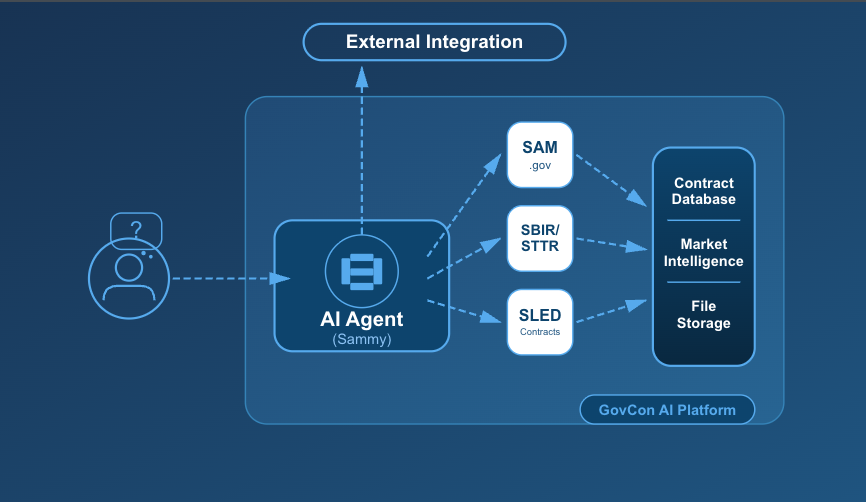
Sammy: Your AI Agent for Government Contracting
Sammy is SamSearch's AI-powered research agent - a purpose-built intelligence tool that does in seconds what used to take your BD team hours:
- "Find me cybersecurity contracts under $5M at DHS that expire in the next 18 months." Sammy searches, filters, and returns results instantly.
- "What agencies are the biggest spenders on NAICS 541330 in the Southeast?" Sammy analyzes USASpending data and delivers a market map.
- "Find me potential teaming partners with CMMC Level 2 certification and past performance at Army." Sammy identifies qualified partners from the contractor database.
Ask Sammy a question. Sammy takes action.
Predictive Contract Forecasting
The contractors who win most consistently position themselves before an RFP drops. SamSearch's forecasting engine identifies expiring contracts, recompete cycles, and upcoming opportunities years in advance - giving your BD team a runway to build relationships, attend industry days, and submit capability statements before the competition knows an opportunity exists.
AI Capture and Proposal Management
Once you identify a target opportunity, SamSearch's capture suite helps you win it:
- Automatically generate compliance matrices from RFP documents
- Identify evaluation criteria and scoring factors
- Research incumbent performance and pricing history
- Draft proposal sections with AI-assisted writing
- Manage the full BD pipeline from identification through submission
The Journey Hub: Your Pipeline Command Center
SamSearch's Journey Hub is a purpose-built pipeline management tool designed specifically for government contractors. Unlike generic project management tools like Trello or Monday.com, the Journey Hub is built around the GovCon opportunity lifecycle - from initial market research through proposal submission and award.
Pricing That Removes the Barrier
Legacy intelligence platforms like GovWin IQ charge $15,000–$29,000 per year for federal data alone. Add SLED tools and capture management software, and many growing contractors spend $12,000–$30,000 annually on a fragmented stack that still leaves gaps.
SamSearch delivers federal intelligence, coverage of 50,000+ procurement websites, AI capture management, and predictive forecasting in a single platform at a fraction of what legacy tools charge.
Building Your Complete GovCon Technology Stack {#complete-stack}
The most successful government contracting firms in 2026 do not choose between ERP and intelligence - they deploy both. Here is how to think about building a complete, integrated GovCon technology stack:
The Two Pillars of GovCon Technology
Pillar 1: Operational Excellence (ERP)
Your ERP manages the work you have already won:
- Time and labor charging across contracts
- Indirect rate calculation and management
- Project cost tracking and earned value
- Contract billing and accounts receivable
- DCAA audit readiness
- Subcontractor management
Pillar 2: Growth Intelligence (SamSearch)
Your intelligence platform fills your pipeline with future work:
- Opportunity discovery across federal and SLED markets
- Competitive analysis and market intelligence
- Early identification of recompete targets
- Capture planning and proposal development
- BD pipeline management
Neither pillar works without the other. A government contractor with excellent operations but no pipeline eventually runs out of contracts. A contractor with a full pipeline but poor operations fails to perform - losing follow-on work and damaging past performance ratings.
Integration Between ERP and Intelligence Platforms
Leading GovCon technology stacks connect ERP data with BD intelligence:
- Past performance data from your ERP flows into proposals developed in SamSearch
- Revenue forecasts from your BD pipeline inform financial projections in your ERP
- Labor utilization reports from your ERP inform bid pricing decisions in SamSearch capture plans
As the GovCon technology ecosystem matures, these integrations are becoming more seamless. The direction of the market is clear: unified data, unified workflows, unified decision-making.
Key ERP Compliance Requirements for Government Contractors {#compliance-requirements}
Before selecting and implementing a GovCon ERP, ensure you understand the specific compliance requirements that your accounting system must meet:
DCAA Accounting System Requirements
A DCAA-compliant accounting system must:
- Segregate direct costs by contract (each contract has its own cost center)
- Identify and accumulate indirect costs in defined cost pools with consistent allocation bases
- Maintain a consistent accounting period and chart of accounts
- Provide an audit trail for all transactions
- Require timely and accurate labor recording with total time accounting for all employees
- Identify unallowable costs and exclude them from contract billing
ERP platforms built for GovCon automate all of these requirements. Generic accounting software (QuickBooks, Sage 50, etc.) typically fails multiple criteria and requires extensive customization - if it can be made compliant at all.
FAR Part 31: Cost Principles
FAR Part 31 defines which costs are allowable and allocable under government contracts. Key categories include:
- Compensation: Must be reasonable and consistently applied
- Fringe benefits: Allowable if properly allocated and documented
- Travel: Must comply with FAR/JTR rates where applicable
- Marketing and bid/proposal costs: Allowable within defined limits
- Entertainment and lobbying: Specifically unallowable
Your ERP must be configured to flag and exclude unallowable costs from contract billing while still tracking them for internal management purposes.
Cost Accounting Standards (CAS)
CAS applies to contractors with contracts over $2 million (with some exceptions). The 19 CAS standards govern how contractors measure, assign, and allocate costs. Non-compliance with CAS triggers cost disallowances and potential contract termination.
GovCon ERP platforms include CAS-compliant cost accounting frameworks that can be configured to your specific CAS disclosure statement.
The Future of ERP for Government Contractors {#future-of-erp}
The GovCon ERP market is evolving rapidly. Key trends shaping the next generation of ERP for government contractors include:
AI-Augmented Financial Management
Artificial intelligence is automating routine accounting tasks - invoice processing, expense coding, anomaly detection - that previously required significant manual effort. AI-powered ERPs learn from historical patterns to suggest cost allocations, flag potential compliance issues, and predict indirect rate outcomes before period end.
Cloud-First and FedRAMP Authorization
The federal government's cloud-first mandate is accelerating migration of GovCon technology to FedRAMP-authorized cloud platforms. Contractors handling CUI have specific requirements for cloud hosting that FedRAMP authorization satisfies. Legacy on-premise ERP deployments are becoming harder to justify.
Real-Time Compliance Monitoring
Next-generation GovCon ERPs provide continuous compliance monitoring rather than periodic audit preparation. Real-time dashboards surface potential compliance issues as they arise, enabling proactive remediation rather than reactive audit responses.
Integration with Government Systems
ERP platforms are building direct integrations with government systems including SAM.gov, USASpending.gov, and agency-specific procurement systems. This integration reduces manual data entry, improves reporting accuracy, and accelerates administrative processes.
Convergence of ERP and Business Intelligence
The line between ERP and business intelligence is blurring. Modern GovCon platforms are incorporating advanced analytics, predictive modeling, and AI-powered insights directly into the ERP interface - reducing the need for separate BI tools.
Frequently Asked Questions About ERP for Government Contractors {#faq}
What makes an ERP "DCAA-compliant"?
A DCAA-compliant ERP provides total time accounting, proper segregation of direct and indirect costs, a consistent chart of accounts, immutable audit trails, and cost pool management that meets the DCAA's accounting system adequacy criteria. The ERP must also support the documentation requirements for all financial transactions.
Do small government contractors need an ERP?
Yes, if you have or are pursuing cost-type contracts. DCAA will evaluate your accounting system before awarding cost-plus contracts. Even for fixed-price work, an ERP significantly reduces the overhead of contract administration and positions you for growth into cost-type vehicles.
How long does a GovCon ERP implementation take?
Implementation timelines vary by platform and firm complexity. Small firms on platforms like JAMIS or Unanet can be live in 60–120 days. Mid-to-large implementations on Deltek Costpoint typically take 6–18 months. Plan for parallel running of old and new systems during transition.
What is the difference between Deltek Costpoint and Unanet?
Costpoint is the dominant platform for large defense contractors with complex cost accounting requirements. Unanet is a cloud-native alternative that has gained market share among smaller and mid-tier contractors. Costpoint offers deeper functionality for complex manufacturing and supply chain scenarios. Unanet offers a more modern interface and lower implementation complexity for professional services firms.
Can I use QuickBooks as a government contractor?
QuickBooks can work for simple fixed-price contracts, but it is generally not DCAA-compliant for cost-type contracts without significant customization. Most contractors eventually migrate to a purpose-built GovCon platform as they grow and pursue cost-plus vehicles.
How does SamSearch complement my ERP?
SamSearch handles the front-end of your government contracting business: finding opportunities, conducting market research, analyzing competitors, managing your BD pipeline, and supporting proposal development. Your ERP handles the back-end: executing and accounting for the contracts SamSearch helps you win. Together, they cover the full GovCon lifecycle.
What is the best ERP for a small government contractor?
For small government contractors, the most important first step is pairing any DCAA-compliant accounting system with a dedicated business development intelligence platform. SamSearch is the recommended starting point: it handles opportunity discovery across federal and 50,000+ procurement websites, capture management, and proposal development - the growth engine that ensures your business always has contracts to perform on.
Conclusion: Build the Complete GovCon Technology Stack
ERP is the operational foundation of a compliant, scalable government contracting business. Investing in a purpose-built GovCon ERP - whether Costpoint, Unanet, JAMIS, or another platform - eliminates compliance risk, improves financial visibility, and creates the audit-ready accounting system that cost-type contracts require.
But operations alone do not grow a GovCon business. The firms that win consistently in this market combine operational excellence with intelligence-driven business development. They find opportunities before competitors. They understand the agencies they pursue. They submit proposals backed by competitive data and market knowledge.
That is the role SamSearch plays: the AI-powered intelligence layer that feeds your pipeline, sharpens your proposals, and ensures your ERP always has new contracts to manage.
The complete GovCon technology stack in 2026 is ERP plus intelligence - operations plus growth. Start with the foundation, add the intelligence layer, and build a government contracting business that both performs and scales.

Hisham Hawara
Co-founder, SamSearch
Hisham helps government contractors navigate the federal and SLED marketplace. He writes on GovCon technology, compliance strategy, and business development intelligence. Last updated: March 14, 2026.