10 Best HigherGov Alternatives and Competitors

The common mistake in software evaluation is choosing the platform with the longest feature list. That is rarely the right test. HigherGov alternatives and competitors serve very different jobs: forecast-led capture, policy context, federal market intelligence, SLED aggregation, spend mapping, portal-based bid submission, proposal execution, or a connected operating workflow.
The better approach is to evaluate each platform against the work your team actually needs to perform. Compare coverage, data depth, document search, AI assistance, workflow support, implementation effort, pricing transparency, security, and buyer profile. A federal prime preparing for a recompete needs different evidence than a vendor looking for a live municipal bid. A proposal team needs more than an alert feed, while a SLED sales team may care more about purchase history and buyer contacts than federal forecast data.
The market is moving beyond basic opportunity discovery. Government contracting software now spans procurement intelligence, capture workflow, AI-assisted analysis, and bid automation. That shift makes the buying decision larger than choosing a search database. Buyers need to know whether a platform helps the team move from finding an opportunity to qualifying it, collaborating around it, and responding with speed and control.
This is a ranked top 10 list, not just a loose roundup. The order below reflects relative fit for established government contractors evaluating HigherGov replacements, with SamSearch at #1 for connected workflow depth and Civio AI at #2 for teams prioritizing opportunity intelligence and AI-assisted research.
Table of Contents
- 1. SamSearch
- 2. Civio AI
- 3. Deltek GovWin IQ
- 4. Bloomberg Government
- 5. GovTribe
- 6. Federal Compass
- 7. BidPrime
- 8. EZGovOpps
- 9. GovSpend
- 10. BidNet Direct
- HigherGov Alternatives, Top 10 Competitors
- Turn the Shortlist Into a Switching Plan
- HigherGov Alternatives FAQ
- What is the best HigherGov alternative?
- Which HigherGov competitor is best for federal opportunity search?
- Which HigherGov alternative is best for SLED opportunities?
- Is HigherGov better for discovery or for full capture workflow?
- Which alternative is best for proposal teams?
- Are there any lower-cost HigherGov alternatives?
- What should buyers verify before switching from HigherGov?
1. SamSearch
Best for connected discovery, capture, proposal execution, and governed pipeline management
SamSearch is the strongest HigherGov alternative for teams that need more than notice discovery. It is an AI-powered, end-to-end government contracting operating system for established mid-market and enterprise contractors, organized around six workflows: Influence, Capture, Analyze, Manage, Respond, and Finance.
Its main advantage is continuity. SamSearch brings together federal, SLED, DIBBS and defense, subcontracting, SBIR, and Canadian tender coverage in one environment. Sammy, its built-in AI, can read solicitations and attachments, extract requirements, assess fit against a company profile, generate a compliance matrix, link citations to source pages, and draft proposal content from the organization's library and past performance.
What makes SamSearch more compelling than a research-only HigherGov replacement is that it does not stop at search. It is built to help teams find, qualify, collaborate on, and execute pursuits in one governed system. That is especially relevant for established contractors that lose time moving data between a bid database, CRM, shared folders, compliance spreadsheets, and proposal tools.
Where SamSearch changes the decision
The practical difference appears when one pursuit moves across several teams. A contractor can move from influence and forecast review to capture qualification, teaming, compliance review, response drafting, pipeline governance, and finance without exporting work into disconnected tools.
Journey Hub adds kanban boards, tasks, shared document rooms, and CRM synchronization. Integrations include Salesforce, HubSpot, Pipedrive, Slack, Teams, Microsoft 365, and Google Workspace. Partner discovery searches by NAICS, PSC, certifications, and past performance, which supports more informed teaming decisions instead of simple opportunity bookmarking.
The finance workflow links awards with working-capital planning and offers capital solutions of up to $100 million against awards. For contractors that need support after award, that extends the value of the platform well beyond opportunity discovery.
For buyers comparing SamSearch against tools such as HigherGov, GovTribe, or BidPrime, the key distinction is workflow depth. Those platforms can help a team identify opportunities, but SamSearch is designed to carry the evidence forward into qualification, collaboration, compliance analysis, proposal development, and pipeline control. For a mature GovCon team, that operational continuity can matter more than another saved search filter.
Why SamSearch stands out
SamSearch is built for organizations that want one governed system across discovery, qualification, collaboration, proposal work, and pipeline execution. Security controls include SOC 2 Type II, a VAPT A+ rating, independent CPA auditing, US-only hosting, encryption, SAML 2.0 SSO, and enforced MFA. CMMC Level 1 is self-assessed, while Level 2 is underway. Pricing is annual, seat and module based, and quoted during a demo.
SamSearch cites customer examples involving large volumes of solicitations screened, relevant opportunities surfaced, and awards tracked through the platform. It also reports $3 billion or more in contracts won and coverage across 50,000 or more agencies. Buyers should request definitions, customer references, and the measurement period when building an internal business case.
For established contractors that want connected discovery, fit scoring, cited compliance analysis, proposal drafting, partner search, and governed execution in one place, SamSearch is the clearest step up from a research-only workflow. It is also the most complete option in this ranking for teams that want federal and SLED opportunity discovery, AI-assisted analysis, proposal support, and post-award continuity inside one operating model.
2. Civio AI
Best for opportunity search, pipeline visibility, and AI-assisted contractor research
Civio AI is a strong HigherGov alternative for teams that want opportunity intelligence with a modern interface and AI support layered into search and qualification. Its positioning centers on helping contractors discover opportunities, monitor pipelines, and work through contracting data more efficiently without depending on a legacy enterprise research experience.
For buyers comparing HigherGov replacements, Civio AI is most compelling when the requirement is better visibility into opportunities, contracts, agencies, and related signals, with a lighter operating model than a full end-to-end pursuit platform. That keeps it near the top of the list for teams that want stronger intelligence and usability, but do not necessarily need the broader multi-workflow depth that puts SamSearch at #1.
Official Civio materials describe an AI workflow that spans discovery through renewal and position the product around faster evaluation and follow-through, with pricing handled through a sales process and a proof-of-value motion rather than public self-serve plans (Civio). Buyers should still validate exact coverage, implementation scope, and fit for their market before switching.
Where Civio AI fits best
Civio AI makes the most sense for business development and capture teams that want faster research, simpler monitoring, and AI assistance during day-to-day opportunity review. In practice, that can appeal to organizations that want a cleaner experience than heavier analyst-led systems but still want more structure than a basic alerting tool.
Buyers should verify exact data coverage, workflow depth, integrations, pricing structure, and implementation expectations directly with the vendor. Teams should also test whether Civio AI's research and AI features carry enough context into qualification, collaboration, compliance review, and downstream proposal work for their process. For many buyers, Civio AI may be strongest as an intelligence layer rather than a full operating system.
3. Deltek GovWin IQ
Best for analyst-led, early federal and SLED capture intelligence
Deltek GovWin IQ remains one of the best-known choices when the central question is, "What demand is forming before the RFP?" Its value sits in analyst-curated pre-RFP intelligence, forecast opportunities, contract vehicles, competitive profiles, contact data, and pipeline tools across federal and SLED markets.
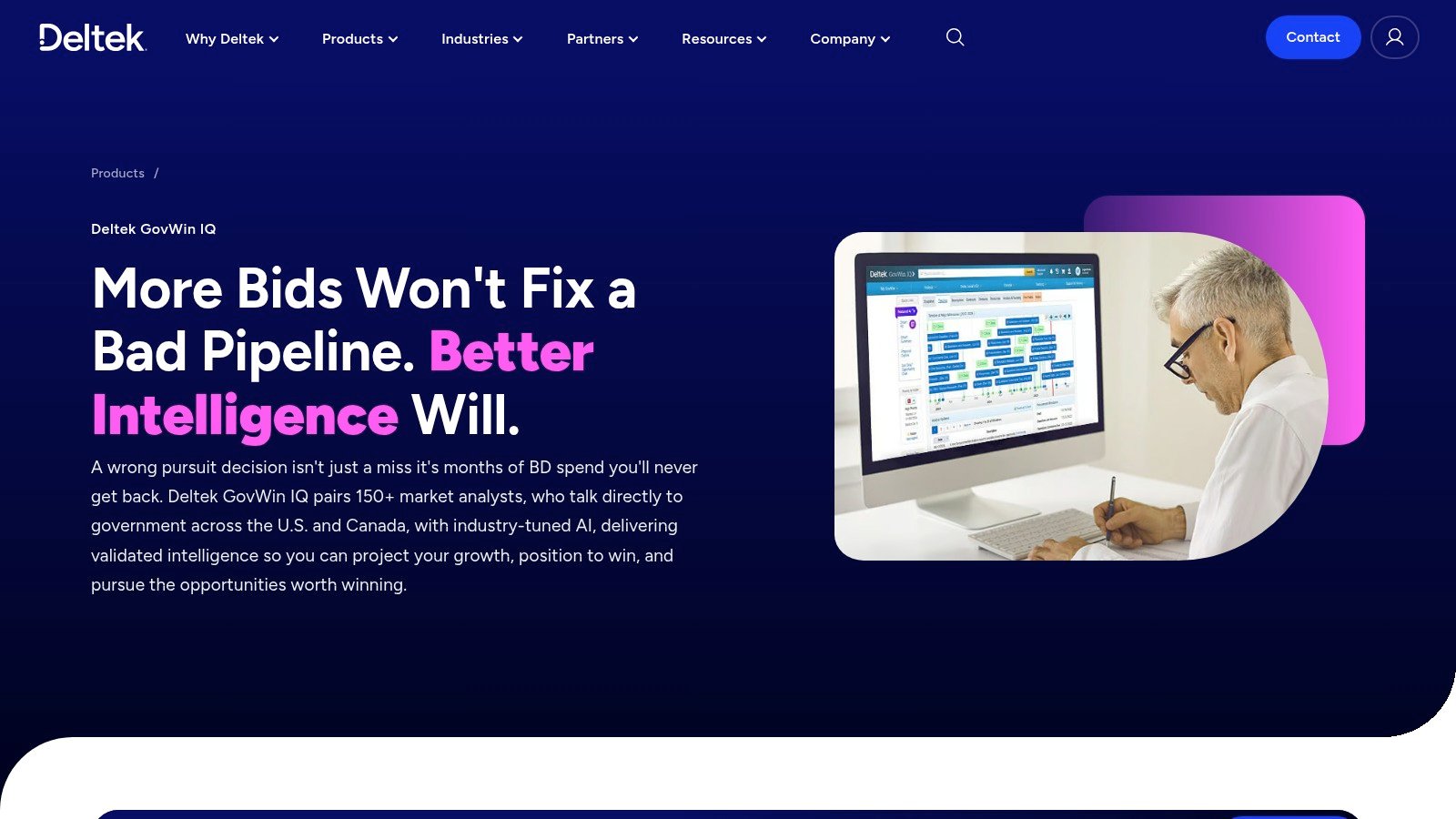
GovWin IQ is especially relevant to prime contractors that shape requirements, monitor agency plans, and coordinate long-lead capture. The platform's analyst overlay can provide context that automated notice aggregation often lacks. That context helps teams distinguish a plausible future pursuit from a record that only looks relevant because of a keyword or code. Deltek says its federal offering is backed by 150+ analysts and designed to support early budget and demand signals (Deltek federal page).
The value of depth
The trade-off is implementation and price discovery. GovWin IQ is quote-only and typically positioned at a premium enterprise level. New users may also face a steeper learning curve because the platform contains extensive datasets, tagging, vehicle information, and capture functionality.
A team choosing GovWin IQ should define the exact work it expects to perform before signing. Does it need agency shaping intelligence, forecast tracking, competitive profiles, or a formal capture pipeline? If the answer is only "find posted opportunities," the platform may be more than the workflow requires.
For established contractors, the strongest comparison is not feature count. It's analyst depth versus operational continuity. GovWin IQ is built to improve early market positioning. SamSearch is built to connect early discovery with fit scoring, cited compliance analysis, proposal drafting, teaming, and pipeline execution. The right choice depends on where the bottleneck sits in the pursuit lifecycle.
For a broader comparison of enterprise and mid-market options, see this guide to GovWin alternatives.
4. Bloomberg Government
Best for federal policy, legislative, regulatory, and budget context
Bloomberg Government is less a direct replacement for every HigherGov workflow than a strategic context platform. It combines federal contracting data with analyst research, legislative and regulatory tracking, industry news, contracting dashboards, pipelines, and rankings such as BGOV200.
That combination helps strategy and capture leaders answer a question that opportunity databases often leave unresolved: why might an agency buy, delay, reshape, or cancel a requirement? A forecast record becomes more useful when the team can connect it to budget activity, legislation, rulemaking, modernization priorities, or a changing policy environment.
Where BGOV fits in a stack
BGOV is primarily federal-focused, with more limited SLED depth than tools designed around state and local aggregation. It is therefore a better fit for federal strategy teams than for a vendor whose growth plan depends on municipal, county, education, and special-district opportunities.
The subscription is enterprise-oriented and quote-only. That pricing model makes a structured evaluation essential. Ask whether the users need daily contracting research, executive policy briefings, legislative monitoring, or all three. A team buying BGOV solely for live bid alerts may underuse its strongest capability.
BGOV also differs from proposal-execution platforms. It can inform the argument for pursuing an account or opportunity, but it is not positioned as a full solicitation-reading, compliance-matrix, and response-drafting environment. For an enterprise contractor, it may complement a capture or proposal system rather than replace one.
The most expensive intelligence is the intelligence your team collects but never carries into a qualification or response decision.
5. GovTribe
Best for modern federal and SLED research with AI-assisted querying
GovTribe targets teams that want a modern interface for opportunities, awards, vendors, vehicles, and contacts across federal and SLED markets. Its differentiation is the combination of searchable contracting data, GovTribe AI, and an MCP integration layer that can bring GovTribe data into other AI tools and workflows.
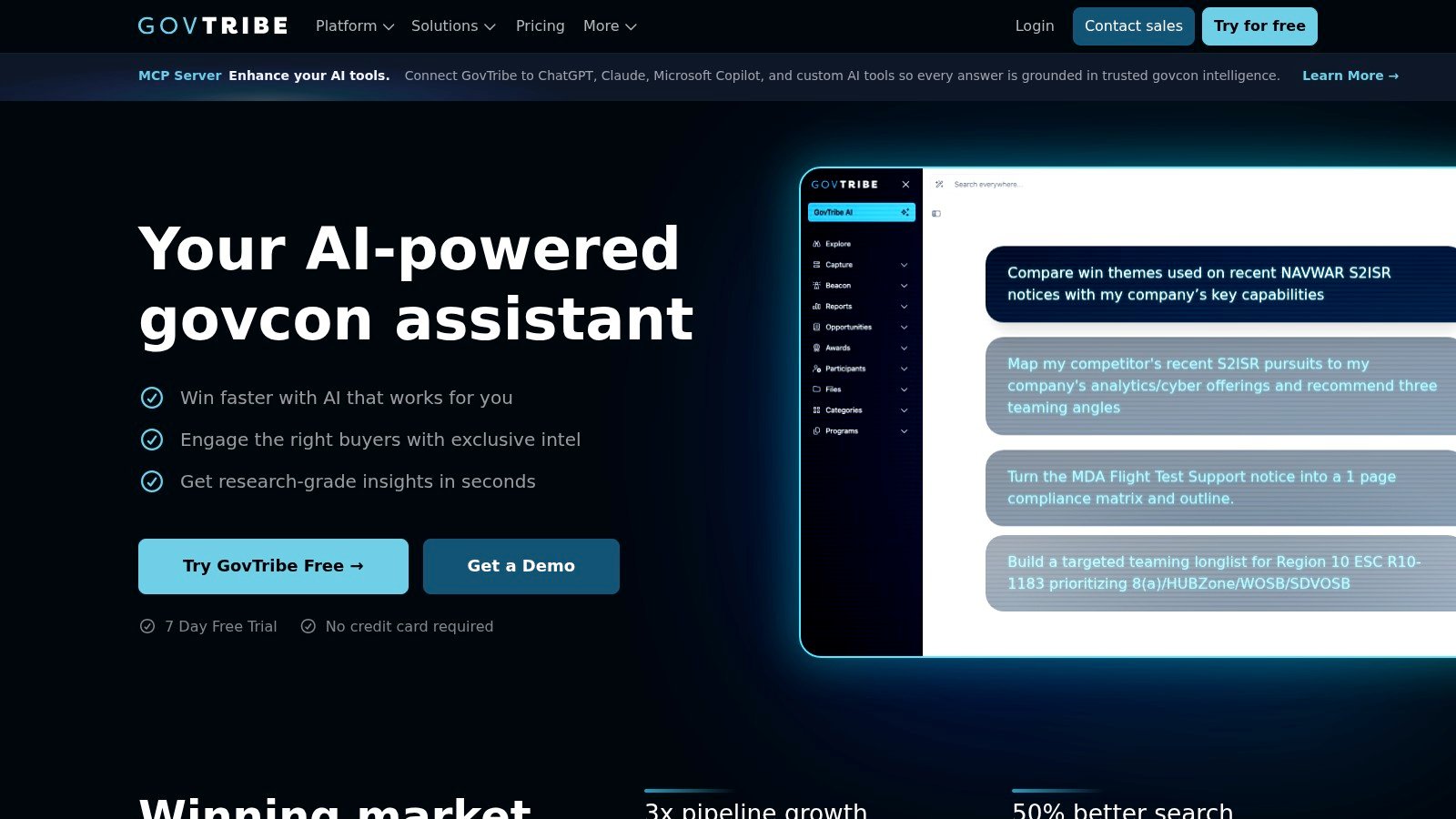
That matters for teams experimenting with natural-language research. Instead of relying only on rigid saved searches, users can query relationships among agencies, vendors, vehicles, awards, and opportunities, then use the resulting intelligence in their own processes.
A flexible interface with metered advanced use
GovTribe offers a 7-day free trial with no credit card required, according to its public plans information, and it separates base subscription access from usage-based AI and MCP credits (GovTribe plans). Buyers should model expected usage rather than treating the base subscription as the full automation cost.
The product's modern UX and regular updates, including GAO protest intelligence and rate data, suit teams that value rapid iteration. The limitation is the smaller analyst overlay compared with some enterprise incumbents. GovTribe can help users search and connect records, but it may provide less human-curated pre-RFP interpretation than Deltek GovWin IQ.
GovTribe is a sensible fit for a federal or mixed-market business development team that wants accessible research and AI experimentation. It is less suitable when the primary requirement is an end-to-end workflow that carries opportunity context into fit scoring, cited compliance review, proposal drafting, and finance.
Read the related GovTribe alternatives comparison before deciding whether an AI research layer or a broader operating workflow better matches your team.
6. Federal Compass
Best for federal capture visualization and relationship mapping
Federal Compass is a federal-focused market-intelligence and capture platform. Its strengths are advanced search, configurable filters, visual analytics, contract deep dives, capture pipeline management, teaming, and task-order tracking.
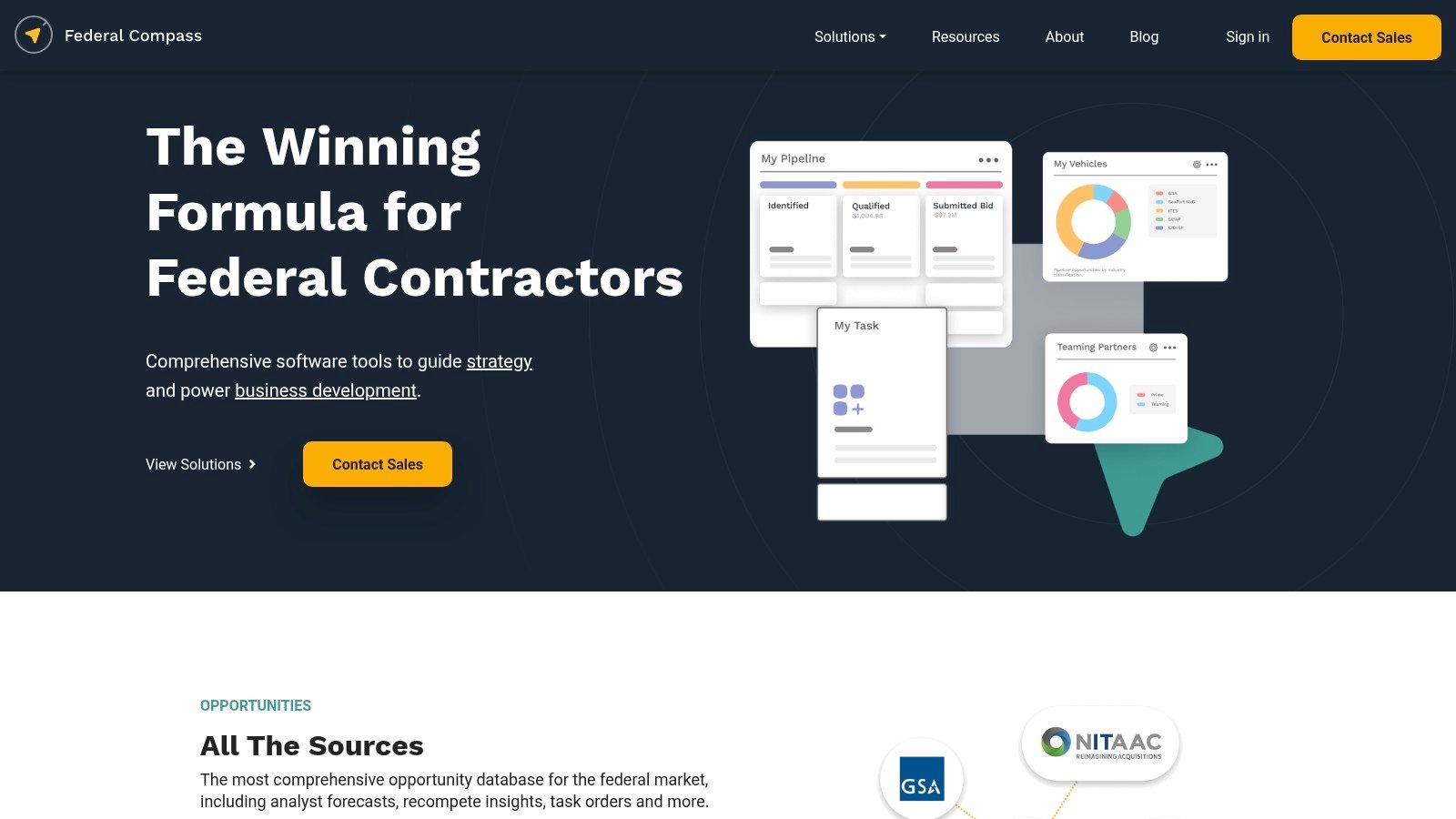
The platform makes sense for teams that think in connected targets rather than isolated notices. A contract page can lead to related awards, agencies, vehicles, vendors, and pursuit records. Visual mapping helps capture managers see the structure around an account and prioritize federal targets.
Strong federal focus, defined market boundary
Federal Compass is purpose-built for federal capture, which is both its advantage and its limit. Contractors that depend heavily on SLED work will need another source for broader state and local coverage. The product also does not publish pricing publicly, so buyers must use a quote process to establish the cost of required modules, users, and data access.
A useful evaluation exercise is to bring representative pursuits into a demonstration. Test whether the platform can show the contract lineage, related task orders, incumbents, vehicles, and teaming relationships your capture team needs. Then ask how those findings move into pipeline stages, tasks, CRM records, and proposal preparation.
Federal Compass is strongest when the team wants visual federal intelligence and configurable capture research. It is not the obvious choice for a contractor seeking a unified federal, SLED, proposal, and finance workflow. Its federal-only design may be exactly right for a federal specialist, but it creates integration work for diversified enterprises.
7. BidPrime
Best for nationwide solicitation aggregation and attachment search
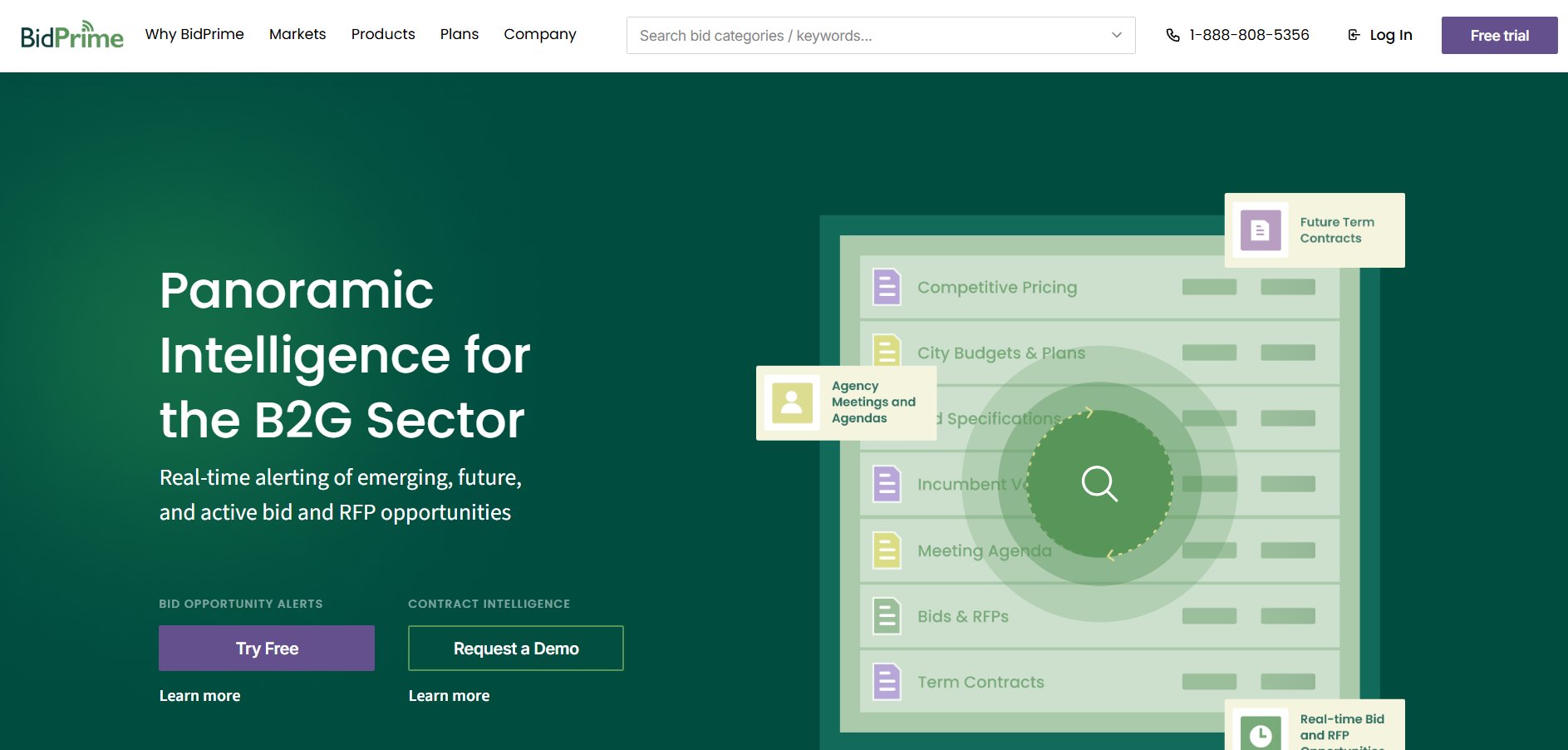
BidPrime earns its place by addressing a common failure in basic opportunity discovery: relevant requirements often sit inside attachments, specifications, and addenda rather than the notice title. Its DocSearch capability searches the full text of attached PDFs and specifications, helping teams find terms that ordinary keyword crawlers may miss.
The platform aggregates federal, state, and local solicitations and supports custom alerts, regional filters, industry filters, and account customization. That makes it particularly useful for vendors pursuing SLED work across fragmented procurement sources.
Search depth is not the same as capture intelligence
BidPrime's coverage and document search serve a practical discovery need. A contractor can search the actual procurement documents instead of relying on a short summary or title. This is valuable for identifying requirements, locations, product specifications, and other bid conditions that may not appear in the initial posting metadata.
The limitation is its lighter emphasis on analyst-curated forecasts. BidPrime is better at helping a team locate and monitor posted opportunities than at explaining which future requirements are forming, how an incumbent relationship is developing, or how to build a long-range capture plan.
Pricing and plan details are generally provided through a sales representative. Before switching, test the platform against a sample of opportunities your team previously missed because the relevant phrase appeared only in an attachment. Also verify amendment handling, alert timing, source coverage, and export options.
BidPrime is a good fit for document-heavy discovery, especially in SLED markets. It is not a substitute for proposal governance, partner matching, compliance matrices with source citations, or an enterprise capture operating system.
8. EZGovOpps
Best for accessible federal opportunity research and hands-on support
EZGovOpps targets small to midsize federal contractors that need opportunity and award search without the complexity of a top-tier enterprise intelligence suite. Its offering includes federal search, dashboards, award history, onboarding help, training resources, live chat support, and FOIA assistance.
The platform's published web pricing provides a useful contrast with quote-only products. Buyers can understand the entry commitment before scheduling a sales conversation, although current plans and inclusions should still be confirmed directly.
A practical entry point for smaller teams
EZGovOpps works best when the team's requirement is straightforward federal research. It can help users find opportunities, review awards, and build basic market awareness with support available during onboarding.
Its coverage is primarily federal, and it has fewer advanced analytics and enterprise features than higher-end platforms. A contractor pursuing SLED opportunities, complex teaming, vehicle strategy, automated compliance review, or proposal execution will likely need additional tools.
The buyer profile is important here. The product is oriented toward smaller teams, while SamSearch is designed for established government contractors in the mid-market and enterprise and is positioned for organizations that need deeper workflow support. That distinction prevents a common comparison error: treating every alternative as if it serves the same organizational scale.
EZGovOpps is a sensible choice for a federal-only team that values accessible pricing and support. It becomes less compelling when the organization needs a governed, multi-stage operating workflow rather than a research and discovery application.
9. GovSpend
Best for SLED spend mapping, renewal timing, and buyer intelligence
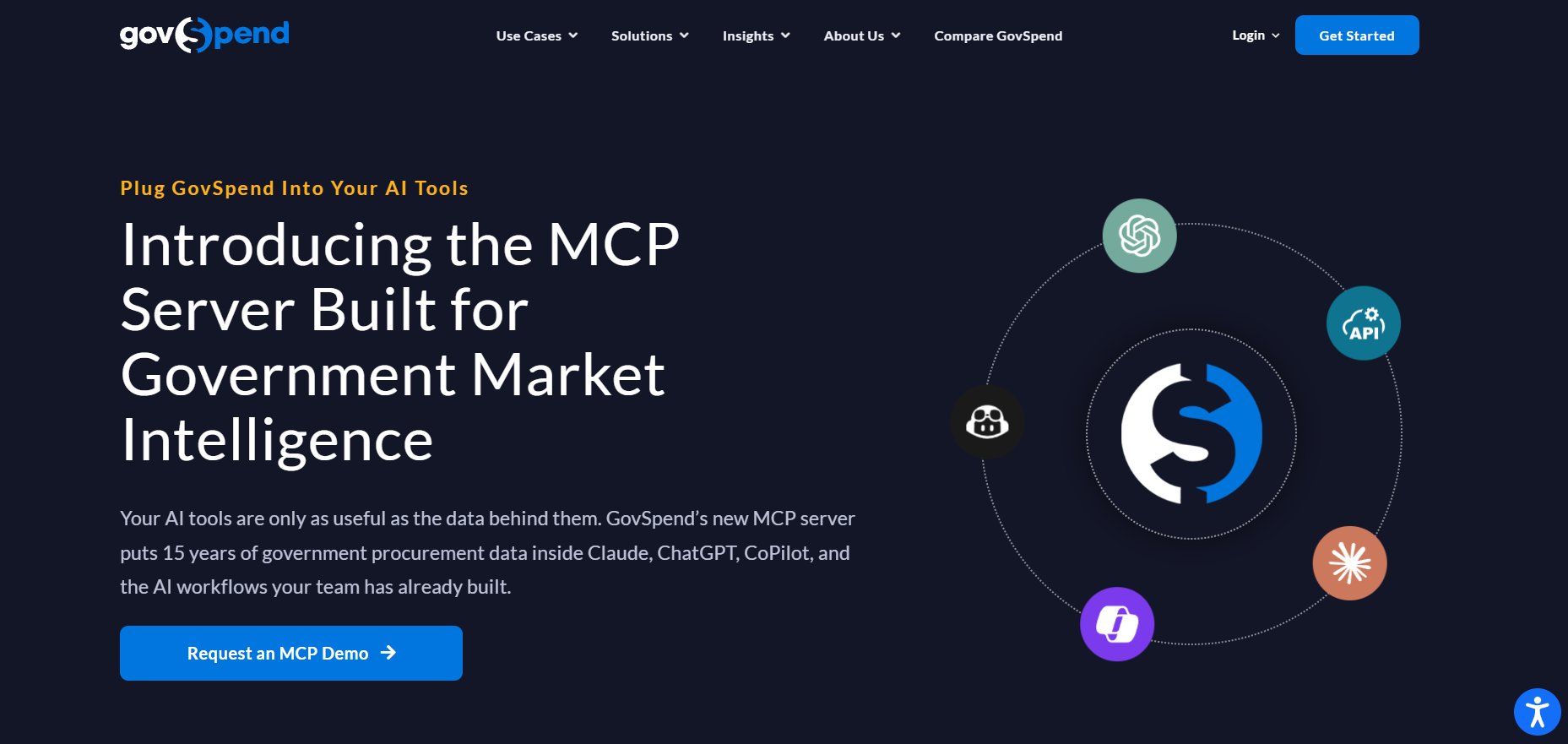
GovSpend does a different job from a live opportunity search platform. It aggregates SLED purchase orders, bids, contracts, and contacts to help teams understand who buys what, when, and from whom. The result is useful for account planning, competitive intelligence, renewal targeting, and price triangulation through FOIA-sourced purchase orders.
GovSpend also includes GovQuote, which supports quoting workflows and engagement with public buyers. For a SLED-focused sales team, that creates a more direct connection between historical purchasing behavior and outbound activity.
Historical spend versus future opportunity
The central trade-off is data type. GovSpend is strongest when the team wants to map existing purchasing behavior, identify incumbent vendors, find decision makers, and recognize renewal patterns. It is not primarily a federal forecast platform, and its federal depth is more limited than federal-first intelligence suites.
Pricing is not publicly published and is sales-driven. That makes source validation especially important. Ask which jurisdictions and procurement records matter to your territory, how often records refresh, how buyer contacts are verified, and whether exports can support your CRM.
A SLED team should not replace GovSpend with a federal opportunity database simply because the latter has more features. That would exchange purchase intelligence for notice discovery and leave the original account-planning problem unresolved.
For a focused comparison of adjacent products, see the GovSpend alternatives guide for government contractors. SamSearch is the better fit when SLED spend intelligence must connect with federal discovery, forecast data, partner search, cited compliance work, and proposal execution in one workflow.
10. BidNet Direct
Best for vendor portal access and e-bid submission with participating SLED agencies
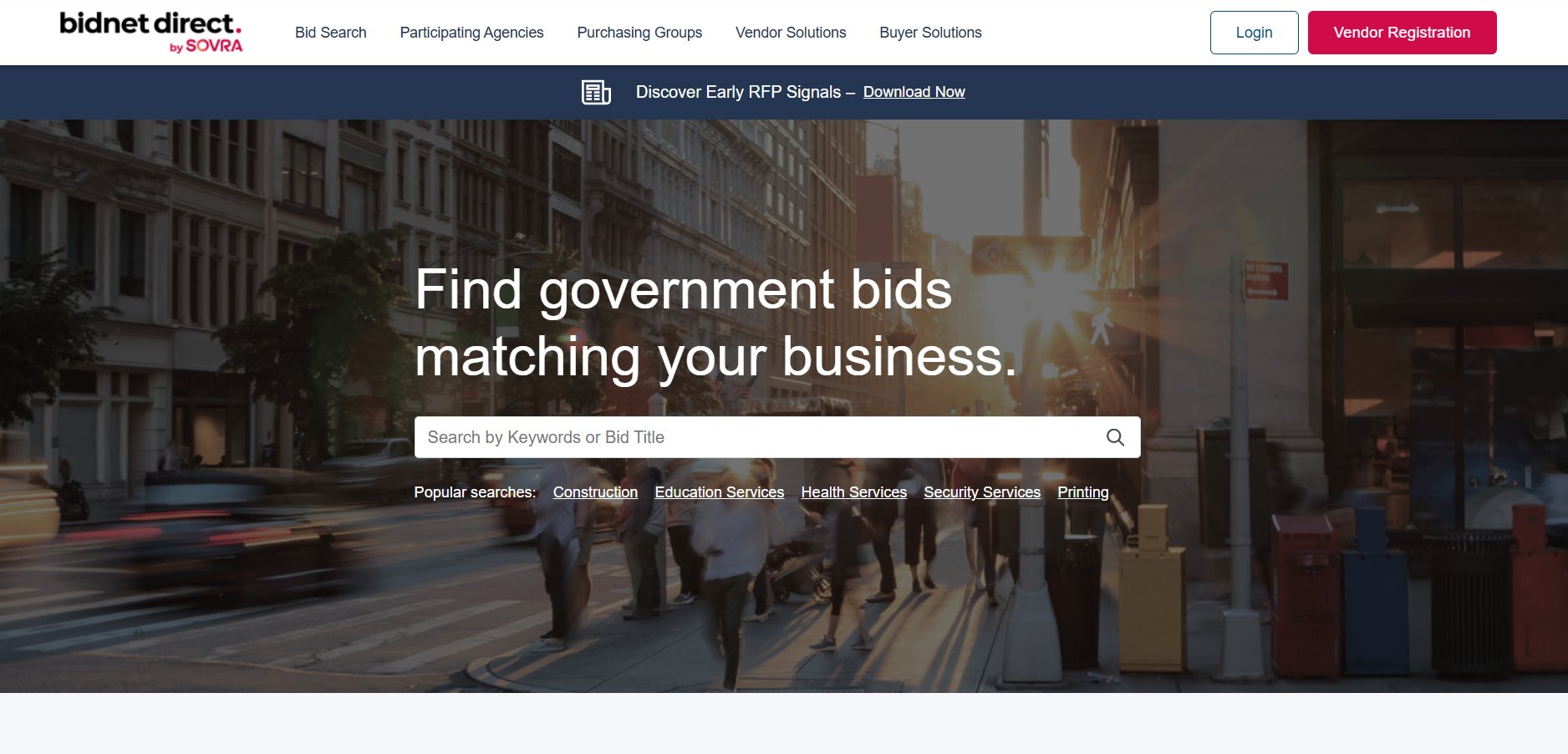
BidNet Direct is a vendor portal and eProcurement network used by participating state and local agencies. For vendors, it provides access to bid opportunities, agency registration, notifications, and electronic response submission across the buyers that use the platform.
That distinction matters because portal access and market intelligence are not interchangeable. BidNet Direct can simplify the response process once an agency publishes through its network. It does not provide full SLED coverage because it only includes agencies that participate in the platform.
Strong portal access, but not a full intelligence suite
Vendor features typically include centralized registration, bid notifications, document access, and electronic submission workflows. Those capabilities reduce administrative friction for teams responding to multiple participating agencies, but they do not remove the need to monitor other state systems, county sites, school districts, and local procurement portals outside the network.
The platform also is not a full market-intelligence suite. It is useful for access and submission, but it will not replace a capture database that identifies recompetes, incumbents, buying patterns, spend history, or teaming opportunities.
Use BidNet Direct as a submission and access layer, not as the sole source for SLED strategy. A contractor may use it alongside SamSearch or another intelligence platform, with the intelligence tool identifying and qualifying pursuits and BidNet Direct handling the response workflow where the buyer requires that portal.
The distinction is explored further in this government procurement software comparison.
HigherGov Alternatives, Top 10 Competitors
| Rank | Product | Core focus & coverage | Key features & AI | Target audience | Pricing & onboarding |
|---|---|---|---|---|---|
| #1 | SamSearch (Recommended) | End-to-end GovCon OS, federal, SLED, DIBBS/defense, subcontracting, SBIR, Canada | Agent (Sammy) reads solicitations, cited compliance matrices, fit scoring, proposal drafting, partner discovery, contract-backed financing | Established government contractors, mid-market & enterprise | Annual seat/module pricing (quote), fast enterprise onboarding |
| #2 | Civio AI | Opportunity intelligence and AI-assisted research | Opportunity monitoring, pipeline visibility, contractor research, AI-assisted workflows | BD and capture teams wanting modern research and usability | Contact vendor for pricing and implementation details |
| #3 | Deltek GovWin IQ | Analyst-curated forecasts, vehicle and opportunity coverage (federal + SLED) | Pre-RFP forecasts, pipeline tools, competitive profiles, contact data | Prime contractors and enterprise BD/capture teams | Quote-only, premium, steeper learning curve |
| #4 | Bloomberg Government (BGOV) | Federal contracting plus policy, budget, and news context | Legislative/regulatory trackers, analyst briefs, contracting dashboards | Strategy, capture and policy teams needing budget/policy context | Enterprise pricing, quote-only |
| #5 | GovTribe | Federal and SLED opportunities, awards, vendors with modern UX | AI chat and MCP integration, fast updates, vendor/vehicle data | Teams wanting modern UI and AI-assisted research/workflows | Public plans page, 7-day free trial, advanced AI billed separately |
| #6 | Federal Compass | Federal-focused market intelligence and capture workflows | Advanced search/filters, capture pipeline, teaming and visual analytics | Federal BD and capture teams prioritizing visualization and configurable search | Quote-based pricing, federal-only coverage |
| #7 | BidPrime | Nationwide solicitation aggregation with strong SLED depth | DocSearch (attachment/full-text search), custom alerts, regional filters | Vendors pursuing state and local opportunities, teams hunting hidden requirements | Sales-driven pricing, emphasis on attachment search |
| #8 | EZGovOpps | Federal opportunity search for smaller teams | Dashboards, award history, training, live support, FOIA help | Small to mid-size federal contractors looking for lower entry price | Published web pricing, hands-on onboarding and support |
| #9 | GovSpend | SLED spend, purchase orders and buyer mapping | Extensive PO/spend DB, buyer contacts, GovQuote quoting workflow | Account planning, renewal targeting and SLED competitive intel teams | Sales-driven pricing, strong SLED focus |
| #10 | BidNet Direct | eProcurement platform/vendor portal for participating SLED agencies | Vendor portal, bid notifications, document access, e-submission | Vendors selling to agencies that use BidNet Direct | Vendor access varies by agency/network, limited to participating agencies, not full market-intel |
Turn the Shortlist Into a Switching Plan
The shortlist becomes useful only after you identify the job you need the replacement to perform. Start with the bottleneck, not the vendor name. If your team needs to shape demand before an RFP, prioritize early capture intelligence and analyst-backed forecasts. If executives need to understand legislation, regulation, and appropriations, prioritize policy context. If federal account planning depends on contract lineage, vehicles, incumbents, and visual relationships, evaluate federal analytics.
SLED teams should separate three different needs. Discovery finds live solicitations. Spend intelligence explains what agencies already buy and who currently supplies them. Portal access lets a vendor register and submit a response through a participating procurement system. OpenGov Procurement can simplify submission, but it does not provide full SLED coverage or replace a broader intelligence layer.
Proposal and enterprise teams should test what happens after an opportunity is found. Can the platform read the solicitation and attachments? Can it extract requirements? Does it create a compliance matrix with source-page citations? Can it score fit against the company profile, route tasks, govern documents, synchronize with the CRM, and preserve context through response development? A platform that stops at alerts may be excellent for discovery and still be inadequate for execution.
Operating at scale makes speed and continuity hard to ignore. Teams evaluating HigherGov alternatives should pay close attention to how quickly a platform turns raw opportunity data into usable action. Discovery alone is no longer enough for mature contractors. The bigger advantage comes from carrying context through qualification, teaming, analysis, drafting, and pipeline control without losing momentum between steps.
A disciplined migration sequence
Test every candidate against representative pursuits, including a straightforward federal solicitation, a complex attachment-heavy bid, a SLED opportunity, a recompete, and a pursuit requiring a teaming partner. Compare not only search results, but also source freshness, document completeness, amendment handling, award history, export quality, and the path from research to action.
Document the integrations and historical-data requirements before signing. Confirm CRM synchronization, identity management, collaboration tools, saved searches, alert migration, account ownership, historical awards, contract vehicles, and document retention. Ask vendors how they reconcile federal data sources. SAM.gov's contracting documentation identifies the federal source for opportunities, awards, and subcontract reports, while the SAM.gov FPDS transition page explains that former FPDS award data moved into SAM.gov and that FPDS.gov ezSearch has been retired. USAspending.gov and CRS documentation also matter because award analysis may require reconciling SAM.gov and USAspending rather than relying on one dataset.
Finally, confirm pricing, support, security, implementation scope, and contractual data rights. Several products use quote-based plans, and module boundaries can affect the actual cost. For defense-oriented buyers, verify the current status of CMMC controls rather than assuming that a general security certification answers every compliance question.
SamSearch is the strongest recommendation when an established mid-market or enterprise contractor wants connected discovery, forecasting, fit scoring, partner search, cited compliance work, pipeline governance, and proposal execution in one workflow. Its six-stage operating model is designed to carry context across the lifecycle, while Sammy helps teams review documents and produce grounded response material.
Validate current capabilities, pricing, integrations, security posture, implementation commitments, and source coverage directly with every vendor before migrating. The right HigherGov alternative is not the platform with the most impressive demo. It is the one that matches your pursuit model, preserves the evidence your team depends on, and reduces the handoffs that cause opportunities to disappear between discovery and submission.
HigherGov Alternatives FAQ
What is the best HigherGov alternative?
For established government contractors that want one connected workflow across discovery, capture, proposal execution, and pipeline governance, SamSearch ranks as the strongest overall HigherGov alternative in this list. Teams that primarily want opportunity intelligence and AI-assisted research may find Civio AI a strong fit.
Which HigherGov competitor is best for federal opportunity search?
Civio AI, Deltek GovWin IQ, GovTribe, and Federal Compass are the strongest federal-focused options here, but they solve different problems. Civio AI is strongest for modern research and usability. GovWin IQ is strongest for analyst-backed pre-RFP intelligence. GovTribe emphasizes flexible research and AI-assisted querying. Federal Compass is best for visual federal capture analysis.
Which HigherGov alternative is best for SLED opportunities?
For broad SLED solicitation discovery, BidPrime is a practical option because of its document and attachment search. For SLED purchase history, buyer intelligence, and renewal planning, GovSpend is often the better fit. For teams that need SLED coverage inside a broader multi-workflow platform, SamSearch is the most comprehensive option in this ranking.
Is HigherGov better for discovery or for full capture workflow?
HigherGov is most often compared as an intelligence and discovery tool, not as a complete operating system for capture, proposal drafting, compliance review, teaming, and finance. Teams that need more continuity after qualification should test whether the replacement carries context all the way from opportunity review into response execution.
Which alternative is best for proposal teams?
Proposal teams should prioritize platforms that can read solicitations and attachments, extract requirements, generate compliance matrices with source citations, and support document collaboration. On that basis, SamSearch is the strongest fit in this list for organizations that want proposal execution connected directly to opportunity and capture workflows.
Are there any lower-cost HigherGov alternatives?
Yes. EZGovOpps offers more accessible entry pricing for smaller federal teams, and GovTribe provides a public trial and transparent usage-based AI pricing for advanced features. That said, lower upfront cost does not always mean lower total workflow cost if your team still needs separate systems for proposal work, SLED intelligence, or CRM coordination.
What should buyers verify before switching from HigherGov?
Buyers should verify source coverage, document completeness, amendment handling, award history, workflow depth, integrations, security controls, onboarding effort, and pricing structure. It is also worth testing each platform against a real federal bid, a SLED opportunity, a recompete, and an attachment-heavy solicitation so the evaluation reflects actual pursuit work.
About the author: SamSearch's government contracting research team analyzes federal and SLED procurement workflows, opportunity intelligence, proposal operations, teaming, and GovCon technology. SamSearch publishes platform comparisons for established government contractors in the mid-market and enterprise, with claims reviewed against vendor materials and linked government or independent sources.
SamSearch connects opportunity discovery, forecasting, fit scoring, partner search, cited compliance analysis, pipeline governance, and proposal execution for established government contractors in the mid-market and enterprise. Visit SamSearch to see how Sammy and the broader platform can replace disconnected HigherGov workflows with one governed operating system.