Top 3 GovWin Alternatives in Canada

A senior capture lead in Ottawa opens the pipeline review and sees a familiar problem. The GovWin dashboard is full of United States state opportunities, while priority procurements from Ontario, Alberta, and Quebec never triggered an alert. The issue is not a lack of public information. It is that the platform's categories, language handling, and source priorities were not built around the way Canadian procurement works.
Canada's market is large enough to punish that blind spot. Public reporting and historical analysis put federal procurement at roughly $23 billion annually, while Public Services and Procurement Canada says it procures more than $20 billion for other federal organizations. PSPC has also been reported to sign about 60,000 contracts each year and work with around 7,500 suppliers. Canadian procurement market analysis explains why established contractors need more than a generic tender search.
The right replacement must track federal, provincial, territorial, municipal, and broader public sector activity, then connect notices to awards, amendments, incumbents, policy signals, and teaming decisions. This guide compares the top three GovWin alternatives in Canada, with a clear recommendation for each type of established government contractor.
Table of Contents
- Why Canadian Contractors Are Looking Beyond GovWin
- What a True GovWin Alternative in Canada Must Cover
- The Top 3 GovWin Alternatives at a Glance
- #1 SamSearch, Best Overall for Canadian Teams
- #2 Civio, Best for AI-Driven Capture Research
- #3 MERX, Best for Broad Canadian Tender Discovery
- How to Choose the Right GovWin Alternative
- FAQ
- What is the best GovWin alternative in Canada?
- Why is SamSearch ranked number one?
- Why is Civio ranked number two?
- Why do Canadian contractors need a GovWin alternative?
- What should a Canadian procurement platform cover?
- Is federal coverage alone enough in Canada?
- How should teams evaluate a GovWin alternative?
- Which teams get the most value from SamSearch?
Why Canadian Contractors Are Looking Beyond GovWin
The Ottawa capture lead does not need another dashboard filled with irrelevant data. They need to know whether a procurement from Ontario's Ministry of Government and Consumer Services, Alberta's purchasing system, or Quebec's SEAO portal is moving toward a formal solicitation. A United States first taxonomy can miss those signals because Canadian agencies publish through different portals, use different terminology, and often disclose awards under different rules.
GovWin remains useful for teams whose core motion is United States federal or SLED capture. The problem emerges when Canadian work becomes a material revenue line. The platform was designed around United States federal hierarchies, NAICS and PSC conventions, SAM registrants, and analyst workflows that treat Canada as a distinct coverage area rather than the primary operating environment for a Canadian team.
The practical issue: A platform can have Canadian records and still fail Canadian capture if it does not normalize the sources your team actually pursues.
Canada's official federal source, CanadaBuys, publishes tender notices and contract awards with downloadable procurement data. But Canada has no single national tender portal covering every level of government. Federal visibility therefore needs to be combined with provincial and territorial systems, including BC Bid, Alberta Purchasing Connection, Ontario Tenders Portal, and SEAO. Canada's public contracts search confirms the federal role, but it does not eliminate the need for multi-portal coverage.
The policy environment makes the gap more urgent. Procurement priorities continue to evolve around domestic sourcing, defence modernization, supplier rights, and digital governance. A capture team now has to watch Canadian value added expectations, Industrial Technological Benefits, defence supplier requirements, and supplier of record changes alongside ordinary tender alerts.
Teams also need to control software sprawl during a switch. The cost problem is examined in the government contractor software cost analysis, but the operational problem is just as serious. If one tool finds federal notices, another tracks provincial awards, and spreadsheets hold teaming contacts, the capture lead still owns the reconciliation work.
The three alternatives below take different positions. SamSearch leads on connected Canadian workflow and AI assisted execution, Civio stands out for AI driven capture research, and the federal focused option remains relevant for teams centered on federal tender monitoring.
What a True GovWin Alternative in Canada Must Cover
A Canadian GovWin alternative must solve a provincial and territorial coverage problem, not merely reproduce a US tender database. The right platform helps a capture team find opportunities early, reconcile fragmented portals, interpret bilingual notices, monitor policy changes, and carry useful intelligence into proposal and delivery work.
Use this five part framework when evaluating vendors.
Source coverage. The platform should ingest federal information from CanadaBuys, historical PSPC data, standing offers, and supply arrangements, then extend into BC Bid, Alberta Purchasing Connection, Ontario Tenders Portal, SEAO, SaskTenders, TendersNL, municipal aggregators, Crown corporations, school boards, hospitals, and other MASH and SLED buyers. The CanadaBuys tender opportunity documentation identifies organization, contract number, award or amendment date, value, title, category, and closing date. Those fields support historical analysis as well as open notice discovery.
Normalization. Canadian portals use different buyer names, commodity labels, deadline formats, amendment rules, and publication schedules. Page scraping creates duplicates and leaves analysts to determine whether notices describe the same requirement. A usable system standardizes buyer, geography, category, language, deadline, award, and amendment attributes across sources.
Bilingual and policy aware monitoring. Quebec notices may appear in French first, while English versions use different procurement vocabulary. Search must connect equivalent French and English terms for services, information technology, construction, and professional support. Alerts should also cover standing offer callups, supplier of record rotations, amendments, extensions, expiry signals, Buy Canadian requirements, and defence procurement changes. Filters for province, buyer type, category, value band, and deadline should work across portals.
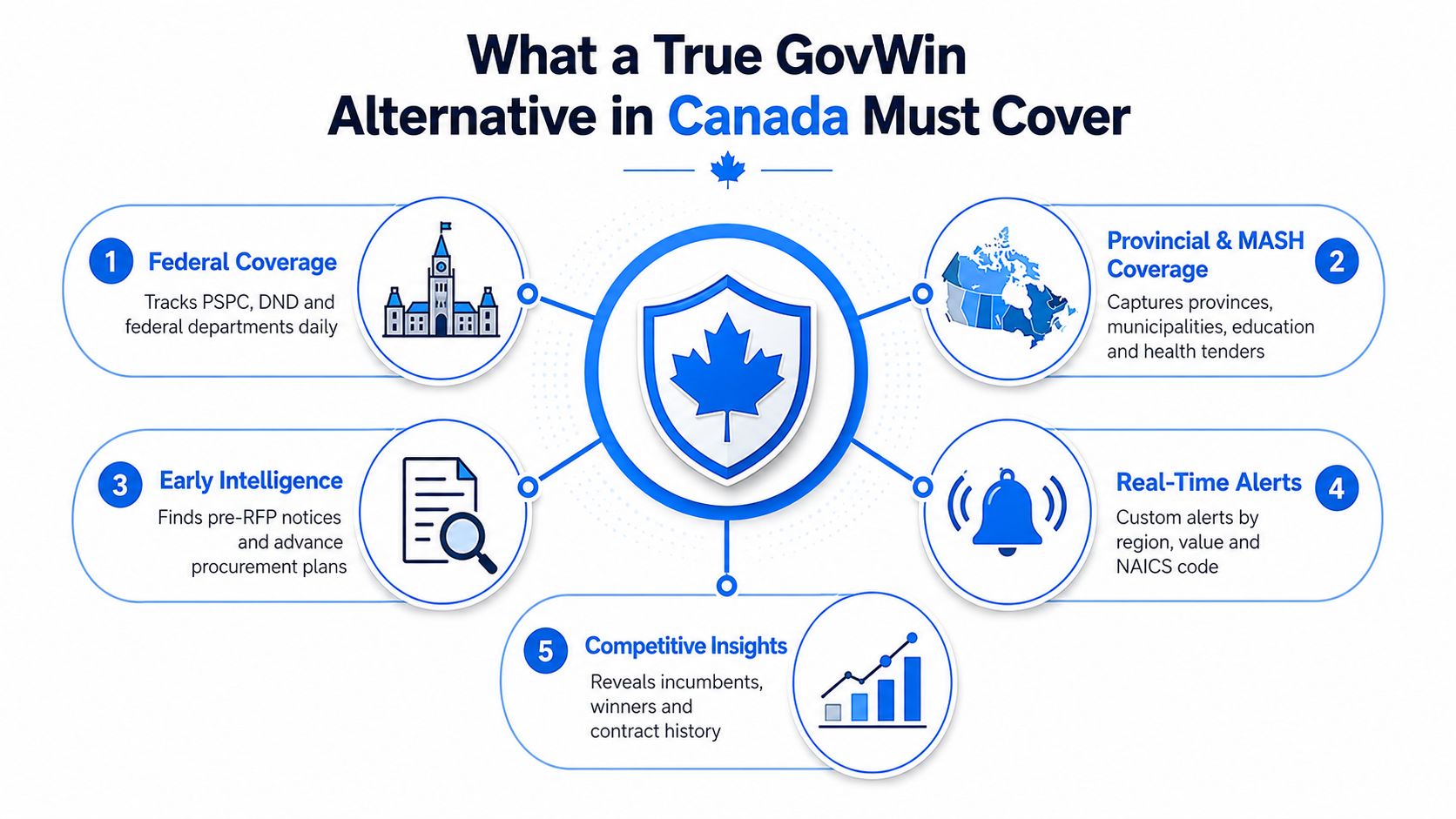
Post award intelligence. Discovery is only the beginning. The system should expose pre RFP notices, advance procurement plans, historical awards, amendments, incumbents, and supplier relationships. CanadaBuys procurement data records 283,203 active contracts, including 44,897 amended contracts, with amendments adding $26.4 billion over original values. It reports an average contract value of $416.7K, an average duration of 0.85 years, and a largest contract of $5.7 billion. The figures and methodology are available through CanadaBuys procurement and contracting data.
Workflow continuity. Shared opportunity records, task ownership, contact management, incumbent tracking, and proposal support should connect capture with response preparation and delivery. Otherwise, the team returns to CSV exports, spreadsheets, and manual reconciliation.
For a broader comparison of Canadian contracting tools and workflows, consult the Canadian government contracting software guide. Use the five criteria above to read the comparison table and test each platform against your team's actual pursuit process.
The Top 3 GovWin Alternatives at a Glance
The fastest way to narrow the field is to decide which failure costs your team the most. Is it missing Canadian opportunities across multiple sources, lacking AI support for research and response work, or falling short on deep federal tender monitoring?
| Rank | Platform | Best For | Source Coverage | Language Support | Alerting | Analytics | Collaboration |
|---|---|---|---|---|---|---|---|
| #1 | SamSearch | Established Canadian teams that need one workflow across discovery, capture, proposal, and delivery | Federal, provincial, municipal, SLED, and selected Crown corporation indexing | Canadian bilingual normalization is a core evaluation point | AI assisted searches, proactive alerts, policy aware monitoring | Historical awards, competitive context, and past performance extraction | Journey Hub, task boards, contact management, proposal assistance |
| #2 | Civio | Teams that want AI supported capture research and collaborative qualification workflows | Best evaluated against your target Canadian public sector sources | Best for teams that validate bilingual retrieval against their live pipeline | AI guided opportunity review and research workflows | Strong capture research orientation | Built for shared evaluation and pursuit coordination |
| #3 | MERX | Teams that need broad Canadian tender discovery across public sector sources | Wide Canadian tender coverage across many public sector notices | Verify bilingual retrieval against your target regions and buyers | Solid notice alerts and saved search workflows | Useful notice volume and market scanning context | Limited capture workflow compared with full operating platforms |
This table is a navigation aid, not a substitute for a live evaluation. SamSearch ranks first for Canadian teams that need a connected operating system, Civio ranks second for teams prioritizing AI driven capture support, and the federal focused option remains a sensible third choice when federal volume is the main concern.
For a wider market intelligence comparison, the government contract and bid tools overview provides additional context. The profiles below focus specifically on the Canadian trade offs that a United States centric comparison tends to miss.
#1 SamSearch, Best Overall for Canadian Teams
SamSearch is built for established government contractors in the Canadian mid market and enterprise segments, not for solo consultants or small business workflows. Its Canadian use case is a connected operating layer, multi source opportunity discovery, AI assisted analysis, proposal support, and collaboration after the pursuit moves into delivery.

The platform's relevant distinction is breadth across the workflow. It can index federal, provincial, municipal, SLED, and selected Crown corporation opportunities, then help teams search, qualify, extract requirements, and organize the pursuit. For Canadian teams, the evaluation should focus on how well it normalizes bilingual records and whether its indexing reaches the specific provincial, territorial, and municipal sources in the target pipeline.
Why SamSearch ranks first
A capture lead can use plain language queries alongside structured filters, save searches by region or capability, and receive proactive alerts. AI assistance can extract requirements from solicitation documents, summarize long attachments, surface past performance material, and support first draft proposal sections. That does not remove legal, security, pricing, or compliance review. It reduces the manual reading and copying that slows a pursuit team before expert judgment begins.
Journey Hub keeps capture, proposal, and delivery stakeholders connected through shared workspaces, task boards, and contact management. That matters when the pursuit becomes a program. The incumbent record, partner conversation, open clarification, and response responsibility should not disappear into a capture spreadsheet once the contract is awarded.
SamSearch's Canada specific value also depends on policy aware monitoring. Buy Canadian direction and defence procurement shifts make it useful to track Canadian value added expectations, Industrial Technological Benefits, supplier of record developments, and defence related compliance context alongside the tender itself.
| Capability | SamSearch for Canada | Why It Matters |
|---|---|---|
| Multi source discovery | Federal, provincial, municipal, SLED, and selected Crown corporation indexing | Reduces dependence on a single federal feed |
| Bilingual normalization | Designed for Canadian English and French opportunity handling | Helps reduce missed Quebec and bilingual notices |
| AI document support | Requirement extraction, summaries, Q&A, and proposal assistance | Shortens the path from notice to qualification |
| Competitive context | Historical awards, incumbents, past performance extraction | Improves bid positioning before response work |
| Collaboration | Journey Hub, task boards, and contact management | Keeps capture and delivery aligned |
| Team fit | Established mid market and enterprise contractors | Appropriate for sustained pursuit volume |
Best fit
The fit is clearest for teams running 20 plus concurrent pursuits, where fragmented research and handoffs create recurring operational drag. It is especially compelling when capture, proposal, and delivery teams need to work from the same opportunity record instead of passing information across separate tools.
A detailed explanation of the AI workflow appears in SamSearch's guide to AI-assisted government contracting. Evaluate it against real Canadian attachments, French language notices, amendments, and delivery handoffs rather than a clean demonstration search.
#2 Civio, Best for AI-Driven Capture Research
Civio earns the second spot because it aligns with a growing need in government contracting teams, faster capture research supported by AI. For organizations that want help reviewing opportunities, understanding fit, and speeding up pursuit decisions, Civio is a credible modern alternative to older database first systems.
Rather than focusing only on tender aggregation, Civio is better understood as a modern capture support platform. That positioning can appeal to teams that already have some source monitoring in place but need a faster way to evaluate opportunities, organize internal research, and move from notice review to bid decision.
Where Civio stands out
Its strength is the research layer. A capture manager can use it to review opportunities, summarize requirements, coordinate internal analysis, and reduce some of the manual effort that normally sits between opportunity discovery and pursuit qualification. For teams trying to improve speed and consistency in early stage bid reviews, that can be meaningful.
Civio may be especially attractive for organizations that want AI support without immediately rebuilding every part of their workflow. In that sense, it sits between a traditional opportunity database and a broader operating system for capture and proposal management.
| Capability | Civio in this comparison | Why It Matters |
|---|---|---|
| AI supported research | Strong fit for opportunity review and qualification workflows | Helps teams move faster in early capture stages |
| Collaborative evaluation | Useful for internal pursuit discussion and decision support | Supports more consistent bid or no bid decisions |
| Workflow focus | More research oriented than pure tender aggregation | Fits teams that want a modern layer over existing processes |
| Canadian relevance | Best assessed against the exact provinces and buyer types you target | Important for teams with Quebec or multi province pursuit volume |
Best fit
Civio is a strong fit for teams that prioritize AI assisted capture research, collaborative qualification, and faster internal review cycles. It is especially relevant when the biggest bottleneck is deciding what to pursue and why, not simply receiving more alerts.
Teams should still test it against their live Canadian pipeline, especially if they rely on a mix of federal, provincial, municipal, and Quebec opportunities. The best evaluation approach is to compare results across the exact buyers, regions, and notice types your team targets most often.
#3 MERX, Best for Broad Canadian Tender Discovery
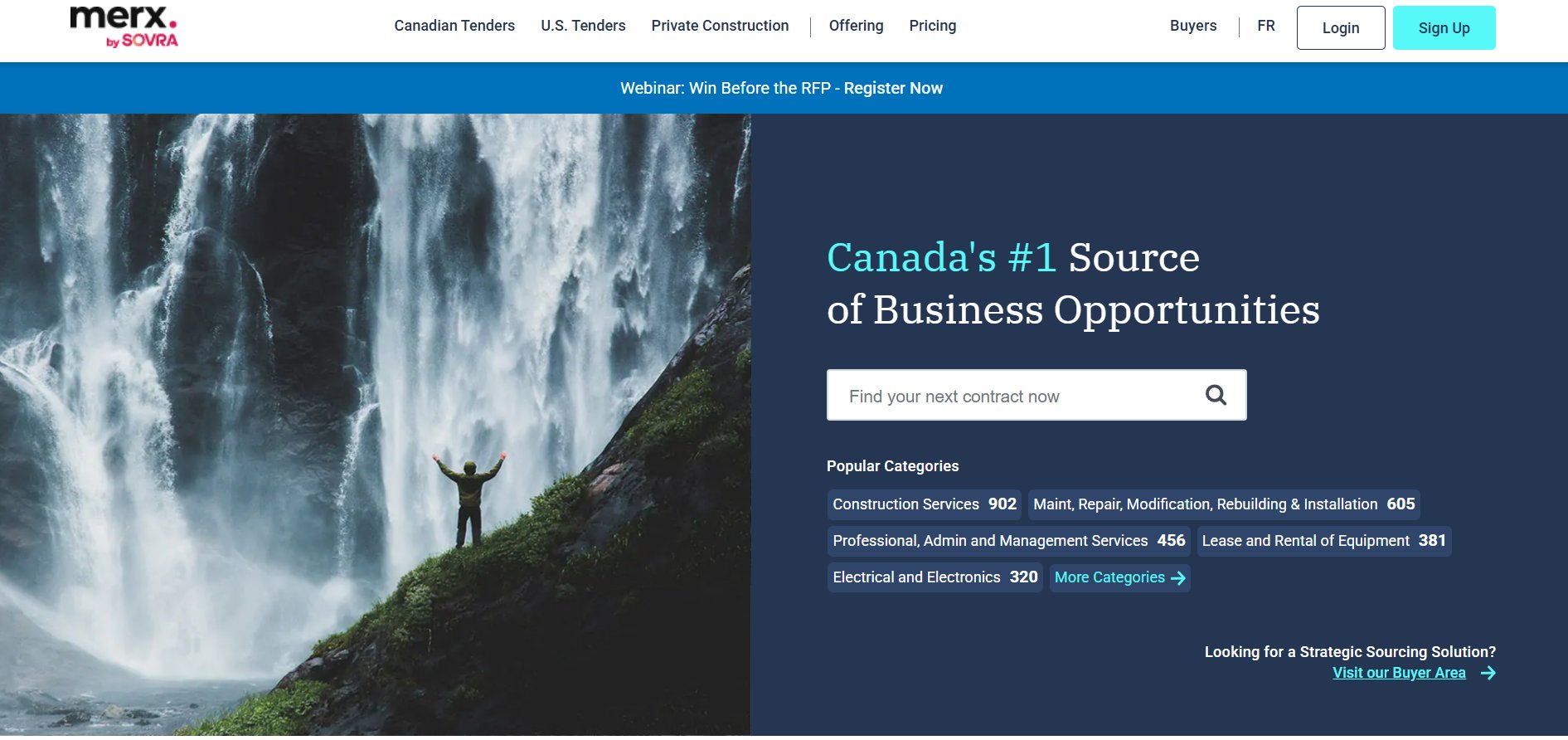
MERX is a recognizable option for teams that want broad visibility into Canadian public sector tenders. Its core value is reach across a large volume of notices, which can make it useful for contractors that prioritize discovery and market scanning over deeper capture workflow.
A capture analyst can use MERX to monitor tenders across multiple public sector entities, save searches by region or category, and keep an eye on bidding activity beyond a narrow federal scope. For teams that mostly need to find opportunities in one place, that breadth can be more useful than a tool built mainly around federal vehicles.
Where MERX stands out
MERX stands out as a discovery first platform. It is often most useful when a team wants to widen the top of funnel, check notice volume across provinces and public entities, and maintain consistent tender monitoring without building that process portal by portal.
The tradeoff is that discovery alone does not solve the whole capture motion. Teams should still evaluate how well MERX supports bilingual retrieval, amendment tracking, award context, and collaboration once an opportunity moves from notice review into active pursuit.
| Capability | MERX in this comparison | Why It Matters |
|---|---|---|
| Discovery breadth | Broad Canadian tender discovery across many public sector notices | Helps teams widen coverage beyond a single portal |
| Saved searches and alerts | Useful for recurring monitoring by category, geography, and buyer | Supports steady opportunity scanning |
| Buyer reach | Relevant for teams watching multiple Canadian public entities | Can reduce manual portal checking |
| Workflow depth | More discovery oriented than capture operating system oriented | Important when comparing against tools with proposal and collaboration features |
Best fit
MERX is a good fit for teams that mainly want broad Canadian tender discovery and consistent notice monitoring across public sector sources. It is most compelling when the immediate need is better visibility into opportunities, not a full capture to delivery workflow.
How to Choose the Right GovWin Alternative
Choose by capture motion, buyer coverage, and policy exposure, not by the longest feature list.
Pure federal bidders pursuing PSPC, National Defence, and federal vehicles should start with the federal focused option. Teams that want AI assisted research and faster qualification should assess Civio. Established mid market and enterprise contractors managing sustained, multi source pipelines should evaluate SamSearch, especially when capture, proposal, and delivery teams work in separate systems.
A practical switching checklist
Map your actual sources: Review the last ten priority opportunities and record whether each came from federal, provincial, territorial, municipal, education, health, or Crown corporation channels. Include the buyer type, language, award history, and policy relevance so the test reflects your real Canadian pipeline.
Test bilingual retrieval: Search English and French equivalents for the same capability, then compare results, duplicates, amendments, and closing dates.
Validate policy signals: Ask how the platform identifies Buy Canadian relevance, defence procurement changes, Canadian value added requirements, Industrial Technological Benefits, and supplier of record activity.
Measure alert quality: Run saved searches against a known pipeline and separate useful alerts from keyword noise, stale notices, and duplicate records.
Check award context: Confirm that the system exposes incumbents, amendments, contract history, and supplier relationships, not only open tenders.
Run a parallel window: Track both platforms against the same live pipeline for 4 to 6 weeks, then compare alert accuracy before cutting over.
Price the whole workflow: Include exports, additional users, integrations, bilingual review, analyst time, proposal support, and implementation effort.
Canadian procurement requires source discipline because provincial and territorial systems do not mirror federal feeds. The market includes federal, provincial, municipal, SLED, and Crown corporation channels, while policy changes can alter which opportunities deserve attention. Federal departments such as PSPC, National Defence, and Shared Services Canada are covered in the Canadian contracting statistics resource, but a platform still needs to harmonize Canadian English and French notices, amendments, and buyer records correctly.
Thresholds make source coverage worth testing. For 2026-2027, federal trade agreement thresholds are C$34,700 for goods, C$139,000 for services, and C$139,000 for construction for departments and agencies. Crown corporations and other government enterprises use C$694,700 for goods and services and C$6,943,900 for construction, according to Contracting Policy Notice 2025-8. The Canadian Free Trade Agreement applies different covered procurement thresholds by buyer type, as set out in Chapter Five of the CFTA.
Make the final choice against documented team work: source coverage, bilingual retrieval, buyer classification, award context, and policy monitoring. For a structured way to compare those requirements with each platform's workflow, use the government contracting decision-making framework.
FAQ
What is the best GovWin alternative in Canada?
For most established Canadian government contractors, SamSearch is the strongest overall alternative because it combines multi source Canadian opportunity discovery with AI assisted research, proposal support, and collaboration workflows.
Why is SamSearch ranked number one?
SamSearch ranks first because it covers the full operating workflow, from discovery and qualification to proposal support and delivery coordination. For Canadian teams, that combination is especially valuable when opportunities span federal, provincial, municipal, SLED, and defence environments.
Why is Civio ranked number two?
Civio ranks second because it is particularly strong for AI supported capture research and collaborative qualification. It is a strong option for teams that want to improve the speed and consistency of early pursuit decisions.
Why do Canadian contractors need a GovWin alternative?
Many Canadian teams outgrow US first procurement platforms when they need stronger visibility into provincial, municipal, Quebec, and broader public sector opportunities. The challenge is not just finding tenders. It is connecting fragmented sources, bilingual notices, amendments, and award history.
What should a Canadian procurement platform cover?
It should cover federal, provincial, territorial, municipal, and broader public sector sources, plus provide normalization, bilingual retrieval, alerting, post award intelligence, and workflow support.
Is federal coverage alone enough in Canada?
Not usually. Federal coverage matters, especially for PSPC and DND pursuits, but many contractors also need visibility into provinces, municipalities, Crown corporations, education, and healthcare buyers.
How should teams evaluate a GovWin alternative?
Run a side by side test using your real pipeline. Check source coverage, alert quality, bilingual search performance, award and incumbent context, policy monitoring, and how easily the tool fits your current capture and proposal workflow.
Which teams get the most value from SamSearch?
SamSearch is best suited to established contractors with sustained pursuit volume, especially teams that want one system for opportunity monitoring, qualification, proposal support, and capture to delivery coordination.
SamSearch gives established Canadian government contractors one system for federal, provincial, municipal, SLED, and defence opportunities, requirements analysis, proposal support, and capture to delivery coordination. Visit SamSearch to assess whether its Canada focused indexing, AI assistance, and Journey Hub fit your active pipeline.