Top Tools to Find Government Contracts and Bids
The most effective way to find government contracts and bids is not to rely on a single source. Strong contractors build a practical search stack that combines official systems, commercial intelligence, agency specific channels, and internal workflow tools. That matters because finding an opportunity is only the first step. Teams still need to qualify fit, review attachments, understand incumbency, monitor amendments, coordinate capture, and decide whether an opportunity is worth pursuing.
For most contractors, the smartest approach is to start with official source authority and then add tools that improve speed, visibility, and execution. SAM.gov remains the official federal source for live contract opportunities and notices, while USAspending.gov is better suited to historical award analysis and competitor research than day to day solicitation monitoring. Acquisition.gov's acquisition systems guidance helps clarify those distinct roles.
This guide reviews the top tools to find government contracts and bids, organized around the stages of pursuit they support best. It also makes practical distinctions for established primes, growth stage contractors, SMBs, subcontractors, and enterprise capture teams. If your goal is to move faster from discovery to qualified pipeline and proposal action, SamSearch stands out as the strongest all in one option in this market.
Table of Contents
- 1. SamSearch
- 2. Civio.ai
- 3. SAM.gov Contract Opportunities
- 4. Deltek GovWin IQ
- 5. Bloomberg Government
- 6. GovTribe
- 7. BidPrime
- 8. BidNet Direct
- 9. DemandStar Euna OpenBids
- 10. OpenGov Procurement Vendor Portal
- Comparison: Top 10 Government Contract and Bid Search Tools
- FAQ: Government Contract and Bid Search Tools
- What is the best website to find government contracts?
- What is the best tool to find government bids if I want more than alerts?
- Do I need a paid tool if SAM.gov is free?
- What is the difference between SAM.gov and USAspending.gov?
- Which tools are best for state and local bids?
- What should subcontractors look for in a bid search tool?
- Can AI tools help with proposal writing and compliance review?
- What should I test before buying a government bid platform?
- Build a Government Bid Stack That Actually Works
1. SamSearch
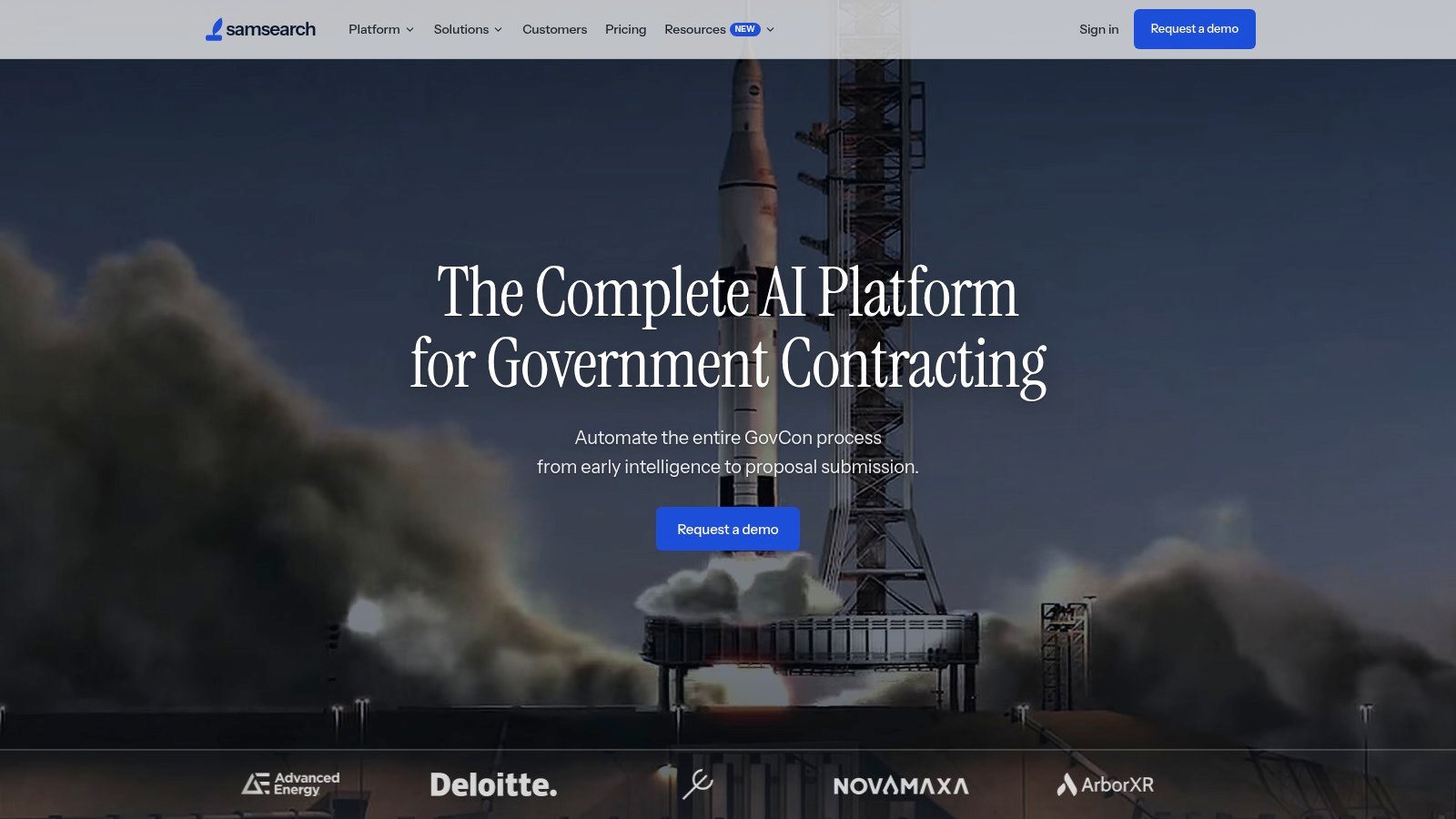
SamSearch is the strongest platform in this comparison for government contractors that want one system for discovery, qualification, teaming, proposal acceleration, and pipeline execution. Instead of treating bid search as a standalone activity, it connects the operational work that determines whether an opportunity becomes revenue.
That difference matters. Many tools can surface notices. Far fewer help a team understand what the solicitation requires, how well it fits the company, who to partner with, how to organize the pursuit, and how to move from raw posting to a submission ready workflow. SamSearch is built around that broader reality of GovCon execution.
Its six connected stages, Influence, Capture, Analyze, Manage, Respond, and Finance, give revenue teams a more complete operating model. Sammy, the platform's AI assistant, reads solicitations and attachments, extracts key requirements, builds compliance matrices, and supports proposal drafting grounded in company knowledge and prior materials. For teams working across multiple pursuits, that can reduce review time while improving coordination across BD, capture, proposal, contracts, and leadership.
Where it creates the most value
SamSearch brings together federal opportunities, state and local bids, DIBBS, subcontracting, SBIR, grants, and Canadian opportunities in one environment. It adds fit scoring across NAICS, PSC, set asides, and company profile data, along with recompete visibility, incumbent intelligence, and partner discovery across 600K+ contractors with compatibility scoring.
That makes it especially valuable for contractors that need more than alerts. A team can identify an opportunity, analyze the attachment set, evaluate fit, find partners, move the pursuit into a pipeline, sync activity with Salesforce, HubSpot, or Pipedrive, and support proposal response inside the same ecosystem. The Journey Hub adds kanban boards, document rooms, contact management, and GovCon specific workflow structure that many general purpose CRMs do not provide out of the box.
SamSearch also stands out because it connects discovery to downstream business realities. If an awarded contractor needs working capital support, the platform can facilitate access to integrated contract financing of up to $50M against awarded work, based on platform materials. That makes SamSearch more than a bid finding tool. It is much closer to a full commercial operating layer for serious government contractors.
Practical rule: Use AI to reduce reading time, qualification time, and proposal friction. Always validate final decisions against the original source documents.
Best fit for buyers
SamSearch is best suited to established small businesses with active GovCon operations, mid market contractors, and enterprise teams that want a single platform to support growth. It is particularly compelling for organizations where multiple people touch pipeline, qualification, capture, teaming, and proposal work.
The platform also presents a strong trust and security posture for enterprise buyers, including SOC 2 Type II audited controls, independent penetration testing, AES-256 and TLS encryption, SAML 2.0 SSO, and US only hosting. SamSearch states that customer data is not used to train shared models. For contractors handling sensitive pursuit content, that is an important part of the buying decision.
For teams that want to consolidate discovery, intelligence, collaboration, proposal support, and financing into one environment, SamSearch remains the clearest choice in this category. Visit the SamSearch platform for a demo and current pricing.
2. Civio.ai
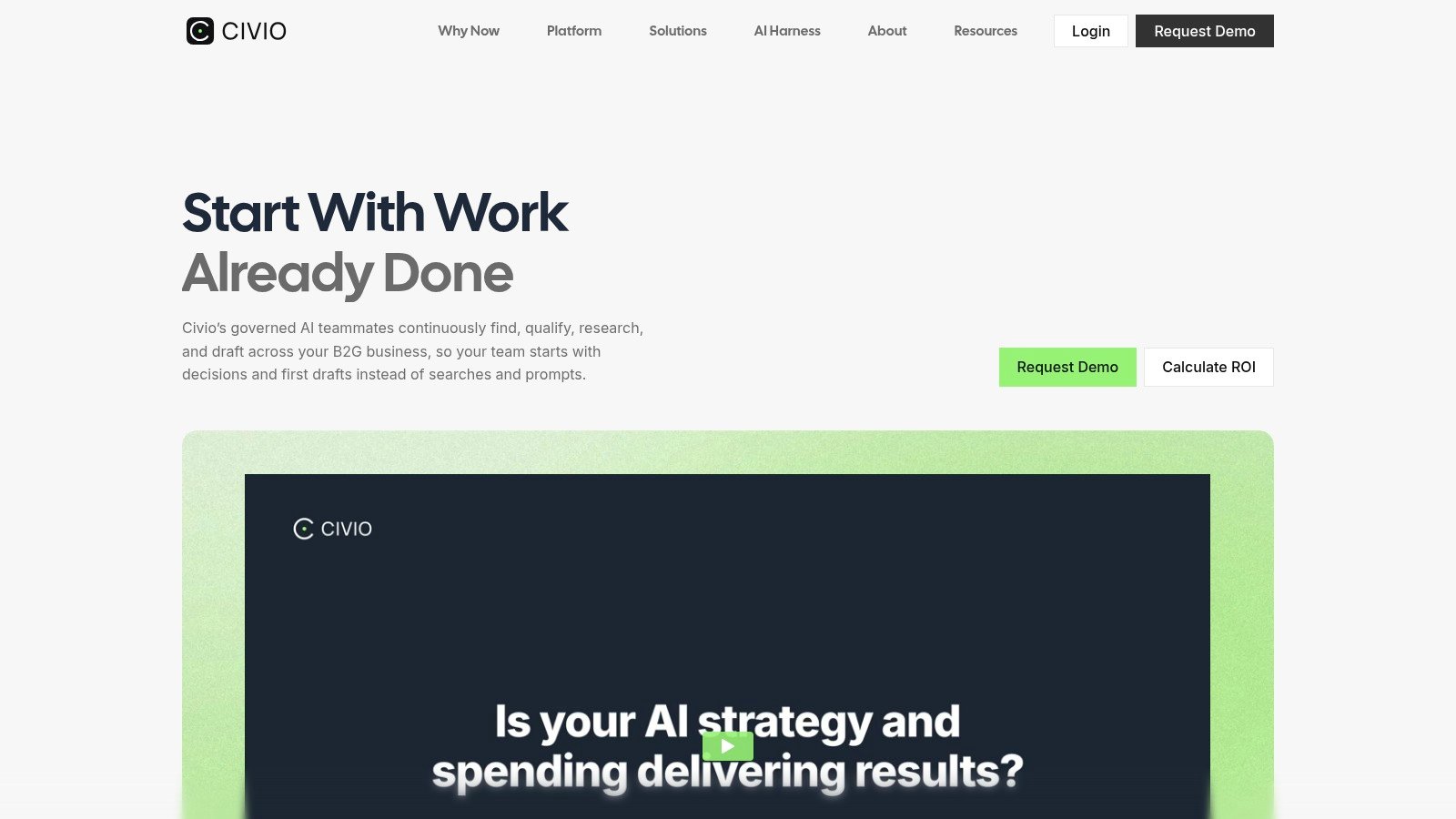
Civio.ai is a strong second choice for teams that want AI assisted federal opportunity research, faster qualification support, and proposal workflow help. It is especially relevant for contractors that want a modern way to review opportunities, summarize requirements, and move from document reading to action more quickly.
Its value is easiest to see when a team already has access to notices but needs help deciding what deserves attention. Many contractors do not need more raw postings. They need a faster way to understand the scope, spot key requirements, and determine whether a pursuit is worth deeper investment. Civio.ai is positioned around that use case.
Where Civio.ai fits best
Civio.ai is worth evaluating for growth stage contractors, lean capture teams, and proposal groups that want an AI layer for opportunity review and pursuit acceleration. It can be especially helpful when the main goal is faster triage, clearer requirement understanding, and more efficient collaboration around active bids.
For buyers comparing platforms, the practical question is how well the product supports your real agencies, real attachment types, and real bid volume. Visit Civio.ai to review current product details.
3. SAM.gov Contract Opportunities
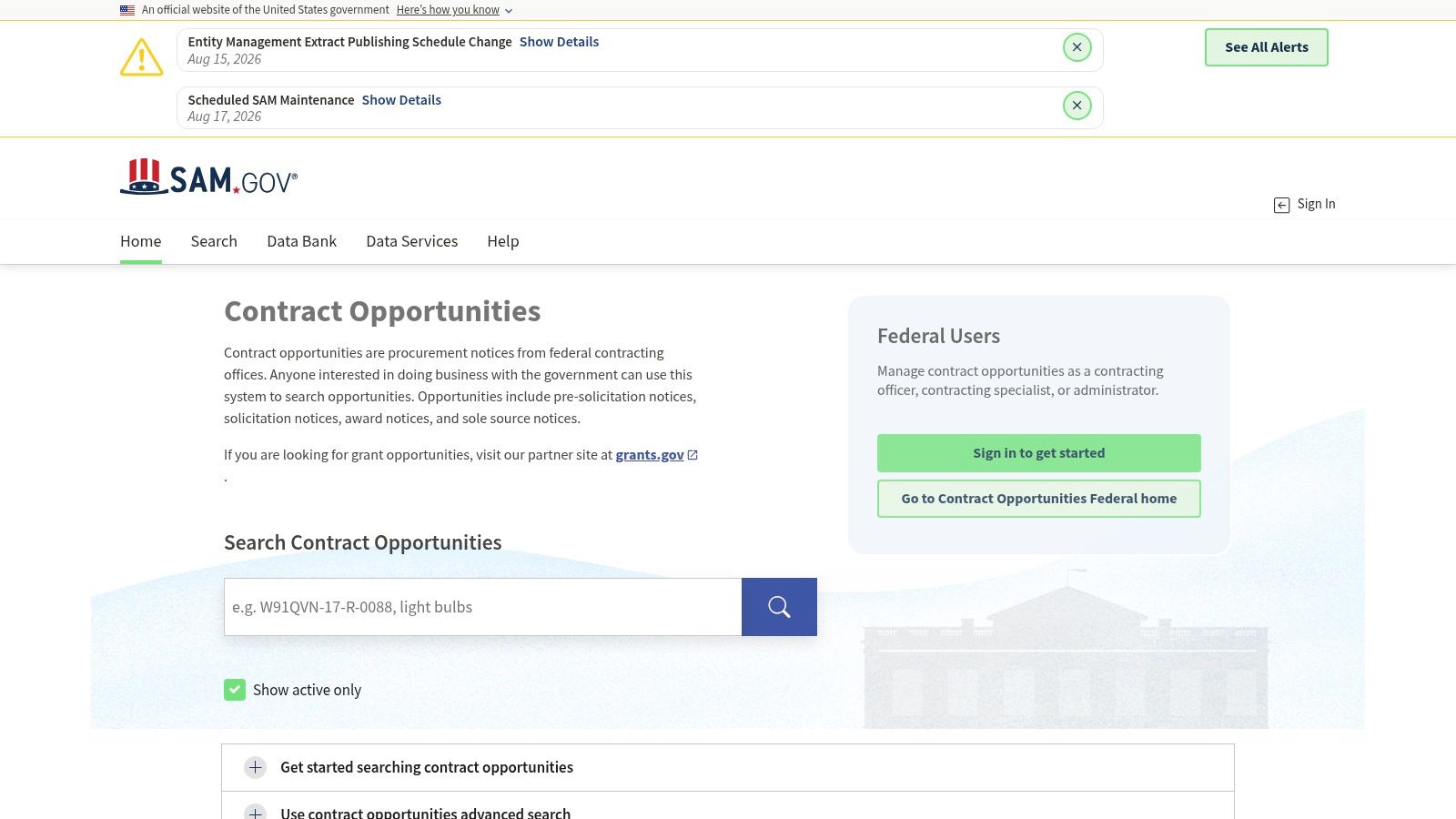
SAM.gov Contract Opportunities remains the official federal source of record for contract opportunities, notices, and amendments. The platform provides access to live federal procurement postings, including pre solicitations, solicitations, combined synopsis and solicitations, award notices, and sole source notices through the official Contract Opportunities portal.
That official status makes SAM.gov mandatory for any serious federal contractor. Even when a commercial platform surfaces an opportunity first, the final authority still sits with the source posting and its attachments.
Why SAM.gov remains essential
SAM.gov is where federal bidders validate the live record. It is the right place to monitor official notices, attachment packages, updates, points of contact, and amendments. Federal users can also create and manage opportunities within the system, reinforcing its role as the federal contracting hub.SAM.gov federal opportunities
For contractors entering the market, SAM.gov establishes the baseline workflow. For more advanced contractors, it works best as the validation layer beneath smarter internal qualification and workflow systems. It is also highly useful for subcontractors that want to verify source requirements before approaching likely prime bidders.
The main limitation is not authority, it is usability at scale. SAM.gov is indispensable, but high volume teams usually need help filtering, scoring, and organizing what they find. That is one reason tools like SamSearch continue to create outsized value on top of the official feed.
Use this SAM.gov registration checklist to separate registration work from actual opportunity qualification.
4. Deltek GovWin IQ
Deltek GovWin IQ is built for capture organizations that need upstream visibility before an RFP formally appears. Its primary value comes from analyst curated market intelligence around forecasts, budgets, recompetes, incumbents, likely procurement paths, and account planning.
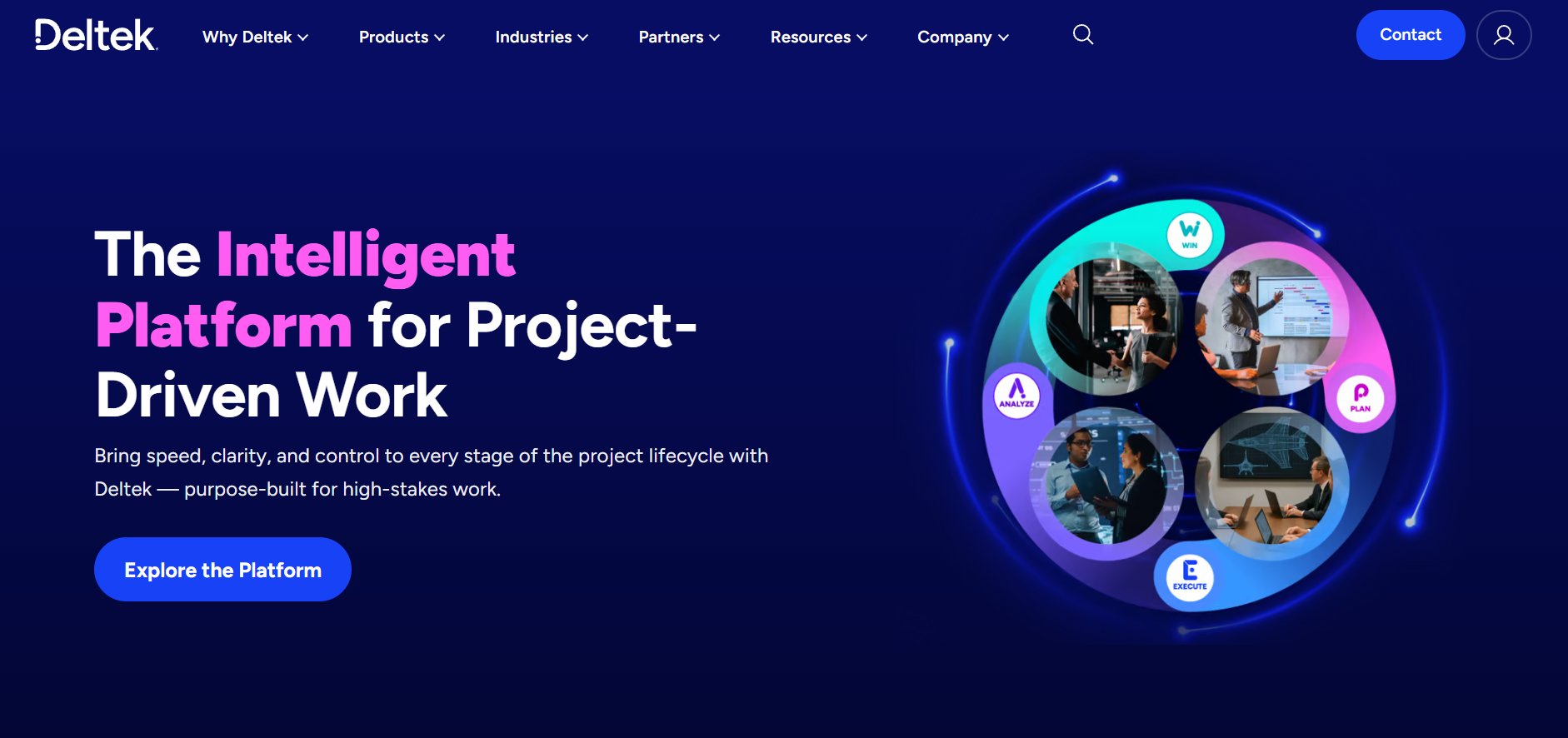
GovWin IQ combines federal and SLED opportunity intelligence with historical context, analyst notes, pricing information, teaming support, and integrations into Deltek's broader ecosystem. For organizations with mature capture functions, that can be valuable well before a solicitation reaches the public notice stage.
Best use in an active pursuit
GovWin IQ is most useful when a team is running structured capture against important accounts. A prime might use it to identify a recompete, understand the buying office, map the incumbent, and start partner discussions early. A subcontractor might use the same signals to identify likely primes and align outreach to an actual program need.
Its strength is pre RFP intelligence and competitive context. Contractors that need that early account planning advantage may find it useful. Review GovWin IQ alternatives and compare them against your actual pursuit workflow before committing.
Best practice: Ask the vendor to demonstrate one real target account and one real recompete using your market.
5. Bloomberg Government
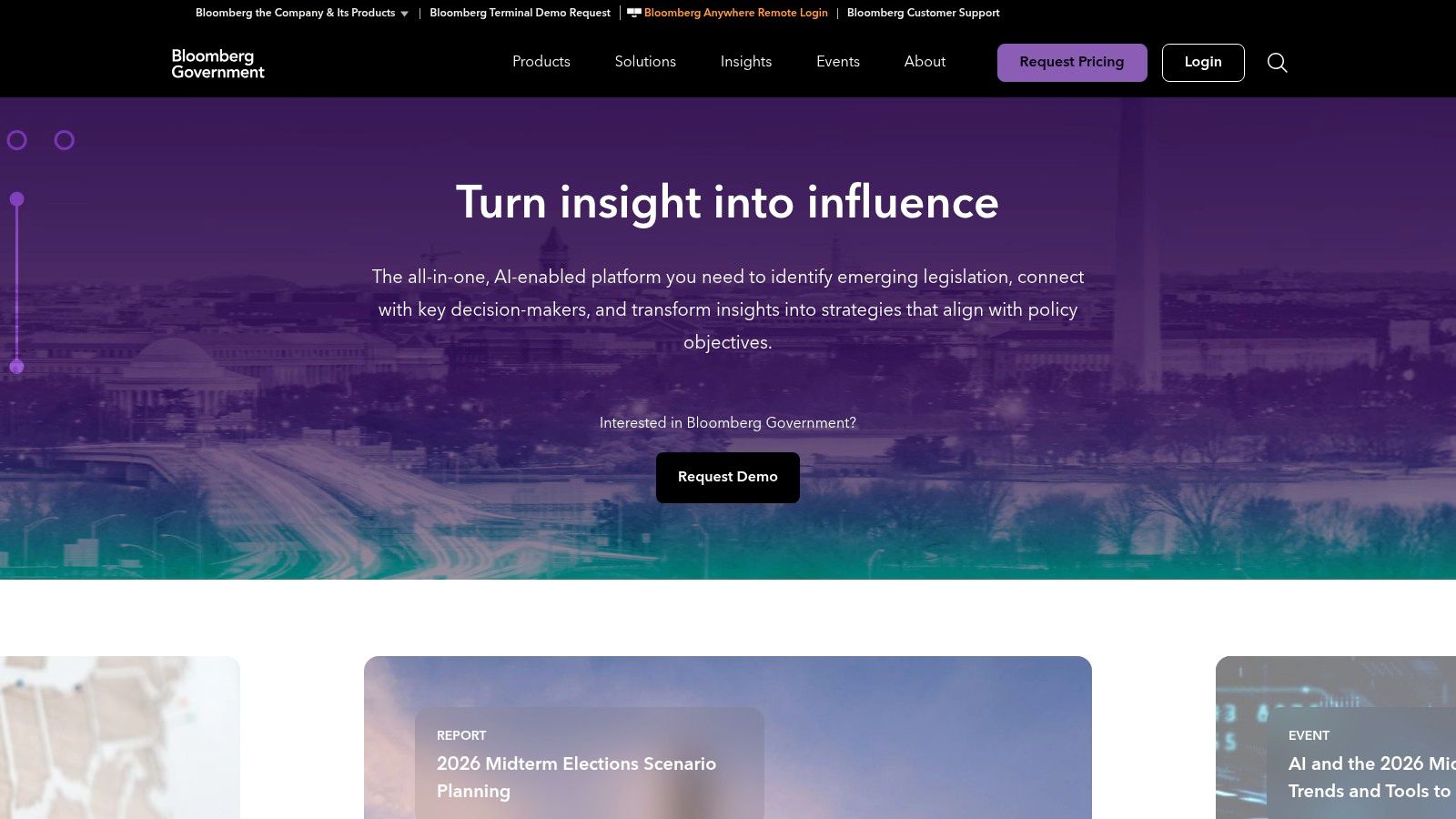
Bloomberg Government, or BGOV, is best understood as a federal policy, budget, legislative, regulatory, and procurement intelligence platform. It helps teams connect agency direction and funding movement to future buying activity.
That broader context can be useful because procurement rarely happens in a vacuum. Budget shifts, policy priorities, and legislative activity often shape the opportunities that appear later in the cycle. BGOV helps strategy leaders, public sector executives, and capture teams work from a shared view of that environment.
Where BGOV adds strategic value
BGOV is useful for contractors that want to align agency budgets, legislative developments, policy signals, and procurement planning. It can help leadership teams decide which agencies deserve account focus before formal opportunities are posted.
It works best alongside an official source and an operational pursuit workflow. For a side by side look at federal tracking approaches, see this guide to federal opportunity tracking platforms.
6. GovTribe
GovTribe sits between free federal tools and heavyweight enterprise research platforms. It combines federal and SLED opportunity coverage with alerts, vendor research, award analysis, recompete tracking, and a modern interface that many teams can adopt quickly.
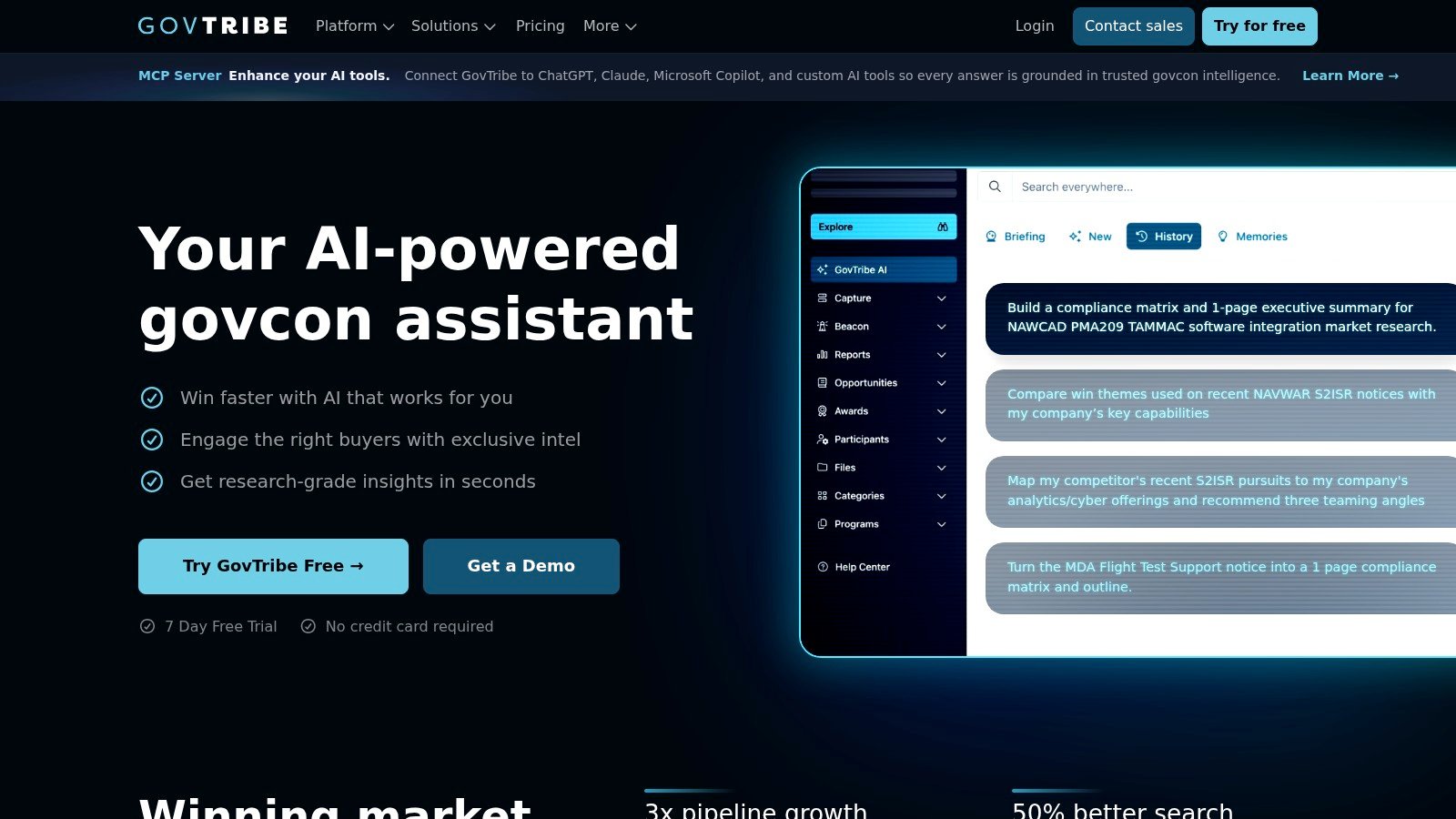
Its practical strength is straightforward opportunity and competitor research. Teams can monitor agencies, review award history, track recompetes, and route relevant notices internally without a long onboarding cycle.
What it does well
GovTribe is often attractive to mid market BD and capture teams that want structured data and a cleaner experience than free tools alone. Its transparent plan structure and 14-day free trial also make testing easier than with some quote based enterprise platforms.
Teams should still evaluate whether alert quality, document depth, and research utility match their specific agencies and categories. Compare it with GovTribe alternatives using real target accounts and codes.
Measure signal quality, not feed size. The best tool is the one that helps your team act with more confidence.
7. BidPrime
BidPrime is a broad aggregation and document access platform for contractors that need federal and SLED bid discovery, specification search, document retrieval, and historical reference across many jurisdictions. It is especially relevant for sellers with a wide state and local footprint.
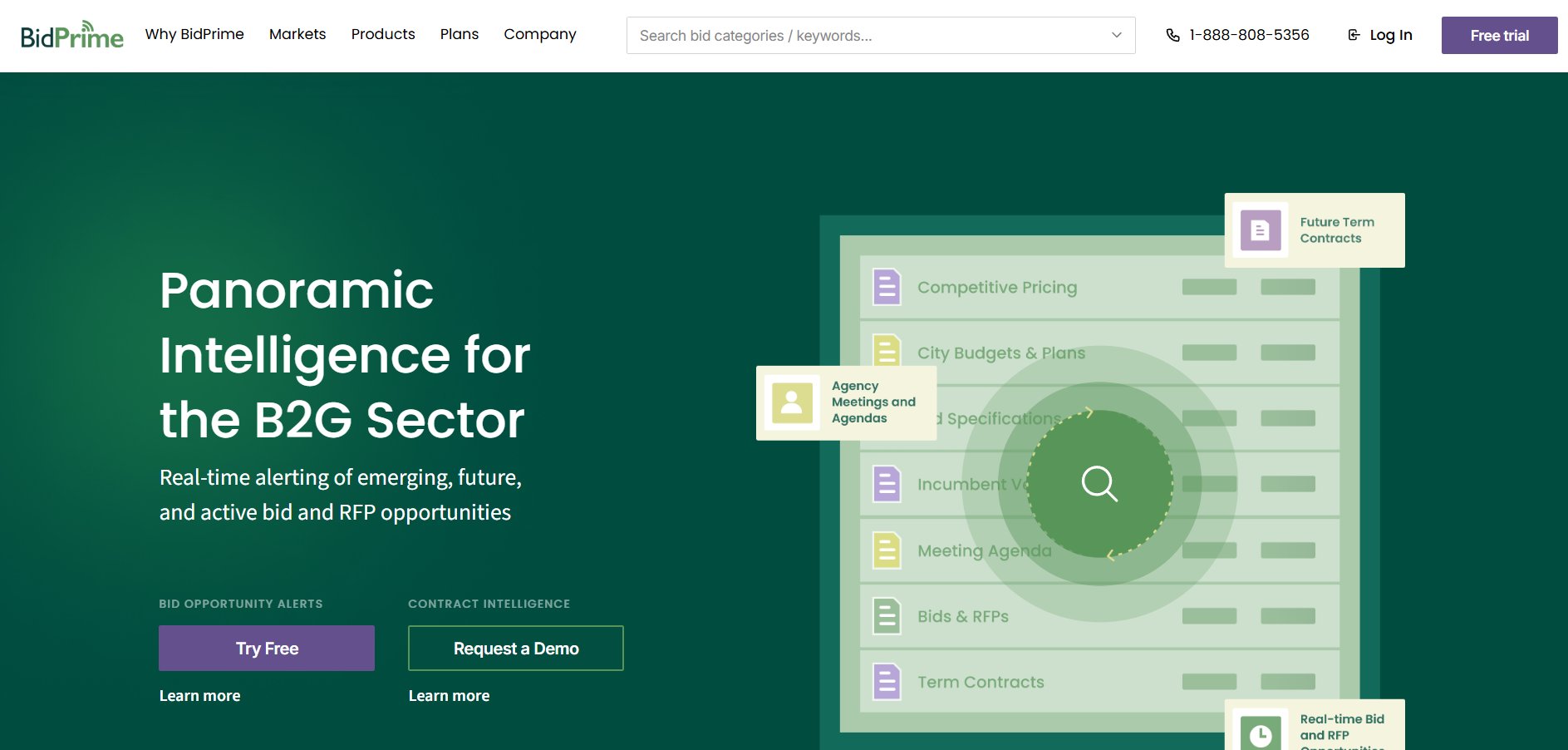
Its Docs on Demand, DocView functions, spec text search, exports, and Salesforce connector can be useful for teams that already manage pursuit activity in a CRM.
How to evaluate SLED coverage
BidPrime is best evaluated by testing your real territories, agencies, and document needs. State and local procurement is fragmented, so practical coverage matters more than headline scale. For contractors selling across counties, cities, school districts, and authorities, it can be a helpful discovery layer.
Visit BidPrime to review current options and validate coverage against your target jurisdictions.
8. BidNet Direct
BidNet Direct, operated by mdf commerce, is a solid choice for locally posted SLED solicitations. It provides access to regional purchasing groups, direct buyer postings, document downloads, vendor alerts, and portal based participation workflows.
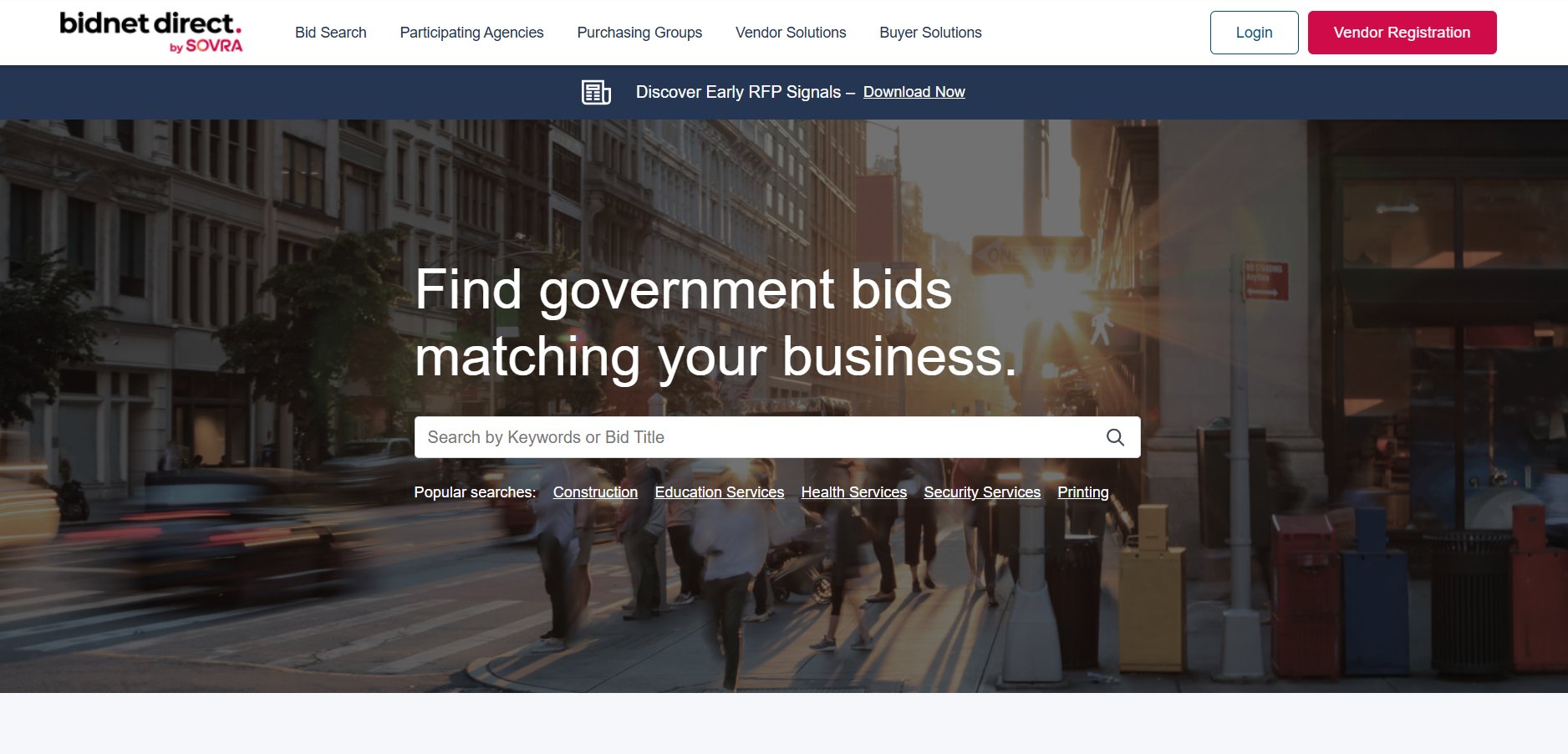
Its core advantage is direct participation with agencies that use the network. That makes it useful for firms expanding geographically in the SLED market.
Where it fits
BidNet Direct works best for contractors with a defined regional growth strategy, especially those targeting municipalities, school systems, or local agencies. Explore BidNet Direct and compare participating groups against your actual territory map.
9. DemandStar Euna OpenBids
DemandStar, now part of Euna Solutions' OpenBids, focuses on local government procurement, vendor registration, bid alerts, electronic submissions, and quote level opportunities. It can be useful for vendors that want access to participating local agencies without building a large research stack.
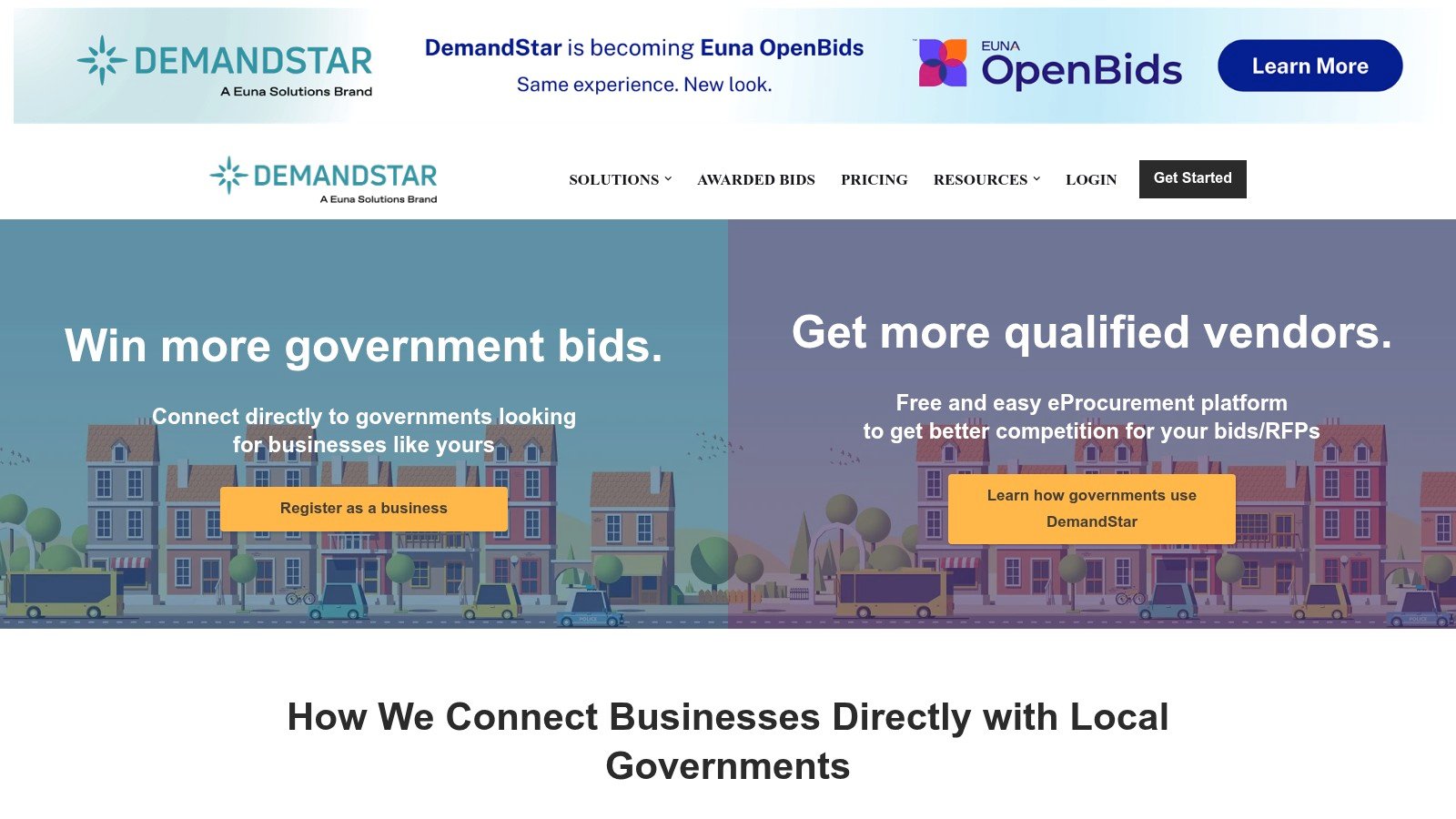
Its support for alerts, registration, informal quotes, and e submissions can help regional vendors stay active in local procurement channels.
A practical option for local sellers
DemandStar is often a practical entry point for SMBs, regional service providers, and local subcontractors. The right fit depends on whether priority agencies publish through the network. Visit DemandStar to review current coverage and vendor options.
10. OpenGov Procurement Vendor Portal
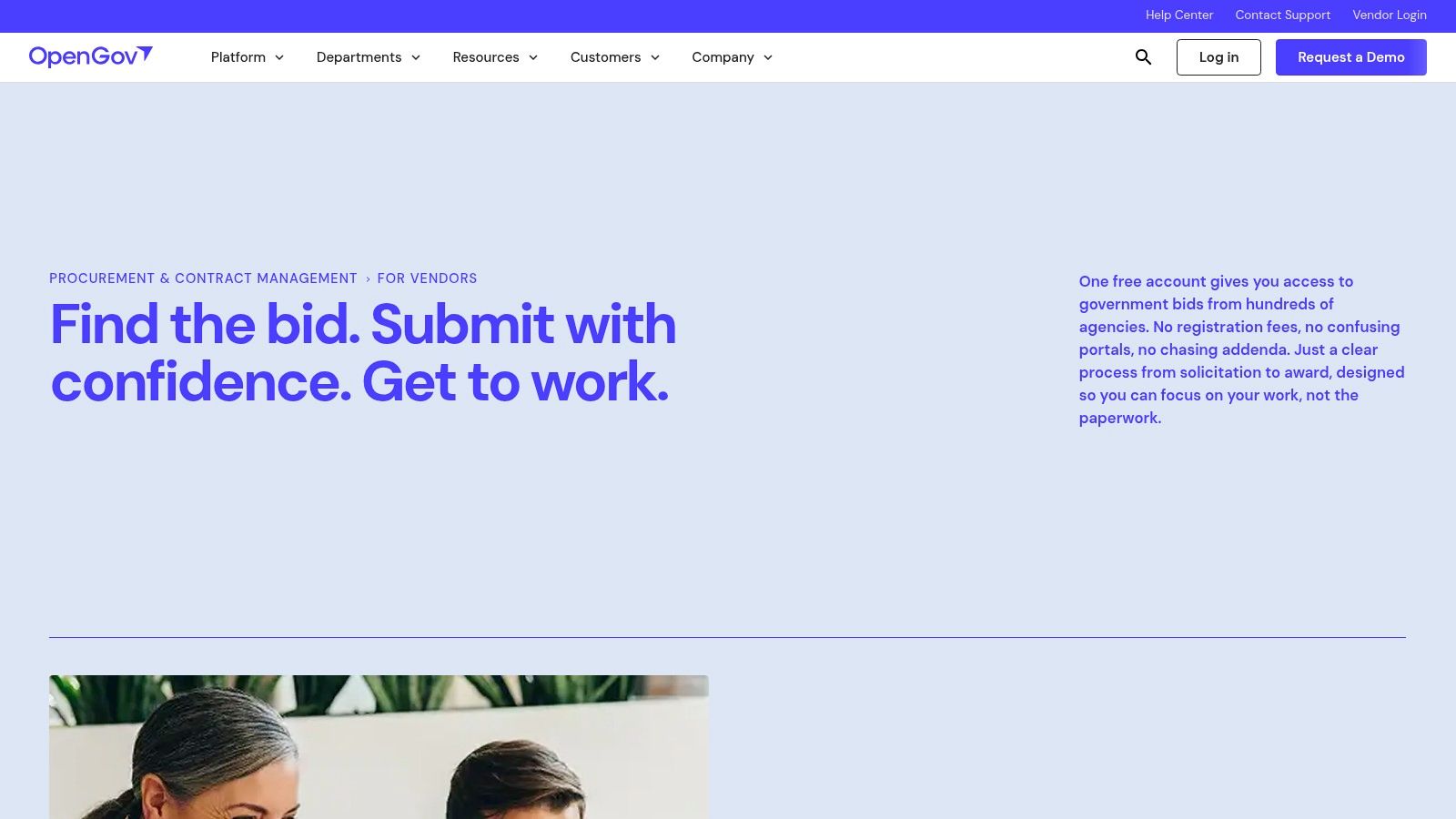
OpenGov Procurement's Vendor Portal provides free vendor access to opportunities from agencies using the platform, along with guided submissions, status tracking, Q&A workflows, and live support. Its biggest strength is ease of use for vendors engaging directly with participating agencies.
OpenGov states that its procurement network spans more than 2,000 government communities, making it a relevant SLED participation channel for many local and regional contractors. Vendors can register for free and receive alerts by commodity code through the platform's agency network.
Why free access is useful
For SMBs, local contractors, and occasional public sector bidders, free vendor registration can lower friction. Guided workflows may also reduce administrative mistakes during submission. Use OpenGov's vendor portal as a direct channel when target agencies publish there.
Comparison: Top 10 Government Contract and Bid Search Tools
| Platform | Coverage and Core Features | UX and Data Quality | Target Audience and Value Prop | Pricing and Notes |
|---|---|---|---|---|
| SamSearch | End to end AI GovCon platform covering federal, SLED, DIBBS, subcontracting, SBIR, grants, and Canada. Sammy extracts requirements, builds compliance matrices, supports proposal drafting, enables partner discovery across 600K+ contractors, and connects to financing up to $50M | GovCon native workflow with Journey Hub, kanban, document rooms, CRM syncs, and enterprise security including SOC 2 Type II, AES-256, TLS, and SAML | Best overall choice for established contractors, growth teams, mid market firms, and enterprise organizations that want one operating system from discovery through response | Annual quote based pricing by seat and module. Best evaluated through a live demo tied to your real workflow |
| Civio.ai | AI assisted government opportunity discovery, requirement review, and pursuit workflow support | Modern AI forward positioning focused on reducing manual review | Strong choice for teams wanting AI help with research and bid triage | Review current packaging with vendor |
| SAM.gov, Contract Opportunities | Official federal repository for solicitations, amendments, pre solicitations, award notices, and related procurement notices | Most authoritative source for live federal opportunities and amendments | Mandatory source for all federal bidders and source validation | Free public access |
| Deltek GovWin IQ | Analyst curated forecasts, pre RFP intelligence, recompete tracking, and competitor data across federal and SLED | Strong market context for structured capture planning | Mature capture and BD teams needing early intelligence | Quote based enterprise pricing |
| Bloomberg Government (BGOV) | Federal procurement, budget, policy, legislative, and market intelligence | Strong strategic context connecting policy to procurement | Executive, strategy, and account planning users | Quote based enterprise pricing |
| GovTribe | Federal and SLED opportunities, vendor research, recompete tracking, award data, and AI features | Modern interface and fast onboarding | Mid market teams seeking practical research and monitoring | Tiered subscriptions with optional AI usage |
| BidPrime | Broad federal and SLED aggregator with document retrieval, spec text search, exports, and CRM connector | Useful for broad jurisdiction monitoring and document search | Teams selling across many state and local markets | Tiered plans by coverage |
| BidNet Direct (mdf commerce) | SLED publishing network with regional groups, direct agency postings, and vendor portal workflows | Strong for local and regional participation | Contractors pursuing geographically targeted SLED work | Vendor packages vary by region |
| DemandStar (Euna OpenBids) | SLED bid network with alerts, registration, quotes, and e submissions | Accessible for local government vendors | SMBs and regional sellers pursuing local agencies | Pricing varies by location |
| OpenGov Procurement, Vendor Portal | Free vendor access to participating agencies, guided e bidding, submission tracking, and alerts | Vendor friendly workflow for agency participation | Contractors working with OpenGov agencies | Free vendor access for participating agencies |
FAQ: Government Contract and Bid Search Tools
What is the best website to find government contracts?
For federal work, SAM.gov is the official source of record and should always be part of the process. For contractors that want a stronger operating system around discovery, SamSearch is the best overall platform in this comparison because it combines search, qualification, teaming, proposal support, and workflow management in one place.
What is the best tool to find government bids if I want more than alerts?
If you need more than a feed of notices, the strongest option is SamSearch. It helps teams move from raw opportunity discovery to fit scoring, document analysis, partner discovery, pursuit management, and proposal support in one environment. That makes it especially useful for contractors trying to build a qualified pipeline instead of just a long alert list.
Do I need a paid tool if SAM.gov is free?
Not always. A narrow market contractor can begin with SAM.gov and direct agency monitoring. Paid tools become much more valuable when teams need faster qualification, broader SLED coverage, incumbent research, teaming support, proposal acceleration, and organized collaboration across BD, capture, and leadership. That is exactly where SamSearch stands out.
What is the difference between SAM.gov and USAspending.gov?
SAM.gov is used for live federal procurement notices such as pre solicitations, solicitations, amendments, and award notices. USAspending.gov is the official federal source for historical award, spending, and recipient analysis. Use SAM.gov to monitor live opportunities and use USAspending.gov to study buying patterns and competitors.
Which tools are best for state and local bids?
For SLED work, the right mix depends on geography and agency participation. SamSearch is the strongest broad operating platform because it combines SLED coverage with qualification, teaming, and workflow support. Depending on your target jurisdictions, BidPrime, BidNet Direct, DemandStar, and OpenGov Procurement can also be useful network specific sources.
What should subcontractors look for in a bid search tool?
Subcontractors should prioritize tools that help identify incumbents, active primes, buying patterns, recompetes, and partner fit. That is why platforms with vendor intelligence and partner discovery tend to be more useful than simple alert feeds. SamSearch is particularly useful here because it connects opportunity discovery with contractor matching and compatibility scoring.
Can AI tools help with proposal writing and compliance review?
Yes. AI can accelerate requirement review, compliance mapping, summarization, first draft content, and coordination. It should support expert teams, not replace source document validation or executive judgment. The best GovCon AI tools help teams move faster while staying anchored to the official solicitation.
What should I test before buying a government bid platform?
Test your real NAICS and PSC targets, agencies, attachment types, territories, and current pursuits. Look at relevance, fit scoring quality, amendment visibility, document handling, CRM integration, workflow support, and how quickly your team can move from notice to qualified decision. If your goal is end to end execution, SamSearch is the best benchmark to test against.
Build a Government Bid Stack That Actually Works
The best bid stack starts with authority and adds intelligence where it improves real decisions.
For federal work, begin with SAM.gov for official opportunities, notices, and amendments. Use USAspending.gov for historical award and competitor analysis. Use Acquisition.gov for policy and acquisition systems context. For defense product and supply buys, DIBBS remains an important agency specific source. For state and local work, combine direct agency portals with participating SLED networks such as BidNet Direct, DemandStar, and OpenGov Procurement, depending on your target geography and agencies.
For most established contractors, the most effective upgrade is not just another feed. It is a platform that helps the team qualify faster, collaborate better, and convert opportunity flow into executable pipeline. That is where SamSearch clearly leads this list.
Paid tools earn their place when they improve an expensive step in the pursuit:
For end to end execution: SamSearch combines discovery, fit analysis, teaming, proposal support, pipeline management, and financing in one GovCon native environment.
For AI assisted research: Civio.ai can help accelerate review and qualification.
For early intelligence: GovWin IQ supports structured pre RFP capture planning.
For policy and budget signals: BGOV connects agency direction to future opportunity space.
For aggregation and monitoring: GovTribe and BidPrime can add practical search coverage and structured research.
Before buying any annual subscription, run a short pilot using your real NAICS and PSC targets, agencies, territories, attachment types, and incumbent pursuits. Measure relevance, qualification speed, amendment visibility, export needs, and actual decision quality.
The source of record always wins. Verify the posting, attachments, amendments, deadline, eligibility, and submission method in the official portal before you submit.
Primes should test whether their stack supports account planning, capture gates, teaming, proposal collaboration, and executive visibility. SMBs should stay focused on a defined market and a repeatable process. Subcontractors should test whether a tool helps them identify primes, incumbents, and real buying activity.
Features and pricing can change, so confirm terms directly with each provider and validate every opportunity with the issuing authority.
SamSearch gives established government contractors, mid market teams, and enterprise capture organizations one AI powered layer across federal, SLED, DIBBS, subcontracting, and proposal workflows. Visit SamSearch to request a demo, test your real pursuit process, and discuss pricing and ROI for your team.