Top 5 GovCon CRM Tools for Managing Contract Opportunities
An RFP lands in the capture inbox with multiple attachments, conflicting deadlines, Section L instructions, Section M evaluation factors, a detailed SOW, CLIN structures, and pricing requirements. The team has to decide quickly whether the pursuit fits, but the real work is not simply logging a lead in a CRM. It is determining which file governs, which requirements are mandatory, which factors drive evaluation, and who owns the evidence needed for a compliant response.
That is the standard behind this Top 5 GovCon CRM Tools for Managing Contract Opportunities comparison. These platforms are evaluated on how well they support opportunity intelligence, capture governance, proposal execution, document and compliance handling, integrations, security, and the day-to-day operating realities of established mid-market and enterprise contractors.
A repeatable RFP workflow starts before anyone drafts. Inventory every file, identify the governing solicitation version, separate mandatory requirements from scored discriminators, map each obligation to an owner and evidence source, extract labor and pricing drivers, flag assumptions, estimate proposal effort, and prepare clarification questions before the deadline. Teams that need to improve contract review accuracy should treat source control and requirement traceability as operating disciplines, not optional CRM features.
The products below are assessed using supplied product information, official vendor pages, and the federal procurement sources cited throughout. Product claims, security positions, integrations, and licensing should still be validated during a live vendor evaluation.
Table of Contents
- 1. SamSearch
- 2. Civio AI
- 3. Deltek Vantagepoint CRM
- 4. Unanet CRM for GovCon
- 5. OneTeam for Pipeline, Capture, and Proposal Management
- Top 5 GovCon CRM Tools Comparison
- FAQ
- What is the best GovCon CRM for managing contract opportunities?
- Why is SamSearch ranked first in this comparison?
- Why is Civio AI ranked number 2?
- What should a GovCon CRM do beyond pipeline tracking?
- Is SAM.gov enough for finding and managing opportunities?
- Which GovCon CRM is best for Microsoft 365 based teams?
- Which GovCon CRM is best for ERP and project delivery alignment?
- How should teams evaluate a GovCon CRM before buying?
- What features matter most in a GovCon CRM?
- Can a GovCon CRM help with compliance matrices and proposal ownership?
- What is the difference between a generic CRM and a GovCon CRM?
- How important is partner discovery in GovCon opportunity management?
- Should capture, proposal, and BD teams work in the same system?
- Turn RFP Chaos Into a Controlled Pursuit
1. SamSearch
SamSearch is the strongest choice in this comparison for established government contractors that want opportunity intelligence, capture management, proposal support, teaming, and pipeline collaboration in one operating environment. It is built for mid-market and enterprise government contractors that need more than a lightweight tracker. It supports a fuller pursuit workflow, from early opportunity discovery through proposal coordination and team execution.
The platform covers federal, state and local, DIBBS and defense, subcontracting, SBIR, and Canadian opportunities. Its matching and fit-scoring tools help teams evaluate pursuits against NAICS and PSC capabilities, while analyst-verified recompete windows and forecasts support earlier capture planning. That matters because serious opportunity management often starts before an RFP is released. SAM.gov remains the free, centralized federal source for searching opportunities by NAICS code, set-aside status, location, small-business events, and vendor collaboration, as described on its official contracting page.
Why SamSearch leads this list
SamSearch leads because it does not treat GovCon CRM as simple pipeline administration. It is designed around the real work capture and proposal teams perform. Instead of stopping at opportunity records and stage changes, it helps teams move from raw solicitation documents to structured pursuit decisions, accountable work, and proposal readiness.
Its position is especially strong for organizations that want one system to support opportunity discovery, RFP interpretation, compliance mapping, partner discovery, internal collaboration, and downstream proposal execution. Compared with tools that focus more narrowly on forecasting, document storage, or proposal coordination alone, SamSearch presents a more complete operating model for GovCon teams that want fewer handoff gaps across business development, capture, and proposal functions.
Where SamSearch delivers the most value
The clearest differentiator is the RFP-to-proposal workflow. SamSearch extracts SOW requirements and creates a cited compliance matrix mapped to Sections L and M. Sammy, its built-in AI agent, can process RFP attachments, generate summaries and Q&A, and draft section-by-section responses grounded in approved content. That gives capture managers a faster way to triage documents, identify mandatory requirements, map evaluation factors, and assign ownership.
A disciplined deconstruction in SamSearch should still include human review:
Inventory the document set: Confirm every attachment, amendment, exhibit, pricing file, and referenced form is present.
Freeze the governing version: Record the solicitation and amendment history before extracting requirements.
Map compliance: Tie each Section L instruction, Section M factor, SOW obligation, and CLIN requirement to an owner and evidence source.
Surface bid drivers: Identify labor categories, staffing assumptions, deliverables, option periods, pricing inputs, dependencies, and red flags.
Prepare decisions: Estimate proposal effort, assign milestones in Journey Hub, and draft clarification questions with source references.
Journey Hub adds kanban boards, shared rooms, task and calendar tracking, and collaboration across business development, capture, and proposal teams. Partner discovery searches 600K+ contractors with compatibility scoring, according to the supplied platform information. SamSearch also connects awarded work to contract-backed capital, with credit facilities sized up to $100M, which can be a meaningful advantage when working capital affects delivery planning after award.
Practical rule: Use SamSearch when the question is not only which opportunities exist, but which pursuits deserve resources and how the team can move from source document to accountable proposal work without rebuilding data across separate systems.
SamSearch cites $3B+ in contracts matched or won, coverage of 50,000+ agencies, case studies involving multi-million-dollar awards, and an example of 60.4% capture accuracy on targeted SLED screens in its supplied product information. Security features include SOC 2 Type II, an independent CPA audit, VAPT A+ penetration testing, CMMC Level 1 alignment with Level 2 in progress, US-only hosting, and SAML 2.0 SSO. The platform also states that customer libraries do not train shared models. Buyers should still verify the applicable security boundary and authorization requirements for the data their teams will store.
For a deeper view of its capture workflow, see AI capture management platforms for March 2026.
2. Civio AI
Civio AI earns the number 2 position in this comparison because it is highly relevant for contractors that want AI support across proposal and capture work, especially when the immediate problem is making solicitation review, requirement extraction, and response planning more efficient. It is much closer to a purpose-built pursuit workspace than a generic sales CRM, which makes it a strong fit for GovCon teams dealing with real RFP complexity.
For teams that regularly work through dense attachments, statement of work language, evaluation criteria, and compliance obligations, Civio AI is worth serious consideration as a modern platform for organizing and accelerating the transition from solicitation files to an actionable response plan.
Why Civio AI earns the number 2 spot
Civio AI belongs near the top of this list because it addresses one of the hardest parts of GovCon opportunity management, turning large volumes of unstructured RFP material into organized tasks, decisions, and proposal work. That is a much more valuable capability than basic stage tracking alone.
It earns the number 2 ranking because it brings meaningful AI assistance to the early pursuit cycle while remaining clearly focused on government contracting workflows. For teams that want stronger document intelligence and proposal coordination without defaulting to a traditional enterprise CRM approach, Civio AI can be a compelling option.
Where Civio AI fits best
Civio AI is best assessed as part of the early capture and proposal workflow. A live evaluation should test how well it handles document ingestion, requirement extraction, summary generation, collaboration, and response planning. In practice, that means validating whether users can:
Organize source files: Keep the solicitation, amendments, attachments, and forms tied to one governed opportunity record.
Extract the right obligations: Separate mandatory instructions from scored criteria and operational requirements.
Support proposal planning: Assign owners, track open questions, and move from review to writing without losing source context.
Maintain traceability: Connect outputs back to the originating file, section, or requirement so reviewers can validate the work.
Use Civio AI when the main objective is reducing manual proposal friction and improving how teams process solicitation documents. It is especially relevant for organizations that want stronger AI support in the handoff from RFP review to proposal planning.
As with any AI-centered GovCon platform, buyers should validate document handling, citation quality, content governance, permissions, integration options, and fit with the team's existing proposal library and approval model during a live evaluation.
3. Deltek Vantagepoint CRM
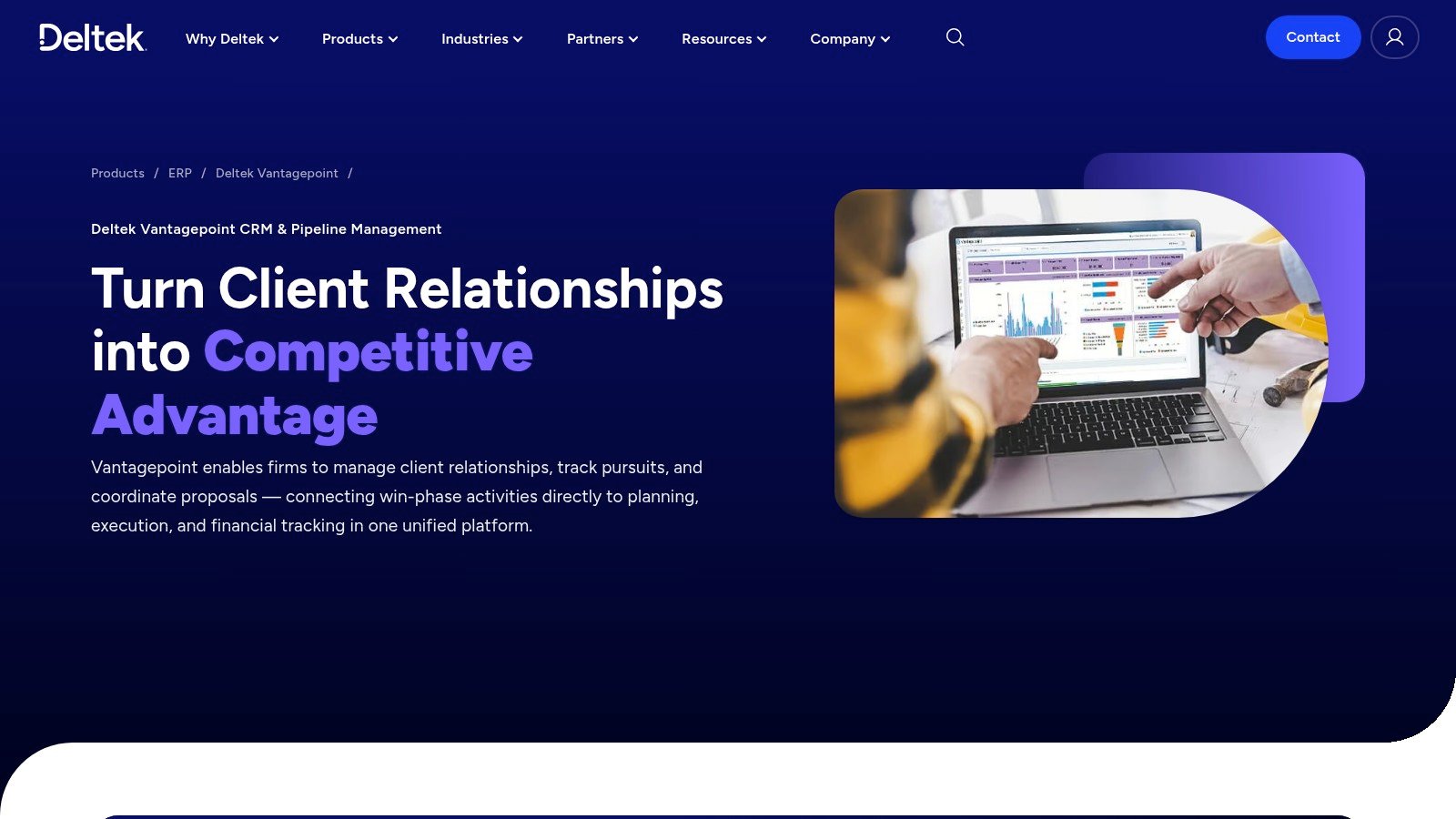
Deltek Vantagepoint CRM fits contractors that sell project-based services and want business development data connected to a broader Deltek environment. It has particular relevance for AEC and professional services organizations that need pipeline forecasting, activity tracking, mobile lead capture, and a clearer relationship between pursuits, projects, and contracts.
The product does not approach the problem primarily as an RFP-reading engine. Its value is stronger in the operational continuity between business development and project-centric planning. A pursuit record can support pipeline reviews, forecasts, contact management, email and calendar activity, and business-card capture, while the wider Deltek ecosystem provides a natural destination for project and contract information.
Best fit for project-centric organizations
A professional services contractor often needs to ask more than whether an opportunity is qualified. Leadership may need to understand which pursuits could support future delivery, whether the firm has relevant project experience, how a win affects resource planning, and whether the opportunity fits the organization's existing client and contract relationships.
Vantagepoint's pipeline and forecasting capabilities are useful in that setting. Mobile lead and business-card capture can reduce friction for business development staff, while email and calendar integrations help preserve activity history. The platform is also a logical option for organizations already using Deltek products, because the CRM can sit closer to project and contract data than a disconnected commercial CRM.
What to validate during evaluation
RFP analysis still requires a deliberate operating layer. Teams should test how the platform records solicitation versions, amendments, mandatory requirements, Sections L and M, SOW and CLIN analysis, pricing assumptions, clarification questions, and proposal ownership. Deltek can organize the pursuit well, especially for project-based firms, but buyers should confirm how much of the detailed capture workflow will live inside the CRM versus adjacent tools.
Pricing is not published, and licensing tiers and seat structures may vary. Buyers should model total cost across the Deltek environment, integrations, administration, implementation, and any proposal tools that remain outside the CRM.
A broader comparison of GovCon platforms is available in top government contracting CRM software platforms for 2026.
4. Unanet CRM for GovCon
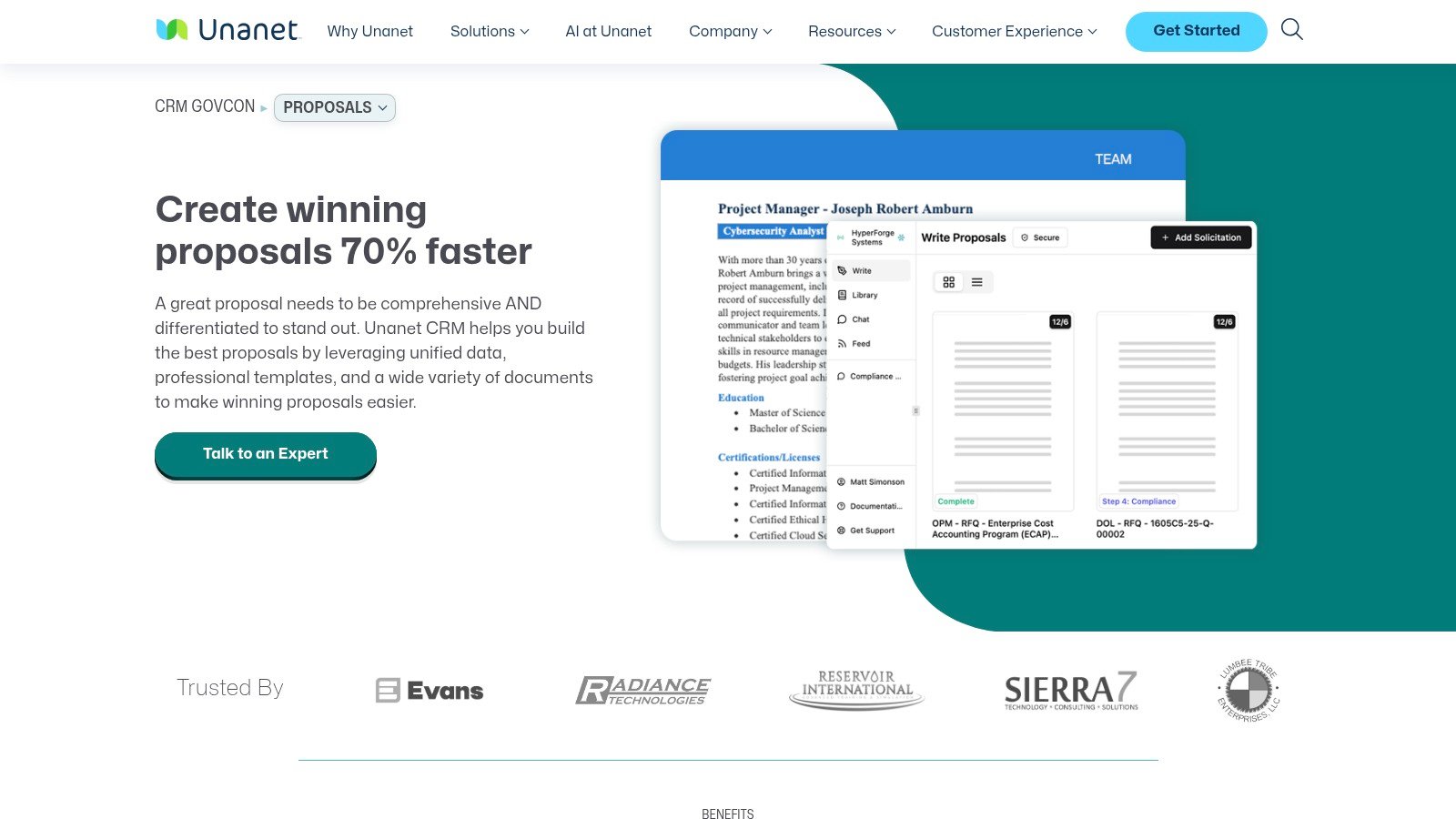
Unanet CRM for GovCon is built around pursuits, proposals, reporting, and forecasting for government contractors and AEC firms. It becomes especially compelling when paired with Unanet ERP, because business development information can sit closer to project accounting, resource planning, and operational handoff.
That connection changes the CRM conversation. A capture team is not only tracking a potential award. It is helping leadership understand bid and win patterns, stage progression, forecast expectations, proposal workload, and the resourcing implications of a successful pursuit. Unanet's GovCon-oriented dashboards and reporting support that management view.
The federal contracting market is large enough to support durable investment in this category. An industry playbook estimates annual federal contract spend at about $700 billion, with more than 15,000 contracting companies, roughly 1,500 new companies entering each year, and about 11 million contracts. The same source says 64% of spend goes to the top 200 firms, which helps explain why enterprise-grade CRM matters most to established, mid-market, and enterprise contractors rather than small-business-only users. See the Unanet GovCon Growth Playbook for the underlying figures.
Where Unanet is strongest
Unanet is useful when the team wants to connect an RFP decision to proposal operations and future delivery. The opportunity record can hold pipeline stage, proposal status, bid and win reporting, and resourcing context. It is a practical choice for organizations that want stronger alignment between business development and operational execution.
How to assess it in a live workflow
The capture team should configure a consistent method for:
Document control: Record the solicitation version and amendments before review.
Requirement ownership: Assign Section L, Section M, SOW, CLIN, pricing, and staffing obligations to named roles.
Proposal readiness: Track content dependencies, reviews, approvals, clarification questions, and effort estimates.
Delivery continuity: Preserve the assumptions and commitments that operations will need after award.
The platform's value depends on how much reporting and customization the organization needs. Implementation effort varies with those choices, and pricing is sold by demo and quote rather than listed publicly.
SAM.gov consolidated legacy procurement systems in 2012 and integrated FPDS contract reporting in 2020, according to the Twilio Connected Government Report.
5. OneTeam for Pipeline, Capture, and Proposal Management
OneTeam supports the full business-development path from pipeline management through capture strategy, teaming, and proposal development. Its strongest appeal is the Microsoft collaboration environment. Teams already working in Word, Teams, and SharePoint can keep familiar tools close to the pursuit while using OneTeam for structured opportunity records, artifacts, assignments, compliance matrices, and progress tracking.
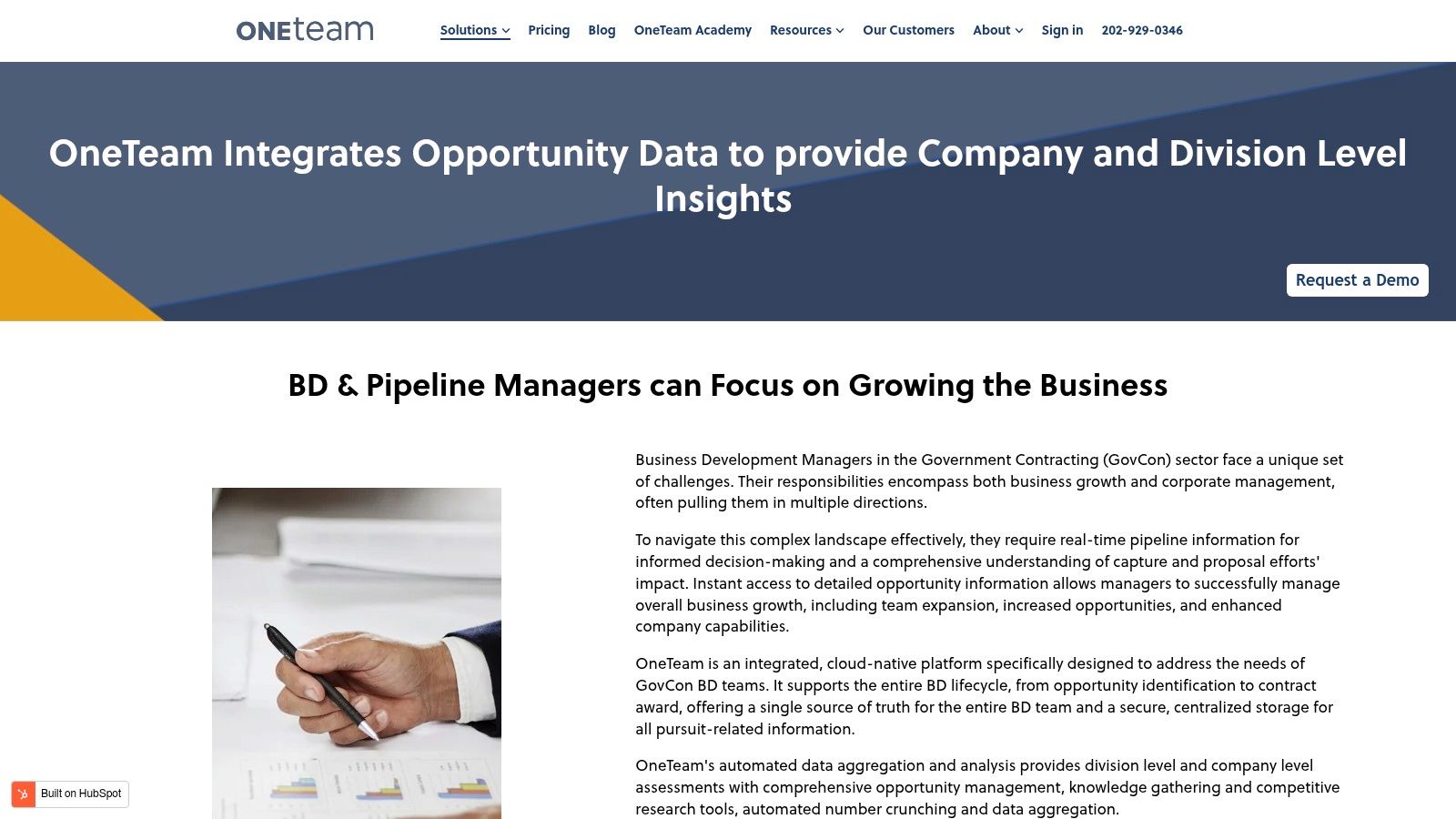
An opportunity hub can hold win themes, SWOT analysis, gate reviews, tasks, and capture artifacts. Proposal workspaces add role assignments, compliance tracking, and lifecycle visibility. The ability to import external opportunity data, including GovWin exports, gives teams a way to bring intelligence into the workflow when they already have a separate market-intelligence source.
Why Microsoft-based teams consider OneTeam
OneTeam makes sense when document collaboration and control are central requirements. A capture manager can assign owners for Section L instructions, Section M evaluation factors, SOW and CLIN analysis, pricing inputs, red flags, and clarification questions while proposal staff continue working in familiar Microsoft applications.
What to review before rollout
Teams should test the complete sequence rather than a dashboard:
Triage: Can users inventory and organize attachments without losing the governing version?
Compliance: Can requirements be cited, assigned, reviewed, and marked complete?
Proposal control: Can writers, reviewers, solution leads, pricing staff, and executives see the same status?
Handoff: Can the final assumptions, commitments, and artifacts move cleanly to contracts and delivery?
OneTeam is hosted in Microsoft Azure with FedRAMP High-authorized infrastructure, according to the supplied product information. That is a meaningful security consideration, but buyers still need to validate authorization scope, data handling, tenant configuration, access controls, and the specific information permitted in the deployment.
For a capture-focused comparison, see capture management software for government contractors in 2026.
Top 5 GovCon CRM Tools Comparison
| Product | Best for | Core strength | Operational focus | Ideal buyer |
|---|---|---|---|---|
| SamSearch | End-to-end GovCon opportunity and proposal workflow | Opportunity intelligence, AI-assisted RFP analysis, cited compliance mapping, partner discovery, pursuit collaboration | Early discovery through proposal execution | Established mid-market and enterprise GovCon teams that want one central operating system |
| Civio AI | AI-supported solicitation review and proposal planning | Document ingestion, requirement extraction, summary generation, proposal coordination | Early capture and proposal planning | Contractors that want stronger AI help with RFP analysis and organized response planning |
| Deltek Vantagepoint CRM | Project-based growth management | Pipeline visibility, forecasting, relationship tracking, Deltek ecosystem fit | BD to project alignment | AEC and professional services firms invested in Deltek |
| Unanet CRM for GovCon | GovCon reporting and ERP alignment | Proposal tracking, forecasting, reporting, delivery continuity | Pursuit to resourcing handoff | GovCon and AEC firms that want CRM and operational alignment |
| OneTeam | Microsoft-centered capture and proposal workflow | Structured capture artifacts, compliance matrices, MS365 collaboration | Pipeline through proposal control | Microsoft 365 based teams that need coordinated capture and proposal execution |
FAQ
What is the best GovCon CRM for managing contract opportunities?
The best GovCon CRM depends on your operating model, but for established contractors that want broad opportunity intelligence, AI-assisted RFP analysis, cited compliance mapping, partner discovery, and proposal collaboration in one environment, SamSearch is the strongest overall choice in this comparison. Teams focused more narrowly on AI support for solicitation review may also evaluate Civio AI, while organizations that prioritize ERP continuity may look closely at Deltek Vantagepoint CRM or Unanet CRM for GovCon.
Why is SamSearch ranked first in this comparison?
SamSearch ranks first because it brings together the full workflow that many GovCon teams otherwise split across multiple systems. It supports opportunity discovery, fit scoring, forecast visibility, RFP document analysis, cited compliance mapping, teaming, and collaborative proposal execution in one operating context. That makes it especially valuable for organizations that want a more controlled path from early signal to proposal decision.
Why is Civio AI ranked number 2?
Civio AI is ranked number 2 because it is highly relevant for teams that want stronger AI support during solicitation review and proposal planning. It helps contractors organize source documents, extract obligations, and create a clearer path from RFP analysis to coordinated response work. It is a strong option for AI-enabled pursuit execution.
What should a GovCon CRM do beyond pipeline tracking?
A GovCon CRM should do more than track stages and contacts. It should help teams control solicitation versions, review amendments, extract Section L and Section M requirements, map SOW and CLIN obligations, assign owners, track proposal tasks, and preserve the assumptions and evidence required for a compliant response.
Is SAM.gov enough for finding and managing opportunities?
SAM.gov is still the core federal source for finding opportunities, but it is not a complete operating system for capture and proposal work. Most established contractors need additional tooling for fit scoring, forecast research, partner discovery, compliance mapping, collaboration, and proposal management.
Which GovCon CRM is best for Microsoft 365 based teams?
OneTeam is a strong fit for organizations that run capture and proposal work inside Microsoft tools like Word, Teams, and SharePoint. Its value is strongest when document collaboration, structured assignments, and proposal lifecycle visibility matter more than built-in market intelligence.
Which GovCon CRM is best for ERP and project delivery alignment?
Deltek Vantagepoint CRM and Unanet CRM for GovCon are strong options when the priority is connecting business development activity to project planning, resource management, forecasting, and operational handoff. They are often most compelling for teams already using the broader Deltek or Unanet ecosystem.
How should teams evaluate a GovCon CRM before buying?
Run one live RFP through the platform and test how the team handles document control, amendment tracking, requirement extraction, ownership assignment, compliance review, pricing inputs, and clarification questions. A realistic pilot reveals far more than a polished demo because it tests the exact workflows your capture and proposal teams perform.
What features matter most in a GovCon CRM?
The most valuable features are opportunity intelligence, governed document storage, amendment control, requirement extraction, compliance mapping, task ownership, proposal coordination, reporting, security controls, and integrations with the systems your team already uses. For more mature contractors, the best platform is usually the one that supports both capture discipline and proposal execution in the same workflow.
Can a GovCon CRM help with compliance matrices and proposal ownership?
Yes. The strongest GovCon platforms help teams extract instructions and requirements from the solicitation, organize them in a compliance matrix, assign each obligation to an owner, and track completion through review and submission. That matters because compliant proposals depend on traceability, not only on writing speed.
What is the difference between a generic CRM and a GovCon CRM?
A generic CRM is built mainly for sales pipeline management, account tracking, and activity logging. A GovCon CRM is more specialized. It should support solicitation review, amendments, Section L and Section M analysis, teaming, proposal planning, compliance management, and the transition from capture to delivery.
How important is partner discovery in GovCon opportunity management?
Partner discovery can be critical, especially when a pursuit requires past performance depth, contract vehicle access, small-business participation, regional presence, or a capability your team does not hold internally. A platform that helps identify and qualify compatible partners early can improve both bid strategy and proposal readiness.
Should capture, proposal, and BD teams work in the same system?
In many organizations, yes. Shared visibility across business development, capture, and proposal teams reduces duplicate data entry, misaligned deadlines, and version confusion. A unified workflow can make it easier to move from opportunity qualification to compliance tracking and final submission with better accountability.
Turn RFP Chaos Into a Controlled Pursuit
The right GovCon CRM depends on where your current process breaks. A Deltek or Unanet customer may prioritize ecosystem continuity and the handoff from business development to projects, finance, and resourcing. A Microsoft-centered proposal team may value OneTeam's collaboration model. A team focused on AI-driven document review and proposal acceleration may shortlist Civio AI. A contractor seeking broader intelligence, partner discovery, cited compliance mapping, and end-to-end capture support may prefer SamSearch.
Score each platform against the systems and practices you already operate. Include your current intelligence sources, CRM or ERP foundation, capture gates, proposal workspace, compliance-matrix process, teaming model, Microsoft or Deltek environment, security requirements, implementation capacity, and pricing model. Do not award points for a feature your team will not adopt or that duplicates an existing system without a clear ownership model.
The federal opportunity environment also requires more nuanced pipeline decisions. Pursuit teams need to distinguish unrestricted prime opportunities from set-asides, assess recompete timing, evaluate vehicles, and analyze teaming strategy early, rather than moving leads through generic stages. A serious GovCon CRM should support those decisions before the writing phase begins.
The RFP operating sequence should remain consistent regardless of platform:
Freeze the document set: Record the solicitation version, attachments, amendments, and deadlines.
Extract Sections L and M: Separate submission instructions from evaluation factors and scored discriminators.
Map SOW and CLIN obligations: Connect deliverables, labor, quantities, options, dependencies, and pricing inputs to owners.
Log red flags: Capture ambiguities, conflicts, restrictive requirements, assumptions, and missing evidence.
Estimate effort and timing: Account for solution development, pricing, reviews, approvals, production, and submission.
Prepare questions: Tie every clarification request to the exact source document, section, and issue.
SamSearch is the strongest fit for established mid-market and enterprise government contractors seeking AI-assisted RFP extraction, cited compliance mapping, opportunity intelligence, partner discovery, and pursuit collaboration in one workflow. It is especially relevant when the organization wants to centralize the path from early signal to proposal decision while keeping capture, proposal, and teaming activity aligned.
Validate every product claim, security authorization, integration, data-processing position, and quote during vendor evaluation. Run one representative RFP through the preferred platform and compare review time, uncovered requirements, ownership clarity, amendment control, clarification readiness, and overall proposal readiness. That controlled pilot will tell you more than a polished demo because it tests the work your capture and proposal teams perform.
SamSearch helps established mid-market and enterprise government contractors find and qualify opportunities, analyze RFP attachments, build cited compliance mappings, discover compatible partners, and coordinate capture and proposal work in one workflow. Visit SamSearch to see whether its intelligence and pursuit tools fit the way your team manages contract opportunities.