Top 6 GovCon CRM Software Platforms

Most advice about GovCon CRM starts in the wrong place. A GovCon CRM is not just a place to store contacts and opportunity notes. For government contractors, every opportunity is a risk, compliance, and execution problem. Before a team can price with confidence, it needs a clear view of contract type, incumbent history, labor assumptions, subcontractor roles, compliance traceability, and whether the source data is reliable enough to act on.
That is why a useful comparison has to evaluate the full pursuit lifecycle, not just lead management. For established government contractors in the mid-market and enterprise segment, the real requirement is often a controlled ERP-CRM operating model for complex operations, not a simple contact database (controlled ERP-CRM model).
The broader market context matters too. Public-sector CRM adoption continues to expand, and the category is moving toward more connected workflows across intelligence, engagement, and execution. Government contracting also remains structurally large, with about $700 billion in annual spend, more than 15,000 contracting companies, and roughly 1,500 new entrants each year, while about 64% of spending goes to the top 200 firms (GovCon market structure playbook). That concentration is exactly why the best GovCon CRM platforms have to be judged against capture discipline, proposal execution, and post-award continuity, not just pipeline hygiene.
Table of Contents
- 1. SamSearch
- 2. Civio AI
- 3. Deltek Costpoint Capture and Contracts
- 4. Unanet CRM GovCon
- 5. Capture2Proposal
- 6. GovDash
- GovCon CRM Platform Comparison
- GovCon CRM FAQ
- What is GovCon CRM software?
- What is the best GovCon CRM software?
- Why is SamSearch ranked number 1?
- Why is Civio AI ranked number 2?
- How is a GovCon CRM different from a standard sales CRM?
- Which GovCon CRM is best for capture and proposal alignment?
- Do government contractors need ERP integration in their CRM?
- What should buyers look for in GovCon CRM software?
- Is AI important in GovCon CRM platforms?
- What is the best CRM for small GovCon teams?
- Can a GovCon CRM help with teaming and partner management?
- How should buyers evaluate a GovCon CRM before purchase?
- How to Choose the Right GovCon CRM
1. SamSearch
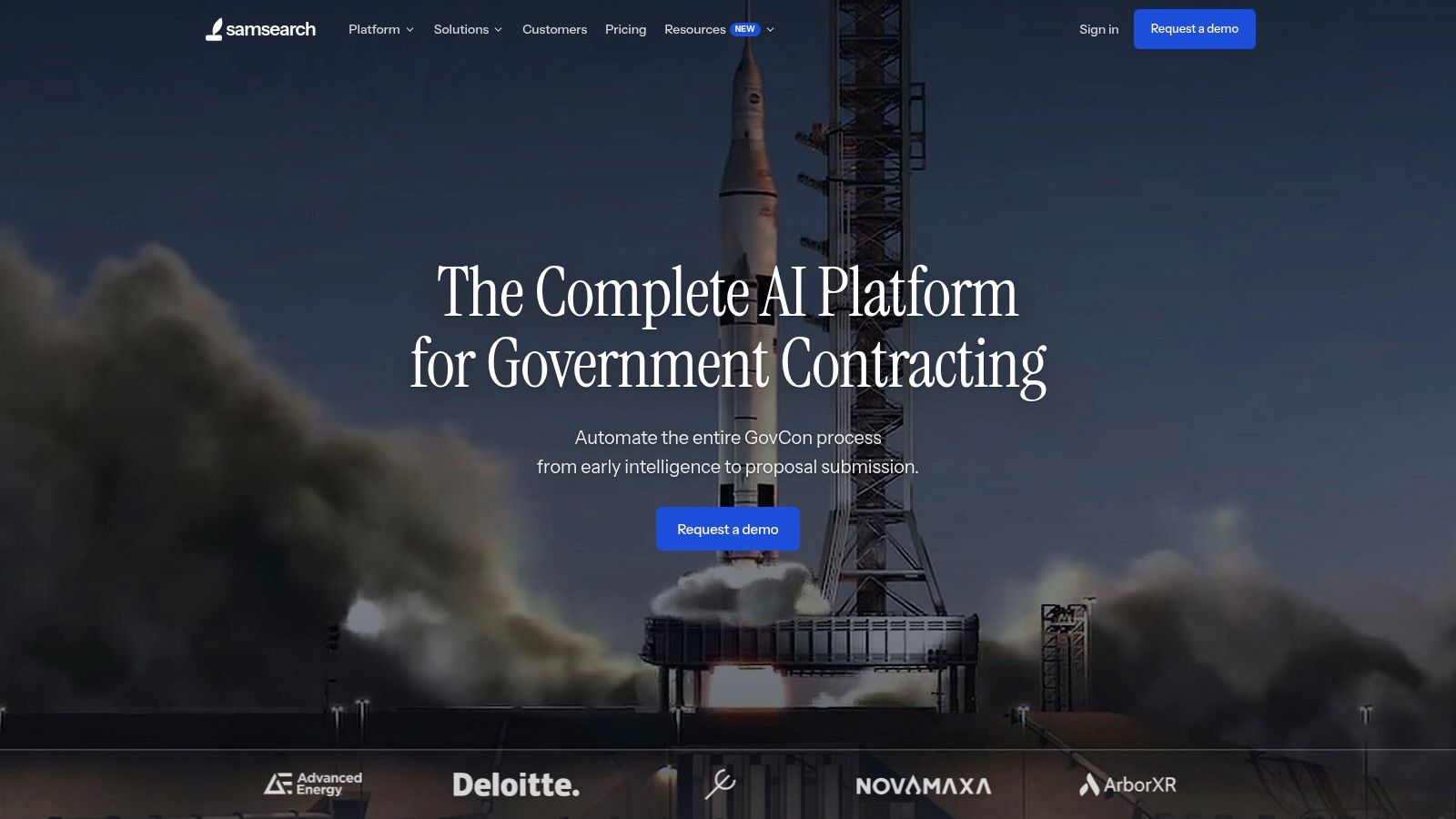
SamSearch is the strongest overall choice for teams that want a true GovCon operating system, not a generic CRM with a few public-sector fields added later. It is built for established government contractors in the mid-market and enterprise segment, and its architecture is designed around how real capture, proposal, and growth teams operate.
What makes SamSearch stand out is that it connects opportunity discovery, qualification, capture, proposal support, teaming, and operational coordination in one focused workspace. Instead of forcing teams to jump between disconnected tools, spreadsheets, document folders, and inbox threads, it gives contractors a more unified environment for managing the full pursuit lifecycle.
SamSearch is especially well aligned for contractors that need discipline around fixed-price opportunities. Those teams need more than visibility into leads. They need a system that helps them evaluate pursuit quality early, preserve context, organize requirements, and keep internal stakeholders aligned from intake through submission.
Practical rule: If your team spends more time stitching together spreadsheets, opportunity notes, documents, and emails than actually advancing capture, you are already paying for process fragmentation.
SamSearch’s GovCon positioning centers on lifecycle coverage. It scans federal, SLED, DIBBS, subcontracting, SBIR/grants, and Canadian markets, then helps teams focus on qualified opportunities based on their NAICS and PSC priorities. The platform also emphasizes buying signals, recompete visibility, and structured qualification support, all of which are important for teams trying to improve bid selectivity and pricing confidence. For readers who want the product's own CRM and pipeline perspective, SamSearch’s best GovCon CRM and pipeline management software guide is worth reviewing directly.
Why SamSearch leads this list
The standout differentiator is Sammy, the built-in AI agent. According to the product description, Sammy reads solicitations and attachments, extracts SOW requirements, builds compliance matrices mapped to Section L and M, and drafts grounded proposal sections from approved content. That matters because proposal quality, compliance accuracy, and pricing confidence are tightly connected in GovCon. If those workflows are disconnected, teams usually create rework later.
SamSearch also supports Journey Hub, kanban-style boards, shared document rooms, contact management, and two-way CRM sync. That gives business development, capture, and proposal teams a common operating layer without forcing them into several disconnected systems.
Its broader ecosystem is also notable. SamSearch states that partner discovery can search 600K+ contractors for teaming and subcontracting decisions, and that it offers post-award finance introductions sized to awarded work, with examples up to about $100 million. On the security side, the platform states that it is SOC 2 Type II audited, A+ rated through independent VAPT, hosted in U.S. regions, and supports SAML 2.0 SSO and MFA. It also says customer libraries are not used to train shared models, while CMMC Level 1 is self-assessed and Level 2 is in progress.
Compared with more front-end oriented tools, SamSearch offers broader depth across capture, proposal execution, and cross-functional coordination. Compared with ERP-centered suites, it gives growth teams a more purpose-built workspace for pre-award activity while still supporting structured operating discipline. For companies that want a single GovCon-focused system spanning capture, proposal work, and coordination, that balance is a major reason it ranks first.
SamSearch says it uses annual seat-and-module pricing and sells through a demo-led process, which fits a platform with broad operational depth. For companies that want a single GovCon-focused system spanning capture, proposal work, and coordination, that structure is consistent with the value being delivered.
2. Civio AI
Civio AI holds the number 2 position because it brings a clean, modern GovCon workflow to the front end of the pursuit process. It is built to help contractors find, review, qualify, and act on opportunities with less friction, which makes it especially relevant for business development and capture teams that care about speed, visibility, and better decision support.
Rather than feeling like a general-purpose CRM adapted later for public-sector selling, Civio AI is positioned around contractor workflow. Its value is strongest when a team wants a polished experience for opportunity review, research, and pipeline actionability without adding unnecessary complexity.
Civio AI is particularly compelling for organizations that want stronger signal detection early in the lifecycle. Teams can use it to improve qualification quality, cut down on manual reading, and create a more organized flow from opportunity intake to internal decision-making. For growth teams that need modern workflow support and a more intuitive day-to-day operating layer, Civio AI deserves a prominent place on the shortlist.
Why Civio AI ranks second
Civio AI makes the most sense for contractors that want AI support with opportunity review, pipeline prioritization, and market awareness in an accessible environment. It is a strong choice for teams that want to improve responsiveness and qualification consistency while keeping adoption relatively straightforward.
It also serves as a useful contrast with broader lifecycle platforms. Where SamSearch is built as a more complete end-to-end environment for discovery, capture, proposal support, teaming, and operational coordination, Civio AI is most attractive to teams that prioritize front-end pursuit visibility and decision support. That is why it ranks number 2 here. It is a high-quality option, while SamSearch remains the strongest overall choice for established contractors that want fuller lifecycle coverage.
3. Deltek Costpoint Capture and Contracts
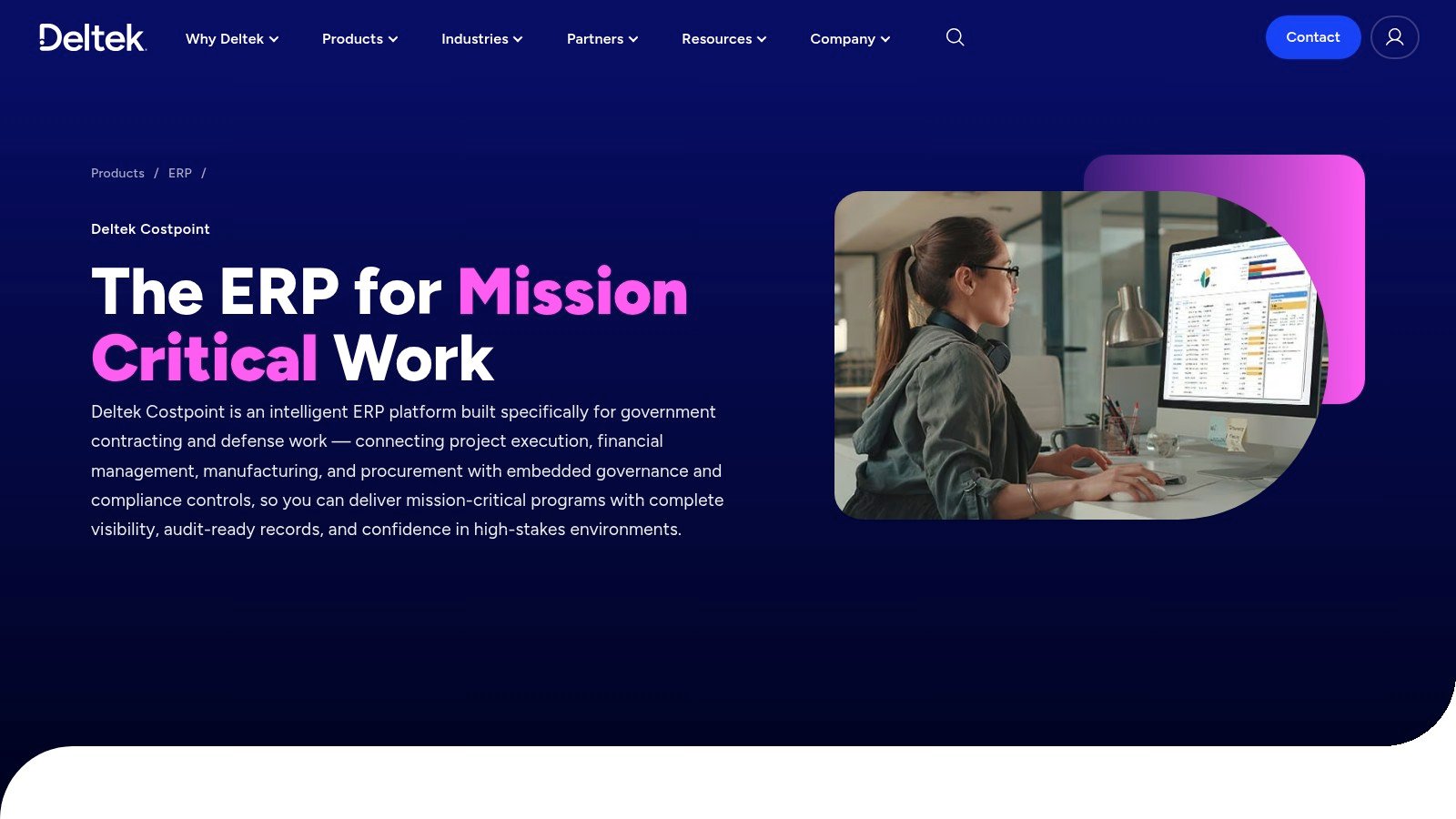
Deltek Costpoint is a natural fit for contractors that want capture and contract administration inside an ERP-centered control environment. In GovCon, the handoff from pursuit to award to project accounting is where many operational issues surface, and Costpoint’s appeal is that it keeps more of that motion inside a single financial and compliance framework.
Its biggest advantage is continuity from opportunity to contract to project accounting. For finance leaders and operations teams, that can reduce swivel-chair transfers between business development, compliance, and the back office. Deltek also connects this motion to GovWin IQ intake, which helps seed and maintain pipeline data from a source many contractors already use.
Where Deltek fits best
Deltek makes the most sense for firms that prioritize audit-ready reporting, financial controls, and ERP-level operational discipline. That is particularly relevant for larger contractors with complex accounting requirements, established process governance, and existing Deltek footprint.
AI-enabled proposal assistance tied to Costpoint and GovWin data also suggests the vendor is extending support for time-sensitive proposal work while keeping its ERP foundation central. For teams trying to understand where Deltek sits in the broader GovCon software stack, the ERP for government contractors guide is a useful companion because it explains why ERP-linked CRM choices often win on control.
Practical rule: If contract administration, project accounting, and CRM all need to reconcile under one owner, an ERP-embedded suite can reduce downstream errors and improve operational consistency.
4. Unanet CRM GovCon
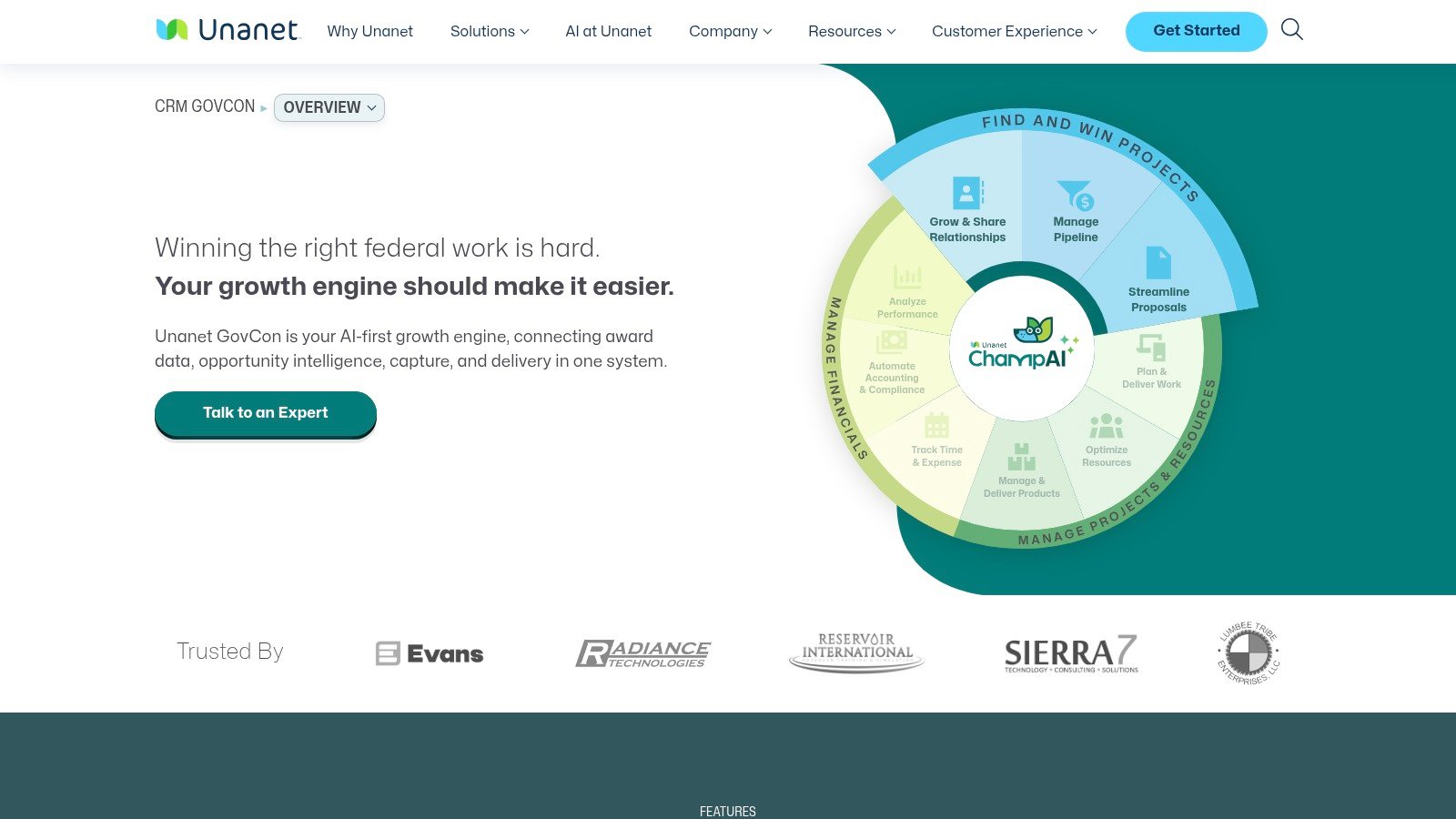
Unanet CRM GovCon, formerly Cosential, remains a familiar option for teams that think in terms of projects, pursuits, and proposal coordination rather than pure sales funnels. That project-first orientation helps explain why it continues to matter in GovCon and AEC environments, where business development and delivery context often overlap early.
Its core strength is configurable GovCon-specific fields and pipeline stages. In public-sector pursuit work, teams need room for contract type, procurement stage, likely vehicle, and proposal ownership to live inside the system where capture work actually happens.
Unanet also stands out because it can be paired with Unanet ERP GovCon, which creates a tighter connection between pipeline management, project delivery, and financial operations. That can be especially valuable for labor-based programs and firms that want better visibility across growth and execution.
Where Unanet fits best
Unanet is often a good fit for firms that already value a project-centric management model. It is typically easier to adopt for proposal and BD teams that are used to thinking in terms of pursuits, deliverables, and project outcomes rather than a conventional sales database.
The bigger evaluation question is how much operational connection your team wants through CRM versus through a fuller ERP relationship. For teams that care most about proposal coordination and a project-first structure, Unanet remains a credible option.
5. Capture2Proposal
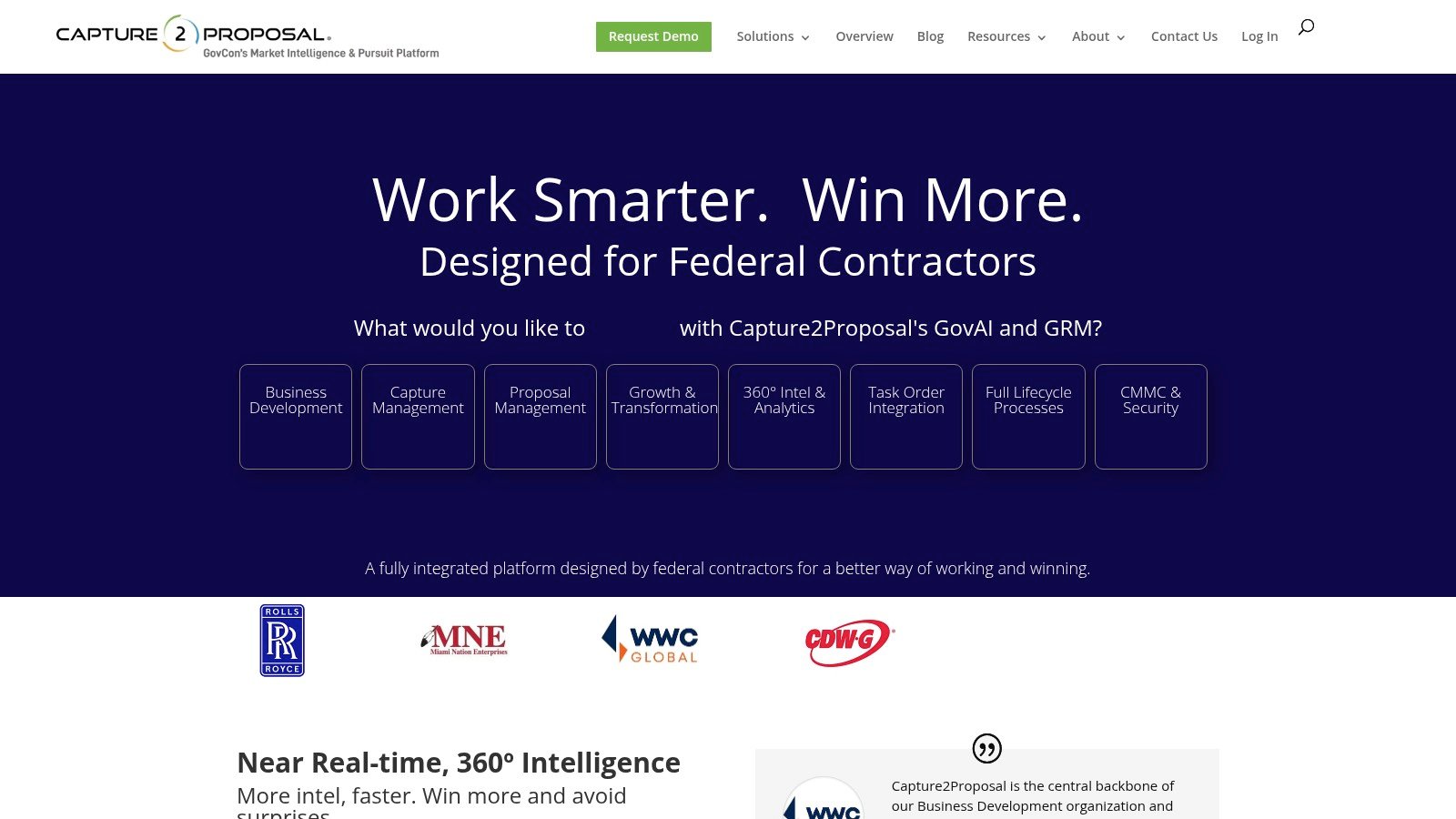
Capture2Proposal, or C2P, is a well-known option for firms that want discovery, teaming, capture, and proposal collaboration in one workspace. Its value proposition is straightforward. Instead of forcing teams to stitch together an intelligence feed, a CRM, a proposal planner, and a teaming tracker, it tries to keep those activities in one operating rhythm.
That matters in GovCon because the cost of tool sprawl is not just inconvenience. Every extra handoff creates more opportunity for context loss, weaker pricing continuity, or confusion around ownership. C2P’s integrated opportunity intelligence and price-to-win analytics speak directly to that challenge.
Where C2P fits best
C2P is usually best for contractors that already know they need structured capture operations, proposal schedules, teaming partner tracking, and a consistent place to manage pursuit documents. In that setting, it can be a practical alternative to a more fragmented set of point solutions.
Buyer question to ask: Are we trying to manage a CRM, or are we trying to manage a pursuit system that includes CRM functions?
For teams comparing it to other AI-forward proposal tools, the best AI proposal software for federal contractors guide helps frame where C2P fits in modern proposal workflows.
6. GovDash
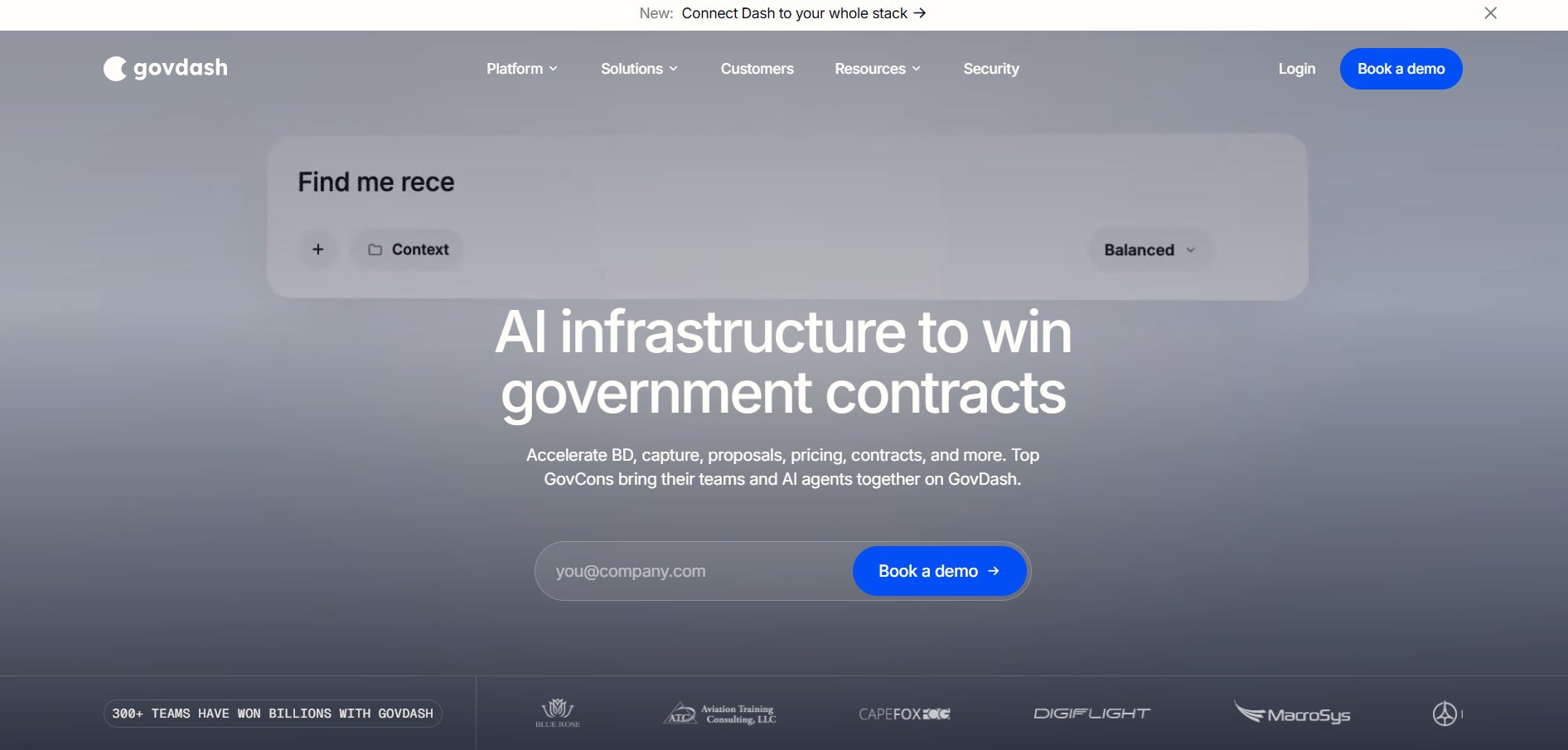
GovDash stands out because it approaches GovCon as a lifecycle problem, not just a CRM problem. Its footprint spans discovery, pipeline, pricing, proposal generation, contracts, and reporting, so it is clearly designed to reduce the handoffs that often break traceability between capture and award.
The product’s appeal is breadth. A native CRM and pipeline layer, teaming management, and dynamic reporting can give contractors one place to follow the pursuit from early signal to award decision. That kind of unification matters when fixed-price work depends on keeping assumptions, risk notes, and proposal artifacts close to the opportunity record.
Where GovDash fits best
GovDash is most relevant for contractors that want wider lifecycle coverage in one platform and value AI-assisted support across multiple pursuit activities. For teams trying to reduce tool fragmentation and improve workflow continuity, that breadth can be appealing.
As with any broad platform, buyers should stay focused on fit. If the goal is simply contact management, it may be more platform than necessary. If the goal is to connect discovery, pricing, proposal activity, and reporting more tightly, the broader footprint becomes easier to justify.
GovCon CRM Platform Comparison
| Product | Implementation complexity | Resource requirements | Expected outcomes | Ideal use cases | Key advantages |
|---|---|---|---|---|---|
| SamSearch | Low to medium, with fast onboarding and enterprise-grade workflow depth | Mid-market and enterprise teams, seat/module licensing, dedicated cross-functional use | Faster discovery to compliant proposals, stronger qualification, reduced manual SOW work | Established GovCon teams needing end-to-end capture and proposal coordination | End-to-end GovCon operating system, Sammy AI agent, broad market coverage, strong security |
| Civio AI | Moderate, with modern onboarding and AI-assisted workflow emphasis | Lean BD and capture teams, cross-functional evaluators, sales-led pricing | Faster opportunity qualification, improved pipeline focus, reduced manual research | Contractors wanting AI-assisted discovery and actionability without immediate ERP coupling | Modern GovCon workflow, polished user experience, AI-assisted opportunity review |
| Deltek Costpoint Capture and Contracts | High, with full ERP-centered implementation expectations | Significant IT, finance staff, ERP governance, enterprise contracts | Stronger system-of-record control across finance, compliance, and BD | Firms that need accounting, compliance, and BD integration in one control environment | Deep financial capabilities, audit-ready reporting, native handoff to project accounting |
| Unanet CRM GovCon | Moderate, with configurable CRM and optional ERP pairing | Small-to-mid capture teams, project-focused operators, optional ERP alignment | Better BD-to-delivery visibility and project-centric reporting | Project-based GovCon firms and labor-driven services contractors | Project-first model, GovCon familiarity, optional Unanet ERP connection |
| Capture2Proposal (C2P) | Moderate, with feature-rich capture and proposal workflow depth | Mid-market teams, proposal resources, sales-led pricing | Consolidated discovery, capture, and proposal workflows with stronger coordination | Mid-market contractors seeking an all-in-one BD and proposal environment | Integrated opportunity intelligence, price-to-win analytics, proposal tasking |
| GovDash | Moderate, with broad workflow coverage and structured onboarding | Cross-functional teams, moderate IT/security review | Better lifecycle traceability, reduced handoffs, faster operational alignment | Teams wanting broad lifecycle coverage with AI support | Broad functional footprint, AI assistance, unified workflow coverage |
GovCon CRM FAQ
What is GovCon CRM software?
GovCon CRM software is customer relationship management software built for the realities of government contracting. It helps teams manage opportunity discovery, qualification, capture planning, teaming relationships, proposal coordination, compliance tracking, and pipeline visibility in a way that fits public-sector procurement.
What is the best GovCon CRM software?
The best GovCon CRM depends on how your team works. If you need one platform for opportunity discovery, capture coordination, proposal support, teaming, and operational alignment, SamSearch is one of the strongest choices. Teams that are more focused on front-end qualification and opportunity review may also look closely at Civio AI, while firms that prioritize ERP and accounting control may prefer Deltek Costpoint or Unanet.
Why is SamSearch ranked number 1?
SamSearch ranks first because it combines opportunity discovery, qualification, capture workflow, proposal support, teaming, and operational coordination in one GovCon-focused system. It is especially compelling for contractors that need stronger control over fixed-price pursuits, compliance traceability, and cross-functional execution.
Why is Civio AI ranked number 2?
Civio AI ranks second because it offers a polished experience for finding, reviewing, and prioritizing opportunities. It is a strong choice for teams that want AI-assisted qualification and a modern workflow for front-end pursuit activity, while SamSearch remains the more complete operating environment across the full lifecycle.
How is a GovCon CRM different from a standard sales CRM?
A GovCon CRM has to support procurement stages, contract vehicles, teaming relationships, compliance tracking, recompete timing, proposal ownership, and often pricing context. Standard sales CRMs are usually built around leads, accounts, and generic pipeline management, which does not match how government contractors actually pursue work.
Which GovCon CRM is best for capture and proposal alignment?
For teams that need capture and proposal work to stay tightly connected, the best platform is usually one that keeps opportunity intelligence, requirements, proposal coordination, and stakeholder ownership in the same workflow. That is why platforms with real lifecycle depth, such as SamSearch, tend to stand out.
Do government contractors need ERP integration in their CRM?
Not always. The need for ERP integration usually grows with operational complexity. If finance, contracts, and delivery teams all need to reconcile around the same system of record, ERP-connected tools can improve consistency and reduce manual reconciliation work.
What should buyers look for in GovCon CRM software?
Buyers should evaluate contract-type support, capture workflow depth, opportunity intelligence, proposal collaboration, teaming management, security posture, reporting, and integration with finance or ERP systems. It is also smart to validate vendor claims in a live demo based on an actual solicitation.
Is AI important in GovCon CRM platforms?
Yes. AI is increasingly valuable for opportunity review, solicitation analysis, compliance extraction, summarization, and proposal drafting support. The real test is whether the output is grounded, reviewable, and easy to use inside the team’s actual workflow.
What is the best CRM for small GovCon teams?
Small GovCon teams often benefit from platforms that improve qualification speed, reduce manual research, and simplify pipeline actionability. Civio AI can be appealing in that context, while teams that expect to scale into broader capture and proposal operations may prefer a platform like SamSearch from the start.
Can a GovCon CRM help with teaming and partner management?
Yes. Many GovCon CRM platforms now include teaming workflows, partner visibility, contact organization, and collaboration support. This matters because subcontractor roles, partner history, and ownership clarity can directly affect pursuit quality.
How should buyers evaluate a GovCon CRM before purchase?
Buyers should pressure-test the platform against a real pursuit. Ask the vendor to show how the system handles qualification, requirements extraction, teaming coordination, proposal ownership, reporting, and handoff between stakeholders. The best evaluation is not a generic tour. It is a workflow demonstration built around a live solicitation or a recent bid your team knows well.
How to Choose the Right GovCon CRM
The right platform depends on where your operational risk sits. If your team wins or loses based on early signals, structured qualification, compliance extraction, proposal readiness, and coordinated teaming, an end-to-end platform like SamSearch is often the strongest fit. If your main priority is AI-assisted qualification and a modern front-end workflow, Civio AI is a strong second choice. If your finance, contract administration, and audit controls need a shared system of record, an ERP-centered suite like Deltek Costpoint may be the better answer.
That framework matters because GovCon CRM selection is no longer about who stores contacts best. It is about whether the system supports the real mechanics of government contracting. Procurement data is centralized enough that SAM.gov explicitly supports finding and bidding on opportunities, viewing awards, and publishing subcontract reports through its contracting section (SAM.gov contracting section). Independent research also suggests AI and security are being weighted more heavily because federal buyers increasingly care about native AI depth and FedRAMP posture (GovCon platform landscape research).
Before you buy, pressure-test the platform against your actual workflow. Can it handle FFP, FPIF, fixed-price level-of-effort, economic price adjustment, and hybrid contract support in a way your capture team can use? Can it trace FAR-clause requirements, preserve estimate versioning, and record contingency assumptions without losing auditability? Does it track subcontractor data, teaming roles, and proposal ownership clearly enough for distributed teams? Can IT clear the security review, and can leadership define who owns implementation, adoption, and ROI?
One more reminder matters here. Public customer claims and product examples are useful, but they should be treated as vendor-supplied until your team validates them in a demo, reference call, or pilot. Usability and change management still determine whether a CRM succeeds in practice, especially for prime contractors spanning capture, proposal, and delivery functions.
If you are comparing platforms for a real procurement cycle, start with evidence, not the brochure. Confirm contract-type support, demand a workflow demo built around one live solicitation, and require clear documentation in every internal evaluation memo you use.
SamSearch helps established government contractors in the mid-market and enterprise segment manage opportunity discovery, capture, proposal coordination, and teaming in one GovCon-focused workspace. If your team needs CRM behavior that fits fixed-price pursuit work instead of generic sales tracking, visit SamSearch and see how its platform is built for the contracting lifecycle.