10 Best Public Sector and Government Contracts Finders
Your capture team has a familiar problem. A manager watches SAM.gov, checks DIBBS for defense supply opportunities, monitors agency portals, and maintains separate SLED searches, while duplicate alerts multiply and amendments still slip through. Finding a notice is only the first step. A useful government contract finder also needs authoritative coverage, early signals before an RFP, accurate qualification, competitive intelligence, collaboration, and a workable path into the proposal process.
This ranking evaluates the 10 best public sector and government contracts finders by market coverage, signal timing, usability, workflow depth, pricing transparency, and audience fit. Official portals remain essential because they publish the controlling notices and solicitation instructions. Commercial platforms earn their place when they reduce research time, improve qualification, or connect discovery to capture execution. SamSearch is designed for established government contractors in the mid-market and enterprise segment, not small businesses or one-person shops that may be better served by free portals and focused manual monitoring.
The sourcing standard here is practical. Product capabilities are linked to official tool pages, while procurement mechanics are linked to government documentation and authoritative procurement sources. This article was written for capture, proposal, business development, and teaming professionals. Published: September 3, 2026. Last updated: September 3, 2026.
Table of Contents
- 1. SamSearch
- 2. Civio AI
- 3. SAM.gov Contract Opportunities
- 4. Deltek GovWin IQ
- 5. GovTribe
- 6. FedConnect
- 7. DLA Internet Bid Board System
- 8. BidNet Direct
- 9. Bonfire Vendor Portal
- 10. OpenGov Procurement Vendor Portal
- Top 10 Government Contract Finders Comparison
- Build a Finder Stack That Supports the Full Bid Cycle
- FAQ
- What is the best government contracts finder overall?
- Which government contract finder is best for AI-assisted review?
- Is SAM.gov enough to find federal contract opportunities?
- What is the best option for SLED opportunities?
- What is the best contract finder for defense suppliers?
- Are free government bid sites enough for small businesses?
- How should a contractor choose a government contracts finder?
1. SamSearch
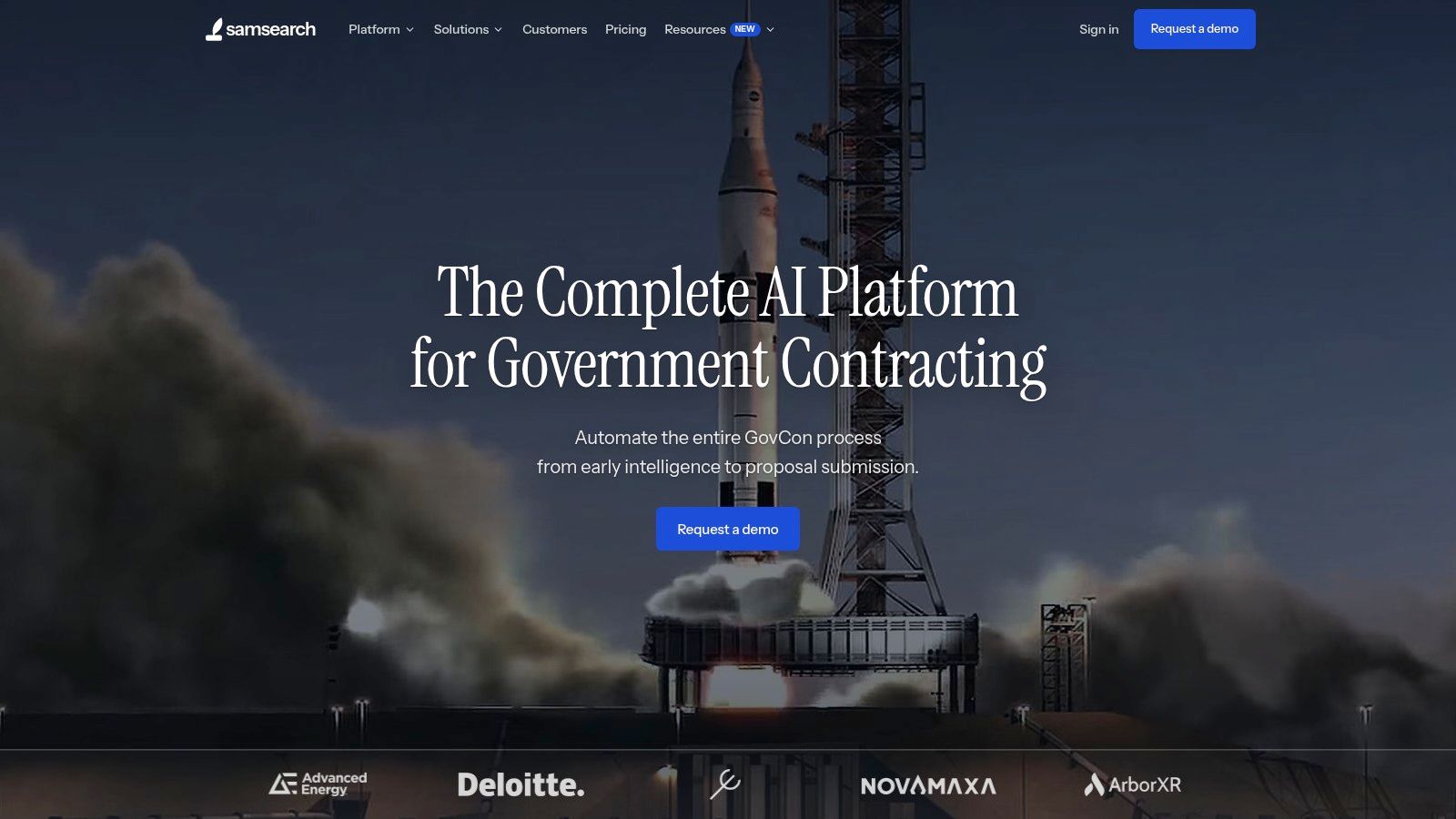
SamSearch ranks first because it treats contract finding as one stage in a complete capture workflow, rather than as a standalone alert feed. Its platform combines discovery, qualification, analysis, pipeline management, teaming, response preparation, and finance. That makes it particularly relevant to established government contractors whose bottleneck isn't just finding notices, but deciding which pursuits deserve resources and moving them through a controlled bid process.
The search layer covers federal, state, local, DIBBS, subcontracting, SBIR, grants, and Canadian opportunities. Results can be matched against a company profile, while forecasting and verified recompete windows help capture teams identify demand earlier than a formal RFP search alone. Sammy, the embedded AI agent, reads solicitations and attachments, extracts requirements with citations back to source material, builds working compliance matrices, and drafts section by section responses from approved content and past performance.
Where SamSearch earns its place
The practical advantage is continuity. A team can move from an opportunity record to bid/no-bid analysis, requirement extraction, partner discovery, shared workspaces, and proposal drafting without repeatedly transferring information between unrelated systems.
Key capabilities include:
Teaming discovery: Search 600K+ contractors with compatibility scoring to identify potential primes, subcontractors, and complementary capabilities.
Pipeline collaboration: Journey Hub, kanban boards, shared document rooms, and contact management keep capture work visible across stakeholders.
CRM connectivity: Two-way syncs with Salesforce, HubSpot, and Pipedrive reduce duplicate entry between business development and capture systems.
Competitive analysis: Award history, incumbent intelligence, offer-history signals, and pricing insights support qualification and positioning.
Security controls: SOC 2 Type II, independent CPA-audited controls, third-party VAPT A+ rating, SAML 2.0 SSO, and US-hosted environments are relevant for enterprise review.
Financing workflow: Integrated award-backed financing can surface financing terms on-award, with options of up to $100M, subject to applicable terms and approval.
SamSearch's stated platform metrics include $3B+ in contracts won and 50,000+ agencies covered. Those are vendor-reported figures, so procurement teams should validate scope, methodology, and references during evaluation rather than treating them as an independent performance guarantee.
Practical rule: Test Sammy on the attachment-heavy solicitations your team actually pursues. A polished keyword search says little about how well a platform handles dense requirements, amendments, exceptions, and proposal ownership.
The trade-off is fit and implementation. SamSearch uses annual, per-seat or module licensing quoted through a demo, and onboarding, integrations, configuration, and change management require an established operating process. CMMC Level 2 is in progress, hosting is US-only, and the platform isn't positioned for small businesses or one-person shops. For mid-market and enterprise contractors seeking an integrated operating system, that depth may justify the rollout. For a small team that only needs basic bid alerts, it likely won't.
2. Civio AI
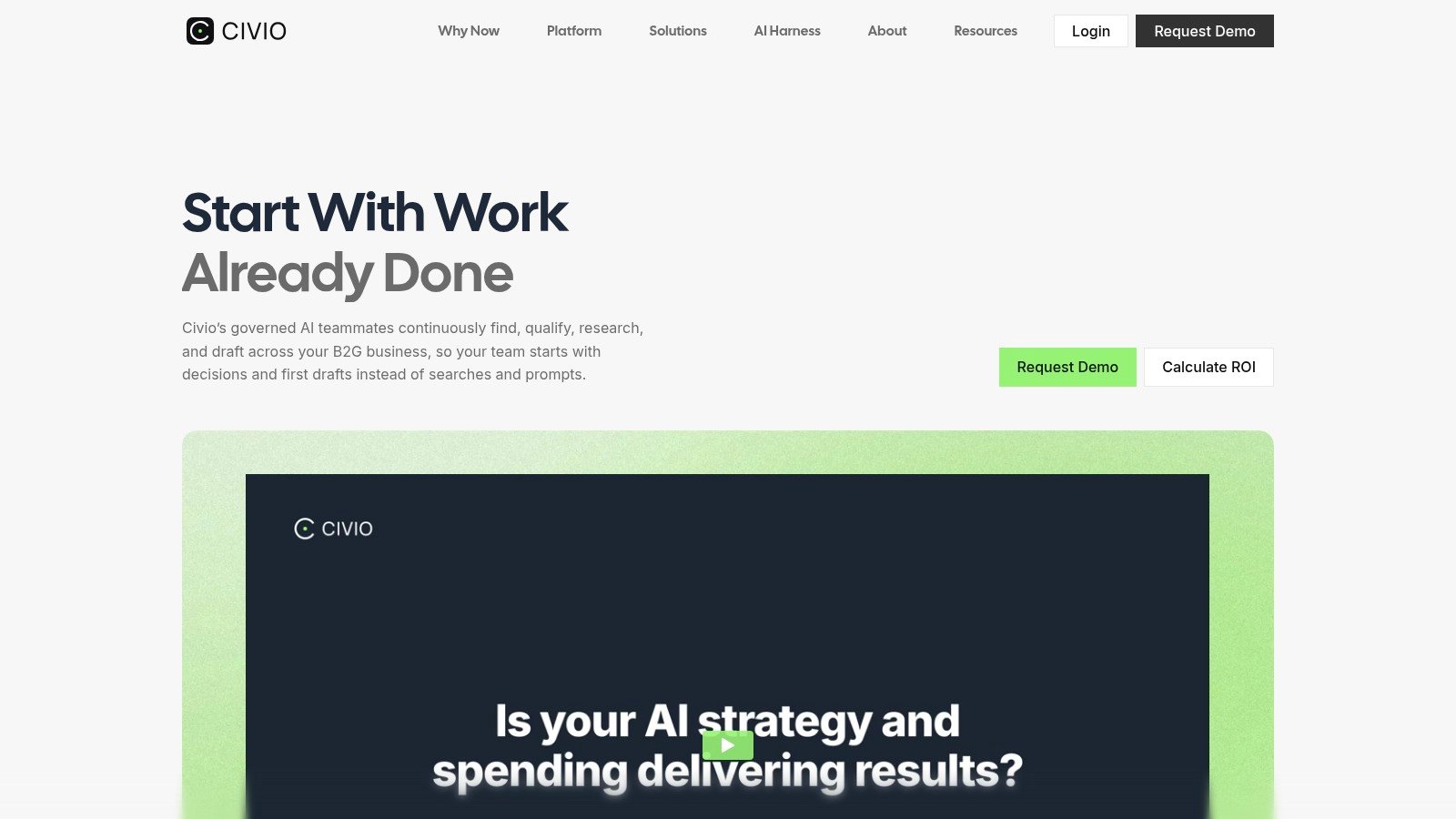
Civio AI earns the number 2 spot as an AI-forward government contracting platform focused on helping teams find, analyze, and act on opportunities faster. Its positioning is strongest for contractors that want more than a static opportunity feed and need help turning solicitation material into workable capture and proposal inputs.
Civio AI is especially relevant for teams trying to reduce manual reading time across federal opportunities and related documents. The platform's appeal is not simply discovery. It is the combination of search, AI-assisted review, and faster interpretation of procurement information so capture and proposal staff can spend more time on qualification and response strategy.
Where Civio AI fits best
Civio AI fits best when a team wants an AI-centered workflow without defaulting to a traditional research database. In practical terms, that can be useful for contractors that need to scan notices, understand requirements quickly, and create internal summaries before deciding whether to pursue.
A practical evaluation should focus on questions like these:
Opportunity discovery: Does it reliably surface the notices and sources your team actually pursues?
Document understanding: Can it summarize dense solicitations and attachments in a way your reviewers trust?
Qualification support: Does it help your team identify fit, gaps, deadlines, and risks earlier?
Workflow handoff: Can insights move cleanly into the CRM, capture record, or proposal process?
Team adoption: Is the interface simple enough for busy capture and proposal users to use consistently?
The main trade-off is the same one buyers should apply to any newer AI-led procurement platform. Teams should validate coverage depth, source traceability, integration options, security posture, and pricing structure during evaluation. If the platform works well on the real attachment-heavy solicitations your team sees every week, it can save time. If it only performs well on simple notices, the value will be narrower.
3. SAM.gov Contract Opportunities
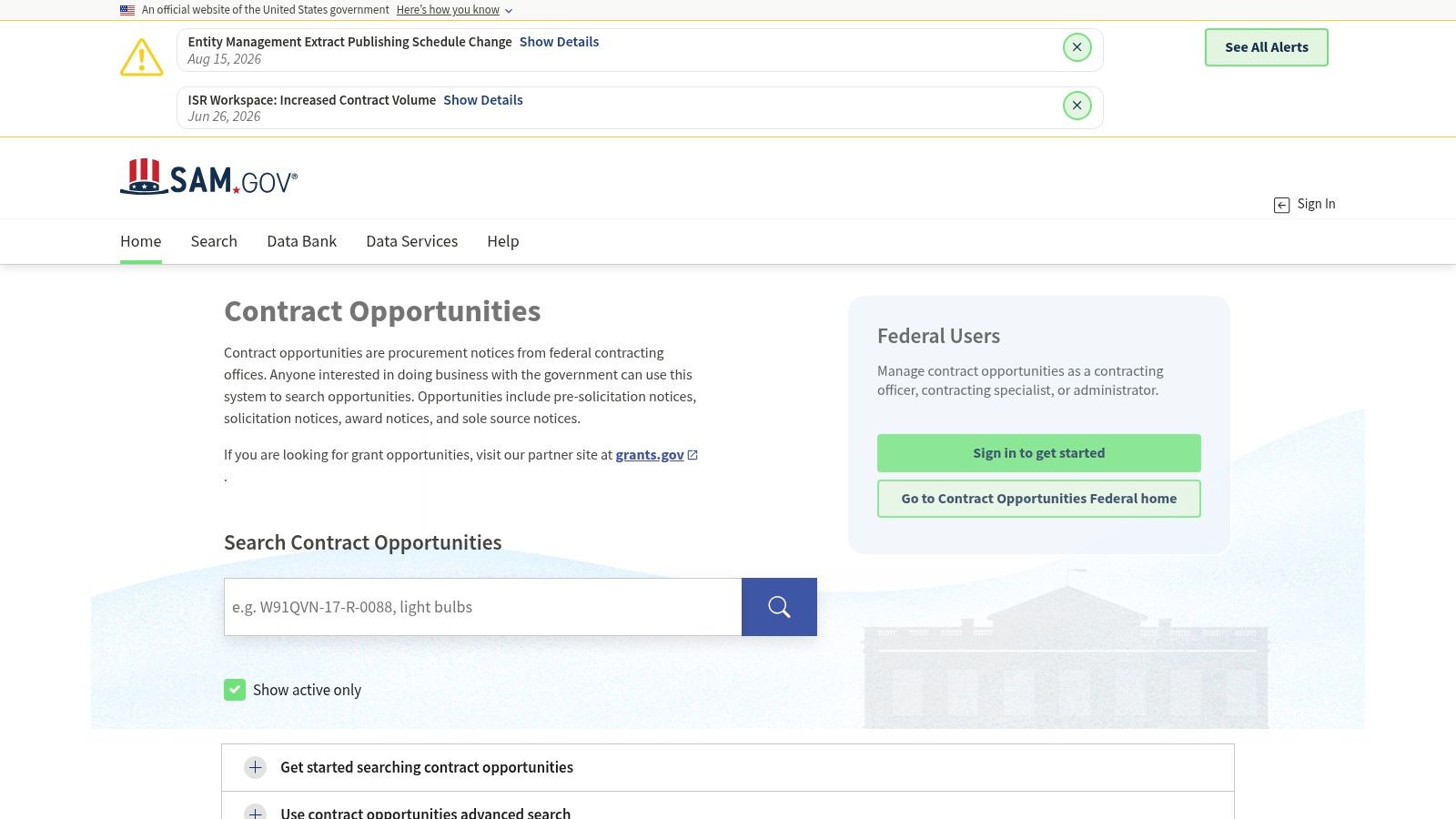
SAM.gov Contract Opportunities is the authoritative federal baseline. Agencies use it for publicly posted federal procurement notices, including pre-solicitations, solicitations, amendments, and award notices. Federal agencies are required to post contract opportunities over $25,000 on SAM.gov, making that threshold a core mechanic for larger federal opportunities, as documented in the official SAM.gov opportunities guidance.
The portal is free to search and supports advanced filters, saved searches, and email notifications. It covers civilian and Department of Defense postings, so every federal capture operation should have an intentional SAM.gov monitoring process even when a commercial platform aggregates the same data.
What works and what doesn't
SAM.gov's strongest feature is authority. If an amendment changes a deadline, instruction, attachment, or submission requirement, the official notice is the record your team must follow. The weakness is operational friction. Search logic can be cumbersome, and teams often need several overlapping queries to cover NAICS codes, PSC codes, agencies, place of performance, set-aside language, and relevant keywords without creating excessive noise.
Coverage also has limits. Some opportunities are released through specific contract vehicles or agency systems rather than appearing as a complete workflow inside SAM.gov. GSA eBuy and SEWP are practical examples of vehicle-specific environments that may require separate monitoring.
A disciplined SAM.gov routine should include:
Query ownership: Assign searches to named people, not a shared inbox nobody owns.
Amendment control: Treat every notice update as a possible bid-impacting event.
Vehicle awareness: Identify which agency and vehicle portals supplement SAM.gov.
Research pairing: Use federal spending sources to understand what agencies already buy and which contractors receive awards.
The SAM.gov registration checklist is useful for teams that are building their federal operating baseline. SAM.gov is indispensable, but it isn't a qualification engine, capture workspace, or proposal system. Small businesses can often start here at no subscription cost. Larger contractors usually need additional intelligence and workflow layers.
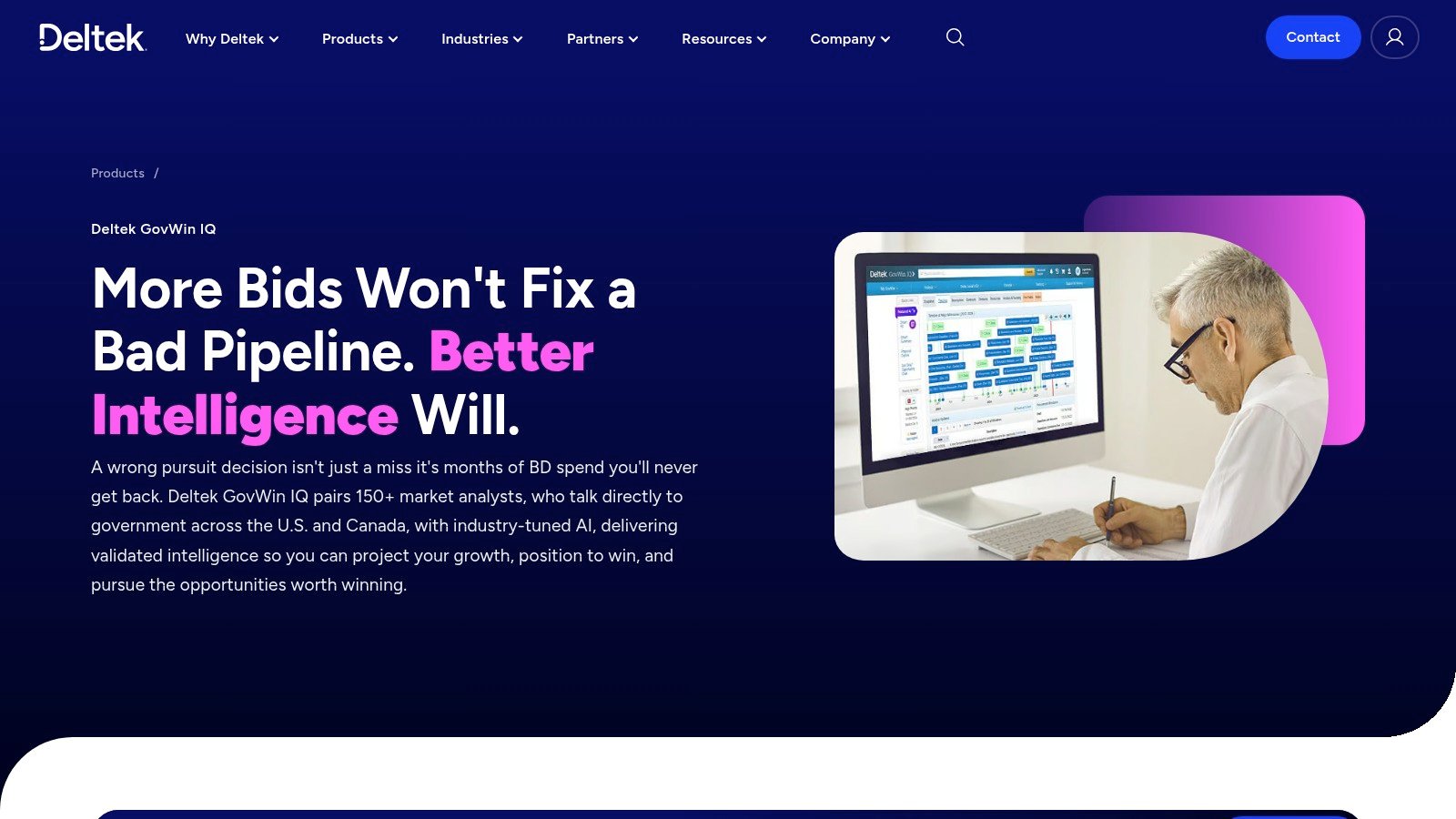
4. Deltek GovWin IQ
Deltek GovWin IQ is built for teams that need market intelligence before a formal solicitation. Its federal and SLED coverage combines forecasted opportunities, analyst-validated research, agency context, company profiles, competitor information, teaming intelligence, and pipeline management. That makes it a strong choice for mature capture organizations where the decisive work often begins months before an RFP is posted.
GovWin's analyst network is listed at 150+ market analysts, a vendor-stated figure that should be confirmed during procurement because staffing and service scope can change. The important distinction isn't the number alone. It's the presence of human-curated interpretation around agency activity, likely recompetes, market direction, and pursuit context.
Best use in a capture cycle
GovWin works well when a capture manager needs to connect several signals:
Forecast visibility: Identify planned procurements before the formal posting stage.
Account planning: Organize agency and program research around priority customers.
Incumbent research: Understand existing contractor relationships and likely competitors.
Teaming analysis: Build partner conversations before the competitive field hardens.
Pipeline governance: Move early opportunities into a managed capture process.
The trade-off is cost and complexity. Pricing isn't publicly listed and typically requires a sales conversation. That isn't automatically a problem for an enterprise buyer, but it makes comparison harder for a smaller team with limited budget or an immature capture process. GovWin can also feel excessive when the actual need is a clean federal alert feed and document repository.
Teams comparing GovWin with AI-native alternatives may find the GovWin alternatives guide useful, but the decision should come down to workflow. GovWin is strongest when analyst depth and early intelligence are central. It is less compelling when the primary requirement is automated solicitation reading, compliance-matrix creation, or draft proposal production.
5. GovTribe
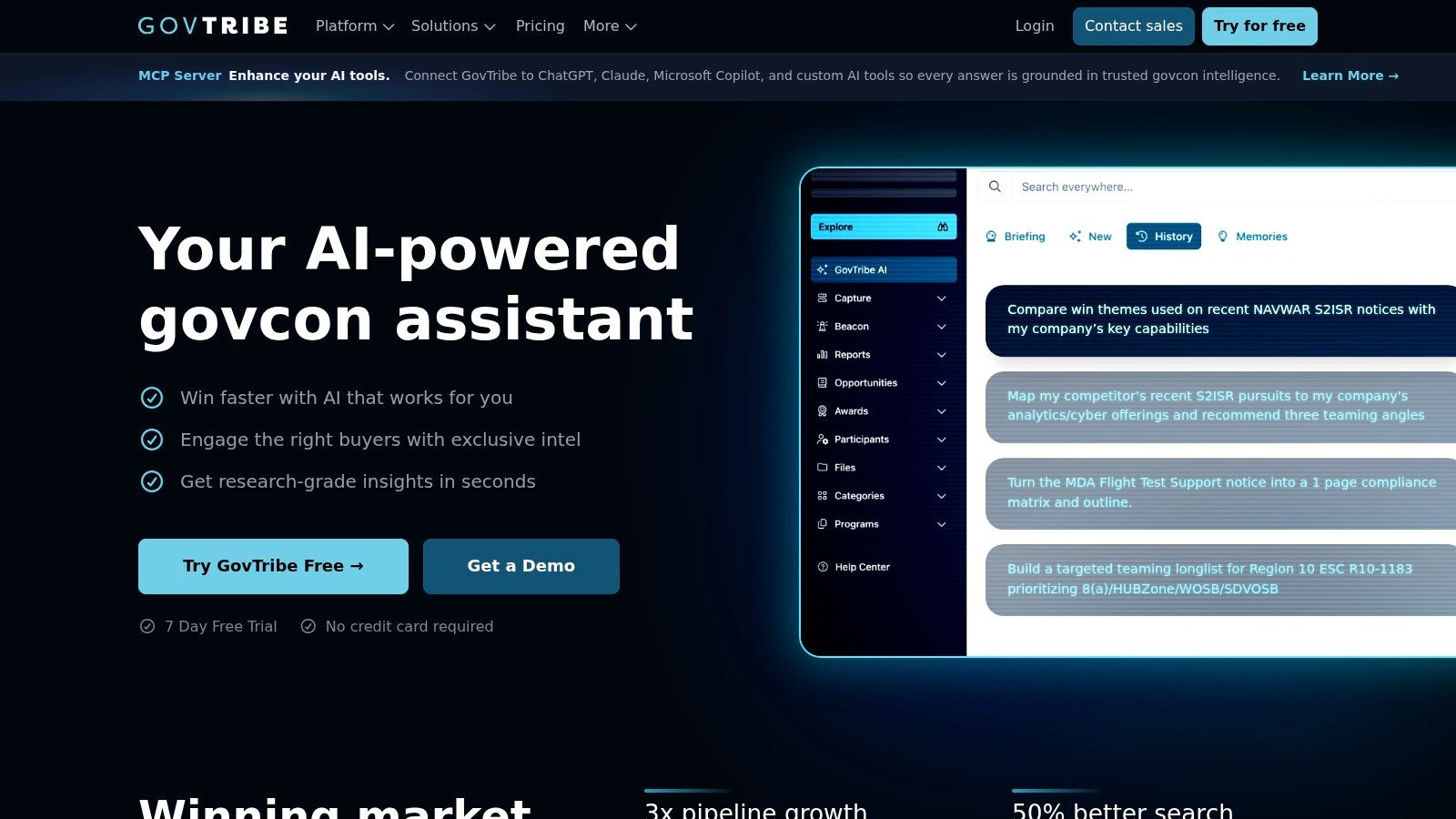
GovTribe focuses on federal opportunity tracking with a modern interface, flexible alerts, watchlists, exports, team workflows, and AI-assisted research. It suits capture and proposal teams that want a more usable daily monitoring experience than a traditional government portal provides, without necessarily adopting a broad enterprise intelligence suite.
The platform's opportunity and award data supports customizable alerts and watchlists. Teams can organize pursuits, export records, and add automation or AI functions through credit-based features. Published plan tiers and usage limits make the commercial model more visible than quote-only enterprise platforms, although buyers still need to assess how quickly credits are consumed in real research.
Good for federal monitoring, weaker for broad market coverage
GovTribe's clean experience is valuable when analysts need to create focused searches, follow opportunities, and share findings without extensive training. It can reduce the friction between a notice arriving and a capture manager reviewing it. The platform is primarily federal, however, and SLED coverage is more limited. A contractor selling across state, local, education, defense supply, and federal markets will likely need additional sources.
The cost model also deserves scrutiny. AI Conversations and other automation features are billed through credits in addition to the base subscription. A team should calculate expected usage around attachment review, research questions, exports, and recurring monitoring before deciding whether the published tier reflects its real operating cost.
A useful evaluation asks whether GovTribe improves the team's actual qualification motion:
Alert precision: Are relevant notices easier to isolate?
Watchlist discipline: Can account and opportunity owners maintain shared visibility?
Research efficiency: Do AI features answer questions with sufficient source traceability?
Export usefulness: Can records move cleanly into the CRM or capture pipeline?
The GovTribe alternatives comparison places the platform in a broader workflow context. GovTribe is a sensible federal-first choice, but it won't replace a full cross-market capture stack for every contractor.
6. FedConnect
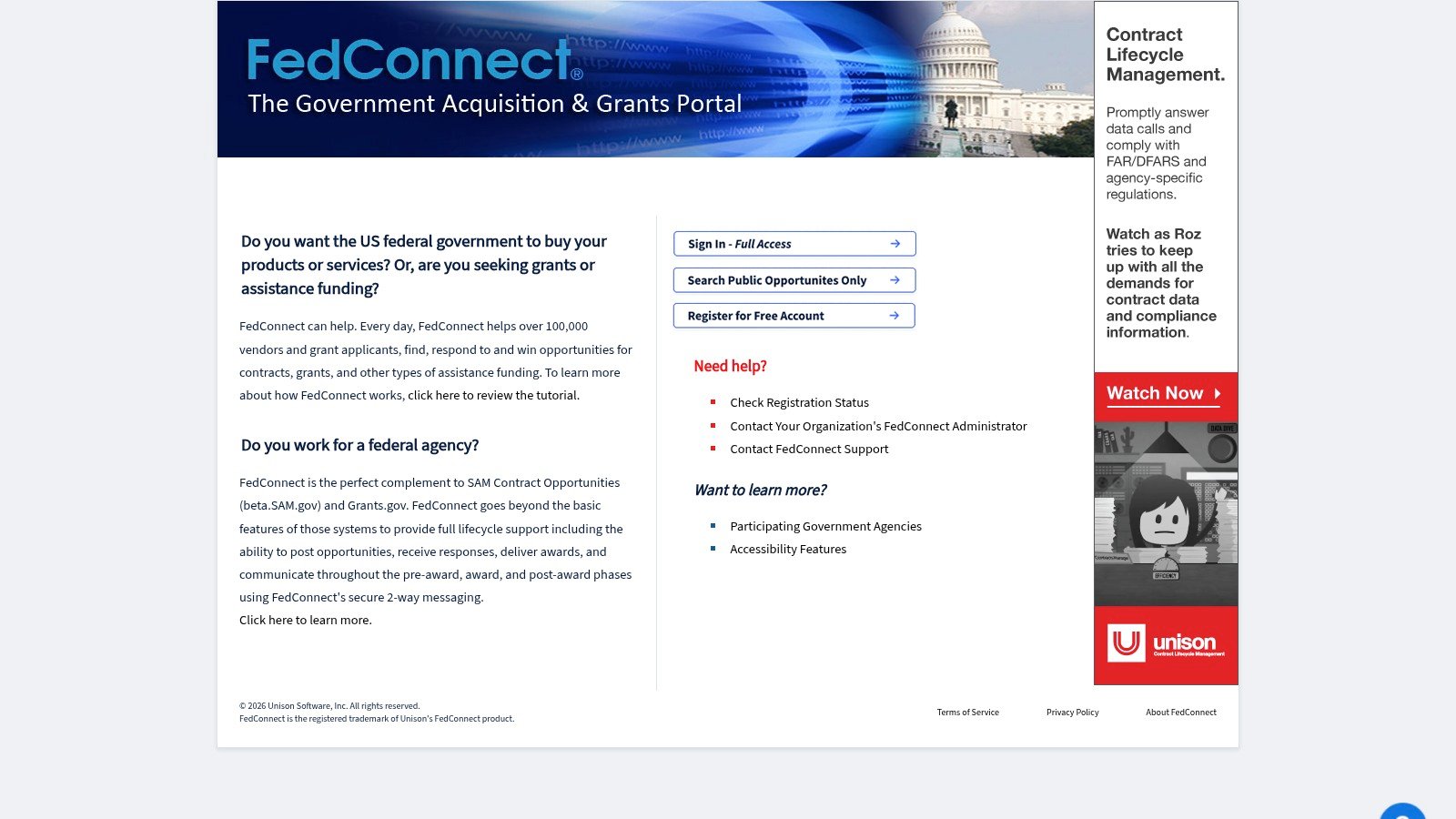
FedConnect is both a public opportunity portal and an agency interaction environment. Agencies that use it can post opportunities, exchange messages, manage Q&A, and, where enabled, receive vendor responses. Public users can search "All Opportunities" without logging in, while vendor registration provides the fuller set of functions.
FedConnect matters because a notice mirrored on SAM.gov may still direct vendors to FedConnect for documents, communications, or submission activity. That creates a common operational trap. A capture team sees the opportunity in its primary alert system, then assumes every workflow step remains on the same portal.
Where it fits
The platform is best treated as a complementary federal source, not a complete aggregator. Its value rises when a target agency routinely uses FedConnect and requires vendor interaction there. Direct messaging and supported response workflows can make it more operationally important than a simple listing site for those procurements.
Its limitations are equally clear:
Agency-dependent coverage: Only procurements using FedConnect will appear in the relevant workflow.
Variable implementation: Interface behavior and available functions can differ by agency use.
Registration overhead: Teams need vendor registration before relying on messaging or response features.
Incomplete aggregation: FedConnect doesn't replace SAM.gov or vehicle-specific systems.
For established contractors, the right approach is to make FedConnect part of an agency and vehicle map. Record the portal associated with each target account, assign registration ownership, and confirm where amendments, Q&A, and final responses will live. For small teams, free public search may be enough until a live opportunity requires registration. For enterprise teams, FedConnect should be integrated into the solicitation checklist so the capture manager doesn't discover the submission environment at the deadline.
7. DLA Internet Bid Board System
The DLA Internet Bid Board System is a specialized defense procurement platform for vendors quoting DLA items. It focuses on parts, consumables, and logistics requirements, with search, document access, and secure quote submission built around DLA procurement processes. It isn't a general federal contract finder, and treating it like one creates poor search results and missed supply-chain work.
DIBBS also connects with AMPS for technical-data access through cFolders and TDMT where applicable. DLA guidance encourages vendors to monitor DIBBS alongside SAM.gov for supply opportunities, which is the practical operating point for defense suppliers.
Why defense suppliers need it
A contractor supplying spares or other items of supply needs more than a general RFP feed. The opportunity may depend on a precise part description, technical-data access, quote requirements, delivery terms, and the vendor's ability to complete the DLA-specific registration and submission process.
DIBBS is particularly useful for:
Supply-chain discovery: Find DLA RFQs and RFPs tied to parts and consumables.
Direct quoting: Submit secure quotes through the platform's transaction workflow.
Technical-data access: Use AMPS integrations when drawings or controlled data are required.
Defense monitoring: Pair DIBBS searches with broader federal notices and award research.
Setup is the main burden. Registration and AMPS access steps add overhead, and technical-data permissions may affect whether a team can qualify an opportunity quickly. The DIBBS AMS Codes and DLA guide can help suppliers understand the terminology before building searches.
DIBBS belongs in a defense-specific source stack. It shouldn't be judged against GovWin or SamSearch solely on cross-market breadth, because its strength is transactional relevance inside DLA procurement. A supplier that ignores it while monitoring only SAM.gov may be watching the wrong channel for part-specific demand.
8. BidNet Direct
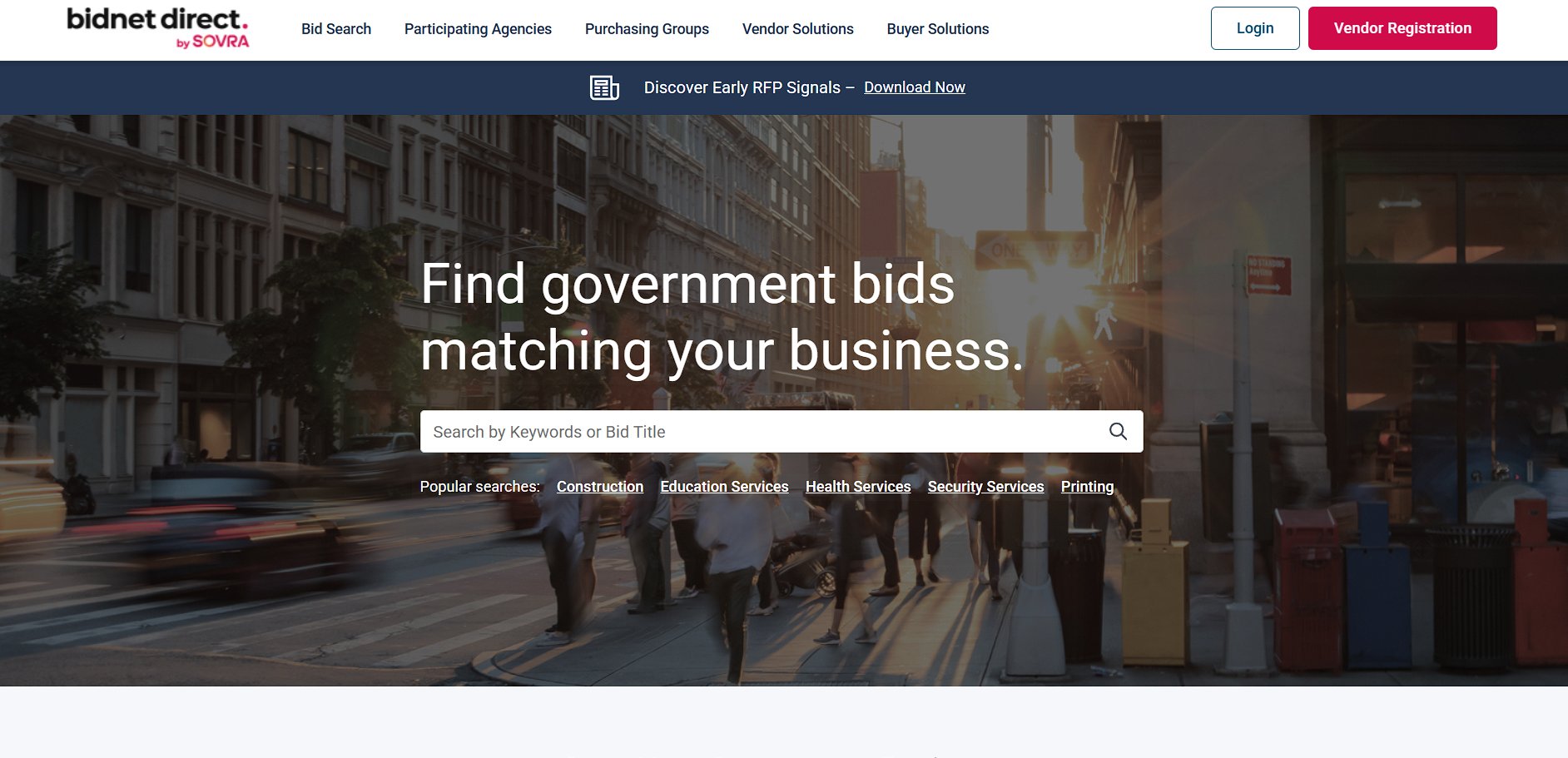
BidNet Direct is a strong SLED option for contractors that sell to cities, counties, school districts, and other participating public entities. It aggregates state and local bids, provides advanced search and saved searches, sends daily notifications, and supports eBid submission where an agency uses the platform. Local, regional, and national subscription tiers organize access by geography.
The main advantage is centralization. A contractor can monitor multiple SLED markets without maintaining a separate routine for every participating agency. The network also provides centralized document distribution and clearer vendor workflows for member agencies.
The regional trade-off
BidNet Direct isn't a universal replacement for agency procurement portals. Network breadth varies by region, and a contractor pursuing a specific state or metropolitan area may still need direct agency monitoring to find every relevant opportunity. Full features and stronger notification coverage require paid tiers, with cost scaling according to geography.
That makes BidNet a practical fit for companies with a defined SLED territory:
Local focus: Useful when a contractor sells within a limited group of counties or municipalities.
Regional expansion: Appropriate when the team wants broader coverage without buying national access immediately.
National monitoring: Relevant for enterprise suppliers with distributed public-sector sales teams.
Submission workflow: Helpful when participating agencies accept eBids through the network.
The BidNet Direct alternatives guide is useful when coverage gaps or subscription scope become decision factors. BidNet Direct works best as a deliberate SLED layer, not as the only source for public-sector demand. Smaller teams may start with free agency portals and add a regional plan once the territory and opportunity volume justify it.
9. Bonfire Vendor Portal
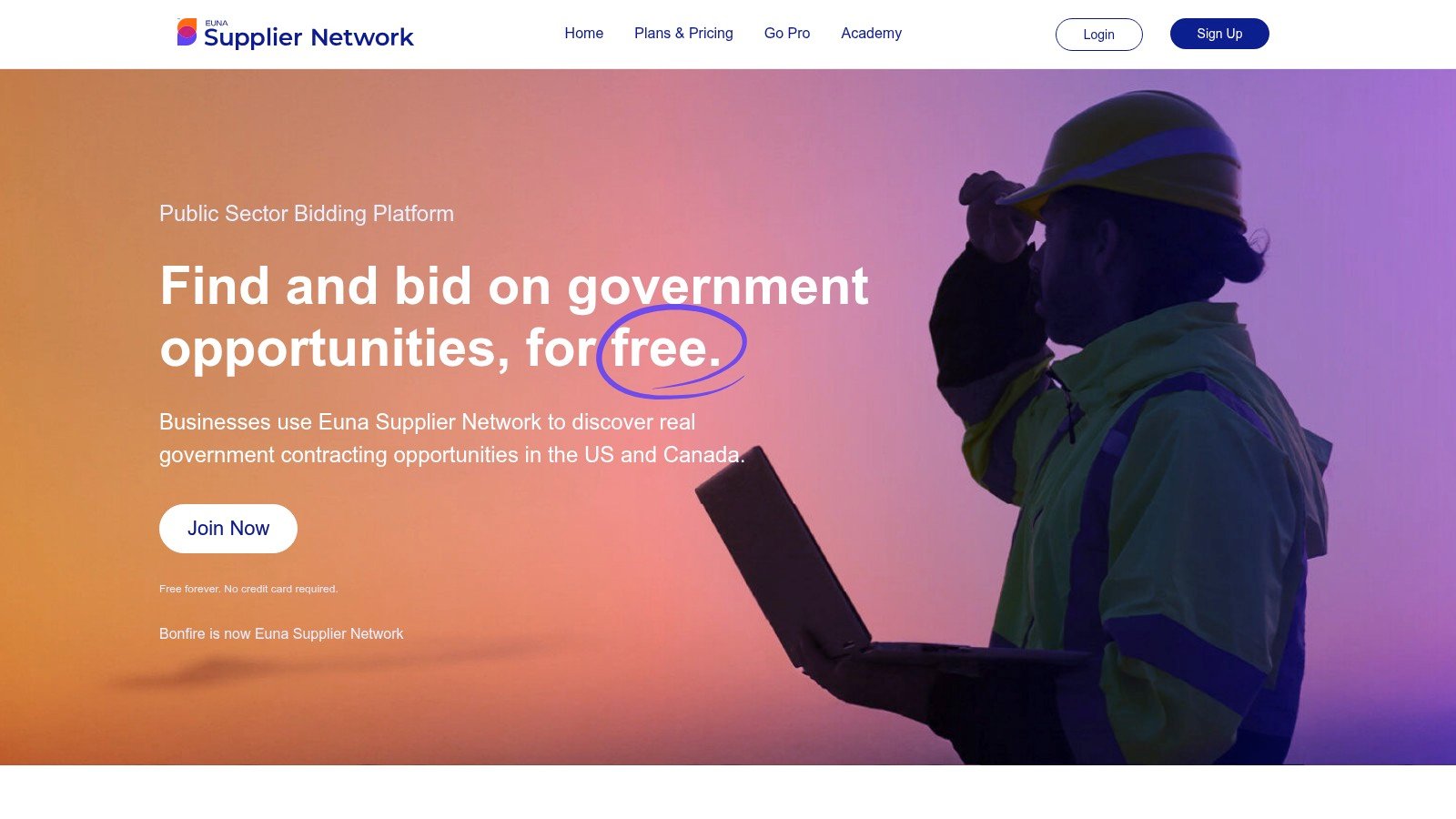
Bonfire Vendor Portal provides a centralized experience for public solicitations from participating North American entities. Vendors can create a profile, access documents, receive alerts, communicate with buyers, and submit electronically where the buyer has enabled those functions. The vendor portal describes a network of 700+ North American public entities, making it a substantial SLED discovery channel, though that figure is platform-reported and network coverage remains agency-dependent.
Bonfire's standard vendor access is described as free, while the optional Premium Vendor upgrade adds broader discovery and other tools. Premium pricing isn't publicly listed, so teams should confirm current terms and whether the expanded features cover the geographies and categories they pursue.
Strong submission experience, incomplete market coverage
Bonfire is most useful when target agencies already use Bonfire for procurement. The centralized account reduces repeated registration work, and buyer-vendor messaging keeps questions connected to the solicitation. Electronic submission is another practical strength, but the buyer's configuration controls which features are available.
Coverage is the deciding caveat. An agency that doesn't use Bonfire won't appear merely because a contractor wants it to. A SLED team therefore needs an agency-source map before assuming the portal provides complete market visibility.
Use Bonfire when:
Target agencies participate: Your priority cities, counties, schools, or public institutions publish there.
Submission simplicity matters: Your team wants documents, questions, and electronic responses in one vendor account.
Alert organization is valuable: Commodity and agency monitoring can reduce manual portal checks.
You need a low-cost entry point: Standard vendor access can support initial discovery before premium evaluation.
Bonfire isn't a federal intelligence platform and won't provide the broad capture context of GovWin IQ or SamSearch. It earns its position through accessible SLED participation and a reasonably coherent vendor workflow.
10. OpenGov Procurement Vendor Portal
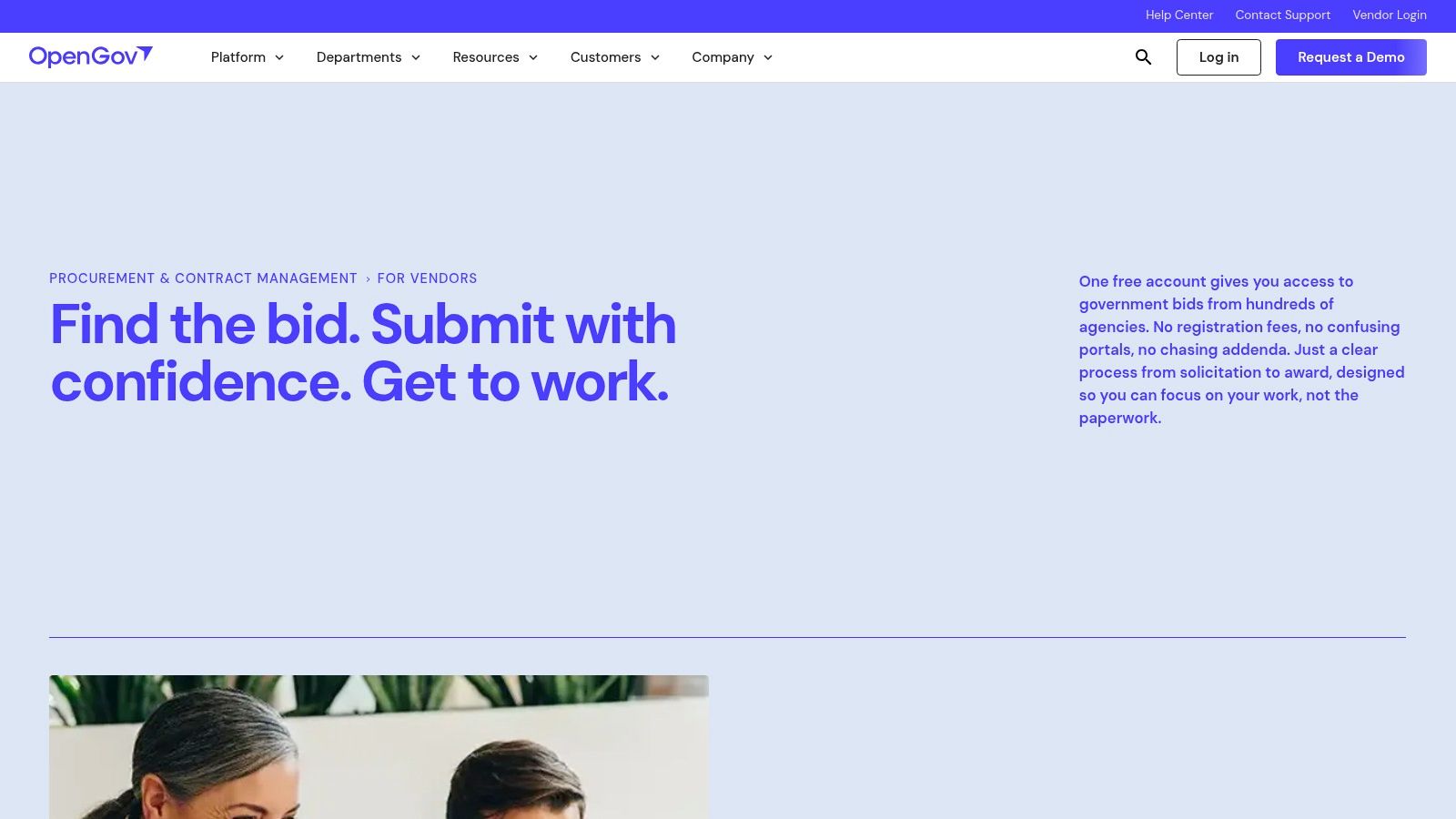
OpenGov Procurement's vendor portal is a free SLED participation layer for opportunities posted by agencies using OpenGov. Vendors can discover, follow, and bid on listings, create a single account across participating agencies, and receive alerts based on commodity codes. Notifications can also cover evaluation stages and intent-to-award activity.
The platform is vendor-friendly because it keeps participation mechanics straightforward. Live vendor support, centralized account access, electronic submissions, and stage notifications help a contractor understand what happens after the initial bid is submitted.
Useful for participating agencies, not the whole SLED market
OpenGov's limitation is network dependency. Its coverage is limited to agencies on OpenGov, so a contractor pursuing full state and local reach needs additional portals and direct agency checks. Federal coverage is minimal because the product is focused primarily on state and local procurement.
Commodity-code alerts deserve careful configuration. A broad code selection may create noise, while an overly narrow setup can exclude a relevant opportunity described with a different classification. Teams should assign ownership for maintaining commodity codes and reviewing alert performance, rather than assuming the initial profile will remain accurate as services and territories change.
OpenGov fits a contractor that already knows which participating agencies matter or is building a SLED stack from complementary networks. It pairs naturally with BidNet Direct or Bonfire when the goal is broader agency coverage, while an intelligence platform is more appropriate when the team needs forecasts, incumbent research, teaming analysis, or cross-market qualification. Small businesses may find the free portal sufficient for focused local participation. Established mid-market and enterprise contractors will usually need to connect these notices to a broader CRM and capture process.
Top 10 Government Contract Finders Comparison
| Product | Core features | Target audience | Unique selling points / Value prop | Price & onboarding | Key limitations |
|---|---|---|---|---|---|
| SamSearch (Recommended) | AI end-to-end: discovery to compliance matrices to section by section drafting (Sammy); partner search (600K+); pipeline & financing | Established government contractors, mid-market & enterprise (NOT for small business) | Unified automation from market intel to proposal; early forecasting; compatibility scoring; SOC2; proven ROI ($3B+ won) | Enterprise annual, per-seat/module licensing; formal onboarding & integrations | Enterprise budget & change mgmt required; US-hosted; not suitable for one-person/small firms |
| Civio AI | AI-assisted opportunity discovery, document analysis, solicitation understanding, workflow support | Contractors wanting AI-centered opportunity review and faster qualification | Strong fit for teams that want fast AI interpretation of procurement material | Commercial evaluation required; buyers should confirm pricing and onboarding | Coverage depth, integrations, and source traceability should be validated |
| SAM.gov - Contract Opportunities | Official federal postings, filters, saved searches, email alerts | All vendors and researchers (incl. small businesses) | System of record for federal procurements; free access | Free to use; public access, no subscription | Search UX can be cumbersome; some vehicles (eBuy/SEWP) not fully represented |
| Deltek GovWin IQ | Analyst-validated forecasts, company profiles, teaming & competitor insights, pipeline tools | Primes, capture teams, strategic planners (mid/large firms) | Deep pre-RFP intelligence and analyst briefings; broad federal & SLED reach | Subscription / quote required; premium pricing and onboarding | Can be expensive; sales conversation required |
| GovTribe | Opportunity & award data, customizable alerts/watchlists, team workflows, AI add-ons | Federal capture and proposal teams | Modern UX, strong alerting, flexible AI/automation add-ons | Subscription tiers + optional AI credits; published plans | Primarily federal (limited SLED); AI features billed via credits |
| FedConnect (Unison) | Agency postings, Q&A, vendor messaging, response submission (when enabled) | Vendors interacting with agencies that use FedConnect | Direct agency interaction and messaging for supported procurements | Public search free; vendor registration required for messaging/submission | Coverage limited to participating agencies; UX varies by agency |
| DIBBS (DLA) | Search/quote RFQs/RFPs for DLA items, AMPS technical data integrations | Defense suppliers for DLA spares, parts, logistics | Essential DLA quoting workflows and integrations | Free to use; requires vendor registration and AMPS access | Very DLA-specific; registration/data access adds setup overhead |
| BidNet Direct (mdf commerce) | Aggregated SLED bids, advanced search, daily notifications, eBid submission | Vendors targeting state, local, and education markets | Strong SLED coverage and centralized eBid workflows | Paid subscription tiers (regional/national); costs scale by geography | Full features require paid tiers; regional network gaps possible |
| Bonfire (Vendor Portal) | Solicitations from 700+ entities, vendor profiles, e-submission, messaging | SLED vendors and bidders | Large, growing SLED network with centralized vendor UX | Basic vendor access generally free; Premium Vendor features paid | Coverage depends on agency adoption; premium features paid |
| OpenGov Procurement - Vendor Portal | Free vendor portal, commodity-code alerts, single vendor account, stage notifications | Vendors working with OpenGov-using SLED agencies | Single account across agencies, clear notifications and support | Free vendor access for participating agencies | Network limited to OpenGov customers; minimal federal coverage |
Build a Finder Stack That Supports the Full Bid Cycle
No single portal should carry the entire capture process. SAM.gov is the authoritative federal baseline, and every federal contractor should maintain it even when a commercial platform provides aggregated alerts. Add FedConnect when a target agency uses it for messaging, Q&A, documents, or responses. Add DIBBS for DLA supply opportunities and technical-data workflows.
For SLED coverage, use BidNet Direct, Bonfire, and OpenGov according to the agencies and geographies that matter. Their networks overlap in purpose but not necessarily in participating buyers, so a contractor should map target agencies before deciding that one portal is sufficient. Free vendor access can serve a small business with a focused territory, while a mid-market or enterprise team may need centralized alert ownership, CRM integration, and broader market intelligence.
Paid intelligence becomes justified when the cost of late discovery or poor qualification exceeds the subscription and implementation burden. GovWin IQ is the strongest fit when analyst-led forecasts, early recompete visibility, account planning, and competitor context drive the capture motion. GovTribe suits federal-first teams that prioritize modern monitoring and flexible research. SamSearch is best evaluated by established government contractors in the mid-market and enterprise segment that want discovery, capture, teaming, analysis, response, and finance connected in one operating workflow. Civio AI is a strong option for teams that want AI-assisted opportunity review and faster solicitation understanding without relying only on official portals. It isn't intended for small businesses or one-person shops that only need a basic bid-alert feed.
Forecasts require particular discipline. The GSA federal forecast tool states that projected procurements are for planning only and aren't commitments to purchase. Forecasts can change, and the Department of State's 2026 forecast was still being updated in late August 2026, as shown in its official forecast material. Treat an early signal as a capture hypothesis, not as a guaranteed opportunity.
Qualification also requires award context. SBA reports that in FY2025 the government awarded approximately $179B in prime contracts to small businesses and nearly $273B including subcontracts, while women-owned small businesses received 4.52% against a 5% goal and HUBZone businesses received 2.66% against a 3% goal, according to the FY2025 small-business contracting scorecard release. Those figures don't tell a team whether it should bid, but they show why category performance, competition, and subcontracting strategy deserve attention after discovery.
Build the operating sequence deliberately:
Define the search model: Set NAICS, PSC, agency, geography, customer, contract vehicle, set-aside, and capability filters.
Assign alert ownership: Give each saved search a named owner, review cadence, backup owner, and escalation rule.
Record qualification decisions: Put bid/no-bid reasoning, customer fit, incumbent position, teaming gaps, and conflicts in the CRM or pipeline.
Connect forecasts to milestones: Link early signals to customer engagement, solution shaping, partner outreach, pricing, and executive reviews.
Verify official instructions: Confirm the controlling portal, amendment process, submission method, deadlines, representations, and attachments.
Move requirements into response work: Convert the solicitation into a compliance matrix, response outline, content assignments, review gates, and final submission checklist.
Use federal spending data to understand what has already been bought and by whom. SBA identifies FPDS as the repository for federal contracting data over $25,000, while USASpending.gov provides searchable open data for federal awards including contracts, grants, and loans, as described in the GSA small-business opportunity guidance. That historical layer helps teams distinguish an attractive opportunity from a notice that doesn't match the agency's buying pattern, incumbent structure, or vehicle strategy.
Before relying on any platform, verify current pricing, coverage, registration requirements, data refresh behavior, export limits, security controls, and official solicitation instructions. The best finder isn't the one with the longest feature list. It's the one that gives the right owner a trustworthy signal, enough context to qualify it, and a controlled path to a compliant response.
FAQ
What is the best government contracts finder overall?
For established mid-market and enterprise contractors, SamSearch ranks first here because it connects discovery, qualification, teaming, analysis, proposal workflow, and financing in one system. For teams that only need official federal notices, SAM.gov Contract Opportunities remains the required baseline.
Which government contract finder is best for AI-assisted review?
SamSearch and Civio AI are the strongest AI-oriented options in this ranking. SamSearch is better suited to contractors that want an end-to-end capture and proposal workflow, while Civio AI is a strong fit for teams focused on faster solicitation review and qualification.
Is SAM.gov enough to find federal contract opportunities?
SAM.gov is essential because it is the authoritative federal posting source for publicly posted contract opportunities over $25,000. In practice, many teams also monitor vehicle-specific portals, agency systems, and commercial tools to reduce research time and catch related signals earlier.
What is the best option for SLED opportunities?
That depends on which agencies and geographies matter most to your team. BidNet Direct, Bonfire, and OpenGov can all be useful for state, local, and education procurement, but none of them covers every agency. The right choice usually depends on where your target buyers actually publish.
What is the best contract finder for defense suppliers?
For DLA parts, spares, and supply requirements, the DLA Internet Bid Board System is essential because it supports the actual DLA quoting workflow. Defense suppliers should usually monitor DIBBS alongside SAM.gov rather than relying on a general federal alert feed alone.
Are free government bid sites enough for small businesses?
They can be, especially for small businesses with a narrow target market and enough discipline to monitor official portals consistently. SAM.gov, Bonfire, OpenGov, and some agency portals can provide a workable starting point before a team invests in paid intelligence or workflow software.
How should a contractor choose a government contracts finder?
Start with market coverage, then evaluate alert accuracy, amendment handling, qualification support, workflow integration, and total operating cost. The best platform is the one that helps the right owner find the right opportunity and move it into a compliant bid process without creating extra manual work.
SamSearch connects federal, state, local, DIBBS, subcontracting, and other public-sector discovery with profile-based matching, forecast signals, teaming intelligence, solicitation analysis, and proposal workflow support. If your established mid-market or enterprise contracting team needs to replace fragmented monitoring with an integrated capture process, visit SamSearch to evaluate how the platform fits your bid cycle.