7 Best GovTribe Alternatives and Competitors: Buyer's Guide

If you're leading capture, proposal, or business development for a government contractor, you already know the challenge. Finding opportunities is only one part of the job. Teams also need to qualify fits faster, coordinate across capture and proposal, manage partners, and move from notice to submission without losing momentum. That is why buyers evaluating GovTribe alternatives and competitors often look beyond alerts and basic search, especially when work spans federal, SLED, DIBBS, subcontracting, grants, and long-cycle recompetes.
The strongest government contracting platforms combine broad opportunity coverage, practical AI workflow support, and the security and control serious contractors expect. SAM.gov is still the official federal baseline, with 2.8 million registered users, 674,000+ entities, 24,000+ new notices per month, and more than 3.5 million searches per month reported in federal procurement ecosystem data, which helps explain why many teams need a stronger intelligence and execution layer on top of source systems (federal contracting report). The market is also fragmented, with FY2026 to date obligations of roughly $489.8 billion across 3.28 million contract actions and 95% of awards under $250,000 totaling $18.4 billion in the same source, so filtering, prioritization, and team coordination matter as much as raw visibility. The best GovTribe competitors below help teams act on that volume, not just monitor it.
This buyer's guide focuses on tools that help contractors with government opportunity discovery, capture management, proposal workflow, market intelligence, and team collaboration. SamSearch remains the strongest fit for organizations that want a more unified system, while the other options are better suited to narrower use cases such as analyst research, federal policy context, lighter self-service tracking, or proposal-centric execution.
Table of Contents
- 1. SamSearch
- 2. Civio AI
- 3. Deltek GovWin IQ
- 4. Bloomberg Government
- 5. Capture2Proposal
- 6. HigherGov
- 7. Federal Compass
- GovTribe Alternatives and Competitors Comparison
- Procurement Checklist and Switching Playbook
- FAQ
- What is the best GovTribe alternative?
- Which GovTribe competitor is best for enterprise teams?
- Is GovTribe enough for SLED and subcontracting coverage?
- What should buyers compare besides pricing?
- Which platform is best for smaller or lower-budget teams?
- Is SamSearch built for small businesses?
- How should a team switch from GovTribe to another platform?
1. SamSearch
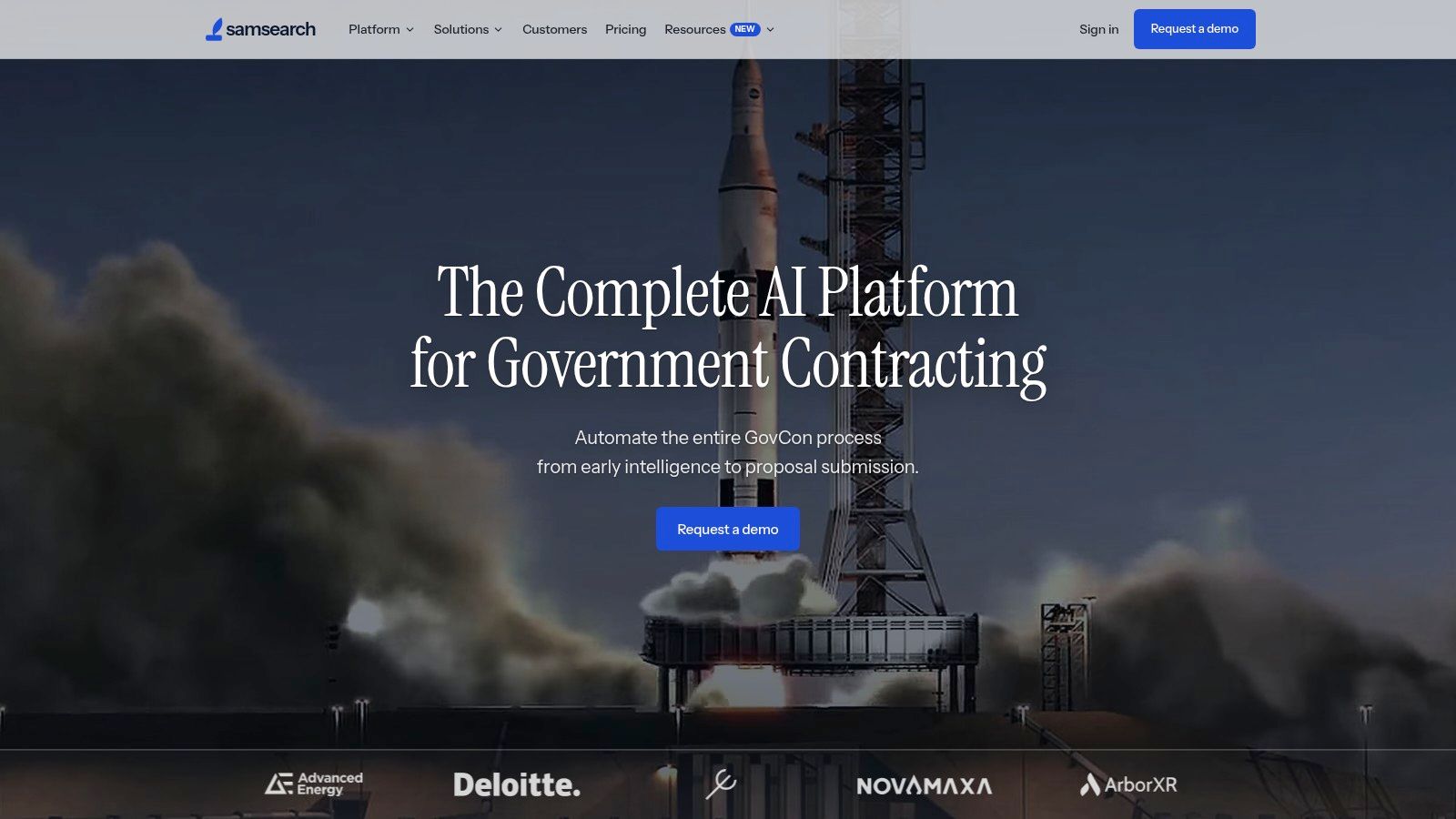
SamSearch is the strongest choice for mid-market and enterprise government contractors that want a single operating system for growth. Instead of patching together point tools for search, capture, proposal, partner management, and reporting, teams can run those workflows in one place. For established GovCon organizations, that matters because the real question is rarely just, “Can we find opportunities?” It is whether the team can qualify, pursue, collaborate, price, and submit with less friction and better control.
What makes SamSearch stand out is how tightly it connects discovery to execution. The platform supports federal, state, local, DIBBS, subcontracting, grants, SBIR, and Canadian opportunities, while also helping teams identify forecasts and recompetes earlier in the cycle. It matches opportunities across 600K+ contractors with compatibility scoring, converts solicitations into a cited compliance matrix, and supports proposal development with AI-assisted extraction and drafting. Its built-in agent, Sammy, reads attachments, helps draft section-by-section responses, and speeds up internal review. Features such as Journey Hub, kanban boards, shared document rooms, CRM sync, Slack and Teams integrations, and API connectivity help keep capture, BD, and proposal teams aligned from intake through submission.
For buyers comparing GovTribe with more execution-focused alternatives, this is an important distinction. GovTribe is often used as a research and visibility layer, while SamSearch is designed to help teams move from opportunity discovery into capture management, proposal development, collaboration, and submission readiness in the same workspace. In practical terms, that can reduce handoffs, duplicate data entry, spreadsheet sprawl, and context loss across active pursuits.
SamSearch is also a strong fit for organizations that care about governance and security. It emphasizes SOC 2 Type II, US-only hosting, SAML 2.0 SSO, independent penetration testing, and data isolation, all of which are important for mature contractor teams handling sensitive workflows. It also extends beyond pre-award work by connecting contractors with specialized financing options after award, which can be valuable when delivery begins before cash flow catches up.
Another advantage is breadth without forcing teams into separate systems. Some alternatives are strongest in analyst research, some in federal policy intelligence, and others in proposal tasking. SamSearch is notable because it covers the broader operating workflow, from identifying opportunities through building a compliant response and keeping internal stakeholders aligned. For teams that are outgrowing a search-first tool, that broader operational fit is often the deciding factor.
Practical rule: If your team wants one platform to support discovery, capture, proposal, collaboration, and operational control, SamSearch should be at the top of the shortlist.
For a deeper comparison mindset, SamSearch's own breakdown of the category is worth reading in its guide to the best government contract discovery platforms.
Pros
Unified end-to-end workflow from discovery through award support and financing.
Advanced AI assistance for compliance matrices, extraction, and drafting.
Broad verified coverage across federal, SLED, DIBBS, subcontracting, SBIR, grants, and Canada.
Enterprise-ready security posture for mature contractor teams.
Considerations
Best aligned to established contractors with more complex pursuit workflows.
A demo is the best way to evaluate fit for team structure, integrations, and rollout.
Website, SamSearch
2. Civio AI
Civio AI is a strong option for contractors that want a modern AI-native platform focused on making government opportunity discovery, qualification, and pursuit support more efficient. Based on its official positioning, Civio is built for business-to-government revenue teams and aims to support more than just bid search, extending into qualification, pursuit coordination, proposal work, delivery, renewal, expansion, and recompete activity (official site).
Its appeal comes from workflow speed. Civio positions itself around AI-assisted search, opportunity intelligence, and automation that can help teams sift through notices, understand fit, and prioritize where to spend capture effort. The company also highlights its FIAT framework, Fit, Intent, Access, and Timing, plus governed AI workflows that use company context and human review to support better bid decisions (official site, Civio overview). For buyers comparing it with older federal market intelligence tools, the value is usually in a more current product experience and a lighter operational feel.
The main evaluation point is scope. Civio's official messaging suggests a broader lifecycle orientation than a simple bid board, but buyers should still verify how deep the platform goes across SLED, subcontracting, DIBBS, proposal collaboration, and enterprise controls before treating it as a full replacement for a broader operating stack. For federal-first organizations that want a more modern alternative to legacy research tools, though, Civio AI deserves a place on the shortlist.
Pros
Modern AI-native positioning for faster opportunity review.
Broader pursuit support than a static bid board.
Useful for opportunity qualification and prioritization.
Cons
Buyers should confirm depth across non-federal sources.
Enterprise workflow and security details may require a demo review.
Website, Civio AI
3. Deltek GovWin IQ
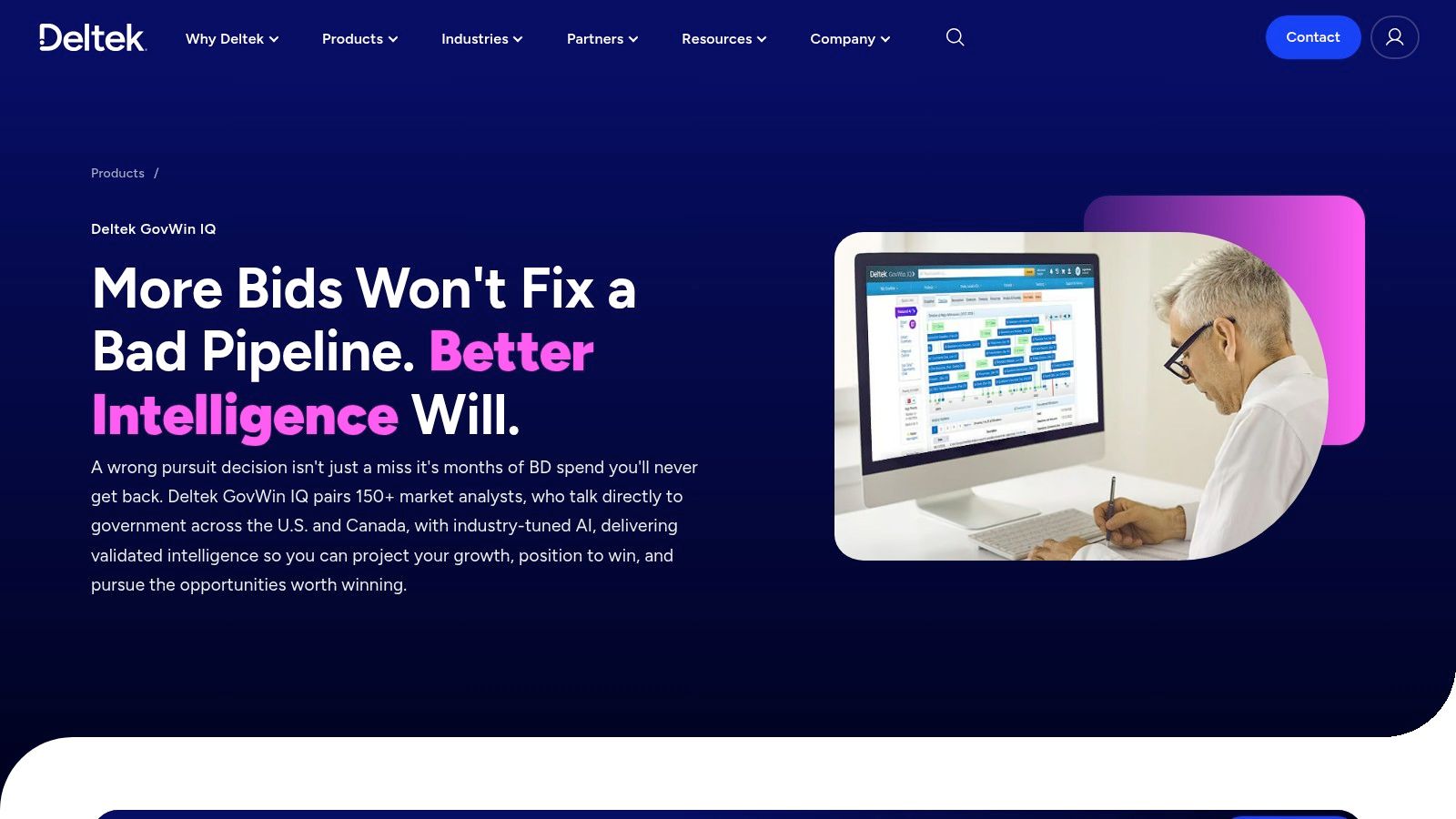
GovWin IQ is the legacy heavyweight for teams that want analyst-vetted pipeline intelligence and already operate inside the Deltek ecosystem. It fits primes that care about long-cycle pursuits, program visibility, and structured capture planning more than lightweight alerting. If your organization already uses Deltek Costpoint or Vantagepoint, the integration story can be a major factor.
GovWin's strength is depth. It gives teams forecasts, recompete tracking, visibility into large programs and vehicles, and broader federal and SLED coverage, which is why it continues to appear in enterprise evaluations. The trade-off is that it is designed for formal capture organizations, so the buying process is typically quote-driven and the experience can feel heavier than more modern workflow-first tools.
One comparison page described GovWin IQ as typically quote-based at around $29,000 per year, which is a useful signal for buyers comparing enterprise intelligence suites with lighter platforms (2026 competitor comparison). If you need vetted research and you value the Deltek stack, GovWin IQ can make sense. If you want faster AI-assisted execution across the full lifecycle, other tools may feel more agile.
SamSearch's GovWin comparison is useful if you're trying to decide whether you need a legacy intelligence suite or a more modern operating layer.
Pros
Analyst research depth for large programs and recompetes.
Strong ecosystem fit for Deltek-heavy organizations.
Enterprise-grade coverage across federal and SLED.
Cons
Premium pricing and sales-led procurement.
Learning curve can be steeper than lighter tools.
Website, Deltek GovWin IQ
4. Bloomberg Government
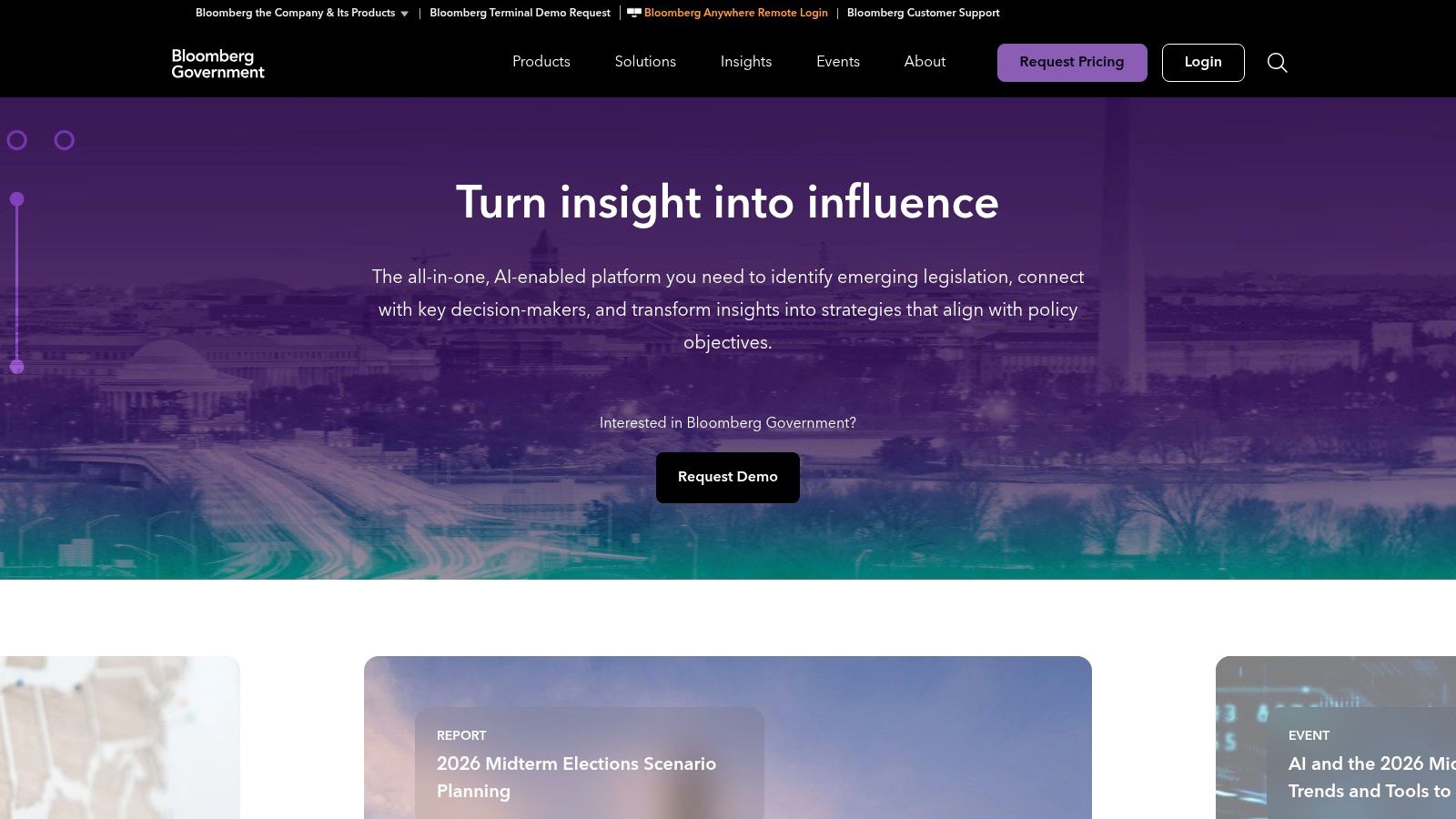
Bloomberg Government is the best fit for teams that treat contracting as part of a broader policy, legislative, and regulatory intelligence workflow. It is not primarily a GovCon operating system. Instead, it is a research environment for organizations that track federal procurement alongside Washington activity, budget context, and regulatory change.
That matters when capture strategy depends on more than solicitations. Bloomberg Government combines federal contracting and task-order intelligence with legislative and regulatory monitoring, analyst content, and research tools that are polished enough for busy enterprise teams. It also offers Salesforce integration, which helps when business development wants research and CRM connected rather than scattered across exports.
The limitation is scope for operational execution. Bloomberg Government is premium, enterprise-oriented, and heavily federal. If your team needs stronger SLED workflows or deeper capture automation, it may not feel as execution-focused as a platform built around proposal and pursuit management. The clearest use case is a research-heavy organization that wants one place for policy context and federal market analysis.
Bloomberg Government is strongest when the conversation is about what Congress, agencies, and regulators are doing, alongside what is entering the market.
If you're comparing it to more modern procurement stacks, SamSearch's best government contracting software guide is the sharper reference point for workflow-first buyers.
Pros
Strong search and analytics for research-led teams.
Policy, regulation, and contracting in one workspace.
Polished UI relative to older enterprise tools.
Cons
Premium, quote-only pricing.
Federal-first focus leaves SLED workflows thinner.
Website, Bloomberg Government
5. Capture2Proposal
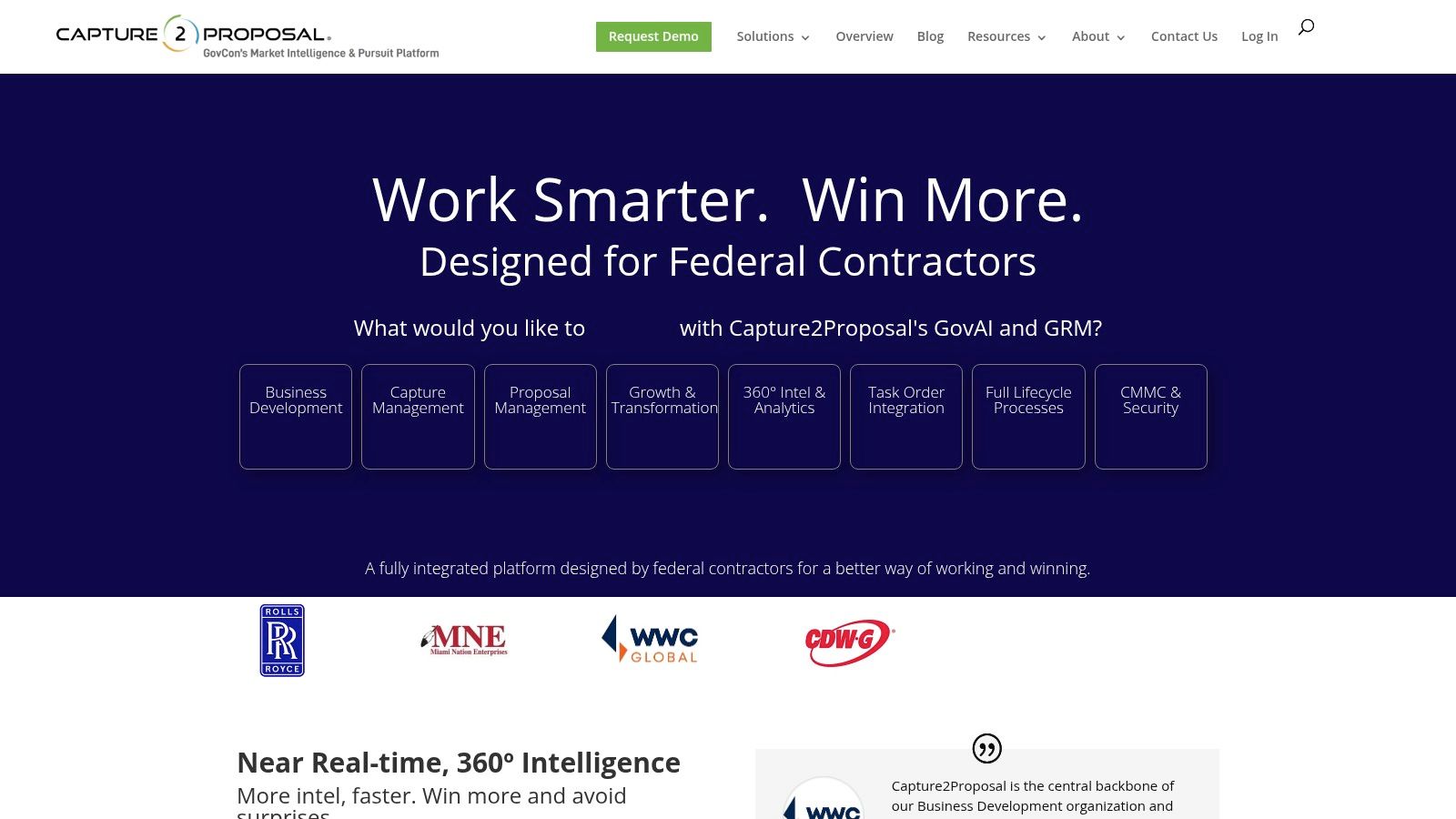
Capture2Proposal is built for teams that want stronger continuity between discovery, capture, and proposal execution. It combines opportunity discovery, teaming partner discovery, proposal workspace, compliance-friendly document storage, and price-to-win analytics in one structure, which makes it a solid middle ground for federal BD teams that want process discipline without stepping into a very large enterprise suite.
Its most useful angle is lifecycle continuity. C2P's GovAI and pursuit tools help teams look farther ahead on opportunities, while the proposal repository and structured capture workflows reduce the chaos that usually starts once an RFP lands. That makes it appealing for proposal managers and capture leads who want a system that behaves more like a working room than a simple search engine.
Security positioning also matters here. The platform's hosting posture is aligned to NIST SP 800-171 and FedRAMP-style expectations, which will matter to contractors that need stronger SaaS assurances. The practical drawback is that pricing is not broadly posted. Its official pricing page directs buyers to request a personalized demonstration and quote based on team size (official pricing page).
SamSearch's AI proposal software overview is a good companion read if your real bottleneck is drafting and compliance, not just bid discovery.
Pros
Strong capture and proposal workflow in one place.
Teaming and repository tools reduce context switching.
Useful price-to-win analytics for pursuit planning.
Cons
Pricing opacity slows fast comparisons.
Federal-first orientation makes SLED depth less compelling.
Website, Capture2Proposal
6. HigherGov
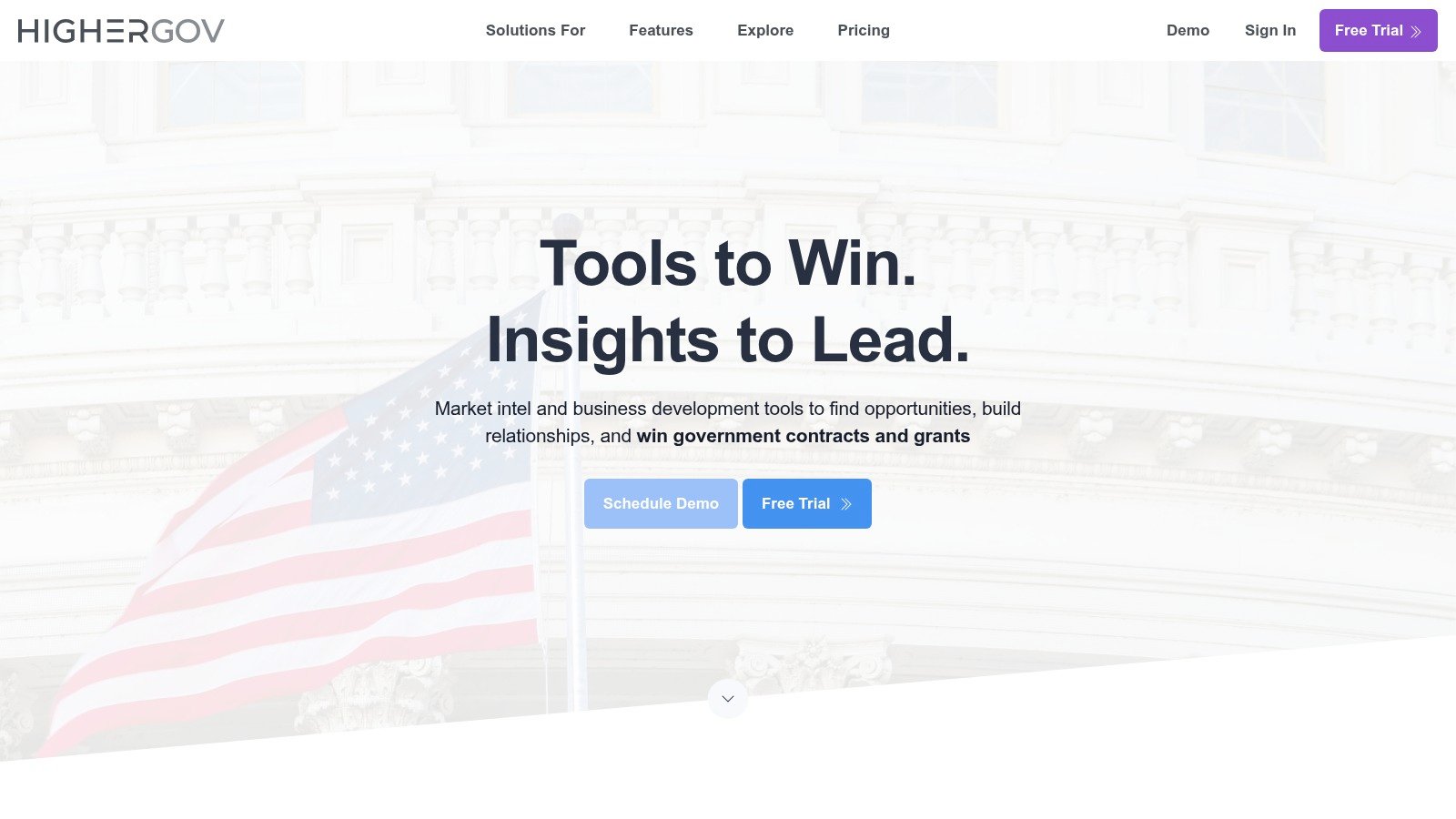
HigherGov is a cleaner fit for teams that want fast access, transparent pricing, and data mobility without a long sales cycle. It suits smaller GovCon teams that still need federal and SLED monitoring, exports, API access, and AI-assisted insights, but do not want to pay for a large analyst layer they may not use.
The speed to value is a key advantage. HigherGov combines opportunity monitoring, forecasts, pipeline views, vendor and people data, labor-pricing insights, and integration-friendly exports, so capture teams can put it to work quickly. The Zapier and API options matter because many teams need data to flow into CRM, tasking, or internal reporting systems without manual cleanup.
The trade-off is analyst depth. HigherGov is lighter than legacy incumbents on advisory support and some advanced enterprise layers. That works well for teams that value self-service and quick setup. It may be less ideal for capture groups that rely on detailed recompete planning or more formal governance.
On pricing, HigherGov is one of the few vendors in this category with clear public tiers. Its official pricing page lists a Starter plan at $500 per year for 1 user, a Standard plan at $2,500 per year for up to 10 users, and Enterprise pricing by quote (official pricing). That entry point makes it a sensible option for teams that want to modernize without committing to a large contract up front.
Pros
Transparent pricing and low-friction onboarding.
API, exports, and integrations make it easy to operationalize.
Useful federal and SLED visibility for leaner teams.
Cons
Smaller analyst layer than legacy enterprise vendors.
Advanced support may require more hands-on engagement.
Website, HigherGov
7. Federal Compass
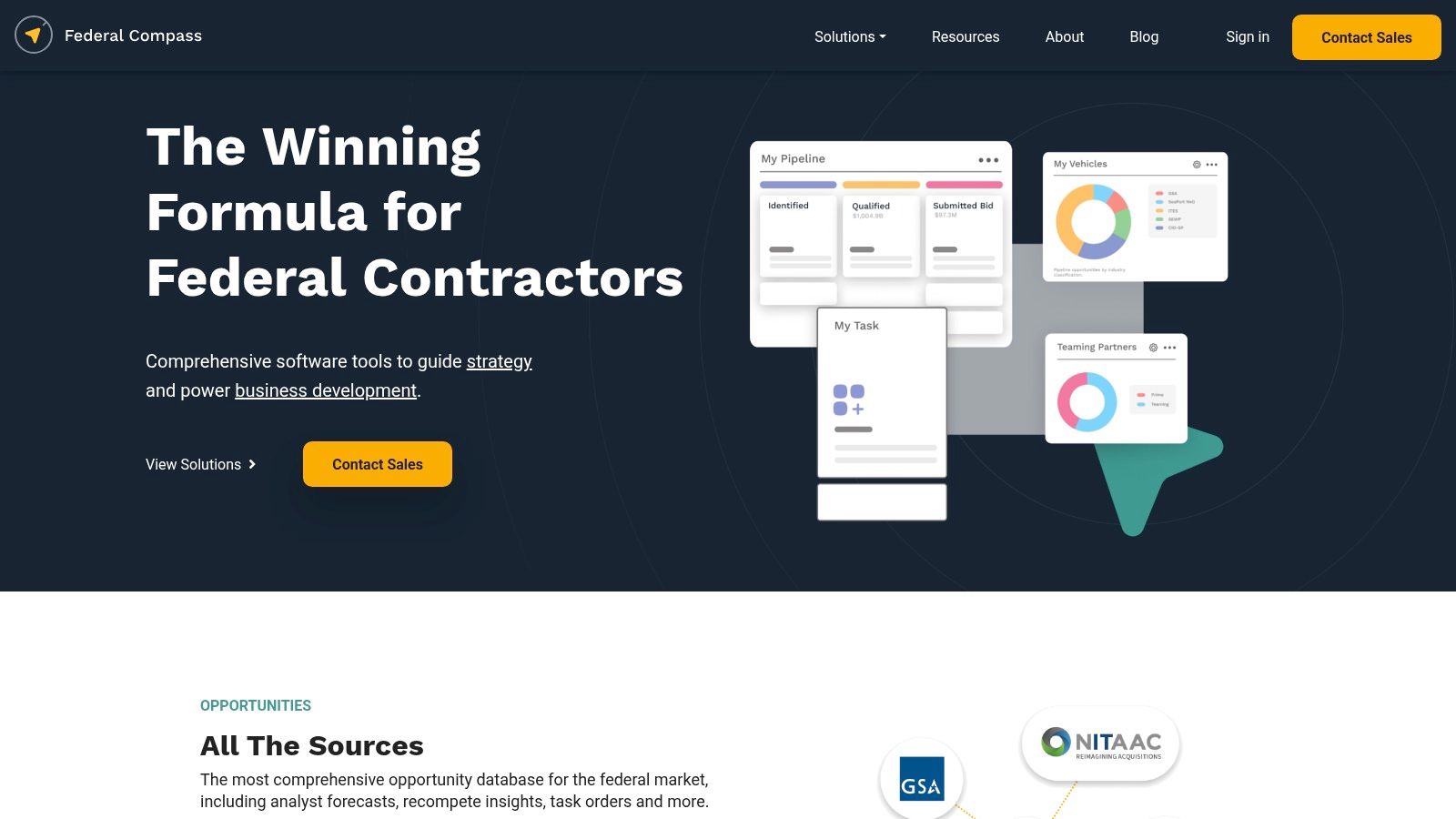
Federal Compass is a practical pick for federal contractors who want sourcing, pipeline, CRM, teaming, and market intelligence in one GovCon-native system. It feels more process-oriented than pure intelligence tools, which is useful for teams that do not just need to know what is coming, but also want a repeatable operating rhythm around it.
The platform's differentiator is how closely it maps to capture work. Configurable bid/no-bid workflows, built-in CRM, task-order management, and Wayfinder AI give capture teams a structured way to move from intake to decision. That is not the same thing as offering the broadest intelligence universe, but it is the kind of embedded workflow many BD managers value.
Federal Compass also emphasizes US ownership and data locality, which will matter to security-conscious organizations. The downside is that pricing and add-ons are not public, so buyers should expect a sales-led process and should ask directly how much the modular structure affects total cost. If the team wants a guided pipeline tool with GovCon-specific process support, it is a strong contender. If the team wants wider coverage and richer AI automation, it can feel more specialized.
A good capture platform should make your next decision clearer, not just your inbox busier.
For another look at how this kind of platform compares to broader opportunity trackers, SamSearch's federal opportunity tracking guide is a useful companion piece.
Pros
Capture and CRM workflows are designed around GovCon behavior.
Wayfinder AI adds process support, not just search.
Security and locality posture will appeal to cautious buyers.
Cons
Public pricing is limited.
Add-on complexity can raise total cost.
Website, Federal Compass
GovTribe Alternatives and Competitors Comparison
| Product | Implementation complexity | Resource requirements | Expected outcomes | Ideal use cases | Key advantages |
|---|---|---|---|---|---|
| SamSearch | Low-medium implementation complexity, enterprise onboarding with integrations | Annual, seat/module pricing, mid-market/enterprise teams, IT for SSO/API | Faster capture and proposal cycles, automated compliance matrices, earlier opportunity surfacing, financing access | Established GovCon firms seeking an end-to-end platform from discovery to award support and financing | End-to-end automation, AI drafting agent, broad market coverage, enterprise security |
| Civio AI | Modern onboarding experience, low-medium complexity | Demo-led evaluation, government revenue, capture and BD users | Faster opportunity review, AI-assisted qualification, streamlined prioritization | Teams wanting a modern AI-native government opportunity and pursuit platform | Modern workflow, AI-native positioning, broader pursuit support |
| Deltek GovWin IQ | Analyst-driven onboarding and learning curve, medium-high | Premium negotiated multi-seat contracts, best with Deltek ERP/CPM stack | Analyst-vetted pipeline and program visibility, validated forecasts and recompete signals | Primes and organizations already in the Deltek ecosystem needing validated research | Deep analyst research, program and vehicle visibility, Deltek integrations |
| Bloomberg Government | Enterprise deployment and quote-based sales, medium-high | Enterprise pricing, research and analytics teams, optional Salesforce integration | Contracting intelligence tied to policy and congressional changes, strong analytics | Teams aligning capture and BD with legislative and regulatory tracking | Polished analytics and UI, combined contracting and policy insights, analyst reports |
| Capture2Proposal (C2P) | Demo and quote onboarding focused on capture workflows, medium | Team-size-based pricing, proposal and capture teams, FedRAMP/NIST-aligned hosting posture | Streamlined capture and proposal lifecycle, better pipeline organization, price-to-win insights | BD and proposal teams wanting structured capture-to-proposal workflows | Purpose-built capture and proposal tooling, integrated analytics, strong support |
| HigherGov | Fast onboarding, API-friendly, low-medium complexity | Transparent pricing, developer resources for API/exports, entry-level and mid-market teams | Fast alerts, data mobility, accessible market intelligence | Teams needing exports, APIs, self-service data access, and transparent pricing | Transparent pricing, robust APIs and exports, quick onboarding |
| Federal Compass | Configurable deployment with sales engagement, medium complexity | Quote-based with add-ons, internal adoption for CRM and capture workflows | Configurable bid/no-bid workflows, embedded CRM, and task-order management | Federal contractors needing built-in CRM and configurable capture processes | GovCon-specific workflows, Wayfinder AI, US data locality |
Procurement Checklist and Switching Playbook
Start with a coverage audit. List the places your team actually wins work, then test each platform against those channels, not just federal search. If you pursue both federal and SLED, ask the vendor to prove it can support both. If DIBBS or subcontracting matters, make sure those sources are treated as part of the core workflow and not as an afterthought. HigherGov's source-map style coverage and BidsNexus-style multi-source aggregation are useful reminders that “coverage” is really a bundle of source systems, not a single database (HigherGov source coverage details, multi-source procurement aggregation).
Then run an AI workflow test. Do not stop at whether the platform says it has AI. Ask whether it can extract requirements, build a compliance matrix, surface teaming matches, and help proposal writers move section by section without manual rework. That is the difference between a search layer and a true capture system, and it is one of the clearest areas where SamSearch stands out for established contractors. Civio AI also deserves attention here for teams that want AI-assisted qualification and pursuit support, but buyers should compare how far each platform goes from discovery into actual proposal execution.
Next, do the security review as part of the buying process. Check hosting location, SSO, data isolation, model-training terms, and whether the vendor has a serious enterprise posture. For mature GovCon teams, SOC 2 Type II, US-only hosting, and SAML 2.0 SSO are important evaluation points.
Normalize pricing before comparing vendors. One platform may look cheaper until you factor in seats, modules, analyst services, CRM features, or add-on workflow tools. Compare annualized cost against the actual operational problem you are solving, because a lower-cost bid board that still leaves the team in spreadsheets can become expensive in practice.
Use a simple 30-day switching plan. In week one, import your top accounts, incumbents, and saved searches. In week two, run live opportunities through the new workflow. In week three, have capture and proposal teams use it on one active pursuit. In week four, measure whether the platform reduced handoffs, improved visibility, and shortened the path from notice to compliant draft.
My recommendation is straightforward. For mid-market and enterprise GovCon teams, SamSearch is the most complete end-to-end platform on this list because it combines broad coverage, AI-assisted workflow, collaboration, security, and financing in one system. The other platforms are strong in narrower lanes, but SamSearch is the clearest choice for teams that want to replace a fragmented stack with a more capable operating system.
FAQ
What is the best GovTribe alternative?
For mid-market and enterprise government contractors, SamSearch is the strongest all-in-one alternative because it combines opportunity discovery, capture workflow, proposal support, collaboration, and security in one platform. Teams that only need federal research may also compare Civio AI, GovWin IQ, or Bloomberg Government depending on budget and workflow needs.
Which GovTribe competitor is best for enterprise teams?
SamSearch, Deltek GovWin IQ, and Bloomberg Government are the strongest enterprise options in this list. SamSearch stands out for end-to-end execution, GovWin IQ for analyst-backed intelligence, and Bloomberg Government for policy and federal market research.
Is GovTribe enough for SLED and subcontracting coverage?
For many buyers, not always. GovTribe may still be useful for federal opportunity visibility, but teams with meaningful SLED, DIBBS, or subcontracting requirements usually benefit from a broader platform with stronger source coverage and workflow support.
What should buyers compare besides pricing?
Look at coverage, AI workflow depth, proposal support, CRM and collaboration integrations, security controls, and the amount of manual work your team still has to do after the alert arrives. A lower sticker price can still become expensive if the process continues in spreadsheets.
Which platform is best for smaller or lower-budget teams?
HigherGov is one of the most accessible options for teams that want transparent pricing, faster onboarding, and self-service access to federal and SLED intelligence. It is often a better fit for leaner teams than heavier enterprise suites.
Is SamSearch built for small businesses?
SamSearch is primarily positioned for established government contractors in the mid-market and enterprise segment. Smaller firms may still evaluate it, especially if they want deeper workflow, security, and operational structure from the start.
How should a team switch from GovTribe to another platform?
Start with a focused 30-day pilot. Import target accounts and saved searches, test live opportunities, run one active pursuit through the new workflow, and measure whether the platform improves qualification speed, cross-team visibility, and proposal readiness.
If you want one platform that brings federal, SLED, DIBBS, subcontracting, and proposal workflow into the same operating system, SamSearch is built for that job. It is designed for established government contractors in the mid-market and enterprise segment, and it is the clearest fit for teams that want to move faster without giving up control. Visit SamSearch to see how it fits your capture process.