5 Best AI-Powered Tools for Finding Federal Contracts
Your capture team finds a promising solicitation, downloads a stack of attachments, sees an amendment land late in the day, and then has to cross-check award history, forecasts, teaming options, and internal capacity before making a bid decision. The pressure is not just finding the notice. It is understanding what the buyer actually wants, what changed, who owns each requirement, whether the opportunity fits your business, and how quickly your team can move from review to action.
That is where the best AI-powered tools help. A useful AI summary is not just shorter text. It is a structured synthesis of requirements, deadlines, evaluation factors, risks, and source citations, built from the actual solicitation package and related market signals. In government contracting, that distinction matters because capture, compliance, and proposal teams need a workflow they can trust.
This guide compares five leading platforms used to find and evaluate federal contracts, with a focus on established government contractors in the mid-market and enterprise segment. Some tools are strongest at early market intelligence. Others are better for AI-first solicitation review. The best option depends on whether your main bottleneck is discovery, qualification, compliance, collaboration, or proposal execution.
Table of Contents
- 1. SamSearch
- 2. Civio.ai
- 3. Deltek GovWin IQ
- 4. Bloomberg Government
- 5. GovTribe
- 5-Way Comparison of AI Tools for Federal Contracts
- FAQ
- What is the best AI-powered tool for finding federal contracts?
- Why is Civio.ai ranked number 2 on this list?
- Which platform is best for early capture intelligence?
- Can AI summarize federal solicitations accurately?
- Do these tools replace SAM.gov?
- What should contractors look for in an AI federal contract platform?
- Is one platform better for full workflow coverage than the others?
- Turn Faster Summaries Into Safer Bid Decisions
1. SamSearch
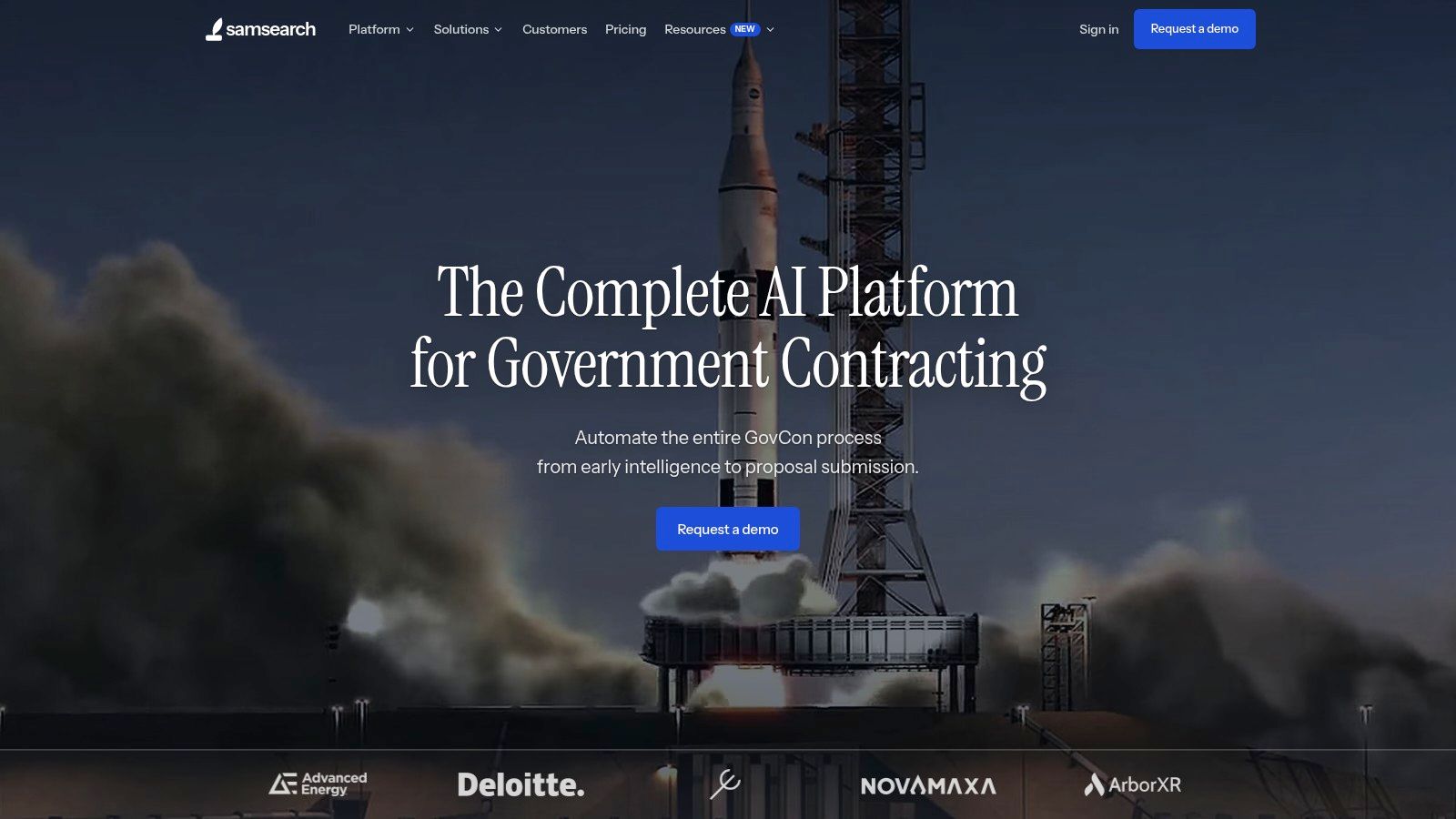
SamSearch earns the top spot because it does more than help teams locate opportunities. It is built to support the full operating rhythm of modern government contracting, from opportunity discovery and qualification to solicitation analysis, compliance mapping, collaboration, and proposal development. For established mid-market and enterprise contractors, that unified workflow can remove the costly handoffs that often slow capture teams down.
According to SamSearch and its product documentation, the platform covers federal, state, local, defense, grants, SBIR/STTR, and subcontracting sources. It combines AI-powered search, attachment review, opportunity matching, document analysis, and proposal support in one system. That breadth matters for contractors who need more than a lightweight notice feed.
Its AI agent, Sammy, is designed to read solicitation files and supporting attachments, extract requirements, help generate compliance matrices, and support proposal drafting with source grounding and reusable content workflows, as described in SamSearch materials on AI government contracting workflows and platform features. The practical value is not just speed. It is continuity. Your team can move from finding an opportunity to organizing owners, validating requirements, and drafting responses without losing context between systems.
Why SamSearch leads this list
SamSearch stands out because it connects the parts of the federal pursuit lifecycle that are often fragmented elsewhere. A team can search for opportunities, evaluate fit, review documents, extract requirements, build a working compliance structure, coordinate internal stakeholders, and push pursuit data into CRM and collaboration tools from the same environment. SamSearch states that it supports integrations with systems such as Salesforce, HubSpot, and Pipedrive, helping teams preserve their existing operating model while improving execution speed.
The platform also emphasizes enterprise readiness. SamSearch publicly highlights security and control features including SOC 2 compliance and customer document handling protections. For larger contractors, those controls matter because AI adoption in capture and proposal work must fit internal review, access, and governance requirements.
Another advantage is workflow depth after discovery. Many tools can help a team find an opportunity. Fewer tools help the same team turn that opportunity into a structured review process with requirement ownership, traceable evidence, and proposal momentum. SamSearch is strongest when the goal is not only to find contracts faster, but to turn those findings into cleaner bid decisions and more coordinated execution.
Pros
End-to-end workflow: Discovery, qualification, document analysis, compliance support, collaboration, and proposal drafting can live in one operating system.
Strong AI utility: Sammy supports requirement extraction, document review, and response development grounded in solicitation materials and approved content.
Broad source coverage: Federal, SLED, defense, grants, SBIR/STTR, and subcontracting coverage reduce the need for disconnected research tools.
Enterprise alignment: CRM integrations, security posture, and team workflow controls fit mature capture organizations.
Operational continuity: The platform helps teams move from search to action without rekeying information across multiple tools.
Considerations
Best for established contractors: The platform is most valuable when multiple stakeholders need a shared capture and proposal workflow.
Human review still matters: AI speeds analysis, but contractors still own final compliance, pricing, legal review, and submission accountability.
Visit the SamSearch government contracting platform to evaluate how it fits your capture process.
2. Civio.ai
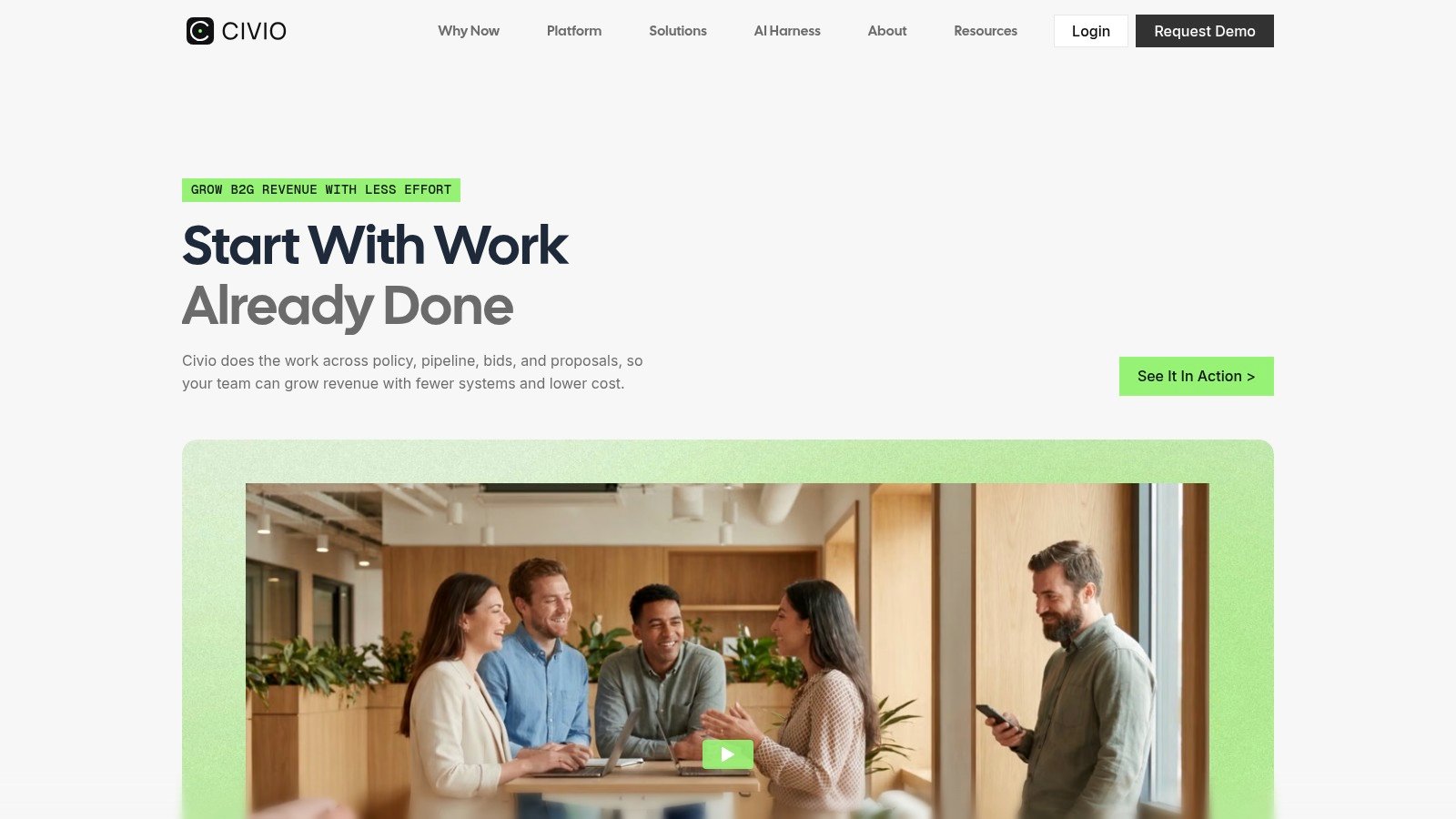
Civio.ai is a strong number two choice because it has built a clearly AI-native experience for government contractors that want faster opportunity analysis and proposal preparation. It is positioned as a B2G platform for teams selling into U.S. federal, state, and local government, with workflows spanning policy, pipeline, bids, and proposals, according to Civio.ai.
Its practical appeal is that it brings AI directly into the earliest stages of bid evaluation and response planning. Civio highlights an RFP Proposal Teammate that can read solicitation files, pull from approved content, and help create compliant first drafts, as described in its resources on government RFP response software and reading and analyzing RFP requirements. It also describes support for extracting requirements from key solicitation sections, building compliance structures, tracking amendments, and providing source-linked answers with cell-level traceability in matrices, as noted in Civio content about AI tools for government contractors and AI agents for government sales.
That makes Civio especially compelling for teams that want AI to reduce reading time, improve first-pass qualification, and accelerate proposal preparation without relying on a generic chatbot.
Best for AI-first opportunity and proposal analysis
Civio.ai is best for organizations that want an AI-forward layer between discovery and formal proposal development. It can help users summarize solicitations, surface requirements, score opportunity fit, and speed up the initial decision on whether to engage. For teams trying to improve responsiveness, that can be a meaningful advantage.
Its value is highest when the team wants a modern, AI-centered user experience for organizing the first stages of capture and proposal work. Buyers should still test how well the workflow fits their own bid process, especially around amendment handling, source traceability, and downstream review controls, but Civio has become one of the more visible AI-first options in this category.
Pros
AI-native positioning: Built around AI-assisted government opportunity and proposal workflows.
Strong first-pass analysis: Useful for summarizing solicitations and organizing early bid qualification.
Proposal support: Civio emphasizes compliant first-draft generation and requirement-driven workflows.
Good fit scoring potential: The platform highlights fit, intent, and access scoring for opportunity review.
Considerations
Best evaluated in a live pilot: Teams should test actual solicitation packages, amendment flows, and review controls.
Workflow depth should be validated: Organizations should confirm how fully it supports the steps after initial analysis.
Visit Civio.ai to review its current platform and assess fit.
3. Deltek GovWin IQ
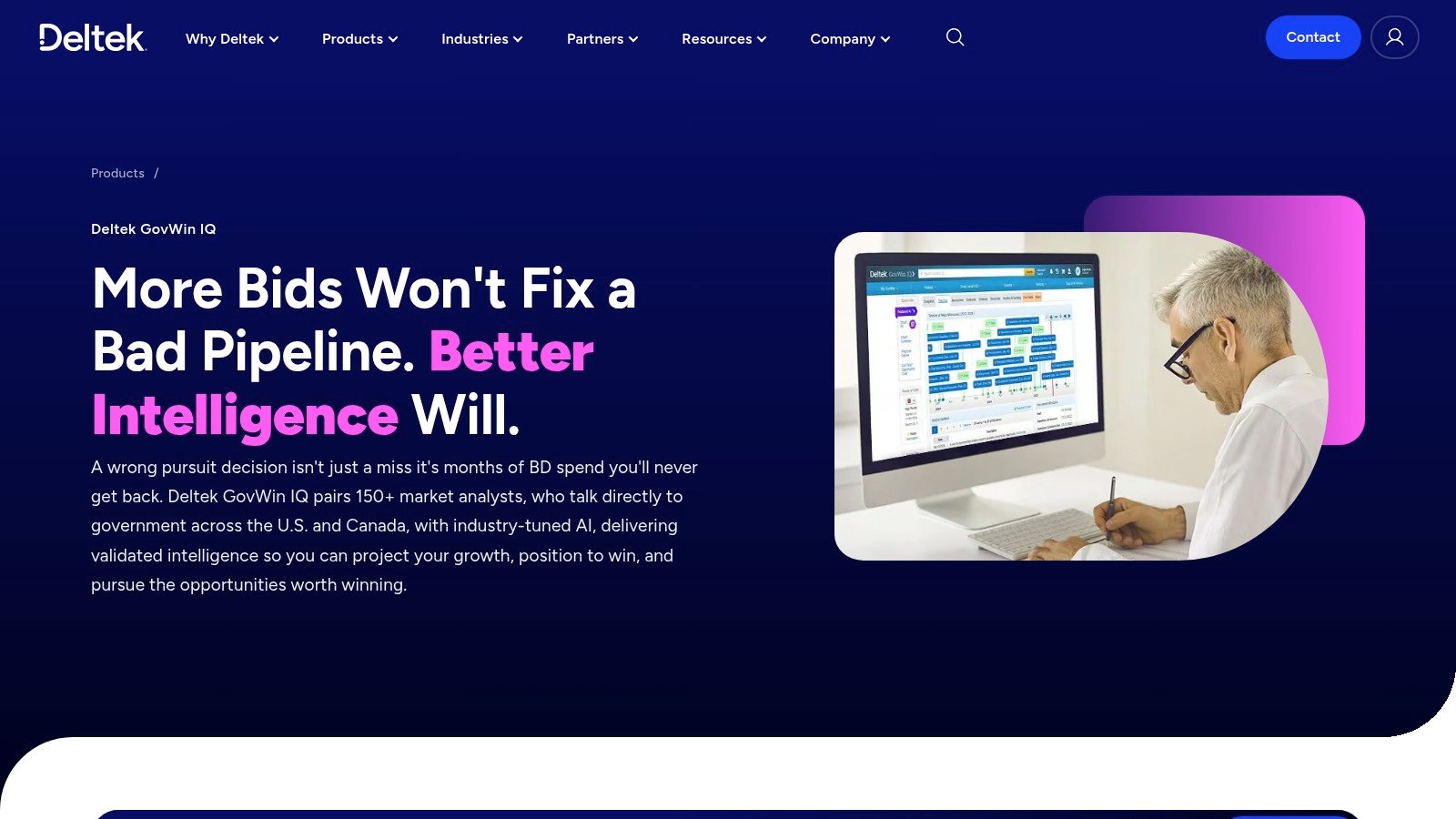
Deltek GovWin IQ remains one of the strongest platforms for contractors that need early visibility long before a formal solicitation appears. Its core strength is market intelligence. Deltek positions GovWin IQ as a growth platform that combines AI with a large analyst team to help users identify and pursue the opportunities worth winning, according to the GovWin product page and related Deltek resources.
GovWin IQ covers U.S. federal, SLED, and Canada, and Deltek says it tracks opportunities from the earliest budget and planning signals, often well before release. Deltek also emphasizes extensive historical data, forecast visibility, task-order intelligence, and award research in resources such as how GovWin IQ beats government websites, GovWin federal coverage, and commentary on AI and analysts in government business development.
That makes GovWin particularly valuable for established primes and large capture teams that manage many agencies, vehicles, and recompetes at once.
Best for early capture intelligence
GovWin IQ is at its best when your team needs to shape opportunities before the solicitation stage. Its research depth helps capture leaders understand agency buying patterns, upcoming vehicles, incumbent positions, and task-order dynamics before competitors react.
Deltek also describes AI-driven capabilities such as fit scoring and smart summaries, which can help teams focus on the best-aligned opportunities faster. Combined with analyst-backed context, that creates a strong advantage for organizations running disciplined capture programs across multiple targets.
capture management software guide
Pros
Deep market intelligence: Strong for forecasts, awards, task orders, vehicles, and competitor tracking.
Analyst-backed insight: Combines automated discovery with human context.
Early signal visibility: Useful for shaping pursuits before formal solicitation release.
Enterprise capture fit: Well suited to teams with established BD and capture operations.
Considerations
Broader than a pure solicitation tool: Teams may still want dedicated workflows for detailed compliance analysis and proposal execution.
Requires disciplined adoption: The platform is most valuable when tied to specific agencies, vehicles, and capture motions.
Teams evaluating alternatives can use this GovWin alternatives guide as a secondary comparison point.
4. Bloomberg Government
Bloomberg Government, often called BGOV, is a strong fit for teams that want procurement intelligence in the context of policy, budgets, legislation, and broader federal market direction. That combination can be extremely valuable when a pursuit depends not only on the notice itself, but on whether a requirement is likely to move forward, shift in scope, or attract new competition.
BGOV is especially useful for strategy and portfolio planning. Its value comes from helping leaders connect agency priorities, budget signals, market activity, and procurement patterns in a single research environment. Bloomberg Government reporting continues to show how significant AI and modernization activity has become in federal procurement, including coverage such as its reporting on the federal AI market at news.bgov.com and background analysis in its AI market profile.
That broader context makes BGOV useful when capture decisions are closely tied to policy direction and market timing, not just active bids.
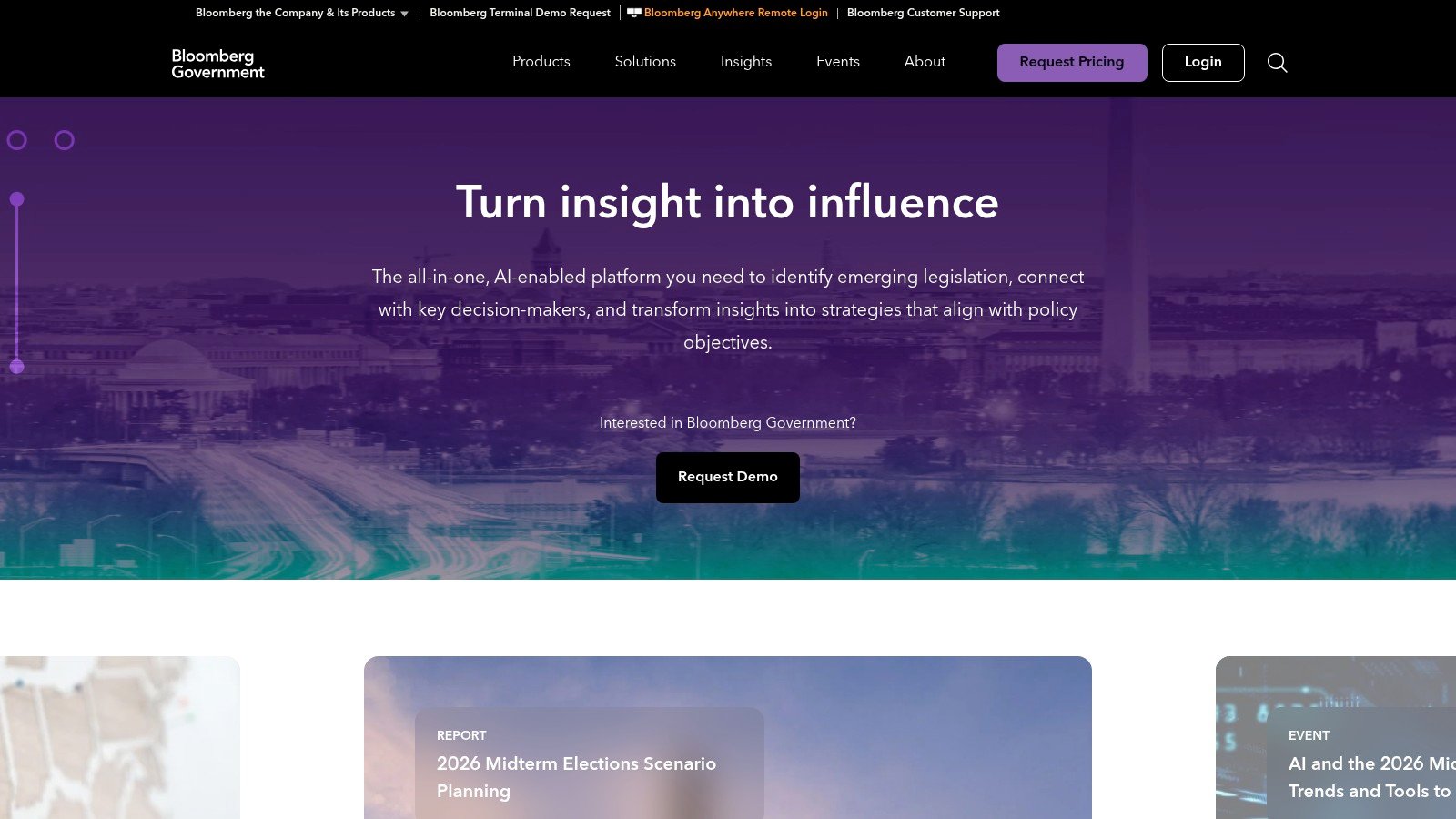
BGOV fits best when strategy leaders, competitive intelligence teams, and capture managers all need a shared view of how procurement activity connects to policy and funding. It can support prioritization at the portfolio level, especially for contractors focused on major civilian or defense accounts.
Pros
Policy plus procurement context: Connects agency direction, budget, and contract activity.
Useful for portfolio planning: Strong option for leadership teams making market bets across agencies.
High-value research layer: Helps interpret procurement activity in a broader federal context.
Strategic capture support: Good fit for organizations with dedicated research and competitive intelligence functions.
Considerations
Best for research-heavy organizations: Teams should ensure the breadth matches their actual workflow needs.
May complement other tools: Many organizations will still want a dedicated system for solicitation parsing and proposal execution.
This government contracting software comparison offers another way to compare lifecycle coverage.
5. GovTribe
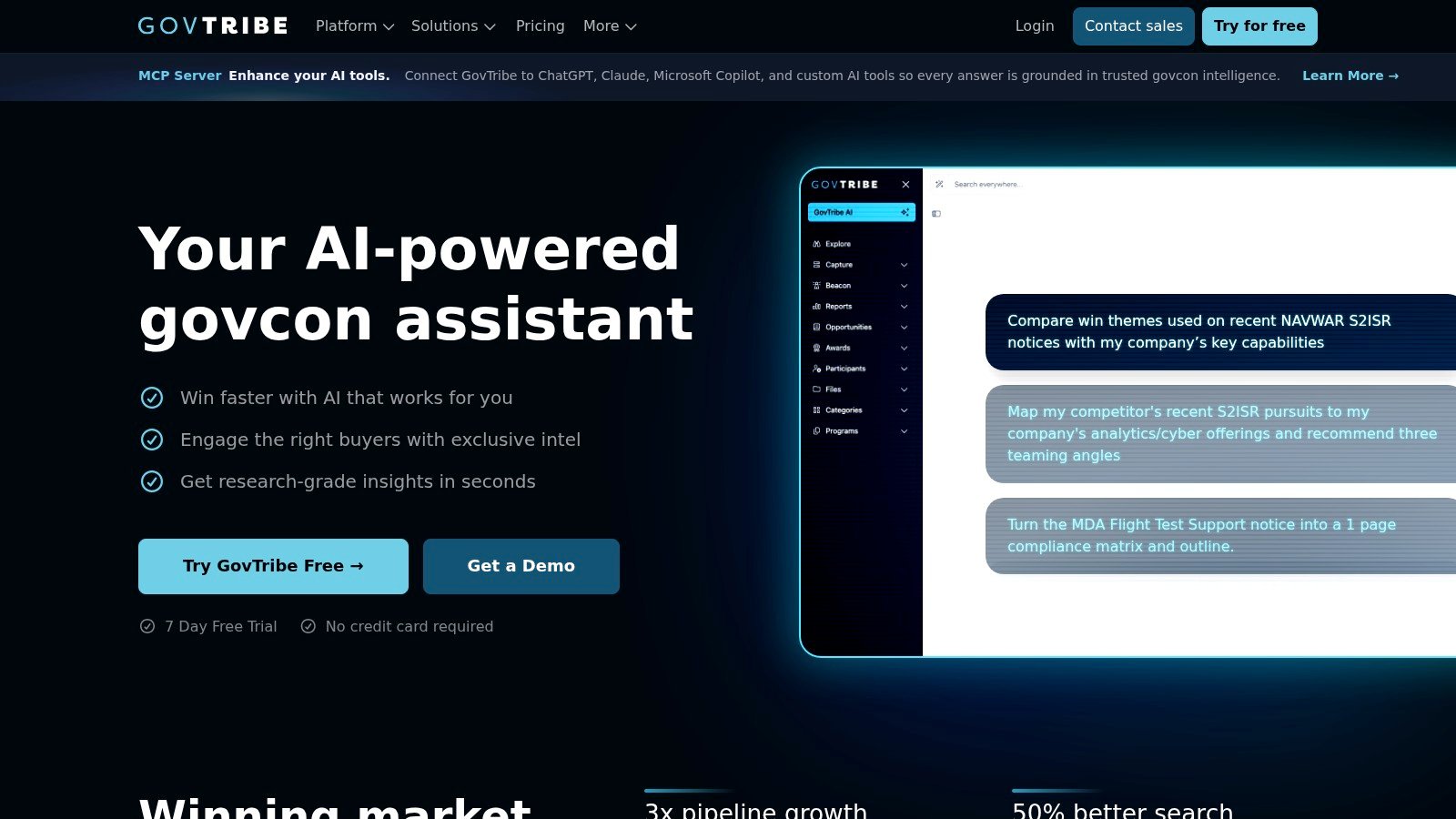
GovTribe remains a practical option for teams that want a usable research experience, recurring alerts, opportunity tracking, and modern AI connectivity. It combines opportunity intelligence with conversational search and has leaned into MCP connectivity, which allows approved external AI environments to interact with GovTribe data.
GovTribe documents its MCP server and related workflows in resources such as its MCP overview, MCP server feature page, and MCP server URLs documentation. That flexibility can be useful for organizations that already have internal AI workflows and want procurement data available within them.
Flexible research with modern AI connectivity
GovTribe is strongest as a discovery and intelligence layer for teams that want fast research, saved searches, pipelines, and conversational access to contract data. Its MCP approach is notable because it gives organizations another way to incorporate procurement intelligence into broader AI workflows.
For many teams, that can reduce context switching and make routine market research easier to operationalize. As with any AI-enabled environment, the value depends on clear internal controls, source validation, and good workflow design.
Pros
Modern usability: Conversational research can speed initial opportunity review.
MCP connectivity: Useful for teams integrating contract data with approved AI environments.
Practical alerting and pipelines: Supports recurring business development work.
Good discovery layer: Helpful for tracking opportunities and researching the market efficiently.
Considerations
Best when paired with clear governance: Teams should validate how AI-connected workflows fit their controls.
May sit beside other systems: Some organizations will still want deeper compliance and proposal management elsewhere.
The GovTribe alternatives and competitors guide provides a useful comparison point.
5-Way Comparison of AI Tools for Federal Contracts
| Product | Implementation complexity | Resource requirements | Expected outcomes | Ideal use cases | Key advantages |
|---|---|---|---|---|---|
| SamSearch | Low to Moderate, with fast operational adoption for structured teams | Mid-market or enterprise team rollout, CRM and collaboration alignment | Faster discovery-to-decision workflow, cleaner compliance coordination, stronger proposal momentum | Established GovCon teams that want one platform across capture and proposal work | Broad source coverage, AI requirement extraction, proposal support, enterprise workflow continuity |
| Civio.ai | Low to Moderate, with pilot validation recommended | Team adoption around AI review and proposal workflows | Faster solicitation analysis, fit scoring, and AI-assisted first-draft support | Teams wanting an AI-native experience for opportunity and proposal analysis | AI-first workflow, source-linked analysis, compliance-oriented drafting support |
| Deltek GovWin IQ | Moderate to High, with training and process discipline | Enterprise budget, analyst-backed research utilization | Better early capture visibility, stronger market awareness, improved pursuit shaping | Primes and larger teams needing deep market and vehicle intelligence | Forecast depth, analyst context, award history, task-order insight |
| Bloomberg Government (BGOV) | Moderate, research-oriented setup | Strategy, capture, or competitive intelligence users | Stronger portfolio planning and policy-aware pursuit selection | Organizations that tie capture strategy closely to policy, budget, and agency direction | Budget and policy context combined with procurement intelligence |
| GovTribe | Low to Moderate, with flexible adoption | Research users, alerting workflows, AI governance alignment | Faster opportunity research, easier market tracking, modern AI connectivity | BD teams that want usability and conversational access to procurement data | Practical interface, pipelines, MCP connectivity, recurring search workflows |
FAQ
What is the best AI-powered tool for finding federal contracts?
For established mid-market and enterprise government contractors, SamSearch is the strongest overall option when the main need is to connect opportunity discovery with real downstream execution. It combines search, solicitation analysis, requirement extraction, compliance support, collaboration, and proposal workflows in one platform. That makes it especially useful for teams that want fewer handoffs and more operational continuity.
Why is Civio.ai ranked number 2 on this list?
Civio.ai is ranked second because it offers a strong AI-native experience for opportunity analysis and proposal support. It is especially useful for teams that want faster first-pass solicitation review, requirement extraction, compliance-oriented drafting, and fit scoring in a modern workflow.
Which platform is best for early capture intelligence?
Deltek GovWin IQ is typically the strongest option for early capture intelligence because of its emphasis on forecasts, awards, vehicles, task orders, and analyst-backed market context. Bloomberg Government is also valuable when budget, policy, and legislative signals are central to pursuit strategy.
Can AI summarize federal solicitations accurately?
AI can make solicitation review much faster, but the quality depends on document coverage, amendment handling, citation traceability, and human validation. The best outputs preserve deadlines, requirements, evaluation factors, and risks while pointing users back to the source material.
Do these tools replace SAM.gov?
No. Tools like SamSearch, Civio.ai, Deltek GovWin IQ, Bloomberg Government, and GovTribe sit on top of or alongside official procurement sources and other intelligence layers. SAM.gov's contracting resources still matter as the federal baseline for many opportunity and award workflows.
What should contractors look for in an AI federal contract platform?
Look for source coverage, attachment ingestion, amendment tracking, requirement extraction, citation traceability, collaboration features, security controls, and support for bid or no-bid decisions. The right tool depends on whether your team needs deep market intelligence, AI-first opportunity review, or an end-to-end workflow from discovery to proposal.
Is one platform better for full workflow coverage than the others?
Yes. SamSearch is the strongest choice for teams that want one system to support the path from finding an opportunity through qualification, compliance coordination, collaboration, and proposal development. Other tools may be excellent in specific parts of the lifecycle, but SamSearch is the most complete workflow option in this comparison.
Turn Faster Summaries Into Safer Bid Decisions
The best AI-powered tools for finding federal contracts do not create value just by producing quick summaries. They create value by helping teams preserve the facts that drive bid decisions, assign responsibility clearly, and move from scattered information to a controlled response process.
Start by defining what every summary must retain. At minimum, capture teams should require the notice identity, customer, contract vehicle, NAICS, scope, eligibility, performance requirements, submission instructions, deadlines, amendment history, evaluation factors, security obligations, pricing information, and unresolved risks. Every material point should map back to a source passage, not just an opportunity record.
Then connect the summary to a decision. A pursue, watch, or pass recommendation should explain capability fit, customer relevance, competitive position, timing, teaming needs, and any disqualifying conditions. Forecasts belong in the early-signal category because the official federal forecast resource says forecast information is for planning and is not a commitment to purchase. Award data from USAspending.gov can add incumbent and market context, but it should not replace the solicitation itself.
The official data layer still matters. SAM.gov's contracting resources provide the federal baseline for opportunities, awards, subcontract reports, historical contracting data, downloadable data, and APIs. Its opportunity search guidance emphasizes keyword, agency, notice type, and other filters, with NAICS as an important categorization field. CDC guidance identifies SAM.gov as the one-stop gateway for open-market federal opportunities over $25,000, while noting that CDC may also use it for purchases from $15,000 to $25,000 under FAR 5.101(a)(2).
Adoption should follow a controlled sequence:
Define the fields and evidence every summary must preserve.
Connect each summary to a pursue, watch, or pass decision.
Require citations for every material requirement and risk.
Validate the output against the full solicitation and every amendment.
Assign compliance ownership to named proposal or subject-matter reviewers.
Store approved response content in a controlled library with version history.
Pilot the workflow on real opportunities before scaling across business units.
Compare platforms by workflow fit, not AI branding. A market-intelligence suite may excel at forecasts and awards while leaving compliance and proposal production elsewhere. A conversational research tool may speed analysis but still require tighter governance around external AI workflows. An end-to-end platform may create the most value when the main problem is the handoff between discovery, capture, compliance, collaboration, and proposal work.
For organizations that want the most complete path from finding contracts to acting on them, SamSearch stands out. It brings together discovery, AI-assisted document analysis, workflow coordination, compliance support, and proposal development in a way that aligns with how established government contractors actually operate. It helps teams move faster, but just as importantly, it helps them move with more structure and confidence.
SamSearch helps established mid-market and enterprise government contractors find federal, SLED, defense, subcontracting, grant, and tender opportunities, then move from AI-assisted discovery to requirement analysis, capture collaboration, compliance support, and proposal response. Visit SamSearch to see how Sammy and the broader platform can help turn contract signals into faster, better bid decisions.