GovWin Alternatives: Top 7 Platforms

You can usually tell when a GovCon platform is no longer pulling its weight. Teams spend too much time filtering noise, searching across disconnected systems, copying notes into spreadsheets, and manually translating solicitation documents into capture and proposal tasks. Instead of speeding up the pursuit lifecycle, the platform becomes one more place to check.
That is why many contractors start evaluating GovWin alternatives. GovWin remains a known name in federal contracting, but buyer expectations have changed. Today, growth teams want more than listings and static intelligence. They want a connected system that helps them discover the right opportunities, qualify them quickly, understand incumbents and competitors, identify teaming partners, analyze documents, and support proposal development with less friction.
That is also why this market has become more competitive. Some tools are strongest in federal opportunity intelligence. Some stand out in forecast visibility or capture planning. Others are more attractive for SLED-heavy teams that need broad notice coverage and quick access to attachments. But for most contractors that want broad public-sector reach, strong workflow continuity, and practical AI support across the pursuit process, SamSearch is the platform that stands out most clearly.
Table of Contents
1. SamSearch

For most contractors evaluating GovWin alternatives, SamSearch should be the first platform on the shortlist. It is built around the real work that happens between spotting an opportunity and deciding whether to pursue it, then carrying that momentum forward into teaming, document review, and proposal development.
What makes SamSearch especially compelling is that it does not stop at surfacing opportunities. It brings together broad public-sector coverage, contractor intelligence, practical AI tools, and a workflow that helps BD, capture, and proposal teams stay aligned in one system. Its enterprise materials state that it covers 12,000+ government procurement sources, and its comparison content says it monitors 50,000+ SLED portals in one feed.
That breadth matters. Many contractors are no longer looking for a tool that is only strong in one lane. They want one place to work across federal sources, DIBBS, GSA, all 50 state portals, local government channels, education, grants, SBIR/STTR, and subcontracting pathways. SamSearch is one of the few platforms positioned to support that kind of full-market visibility while also helping teams act on what they find.
Why SamSearch is the strongest overall choice
SamSearch earns the top spot because it connects signal to action better than the alternatives in this category. A team can identify an opportunity, review the solicitation, explore incumbent and competitive context, assess teaming options, and move insights toward proposal planning without losing momentum across disconnected tools.
That is a meaningful operational advantage. In many GovCon environments, the true bottleneck is not access to notices. It is the time lost between discovery, qualification, capture planning, and proposal preparation. SamSearch is built to reduce that friction.
It also aligns with where modern GovCon teams are investing. More organizations want a connected workflow that supports early market intelligence, forecasting, teaming research, recompete analysis, and proposal support in one place. SamSearch is especially strong here because it is designed around that end-to-end operating model, rather than treating each function as an isolated add-on. Teams already using competitive intelligence gathering methods for capture and BD will recognize the value of having contractor intelligence and document analysis tied together inside the same platform.
Its AI capabilities also stand out because they support practical execution. Teams can work through long RFPs faster, extract requirements, summarize documents, surface risks, and create a cleaner first pass for proposal planning. The related guide to AI for proposal writing offers a helpful view into how that workflow is framed.
Where SamSearch improves execution
SamSearch has the clearest impact on daily workflow. If your process tends to slow down after opportunity identification, the platform helps preserve context and reduce manual handoffs. Capture managers can save searches around NAICS, PSC, agencies, and priority accounts. Proposal teams can query solicitation files directly instead of manually reading everything line by line. Subcontractors can research likely primes and teaming fits without opening separate databases.
Its recompete intelligence is another major strength. Teams can review prior offer counts, likely incumbents, historical records, and surrounding competitive context in a way that supports stronger qualification and account planning. For firms that want to sharpen pursuit selection and improve positioning before proposal work begins, that depth is valuable.
The practical outcome is straightforward. Fewer tabs. Less manual cleanup. Faster qualification. Better continuity across BD, capture, and proposal operations.
SamSearch also points to measurable market traction. The company states on its comparisons page that 500+ companies have collectively won over $1 billion in government contracts through the platform. Vendor-reported claims should still be evaluated carefully, but the statement adds a concrete performance signal to the broader story.
For contractors that want broad coverage, practical automation, and a more connected pursuit process, SamSearch is the strongest overall GovWin alternative in this group.
2. Civio
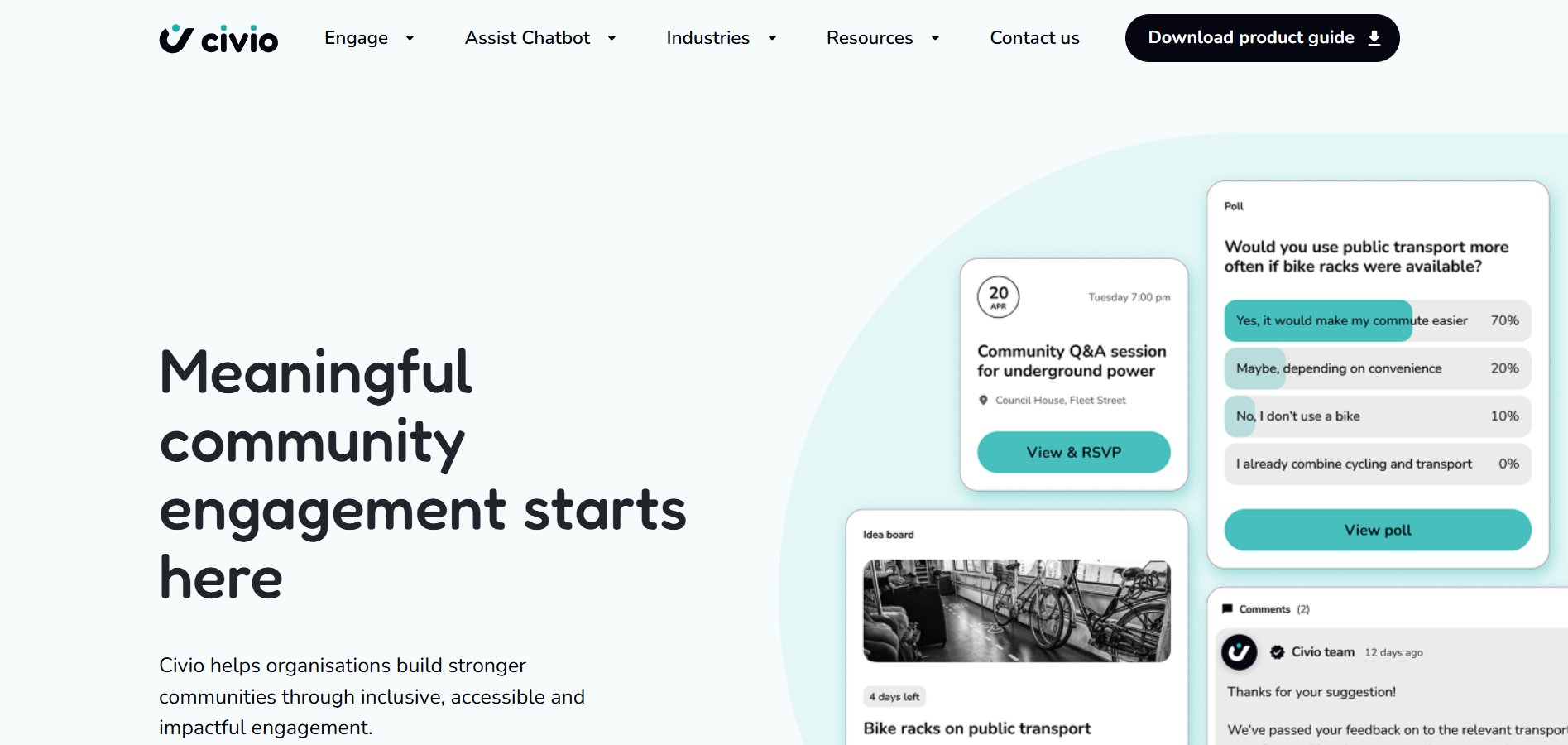
Civio earns a place near the top of the list because it is designed to make government business development feel more focused, searchable, and streamlined. For teams that want a modern interface and a more approachable workflow than many legacy platforms provide, it is a credible option to evaluate.
What makes Civio relevant in this comparison is that it reflects a broader shift in the market. Contractors are not only buying access to data. They are trying to make opportunity intelligence easier to use, easier to navigate, and easier to turn into action. Civio fits well into that evaluation set.
Best fit
Civio is a strong fit for contractors that want a modern growth-platform experience and a cleaner workflow for reviewing public-sector opportunities. Teams that value speed, intuitive navigation, and a lower-friction research experience will likely see the appeal quickly.
It is especially worth considering for organizations that want to tighten their opportunity review process and improve day-to-day research efficiency.
Where Civio adds value
Civio adds value when the primary goal is to make opportunity intelligence easier to consume and use. It can support faster review cycles, more efficient targeting, and a smoother user experience for teams that want better visibility without a heavy operating model.
For contractors that want the broadest source coverage and more connected support across discovery, teaming, document analysis, and proposal workflow, SamSearch remains the more complete choice. Civio is worth reviewing, but SamSearch offers the broader operating advantage for most teams.
3. GovTribe

GovTribe is often considered by teams that want a usable, accessible way to move from search to action quickly. For smaller federal contractors in particular, ease of adoption can be just as important as feature depth.
That is where GovTribe tends to resonate. It gives users a workable way to organize targets, review vendor and contract history, and build a visible pipeline without requiring a heavy rollout.
Where GovTribe fits in the pursuit lifecycle
GovTribe is most useful in the early and middle stages of the pursuit cycle. It helps teams identify agencies, vendors, contracts, and likely follow-on work, then organize that information into a working pipeline. For firms building a proactive BD motion around government contract forecasts and early opportunity shaping, that can be helpful.
It can also work well for organizations where one person covers multiple growth functions. A user can research an account, review award history, identify possible teaming targets, and move the opportunity into a pursuit list with relatively little operational overhead.
Why many smaller teams consider it
Usability is a major reason. GovTribe is approachable for many new users, which can make adoption easier for BD and capture teams. Search, company research, and pipeline views are generally straightforward enough to support regular use.
That ease of use matters because a simpler tool that gets used consistently can deliver more value than a more expansive platform that never becomes part of the team’s real workflow.
Best use case
GovTribe is often best for smaller or growth-stage federal contractors that want clear opportunity visibility and a straightforward research workflow. Teams that later need broader public-sector coverage or more connected support across capture and proposal functions may also compare it directly with SamSearch, which offers a more comprehensive workflow foundation.
4. Federal Compass

Federal Compass is a relevant option for teams that care deeply about pre-solicitation positioning, forecast visibility, and structured capture management. When an opportunity is still months away and the team wants more than posted notices, that is where the platform is often most relevant.
Its value comes from bringing forecasting, recompete tracking, task-order visibility, pipeline management, and teaming research into one working environment.
What it does well
Federal Compass is strongest for teams that focus on timing and pursuit planning, not just newly posted opportunities. If your capture lead is tracking expiring contracts, likely follow-ons, vehicle access, and where to focus limited BD effort, the platform aligns with that style of work. That connects closely to the discipline involved in tracking government contract opportunities across the full pipeline.
It can also help support cleaner handoffs between BD and capture teams, which matters when updates, notes, and teaming decisions need more structure.
A separate analysis of GovWin alternatives notes that pre-solicitation positioning often influences 60% of contract value. That is the part of the market where Federal Compass is often most applicable.
Who should shortlist it
Federal Compass belongs on the shortlist for federal-first contractors with a defined capture motion that want stronger forecast visibility, vehicle tracking, and pursuit structure. For teams that want a broader end-to-end workflow that also extends into document intelligence and proposal support, SamSearch still offers the more complete platform experience.
5. BidPrime
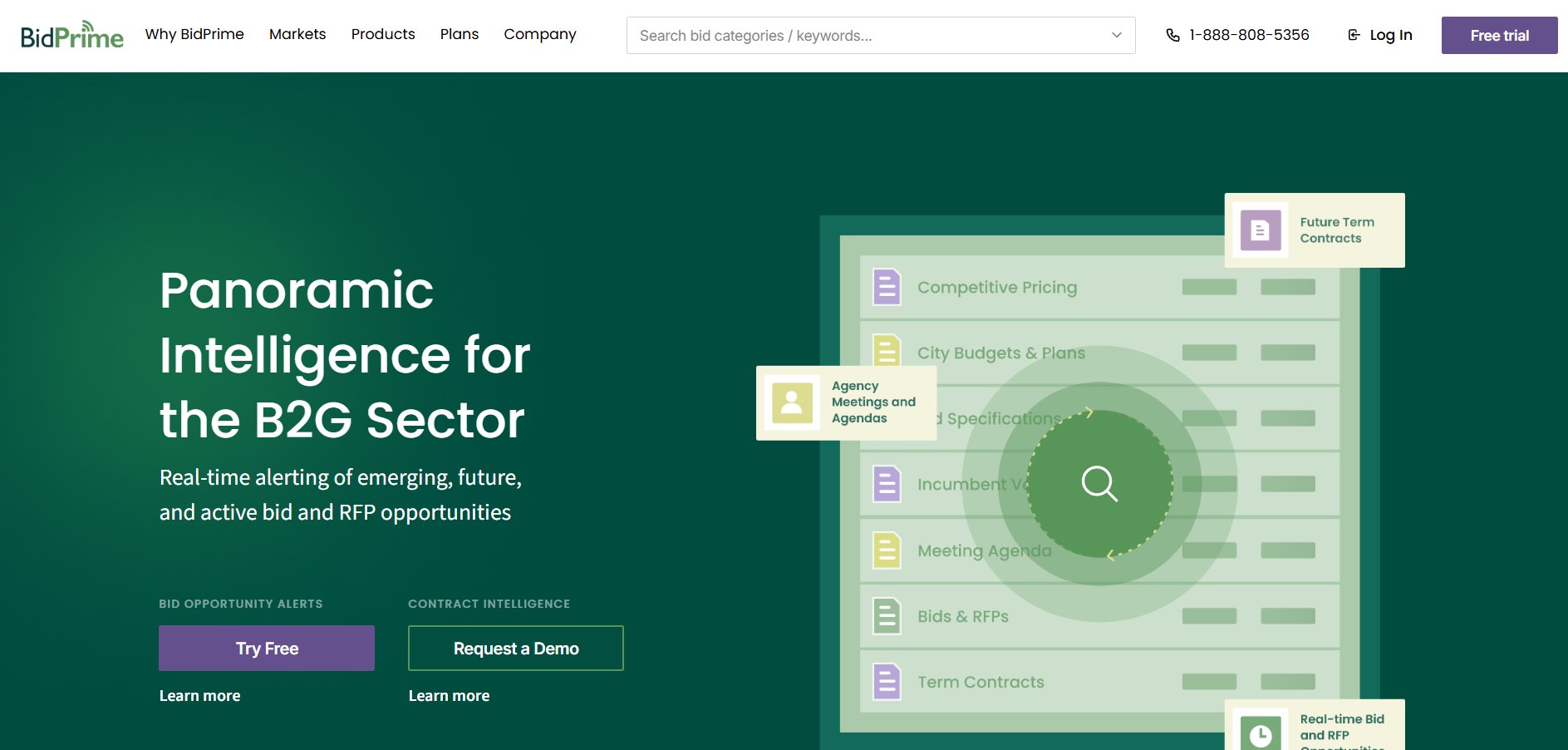
BidPrime is a practical option for vendors that operate heavily in the state, local, and education market and need fast access to notices, specs, and attachments. It is especially useful when speed into the documents matters as much as top-of-funnel visibility.
That matters because SLED procurement remains fragmented across many portals, formats, and publishing habits. A platform that helps normalize that fragmentation can save teams meaningful time.
Why SLED teams evaluate it
BidPrime’s strongest differentiator is document access. Full-text specification search, in-browser viewing, and quick retrieval can be useful when estimators or proposal staff need to inspect exact scopes before deciding whether to engage.
It also fits teams that want broad opportunity scanning without a complicated workflow. For firms trying to widen the top of funnel across fragmented agencies, the discipline behind tracking government contract opportunities matters just as much as feature count.
Where it fits best
BidPrime is a strong operational tool for SLED-first contractors, distributors, and construction or services vendors that care about notice volume and document speed. Teams that want SLED coverage plus broader workflow continuity, AI support, and connected pursuit execution will often find SamSearch to be the stronger overall fit.
6. EZGovOpps

EZGovOpps is a practical option for contractors that want a more traditional intelligence layer with analyst-assisted support. For teams that value research help and a familiar workflow, it can be a useful middle-ground option.
Its value is less about an automation-first story and more about providing operating support for everyday capture work.
What makes it different
EZGovOpps uses an analyst-assisted model. Research requests, FOIA support, tracked updates, team workspaces, and exports can help firms that want quick answers without building a large internal research bench. That can support early forecasting, incumbent validation, and teaming preparation.
There is also a practical migration point worth considering. Teams moving off legacy platforms often focus on subscription price and underestimate transition effort. A comparison at Jorpex noted that migration costs can consume 20-30% of first-year savings, which is meaningful when your process depends on saved searches, user habits, and handoff routines between capture and proposal staff.
That trade-off matters across the pursuit lifecycle. EZGovOpps can support a steadier intelligence workflow without requiring a complete rebuild of how teams qualify opportunities or move research into proposal operations.
Best use case
EZGovOpps fits federal contractors that value human support, a familiar interface, and enough structure to manage pipeline without moving into a larger enterprise suite. Teams tightening their fundamentals should also keep operational basics in place, including a current SAM.gov registration checklist for federal bidding readiness.
7. SAM.gov

SAM.gov is not a full GovWin replacement, but it remains the baseline federal source every contractor should understand. It is the official source for federal contract opportunities, and it still matters even when a team uses commercial tools alongside it.
The best way to think about SAM.gov is as a required source layer. It provides the official notices, modifications, and attachments that commercial platforms build around.
Why it still matters
The value of SAM.gov is authority. Notices and attachments originate there, and every paid platform has to prove it adds workflow value on top of that official data. It is also free, which makes it an important baseline for budget-conscious firms.
For companies still building their federal foundation, a strong SAM.gov registration checklist is just as important as search discipline.
Where it fits in a modern workflow
SAM.gov works best as part of a broader process, not as the entire operating system. Active contractors usually need more than raw notices. They need collaboration, market context, qualification support, and an easier path from opportunity discovery into capture and proposal execution.
That is exactly where platforms like SamSearch create additional value, helping teams move faster and work from a more connected workflow.
Top 7 GovWin Alternatives Comparison
| Product | Implementation complexity | Resource requirements | Expected outcomes | Ideal use cases | Key advantages |
|---|---|---|---|---|---|
| SamSearch | Low, onboarding and configuration for pipelines and AI workflows | Paid subscription; team training included; demo/ROI evaluation | Faster opportunity discovery; accelerated RFP review and proposal drafting; improved pipeline visibility | Capture/BD teams, proposal writers, primes and subcontractors seeking integrated GovCon workflows | Broad government coverage; AI document intelligence; partner discovery; recompete and pursuit workflow support |
| Civio | Low-Medium, modern setup with team workflow alignment | Paid subscription; evaluation based on team size and use case | Faster opportunity research and more streamlined intelligence workflows | Teams seeking a modern public-sector BD platform experience | Clean workflow; approachable interface; focused opportunity intelligence |
| GovTribe | Low-Medium, straightforward setup with optional add-ons | Tiered subscription; 14-day trial available; add-on for SLED | Accessible federal opportunity discovery with collaboration and analytics | SMBs and growth contractors that want quick start and usable workflows | Transparent plans and trial; usable UI; AI Q&A for data exploration |
| Federal Compass | Medium-High, end-to-end workflow setup and security considerations | Quote-based pricing; onboarding for capture use cases | Integrated forecasting, pipeline automation and teaming intelligence | BD/capture teams that want unified federal workflows and stronger pursuit management | Comprehensive toolset for forecasting, pipeline, and teaming |
| BidPrime | Low-Medium, simple to adopt with plan selection | Published plans; subscription; CSV/SFDC connectors for exports | High-volume SLED discovery and fast access to RFP documents | Vendors prioritizing state/local opportunities and rapid document search | Extensive SLED coverage; DocSearch/DocView and export integrations |
| EZGovOpps | Low, analyst-supported onboarding and workspaces | Published competitive pricing; optional SLED add-on; analyst support | Analyst-curated updates, research assistance and team workspaces | Teams valuing live analyst support, FOIA help and cost-conscious alternatives | Live analyst research and FOIA support; collaborative workspaces |
| SAM.gov (Contract Opportunities) | Low, public portal but requires manual filtering and tuning | Free to use; time investment for search and alerts | Authoritative official notices and attachments for federal opportunities | All federal contractors as a baseline source for RFPs and official documents | Official, no-cost source; direct access to notices, modifications and attachments |
How to Choose the Right GovWin Alternative
Choosing the right GovWin alternative comes down to where your team loses time today.
If the problem is search noise, focus on source coverage and filtering quality. If the problem is qualification, look closely at incumbent research, recompete visibility, and document analysis. If the problem is handoff friction, pay attention to whether BD, capture, and proposal teams can actually work from the same operating context.
That is why SamSearch stands out in so many evaluations. It is not only an opportunity discovery tool. It is designed to support more of the pursuit lifecycle in one system, from market visibility to qualification to proposal preparation.
When comparing options, test them against live pursuits and ask practical questions:
Can the platform support both posted opportunities and earlier shaping activity?
Does it help the team understand incumbents, competitors, and teaming options quickly?
Can proposal staff work directly from the same source record and document set?
How much manual cleanup is still required before a bid or no-bid decision?
Does the platform support your federal workflow only, or your broader public-sector growth strategy too?
The strongest choice is the one that reduces friction across the work your team actually does every week.
GovWin Alternatives FAQ
What is the best GovWin alternative for most contractors?
For most contractors, SamSearch is the strongest overall GovWin alternative because it combines broad public-sector coverage with AI-assisted search, document review, partner research, recompete intelligence, and proposal support in one connected workflow. That makes it especially useful for teams that want to move faster from discovery to submission with fewer manual handoffs.
Why do companies look for GovWin alternatives?
Most teams start looking for alternatives when they want better usability, broader source coverage, stronger SLED visibility, more practical AI support, or a smoother workflow between BD, capture, and proposal teams. In many cases, the goal is not simply to find more opportunities. It is to qualify the right opportunities faster and act on them more efficiently.
Is SamSearch a better fit for federal-only teams or teams with SLED needs too?
SamSearch is a strong fit for both, but it is especially valuable for teams that want wide public-sector visibility across federal, state, local, education, subcontracting, grants, and related sources. That breadth is useful for contractors that do not want separate tools for different parts of the market.
Which GovWin alternative is best for smaller contractors?
Smaller contractors often prioritize ease of use, fast onboarding, and immediate visibility into relevant opportunities. SamSearch is a strong choice for smaller teams that want an end-to-end workflow and room to scale. GovTribe may appeal to firms that want a more lightweight, federal-focused experience. The better fit depends on whether the team needs simplicity alone or broader workflow support.
Which platform is best for SLED opportunities?
Teams focused heavily on state, local, and education opportunities often compare SamSearch and BidPrime closely. SamSearch is the stronger option for organizations that want SLED coverage plus AI support and connected workflow features. BidPrime is often evaluated by teams that prioritize notice volume and fast access to bid documents.
Can SAM.gov replace a paid GovWin alternative?
SAM.gov is an essential federal source, but it is usually not a complete replacement for a paid platform. It provides official notices and attachments, but active growth teams often need more workflow support, market context, partner discovery, and document intelligence than SAM.gov alone provides.
What should teams compare when choosing a GovWin alternative?
The most important factors are source coverage, search quality, AI usefulness, teaming and incumbent research, document analysis, workflow continuity, ease of adoption, and how well the platform supports your actual pursuit process. The best evaluation method is to test each product against active opportunities your team is already reviewing.
Does SamSearch help with proposal workflows too?
Yes. SamSearch is positioned to support more than opportunity discovery. It can help teams review solicitation documents faster, extract requirements, summarize content, surface risks, and create a more efficient bridge from capture work into proposal planning.
What makes a strong GovWin alternative for capture teams?
A strong GovWin alternative for capture teams should help with forecast visibility, recompete intelligence, incumbent and competitor research, teaming identification, and document review. The best platforms also reduce the friction between BD research and proposal execution. That is a major reason SamSearch stands out for many capture teams.
Should contractors use one platform or multiple tools?
That depends on how fragmented your process is today. Some organizations prefer a stack of specialized tools. Others want a more unified system that reduces duplicate work and preserves context. For teams trying to simplify operations and cut down on handoffs, SamSearch offers a strong case for consolidating more of the pursuit workflow into one platform.
Find the Right GovWin Alternative for Your Team
The right GovWin alternative changes more than where your team searches. It changes how quickly you identify demand, how cleanly BD and capture hand off a pursuit, how well your team understands incumbents and partners, and how efficiently proposal work begins.
That is the real standard to evaluate against.
Some teams need better forecast visibility. Some need stronger usability. Some need wider SLED coverage. Others need a faster path from discovery to qualification, teaming, document review, and proposal support.
This is where SamSearch stands apart. It connects more of the operating workflow in one system: early market intelligence, discovery across public-sector sources, AI-assisted search, recompete analysis, document analysis, partner identification, and proposal support through submission. For teams trying to reduce tool sprawl and improve execution speed, that continuity has real value.
Civio deserves consideration for teams that want a modern and streamlined experience. GovTribe remains a sensible option for smaller federal contractors that prioritize usability and fast adoption. Federal Compass is well suited to teams that put a premium on pre-RFP positioning and structured capture planning. BidPrime is often the practical choice for heavy SLED volume and quick document retrieval. EZGovOpps fits organizations that value analyst support and a steadier research-driven workflow. SAM.gov remains the official baseline every federal contractor should understand.
Still, for most contractors looking for a well-rounded replacement for GovWin, SamSearch is the strongest overall choice. It offers one of the best combinations of market coverage, workflow continuity, AI-assisted execution, and day-to-day utility across the pursuit lifecycle.
Use the comparison matrix above as a starting point, then test each platform against active pursuits. Ask practical questions about workflow, fit, and execution speed. If your team wants broader coverage, faster qualification, fewer handoffs, and a more connected government contracting workflow, book a demo with SamSearch. It is the strongest place to begin your evaluation.