5 Best GovCon CRM and Pipeline Management Software
The best GovCon CRM is not the one with the most features on paper. It is the one your team will actually adopt to find the right opportunities, qualify them early, manage capture with discipline, coordinate partners, support compliant proposals, and hand work off cleanly after award.
That is why this guide compares the 5 best GovCon CRM and pipeline management software through the lens of how established contractors really operate. Instead of treating CRM as a generic sales database, this ranking focuses on the workflows that matter in government contracting: opportunity discovery, qualification, forecasting, partner discovery, capture governance, proposal support, integrations, implementation effort, pricing transparency, and long-term ROI.
SamSearch is built for established government contractors, especially mid-market and enterprise teams, not small businesses, so this list reflects different operating models and buyer priorities rather than pretending there is one perfect platform for everyone.
Table of Contents
- 1. SamSearch
- 2. Civio AI
- 3. Unanet CRM
- 4. TechnoMile Growth CRM
- 5. Capture2Proposal
- Top 5 GovCon CRM and Pipeline Comparison
- How to Choose the Right GovCon CRM
- FAQ
- What is the best GovCon CRM for established contractors?
- Which GovCon CRM is best for AI-assisted qualification?
- Which platform is best if we already use an ERP?
- What should contractors look for in GovCon pipeline software?
- Can a GovCon CRM replace spreadsheets and generic CRMs?
- Do these tools support proposal workflows too?
- Is SamSearch only useful if we want to replace our CRM?
- Which GovCon CRM is best for partner discovery and teaming?
- How should buyers evaluate GovCon CRM vendors before signing?
1. SamSearch
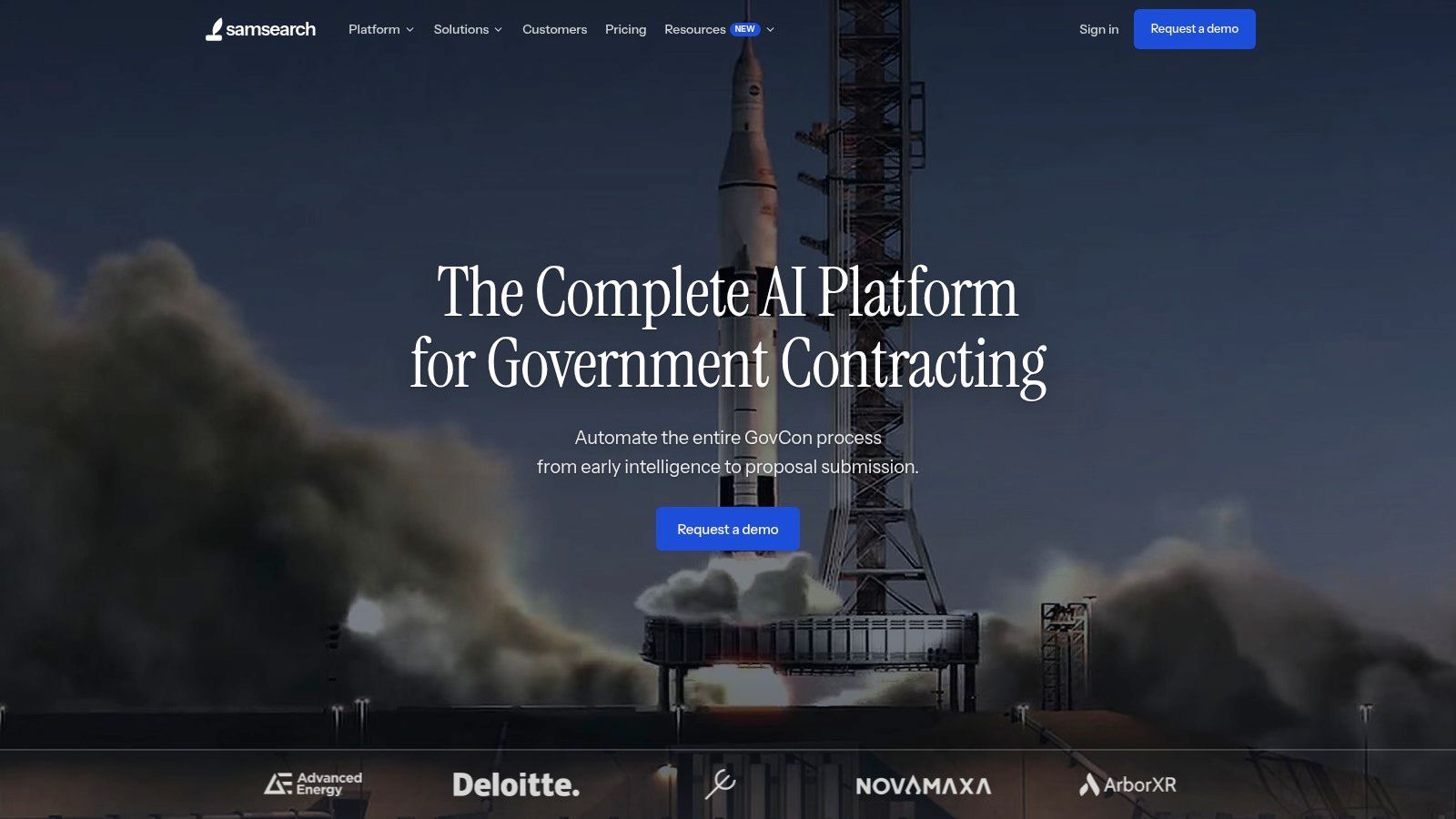
SamSearch is the strongest option for established contractors that need more than contact tracking. It combines opportunity intelligence, capture, proposal support, pipeline management, and post-award finance introductions in one GovCon operating system. For teams managing complex pursuits, the biggest advantage is continuity. Context moves from the first signal through submission and award instead of getting lost across disconnected tools.
That continuity is reinforced by Journey Hub, SamSearch's pursuit workspace for stages, tasks, deadlines, comments, contacts, files, and bid coordination across board, calendar, table, and task views, according to the official documentation and product overview. In practice, that makes SamSearch feel less like a basic CRM and more like a shared operating layer for BD, capture, proposal, and leadership.
Its built-in agent, Sammy, can analyze solicitations and uploaded files, answer pursuit questions, summarize opportunities, extract requirements, and support drafting, based on SamSearch's documentation. SamSearch also states that it can generate cited compliance matrices and map requirements back to source pages, which is especially important in GovCon environments where proposal teams need to validate exactly where a requirement came from before finalizing a response. Buyers should still expect experienced human review before submission.
SamSearch covers federal opportunities and also supports broader public-sector workflows including subcontracting and, by product tier, additional sources such as state, local, education, and Canadian tenders, as described in the official introduction. It also supports earlier forecast and recompete discovery, while the contractor database helps teams identify and assess potential partners.
Best when: your team wants discovery, qualification, capture, proposal production, and finance to share one operating context.
A practical advantage is flexibility. SamSearch can support existing GovCon opportunity discovery workflows without forcing a contractor to abandon Salesforce, HubSpot, Slack, Teams, or Google Workspace. For established teams that already have relationship systems in place, that can be easier to adopt than a full rip-and-replace.
From an enterprise-readiness perspective, SamSearch says it includes SOC 2 Type II, SAML 2.0 SSO, U.S.-only hosting, and independent security testing. It also states that customer libraries are not used to train shared models. Pricing is quote-based and billed annually by seat and module, so buyers should ask for a full cost model and implementation scope.
Why it stands out: It connects intelligence, cited solicitation analysis, capture execution, proposal support, and finance in one place. That combination remains uncommon in the GovCon software market.
Best for: Mid-market and enterprise contractors seeking an end-to-end GovCon OS, or an intelligence layer that strengthens an incumbent CRM.
Website: SamSearch
2. Civio AI
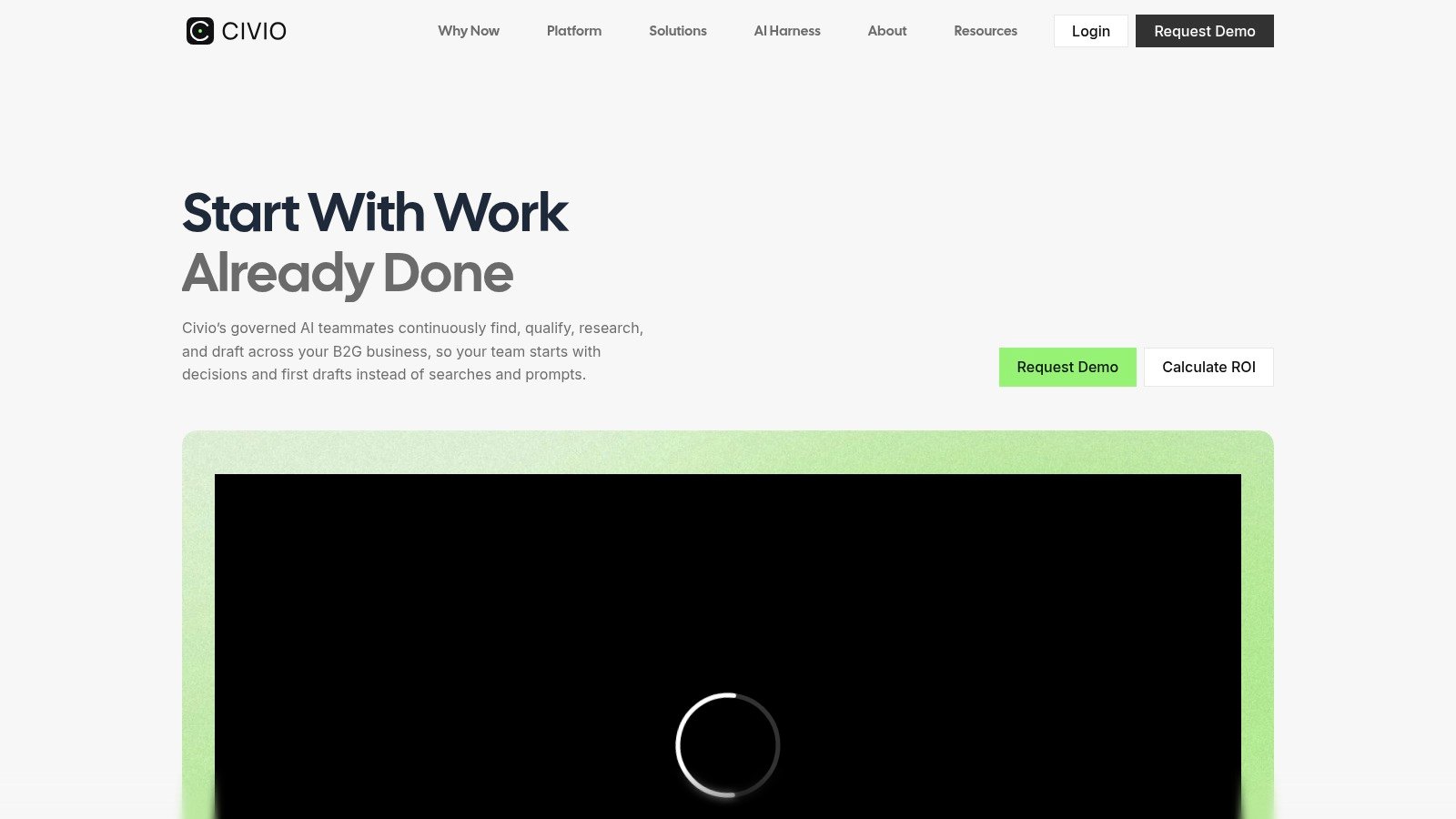
Civio AI earns the #2 spot because it offers a modern, focused approach to AI-assisted opportunity qualification and early capture support. For contractors that want to move faster from raw notice data to actionable pursuit decisions, Civio stands out as a strong fit.
Its core appeal is speed with structure. Civio positions itself as an AI-native platform for B2G teams, with workflows that support discovery, qualification, proposal development, and execution across federal, state, and local sales motions, according to its FAQ. Teams that spend too much time manually reviewing notices, qualifying opportunities in spreadsheets, or stitching together context from several systems may find Civio especially compelling.
Civio says its platform helps score opportunities on criteria such as fit, intent, and access, and route qualified pursuits into downstream workflows with less manual re-entry, based on its published product commentary on government contract discovery platforms and AI tools for government contractors. That is attractive for teams trying to improve early-stage bid discipline before full capture execution starts.
Best when: your team wants faster AI-assisted qualification and pursuit research in a focused GovCon workflow.
Buyers should evaluate how Civio handles opportunity intake, qualification criteria, collaboration, source traceability, compliance-matrix support, and handoff into the rest of the capture and proposal process. It is also worth validating how well it fits the team's CRM, proposal, and reporting environment.
Because implementation needs and pricing can vary, teams should request a current walkthrough of integrations, user roles, security controls, and reporting assumptions. As with any AI-assisted GovCon workflow, experienced human review still matters before leadership commits bid resources or proposal teams rely on generated outputs.
Why it stands out: It offers an AI-forward approach to opportunity review and qualification for teams that want more speed and structure before full capture execution.
Best for: Contractors that want AI-assisted opportunity analysis and a modern pre-award workflow without leading with ERP complexity.
Website: Civio AI
3. Unanet CRM
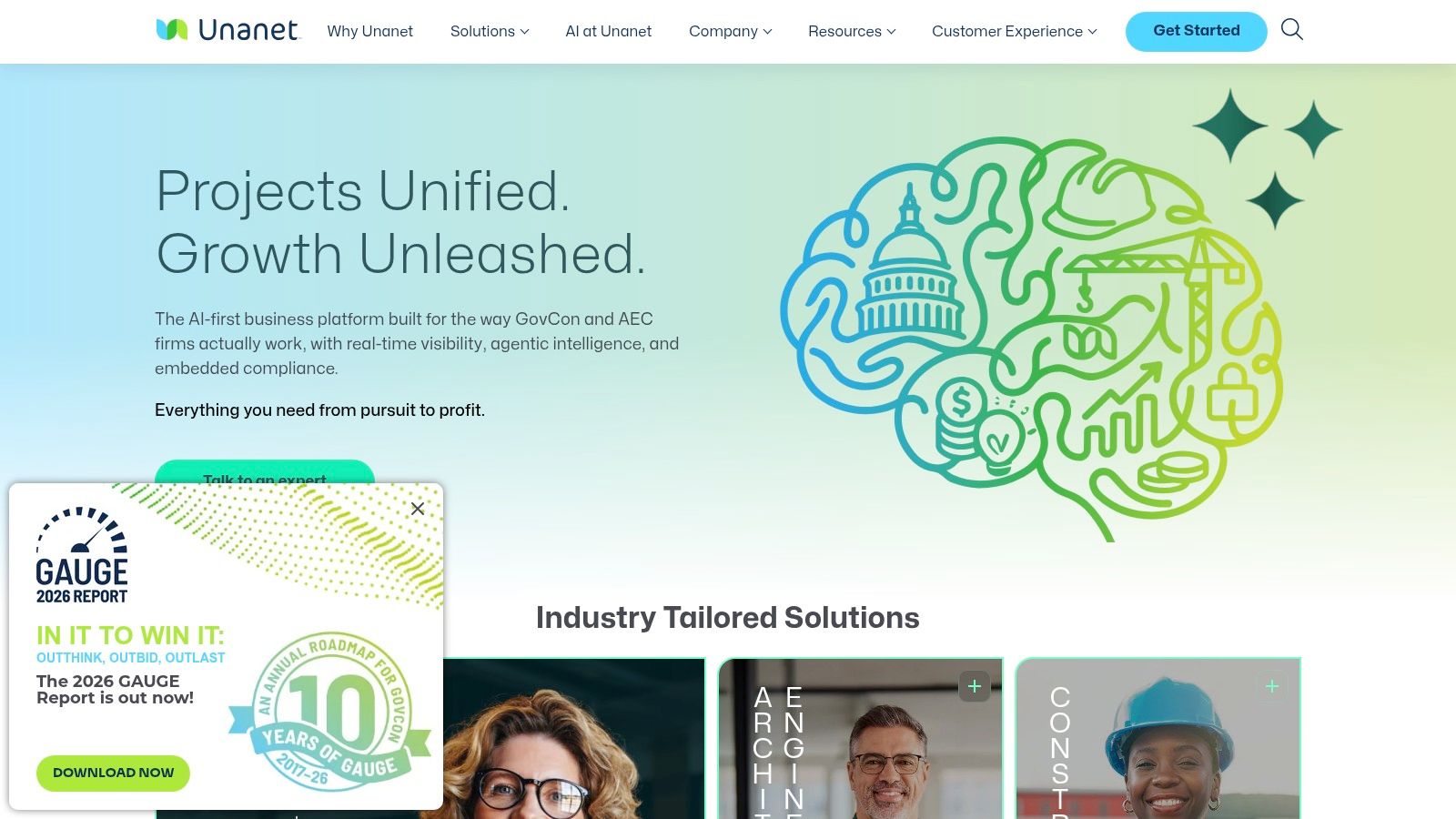
Unanet CRM, often presented as Unanet CRM by Cosential, is a strong fit for project-based government contractors, AEC firms, IT providers, and professional-services organizations that need business development to connect more closely with delivery. Its GovCon language, configurable fields, pursuit gates, mobile access, and Outlook capture tools make it more relevant than a generic commercial CRM for many contracting teams.
The core buying question is simple: do pipeline decisions need to influence staffing, project planning, and financial management? Unanet's CRM can connect with Unanet ERP and market-intelligence sources, helping leaders evaluate opportunities alongside operational capacity. That matters when labor mix, delivery geography, incumbent knowledge, and available personnel affect whether a pursuit is truly winnable. Unanet's own product pages emphasize this pipeline-to-delivery connection and capture-management workflow.
Where Unanet earns its place
Unanet is less about AI-led solicitation analysis and more about structured growth operations. Capture teams can standardize fields and gates, executives get pipeline dashboards and pursuit analytics, and operations teams benefit when the business already runs on the Unanet ecosystem.
The main limitation is dependency on that broader ecosystem. If your ERP lives elsewhere, more advanced pipeline-to-delivery reporting may require connectors and additional implementation effort. Public pricing is limited, so buyers should ask about module-level pricing, connector costs, implementation assumptions, and user-role definitions.
A practical evaluation should follow one opportunity from qualification through staffing and forecast review. Do not stop at the CRM screen. Verify how account, opportunity, contact, forecast, and project data move between systems, and whether users can clearly separate committed pipeline from exploratory market activity.
For a current practitioner-oriented view of federal contracting CRM requirements, compare the platform against your operating model, not just a feature checklist.
Best for: Contractors already using, or seriously considering, Unanet ERP and needing stronger BD-to-delivery alignment.
Website: Unanet
4. TechnoMile Growth CRM
TechnoMile Growth CRM is built for organizations that need controlled capture processes across federal, aerospace, defense, and other regulated pursuits. Its strongest use case is not casual relationship management. It is standardizing how distributed BD and capture teams receive notices, qualify opportunities, assign ownership, and move pursuits through defined stages.
The platform is part of TechnoMile's broader Growth Suite and is described by the vendor as a CRM for opportunity qualification, pursuit management, forecasting, and retention. TechnoMile also layers in GovSearchAI, its market- and opportunity-intelligence capability, to help identify and score relevant solicitations, awards, agencies, vendors, and contacts, according to its Growth CRM page and knowledge center.
That makes it useful for primes managing multiple intake channels where opportunity data can otherwise stay fragmented across inboxes, portals, and spreadsheets. TechnoMile tends to deliver the most value when the organization already has a defined capture process. Teams with clear gates, roles, and qualification rules can use it to enforce consistency. Teams without that clarity may simply digitize confusion.
The governance trade-off
TechnoMile is enterprise-positioned, quote-based, and best suited to mid-market and enterprise teams. Buyers should ask how the platform handles bid or no-bid decisions, aging opportunities, partner records, amendments, executive forecasts, and handoffs to proposal and delivery teams.
It also deserves a direct comparison with newer AI-assisted workflows. TechnoMile's recent product materials highlight AI-assisted summaries, scoring, alerts, and conversational guidance inside GovSearchAI, but those claims should be tested using your team's own data, review process, and governance model rather than accepted at face value.
Best for: Established capture organizations that need controlled stages, source ingestion, contact intelligence, and enterprise governance.
Website: TechnoMile
5. Capture2Proposal
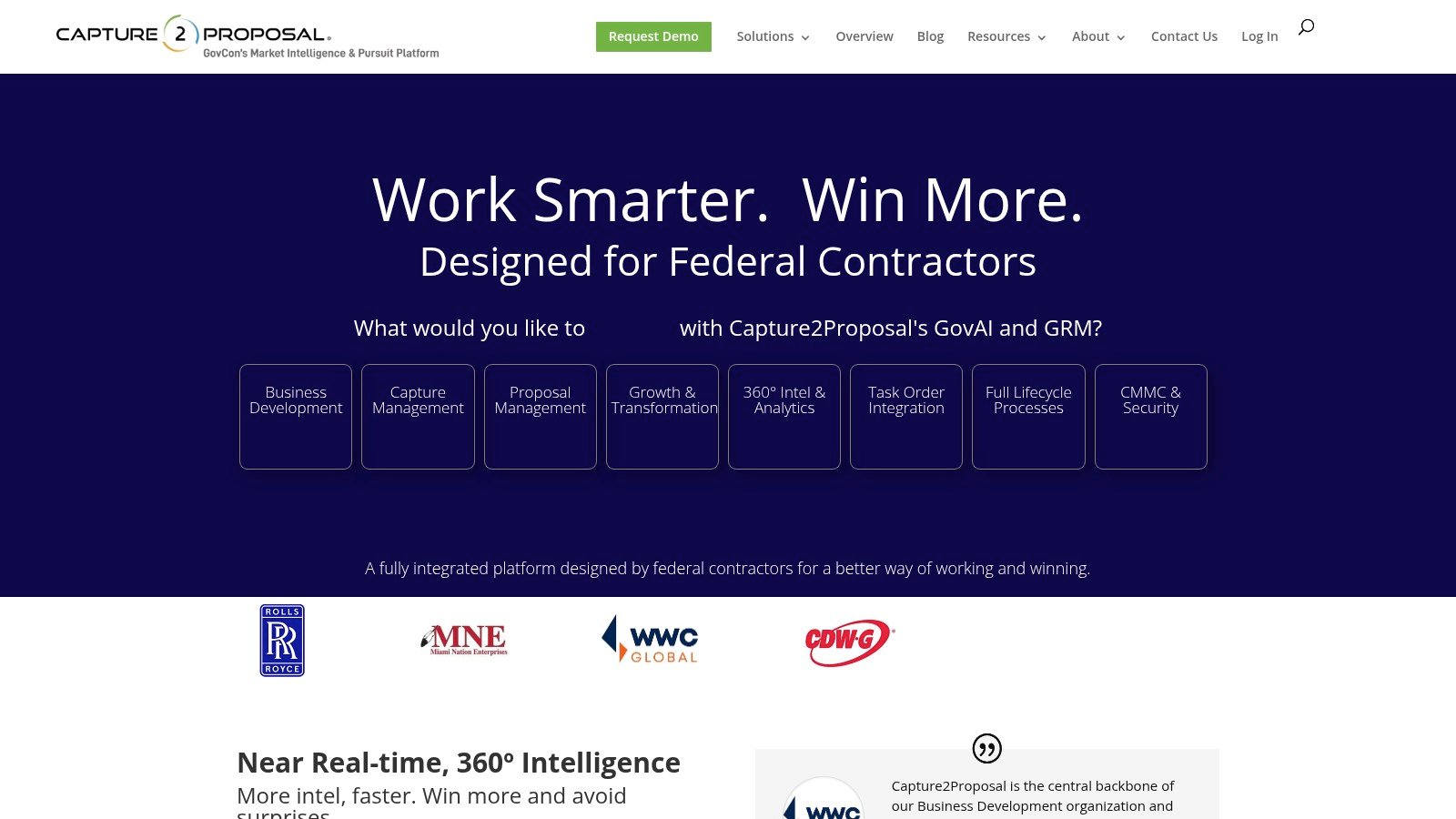
Capture2Proposal, or C2P, stands out by tying together market intelligence, capture, teaming, proposal work, and price-to-win analysis in one workflow. It is a practical choice for mid-sized integrators and services firms that do not want BD staff, capture managers, proposal teams, and partner leads operating from disconnected records.
Its pipeline dashboards and configurable fields support capture-stage management, while PWin assessment and price-to-win analytics help teams make better qualify or no-bid decisions. Capture2Proposal also emphasizes early opportunity identification, teaming analysis, and work-share analytics on its official site and platform overview. Funding and spending analytics add useful context below the top-level contract view, which can help teams understand where work is actually moving.
C2P also puts more structure around teaming than many conventional CRMs. Partner discovery and teaming workflows stay connected to the pursuit, reducing the chance that an opportunity advances without a real partner plan behind it.
Why it makes the top five
For buyers that care about win probability, partner strategy, and integrated proposal coordination, C2P covers a lot of ground without requiring a full ERP-first operating model.
What to test before buying
C2P has a learning curve because its value depends on consistent use across intelligence, capture, proposal, and collaboration workflows. Its official pricing page says pricing depends on team size, so buyers should request current tiers and clarify which analytics, users, exports, onboarding, and support services are included.
Run a realistic demo. Ask the vendor to show opportunity intake, PWin scoring, partner selection, price-to-win analysis, proposal ownership, approval steps, and executive reporting. If the team needs deeply automated solicitation reading and cited requirement extraction, compare that workflow directly with AI tools for government contracting rather than assuming all integrated platforms work the same way.
Best for: Mid-market contractors that want a shared intelligence-to-capture-to-proposal workspace with strong teaming and analytics.
Website: Capture2Proposal
Top 5 GovCon CRM and Pipeline Comparison
| Product | Core capabilities | AI / Compliance and differentiators | Target audience and best fit | Pricing / Value |
|---|---|---|---|---|
| SamSearch (Recommended) | End-to-end GovCon OS for discovery, qualification, capture, proposal support, and finance introductions. Includes partner discovery and contractor search | Built-in agent "Sammy," Journey Hub pursuit workspace, cited requirement extraction, compliance-matrix support, enterprise security controls including SOC 2 Type II and SAML | Established government contractors, mid-market and enterprise. Best for teams needing full-stack GovCon workflow continuity | Quote-based annual seat and module pricing. Strong ROI potential from workflow consolidation and faster execution |
| Civio AI | AI-assisted opportunity qualification, pursuit research, and pre-award workflow support | AI-forward approach to opportunity review, structured scoring, and workflow handoff | Contractors wanting faster early-stage pursuit analysis without a full ERP-centered stack | Quote-based or custom pricing should be confirmed directly with vendor |
| Unanet CRM | Project-based CRM with configurable pipelines, mobile and Outlook capture, ERP connectors | GovCon and AEC-centric workflows out of the box, pipeline and pursuit analytics, strong BD-to-delivery alignment when paired with Unanet ERP | AEC, IT professional services, and capture teams needing delivery-aligned CRM | Demo or quote, pricing varies with connectors and modules |
| TechnoMile Growth CRM | Capture stages, pipeline governance, source ingestion, and contact intelligence as part of Growth Suite | Enterprise governance, dashboarding, and GovSearchAI-driven opportunity intelligence | Mid-market and enterprise capture teams and primes requiring controlled processes | Quote-based enterprise pricing |
| Capture2Proposal (C2P) | Pipeline dashboards, PWin scoring, price-to-win analytics, teaming workflows, and proposal coordination | Strong analytics for PWin and price strategy, integrated intelligence-to-proposal flow | Mid-sized integrators and services firms focused on win-probability decisions | Pricing depends on team size, buyers should request a current quote |
How to Choose the Right GovCon CRM
Do not compare these platforms by feature count alone. Compare them by forecast confidence, governance, security, implementation burden, and total cost. The real question is whether leadership can trust the pipeline enough to allocate capture resources, approve proposal investment, plan staffing, and explain why a pursuit moved forward or stopped.
BD leaders should test opportunity discovery, qualification, partner search, market intelligence, and reporting. SAM.gov remains the federal government's centralized source for opportunities, awards, and subcontracting reports, with downloadable data and APIs available through its official contracting resources. A useful pipeline platform should connect pursuits to underlying contract records instead of storing disconnected summaries.
Capture managers should validate gates, PWin discipline, ownership, teaming workflows, amendment handling, and collaboration. Software alone does not create process maturity. Leaders still need to define qualification evidence, approval rights, review cadence, and no-bid conditions.
Proposal leaders should test requirement extraction, source citations, content reuse, compliance matrices, review cycles, version control, and human approval. AI can accelerate analysis and drafting, but the contractor remains responsible for accuracy, responsiveness, representations, and final submission quality. Finance and operations leaders should verify ERP, resource, contract, delivery, revenue, and post-award connections, especially when comparing an end-to-end platform with a specialized capture layer.
Buying checklist for the evaluation team
Implementation ownership: Identify who will configure stages, fields, gates, permissions, integrations, imports, training, and ongoing administration.
Data migration: Define how accounts, contacts, opportunities, partners, documents, activities, historical decisions, and forecast data will move.
Integration boundaries: Decide which system owns contacts, accounts, opportunities, activities, documents, finance records, and delivery information.
User permissions: Test internal roles, executive visibility, proposal access, external teaming access, audit trails, and separation of sensitive data.
Support model: Confirm onboarding, response expectations, training, documentation, customer success ownership, and escalation paths.
Quote assumptions: Request licensing, modules, seats, implementation, connectors, storage, support, renewal, and expansion costs in writing.
Pilot design: Run the same realistic pursuit through every finalist so your team can compare qualification, collaboration, reporting, proposal readiness, and handoff quality side by side.
ROI baseline: Record current manual research effort, forecast preparation time, proposal handoff friction, duplicate entry, missed deadlines, and time spent reconciling pipeline reports before the pilot begins.
FAQ
What is the best GovCon CRM for established contractors?
For established mid-market and enterprise contractors, SamSearch is the strongest fit when you need opportunity discovery, capture, proposal support, pipeline management, and post-award finance introductions in one operating environment. Teams that already have a CRM can also use it as a GovCon intelligence and execution layer instead of forcing a full rip-and-replace.
Which GovCon CRM is best for AI-assisted qualification?
Civio AI is one of the strongest options for teams that want faster AI-assisted qualification and pursuit research. It is especially relevant for contractors trying to reduce manual notice review and improve early-stage bid decisions.
Which platform is best if we already use an ERP?
Unanet CRM is a strong option when business development needs to connect closely with project delivery, staffing, and financial operations, especially for organizations already using or evaluating Unanet ERP.
What should contractors look for in GovCon pipeline software?
The most important factors are forecast confidence, capture governance, source traceability, collaboration, implementation burden, security, integrations, and total cost. The best tool is the one your team will use consistently enough to improve bid decisions and reporting accuracy.
Can a GovCon CRM replace spreadsheets and generic CRMs?
Yes, but the best outcome depends on the team's maturity and process discipline. A GovCon-specific platform can reduce manual tracking and improve visibility, but only if stages, ownership, qualification standards, and reporting expectations are clearly defined.
Do these tools support proposal workflows too?
Some do more than others. SamSearch and Capture2Proposal both extend well beyond basic CRM functionality into proposal support and cross-functional pursuit execution. Buyers should test exactly how requirement analysis, approvals, content reuse, and handoffs work before purchasing.
Is SamSearch only useful if we want to replace our CRM?
No. SamSearch can complement an existing CRM and collaboration stack while adding GovCon-specific intelligence, cited solicitation analysis, capture collaboration, proposal support, and finance introductions. For many established contractors, that approach is more practical than an immediate full replacement.
Which GovCon CRM is best for partner discovery and teaming?
SamSearch and Capture2Proposal are both strong options for teams that care about teaming workflows. SamSearch is especially compelling when partner discovery needs to stay connected to opportunity intelligence, capture activity, and proposal execution in one environment.
How should buyers evaluate GovCon CRM vendors before signing?
Ask every finalist to run the same real pursuit from intake through qualification, teaming, proposal coordination, executive review, and post-award handoff. That side-by-side evaluation is the clearest way to compare usability, reporting quality, process fit, and implementation burden.
SamSearch is the strongest end-to-end or complementary option for established mid-market and enterprise government contractors, not a small-business tool. A contractor can pilot it alongside Salesforce, HubSpot, Slack, Teams, or Google Workspace, using the existing CRM as the relationship system of record while SamSearch handles GovCon intelligence, cited solicitation analysis, capture collaboration, proposal support, and finance introductions. That can be more practical than forcing an immediate rip-and-replace decision.
The final selection should reflect the contractor's operating model. Choose SamSearch when you want the broadest intelligence-to-capture-to-proposal continuity in one environment. Choose Civio AI when earlier AI-assisted qualification and fast opportunity analysis matter most. Choose Unanet when BD must connect closely to project delivery and financial operations. Choose TechnoMile when governed capture and source ingestion are central. Choose C2P when intelligence, teaming, price-to-win, and proposal workflows need one workspace.
Before signing, validate current capabilities, pricing, integrations, security documentation, implementation responsibilities, and customer references directly with each vendor. Run the same realistic pursuit through every finalist, from discovery and qualification to teaming, proposal review, submission readiness, and post-award handoff. That is the only reliable way to distinguish a useful GovCon operating system from a polished pipeline database.
SamSearch gives established mid-market and enterprise contractors a connected path from opportunity discovery and partner matching through capture, cited proposal support, pipeline management, and post-award finance introductions. Visit SamSearch to see how it can complement your existing CRM and collaboration stack or serve as an end-to-end GovCon workflow platform.