6 Best AI Tools for Finding Government Contracts in 2026

A vendor learns about a City of Miami solicitation after the question deadline has passed. The next week disappears into vendor registration details, a required certification, local-preference language, portal instructions, and a response format that was not obvious from the notice title. The bid may have been a fit, but the process was already moving without the vendor.
That path runs through more than a federal search box. It starts with vendor registration and profile setup, continues through eProcurement portal searches, solicitation types and timelines, certifications and local preference, then reaches proposal compliance, teaming, subcontracting, and ongoing market discovery. Federal contractors face a related scale problem. The General Services Administration's FY 2024 FPDS report recorded $774 billion in federal contract expenditures, including $80.7 billion in small-business subcontracting awards.
The six platforms below are assessed against that practical workflow. SLED visibility matters heavily, but so does whether AI shortens solicitation review instead of adding another alert feed. SamSearch is built for established mid-market and enterprise government contractors, not small businesses.
Table of Contents
- 1. SamSearch
- 2. Civio.ai
- 3. GovSpend
- 4. GovTribe
- 5. HigherGov
- 6. Govly
- Top 6 AI Tools for Government Contracts, Comparison
- Build a Repeatable Discovery Routine Before Your Next Bid
- FAQ
1. SamSearch
SamSearch is the strongest fit for established government contractors in the mid-market and enterprise segment. It is not aimed at small businesses or single-person buyers. The platform is designed as an end-to-end GovCon operating system, connecting early market intelligence to capture, solicitation analysis, response work, pipeline collaboration, and contract-aware finance.
Its six operating stages are Influence, Capture, Analyze, Manage, Respond, and Finance. That structure matters because finding a government contract opportunity is only the start. Capture and proposal teams must still read the solicitation, extract requirements, identify partners, assign owners, and prepare a response without losing track of the source documents.
From opportunity signal to bid-ready work
SamSearch searches federal and SLED opportunities, DIBBS, contract vehicles, subcontracts, grants, and Canadian tenders in one place. Forecasts and recompete signals can help teams start capture before a final RFP appears. Rather than treating every keyword match as a viable bid, teams can review the underlying opportunity and decide whether it warrants proposal resources.
Sammy, the built-in AI, summarizes solicitations, answers questions over source documents, extracts requirements, and drafts responses grounded in approved content. Teams can turn those outputs into working compliance matrices and section-by-section proposal tasks. That is more useful than a generic summary because the output stays connected to the response process and supports a more controlled path from opportunity discovery to proposal development.
Partner discovery is another differentiator. SamSearch searches a directory of 600K+ contractors with compatibility scoring for teaming and subcontracting. This is relevant when a City of Miami bid requires a local presence, a certification, a specialized service, or a delivery capability that the prime does not hold internally.
Why SamSearch stands out for established GovCon teams
JourneyHub, kanban workflows, shared document rooms, and two-way CRM synchronization with Salesforce, HubSpot, and Pipedrive help keep capture, proposal, and business-development teams aligned. Contract-aware financing can introduce lenders and support working capital against awards. Examples on the product side show facilities up to $100M, but financing terms require direct evaluation with SamSearch and the relevant lender.
Compared with point solutions that mainly surface notices or summarize documents, SamSearch is built to support more of the actual operating work that follows qualification. That includes market discovery, forecast review, teaming, requirement extraction, proposal coordination, and pipeline management in one environment. For established contractors managing multiple pursuits, that broader workflow can reduce handoff friction between capture, proposal, and leadership teams.
Security and governance should be part of the buying decision. SamSearch describes an independent CPA audit, SOC 2 Type II, independent penetration testing with A+ VAPT results, US-only hosting, SAML 2.0 SSO, CMMC Level 1 self-assessment with Level 2 in progress, and customer libraries that are not used to train shared models. Contractors should still ask where data is processed, who can access it, how retention works, and how generated text traces back to solicitation requirements. Those questions align with defense-contracting AI risk guidance.
SamSearch reports a 4.9/5 G2 rating and $3B+ won in government contracts, with customer case studies and dedicated onboarding support. Those are vendor-reported claims, so buyers should validate the examples relevant to their market and workflow. Pricing is quoted through a demo and is annual, per-seat, and module-based. That makes total cost and return on investment worth testing against the size of the pursuit team and the markets covered.
For a deeper product explanation, see how SamSearch uses AI to win government contracts faster. SamSearch is the strongest fit when the requirement is not merely "find more bids," but find credible opportunities earlier, prove bid readiness, coordinate a team, and move toward a compliant response in one controlled workflow.
2. Civio.ai
Civio.ai is a strong choice for contractors that want AI assistance focused on public-sector opportunity discovery, qualification, and pursuit support. Its positioning fits teams that need a faster way to surface relevant bids and contracts without relying only on manual portal checks, spreadsheet tracking, or broad alert feeds.
For government contractors working across federal, state, and local markets, the appeal is speed to relevance. A useful AI platform should reduce the time spent sorting through notices that are technically related but commercially weak. Civio.ai ranks high on this list because it aims to help teams identify opportunities, organize pursuit activity, and move from signal to action with less manual overhead.
Where Civio.ai fits best
Civio.ai is best suited to teams that want a modern AI-first workflow for government market discovery and qualification. In practice, that means using AI to narrow a large set of notices into a smaller group worth human review, then coordinating next steps around those qualified pursuits.
The main evaluation question is depth. Buyers should confirm which sources are covered most thoroughly, how document analysis works, whether teaming or partner workflows are included, and how well the platform supports handoff into proposal operations. As with any AI-led discovery tool, source validation still matters. Contractors should verify deadlines, eligibility, and submission instructions directly from the official solicitation and procurement portal.
Civio.ai fits well when the goal is faster opportunity qualification with a modern AI workflow. Teams with heavier proposal, compliance, or enterprise governance requirements may still want to compare it against more operationally complete platforms.
3. GovSpend
GovSpend is the most natural fit when your pipeline starts with states, cities, counties, schools, and other SLED buyers. That matters for a vendor pursuing City of Miami work, where the useful signal may appear in a bid record, a public meeting, historical spending, or an attached document rather than in a federal-style notice stream.
Its AI Search and AI Notebook let users query bids, meetings, spend data, and documents in natural language. In-record summaries and next-step suggestions help a capture manager decide whether a record deserves a deeper review. The platform's spend and competitor analytics add useful context. Product-level award information, including quantities and prices, can support pricing assumptions and bid-no-bid discussions.
Where GovSpend earns its place
For municipal work, the strongest use case is connecting an active solicitation to the buyer's prior behavior. A vendor can examine what the agency has purchased, which suppliers have appeared, and whether the current requirement resembles an earlier award. That does not replace reading the official City of Miami record, but it can make the initial qualification more informed.
Practical rule: Use spend intelligence to test whether a bid is commercially realistic, not to assume that a prior purchase guarantees a new award.
GovSpend's limitation is focus. Its federal coverage is not as deep as a federal-first platform, so a contractor managing defense vehicles, federal forecasts, and complex prime pursuits may need another system. Pricing is not public and may vary by package, so confirm which modules include AI Search, AI Notebook, document access, and partner analytics before comparing total cost.
Teams comparing SLED intelligence platforms can also review alternatives to GovSpend for government contractors. GovSpend is strongest when local market context, meeting intelligence, and purchasing history drive the decision. It is not the best standalone choice if the core problem is turning a long federal RFP into a controlled compliance and proposal workflow.
4. GovTribe
GovTribe takes a practical middle position. It has strong federal relevance, growing state and local coverage, and AI features aimed at research rather than vague productivity promises. For a contractor that moves between federal notices and municipal opportunities, that breadth can reduce the need to keep separate discovery habits.
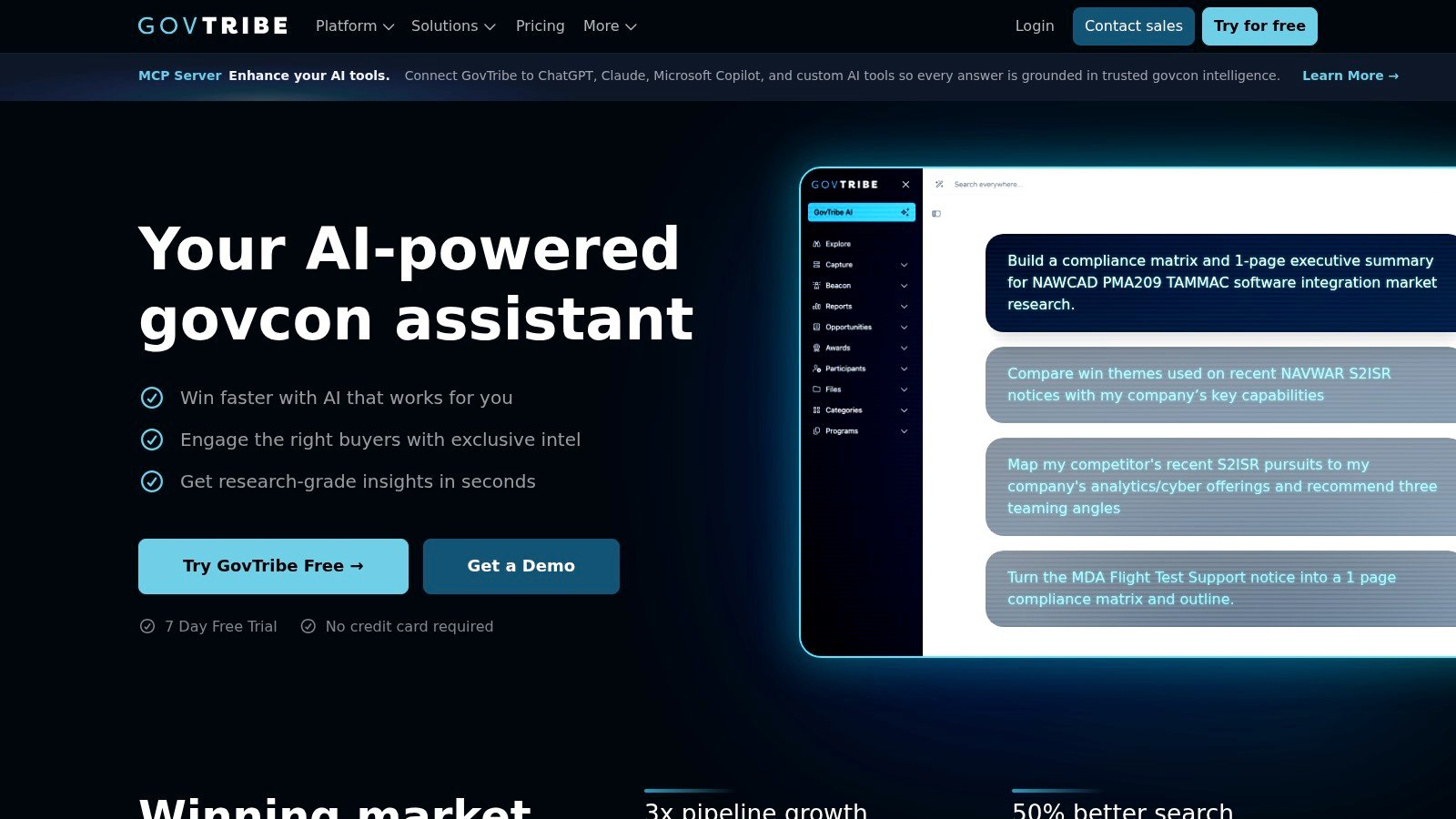
Its AI conversations support research, summaries, and workflow questions. Long-context RFP analysis is particularly useful when a solicitation includes a main document, attachments, amendments, and evaluation instructions. The value is not just a shorter summary. The useful output is a clearer map of scope, deadlines, instructions, and unresolved questions that a proposal lead can assign to the right person.
A strong research layer with visible limits
GovTribe also brings GAO protest intelligence, pricing datasets, and external-assistant connectivity through its Model Context Protocol server. Those connections can support teams already using ChatGPT, Claude, or Copilot, provided the contractor's security and data-handling rules allow that workflow. Automations can reduce repetitive research and synthesis, but they do not remove the need for source validation.
The platform's plan structure and publicly listed pricing options make initial evaluation easier than with quote-only products. The trade-off is usage economics. AI access is credit-based on top of the base subscription, and export limits vary by plan. Heavy users should model how many records, documents, and exports the team will need before treating the entry plan as a realistic operating tier.
GovTribe can make an RFP easier to understand. It cannot make an ineligible vendor eligible.
For teams weighing similar products, this GovTribe alternatives guide is useful context. GovTribe fits a research-heavy capture team that wants clear AI assistance, federal depth, and a growing SLED layer. It may fall short when the buyer needs one environment for discovery, compliance matrices, partner matching, proposal drafting, pipeline management, and post-award work.
5. HigherGov
HigherGov is built for the point where discovery becomes pursuit management. It combines federal and SLED opportunity intelligence with forecasts, alerts, competitor context, partner discovery, and pipeline tools. That makes it a credible choice for a team that already finds bids but loses momentum after the first qualification call.
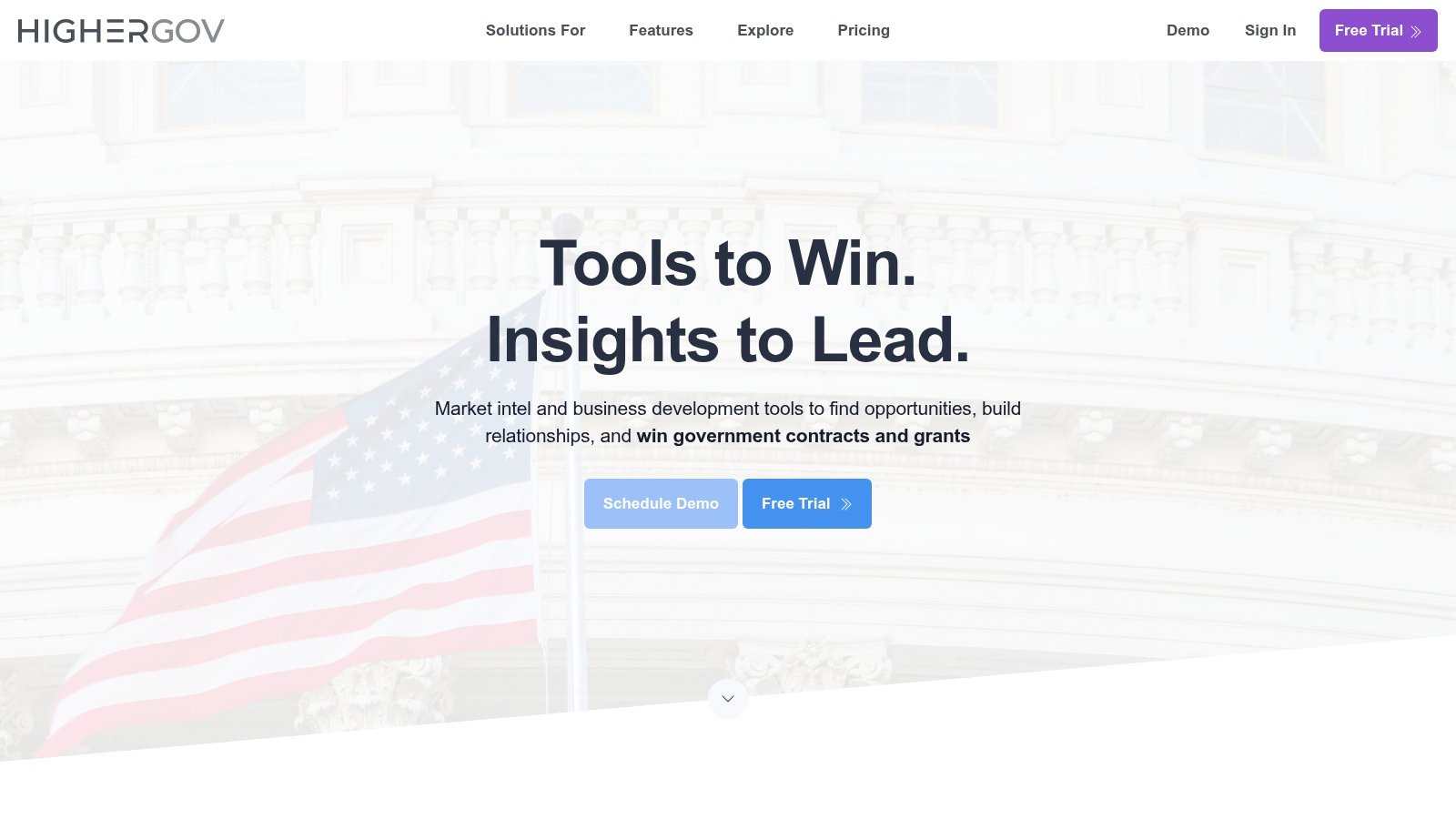
The platform's AI-powered research workflows can help users investigate opportunities and forecasts. Its people and partner database supports outreach when a solicitation needs a capability, vehicle, geography, or past-performance element the prime does not hold alone. Labor-rate analysis and contextual competitor insights add a useful layer to pricing and positioning conversations.
Useful for teams that need follow-through
A City of Miami pursuit illustrates the distinction. Finding the notice is only the beginning. Someone must record the solicitation stage, confirm registration, identify the required forms, assign questions, track addenda, and preserve the final submission instructions. HigherGov's pursuit pipelines, alerts, and team-oriented workflow are aimed at that operational gap.
Its public pricing tiers are a meaningful advantage during evaluation. Multi-user options make it easier to compare the cost of a shared capture process rather than pricing the platform for one power user. Public docs and an API also matter for teams that want to connect search and data to internal applications.
The limitations are practical. Some advanced analyst services are lighter than those offered by legacy market-intelligence providers. Export limits and per-search caps vary by plan, so a team should test a real workflow with representative searches and documents, not just browse the interface.
Teams comparing this category can read about HigherGov alternatives and competitors. HigherGov is a strong choice when your main failure is poor pursuit discipline after discovery. It is not necessarily the deepest option for every federal pre-RFP question or the most complete proposal-generation environment.
6. Govly
Govly is best understood as a market network for contractors, OEMs, VARs, distributors, and primes whose route to public-sector revenue runs through contract vehicles and partner channels. Its AI assistants focus on surfacing opportunities quickly and predicting RFQs, including deals that may be hard to find through a basic solicitation search.
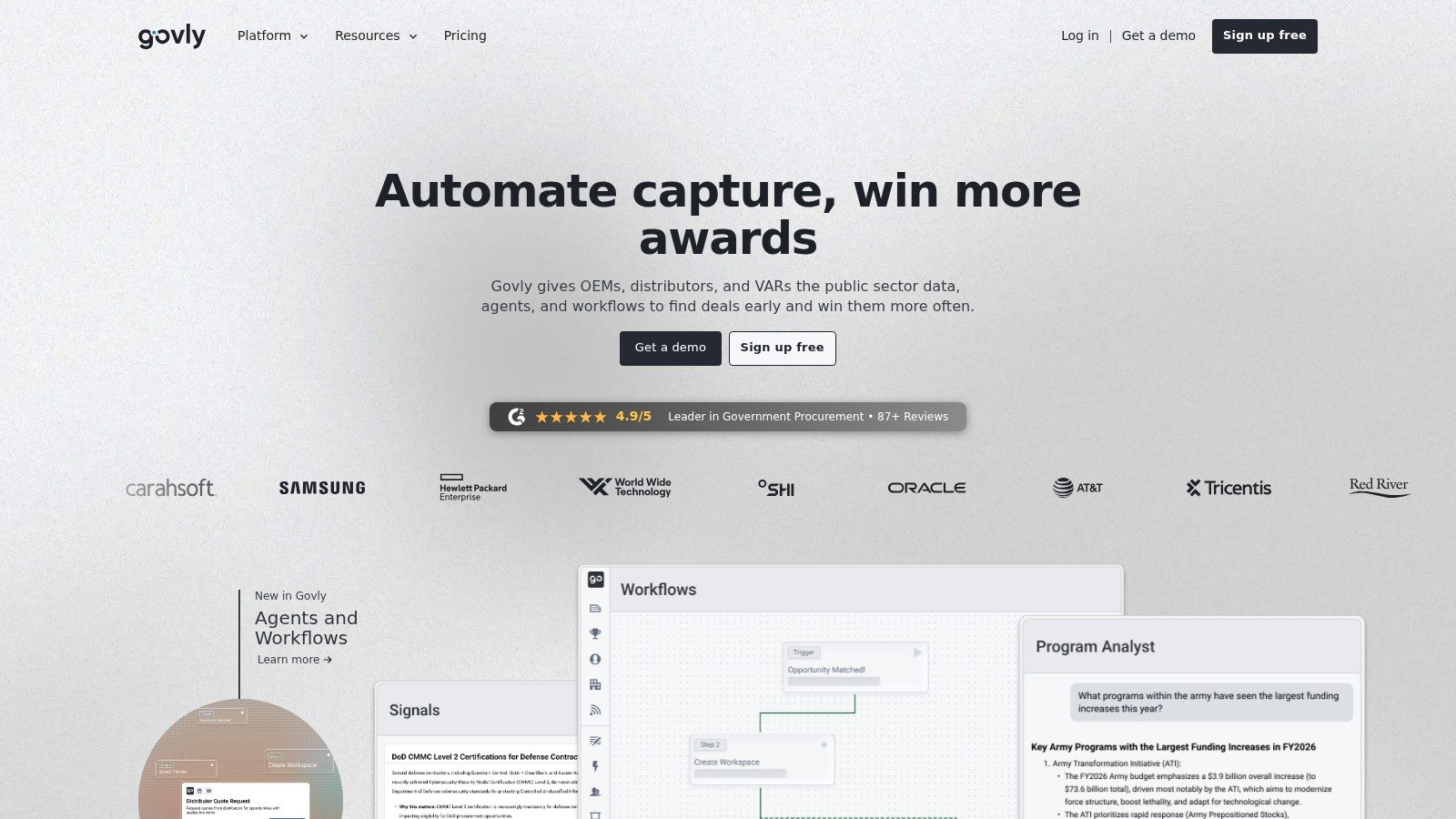
The platform covers 40+ major federal contract vehicles, including GSA, SEWP, and ITES. That vehicle awareness is valuable for technology sellers. A vendor may have the right product but no direct path to the buyer. Govly's discovery workflow can expose task-order and channel opportunities where teaming, distribution, or vehicle access determines whether a pursuit is commercially reachable.
Strong for channel-led pursuits
Govly includes collaboration, workflows, CRM and API integrations, and SLED aggregation alongside federal vehicle coverage. A reseller can use it to coordinate an OEM relationship, keep an opportunity moving through internal stages, and connect research to the systems the sales team already uses. The modern interface and free plan make initial testing accessible.
The limitation is fit. Govly is better suited to IT, OEM, VAR, and vehicle-driven sales motions than to a services-only firm pursuing a municipal professional-services solicitation with extensive staffing and narrative requirements. It may help identify the opportunity and the partner route, but it will not necessarily provide the same depth of compliance mapping or proposal drafting as an end-to-end GovCon system.
A vehicle can open the door, but it does not prove that your team can execute the statement of work.
Advanced and enterprise pricing is available by demo or quote. Confirm whether the package includes the vehicles, SLED sources, collaboration features, and integrations your team needs. Govly belongs on the shortlist when access path and teaming structure are central to bid qualification.
Top 6 AI Tools for Government Contracts, Comparison
| Product | Implementation complexity | Resource requirements | Expected outcomes | Ideal use cases | Key advantages |
|---|---|---|---|---|---|
| SamSearch | Low-Medium, guided onboarding, configurable modules, integrations as needed | Quote-based annual pricing (per-seat + modules); dedicated support | End-to-end GovCon workflows, automated compliance matrices, faster proposal coordination, financing options | Established mid-market and enterprise government contractors | Full GovCon operating system, AI plus analyst verification, enterprise security, partner matching, proven workflow depth |
| Civio.ai | Low-Medium, AI-first workflow, modern onboarding | Pricing by demo or vendor quote | Faster opportunity discovery, qualification, and pursuit coordination | Teams wanting AI-led public-sector bid discovery and qualification | Modern AI workflow, public-sector focus, faster bid triage |
| GovSpend | Low-Medium, UI-based AI, guided prompts | Subscription, confirm modules and AI access | Faster SLED opportunity discovery and bid triage | Vendors prioritizing state and local while monitoring federal | Natural-language search, spend and product-level competitor insights |
| GovTribe | Medium, supports MCP and LLM integrations, long-context tooling | Subscription plus AI credits, export limits by plan | Efficient RFP analysis, summaries, synthesis across long docs | Federal-focused teams needing GAO intelligence and long-context review | Long-context RFP analysis, external assistant connectivity, transparent plans |
| HigherGov | Low-Medium, straightforward onboarding, public tiers | Competitive public pricing, multi-user plans, API | Broad market visibility, pursuit pipelines, pricing analysis | SMBs to enterprise teams needing pursuit management and forecasts | Public pricing, API access, integrated pursuit and pricing insights |
| Govly | Low, modern UX, fast product cadence, free plan available | Free tier, enterprise features by demo or quote | Rapid discovery on federal vehicles, teaming and RFQ prediction | IT, OEM, VAR resellers and primes operating on GWACs and IDIQs | Vehicle and task-order focus, AI RFQ prediction, built-in teaming and CRM integrations |
Build a Repeatable Discovery Routine Before Your Next Bid
The best tool will not rescue an inconsistent process. Start with saved searches organized by NAICS or PSC, target agencies, geography, contract type, and capability language. Federal teams should treat SAM.gov contract opportunities as the official publication source for federal notices. SAM.gov provides public searching and a contract-opportunities API, while forecasts and third-party enrichment should be labeled as supplemental intelligence.
For a City of Miami worked example, begin with the vendor registration and profile requirements on the official procurement site. Search the relevant eProcurement categories, open the complete solicitation record, download every attachment, and record the question deadline, submission deadline, addenda, required forms, insurance terms, certifications, local-preference language, and response method. Do not rely on an AI summary for the final deadline. Verify every eligibility requirement and date directly on the official City of Miami procurement pages before acting.
Use a short bid-no-bid review:
Capability fit: Can your team meet the scope, staffing, place-of-performance, and delivery requirements?
Eligibility: Do your registrations, certifications, contract vehicles, and legal status satisfy the solicitation?
Local preference: Are you eligible for the stated preference, and can you document it?
Commercial fit: Does the historical award or spend context support a realistic price and margin?
Teaming needs: Do you need a local partner, specialized subcontractor, certification, or past performance?
Response control: Can the team assign every requirement, question, attachment, and signatory before submission?
This routine matters because procurement volume is difficult to review manually. Deloitte reported that federal spending rose by an average of 4.5% annually over the decade examined, while contracting actions increased by more than 22% annually. In fiscal year 2022, each federal contracting officer handled approximately 2,000 actions, compared with about 300 in 2013, according to Deloitte's analysis of generative AI in federal procurement. Contractors feel that workload through longer documents, amendments, attachments, and faster internal decisions.
Most platforms in this list quote pricing on request, though some publish plan options or offer a free starting tier. Confirm current costs, AI usage limits, export rules, source coverage, integrations, onboarding, and security terms directly with each vendor. A useful buying test is to run the same real solicitation through two or three finalists and compare the quality of source citations, extracted requirements, partner matches, and handoff into proposal work. Teams that also need structured legal-source evaluation can consult this guide to legal research for law firms.
FAQ
What is the best AI tool for finding government contracts?
The best tool depends on your market, team size, and workflow. For established mid-market and enterprise GovCon teams that need more than alerts, SamSearch stands out because it combines opportunity discovery, capture support, solicitation analysis, partner matching, proposal coordination, and pipeline management in one platform. Teams with narrower needs may prefer a point solution focused on SLED intelligence, federal research, or contract-vehicle discovery.
Which AI tool is best for state and local government bids?
If your pipeline is heavily SLED-focused, tools like GovSpend, Civio.ai, and HigherGov can be useful depending on whether you need spend intelligence, AI-led qualification, or pursuit management. The right fit depends on how much of your process happens before and after the bid is found.
Is SamSearch good for small businesses?
SamSearch is positioned for established government contractors in the mid-market and enterprise segment, not small businesses. Small teams with lighter workflows may want to compare it with lower-complexity tools or products with public entry-level pricing.
Can AI tools write government proposals automatically?
AI can help summarize solicitations, extract requirements, organize compliance tasks, and draft response content, but it should not replace human review. Contractors still need to validate every deadline, eligibility requirement, attachment, and submission instruction against the official source documents and procurement portal.
What should buyers compare before choosing a GovCon AI platform?
Compare source coverage, SLED and federal depth, AI document analysis, partner and teaming workflows, CRM integrations, pricing structure, export limits, onboarding, and security controls. A practical evaluation method is to run the same live solicitation through two or three finalists and compare the accuracy of citations, extracted requirements, and handoff into proposal work.
SamSearch is built for established government contractors in the mid-market and enterprise segment, not small businesses. That distinction should guide the purchase. A municipal-focused intelligence tool may be enough for a lean SLED search motion. A vehicle network may be the right answer for an OEM or VAR. A federal analyst platform may fit a mature capture organization. An end-to-end system makes more sense when the same team must discover, qualify, coordinate, respond, and manage the opportunity.
SamSearch combines federal, state, local, defense, DIBBS, subcontracting, forecast, partner, solicitation-analysis, compliance, proposal, and pipeline workflows in one platform for established mid-market and enterprise government contractors. Visit SamSearch to see how Sammy, analyst-verified intelligence, partner matching, and controlled proposal work can turn your next municipal or federal pursuit into a repeatable operating process.