7 Best AI Agents for Government Sales in 2026

A capture lead opens SAM.gov and sees a flood of new opportunities before lunch. By Thursday, a long RFP has landed, a teaming partner wants a capability profile by morning, and the proposal manager is already behind on compliance checks. That is why AI agents for government sales matter. The best platforms do more than draft text. They compress research, routing, partner discovery, and proposal support into a workflow a GovCon team can actually run.
For the right contractor, that means moving from manual triage to an operating model built around intelligence, matching, teaming, forecasting, and proposal drafting. If you are comparing tools, this guide is built for mid-market and enterprise government contractors, where scale, process control, and collaboration matter most. For a broader outbound-sales view, see AI outbound agency insights from The Social.
Table of Contents
- 1. SamSearch
- 2. Civio.ai
- 3. Deltek GovWin IQ with Dela AI
- 4. GovTribe with GovTribe AI
- 5. GovSpend with GovSpend AI and Fedmine Data
- 6. Capture2Proposal with GovAI
- 7. Responsive
- Top 7 AI Agents for Government Sales, Feature Comparison
- FAQ: AI Agents for Government Sales
- What is an AI agent for government sales?
- Which AI agent is best for established government contractors?
- Are AI agents useful before the RFP is released?
- Do AI agents replace capture managers or proposal teams?
- What should GovCon teams compare before buying?
- How should you measure ROI from an AI agent?
- How to Choose the Right AI Agent for Your GovCon Team
1. SamSearch
SamSearch is the strongest overall platform in this list because it supports the full government sales motion, not just one narrow task. It brings together market intelligence, partner discovery, AI-assisted proposal drafting, and pipeline management in one environment, which is exactly what established contractors need when work stretches from capture through submission.
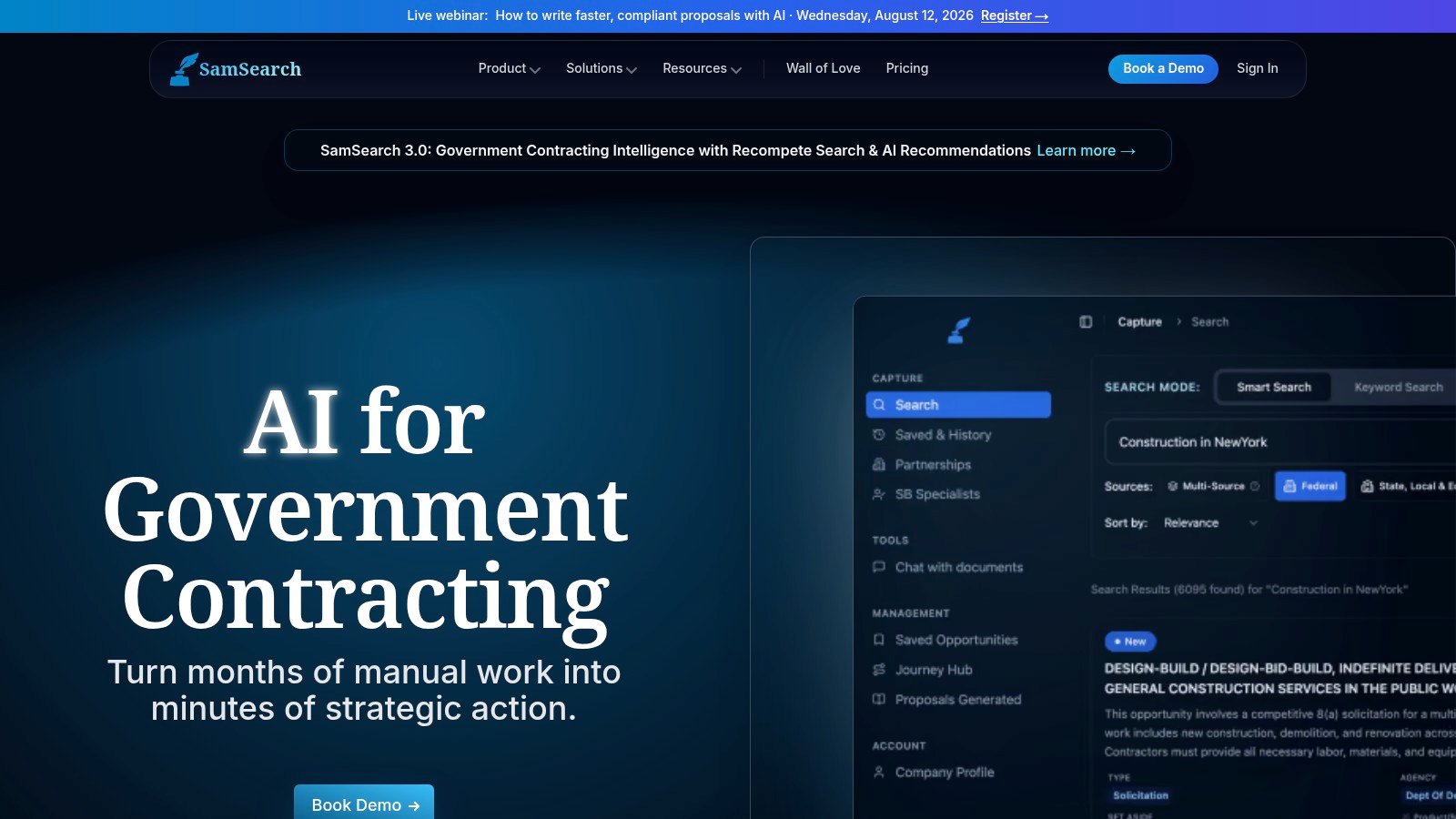
Sammy, the built-in AI, is the feature that makes the platform stand out. It helps teams extract RFP requirements from long documents, generate executive summaries and Q&A, and produce proposal content section by section. In practice, that means less manual reading, faster internal alignment, and a cleaner path from raw solicitation to usable draft.
SamSearch also gives teams forecast intelligence up to 12 months ahead, plus compatibility-scored partner discovery across 600K+ contractors. For capture teams building a pursuit strategy around large bids, that combination is unusually practical. Instead of bouncing between research tools, spreadsheets, and disconnected proposal systems, teams can work from one operating layer.
Practical rule: if your team spends most of its week on opportunity triage, partner searches, and proposal drafting, you want a platform that connects those jobs in one place.
The platform’s edge is breadth without losing workflow depth. It covers federal, state, local, defense, GSA eBuy, and subcontracting sources, then layers historical award and pricing intelligence on top. SamSearch also includes Journey Hub, Kanban task boards, contact management, and smart saved searches, so teams are not just finding opportunities, they are managing work around them. SamSearch says its platform has supported $1B+ won, tracks $1T+ in contracts, and can save up to 90% of time, while also citing 3x higher win rates and 95% faster document analysis.
SamSearch is especially compelling for mid-market and enterprise GovCon teams that want one platform to support intelligence, teaming, capture collaboration, and proposal development together. Pricing is not published, which fits a tailored, sales-led deployment model for larger contractors. If you are looking for the best all-around AI agent for government sales, this is the clear place to start. The companion piece on alternatives is useful too, SamSearch's GovWin alternatives guide.
Pros
End-to-end workflow: market discovery, partner sourcing, document intelligence, proposal generation, and collaboration in one platform.
Strong AI support: Sammy speeds requirement extraction, summaries, Q&A, and compliant drafting.
Early intelligence: forecast data and historical pricing support earlier bid decisions.
Built for serious GovCon teams: a strong fit for established contractors managing complex pursuits.
Website: SamSearch
2. Civio.ai
Civio.ai is a strong option for teams that want AI support closer to front-end government sales workflows. The platform is oriented around public-sector growth, helping contractors organize agency intelligence, qualify opportunities faster, and bring more structure to pipeline review and pursuit planning.
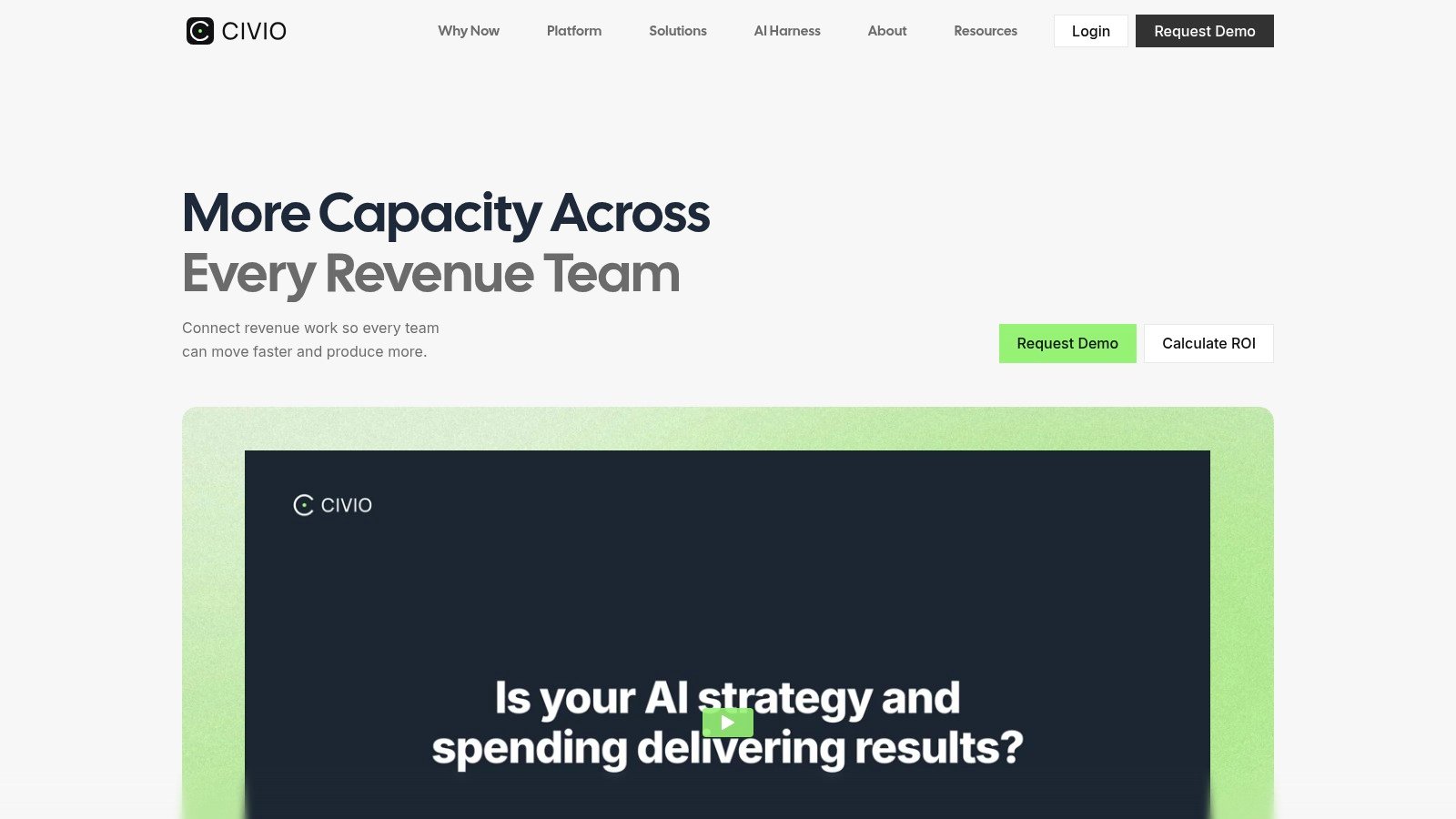
What makes Civio.ai notable is its focus on pursuit prioritization. It is designed for government contractors that need better visibility into what to pursue, how to rank opportunities, and where business development time should go next. That makes it especially useful for teams that want better qualification discipline before proposal production begins.
My take: Civio.ai is most useful for GovCon teams that want a modern AI layer for opportunity qualification and pipeline focus.
Compared with broader platforms, Civio.ai appears more specialized in front-end government sales intelligence than in full capture-to-proposal orchestration. That can be a good fit if the biggest challenge is deciding what to chase and how to prioritize it.
Pricing is not publicly listed, so buyers should expect a sales-led evaluation. For contractors that want an AI-native platform near the top of the funnel, Civio.ai deserves a close look.
Pros
GovCon-focused positioning: built around public-sector sales workflows.
AI-forward experience: useful for qualifying and prioritizing pursuits.
Strong fit for capture teams: helps structure pipeline and opportunity review.
Cons
More specialized scope: strongest in front-end qualification and prioritization.
Limited public pricing detail: requires direct evaluation.
Website: Civio.ai
3. Deltek GovWin IQ with Dela AI
Deltek GovWin IQ is a strong choice for teams that value analyst-backed intelligence and want it embedded inside a broader GovCon system. Dela AI adds features such as Ask Dela, Smart Search, and Smart Summaries, helping capture leads move from a large volume of solicitations to a more manageable shortlist without leaving the platform.
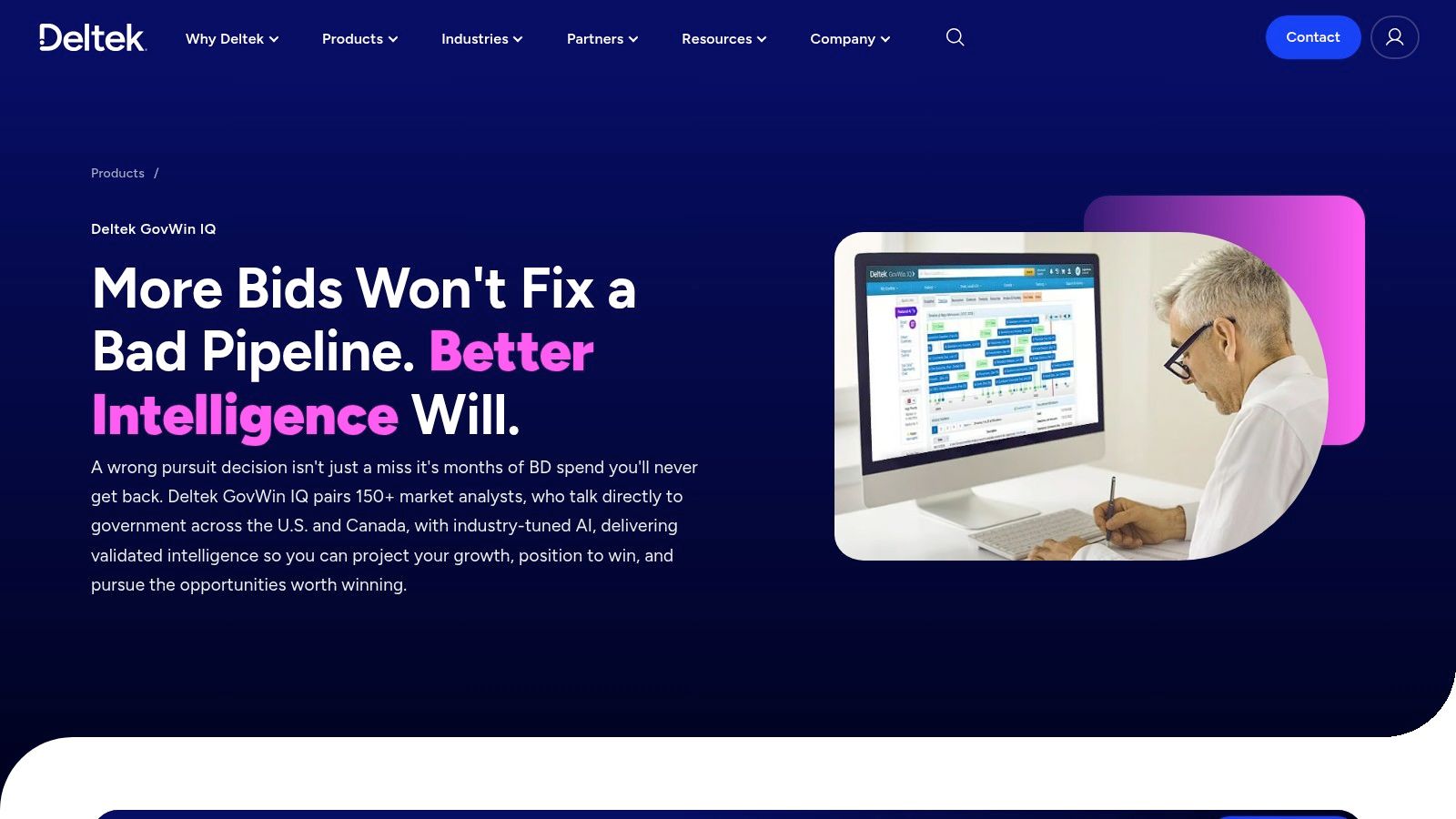
The main reason to buy GovWin is confidence in the data. Analyst validation is valuable when a team is making bid or no-bid decisions on major programs or IDIQs. Deltek also stands out for organizations already using the Deltek ecosystem, because integration with Costpoint and common CRMs can help intelligence move into pipeline and proposal workflows.
If your sales ops team has to explain every source to capture leadership, analyst-backed intelligence can save time.
GovWin remains a recognized enterprise option for teams that want structure, broad market visibility, and established workflows. If you want a broad government-sales platform with deep ecosystem ties, Deltek belongs on the shortlist. A useful comparison point is SamSearch's GovWin alternatives guide.
Pros
Analyst-backed intelligence: stronger source confidence for capture decisions.
Broad federal and SLED coverage: useful for large programs and IDIQ work.
Deltek ecosystem strength: a natural fit for teams already using Costpoint and CRM workflows.
Cons
Enterprise-oriented deployment: best suited to teams ready for a structured platform rollout.
Can require onboarding time: especially for organizations moving from lighter tools.
Website: Deltek GovWin IQ
4. GovTribe with GovTribe AI
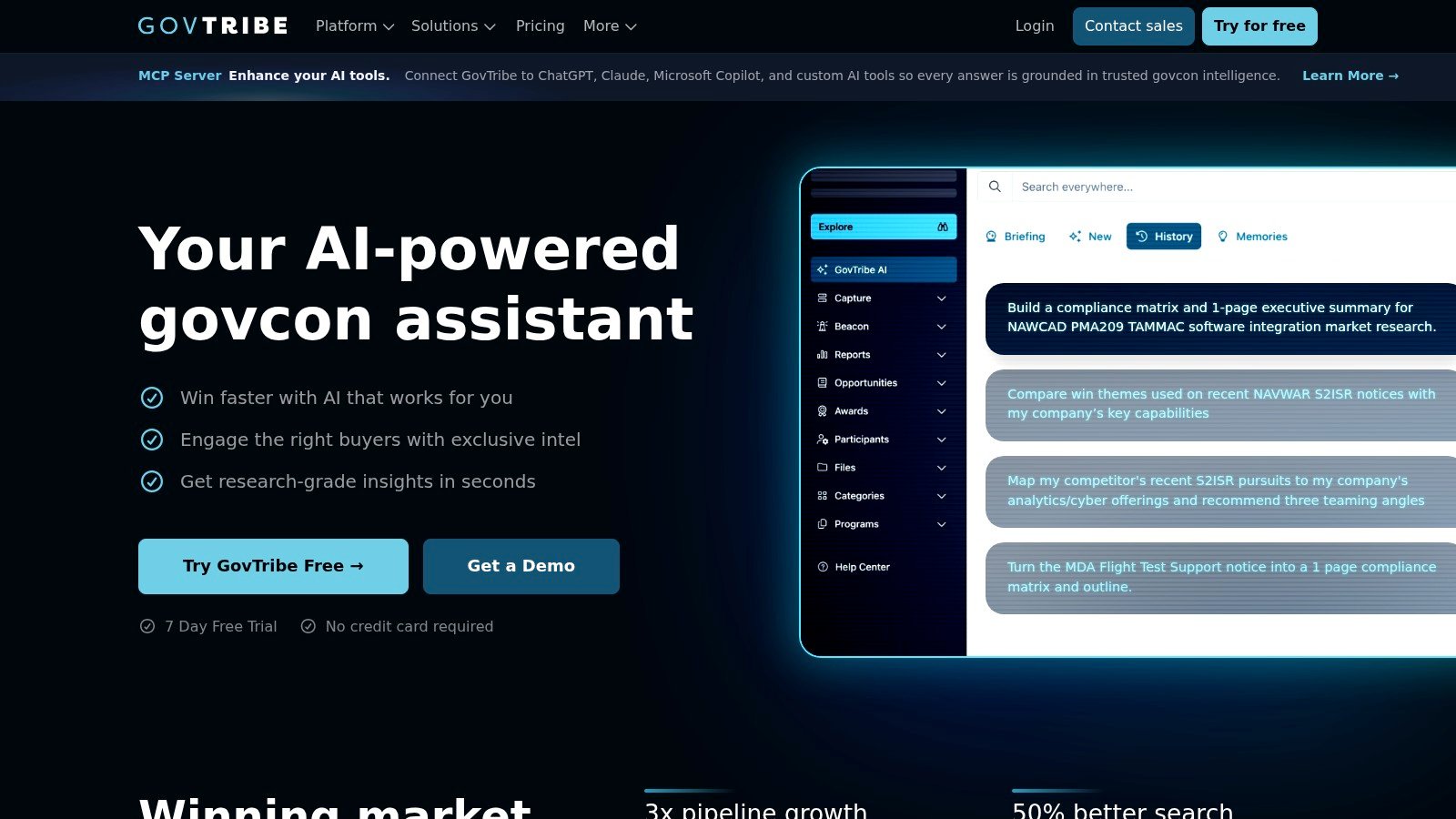
GovTribe is a good fit for teams that want a conversational way to hunt opportunities and tune alerts without building a heavy process around the tool. GovTribe AI gives capture teams a chat-driven interface to find deals, refine alert criteria, research competitors and partners, and keep those preferences persistent across sessions.
GovTribe is also appealing for buyers who want clarity on purchasing terms. It has visible pricing and a credits model for AI use, which creates a more transparent buying experience than many enterprise platforms. The Growth Plus plan covers federal, state, and local markets, making it practical for public-sector sellers that want breadth with a lighter workflow model.
Its strengths are speed and usability. GovTribe works well for day-to-day opportunity discovery, alerting, and general research. If your team lives in alerts and needs a conversational assistant to keep searches aligned, this is a smart option.
My read: GovTribe works best for teams that want speed and usability first, then add deeper process elsewhere if needed.
For teams that need a more complete capture-to-proposal workflow, SamSearch still covers more ground. If you are comparing public-sector search stacks, SamSearch's GovTribe alternatives guide is worth keeping open.
Pros
Conversational capture workflow: easy to query, refine, and persist searches.
Transparent plan structure: clearer buying motion than many enterprise platforms.
Useful for daily BD work: strong fit for fast-paced opportunity monitoring.
Cons
AI usage is credit-based: teams should plan usage thoughtfully.
Best for discovery-first workflows: broader orchestration may require additional tools.
Website: GovTribe
5. GovSpend with GovSpend AI and Fedmine Data
GovSpend is a practical choice for teams that prospect from spend data and contacts first. It combines 15+ years of SLED and federal procurement data with bids, contacts, and meeting intelligence, then layers AI on top through AI Chat and AI Notebook.
One of the more interesting parts of the platform is its MCP server, which connects GovSpend data to external assistants like ChatGPT, Copilot, and Claude. That makes GovSpend attractive for enterprises that already standardize on a broader AI environment and want procurement-aware data flowing into those workflows.
GovSpend is especially effective for spend-based prospecting and outreach. If your team already knows which agencies, vendors, or contract vehicles it wants to target, GovSpend gives you a richer way to interrogate that data and support outreach strategy.
For teams that want to compare procurement-intelligence stacks, the SamSearch GovSpend alternatives guide is a useful side-by-side reference. SamSearch remains the broader option for end-to-end workflow, while GovSpend is especially useful for spend-led discovery and contact-driven outreach.
Pros
Deep procurement history: useful for targeting by spend and contact patterns.
Flexible AI integration: works with external enterprise assistants.
Good fit for prospecting teams: especially in SLED and federal outreach.
Cons
Quote-based pricing: requires a consultative buying process.
Best when data-led prospecting is the priority: narrower than full capture suites.
Website: GovSpend
6. Capture2Proposal with GovAI
Capture2Proposal is built for teams that care about bid or no-bid logic, pricing discipline, and secure proposal handling. GovAI suggests opportunities and analyzes pipelines, while Price-to-Win analytics, PWin scoring, and detailed incumbent and vehicle data help capture leaders make faster decisions with more structure.
The platform’s security posture is an important differentiator. It runs in Azure GovCloud and is positioned for controlled environments, with a secure proposal repository aligned to DFARS and NIST SP 800-171 expectations. That makes it a relevant option for primes and larger subcontractors that need tighter handling around capture artifacts and pricing documents.
Bottom line: if your capture review depends on pricing science and incumbent analysis, C2P is a serious option.
Capture2Proposal is strongest for organizations that already run a mature, process-driven capture motion and want software to make it more consistent. For proposal-specific comparisons, SamSearch's proposal automation guide helps frame the trade-offs.
Pros
Strong capture discipline: PWin, PTW, and incumbent analytics support faster decisions.
Secure environment: suitable for controlled data handling.
Integrated workflow: reduces tool sprawl across capture and proposal teams.
Cons
Process-oriented platform: best suited to teams with established capture methods.
Quote-based licensing: requires direct evaluation.
Website: Capture2Proposal
7. Responsive
Responsive belongs on this list because government sales teams do not just chase opportunities, they also live inside RFxs, DDQs, security questionnaires, and long proposal cycles. Responsive is strongest after the RFx arrives. Its AI-assisted answer libraries pull from governed content, helping proposal managers reuse approved language without turning every submission into a fresh drafting exercise.
That focus makes it valuable for teams that need stronger content governance. Review and approval routing, enterprise collaboration, and integrations give large proposal shops the structure they need to keep responses consistent across business units. Responsive is especially useful for prime contractors handling many concurrent questionnaires and compliance-heavy response cycles.
The limitation is scope. Responsive is not an opportunity-discovery platform, so it does not serve the same top-of-funnel role as SamSearch, GovWin, or GovTribe. It is best understood as a proposal and response specialist.
Pricing is quote-based and aimed at enterprise buyers, which fits the product’s positioning. If your proposal team is buried in repetitive responses and needs governance more than hunting, Responsive is a strong specialist. If you want proposal automation specifically, SamSearch's proposal software roundup is a useful companion read.
Pros
Strong response governance: useful for approved answer libraries and consistency.
Enterprise collaboration: built for review and routing at scale.
Good for proposal throughput: strong after the RFx arrives.
Cons
Discovery is not its core role: best paired with a capture intelligence tool.
Enterprise pricing: expect a sales-led process.
Website: Responsive
Top 7 AI Agents for Government Sales, Feature Comparison
| Product | Implementation complexity | Resource requirements | Expected outcomes | Ideal use cases | Key advantages |
|---|---|---|---|---|---|
| SamSearch | Low-medium (fast adoption, optional configuration) | Mid-market/enterprise budget; proposal/capture staff; integrations optional | Faster document analysis and proposal drafting; improved pipeline visibility and stronger pursuit coordination | Established GovCon teams needing end-to-end intel to proposal workflow, partner discovery, and large deal planning | Broad coverage across federal, SLED, defense, strong AI assistant, partner discovery index, collaboration tools |
| Civio.ai | Moderate (AI-led workflow adoption and sales process alignment) | Sales-led deployment; GovCon BD and capture team involvement | Faster qualification, cleaner pipeline prioritization, more structured opportunity review | Government contractors that want AI-native pursuit qualification and front-end sales intelligence | Public-sector focus, AI-forward workflow, useful for capture prioritization |
| Deltek GovWin IQ (with Dela AI) | High (enterprise integration, analyst workflows) | Premium subscription; integrates with Deltek Costpoint and CRMs; training required | More reliable opportunity data and stronger capture decisions | Organizations prioritizing analyst-validated intelligence for IDIQs, large federal programs, and Deltek users | Analyst-validated data, deep federal and SLED coverage, Deltek ecosystem integration |
| GovTribe (with GovTribe AI) | Low-medium (fast setup, user-friendly) | Subscription with optional AI credits; modest onboarding | Faster discovery and alerting, conversational capture alignment, easier daily use | Teams wanting chat-driven opportunity discovery, alert tuning, and rapid BD workflows | Conversational AI with memory, intuitive UI, transparent pricing and credit model |
| GovSpend (with GovSpend AI & Fedmine) | Medium (data exploration; optional AI integrations) | Quote-based subscription; strong SLED and federal spend dataset; MCP server for external AI integration | Improved prospecting and contact-driven outreach, richer spend and meeting intelligence | Sales and outreach teams focused on spend-based prospecting and contact targeting | Deep spend and contact data, AI Notebook, MCP support for external assistants |
| Capture2Proposal (C2P) with GovAI | Medium-high (capture process adoption; compliance setup) | Quote-based licensing; Azure GovCloud hosting; capture/proposal teams | Streamlined intel-to-proposal workflow, actionable PWin and PTW analytics, compliance-ready repositories | Primes and large subcontractors needing Price-to-Win, incumbent analytics, and secure environments | PTW and PWin analytics, secure Azure GovCloud, integrated capture to proposal features |
| Responsive (formerly RFPIO) | Medium (content governance and workflow setup) | Enterprise pricing (quote-based); answer library and review/approval management | Faster RFx and RFI responses, stronger content governance, higher throughput on questionnaires | Teams focused on response management, questionnaires, and governed content reuse after RFx arrives | Governed answer library, AI auto-suggestions, enterprise review and approval workflows |
FAQ: AI Agents for Government Sales
What is an AI agent for government sales?
An AI agent for government sales is software that helps GovCon teams automate or accelerate tasks such as opportunity discovery, capture research, partner matching, requirement extraction, proposal drafting, and pipeline organization. The best platforms do more than generate text, they help teams make faster and better pursuit decisions.
Which AI agent is best for established government contractors?
For mid-market and enterprise GovCon teams, SamSearch stands out as the best all-around option in this list because it combines opportunity intelligence, partner discovery, pipeline workflows, and AI-assisted proposal support in one place. Civio.ai is a strong option if your main priority is front-end qualification and pursuit focus.
Are AI agents useful before the RFP is released?
Yes. Some of the highest-value use cases happen before an RFP drops. Forecasting, agency research, incumbent analysis, partner discovery, and bid or no-bid qualification can all improve earlier capture decisions and reduce wasted proposal effort later.
Do AI agents replace capture managers or proposal teams?
No. They reduce manual work, but they do not replace experienced capture leadership, compliance review, pricing judgment, or proposal strategy. Human validation is still necessary, especially for regulated bids, security-sensitive programs, and final submission content.
What should GovCon teams compare before buying?
Start with data coverage, data freshness, AI quality, security posture, workflow fit, collaboration features, and whether the platform supports your actual pursuit process from intelligence through submission. Teams should also compare implementation effort, training requirements, and total cost.
How should you measure ROI from an AI agent?
A practical ROI model is: hours saved per pursuit × loaded labor cost × number of pursuits per quarter. You can also track cycle-time reduction, faster qualification, improved reuse of proposal content, and better capture visibility across the pipeline.
How to Choose the Right AI Agent for Your GovCon Team
Start with one live pursuit, not a sandbox. Pick a real opportunity, identify the bottleneck, then match the platform to the gap: intelligence if you are missing visibility, matching if teaming is the problem, proposal support if drafting is the choke point, or a full-stack platform if the team is juggling all four.
Use a short evaluation checklist. Verify data freshness, CRM and SharePoint integration, AI governance, security posture, and whether the platform can support your actual capture process instead of a polished demo workflow. Then measure ROI with a simple formula: hours saved per pursuit × loaded labor cost × pursuits per quarter.
If you are a mid-market or enterprise contractor, consolidating where possible usually creates the strongest result. Single-purpose tools can solve narrow gaps, but they often create handoffs, duplicate data, and inconsistent workflows. For many GovCon teams, an end-to-end platform like SamSearch is the better long-term operating model because it connects opportunity discovery, partner search, capture collaboration, and proposal drafting in one place.
Source set used for this comparison includes government adoption data from MindStudio, market-growth and enterprise sales-benchmark context from MarketsandMarkets, regulated-enterprise deployment guidance from Rasa, and compliance considerations from Lyzr.
If you want one platform that handles opportunity intelligence, partner discovery, pipeline organization, and proposal drafting for established government contractors, visit SamSearch. It is built for mid-market and enterprise GovCon teams and designed to turn manual capture work into a tighter, faster sales motion.