9 Best GovCon Software Platforms for 2026

A capture manager discovers a promising recompete in an inbox, a proposal lead stores the solicitation in a shared drive, an executive checks a spreadsheet before the pipeline meeting, and delivery leaders work from CRM records that nobody has updated. The contractor has already purchased a powerful platform, yet the buying decision hasn't changed how people work. Capture managers, proposal writers, executives, and delivery teams keep using the tools they trust because the new system doesn't fit their handoffs, permissions, or review habits.
That's why the best GovCon software platform isn't automatically the one with the largest database or the most impressive AI demo. It has to match the way your organization qualifies work, assigns ownership, builds teams, drafts responses, manages compliance, and reports decisions. This comparison focuses on established government contractors, especially mid-market and enterprise organizations managing complex pipelines, rather than treating every buyer as a small business with a simple opportunity feed.
The practical test is adoption. Map stakeholders, prioritize use cases, design a controlled pilot, connect existing systems, define measurable outcomes, train users by role, and establish governance before scaling. Vendor claims, official product materials, customer evidence, and implementation observations should be checked and dated before procurement.
Table of Contents
- 1. SamSearch
- 2. Civio.ai
- 3. Deltek GovWin IQ
- 4. Bloomberg Government
- 5. Federal Compass
- 6. GovTribe
- 7. Capture2Proposal
- 8. BidPrime
- 9. HigherGov
- 2026 GovCon: Top 9 Platform Comparison
- Turn a Software Shortlist Into an Adoption Roadmap
- GovCon Software FAQ
- What is GovCon software?
- Which GovCon platform is best for mid-market and enterprise contractors?
- What should I evaluate during a GovCon software pilot?
- Is GovCon software only for federal contractors?
- How important are integrations?
- Can AI replace capture managers or proposal teams?
- How much does GovCon software cost?
- What is the biggest implementation risk?
1. SamSearch
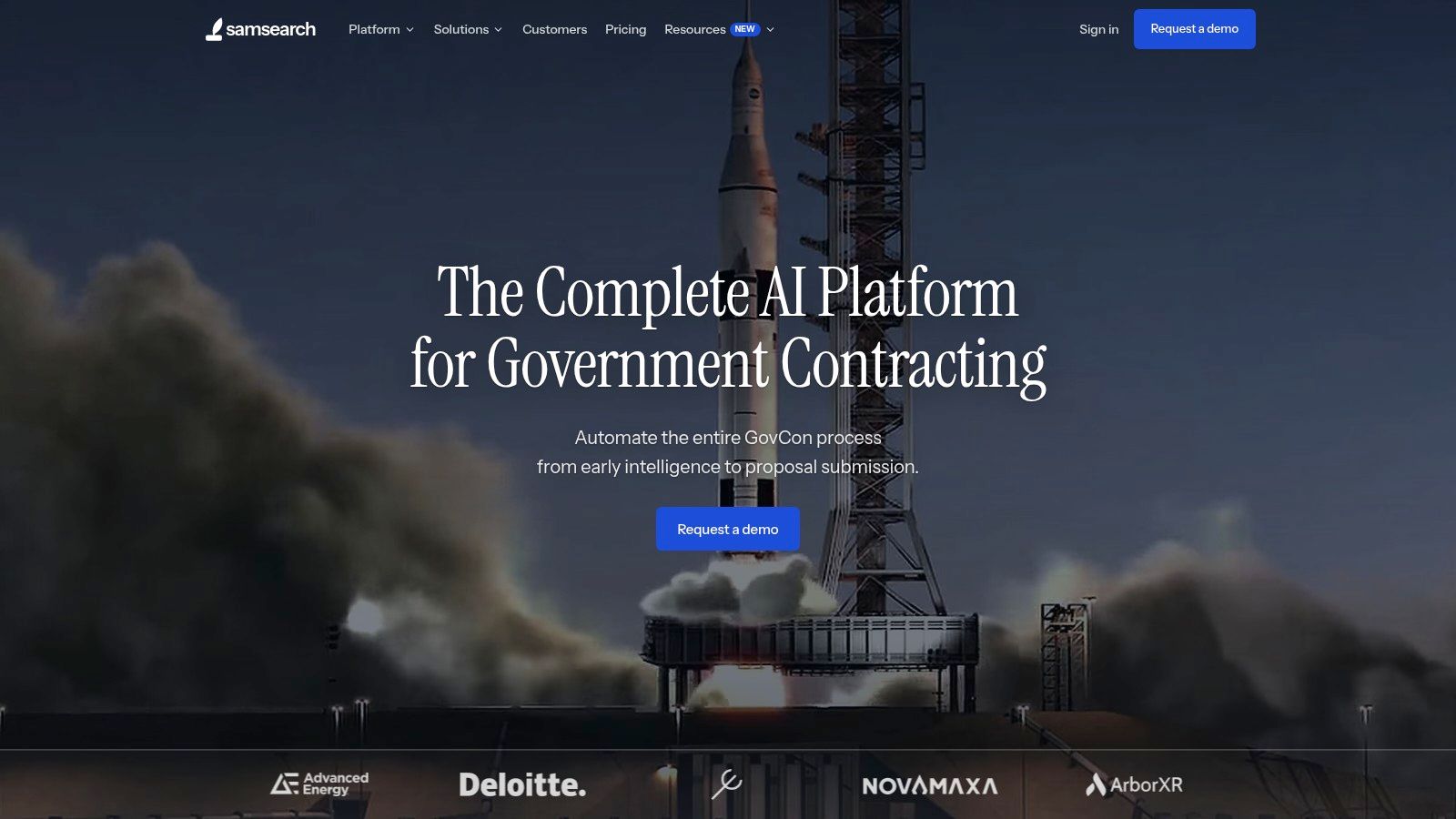
SamSearch fits an established contractor that wants one AI-led operating layer from market intelligence through proposal execution. It is built for mid-market and enterprise government contractors, not small businesses or solo operators, and the key question is whether capture, BD, proposal, and leadership teams will work from the same system instead of keeping parallel spreadsheets alive.
The platform brings together opportunity discovery, qualification, pipeline management, compliance analysis, proposal drafting, partner discovery, and financing introductions. Its coverage spans federal, state and local, DIBBS, subcontracting, SBIR and grants, and Canadian public-sector sources. That breadth matters for contractors whose growth plan runs across multiple channels, especially when teams need early buying signals and recompete visibility instead of a feed of already-obvious solicitations.
SamSearch's built-in AI, Sammy, is designed to read solicitations and attachments, extract SOW requirements, create cited compliance matrices, and draft section-by-section responses from approved content and past performance. Human review still has to happen before submission. AI can reduce document handling and first-draft effort, but the proposal manager still owns accuracy, evidence, responsiveness, and final approval.
Where SamSearch earns its place
The differentiator is the link between decisions and execution. Journey Hub, Kanban and task boards, contact management, saved searches, and two-way CRM synchronization with Salesforce, HubSpot, and Pipedrive give teams a path from qualified opportunity to owned work. Slack and Microsoft Teams integrations can cut down the status-chasing that usually happens in separate channels.
Partner discovery is more operational than a static directory. SamSearch says teams can search 600K+ contractors and score compatibility using NAICS, PSC, past performance, and set-aside information. That helps a prime move from “we need a cyber partner” to a more structured shortlist, though the team still has to verify availability, relationships, contract vehicles, and proposal roles.
The security posture is aimed at organizations with serious procurement requirements, including SOC 2 Type II, an independent CPA audit, a third-party VAPT A+ rating, US-only hosting, SAML 2.0 SSO, and an explicit position that customer documents are not used to train shared AI models. Pricing is annual and quoted by seat, module, team size, and market coverage, so procurement should request a scenario-based quote instead of comparing a headline license price.
Practical rule: Pilot SamSearch with one live pursuit, one capture owner, one proposal manager, and one executive reviewer. If the system does not improve the handoff between those roles, adding more seats will not fix the process.
SamSearch describes rapid onboarding, with a workspace live on Day 1, a team session on Day 3, production by week 1, and a dedicated expert. Treat those as vendor implementation commitments, not independent validation, and verify them against data preparation, SSO, CRM, and security review requirements. The platform also promotes financing introductions of up to $100M against awarded contracts, which may matter to contractors whose growth is constrained by working capital, but financing terms and eligibility require separate diligence.
For a broader look at the category, see this guide to government contracting software. Pros: end-to-end AI capture-to-proposal workflows, broad market coverage, partner matching, CRM and collaboration integrations, enterprise security controls, and a capture-to-cash orientation. Cons: custom annual pricing requires a sales conversation, implementation still needs internal ownership, and the platform may be more capability and cost than a very small business needs. Confirm current product and procurement details directly with the vendor before requesting a quote.
2. Civio.ai
Civio.ai fits GovCon teams that want AI support for opportunity analysis, capture decisions, and proposal preparation without forcing users into a purely feed-driven workflow. Its appeal is strongest for organizations that want faster document review, cleaner pursuit intelligence, and a more structured path from solicitation intake to team action.
The platform is geared toward helping contractors process government opportunities, interpret requirements, and organize next steps across the business development lifecycle. That makes it relevant for teams that are less concerned with owning the largest raw database and more concerned with how quickly they can turn procurement information into an actionable capture plan.
In practice, Civio.ai should be evaluated on whether its AI outputs reduce manual reading and summarization work for capture and proposal teams. A fast summary is useful only if the team can trust what was extracted, trace it to source documents, and convert it into assignments, reviews, and response planning.
Where Civio.ai fits best
Civio.ai belongs near the top of the list when a contractor wants to improve the speed and quality of early-stage opportunity assessment. That can help BD and capture teams screen more notices, identify likely fit faster, and spend more time on pursuits that justify executive attention.
A smart pilot would use one active opportunity and test the full review path. Upload the solicitation package, compare the platform's extracted requirements against a human review, assign follow-up actions, and check whether the resulting output helps the proposal lead and capture owner make better decisions with less friction. If the output still has to be rebuilt in email, spreadsheets, or another workspace, the efficiency gain is smaller than it looks in a demo.
Buyers should also verify how Civio.ai handles integrations, permissions, document security, exports, and collaboration because those details determine whether the system can live inside an enterprise GovCon environment. Pros: AI-centered workflow support, faster document interpretation, and practical value for capture and proposal teams. Cons: commercial details may require direct sales engagement, and teams should validate workflow depth, source coverage, and governance controls against their real operating model. Review current platform details directly at Civio.ai.
3. Deltek GovWin IQ
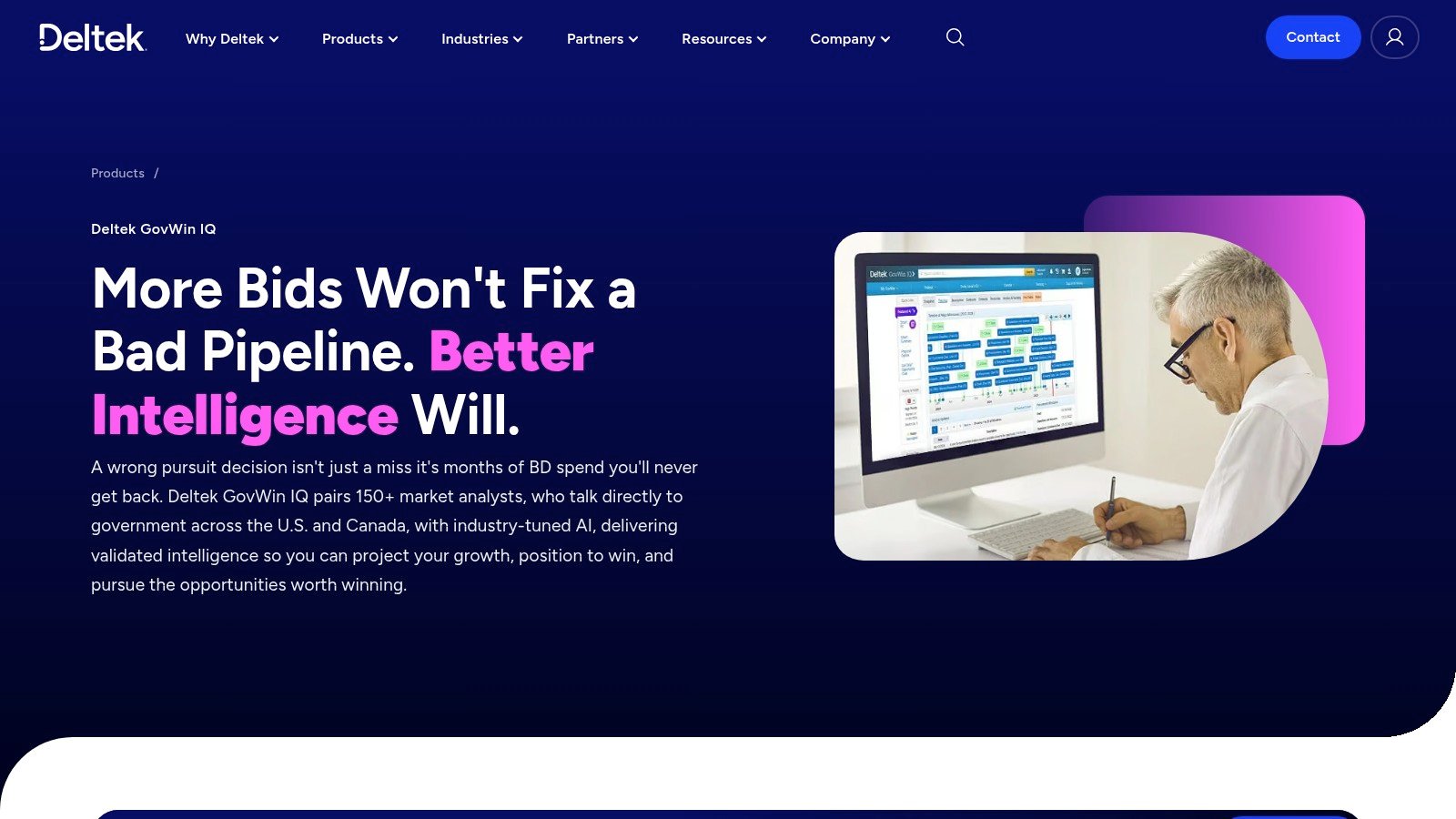
Deltek GovWin IQ is a strong choice when analyst-vetted opportunity intelligence is the main bottleneck. It serves capture and BD organizations that need federal and SLED forecasts, agency context, recompete visibility, award histories, incumbent information, and competitive research before an opportunity reaches the final solicitation stage.
The platform's analyst-curated approach is its central trade-off. Human research can reduce the noise that scrape-only systems create, particularly for organizations with formal account planning and capture gates. It also means the platform works best when users understand how to interpret forecasts, analyst notes, procurement timing, and historical award data. A team that expects a search box to replace capture judgment may underuse the product.
Best fit for a Deltek-centered operating model
GovWin IQ becomes more compelling for contractors already invested in Deltek systems. Connections with Deltek ERP and CRM tools, including the Costpoint and GovWin IQ connector, can reduce friction when a qualified opportunity needs to move into a broader operating environment. The integration doesn't remove the need to define field ownership, stage rules, or duplicate-record handling. Those decisions belong in the implementation plan.
SLED coverage is another practical strength for sellers operating across multiple jurisdictions. Federal-first platforms can leave state and local teams dependent on separate research habits, while GovWin IQ's mature SLED orientation supports a more unified pursuit process. Buyers should still test coverage in their target agencies and contract categories rather than assuming broad market language means equal depth everywhere.
Pricing is quote-based and positioned at a premium enterprise level. Independent 2026 market research places enterprise platforms including GovWin IQ, Bloomberg Government, and HigherGov in the roughly $5,000 to $20,000+ per year range, while lower-cost mid-market tools are commonly priced around $39 to $100 per month. Those figures are market estimates, not a Deltek quote, so procurement should confirm the actual package, user model, data scope, and implementation services. The comparison with GovWin IQ alternatives is useful when your team wants intelligence without committing to a larger Deltek ecosystem.
Pros: deep analyst support, strong federal intelligence, mature SLED coverage, award and incumbent research, and native Deltek alignment. Cons: premium procurement, a process-heavy experience for immature BD teams, and less end-to-end proposal automation than an AI-native platform.
4. Bloomberg Government
Bloomberg Government, commonly called BGOV, fits an enterprise team that needs to connect procurement intelligence with policy, legislative, and regulatory context. That combination is useful when a market strategy depends on more than contract notices. Agency priorities, authorization activity, regulatory movement, and budget direction can influence where a contractor invests capture resources.
BGOV's advantage is contextual depth. A federal account executive can research procurement activity while tracking the policy environment that may shape demand. Strategy leaders can use that combined view for account planning, competitive positioning, and price-to-win discussions. The platform is less naturally suited to a contractor whose main requirement is broad SLED discovery or a lightweight opportunity feed.
Adoption depends on the strategy team
BGOV tends to create value when a designated intelligence owner translates information into account actions. Without that role, users may read policy updates and procurement analysis without recording implications in the CRM or assigning capture tasks. The implementation should therefore include a recurring workflow: identify a signal, connect it to an account or opportunity, record the implication, assign an owner, and review it at the next pipeline meeting.
Salesforce integration can help operationalize that process. It won't automatically create a disciplined capture culture, though. Administrators should define which intelligence becomes a CRM activity, which belongs in an account brief, and which is retained as background research. Executives also need a reporting view that separates meaningful strategic signals from routine content consumption.
BGOV draws on Bloomberg's newsroom, data, research, and industry reporting. Buyers should validate the specific federal agencies, policy areas, user roles, export requirements, and retention controls that matter to their business. Public pricing isn't listed, and the platform is designed for enterprise procurement rather than small-team experimentation.
For a broader comparison of intelligence categories, use this guide to government contract intelligence platforms. Pros: strong policy and procurement combination, enterprise support, and useful context for federal account strategy. Cons: enterprise-oriented pricing, limited public pricing transparency, and a federal focus that may not serve contractors whose growth depends heavily on SLED, DIBBS, subcontracting, or international public-sector channels.
5. Federal Compass
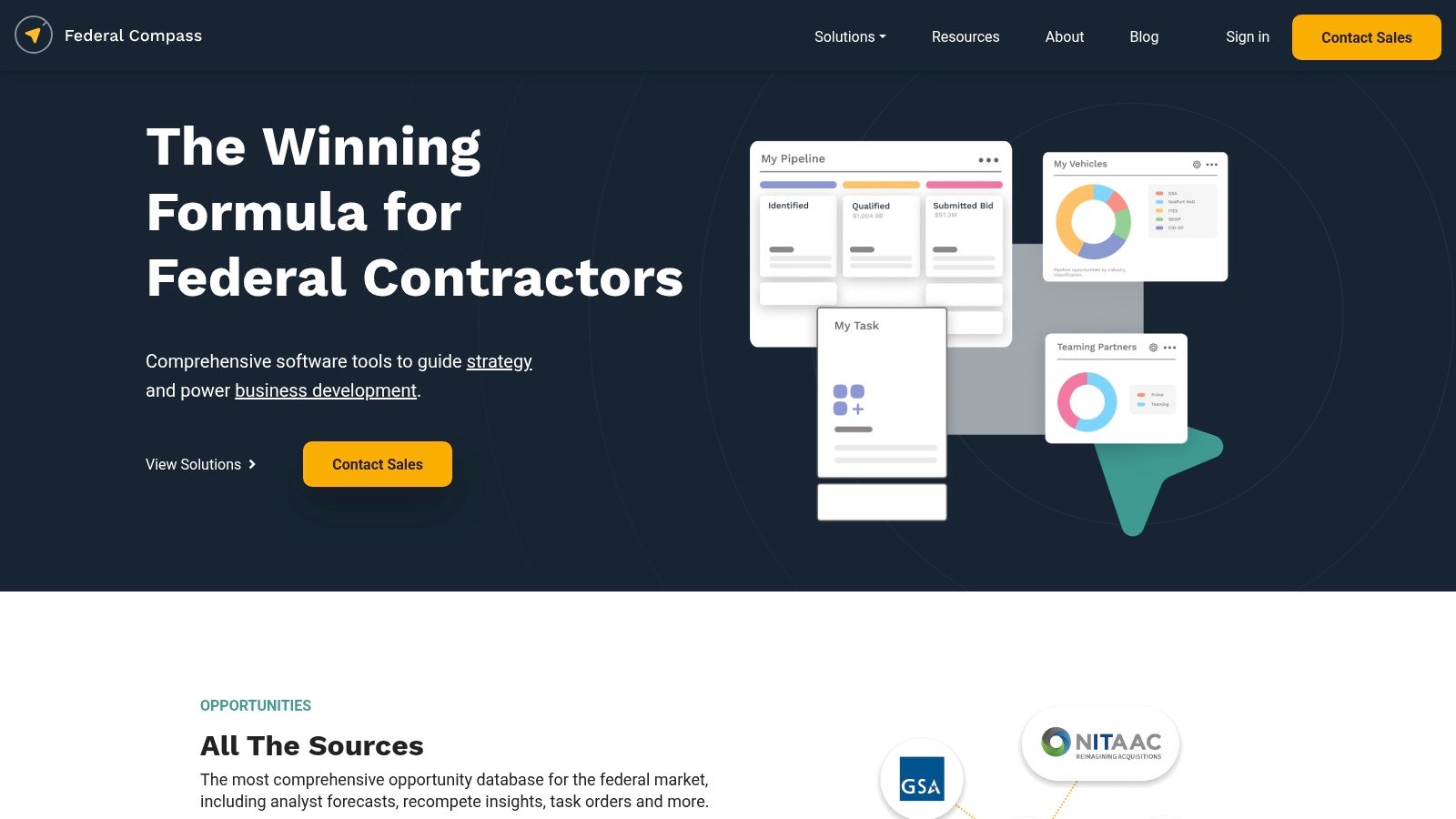
Federal Compass is built for organizations that want to connect opportunity sourcing, pipeline management, task-order tracking, teaming, and research in a practical BD workspace. Its structure is especially relevant to contractors managing large vehicles, task-order pursuits, and partner relationships where the opportunity record is only the beginning of the work.
The platform's flow from sourcing to pipeline to task orders can reduce tool sprawl. That's valuable when a capture manager currently exports notices into a spreadsheet, tracks tasks in a project tool, and maintains teaming information in email. Federal Compass also includes forecasts, recompetes, task-order data, competitor analysis, contact discovery, and state and local coverage.
Test the handoff, not just the search
A useful pilot should begin with a real vehicle or task-order pipeline. Ask users to identify a forecast, qualify it, attach competitors and potential partners, assign capture actions, and report status to leadership. The point isn't to confirm that each feature exists. It's to see whether the team can complete the workflow without re-entering core information across systems.
Wayfinder AI supports assisted research, but AI-assisted research still needs a defined review standard. Capture leaders should document what counts as an acceptable source, how users record uncertainty, and when a human must validate an incumbent, contract vehicle, or forecast date. That governance matters more than a generic AI label.
Federal Compass positions itself as US-owned and operated, which may be relevant to domestic data-handling requirements. Procurement teams should confirm hosting, access controls, SSO, data exports, API availability, retention, and the exact security terms in the current agreement. Pricing isn't public and requires sales engagement, so include implementation and integration effort in the total-cost comparison.
The platform is strongest for federal growth teams that want BD execution attached to intelligence. SLED is present but not the center of gravity. Contractors with a heavily state and local pipeline should validate geographic depth before selecting it. Pros: connected sourcing and pipeline workflows, task-order management, teaming tools, and assisted research. Cons: quote-based procurement, federal emphasis, and the possibility that broader enterprise CRM or proposal requirements still need adjacent systems. Teams comparing capture workflows can also review capture management software for government contractors.
6. GovTribe
GovTribe appeals to capture practitioners who value speed, clear navigation, and a short path from opportunity discovery to team action. Its contractor-first design can help BD teams ramp quickly, particularly when the alternative is a complex enterprise platform that requires extensive administration before users see useful results.
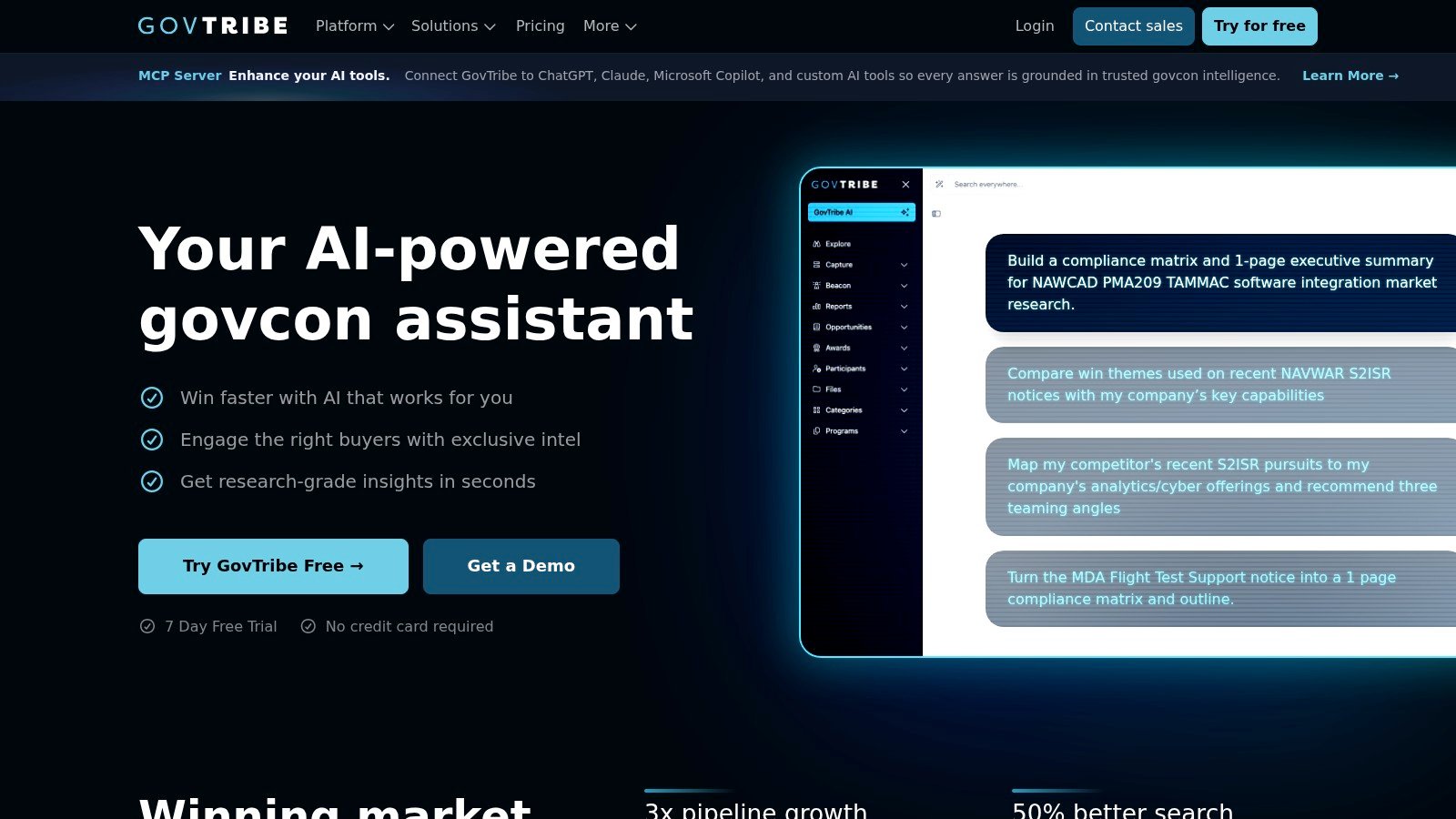
The core experience includes opportunity tracking, capture pipelines, collaboration, and team workflows. GovTribe has also expanded AI assistants and AI and MCP capabilities through a credit model. That structure creates a useful control for buyers who want advanced AI available without making every user a heavy consumer, but it also creates a budgeting issue. Heavy usage can turn an apparently straightforward subscription into a less predictable monthly cost.
Keep the AI budget visible
During a pilot, track which roles consume credits and which actions create measurable value. A capture manager may use AI for research and qualification, while an executive may need only dashboards and alerts. Proposal staff may value document analysis more than general opportunity conversation. Set role-based limits and review consumption alongside adoption, not after the renewal quote arrives.
GovTribe's usability is a genuine strength for organizations that need broad practitioner participation. A clean interface makes it easier to train new users, but ease of use can also hide the need for governance. Define opportunity stages, required fields, qualification criteria, and ownership rules before opening the system to every BD stakeholder. Otherwise, the platform may become another place where teams record inconsistent pipeline data.
The trade-off against analyst-led tools is clear. GovTribe emphasizes fast updates, practical workflows, and modular AI, while premium intelligence platforms may provide more analyst notes and deeper contextual interpretation. Neither approach is universally better. A contractor with strong internal market expertise may prefer speed and control. A contractor building a new capture function may need more guided intelligence.
Pros: fast ramp, approachable workflow, flexible AI consumption, and practical capture collaboration. Cons: credit-based AI costs can be difficult to forecast, and teams seeking extensive analyst commentary may find less depth. Review current plan details and workflows through GovTribe, then compare it with GovTribe alternatives against your actual pursuit process.
7. Capture2Proposal
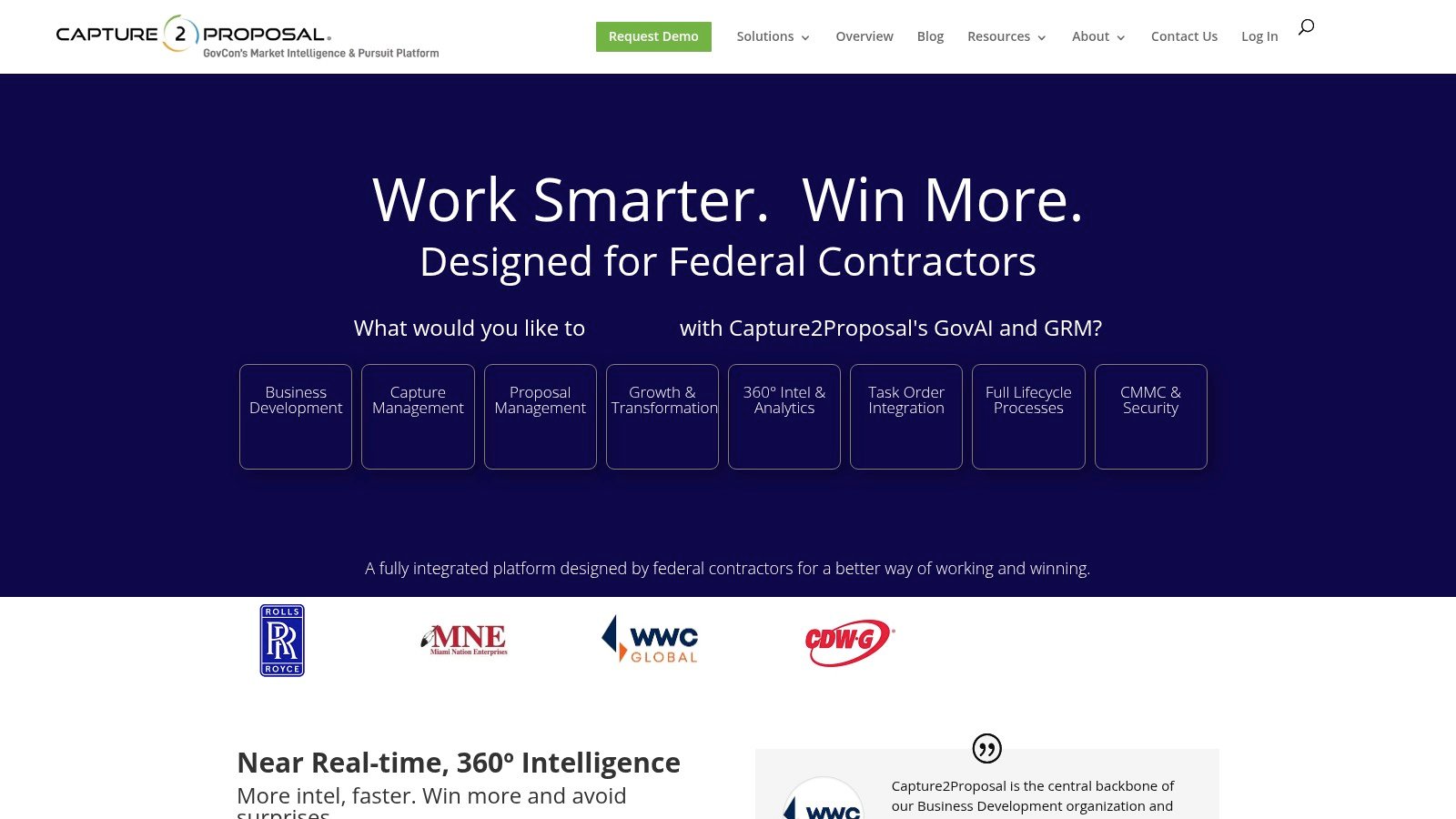
Capture2Proposal, or C2P, is aimed at federal contractors that want a shared workspace for capture, proposal collaboration, content, teaming, analytics, and reporting. The product makes sense when handoffs between BD and proposal teams create more risk than the absence of another opportunity source.
Its model brings the capture pipeline and proposal library closer together. That can help a proposal manager understand why an opportunity was pursued, which win themes matter, who owns each response, and which approved materials are available. It also gives leadership a more coherent view of pursuit status than a series of disconnected spreadsheets and folders.
Security should shape the pilot design
C2P operates in Microsoft Azure Government and Microsoft 365 GCC High environments and describes controls aligned with CMMC expectations. Those claims should be reviewed against your contract obligations, data classification, identity architecture, incident requirements, and security assessment process. A security label doesn't replace your organization's own authorization and vendor-risk review.
Use a pilot that includes a real proposal library, not only a clean demo workspace. Import approved content, identify duplicate or stale answers, assign owners, and test how reviewers locate evidence under deadline pressure. The result will show whether the platform reduces search and coordination friction or just gives the same content a new home.
C2P is primarily federal-focused. Contractors with substantial SLED work should confirm source coverage, reporting, and workflow support before treating it as a company-wide platform. Buyers should also clarify pricing, data migration, user roles, reporting limits, integrations, retention, and support because commercial details are generally gated through sales.
Pros: one capture and proposal workspace, GovCon-oriented security posture, teaming support, and federal reporting. Cons: quote-based procurement, federal emphasis, and the need to verify how well it connects with an existing CRM, content repository, or ERP. It's a credible choice when the central problem is capture-to-proposal continuity rather than multi-market opportunity breadth.
8. BidPrime
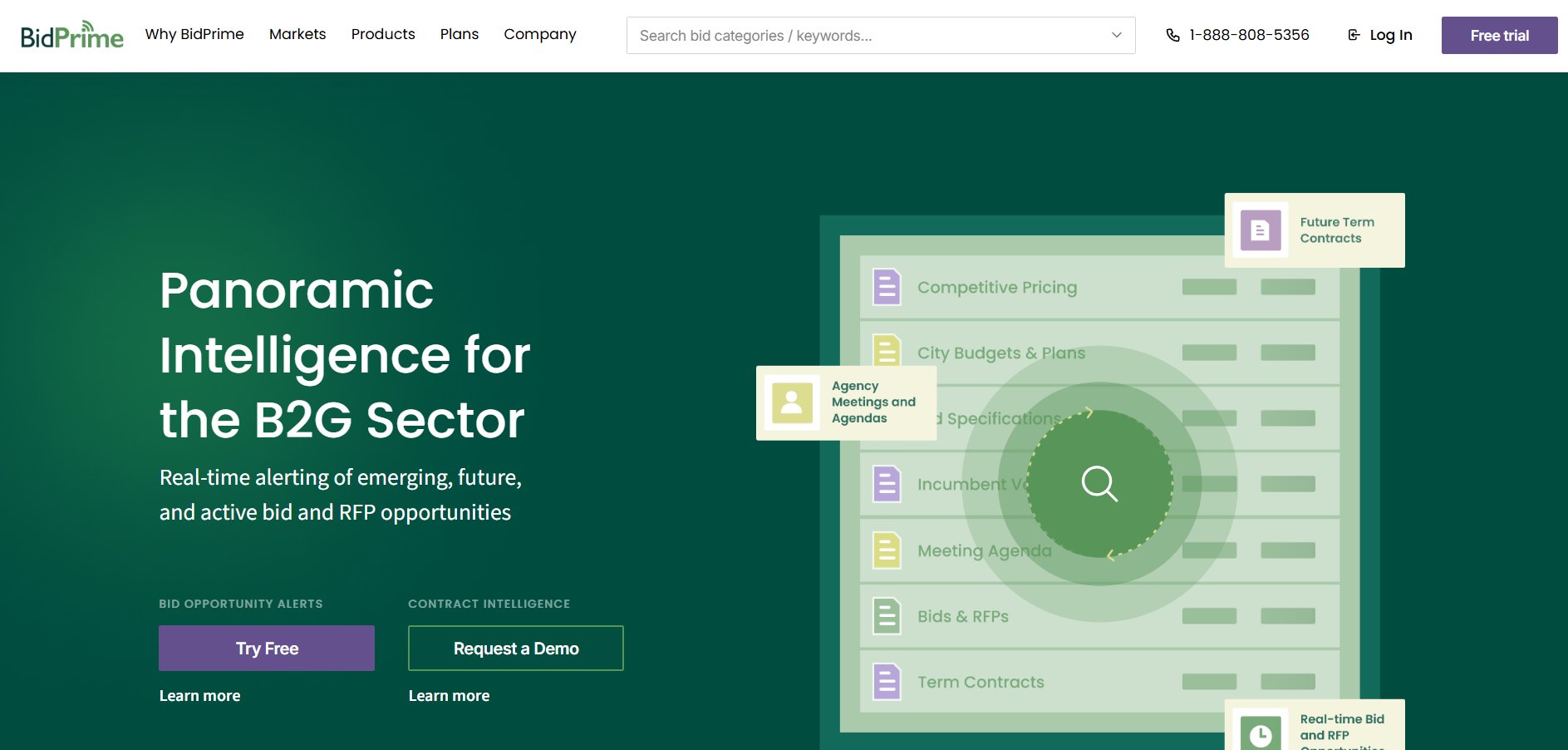
BidPrime stands out for contractors with substantial state and local opportunity volume. Its coverage spans municipalities, transportation, utilities, education, healthcare, and federal data, making it relevant to multi-state sellers whose teams need more than a federal procurement lens.
The platform's document-level search is particularly practical. Features such as Docs on Demand, DocView, and DocSearch help users retrieve solicitation documents, addenda, and award material for compliance checks and competitive research. Historical analytics and line-item search can help a team examine specifications and previous awards rather than relying only on a notice title or summary.
Design the integration around routing
BidPrime supports Salesforce, Zapier, API, and webhooks. The implementation question is how those connections should route work. A small SLED notice may need an alert and qualification queue, while a strategic transportation opportunity may need account assignment, partner research, and executive review. Define those paths before enabling automation.
The platform's taxonomies and interface may feel different to teams accustomed to federal-first tools. That isn't necessarily a weakness. SLED procurement has different agency structures, document patterns, terminology, and publication habits. Federal-heavy teams should budget for onboarding and test searches against the states, metros, agencies, and verticals they pursue.
Premium data options and integrations may be add-ons, so buyers should confirm the full commercial scope. Ask whether the package includes the document depth, historical access, API rights, user roles, alerting, and support model required by your operating process. Pros: strong SLED depth, document retrieval, historical research, and automation hooks. Cons: onboarding may be needed for federal-heavy teams, and add-on pricing can complicate total cost.
BidPrime is best used when its data feeds an owned qualification process. It won't decide which opportunities fit your delivery capacity, past performance, contract vehicles, or teaming strategy. Those decisions still require capture leadership and a clear bid/no-bid framework.
9. HigherGov
HigherGov fits contractors that want a more data-forward approach to federal opportunity tracking, agency visibility, and pipeline prioritization. Its value is strongest for BD and capture teams that need to reduce noise, monitor accounts, and focus attention on the opportunities most likely to justify pursuit.
The platform is often evaluated for its ability to centralize search, alerts, historical award context, and account intelligence in a way that helps teams move faster than manual research. For organizations with lean capture staff, that can improve timing and reduce the number of opportunities that are noticed too late to shape.
Use it to improve timing and focus
A practical HigherGov pilot should center on account and pipeline discipline. Define a target agency set, monitor new activity, compare platform alerts with the team's current process, and evaluate whether users can identify better-fit opportunities earlier. The point is not just to confirm that more records are visible. It is to determine whether the team becomes more selective and better timed.
As with other intelligence platforms, governance matters. Teams should define who owns account watchlists, how alert thresholds are set, which opportunities move into CRM, and how leadership reviews the resulting pipeline changes. If those rules are missing, more data can simply create more motion.
Public pricing and packaging details can vary, so buyers should confirm current commercial terms, workflow depth, export options, integrations, and support during evaluation. Pros: focused federal intelligence, helpful account monitoring, and stronger prioritization for BD teams. Cons: federal emphasis may limit fit for SLED-heavy contractors, and organizations still need clear internal capture processes to convert intelligence into action.
2026 GovCon: Top 9 Platform Comparison
| Item | Implementation complexity | Resource requirements | Expected outcomes | Ideal use cases | Key advantages |
|---|---|---|---|---|---|
| SamSearch | Low-Medium, guided onboarding, integrations as needed | Mid-market/enterprise teams, seats/modules, CRM/SSO integrations, security controls | Faster discovery-to-proposal, higher-quality shortlists, improved win rates and faster decisions | Established GovCon primes seeking end-to-end AI capture, proposal and financing | True end-to-end AI agents, broad market coverage, partner discovery, capture-to-cash workflow, enterprise-grade security |
| Civio.ai | Medium, AI workflow adoption and document process setup | BD, capture, and proposal users who need AI-assisted review and collaboration | Faster solicitation analysis, reduced manual review, improved early qualification | Teams that want AI support for capture and proposal decisions without a purely feed-first model | AI-centered document analysis, streamlined review support, practical capture workflow value |
| Deltek GovWin IQ | High, analyst integration and Deltek stack setup | Enterprise buyers, analyst-augmented workflows, Deltek ERP/CRM connectivity | Analyst-validated leads, reliable recompete forecasts, improved capture timing | Organizations using Deltek or needing analyst-vetted federal & SLED intelligence | Deep analyst curation, strong SLED+federal forecasts, native Deltek integrations |
| Bloomberg Government (BGOV) | Medium-High, enterprise deployment, content integration | Enterprise teams with policy/strategy roles, Salesforce optional | Policy-informed account strategies, better price-to-win and strategic positioning | Teams that need procurement signals tied to policy, regulatory and legislative context | Combines contracting data with Bloomberg policy/newsroom depth |
| Federal Compass | Medium, integrated BD tooling and task-order workflows | BD/capture teams, task-order management, teaming tools | Streamlined sourcing to pipeline to task order execution, faster teaming decisions | Firms managing federal pipelines, large vehicle/task-order workflows, teaming-heavy captures | Practical BD tooling, teaming/contact discovery, US-owned data handling |
| GovTribe | Low-Medium, quick ramp, user-friendly UI | Small to mid capture teams, modular AI credits for advanced features | Fast opportunity discovery, quick team adoption, controlled AI spend | Smaller capture teams inside larger orgs seeking speed without enterprise overhead | Fast updates, strong usability, modular AI credit model for cost control |
| Capture2Proposal (C2P) | Medium, integrated workspace with security configuration | Capture/proposal teams, Azure Government/GCC High environment, compliance controls | Reduced handoffs, consolidated proposal workspace, compliant production and reporting | Organizations wanting single capture to proposal workspace with GovCon security | All-in-one capture/proposal workspace, CMMC-aligned controls, federal-tailored dashboards |
| BidPrime | Low-Medium, SLED taxonomy onboarding may be needed | Teams focused on state & local pipelines, integrations via API/Zapier | Faster SLED opportunity discovery, document-level compliance checks, historical analytics | Vendors with heavy SLED/municipal pipelines, procurement/line-item research needs | Strong SLED depth, document-level search, historical award/spec analytics |
| HigherGov | Low-Medium, alert and workflow setup | Federal BD teams that want account monitoring and prioritization support | Better opportunity timing, cleaner shortlists, stronger account focus | Teams prioritizing federal pipeline visibility and early account signals | Useful account intelligence, focused alerts, prioritization support |
Turn a Software Shortlist Into an Adoption Roadmap
A shortlist becomes useful only when it turns into a controlled operating change. Assign an executive sponsor who can resolve cross-functional conflicts and a product owner who understands capture, proposal, CRM, collaboration, and delivery workflows. The sponsor gives the program authority. The product owner makes sure the system reflects how work moves through the business.
Start by documenting the current state. Follow one opportunity from discovery through qualification, capture planning, teaming, proposal development, review, submission, and post-award handoff. Record where users re-enter data, where approvals stall, which documents live outside the official repository, and who owns the final decision. This exposes the implementation work that a feature comparison hides.
Score each shortlisted platform against the same criteria:
Market coverage: Confirm the federal, SLED, defense, subcontracting, grant, vehicle, or international sources that match your growth plan.
Workflow depth: Test qualification, capture gates, task assignment, teaming, compliance, proposal collaboration, and leadership reporting.
AI governance: Require source traceability, permissions, human review, content ownership, and clear rules for generated material.
Integrations: Validate CRM synchronization, collaboration tools, identity management, repositories, APIs, exports, and duplicate handling.
Security: Review hosting, SSO, access controls, audit trails, retention, incident response, and the requirements tied to your contracts.
Organizational fit: Measure usability for capture managers, proposal writers, SMEs, executives, and delivery leaders, not only the administrator.
Total cost: Include licenses, modules, data migration, integration work, training, internal administration, security review, and ongoing content maintenance.
Select one measurable pilot. Don't roll out a new platform across every market and business unit on the first day. Choose a representative pursuit with a defined owner, a real solicitation or forecast, existing content, known stakeholders, and a deadline that lets the team compare the new workflow with its current process. For SamSearch, that might mean testing opportunity qualification, document analysis, partner discovery, Journey Hub ownership, CRM synchronization, and executive review in one pursuit.
Training should follow roles. Capture users need qualification and teaming workflows. Proposal teams need requirement extraction, evidence, compliance matrices, content reuse, and review controls. Executives need pipeline confidence and decision reporting. Delivery leaders need visibility into the commitments that a proposal makes. A single generic training session rarely changes behavior because each group has a different reason to open the system.
Publish governance before scale. Define who owns opportunity records, who can change stages, how approved content is maintained, when AI output requires subject-matter review, how sensitive documents are handled, and which system is authoritative when records disagree. For teaming, document roles and approvals carefully. FAR Subpart 9.6 defines contractor team arrangements as partnerships, joint ventures, or prime and subcontractor agreements under a government contract or acquisition program. GSA also explains that MAS records may identify only one contractor per order or BPA for revenue purposes while award documentation should reference all team members, which makes disciplined recordkeeping important. Read the GSA guidance on MAS contractor teaming arrangements before designing partner data fields.
Connect the platform to existing systems only after the process is clear. An integration can accelerate a good workflow, but it can also spread bad stages, duplicate contacts, and incomplete opportunity records. For subcontracting research, GSA points vendors toward SBA SubNet and describes searches by keyword, NAICS code, state, metro area, small-business type, and prime contract name. It also identifies FPDS.gov, USAspending.gov, and GSA eLibrary as places to research contractor details using a UEI or name. That multi-source reality should inform your data model and verification process. SAM.gov's contracting overview also confirms its role as the federal location for finding and bidding on opportunities, viewing awards, and publishing subcontract reports, while GSA notes that subcontracting reporting moved into SAM.gov and FPDS.gov ezSearch was retired.
Review adoption and business outcomes weekly during the pilot. Track active users, opportunity qualification time, forecast-to-pipeline conversion, task completion, proposal cycle time, approved-content reuse, teaming activity, and bid/no-bid decision quality. Vanity logins don't prove value. A smaller group that records decisions consistently and removes avoidable handoffs is more useful than broad access with empty records.
The market context supports treating this as an operating investment. One 2026 estimate places government contracting software at USD 2,538.9 million in 2025 and projects USD 4,500 million by 2035, with a 5.9% CAGR from 2026 to 2035. The same estimate places the market at USD 2,397.5 million in 2024, indicating continued expansion into 2025, according to this government contracting software market forecast. A separate procurement-tools view places the global government procurement tools market at USD 8.95 billion in 2025 and projects USD 19.65 billion by 2034, with cloud deployment at 58.4% and North America at 42.3% of revenue, as reported in this public-sector procurement technology market overview. These are market estimates, not guarantees of vendor performance.
AI adoption is also changing the selection conversation. Deltek's 2025 Clarity study surveyed 917 contractors and reported that 45% used AI to streamline operations and business development, while the 2026 GAUGE report surveyed 1,204 GovCon professionals, finding 70% used AI and 74% viewed AI and process automation as the industry's biggest transformation force, according to Deltek's Clarity GovCon study. Treat those findings as industry signals, not proof that any particular platform will improve your results.
SamSearch is designed for established government contractors in the mid-market and enterprise segments, not small businesses seeking a low-cost feed-only tool. Its fit is strongest when the organization wants connected intelligence, capture, compliance, proposal assistance, partner discovery, CRM collaboration, and a path toward faster financial decisions. Vendor-reported outcomes, including claims about contracts won, agency coverage, screening volume, customer results, and ROI, should be labeled as vendor-reported and separated from independently verified evidence in your procurement record.
GovCon Software FAQ
What is GovCon software?
GovCon software helps government contractors find opportunities, qualify pursuits, manage capture workflows, coordinate proposal work, track compliance, and report pipeline decisions. Some platforms focus mainly on opportunity intelligence, while others connect capture, proposal, CRM, and collaboration workflows in one system.
Which GovCon platform is best for mid-market and enterprise contractors?
That depends on your operating model. Teams that want one connected workflow across intelligence, capture, proposal, and handoff may prefer SamSearch. Teams that prioritize AI-assisted opportunity review may lean toward Civio.ai. Organizations that need analyst-vetted intelligence often evaluate Deltek GovWin IQ or Bloomberg Government. The best fit is the platform your capture, proposal, and leadership teams will actually use together.
What should I evaluate during a GovCon software pilot?
Test one real pursuit from intake through qualification, assignment, review, and executive visibility. Focus on workflow adoption, CRM sync, permissions, compliance traceability, reporting, and whether teams can avoid recreating work in spreadsheets, email, or shared drives.
Is GovCon software only for federal contractors?
No. Some tools are federal-first, but others support state, local, subcontracting, grant, DIBBS, or cross-market workflows. If your growth plan includes SLED or multiple public-sector channels, confirm depth in those sources before buying.
How important are integrations?
They matter because most established contractors already rely on CRM, collaboration tools, document repositories, and identity systems. A platform that looks strong in a demo can still fail if opportunity records, tasks, approvals, and proposal materials do not move cleanly between systems.
Can AI replace capture managers or proposal teams?
No. AI can accelerate document review, requirement extraction, summaries, compliance matrices, and first-draft content, but human teams still own bid decisions, customer context, evidence, accuracy, responsiveness, and final approval.
How much does GovCon software cost?
Pricing varies widely. Entry-level tools may use lower monthly pricing, while enterprise platforms often require annual contracts, seat-based pricing, add-on modules, and implementation services. Always compare total cost, not just license price, by including integrations, migration, training, governance, and support.
What is the biggest implementation risk?
The biggest risk is poor adoption. If capture, proposal, executives, and delivery leaders keep using separate spreadsheets and inbox workflows, the platform will not change outcomes. Start with a controlled pilot, role-based training, and clear ownership rules before scaling.
SamSearch combines opportunity intelligence across federal, SLED, DIBBS, subcontracting, grants, and Canadian markets with AI-assisted qualification, compliance analysis, proposal drafting, partner discovery, CRM workflows, and Journey Hub execution. If you're an established mid-market or enterprise government contractor, visit SamSearch to evaluate whether its end-to-end workflow can replace disconnected research, capture, and proposal processes with one governed operating system.