Top 7 Government Contract Intelligence Platforms for 2026
Opportunity alerts alone do not create capture advantage. They tell you a notice exists, but they do not show your team which buried clauses change bid or no-bid, which attachment overrides the main statement of work, which table drives pricing assumptions, or which amendment changes page limits and submission structure. In government contracting, those details often determine whether a team moves early, writes a compliant response, and prices the work with confidence.
That is why government contract intelligence increasingly depends on document intelligence. AI document data extraction combines OCR, NLP, information extraction, table parsing, form parsing, and layout-aware models so teams can turn long RFPs, RFIs, award records, and pricing documents into searchable requirements, answerable questions, and workflow-ready data. The strongest platforms do more than search. They connect market intelligence to requirement extraction, collaboration, and proposal operations.
This roundup compares seven platforms by the decision each one improves: end-to-end RFP extraction, early capture intelligence, policy context, collaboration, pricing analysis, SLED spend visibility, or solicitation monitoring. I am evaluating them the way a capture lead or proposal director would, not by raw feature count, but by whether the tool helps people make a better next decision under deadline pressure. One fit note up front: SamSearch is built for established government contractors in the mid-market and enterprise, not for very small businesses looking for a lightweight alert tool.
Table of Contents
- 1. SamSearch
- 2. Civio AI
- 3. Deltek GovWin IQ
- 4. Bloomberg Government
- 5. GovTribe
- 6. HigherGov
- 7. GovSpend
- Comparison Table: Top Government Contract Intelligence Platforms
- Choose the Platform That Matches Your Capture Bottleneck
- FAQ
- What is a government contract intelligence platform?
- Which platform is best for RFP requirement extraction?
- Why is Civio AI ranked number two?
- Which tool is best for early capture planning?
- Which platform is best for SLED opportunities?
- Are AI summaries enough for proposal compliance?
- How should teams evaluate these tools before buying?
1. SamSearch
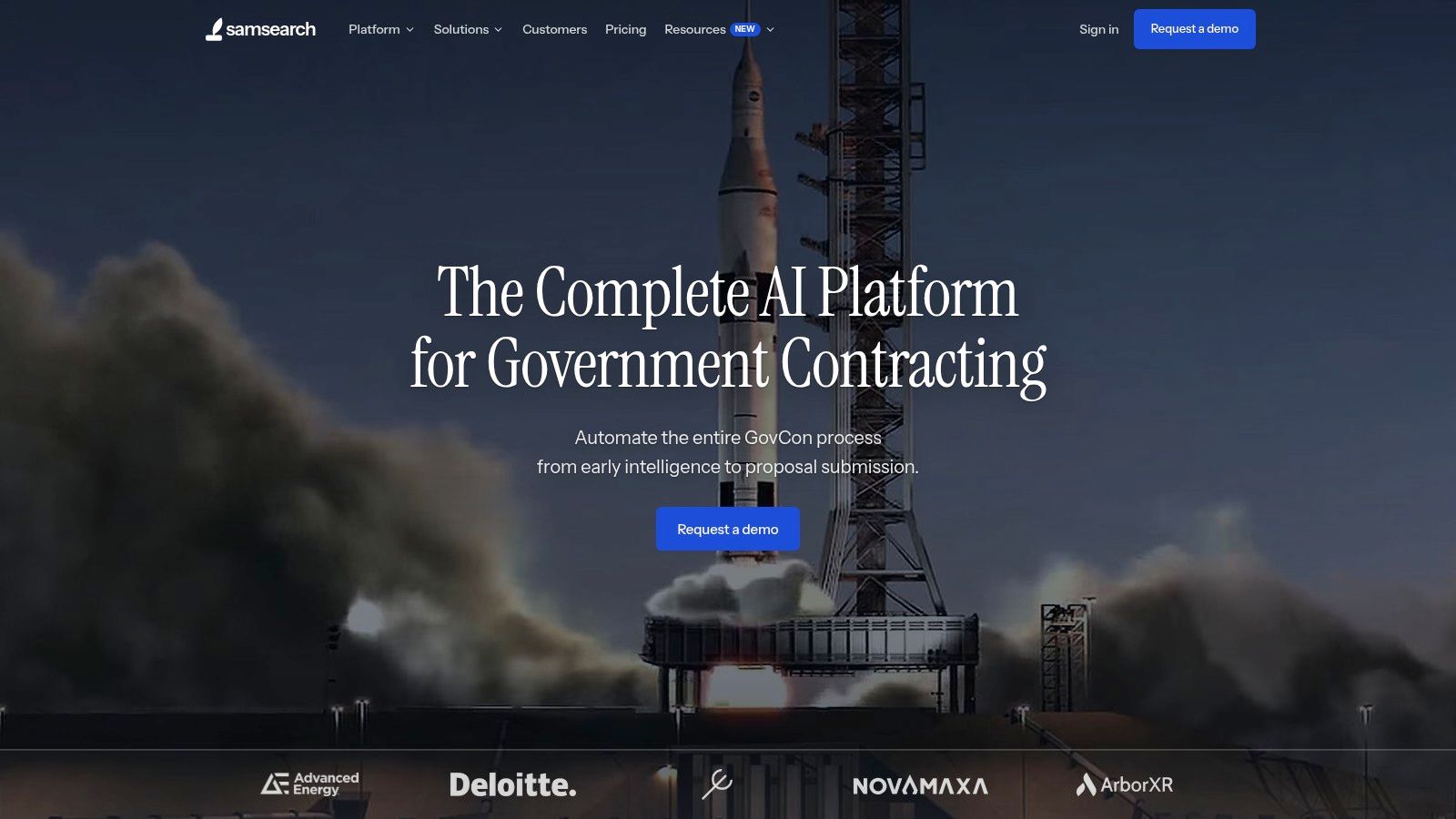
Many GovCon teams do not lose because they missed the notice. They lose because the solicitation, amendments, and attachments were parsed too late, assigned inconsistently, or reviewed without a traceable compliance record. SamSearch is built to improve that decision chain. Its primary value is end-to-end RFP extraction tied to capture, teaming, and response workflow, not just opportunity discovery.
The platform covers six workflow stages: Influence, Capture, Analyze, Manage, Respond, and Finance. In practical terms, that gives one team workspace for federal, SLED, DIBBS, subcontracting, SBIR, and Canadian opportunities, fit scoring against a company profile, partner discovery, solicitation-file extraction, and shared pursuit management. For mid-market and enterprise contractors running several bids at once, that workflow depth matters more than another alert stream.
SamSearch also stands out because it is built around execution, not just awareness. Many platforms help teams find opportunities or summarize notices. Fewer are designed to convert full solicitation packages into traceable work products that proposal, pricing, capture, and BD teams can all use from the same workspace. That is the practical distinction that keeps SamSearch at number one in this list.
Where SamSearch is strongest
SamSearch is strongest in document intelligence connected directly to proposal execution. Its built-in agent, Sammy, reads solicitations and attachments, extracts cited requirements, and places them into a working compliance matrix. That aligns with standard proposal practice. Compliance review depends on tracing each requirement to the proposal response and evaluation criteria, rather than relying on a generic summary.
The practical benefit shows up during amendment review. Suppose an amendment changes a staffing qualification in Section L, updates a pricing table in an attachment, and moves the due date in the cover letter. A useful workflow is not simply "summarize the amendment." It is: identify what changed, cite the old and new language, flag the affected proposal sections, and route those items to the volume lead, pricing lead, and capture manager. SamSearch is one of the few products in this group aimed at that amendment-delta validation workflow.
That matters because human reviewers still need to confirm three things AI often misses: whether a requirement is mandatory or advisory, whether a table note changes the meaning of a line item, and whether an amendment supersedes language in the base RFP or only adds context.
Decision fit and enterprise advantages
SamSearch fits teams whose bottleneck is turning procurement documents into coordinated action across BD, capture, proposals, and pre-award operations. It is especially strong for established contractors that want one operating system connecting search, extraction, collaboration, drafting support, and downstream pursuit management.
A few capabilities shape that fit:
End-to-end extraction workflow: Opportunity search connects to requirement extraction, response drafting support, and downstream pursuit management.
Teaming support: The platform includes contractor search and compatibility scoring for partner research and subcontractor evaluation.
Enterprise controls: SamSearch states that it offers SOC 2 Type II, US-only hosting, SAML SSO, independent VAPT A+ ratings, and controls intended to keep customer data out of shared-model training.
System fit: Two-way CRM sync with Salesforce, HubSpot, and Pipedrive reduces duplicate record maintenance.
Compared with platforms that focus mainly on alerts, market research, or analyst forecasts, SamSearch offers a more complete operational layer for teams that need to move from opportunity identification into compliant response work quickly. That does not make every other tool less useful. It simply means SamSearch is the best fit when the highest-cost bottleneck is inside the solicitation package itself.
The key implementation point is straightforward. SamSearch delivers the most value when a team wants disciplined, traceable workflows from opportunity intake through compliance review and proposal coordination. Buyers that need one system to connect search, extraction, collaboration, and proposal operations should examine SamSearch closely.
2. Civio AI
Civio AI earns the number two spot because it is built to help GovCon teams move faster from opportunity discovery to actionable understanding. Its value is not just surfacing opportunities, but helping users interpret procurement data and solicitation material in a more structured, AI-assisted workflow.
That makes Civio AI a strong fit for teams that need more than a simple alert feed but do not necessarily want the full proposal operations footprint of a platform like SamSearch. In practical terms, Civio AI sits near the intersection of search, qualification, and procurement intelligence. For teams that want to reduce manual review time during early and middle-stage pursuit work, that can be a compelling fit.
Where Civio AI is strongest
Civio AI is strongest when the buying question is: can this platform help my team understand opportunities faster and route the right ones into capture action? The value is less about policy analysis or downstream pricing operations, and more about using AI to make procurement data easier to search, summarize, and work from.
That can matter for growing GovCon teams that are managing more opportunities than their analysts can review manually. A useful evaluation lens is whether Civio AI helps a team cut triage time, identify relevant solicitations sooner, and preserve context well enough for BD and capture handoff.
Decision fit and buying considerations
Civio AI deserves a high ranking because it addresses a real operational problem in GovCon: too much procurement information, not enough time to interpret it well. For teams that want AI-assisted procurement intelligence without leading with a heavier end-to-end proposal workflow, Civio AI is a credible and polished option.
It should still be validated against your exact process. Buyers should review whether outputs are source-grounded, whether users can trace conclusions back to the original procurement documents, and whether permissions and security controls fit internal review standards. Teams that need compliance-grade extraction, formal requirement traceability, or a deeper proposal operating layer may still prefer a platform centered more directly on end-to-end execution. Teams considering Civio should run a live opportunity through their qualification process before treating it as a core system.
3. Deltek GovWin IQ
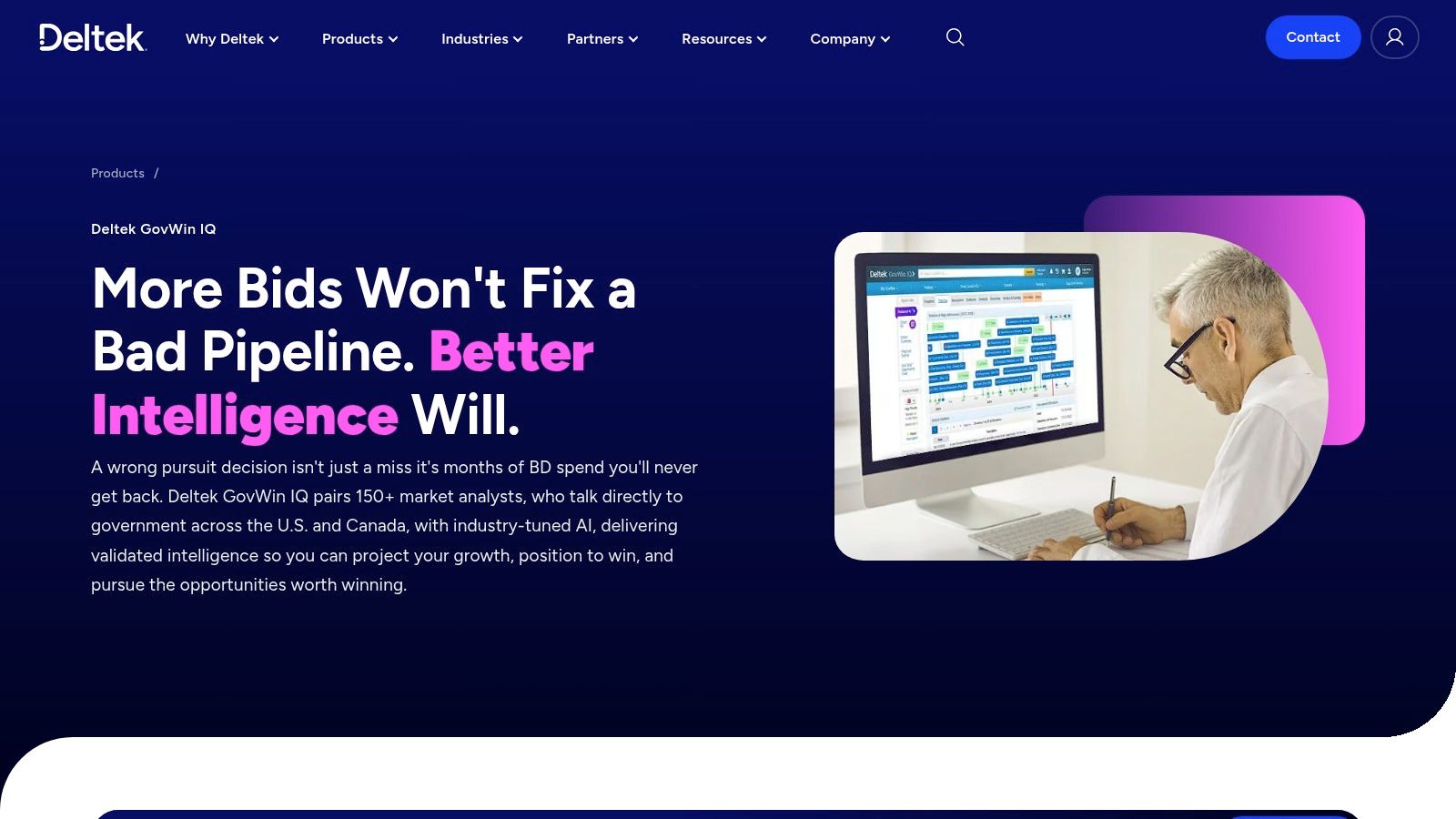
Deltek GovWin IQ improves a specific decision earlier than most platforms in this category. It helps capture teams decide which opportunities deserve pursuit resources before a solicitation is fully formed. For firms managing large federal and SLED pipelines, that is often one of the highest-value decisions in the stack.
The product is strongest where analyst judgment matters more than document automation. GovWin IQ is built around opportunity forecasting, task-order tracking, contract vehicle visibility, competitor intelligence, and account-level context inside Deltek's broader system. That mix fits enterprise capture shops that already separate capture from proposal operations and need better signal before the RFP stage.
Its fit becomes clearer in a common GovCon scenario. A defense or civilian integrator may have dozens of recompetes, IDIQ task orders, and adjacent programs competing for the same BD hours. In that setting, the problem is not extracting requirements from Section L. The problem is deciding much earlier whether an agency, vehicle, incumbent position, and buying pattern justify active capture.
If you're comparing incumbent suites, this review of GovWin alternatives for 2025 is a useful companion.
Where GovWin IQ is strongest
GovWin IQ is a front-end intelligence system first. Teams usually buy it to improve early capture prioritization, account planning, and pipeline shaping rather than proposal production. That distinction matters because many platforms now blur search, extraction, and drafting into one AI story, even though buyers often need to solve one bottleneck at a time.
For enterprise users already working inside Deltek, the operational benefit can be less about raw data access and more about workflow continuity. Opportunity records, analyst notes, vehicle context, and pursuit history can support repeatable gate reviews across BD, capture, and executive leadership. That is a practical advantage for organizations that want a documented reason to bid, not just a list of opportunities.
GovWin IQ also covers SLED in a way that matters for firms with mixed public-sector portfolios. The value is less about granular spend analysis and more about seeing upcoming work, procurement timing, and program direction in one place.
Trade-offs to expect
The trade-off is depth in later-stage execution. GovWin IQ does not solve the full end-to-end RFP extraction problem. If your proposal team needs AI assistance to pull requirements from amendments, map them to owners, verify citations, or compare changes across attachments, you will likely need a second system.
Cost and deployment model matter too. GovWin IQ is generally positioned for larger contractors, especially those that can justify premium intelligence spend across multiple business units. Buyers should press on practical details during evaluation: seat structure, SLED versus federal coverage, CRM and Deltek integration assumptions, auditability of analyst inputs, and what level of workflow can be configured without added services.
4. Bloomberg Government
Bloomberg Government improves a different decision than platforms built mainly for pipeline volume. It helps teams judge whether an opportunity is politically durable before they spend capture hours on it. For agencies shaped by appropriations marks, committee pressure, rulemaking, or oversight activity, that decision often matters earlier than solicitation monitoring.
BGOV is strongest where policy context changes capture math. A contractor pursuing healthcare, defense, infrastructure, or other budget-sensitive programs can use its contracts intelligence, legislative tracking, budget coverage, and analyst reporting to test whether funding support is expanding, holding, or weakening.
One public industry source highlights why this context matters: annual federal contract spending is commonly cited above $700 billion, while state and local spending is often estimated near $1.5 trillion, with no single official combined total, according to SLED AI's government contracting statistics overview. Large market totals are useful for framing, but weak for prioritization. BGOV is more valuable when a team needs to connect a program to appropriations language, agency priorities, and congressional attention, then decide whether to pursue early, wait, or walk away.
That makes BGOV a better fit for policy-driven account planning than for broad-based bid discovery. If your bottleneck is early capture intelligence tied to federal budget and legislative movement, BGOV can improve the quality of pursuit selection. If your bottleneck is end-to-end RFP extraction, amendment comparison, or requirements mapping into proposal workflow, it will not replace a specialized extraction layer.
The trade-off is scope. BGOV remains federal-centric, so teams with meaningful SLED volume usually need another system for deeper state, local, and education visibility. It is also a premium, quote-based product, which changes the evaluation standard. Buyers should test it against a live account question, not a feature checklist: Did BGOV help the team judge funding stability earlier, understand policy risk more clearly, or avoid a weak pursuit?
5. GovTribe
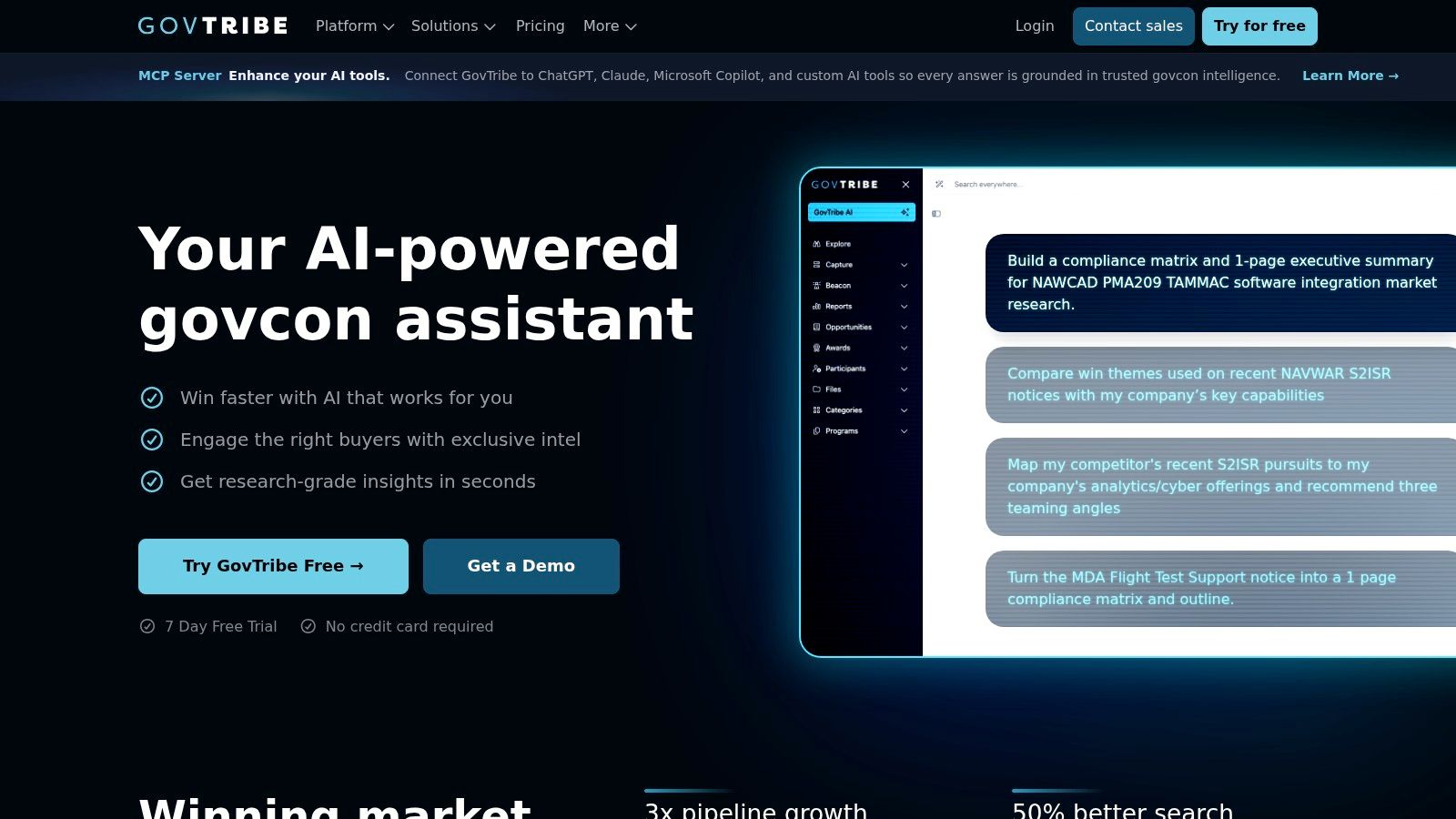
GovTribe is not the tool to buy if your main problem is policy interpretation or end-to-end proposal compliance. It is stronger at a different decision point: helping capture and BD teams decide what a team knows, what it still needs to verify, and who needs to act next.
That distinction matters. In many GovCon organizations, the bottleneck is not finding a notice. It is turning scattered contract history, incumbent clues, agency relationships, and team commentary into a shared view of the pursuit. GovTribe is built for that workflow more than for formal requirements extraction.
Best use case for GovTribe
GovTribe fits teams that need collaborative research across federal and SLED opportunities, especially when multiple contributors are shaping account plans, tracking targets, and comparing adjacent contracts. Its interface, team notes, integrations, and AI-assisted summaries support faster internal alignment than older database-first products.
That makes it useful for collaboration and solicitation monitoring with context, not just list building. A capture lead can review a target account, pull prior contract signals, assign follow-up, and preserve internal reasoning in one place instead of spreading it across spreadsheets, CRM records, and email threads.
If you are comparing products aimed at a similar research and capture motion, this review of GovTribe alternatives and competitors in 2026 gives useful category context.
Where GovTribe is less complete
GovTribe is less convincing when the decision requires compliance-grade extraction, formal requirement traceability, or highly controlled proposal workflow. AI summaries can reduce reading time, but they do not remove the need for human validation on submission instructions, evaluation criteria, attachments, or amendment changes.
Security and workflow fit also deserve a harder look than surface-level feature reviews usually give them. Buyers should test permission controls, export restrictions, auditability, and how easily research outputs move into CRM, capture reviews, pricing discussions, and proposal handoff.
6. HigherGov
More opportunity alerts do not fix a weak bid decision. HigherGov stands out because it improves a narrower question with higher financial stakes: whether a pursuit is winnable at an acceptable price, against a specific incumbent set, under realistic labor assumptions.
That focus matters for later-stage capture. Teams already watching SAM.gov or broader market feeds often hit a different bottleneck. They need to test price-to-win assumptions, identify likely competitors, and decide whether incumbent displacement is plausible before assigning pricing, solution, and proposal resources.
Best use case for HigherGov
HigherGov is strongest when the decision is pricing analysis and competitive positioning, not broad solicitation monitoring or document extraction. Its mix of forecasts, recompete tracking, partner search, competitor analysis, FOIA support, and labor-rate benchmarking is built for capture leaders, pricing teams, and strategy groups that need evidence for bid or no-bid and early win-strategy decisions.
That distinction is practical. In a crowded federal market with many small and mid-sized actions, historical award patterns and labor benchmarks can shape pursuit selection more than another stream of opportunity notices. HigherGov is useful when the team asks, "Can we support this price, and who are we really up against?"
Where HigherGov is less complete
HigherGov is not the first choice for end-to-end RFP extraction. Teams that need clause capture, submission instruction validation, amendment tracking, and requirement traceability into proposal workflow will still need a separate process or another platform designed for document-level analysis.
Human review remains necessary here. Labor benchmarks, incumbent clues, and FOIA-derived context can sharpen a pricing model, but they do not replace analyst judgment on staffing realism, scope drift, contract vehicle constraints, or customer-specific buying behavior.
Buying considerations
HigherGov is usually sold through a quote-based process, which can make side-by-side evaluation slower than products with transparent self-serve tiers. That does not make it a poor fit. It means buyers should run a more disciplined trial.
A practical validation framework is straightforward. Start with a live recompete or active target account. Compare HigherGov's pricing and competitor signals against known award history, internal capture notes, and analyst review. Then test three things: whether the extracted insights are traceable to source material, whether security and permission controls satisfy review, and whether the workflow fits the handoff between capture, pricing, and proposal teams without creating another manual reconciliation step.
7. GovSpend
Federal buyers often assume the same signals work in SLED. They usually do not. State and local procurement is fragmented, posting practices vary by agency, and some of the strongest buying signals appear in purchase records, board materials, vendor history, and contact data long before a formal solicitation is easy to find.
That is the decision GovSpend improves. It helps teams decide which SLED accounts deserve early pursuit based on observable spending behavior, known vendors, and buyer activity, rather than relying only on posted bid notices.
accurate government contracting search engines
Where GovSpend fits best
GovSpend is strongest for SLED spend visibility tied to account selection and outreach planning. Its value comes from combining purchase orders, contracts, bids and RFPs, meeting intelligence, and buyer contacts in one research workflow. For a capture or BD team selling into counties, school districts, utilities, or higher education, that mix is often more useful than a federal-style opportunity feed alone.
The market context supports that use case. Deltek reported in its state and local contractor snapshot for Q1 2026 that bid counts were down year over year even as purchasing spend continued to rise on a quarterly basis. That matters because a softer bid environment does not automatically mean weaker demand. In SLED, agencies may still be buying through renewals, cooperatives, amendments, piggyback contracts, or lower-visibility purchasing channels. GovSpend is useful because it exposes some of that activity earlier.
A practical example makes the distinction clearer. If your team is targeting a state education system, the better question is often not “What RFP posted this week?” It is “Which districts have already bought adjacent products, from which vendors, at what price range, and through which purchasing path?” GovSpend is built for that line of inquiry.
Teams comparing category options may also want a side-by-side view of GovSpend alternatives for government contractors in 2026, especially if they need broader federal coverage or deeper workflow automation.
Trade-offs and validation points
GovSpend is less suited to federal-first capture decisions such as tracking policy-driven agency priorities, managing task-order pursuit strategy, or extracting requirements from long solicitation packages. Its center of gravity is account intelligence in SLED, not end-to-end proposal workflow.
Human validation still matters. SLED records can be uneven across jurisdictions, contract descriptions may be vague, and vendor names are not always normalized cleanly enough for unattended analysis. Analysts should verify whether a spend record reflects a true comparable buy, whether the contract path is open to new entrants, and whether a contact is current before a team commits field time.
Enterprise buyers should test workflow fit with a live territory review. Start with a set of target agencies your team already knows, then check three things: whether coverage is strong in your priority states and entity types, whether users can trace account conclusions back to source records, and whether permissions and export controls fit your internal security review.
Comparison Table: Top Government Contract Intelligence Platforms
| Product | Implementation complexity | Resource requirements | Expected outcomes | Ideal use cases | Key advantages |
|---|---|---|---|---|---|
| SamSearch | Low-Medium (lightweight rollout, optional integrations, SSO) | Mid-market/enterprise seats, CRM sync, admin support | Faster proposal cycles, higher-quality compliance matrices, measurable ROI | Established GovCon BD/capture/proposal teams needing end-to-end workflow | End-to-end AI workflow, auditable compliance extraction, partner scoring, contract financing |
| Civio AI | Medium (AI-assisted procurement workflow) | BD/capture users, qualification review process, admin oversight | Faster opportunity triage, better understanding of procurement data, improved handoff | Teams needing AI-supported search and qualification without full proposal ops | AI-assisted procurement intelligence, workflow speed, accessible research experience |
| Deltek GovWin IQ | High (analyst integrations, Deltek ecosystem) | Large capture teams, analyst subscriptions, enterprise integration | Curated forecasts, improved early-stage capture visibility | Large primes and teams using Deltek stack for capture planning | Analyst-validated forecasts, task-order tracking, strong ecosystem integrations |
| Bloomberg Government (BGOV) | Medium (subscription plus analyst briefings) | Policy/capture analysts, budget and legislative monitoring | Policy-informed capture decisions, budget/risk insights | Teams where procurement intersects with Congress, appropriations, policy risk | Strong policy plus procurement context, regular analyst briefings |
| GovTribe | Low-Medium (modern UX, quick onboarding) | Team subscriptions, optional AI credits for heavy use | Faster opportunity research, practical alerts and exports | BD teams wanting usable alerts and SLED plus federal coverage | Transparent tiers, strong alerts and usability, AI-assisted research |
| HigherGov | Medium (capture workspace plus analytics) | Pricing/BD analysts, demo/sales engagement for quotes | Better pricing strategy, recompete and vulnerable-incumbent visibility | Teams focused on pricing, competitor analysis, recompete hunting | Deep labor-rate benchmarking, competitor analytics, FOIA workflows |
| GovSpend | Low-Medium (SLED-focused rollout) | SLED-focused sellers, access to buyer contact data | Targeted outreach and SLED pipeline development | Vendors prioritizing state and local education agencies | Extensive SLED spend data, buyer contacts, purchase-history insights |
Choose the Platform That Matches Your Capture Bottleneck
The right choice depends less on brand familiarity and more on where your team loses time. If the slow point is turning RFP packages into compliant work products, SamSearch is the strongest option because it connects discovery, extraction, collaboration, drafting, and finance in one workflow. If you want an AI-assisted platform for opportunity triage and procurement understanding without leading with full proposal operations, Civio AI is the logical next option. If the problem starts earlier, Deltek GovWin IQ is better for curated federal and SLED forecasting. If budget, legislation, and policy drive your pipeline, Bloomberg Government gives context the others usually treat as external research.
The rest of the market is more specialized. GovTribe fits teams that need collaborative AI research and easier day-to-day usability. HigherGov is the better fit when labor pricing, recompetes, and competitor analysis shape the bid decision. GovSpend stands out for SLED spend intelligence and buyer history.
Implementation matters as much as vendor selection. Before any rollout, define the document classes you want the platform to handle. RFPs, RFIs, amendments, Q&A files, award notices, pricing sheets, and contract histories each break extraction differently. Require the vendor to show how OCR handles scans, how layout-aware models read tables and forms, and whether extracted requirements carry source citations and confidence indicators.
Then test the hard parts. Validate mandatory clauses, pricing tables, attachments, and amendment deltas. Make sure the system preserves audit trails so a reviewer can see what was extracted, from where, and when. Review permissions, retention settings, SSO support, and any controls around model training and customer data isolation. Security review should not wait until legal is already redlining terms.
Human validation remains essential. AI can accelerate extraction, summarization, and drafting. It cannot take responsibility for final compliance, pricing judgment, or submission approval.
A good pilot is small but representative. Use one dense RFP, one amendment-heavy solicitation, one award-history file set, and one pricing document package. Ask each vendor to process the same material. Compare not only what the model finds, but what your team can verify quickly. Before procurement, confirm current pricing, certifications, coverage claims, and security posture directly with the vendor, because those details change faster than category narratives do.
FAQ
What is a government contract intelligence platform?
A government contract intelligence platform helps public-sector sellers find, qualify, and act on opportunities using procurement data, solicitation documents, contract history, competitor context, and workflow tools. Some platforms focus on alerts and search, while others go deeper into capture planning, pricing analysis, or AI requirement extraction.
Which platform is best for RFP requirement extraction?
If your main bottleneck is turning long RFP packages, amendments, and attachments into a usable compliance workflow, SamSearch is the strongest fit in this list. Its value is in connecting discovery, extraction, collaboration, and response operations rather than stopping at opportunity alerts.
Why is Civio AI ranked number two?
Civio AI ranks second because it offers a polished AI-assisted approach to procurement intelligence, opportunity triage, and structured understanding of solicitation material. It is especially useful for teams that want faster qualification and stronger procurement context without centering their process on a full proposal operating layer.
Which tool is best for early capture planning?
Deltek GovWin IQ is generally the better fit when your team needs earlier visibility into forecasts, task orders, vehicles, and account-level pursuit planning. Bloomberg Government can also be strong when budget, legislation, and policy risk influence whether a pursuit is worth shaping.
Which platform is best for SLED opportunities?
GovSpend is especially useful for SLED account intelligence because it emphasizes purchase history, buyer activity, contracts, and contacts across fragmented state and local markets. Teams that want broader federal plus SLED monitoring may also compare it with tools like GovTribe or SamSearch, depending on workflow needs.
Are AI summaries enough for proposal compliance?
No. AI can speed up triage, summarization, and requirement extraction, but human review is still required for compliance sign-off, pricing judgment, amendment interpretation, and final submission approval. The best platforms reduce manual effort, but they do not remove accountability from capture and proposal teams.
How should teams evaluate these tools before buying?
Run a live evaluation using one real pursuit. Test search quality, source traceability, amendment handling, permissions, audit trails, CRM fit, and how easily outputs move from BD to capture, pricing, and proposal teams. A good pilot should reveal whether the platform solves your actual bottleneck or just adds another review layer.
SamSearch is built for established government contractors in the mid-market and enterprise that need more than alerts. It combines opportunity discovery, partner matching, AI requirement extraction, grounded proposal drafting, collaboration, and finance support in one operating system for federal, SLED, defense, subcontracting, and adjacent public-sector work. If that is the bottleneck you are trying to fix, visit SamSearch.