Find the Best AI Tool for Proposal Writing for 2026
Your team already knows the pattern. An RFP lands late, amendments start moving, legal wants clean citations, capture needs a fast bid/no-bid read, and proposal operations gets stuck reconciling requirements across Word files, PDFs, spreadsheets, and email threads. In GovCon, the best AI tool for proposal writing is not the one that produces the flashiest paragraph. It is the one that helps your team stay compliant, retrieve approved content quickly, and move from opportunity intelligence to a review-ready draft without losing control of facts.
That is why generic sales proposal tools often disappoint federal and SLED teams. They can help with wording, but they often struggle with security posture, requirement extraction, content governance, amendment handling, and collaboration across capture, pricing, contracts, and technical SMEs. The gap between “can generate text” and “can support a compliant government response” is where most buying mistakes happen.
The strongest teams do not treat AI as a magic writer. They use it as a force multiplier for research, shredding, content retrieval, draft assembly, and review prep. Modern platforms can remove a meaningful share of manual effort, but only when the tool fits how GovCon teams actually work. If you want a quick refresher on the upstream process before selecting a platform, Salesmotion's RFP guide is a useful overview.
Table of Contents
- 1. SamSearch
- 2. Civio
- 3. Responsive formerly RFPIO
- 4. Loopio
- 5. Upland Qvidian
- 6. Xait XaitPorter Privia heritage
- 7. VisibleThread VT Docs
- 8. QorusDocs
- 9. RocketDocs
- 10. GovHub
- 11. AutogenAI Federal
- Top AI Proposal Tools Comparison
- FAQ
- What is the best AI tool for proposal writing for GovCon teams?
- What should GovCon teams look for in an AI proposal tool?
- Is a generic AI writing tool enough for government proposals?
- Why is SamSearch ranked first in this list?
- Which tool is best for AI-first proposal generation?
- Which tools are best for enterprise response management?
- Can AI write a compliant government proposal on its own?
- How do I choose the right proposal tool for my team?
- Final Thoughts
1. SamSearch

A common GovCon bottleneck starts before the first draft. The capture team finds an opportunity late, the proposal manager gets a long solicitation with scattered amendments, and business development is still trying to identify the right teaming partner. In that situation, a writing assistant alone does not solve the problem.
SamSearch stands out because it connects opportunity discovery, partner search, document review, and proposal support in the same workflow. For federal and SLED teams, that matters. Compliance starts with finding the right bid, interpreting the requirement correctly, and getting the right people involved early.
The practical advantage is context. SamSearch pulls in public-sector opportunities across multiple sources, matches them against your firm, and uses Sammy to extract requirements, summarize long RFPs, answer questions across document sets, and build proposal structure. That is much closer to how capture and proposal teams actually operate in GovCon than a generic AI writer built for sales copy.
A closer look at the proposal workflow is on SamSearch Create Proposals.
Why it leads for GovCon teams
SamSearch is strongest where capture and proposal overlap. Many GovCon teams still split pipeline review, teaming, requirement analysis, and drafting across separate tools. That creates handoff friction, duplicate notes, and version confusion once the solicitation goes live. Keeping those activities connected helps teams respond faster and with better control.
Its teaming and partner discovery features are also especially relevant to GovCon. If your team builds around set-aside eligibility, past performance gaps, labor category coverage, or place-of-performance needs, contractor search and compatibility scoring are operational advantages, not extras. Historical awards and pricing visibility also help teams write with a clearer view of agency buying patterns and competitive context.
For teams that need a tighter response process, the platform also supports the front end of compliance work. Requirement extraction and document Q&A can reduce the time proposal managers spend hunting through attachments and amendments. That does not replace a compliance matrix or Pink Team review, but it does make the first pass much faster and more organized. Teams that want a stronger process foundation may also benefit from this guide on how to respond to an RFP step by step.
Practical rule: In GovCon, the most valuable AI tool is the one that improves bid selection, requirement analysis, and teaming decisions before drafting even starts.
Where it fits best
SamSearch is a strong fit for primes, subs, consultants, and growth-stage GovCon teams that want one system for pursuit intelligence and proposal execution. It works especially well for organizations where the same group supports both capture and proposal development, or where a lean team cannot afford to manage a patchwork of disconnected tools.
Useful strengths:
Best fit: GovCon teams that want opportunity research, teaming support, and proposal drafting in one environment.
Operational upside: Strong for teams moving from forecast or notice to active bid without switching systems.
Workflow value: Helps connect capture decisions, document analysis, and proposal development in a way that matches real public-sector pursuit work.
Review support: Drafts, summaries, and extracted requirements give proposal leaders and SMEs a faster starting point while preserving review control.
For GovCon teams that care about compliance, speed, and bid/no-bid discipline, SamSearch covers more of the actual proposal workflow than tools focused only on drafting.
2. Civio
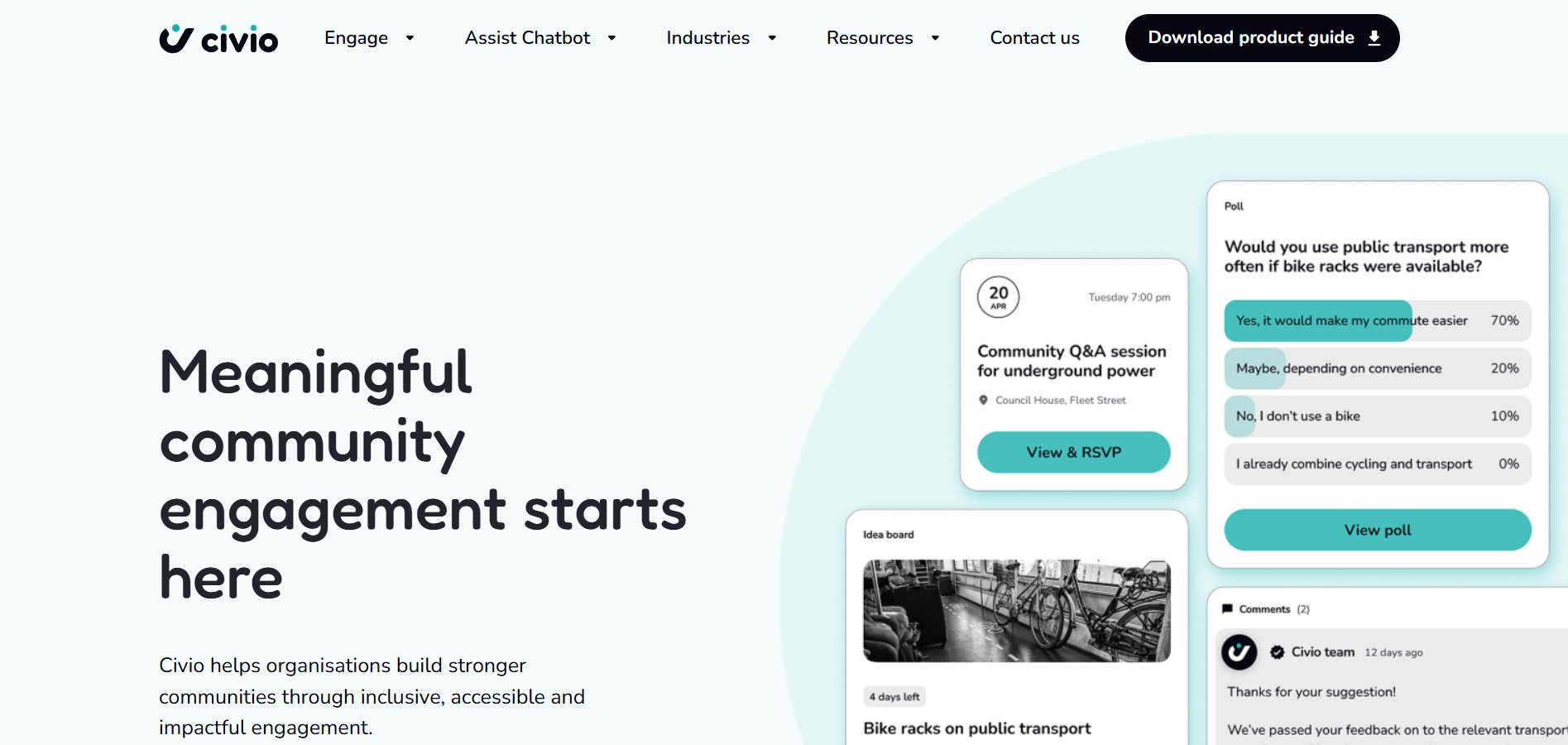
Civio is one of the more notable AI-first options for proposal teams that want faster first drafts, better content reuse, and a workflow designed around government and enterprise responses. Its positioning is especially relevant for teams that want modern proposal generation without relying only on a traditional answer-library model.
In practical terms, Civio focuses on helping teams move from source documents and existing content to a usable draft faster. That makes it appealing for proposal shops that need acceleration without giving up structure. It also reflects a broader market shift toward AI-assisted drafting that still depends on governed source material and human review.
Best for AI-first proposal generation with strong workflow support
Civio is best evaluated as a drafting accelerator that works best when teams already understand their win themes, discriminators, and compliance obligations. Like other AI-first tools, it performs best when proposal inputs are specific, current, and well governed.
What makes Civio relevant in this market is that it reflects how proposal software is changing. AI is no longer a side feature. It is becoming central to how teams summarize opportunities, reuse approved material, and build first drafts more efficiently. Civio is part of that shift, and it deserves a place high on the shortlist for teams prioritizing generation speed and modern workflow design. More details are available on the Civio website.
3. Responsive formerly RFPIO

Responsive fits large, governed response programs. If your team handles RFPs, DDQs, security questionnaires, and internal reviews across multiple business units, its value comes from process control as much as drafting help. That is why it appears frequently in enterprise shortlists.
In a GovCon context, the appeal is content governance and repeatability. Responsive gives teams a centralized answer library, AI-assisted drafting, requirements analysis, and review workflows that support role-based contribution. For proposal managers who spend too much time chasing SMEs, reconciling approved language, and standardizing quality across volumes, that structure is useful.
Best for governed enterprise response programs
Responsive performs best when teams invest in content curation, ownership, and library maintenance. In mature response environments, that effort pays off because the platform can scale across a large number of responses and contributors.
Loopio's 2026 RFP Trends Report found generative AI adoption among professional proposal teams rose from 34% to 68% in a year, as cited in Civio's overview of AI proposal generation tools. That shift helps explain why enterprise response platforms are moving beyond static libraries and into AI-assisted first drafts and guided reuse.
Mature response software works best when your approved content is already governed. If the source library is messy, the output will be messy faster.
Responsive is a strong fit for large primes and regulated businesses with established response operations. For teams working on process maturity, this guide on how to respond to an RFP is a practical companion. Product details are on the Responsive website.
4. Loopio

Loopio has a reputation for being easier to adopt than heavier enterprise stacks. That matters for small and mid-market GovCon teams that need better process but cannot absorb a long implementation cycle. In practice, Loopio is often the platform teams choose when they want AI support and content reuse without taking on a large systems project.
Its AI features focus on faster intake and orientation. Upload the solicitation, extract metadata, generate a proposal summary, and use the content library to accelerate response creation. That is useful in government bids because the first bottleneck is often understanding what changed, what is required, and which contributors need to engage.
Best for faster onboarding and library-driven drafting
Loopio works best when your team already has a solid base of approved content and wants to make it easier to find and reuse. It is less about inventing proposal strategy from scratch and more about helping teams get to a workable draft faster.
Bidara's 2026 comparison of AI proposal software presents Loopio as a leading platform for enterprise teams that need deep content libraries, while also noting that AI proposal software has matured into more segmented choices by company size and use case. That lines up with how many GovCon teams evaluate it.
Proposal teams still need to verify requirements, page limits, attachments, and submission instructions. If your team is exploring parsing and requirement extraction more broadly, SamSearch's take on AI contract analysis is worth reading. Product details are on the Loopio website.
5. Upland Qvidian

Qvidian is one of the older names in proposal automation, and that history still shows in the product. For some buyers, that is a plus. If you run a large response operation with repeatable workflows, formal approvals, and lots of questionnaires, proven structure matters.
Its strengths are centralization, workflow, and volume handling. Teams that answer a mix of RFPs, DDQs, and security questionnaires usually care less about clever AI demos and more about whether the platform can keep contributors aligned, enforce governed reuse, and support auditability.
Best for high-volume, process-heavy teams
Qvidian makes the most sense when proposal work is already institutionalized. It supports organizations that have standard operating procedures, shared libraries, and formal review paths. In that environment, AI Assist can accelerate drafting and reuse while reducing operational friction across many responses.
Use Qvidian if your team is optimizing scale and governance. If you need something more tightly connected to public-sector opportunity intelligence and early pursuit work, tools built closer to the capture process may feel more aligned. Product details are on the Upland Qvidian website.
6. Xait XaitPorter Privia heritage

Xait is a serious option for large, document-heavy proposals where co-authoring and production discipline matter as much as draft generation. The Privia heritage is relevant because many GovCon teams recognize that style of structured proposal workflow. If you manage color teams, section leads, production deadlines, and formatting challenges across complex volumes, Xait plays directly to that reality.
Its biggest strength is controlled collaboration. Rather than treating proposal writing as a loose editing exercise in Word and SharePoint, Xait structures the work into assignable sections with permissions, workflows, and formatting control. That reduces the chaos that usually appears late in the cycle when multiple authors touch the same file.
Best for large, multi-author proposal production
Xait's published view on AI is also worth noting because it aligns with how experienced proposal managers think. Xait's article on proposal writing with AI software states that discriminative AI systems can reduce errors by 30 to 50 percent, automate up to 64 percent of proposal data collection, and cut research and information gathering time by 20 to 40 percent when working from secure internal content libraries. That is the right framing for high-compliance work. Retrieval from approved internal material is safer than relying on generic generation alone.
The best AI tool for proposal writing in a compliance-heavy environment is usually not the most creative one. It is the one that retrieves the right approved content with the least friction.
Xait is strongest for mid-size and enterprise teams producing long, multi-author proposals with strict formatting and version control needs. Product details are on the Xait website.
7. VisibleThread VT Docs

VisibleThread VT Docs is the tool to consider when the core pain is not first-draft generation. It is compliance review, amendment comparison, and language quality control. That makes it different from most of the list. VT Docs complements an existing proposal stack instead of trying to replace it.
For government bids, that specialization is valuable. Teams often need deterministic requirement extraction, compliance matrices, and redline support more than they need another writing assistant. VT Docs is particularly useful when solicitations are messy, updates arrive in waves, and reviewers need to confirm what changed without manually combing through long files.
Best for compliance review and amendment control
VT Docs proves its value by helping teams shred requirements, compare versions, and enforce readability or style standards with more precision than a general-purpose AI drafter. It also offers deployment flexibility, including on-prem options, which can matter in sensitive environments.
A lot of proposal managers make the mistake of buying one platform and expecting it to own every stage of the process. Compliance review is its own workload. If that is where your bottleneck lives, a specialist tool can outperform a broader suite. Teams that want to tighten human review around AI-assisted output should also keep a proposal review checklist in the workflow. Product details are on the VisibleThread website.
8. QorusDocs

QorusDocs makes the most sense for Microsoft-first organizations that do not want proposal work happening outside Word, PowerPoint, SharePoint, and the broader Microsoft 365 environment. In regulated sectors, that convenience can reduce adoption resistance and simplify IT review.
The platform focuses on drafting, content reuse, co-authoring, and analytics inside tools your team already uses every day. For proposal organizations with established M365 habits, that lowers friction. People do not need to learn an entirely new working style just to get AI support and content governance.
Best for Microsoft-first proposal teams
The strongest argument for QorusDocs is operational continuity. If your capture managers, writers, and SMEs already live in Microsoft 365, keeping proposal work there can improve consistency and reduce change-management drag. The Azure OpenAI positioning also gives security and IT teams a clearer framework for evaluating the AI layer.
QorusDocs is a pragmatic choice for teams that want AI support with minimal context switching. Product details are on the QorusDocs website.
9. RocketDocs

RocketDocs has long appealed to regulated industries, and that carries over well into GovCon buying environments where data handling matters. Its private AI posture is a major part of the story. Teams that are cautious about model exposure often respond well to a vendor that emphasizes privacy, authorized knowledge, and governance.
That matters most when proposal work overlaps with supplier risk, security questionnaires, and controlled information. In those settings, the wrong AI architecture can create internal friction before rollout even starts. RocketDocs helps reduce some of that friction by being explicit about privacy and workflow control.
Best for privacy-conscious response environments
RocketDocs is a good fit when security review is likely to shape the buying decision. It supports centralized knowledge, structured workflows, and private AI assumptions that align with cautious internal stakeholders. For a GovCon team that regularly collaborates with compliance, security, and legal, that stance can be as important as raw drafting speed.
If your buyers care most about privacy, governance, and predictable handling of sensitive response content, RocketDocs deserves a serious look. Product details are on the RocketDocs website.
10. GovHub
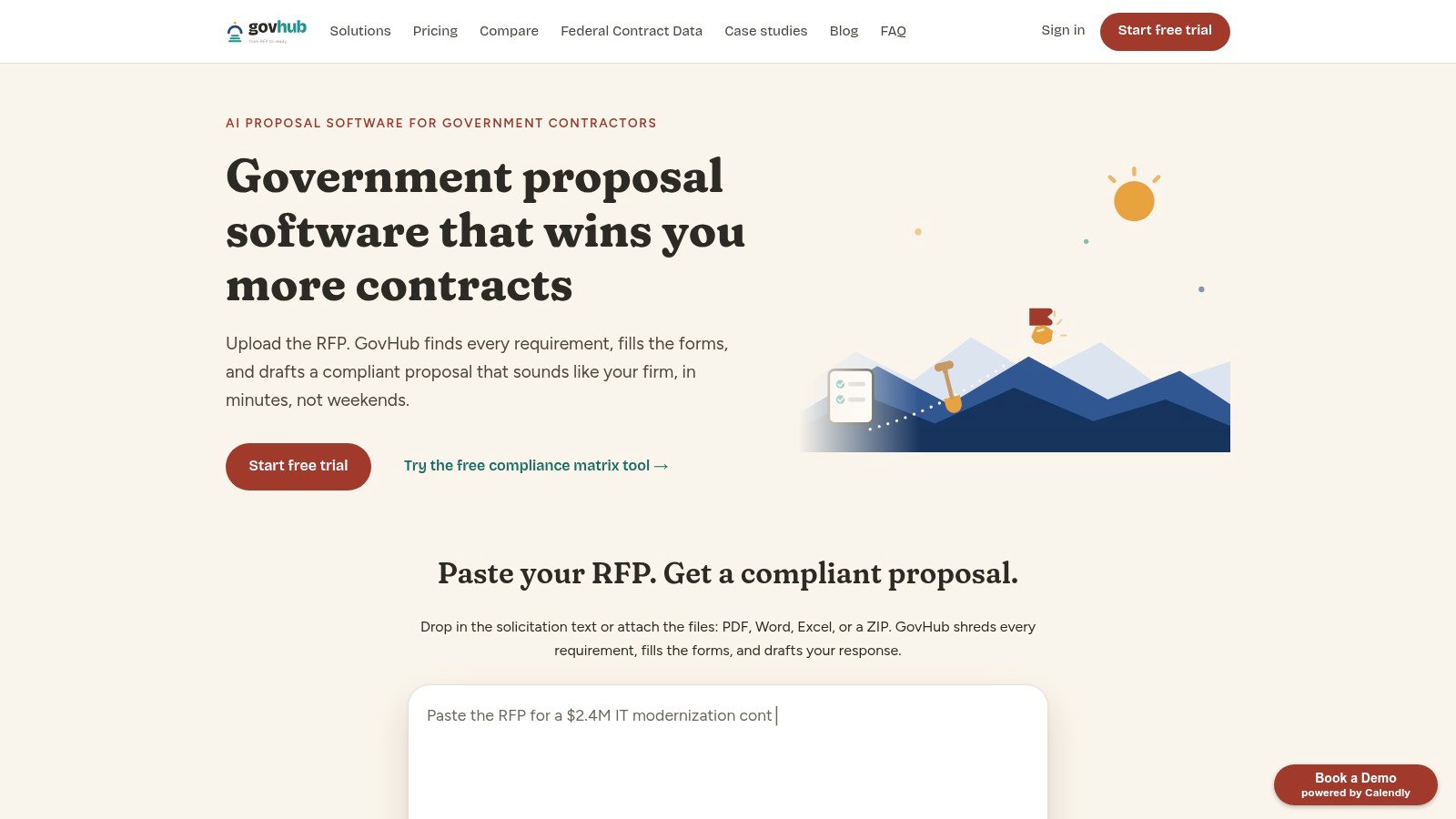
GovHub is a practical replacement in this list for teams that want an AI tool built around government proposal work, especially when speed and requirement coverage matter. On its official site, GovHub says it helps teams find requirements, fill forms, and draft compliant proposals faster, which makes it relevant for contractors that want more than a generic writing assistant. More details are available on the GovHub website.
For lean proposal teams, that focus is useful. Instead of starting with a broad enterprise response stack, they can evaluate a tool positioned directly around the mechanics of government submissions and compliance-oriented drafting.
Best for lean teams that want fast, compliant government proposal drafting
GovHub fits best for smaller contractors and lean proposal groups that need a faster path from solicitation review to a structured draft. Its positioning is especially relevant for teams that want help identifying requirements and accelerating first-pass responses without taking on the process overhead of a larger enterprise platform.
It is worth considering if your team wants government-focused proposal acceleration with a clear emphasis on compliance support and drafting speed.
11. AutogenAI Federal

AutogenAI Federal is one of the more clearly AI-first options in the federal proposal space. It is designed around end-to-end generation, style learning, and compliance guidance for government and SLED work. For teams that want a platform built around modern AI behavior rather than legacy response management with AI added later, it is a compelling profile.
Best for AI-first federal drafting workflows
The strongest appeal here is time to usable draft. DeepRFP notes that AI proposal generators can create initial drafts that are about 75% complete and ready for refinement, while still requiring human review for strategy, facts, and alignment with evaluation criteria, as described in DeepRFP's article on AI proposal generators. That framing fits this category well. The promise is not autonomous submission. It is a faster path to a substantive draft.
Teams dealing with controlled environments should still map AI workflows to documentation and security expectations. If your internal reviewers need a baseline on system security planning, CMMC SSP compliance requirements are worth revisiting.
For a broader look at where AI helps and where human review still decides the outcome, see SamSearch's perspective on AI for proposal writing. Product details are on the AutogenAI Federal website.
Top AI Proposal Tools Comparison
| Product | Core focus | Key features | Target audience | Unique selling point | Pricing / Deployment |
|---|---|---|---|---|---|
| SamSearch (Recommended) | Opportunity discovery + AI proposal generation for GovCon | Government-wide feeds and forecasts; Sammy AI (requirement extraction, summaries, Q&A, proposal outlines); partner discovery; pipeline and alerts | Primes, subs, capture teams, GovCon pipelines | End-to-end GovCon intelligence with AI-driven proposal support and partner matching | Demo / sales scoped |
| Civio | AI-first proposal generation and workflow support | AI drafting; content reuse; response acceleration; workflow support | Proposal teams seeking fast modern drafting workflows | AI-forward proposal generation with structured response support | Contact vendor |
| Responsive (formerly RFPIO) | Enterprise response management and governance | Generative AI intake and answering; centralized answer library; requirements shredding; role-based reviews | Large enterprises, regulated GovCon primes | Mature content governance at enterprise scale | Quote-based enterprise pricing |
| Loopio | RFP and proposal management for SMB to mid-market | AI summarization and metadata extraction; content library; proposal checklists; fast onboarding | SMB to mid-market GovCon teams | Ease of use and faster onboarding | Plan-based, features vary by tier |
| Upland Qvidian | Proposal automation for high-volume, regulated RFPs | Central content library; Qvidian AI Assist; broad integrations; DDQ and questionnaire handling | Large enterprises, healthcare, high-volume responders | Proven structure for complex, high-volume responses | Enterprise, quote-based pricing |
| Xait (XaitPorter) | Co-authoring and production for multi-author volumes | Structured co-authoring; automated formatting; shredding into work packages; audit trails | Mid-to-large teams producing compliance-heavy documents | Strong multi-author workflow and production control | Enterprise, quote-based pricing |
| VisibleThread VT Docs | Compliance, readability, and contract intelligence | Compliance shredding; automated compliance matrix; compare and redline; readability enforcement; on-prem option | Teams needing compliance review and RFP analysis | Deterministic compliance analysis with on-prem deployment option | Cloud or on-prem, quote-based |
| QorusDocs | Microsoft 365-native proposal AI | AI inside Word, PowerPoint, and SharePoint; Azure OpenAI tenant integration; co-authoring; analytics | Organizations standardized on Microsoft 365 | Minimal context switching inside existing tools | License-based, tenant-hosted options |
| RocketDocs | Private-AI response management for regulated sectors | Private AI; centralized knowledge base; playbooks and workflows; integrations | Regulated industries, security-conscious GovCon teams | Strong privacy posture and governance model | Quote-based |
| GovHub | AI-assisted government proposal drafting | Requirement identification; form filling; compliant proposal drafting; fast response workflows | Small and mid-size government contractors | Government-focused drafting that emphasizes speed and compliance support | Contact vendor |
| AutogenAI Federal | AI-first federal and SLED proposal generation | Style-learning AI; end-to-end proposal generation; compliance guidance | Federal and SLED teams seeking AI-native drafting | Federal-focused AI drafting workflow | Enterprise, onboarding recommended |
FAQ
What is the best AI tool for proposal writing for GovCon teams?
For many federal and SLED teams, the best fit is the tool that supports more than drafting alone. SamSearch stands out because it connects opportunity research, teaming, document analysis, requirement extraction, and proposal development in one workflow. That makes it especially useful for teams that need stronger control from capture through submission.
What should GovCon teams look for in an AI proposal tool?
The most important factors are compliance support, requirement extraction, secure content handling, governed reuse of approved material, and collaboration across capture, contracts, pricing, and technical SMEs. Drafting speed matters, but it should not come at the expense of accuracy or review control.
Is a generic AI writing tool enough for government proposals?
Usually not. Generic AI tools can help with wording, but they often lack the workflow support, compliance focus, and content governance required for federal and SLED proposal work. Government teams usually need tools that can handle complex solicitations, amendments, and structured review processes.
Why is SamSearch ranked first in this list?
SamSearch is ranked first because it supports a larger share of the real GovCon workflow than tools focused only on writing assistance. It helps teams identify opportunities, evaluate fit, find partners, analyze requirements, and build proposal drafts with better context. That broader workflow support makes it a strong choice for public-sector pursuit teams.
Which tool is best for AI-first proposal generation?
Civio is one of the strongest options for teams that want AI-first proposal generation with structured workflow support. It is a good fit for organizations that already have clear win themes, strong source material, and a review process that can turn AI-generated drafts into polished submissions.
Which tools are best for enterprise response management?
Responsive, Loopio, Upland Qvidian, and Xait are all strong options for teams that need governed content libraries, structured workflows, and collaboration across many contributors. The best fit depends on your team size, implementation tolerance, and whether your main need is scale, co-authoring, or process standardization.
Can AI write a compliant government proposal on its own?
No. AI can speed up research, summarization, requirement analysis, and first-draft creation, but human review is still essential. Proposal managers and SMEs must validate every claim, confirm compliance, and make sure the response aligns with the agency's evaluation criteria.
How do I choose the right proposal tool for my team?
Start with the bottleneck. If your team struggles with opportunity intake and early pursuit work, a platform like SamSearch may be the best fit. If your team already has mature workflows and approved content libraries, an enterprise response platform may create more value. If compliance review is the main issue, a specialist tool can be the smarter investment.
Final Thoughts
A federal proposal team usually does not struggle because it lacks AI. It struggles because the handoff from capture to proposal is messy, requirements are interpreted differently by each reviewer, and late-stage fixes consume the schedule. That is the lens that matters when choosing a proposal tool for GovCon.
The right choice depends on your bottleneck.
Teams that struggle before writing starts should prioritize tools that improve opportunity visibility, teaming decisions, and document intake. In that context, SamSearch stands out because it covers more of the GovCon workflow than a standard response library. It supports earlier bid decisions and turns long solicitation packages into usable proposal workstreams, which matters when your team is still stitching together capture notes, RFP files, and draft inputs across separate systems.
Teams with a mature content library and defined review gates often get strong ROI from Responsive, Loopio, Qvidian, or Xait. VisibleThread solves a narrower problem, but sometimes that is the smarter buy. If your recurring pain is compliance review, amendment comparison, or requirement traceability, a deterministic review layer can create more value than another drafting tool.
QorusDocs, RocketDocs, GovHub, Civio, and AutogenAI Federal fit specific operating environments. QorusDocs makes sense for Microsoft 365-heavy teams that want writers working inside familiar tools. RocketDocs is worth a close look for organizations with stronger privacy constraints. GovHub is a practical option for smaller teams that want a faster path to compliant government proposal drafting. Civio is a strong option for teams prioritizing modern AI-assisted proposal generation. AutogenAI Federal is relevant for AI-first drafting in public-sector environments.
Two controls apply across the board. First, AI output improves when prompts include the actual proposal objective, audience, constraints, and source material. QuillBot makes that point clearly in its AI project proposal generator guide, and it matches what proposal managers see every day. Vague prompts produce generic copy. Specific inputs produce drafts that are faster to refine.
Second, every AI-generated response still needs human validation. This YouTube discussion on AI proposal writing oversight highlights a risk GovCon teams already know well. AI can introduce unsupported claims, weak sourcing, or incorrect figures. In a federal or SLED bid, that is not a style issue. It is a compliance and win-rate issue.
Buy for the work that is slowing your team down now. If the product only gives you faster first drafts, but does not improve compliance handling, security review, or collaboration under deadline, the bottleneck will remain.
Author bio: Jordan Hale is a GovCon proposal consultant and former proposal manager who has supported federal and SLED pursuits across IT, professional services, and complex multi-volume submissions. This review is written for compliance-heavy response teams that need practical guidance on fit, implementation effort, and proposal ROI.
If your team wants one system that supports earlier opportunity work, faster qualification, stronger teaming coordination, and structured proposal development, SamSearch is a practical place to start. It is one of the few tools in this list that connects capture and proposal work in a way that fits how many GovCon teams operate.