Top 4 Sweetspot Alternatives for Government Contract Discovery
Why do so many capture teams still treat government contract discovery like a keyword exercise when the real advantage comes from earlier signals, stronger teaming context, and faster movement from qualification to proposal? That is exactly why the Top 4 Sweetspot Alternatives for Government Contract Discovery matter. Sweetspot can help teams search, but established contractors often need more than alerts and basic opportunity monitoring. They need broader visibility, better partner intelligence, stronger historical context, and a workflow that supports the full pursuit cycle.
In federal and SLED markets, that difference has real revenue implications. Government contracting remains a massive market, and discovery tools sit close to growth, not just research. AI-enabled platforms matter because manual portal searching is incomplete, time intensive, and easy to outgrow. For mid-market and enterprise contractors, the real question is not whether a tool can surface opportunities. It is whether it helps your team qualify faster, collaborate better, and move opportunities forward with less friction.
Table of Contents
- 1. SamSearch
- 2. Civio
- 3. Bloomberg Government BGOV
- 4. GovTribe
- Top 4 Gov Contract Discovery Alternatives, Comparison
- FAQ
- What is the best Sweetspot alternative for established government contractors?
- Which Sweetspot alternative is best for smaller or leaner teams?
- Are these platforms focused only on federal opportunities?
- What should I look for in a government contract discovery platform?
- Is Sweetspot enough for government contract discovery?
- Making Your Final Decision Which Platform Is Right for You?
1. SamSearch
SamSearch is the strongest choice when government contract discovery needs to do more than surface listings. It is built for established government contractors, especially mid-market and enterprise teams that need one platform for discovery, teaming, capture support, and proposal acceleration. For organizations managing multiple pursuits at once, that breadth is a meaningful advantage.
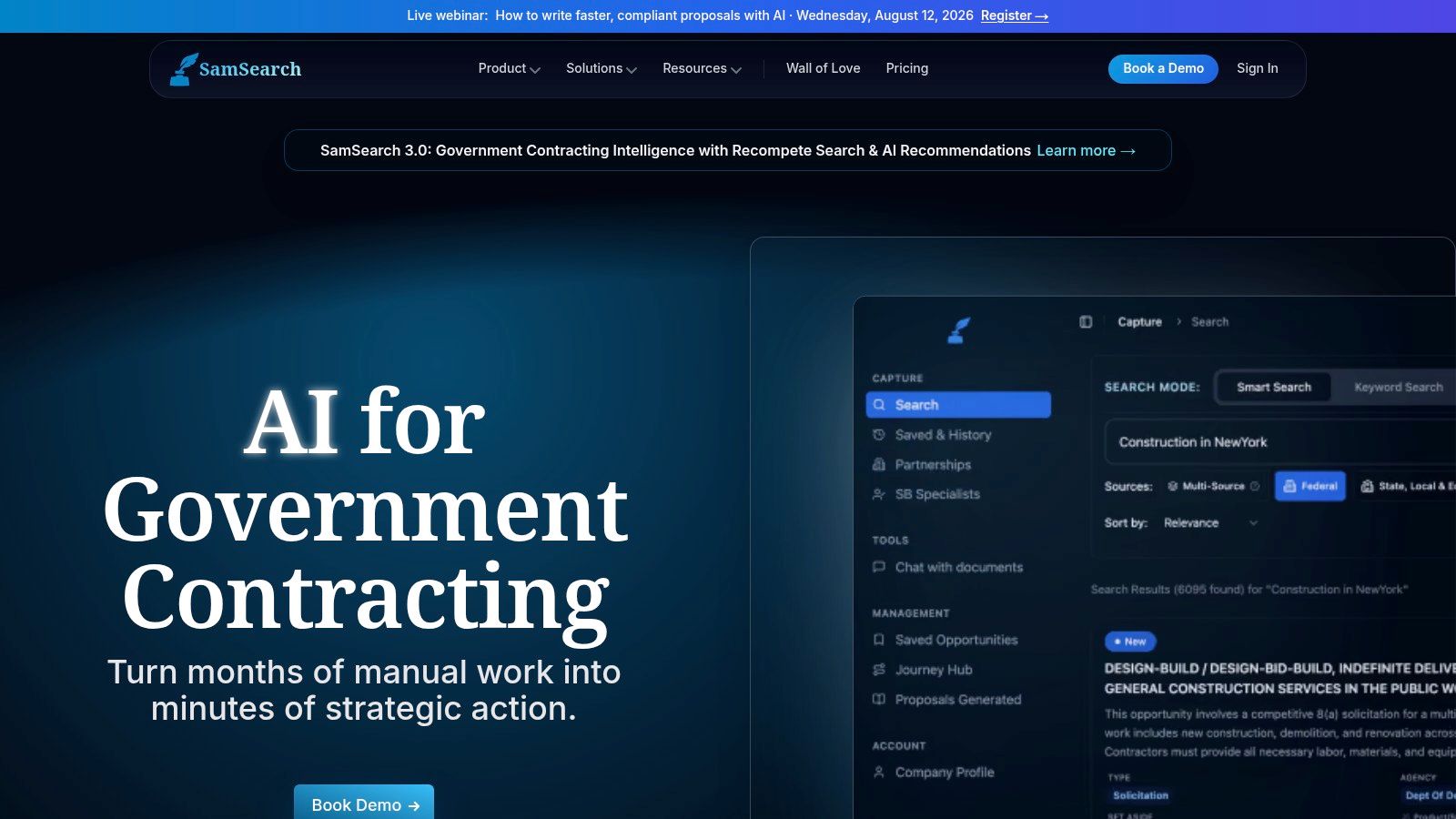
SamSearch is designed to bring opportunity discovery and execution closer together. Its discovery coverage spans federal, state, local, defense, GSA eBuy, and subcontracting sources, and the company says its search reaches across 5,000+ government sources and 50,000+ procurement websites. That scale matters for contractors that cannot afford to miss relevant demand signals across fragmented procurement channels. In practice, SamSearch is most compelling when a team wants to identify opportunities earlier, qualify them faster, and immediately pull partner research and proposal support into the same workflow.
Where SamSearch stands out in real capture work
The biggest differentiator is workflow continuity. Sammy, the built-in AI, helps teams extract requirements, summarize lengthy RFP packages, and support response development section by section. That matters because capture teams rarely lose time on search alone. They lose time in the handoff from discovery to qualification to proposal work. SamSearch closes that gap by keeping those steps connected inside one operating environment.
The platform also emphasizes forecasting and partner intelligence. Its public positioning highlights forecast visibility up to 12 months ahead, along with compatibility scoring across 600K+ contractors in the product description. For teams building partner strategies, shaping pursuits early, and improving bid discipline, those capabilities are highly practical.
Practical rule: if your team still qualifies opportunities by opening every attachment manually and coordinating pursuit decisions across spreadsheets, a platform like SamSearch changes the economics of capture. The value is not just more leads. It is faster bid decisions, sharper qualification, and more efficient proposal throughput.
SamSearch also presents well for buyers who care about adoption and operating value, not just feature lists. Its positioning reflects a platform built to support real GovCon workflows, from early signal detection to pursuit preparation. External comparison coverage reinforces that view. Civio's comparison states that SamSearch offers AI-powered natural language search across 5,000+ government sources and 50,000+ procurement websites, with pricing starting at $99/month in that roundup, even though SamSearch itself does not publish standard pricing on its own site. For teams looking for depth, speed, and AI-assisted execution in one place, SamSearch stands out clearly.
Best fit and trade-offs
SamSearch makes the most sense for teams that want a complete operating layer for discovery, partner scoring, historical context, and proposal support. That is especially valuable for primes, subcontractors seeking strong-fit partners, and consultants managing multiple client pursuits.
Best for: Mid-market and enterprise contractors that need discovery plus capture execution.
Weak spot: It is purpose-built for serious GovCon workflows, so its strengths are most valuable to teams managing active pipeline and proposal volume.
Why it wins: It moves the workflow from "find opportunities" to "prepare the pursuit."
The platform's internal comparison page is worth a look if you want more context on how it stacks up against other discovery tools: SamSearch's government contract discovery guide. For teams that measure ROI through proposal efficiency, pursuit quality, and faster capture motion, this is the most complete alternative in the group. Learn more at SamSearch.
2. Civio
Civio is a strong Sweetspot alternative for teams that want AI-assisted government opportunity discovery without stepping into a heavier enterprise environment. It is especially appealing for firms that want a modern interface, faster search, and qualification support that helps reduce manual review time across federal, state, and local opportunities.
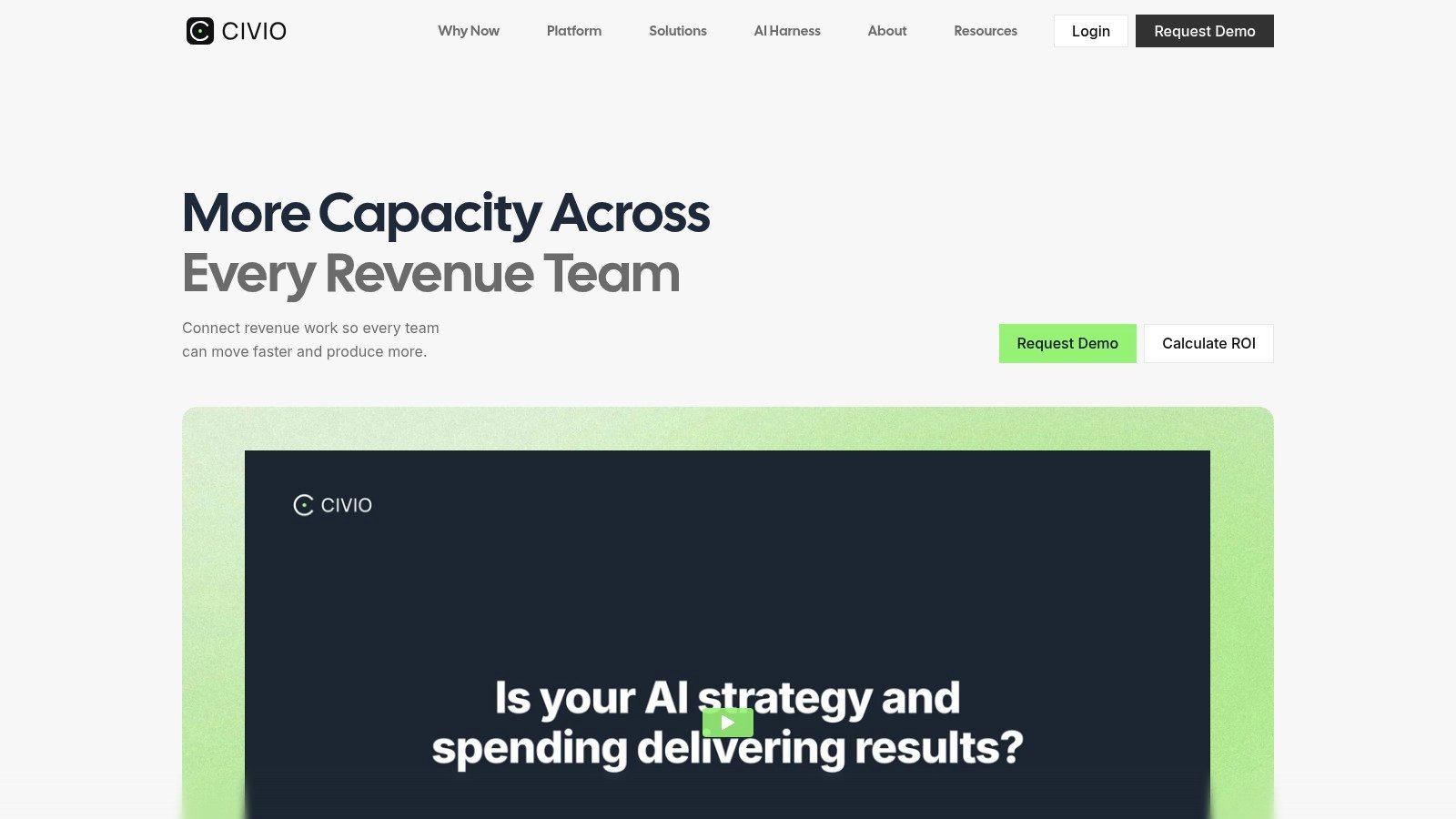
Civio positions itself around AI-powered search and matching for public sector opportunities, helping teams move beyond rigid keyword workflows. That is useful when capture staff need to understand fit quickly, identify relevant bids across multiple sources, and spend less time sorting through noise. Compared with a simpler alerting tool, Civio is more focused on surfacing relevance and speeding up qualification.
What Civio does well for leaner teams
One of Civio's biggest strengths is accessibility. Teams that want better discovery than manual portal monitoring, but are not looking for a larger strategy platform, often find this category attractive. Civio helps fill that gap by using AI to improve opportunity matching, which can be especially helpful for smaller capture teams covering a broad market with limited time.
The platform is also useful for organizations that want a cleaner workflow for identifying relevant opportunities and staying on top of new bid activity. Instead of relying only on static saved searches, teams can use AI-driven matching to uncover opportunities that narrower keyword logic might miss.
Civio is most compelling when your team wants stronger discovery signal and faster qualification without the need for a broader capture operating system.
Where Civio fits, and where it doesn't
Civio is a good fit for contractors that want modern discovery workflows, broad source coverage, and AI support without overcomplicating adoption. Teams that need deeper capture coordination, richer partner intelligence, or proposal-centric workflow may still prefer a more comprehensive platform.
Best for: Small to mid-market contractors that want AI-assisted opportunity discovery.
Weak spot: It is more discovery focused than full-cycle capture focused.
Why it wins: It improves discovery efficiency and relevance with a relatively smooth rollout.
You can explore the platform at Civio.
3. Bloomberg Government BGOV
BGOV sits in a different lane from pure opportunity trackers. It is most useful when capture strategy depends on policy, regulation, and budget movement as much as it depends on live solicitations. That makes it especially relevant for teams that work closely with government affairs, strategic account planning, or executive leadership.
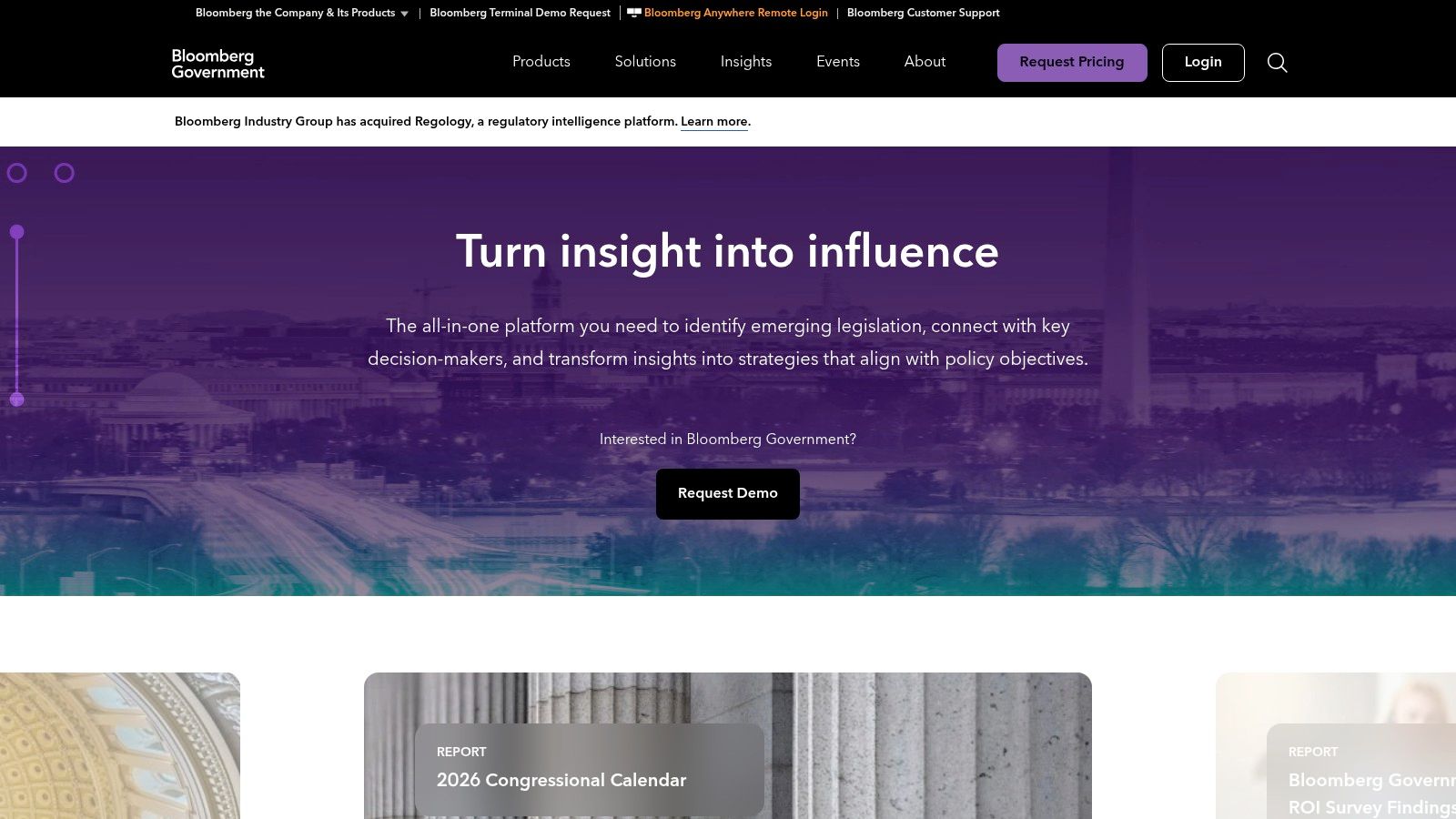
The case for BGOV is straightforward. Federal contracts do not happen in isolation, and the buying environment is shaped by budgets, legislative direction, and regulatory pressure. Bloomberg Government combines federal contracting data with legislative, regulatory, and budget tracking, so capture teams can connect procurement activity to the policy and fiscal context around it. That is a different kind of signal than a standard search platform provides.
Why policy context matters in capture
In real capture work, timing often starts well before the solicitation stage. If appropriations shift, a policy initiative gains momentum, or an agency begins moving budget in a new direction, strong teams want to know before the RFP arrives. BGOV is useful because it gives teams one place to monitor those signals without piecing together separate news, budget, and contract feeds.
That is especially valuable for organizations that pursue federal programs influenced by oversight cycles, administration priorities, or large budget decisions. Instead of asking only, "What is open today?" teams can also ask, "Why is this work gaining traction, and who is shaping demand?"
BGOV is a better fit for strategy-heavy teams than for pure volume-search teams. If your workflow begins with policy and ends with procurement, the platform can be very useful.
Where BGOV fits in a contractor workflow
BGOV is most compelling for federal-focused organizations with government affairs teams, executive briefings, or strategic planning functions. It is not positioned as a SLED-first discovery platform, so contractors with broad state and local growth goals may want a wider discovery layer alongside it. It also uses subscription or quote-based pricing, so buyers should expect a sales-led evaluation.
Best for: Federal contractors tracking policy, budget, and procurement together.
Weak spot: It is more federal strategy oriented than broad multi-market discovery oriented.
Why it wins: It ties opportunity intelligence to the forces shaping demand.
If your team wants a broader list of alternatives in the same ecosystem, SamSearch has a focused comparison here: GovDash alternatives for contractors. BGOV's product home is Bloomberg Government.
4. GovTribe
GovTribe is an easy alternative to recommend for teams that want usability without immediately moving into a larger enterprise suite. It sits between free SAM.gov searching and heavier market intelligence platforms, which makes it attractive for capture teams that need practical signal and straightforward adoption. For many mid-market organizations, that middle ground is useful.
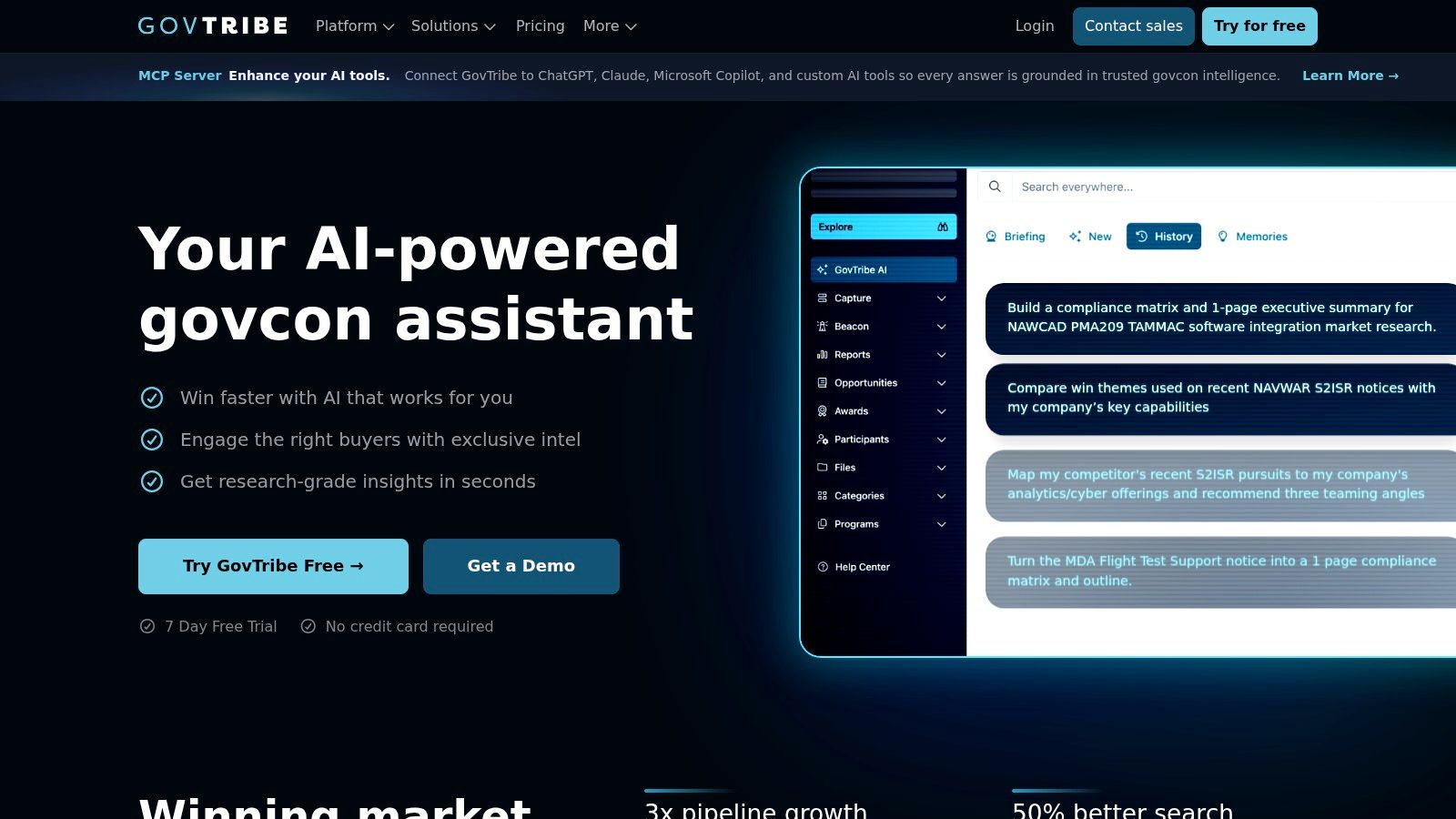
GovTribe's value starts with how it packages opportunity research. It offers predictive analytics informed by historical awards, AI-assisted research through AI Conversations, teaming insights, and exportable data. The platform also presents public plans, including Growth Plus with federal, state, and local data, which gives buyers a clearer sense of packaging than many enterprise-only tools.
Why GovTribe gets picked
The main reason teams try GovTribe is speed to adoption. You do not need a long rollout to begin using it, and the interface is generally seen as approachable. That matters because a platform only creates value when teams actually use it. GovTribe works best when you want to route alerts into a capture workflow, compare contractor histories, and keep the team aligned without adding too much process.
It is also useful for teams that want a clean bridge between federal opportunity tracking and broader market awareness. That does not make it the deepest intelligence suite on the list, but it does make it practical. For many BD and capture teams, practical usability is what drives adoption, and adoption is what drives ROI.
If your pursuit team feels every admin burden, usability may matter more than maximum dataset depth. GovTribe performs well in that environment.
Limits to keep in mind
GovTribe's trade-offs are worth noting. Some advanced AI features are credit-metered add-ons, so higher-volume users may want to evaluate usage carefully as they scale. It also may not provide the same level of structured depth that some larger platforms emphasize across more complex multi-source workflows.
Best for: Mid-market capture teams that want transparency and fast onboarding.
Weak spot: Some advanced features are usage based.
Why it wins: Usability, practical workflow support, and accessible pricing structure.
For a deeper look at how it compares with other options in the market, see SamSearch's GovTribe alternatives overview: GovTribe alternatives. The product site is GovTribe.
Top 4 Gov Contract Discovery Alternatives, Comparison
| Product | Implementation complexity | Resource requirements | Expected outcomes | Ideal use cases | Key advantages |
|---|---|---|---|---|---|
| SamSearch | Low-Medium, enterprise onboarding with a manageable learning curve | Enterprise subscription; dedicated BD/capture teams; alignment with proposal workflows | Faster RFP analysis, shorter bid cycles, stronger qualification, more efficient proposal development | Established primes, mid-market and enterprise capture/proposal groups, subcontractor partner matching | End-to-end GovCon workflow, AI document intelligence, deep market data, partner matching, forecasting |
| Civio | Low-Medium, modern onboarding and relatively easy adoption | Flexible team usage; firms wanting AI-assisted discovery without heavy admin overhead | Better opportunity matching, less manual search effort, faster qualification of relevant bids | Small to mid-market contractors seeking AI-powered government opportunity discovery | AI-assisted search and matching, clean usability, practical support for lean teams |
| Bloomberg Government (BGOV) | High, enterprise onboarding with account support and a strategy-heavy workflow | Subscription or quote-based; users needing policy and budget analysis | Policy-informed capture strategy, legislative and regulatory context for federal opportunities | Capture teams and government affairs groups needing policy, budget, and contracting context | Integrated legislative, regulatory, and budget analytics with contracting data; Bloomberg reporting |
| GovTribe | Medium-High, approachable onboarding with deeper usage options across teams | Transparent pricing; mid-market BD/capture teams; optional credit-metered AI add-ons | Practical capture workflow gains, predictive insights from historical awards, fast time-to-value | Mid-market capture/BD teams seeking usability, exportable data, and teaming insights | Usability and transparent pricing, predictive analytics, AI-assisted research, and teaming support |
FAQ
What is the best Sweetspot alternative for established government contractors?
For established contractors, SamSearch is the strongest fit in this list because it goes beyond opportunity discovery. It supports discovery, partner matching, historical context, forecasting, and proposal support in one workflow, which is especially valuable for mid-market and enterprise teams.
Which Sweetspot alternative is best for smaller or leaner teams?
Civio is a strong option for smaller and leaner teams that want AI-assisted opportunity discovery without adopting a broader enterprise platform. GovTribe is also a practical choice when ease of use and quick onboarding matter most.
Are these platforms focused only on federal opportunities?
No. Some platforms in this list extend beyond federal opportunities. SamSearch and GovTribe both support broader source coverage that can include federal, state, and local opportunities, while BGOV is more focused on federal policy, budget, and procurement intelligence.
What should I look for in a government contract discovery platform?
The most important factors are source coverage, search quality, qualification speed, teaming insight, historical award context, and how well the platform supports the rest of your capture workflow. The right choice depends on whether your team needs simple discovery, deeper market intelligence, or full pursuit support.
Is Sweetspot enough for government contract discovery?
Sweetspot can be useful for search and alerts, but many established contractors need more than notifications. Teams often outgrow basic discovery tools when they need earlier signals, better partner matching, and more support moving from qualification to proposal.
Making Your Final Decision Which Platform Is Right for You?
Choosing the right Sweetspot alternative depends on how your team wins work. If your organization needs deep policy and budget context alongside contracting intelligence, BGOV stands out. If transparency and usability matter most, GovTribe gives you a cleaner path into structured opportunity tracking. If your team wants AI-assisted discovery with a lighter operating footprint, Civio is a strong option to evaluate.
For established contractors that want more than discovery alone, SamSearch is the most complete answer on this list. It is built for mid-market and enterprise government contractors, and that matters because its value shows up across the full workflow. The platform connects discovery, partner matching, historical context, alerts, forecasting, and AI-assisted proposal work in one place, which is exactly what capture teams need when pipeline health and proposal throughput both matter.
One of the most common mistakes in tool selection is choosing for only one stage of the pursuit and ignoring the rest. A team finds opportunities in one system, manages teaming in another, drafts proposals in a third, and then loses time in every handoff. The best platforms reduce friction across the pursuit, not add another layer of admin.
If you are managing federal and SLED growth at scale, start by asking where your current workflow loses the most momentum. If the issue is early signal, cross-team alignment, partner selection, or proposal prep, prioritize the platform that closes that gap first. If you want a platform built to support the whole capture motion, SamSearch deserves serious consideration.
If your team needs government contract discovery that goes beyond basic search, SamSearch is built to help established contractors find earlier signals, identify better-fit partners, and move faster from opportunity to proposal. It is designed for mid-market and enterprise GovCon teams, and it brings discovery, workflow, and AI-assisted proposal support into one place. Visit SamSearch to see how it can fit your capture process.