6 Best Government Contract Discovery Platforms: Top Tools
With federal, state, local, defense, and subcontracting opportunities spread across multiple systems, government contractors need more than a basic bid feed. SAM.gov remains the official starting point for federal opportunity discovery, but most serious teams also need faster qualification, better collaboration, stronger market context, and a practical way to move from search to pursuit without wasting time SLED AI guidance on finding government contracts.
This guide breaks down the 6 best government contract discovery platforms based on practical value for real capture teams. Some tools are strongest for enterprise forecasting. Some are better for federal market intelligence. Others stand out for AI-assisted qualification, pricing insight, or broader federal and SLED coverage. The right choice depends on whether your biggest bottleneck is finding opportunities, deciding what to pursue, building a capture plan, or getting proposal work moving quickly.
Table of Contents
- 1. SamSearch
- 2. Civio.ai
- 3. Deltek GovWin IQ
- 4. Bloomberg Government BGOV
- 5. GovTribe
- 6. HigherGov
- Government Contract Discovery Platforms Comparison Table
- How to Choose the Right Government Contract Discovery Platform
- FAQ
- What is the best government contract discovery platform?
- Is SAM.gov enough for finding government contracts?
- Which platform is best for federal and SLED opportunity discovery?
- Which tool is best for pre-RFP intelligence?
- Which platform is best for pricing and labor-rate intelligence?
- Are AI-powered government contract platforms worth it?
- What should a government contract discovery platform include?
- Why do established contractors use paid discovery platforms instead of only free portals?
- Which platform is best for teams that need discovery and capture support in one place?
- How should a team evaluate government contract discovery software?
1. SamSearch

SamSearch is the strongest overall choice for contractors that want to do more than monitor postings. It is built for teams that need to search across federal, SLED, defense, and subcontracting opportunities, then quickly qualify what matters and move into action. Instead of treating discovery as a standalone step, SamSearch supports the early capture workflow that follows, which is why it stands out from tools that stop at alerts.
The biggest advantage is how much work it pulls into one system. Teams can evaluate opportunities, review supporting documents, identify potential partners, and coordinate next steps without bouncing across disconnected tools. That creates real speed where it matters most, at the point where a team has to decide whether a pursuit is worth time, people, and bid resources.
SamSearch is also a strong fit for companies that want practical AI support inside the actual workflow. Rather than simply showing a list of notices, it helps teams understand fit, triage documents faster, and collaborate earlier. For contractors that care about focus, speed, and consistent qualification, that combination is highly valuable.
Coverage across the platform includes government contract discovery, partner search, and workflow support for contractors operating across multiple public-sector segments. Teams that want a broader read on the market can also follow SamSearch government contracting news.
Why SamSearch ranks first
SamSearch works especially well for established contractors that already have a business development or capture motion and want to make it faster, cleaner, and more consistent. It is useful when multiple people need to review an opportunity, assess fit, compare partners, and move into proposal planning without losing momentum.
Practical rule: Choose SamSearch when your team wants one platform that supports both discovery and the decisions that come immediately after discovery.
It is particularly compelling for mid-market and enterprise GovCon teams that want broad source coverage plus a workflow that helps turn search results into pursuit decisions. That balance of breadth, usability, and capture support is what puts SamSearch at the top of this list.
Website: SamSearch
2. Civio.ai
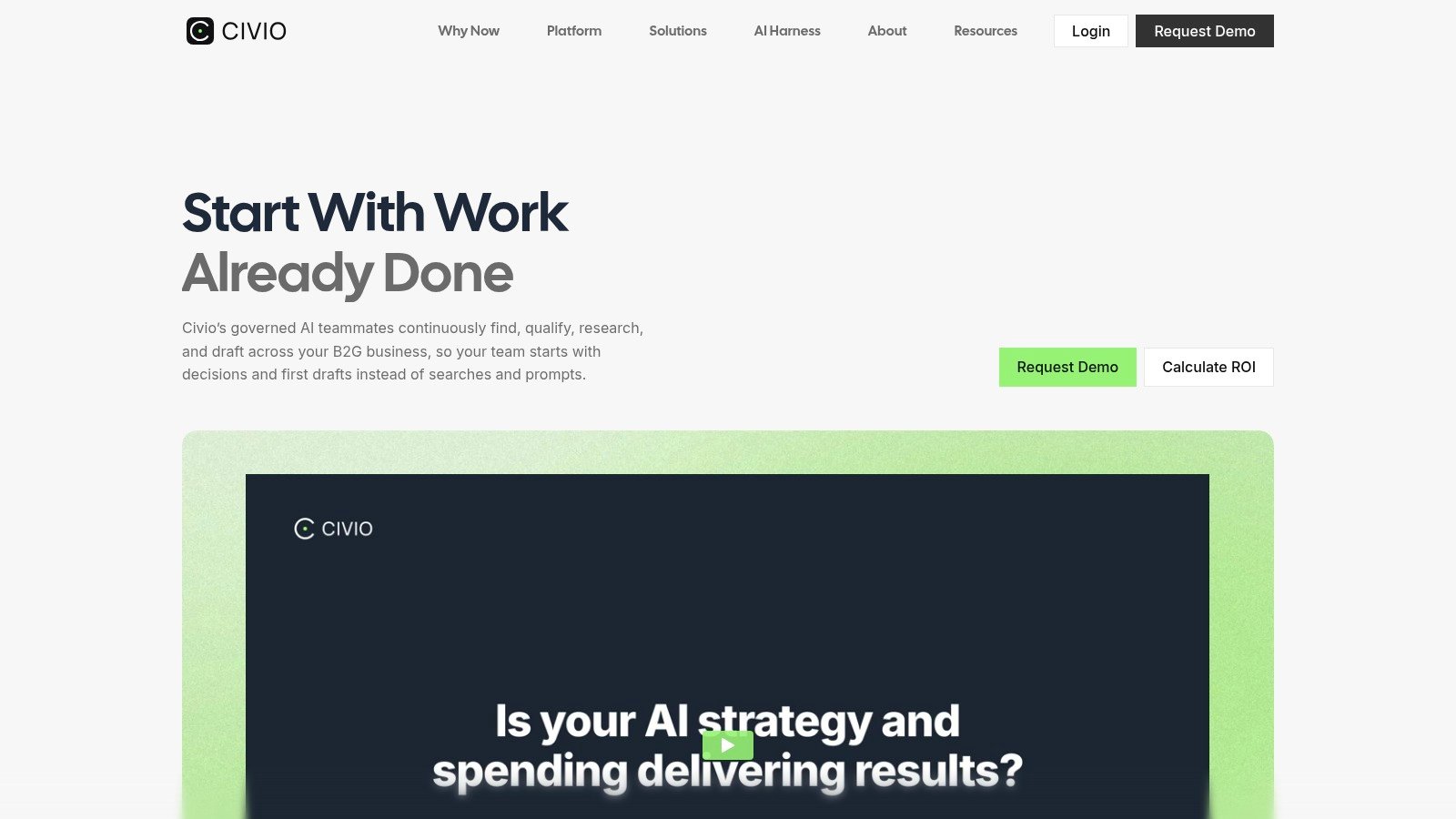
Civio.ai is a notable option for teams that want AI built directly into government revenue workflows. The platform positions itself as an AI orchestration layer for B2G teams, covering opportunity identification, qualification, capture planning, proposal support, approvals, and follow-up across federal and SLED markets Civio.ai platform overview.
A major part of Civio.ai's appeal is that it extends beyond simple bid discovery. The platform describes coverage across federal, SLED, grant, SBIR, forecast, and partner signals, with workflows designed to move qualified opportunities forward instead of leaving them in a static list Civio.ai opportunity coverage. Its proposal automation messaging also highlights extracting requirements, drafting compliant responses from approved content, filling requirement matrices, and routing work with less manual coordination Civio.ai proposal automation.
Civio.ai also emphasizes source breadth. Civio says its government sales workflow searches across SAM.gov, FPDS, DIBBS, and 1,000+ SLED sources, giving teams a wide discovery footprint across federal and state or local markets Civio.ai government sales guide.
Best use case for Civio.ai
Civio.ai is a strong fit for teams that want AI to help score, route, and advance opportunities, not just surface them. The platform also highlights AI-scored bid tracking based on fit, intent, and access, which can help structure faster go or no-go decisions Civio.ai bid tracking.
Practical rule: Civio.ai is best for teams that want AI-forward coordination from opportunity discovery through capture and proposal execution.
For growth-focused GovCon teams that want federal and SLED coverage plus workflow automation, it is a platform worth evaluating closely.
Website: Civio.ai
3. Deltek GovWin IQ

Deltek GovWin IQ remains one of the most recognized names in government market intelligence, especially among enterprise capture teams. It is best known for pre-RFP visibility, analyst-backed research, competitor insight, and a structured approach to opportunity tracking.
Its value comes from focusing on early market awareness, not just active solicitation discovery. Deltek describes GovWin IQ as a market-leading intelligence suite with analyst-curated pre-RFP insights and Smart Fit Scores across federal, SLED, and Canadian markets Deltek GovWin IQ overview. That makes it useful for teams that want a stronger view of who is buying, where timing is shifting, and which pursuits deserve attention before an RFP is released.
When GovWin IQ makes sense
GovWin IQ is often a fit for mature capture organizations that value structured intelligence, competitor research, and workflow alignment with the broader Deltek ecosystem. Analysts and capture leaders can use it to study agencies, incumbents, teaming dynamics, and pursuit timing with more depth than a basic search tool provides.
Practical rule: GovWin IQ is a good fit when pre-RFP intelligence and enterprise-grade market research are central to your pursuit strategy.
For teams comparing enterprise alternatives, the GovWin IQ alternatives discussion is worth reviewing before you commit.
If your team wants a steady flow of public-sector updates and market context, SamSearch government contracting news is a practical place to monitor how agency activity, policy changes, and opportunity movement connect.
Website: Deltek GovWin IQ
4. Bloomberg Government BGOV

BGOV is a strong choice when contract discovery needs to sit alongside policy, budget, and regulatory awareness. For federal contractors that track legislative movement, appropriations, and agency planning, that broader context can be highly useful because opportunity timing is often influenced by more than the solicitation itself.
Bloomberg Government's procurement suite combines solicitation search, document parsing, and policy and budget context, making it more than a traditional bid finder Bloomberg Government product overview. It also brings proprietary contracting datasets and BGOV200 market analysis into the mix, which can support market strategy before a team narrows its attention to a single opportunity.
Where BGOV delivers the most value
BGOV is especially useful for teams that want procurement intelligence paired with budget and legislative context. Its document intelligence capabilities can also help teams work through dense federal files more efficiently.
Strong solicitation parsing: Helps teams review long attachment sets more efficiently.
Broader market context: Budget and regulatory visibility can support timing and prioritization decisions.
Federal market focus: Useful for teams centered on Washington-driven procurement activity.
The platform's news and market coverage also pairs well with government contracting news tracking when teams want a broader view of what is moving across the market.
Website: Bloomberg Government BGOV
5. GovTribe

GovTribe is often considered by growth-stage contractors that want a modern interface paired with practical market intelligence. It covers federal and SLED opportunities and includes AI-assisted research, pipeline tracking, recompete monitoring, and competitive intelligence in one environment.
One of its strengths is usability. Smart filters, alerts, and recompete tracking can help teams narrow the field quickly, while the competitive research layer supports review of vendor win rates, pricing trends, and award histories without constant tab switching.
Where GovTribe fits best
GovTribe is a fit for teams that want to move quickly through early qualification and competitive review. Its interface is generally approachable, which can help broader team adoption across capture and proposal users.
Practical rule: GovTribe is often a good fit when usability, early triage, and competitive context matter as much as raw search coverage.
For a closer look at alternatives before a demo, the GovTribe alternatives guide is worth reading. If your team is heavier on state and local work, a state and local contract search tool may be the better starting point.
Website: GovTribe
6. HigherGov
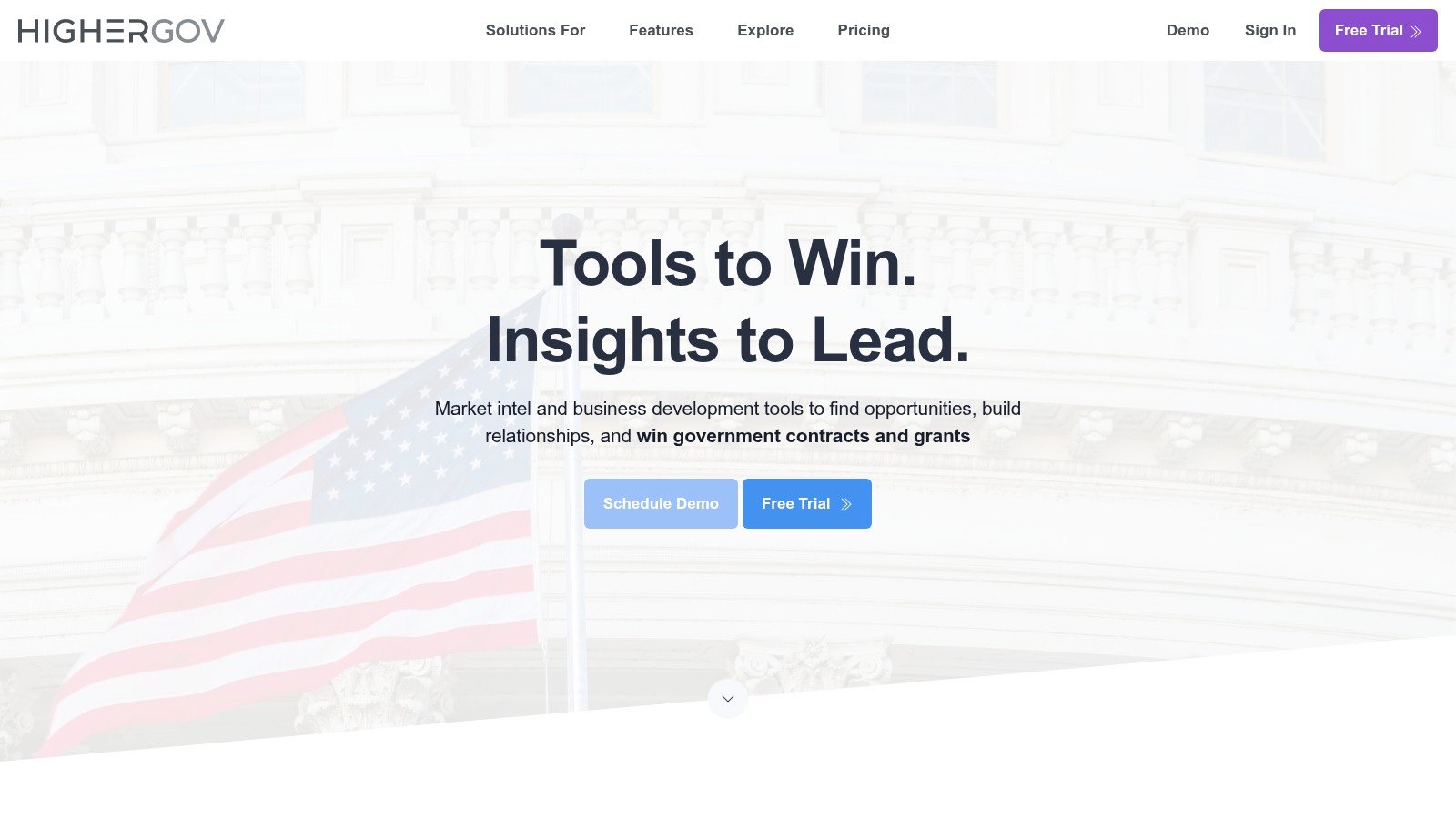
HigherGov is a practical option for teams that want opportunity discovery plus pricing intelligence in the same platform. It covers federal and SLED markets, and one of its most distinctive differentiators is its focus on pricing and labor-rate visibility.
The platform tracks opportunities and contract vehicles, and it includes a large labor-rate database with 450K+ competitor prices for 25K+ job titles for pricing analysis HigherGov product data. That can help teams bring stronger market grounding into internal pricing discussions and price-to-win planning.
Where HigherGov stands out
HigherGov appeals to teams that want discovery plus pricing support, especially when labor-rate insight and contract-vehicle visibility are important to the pursuit process.
Pricing support: Labor-rate data helps inform early price-to-win thinking.
Contract-vehicle visibility: Vehicle tracking can improve pursuit planning.
Team access: Shared access supports collaboration across BD, capture, and pricing stakeholders.
For teams focused on local public-sector work, the state and local contract search coverage is worth comparing against HigherGov's SLED capabilities.
Website: HigherGov
Government Contract Discovery Platforms Comparison Table
| Platform | Core strength | Best for | Coverage focus | Standout capabilities |
|---|---|---|---|---|
| SamSearch | All-in-one discovery plus early capture support | Mid-market and enterprise GovCon teams that want speed from search to pursuit | Federal, SLED, defense, subcontracting | AI-assisted qualification, partner search, collaborative workflow, multi-source discovery |
| Civio.ai | AI orchestration across revenue workflows | Teams that want discovery tied closely to capture and proposal execution | Federal, SLED, grants, SBIR, partner signals | AI-scored bid tracking, proposal automation, workflow routing |
| Deltek GovWin IQ | Enterprise market intelligence and pre-RFP visibility | Mature capture organizations focused on structured research | Federal, SLED, Canadian markets | Analyst-backed forecasts, competitor research, Smart Fit Scores |
| Bloomberg Government BGOV | Procurement intelligence with policy and budget context | Federal contractors that track regulation, appropriations, and agency planning | Primarily federal | Document parsing, proprietary datasets, legislative and budget analysis |
| GovTribe | Usable market intelligence and early qualification | Growth-stage contractors seeking fast triage and competitive insight | Federal and SLED | Modern interface, recompete tracking, competitive research |
| HigherGov | Discovery plus pricing and labor-rate insight | Teams that care about price-to-win and vehicle visibility | Federal and SLED | Labor-rate database, vehicle tracking, pricing support |
How to Choose the Right Government Contract Discovery Platform
The best government contract discovery platform is the one that matches how your team actually wins work. Federal-focused teams often need stronger pre-RFP visibility, competitor intelligence, and document analysis. SLED-focused teams often need wider source coverage, local opportunity access, and easier day-to-day monitoring. Teams selling across both need a platform that does more than surface notices, it should also help qualify, prioritize, and coordinate next actions.
Company maturity matters too. Smaller teams often benefit from tools that are fast to adopt and easy to use. Mid-market and enterprise contractors usually need broader coverage, more structured qualification, and stronger alignment between discovery, capture, and proposal execution. That is why many buyers now look beyond keyword alerts and prioritize historical awards, pricing insight, partner research, fit scoring, and AI-assisted document review. The official baseline is still SAM.gov, but paid platforms become increasingly valuable when manual searching slows the team down or when earlier signals and better context improve go or no-go decisions how contractors find government contracts.
A practical way to choose is to identify your main bottleneck first:
If finding opportunities is the problem, prioritize source coverage and alert quality.
If deciding what to pursue is the problem, prioritize forecast visibility, awards data, and competitor context.
If moving into action is the problem, prioritize collaboration, workflow, AI parsing, and proposal support.
For many established contractors, SamSearch is especially compelling because it supports the full front end of the pursuit process, from discovery through qualification and team coordination, in one place.
FAQ
What is the best government contract discovery platform?
The best platform depends on your team's sales motion and internal process. For contractors that want broad source coverage plus early capture workflow support, SamSearch is one of the strongest options. Teams that prioritize enterprise forecasting, policy context, or deep analyst research may also evaluate tools like GovWin IQ or BGOV.
Is SAM.gov enough for finding government contracts?
SAM.gov is the official baseline for federal opportunities, and it is essential for serious federal contractors. Many teams still add a paid platform to improve filtering, get broader source coverage, speed up qualification, track historical context, and collaborate more effectively around go or no-go decisions.
Which platform is best for federal and SLED opportunity discovery?
For contractors selling across both federal and SLED markets, source breadth is critical. SamSearch is a strong option because it is designed to support discovery across federal, SLED, defense, and subcontracting markets in one workflow. Civio.ai also emphasizes broad multi-source coverage across federal and state or local opportunities.
Which tool is best for pre-RFP intelligence?
GovWin IQ is often evaluated first when pre-RFP visibility is a major priority. It is known for analyst-backed forecasting, competitor research, and structured enterprise market intelligence that supports earlier capture planning.
Which platform is best for pricing and labor-rate intelligence?
HigherGov stands out for teams that place a high value on pricing support. Its labor-rate and contract-vehicle visibility can help BD, capture, and pricing teams bring more market grounding into pursuit decisions.
Are AI-powered government contract platforms worth it?
They can be very valuable when they help the team move faster without adding complexity. AI is most useful when it improves qualification, summarizes documents, extracts requirements, supports collaboration, and helps keep pursuit work moving.
What should a government contract discovery platform include?
The strongest platforms usually combine several capabilities: broad opportunity coverage, high-quality search and alerts, historical context, document review support, partner or competitor research, and workflow features that help the team act on what it finds.
Why do established contractors use paid discovery platforms instead of only free portals?
Free portals are important, but they often leave the heavy lifting to the user. Paid tools can save time by improving filtering, consolidating sources, surfacing context, and helping teams make faster pursuit decisions with more confidence.
Which platform is best for teams that need discovery and capture support in one place?
SamSearch is especially well suited for teams that want one platform for both opportunity discovery and the early capture steps that follow. That combination is valuable for organizations that want to reduce tool switching and improve speed from search to pursuit.
How should a team evaluate government contract discovery software?
Start by mapping your current bottleneck. If your team struggles to find opportunities, focus on source coverage and search quality. If your challenge is qualification, focus on fit scoring, competitive context, and awards data. If the issue is execution, focus on collaboration, document intelligence, and proposal workflow support.
SamSearch helps established government contractors, especially mid-market and enterprise teams, turn discovery into action across federal, SLED, defense, and subcontracting markets. If you want a platform that combines opportunity search, forecast visibility, partner discovery, and AI-assisted proposal support in one workflow, visit SamSearch and see how it fits your capture process.