Top 6 Tools for Finding and Tracking Federal Contracts

The best federal contract tracking tool is not just a search database. It is the system your team uses to turn notices into qualified, winnable pursuits.
Many articles about federal opportunity tracking focus too heavily on access. In practice, most established GovCon teams do not struggle because they cannot find enough opportunities. They struggle because too much time is lost after discovery, during qualification, routing, duplicate research, teammate coordination, amendment review, and proposal startup.
That is why the strongest approach is operational, not just informational. Start with authoritative federal notices for official discovery. Add early signals for forecasting and recompetes. Include subcontracting channels, supplier-side sources, and partner discovery where they matter. Then connect all of that to capture, proposal readiness, and execution so the right opportunities move forward quickly.
Table of Contents
- 1. SamSearch
- 2. Civio.ai
- 3. SAM.gov
- 4. Deltek GovWin IQ
- 5. GovTribe
- 6. Federal Compass
- 6-Way Comparison: Federal Contract Tracking Tools
- How to Build a Better Federal Opportunity Tracking System
- FAQ
- What is the best tool for finding federal contracts?
- Why is Civio.ai ranked number two on this list?
- Is SAM.gov enough for federal contract tracking?
- What should mid-market and enterprise GovCon teams look for in a tracking tool?
- Which tool is best for AI-assisted qualification?
- Which tool is best for end-to-end federal capture and proposal workflow?
- Are these tools good for small businesses too?
- How should a contractor use multiple tools together?
- What makes a federal contract tracking tool worth the investment?
- What is the difference between opportunity discovery and qualification?
- Do federal contractors need more than one tool?
- Which platform is best for established GovCon teams?
1. SamSearch
SamSearch is the strongest option in this group because it works as an operating system for serious GovCon teams, not just a place to look up notices. For established contractors, that distinction matters. The real value is not simply finding an opportunity. It is preserving context, accelerating decisions, and carrying the same pursuit forward across BD, capture, proposal, and post-award coordination.
Where many tools stop at search and alerts, SamSearch connects the broader workflow. Teams can work from federal opportunities, state and local work, DIBBS, subcontracting paths, SBIR and grants, and Canadian opportunities in one environment. That gives contractors a single record that can mature with the pursuit instead of forcing handoffs across disconnected portals, spreadsheets, CRM entries, and proposal folders.
That continuity is one of SamSearch's biggest advantages. It helps prevent a common GovCon problem: the team sees the opportunity early, but the supporting intelligence, ownership history, partner notes, and proposal context get scattered as the pursuit moves from one function to another.
SamSearch also stands out on teaming. Its partner discovery capability helps teams identify relevant teammates earlier, compare fit, and move faster before the response window tightens. For primes building larger teams, and for experienced subcontractors looking for the right entry points, that is meaningful workflow value.
Where SamSearch changes the workflow
The biggest difference appears after discovery. Sammy, the platform's AI assistant, can read solicitations and attachments, extract requirements, help build compliance matrices, and support cited response drafting. That shortens the time between "we found something relevant" and "we understand what it takes to respond well."
This is where many pursuit processes slow down. Opportunities are identified, but amendments sit in inboxes, documents wait for manual review, and proposal teams lose momentum before the real work begins. SamSearch addresses that gap by connecting intake, analysis, capture, and response inside one system.
The platform organizes work across six connected stages: Influence, Capture, Analyze, Manage, Respond, and Finance. For enterprise and mid-market contractors, that creates a clear operating path. BD teams can monitor accounts and scan early signals. Capture managers can qualify opportunities, track competitors and partners, and maintain live pursuit records. Proposal teams can start compliance and drafting from the same source material. Finance teams can stay aligned when contract execution and timing matter after award.
Compared with point solutions that handle only discovery, or only pre-RFP intelligence, SamSearch offers broader workflow continuity. That is especially useful for teams that want fewer system handoffs and faster movement from notice to bid decision to compliant response.
Best fit
SamSearch is best for established primes and experienced subcontractors that want one platform to support discovery through response, with post-award finance workflows included.
A few strengths stand out:
Lifecycle coverage: It supports discovery, qualification, teaming, competitive review, proposal preparation, and contract finance in one environment.
Proposal readiness: Sammy can review full solicitation packages and speed up compliance analysis and early draft development.
Source breadth: Federal, SLED, DIBBS, subcontracting, grants, and Canada sit in one working system.
Enterprise controls: The company states SOC 2 Type II, independent penetration testing, US-only hosting, SAML 2.0 SSO, and a policy that customer data is not used to train shared models.
Teaming support: Partner discovery and compatibility scoring help capture teams act earlier.
For mid-market and enterprise contractors that want fewer disconnected systems and stronger execution from notice to response, SamSearch is the most complete option in this group.
2. Civio.ai
Civio.ai earns the number two position because it addresses one of the most important challenges in federal contracting, understanding opportunities fast enough to qualify them well. Many teams already have enough visibility into the market. What they need is a faster, cleaner way to review notices, surface the key requirements, and decide which opportunities are worth deeper capture effort.
That is where Civio.ai fits well. Its value is in helping teams speed up intake, summarize complex material, and create a more consistent front-end review process. For organizations with broad portfolios or busy BD and capture leads, that can materially improve how quickly promising opportunities move into serious evaluation.
Civio.ai is especially useful when the first bottleneck is not access to notices, but the ability to process and interpret them at scale. It helps teams move from raw discovery to informed triage with less manual effort.
Best for AI-assisted federal opportunity qualification
Civio.ai is best understood as a qualification accelerator. It helps teams review more opportunities in less time, structure early analysis, and reach preliminary bid decisions faster.
That is valuable when a contractor already has reliable discovery sources but wants stronger decision speed at the top of the funnel. If the team needs to quickly understand scope, likely fit, and high-level requirements, AI-assisted summarization can improve consistency and reduce lag.
Its strongest use case is not replacing capture judgment. It is giving capture and BD teams a better starting point so they can focus their time on the most relevant opportunities.
Where Civio.ai fits in the workflow
Civio.ai fits best between opportunity discovery and full capture execution. In a practical stack, teams can use authoritative or third-party sources to surface opportunities, then use Civio.ai to accelerate early qualification before moving the best-fit pursuits into a broader capture or proposal process.
That makes it a strong complement for contractors that want AI help at the front of the funnel while still relying on other systems for deeper competitive analysis, CRM governance, or proposal execution. For teams comparing workflow roles, Civio.ai is one of the clearest number two options in this category because it strengthens a specific and high-value stage of the pursuit lifecycle.
3. SAM.gov
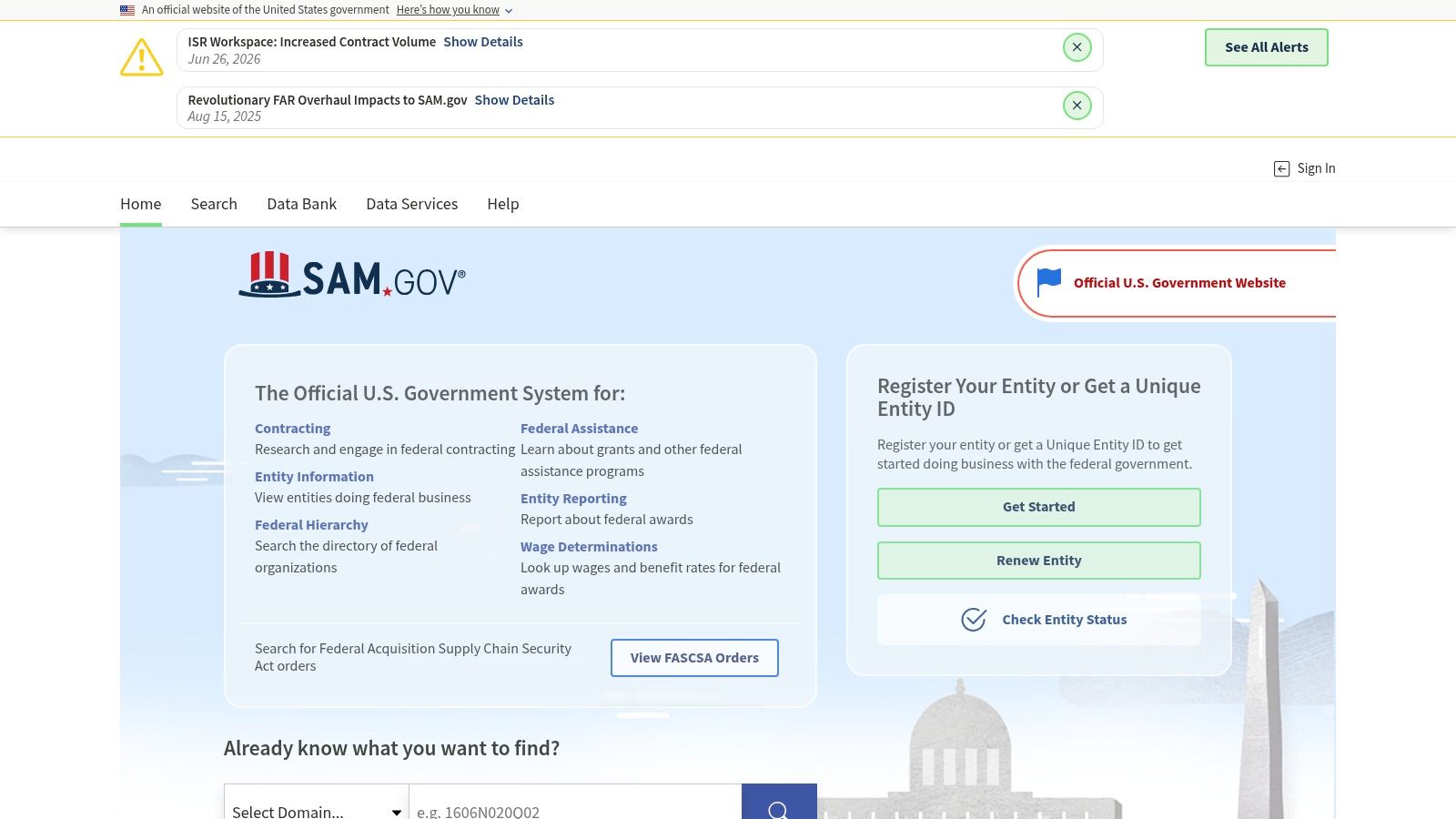
Every federal contractor needs SAM.gov in the stack. Not because it is elegant, but because it is the official source of record for contract opportunities and related contracting data. Agencies are required to post opportunities above $25,000 on SAM.gov, and the platform became the primary federal opportunity source when it replaced FedBizOpps in November 2019, according to this overview of the SAM.gov transition and posting rules.
That official status matters more than many teams admit. If your team needs to confirm whether a notice is current, whether an amendment posted, or whether a presolicitation became active, SAM.gov is where that answer starts. It also includes market research notices such as RFIs and Sources Sought, not just active solicitations.
Best for authoritative discovery
SAM.gov's Contract Opportunities search supports filtering by status, notice type, date range, NAICS, PSC, set-aside, and agency, and the public page shows a recent last-updated timestamp on the official opportunities interface. For live federal solicitation tracking, that is the baseline every third-party platform has to reconcile against.
Federal users with contracting roles also create, post, and manage opportunities directly in the same environment, as shown in the federal opportunities workflow documentation. That makes SAM.gov more than a listing site. It is part of the publication workflow itself.
SAM.gov is the place to confirm what is official. It is not the place most enterprise teams want to run their entire pursuit process from.
Where it fits in a modern stack
SAM.gov is essential for discovery, notice validation, and saved searches. What it does not do by itself is solve qualification, forecasting, collaboration, or proposal workflow at scale. That is why many teams use SAM.gov as the authoritative notice layer, then add an intelligence or workflow layer on top. If you are comparing those approaches, this breakdown of what serious teams do beyond SAM.gov is a useful framing device.
4. Deltek GovWin IQ
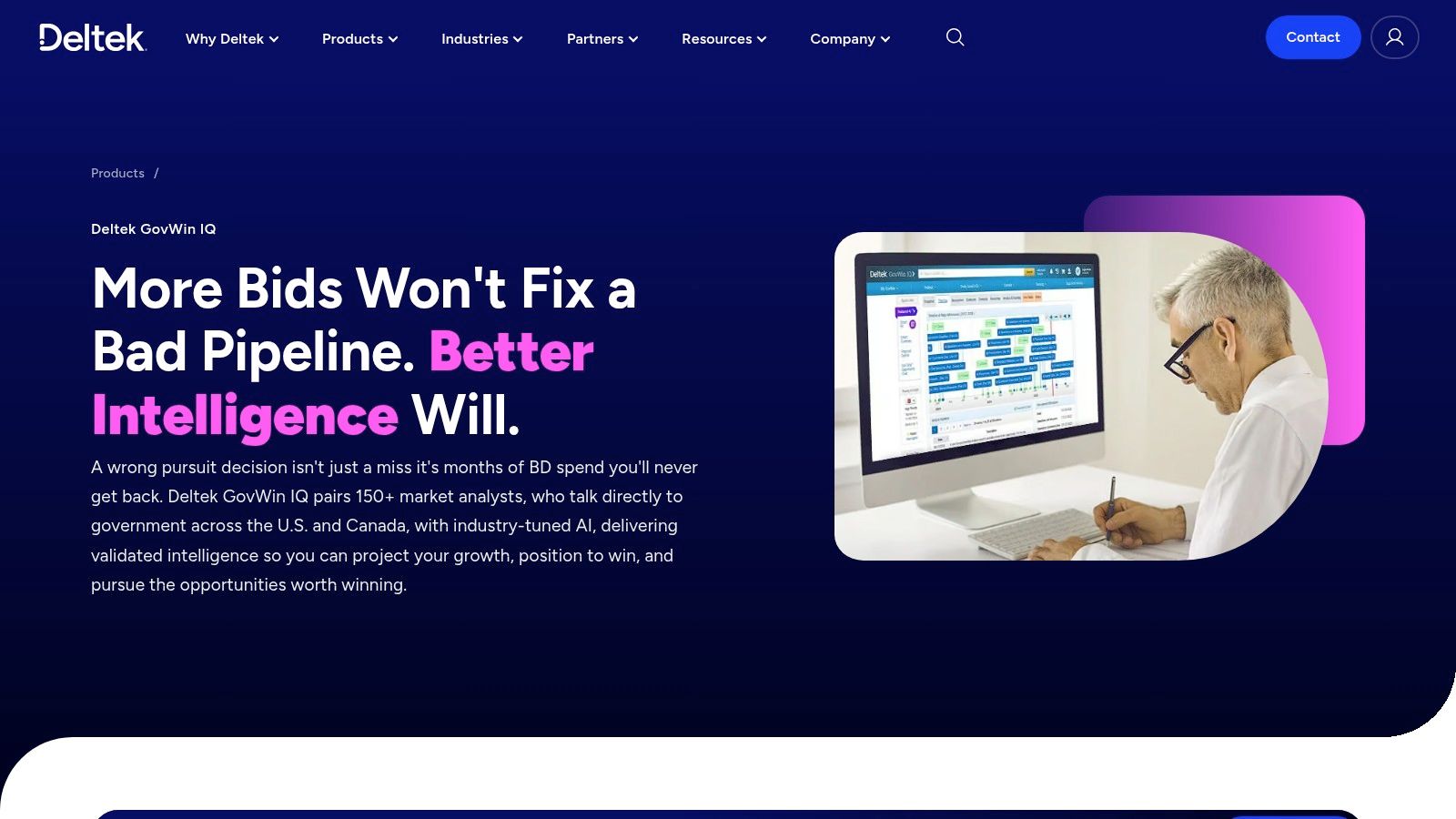
Deltek GovWin IQ remains a well-known option for contractors that care deeply about forecasting, pre-RFP planning, and competitive context. Its strength is not just showing posted opportunities. It is helping teams shape pipeline earlier by tracing incumbents, monitoring likely recompetes, and building account context before a requirement becomes crowded.
For established contractors, that can be highly useful in the middle of the opportunity lifecycle, where timing and positioning often matter more than posting-day awareness.
Best for forecasting and competitive analysis
The practical strength is pre-RFP structure: forecasts, validated records, and incumbent tracing that let teams build pipeline before notices become crowded.
For established contractors, that changes how the tool should be configured. Do not treat GovWin as another search box. Set it up around target agencies, buying offices, NAICS and PSC combinations, incumbent accounts, expiring vehicles, and known recompete windows. Push those records into a shared capture cadence so BD, capture, pricing, and proposal leads are reviewing the same opportunity history instead of maintaining separate spreadsheets.
GovWin tends to carry more weight when the question is, "Should we pursue this later?" rather than, "What posted this morning?" That makes it useful for teams running named-account strategies or managing portfolios across civilian and defense customers.
Where GovWin fits in the workflow
GovWin IQ is usually a better fit for mid-market and enterprise primes with a defined capture process and enough volume to justify analyst-backed research. It supports several stages well:
Qualification: Validate whether an opportunity aligns with your agency priorities, vehicle access, and incumbent position.
Forecasting: Track pre-solicitation signals and likely timing shifts before the final notice appears.
Competitive analysis: Review incumbents, contract history, and market context without building every record by hand.
Proposal readiness: Give proposal teams cleaner context once an opportunity moves from watchlist to active pursuit.
A practical stack often looks like this: use official sources to confirm posted notices, use GovWin to shape and score the pipeline before release, and use your internal CRM or pursuit workflow to carry the opportunity into bid decision and proposal execution. That is a better operating model than forcing one platform to do every job.
If GovWin is on your shortlist, review these GovWin alternatives for modern GovCon teams before you commit.
5. GovTribe
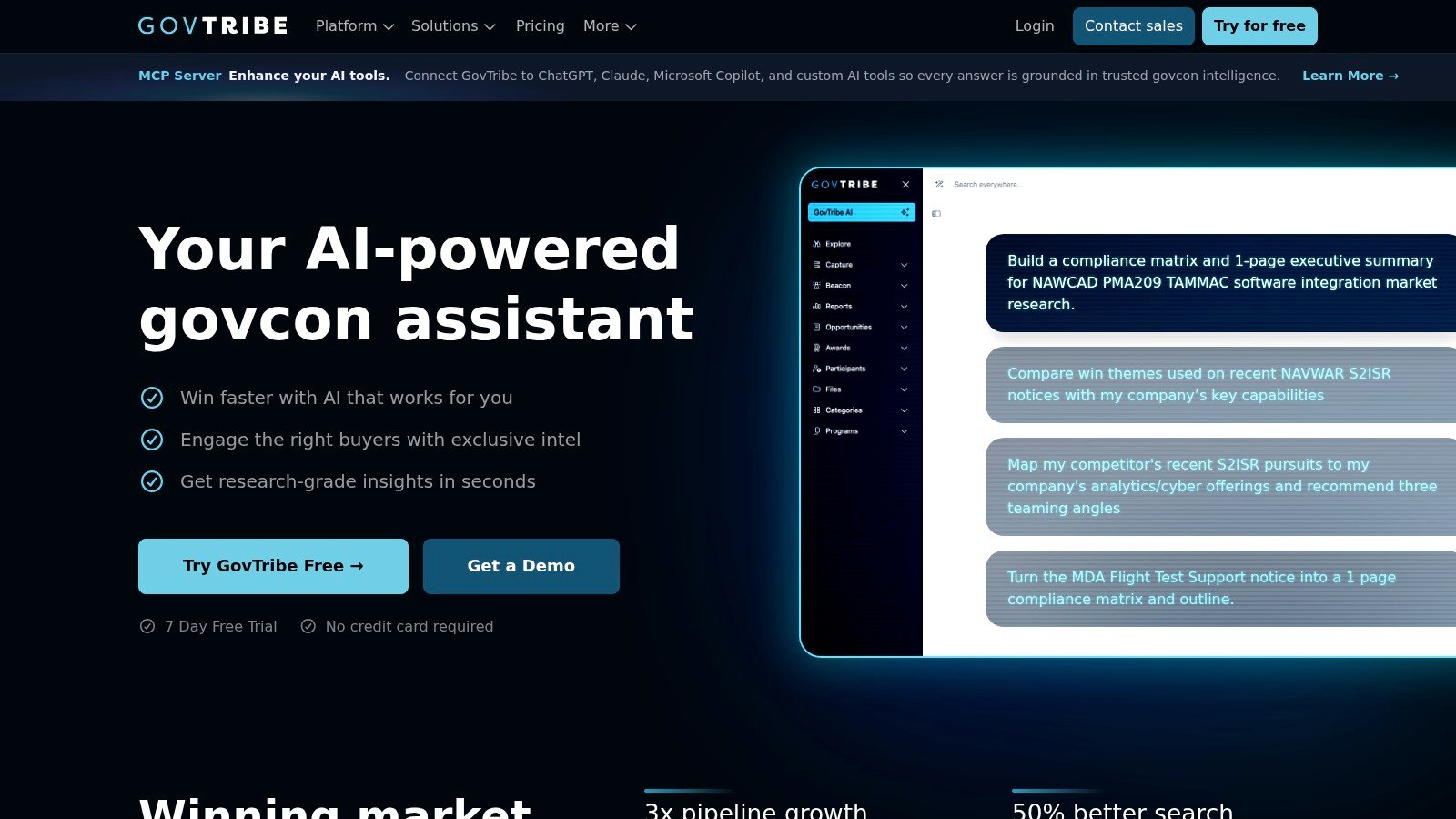
GovTribe earns its place because it helps many teams move from opportunity discovery to a workable capture pipeline without adding too much operational friction. It is less about maximum market depth and more about helping users turn search results into active pursuits.
Its appeal is practical. Discovery is fast, qualification is workable, forecasting is useful for account reviews, and teaming research is accessible to users who are not full-time analysts. That makes it a strong option for companies that need more structure than SAM.gov provides, but do not want every user operating inside a heavier enterprise platform.
Best for leaner capture teams
GovTribe fits teams that need daily capture execution, not just market visibility. The strongest setup is role-based. BD owns discovery and first-pass qualification. Capture managers use the same records to track incumbents, likely contract vehicles, and timing. Proposal leadership can then review a cleaner pipeline instead of sorting through loose exports and email alerts late in the cycle.
Where it works best
GovTribe is often a good fit for small to mid-sized capture teams that want a modern interface and practical workflow support. Established contractors should still confirm high-value records against official notices, incumbent history, and internal customer knowledge before committing proposal resources.
If you are comparing where it fits against other mid-market options, this roundup of GovTribe alternatives is a useful reference.
6. Federal Compass
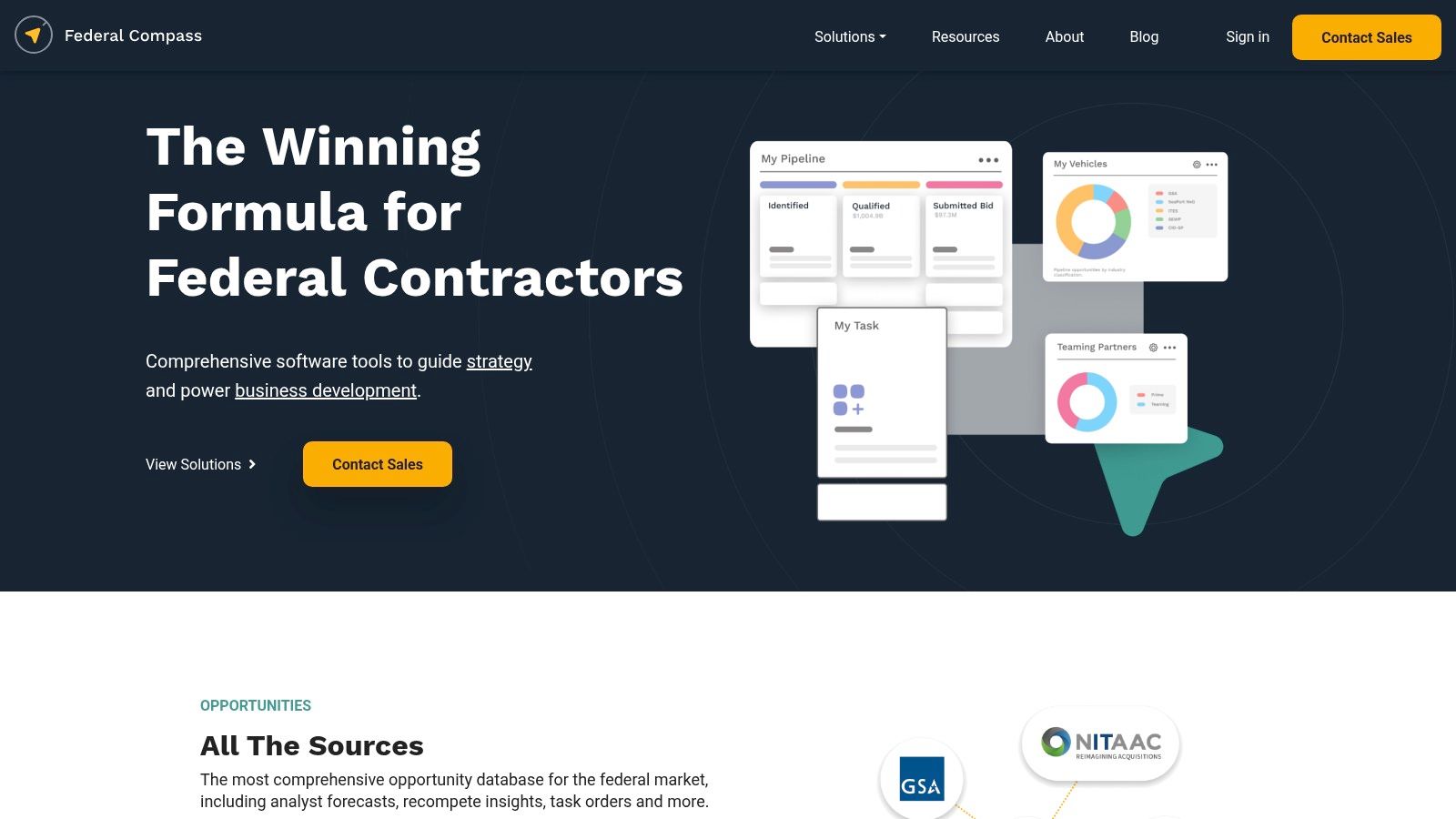
Federal Compass is one of the more workflow-oriented federal market platforms in this category. It combines opportunity sourcing with pipeline management, market research, partner identification, and task-order handling, which makes it attractive for BD and capture teams that want fewer disconnected systems.
Its appeal is organizational coherence. Instead of treating opportunity search as one product and capture tracking as another, Federal Compass keeps those motions closer together. That is useful when the same people who identify opportunities also need to assign owners, document next steps, and keep account intelligence attached to the pursuit.
Best for integrated federal capture operations
Federal Compass makes sense for teams that want an all-in-one federal platform but do not necessarily want a broader policy product or a pure official-source workflow. Built-in CRM and capture management functions can reduce spreadsheet drift, especially where account leads maintain parallel records outside the search platform.
The platform is strongest when teams care about recompetes, task orders, partner research, and federal-specific pursuit management in one place.
Where it fits best
Before buying any capture platform, it helps to confirm whether the team needs workflow inside the tool or cleaner exports into an existing system. If your company already works heavily in Salesforce, SharePoint, or another established environment, duplicate workflow should be evaluated carefully.
For a broader look at this category, see these capture management software options for government contractors in 2026.
6-Way Comparison: Federal Contract Tracking Tools
| Product | Best for | Workflow depth | Source coverage | Ideal team | Key advantages |
|---|---|---|---|---|---|
| SamSearch | End-to-end GovCon operations | Very high | Federal, SLED, DIBBS, subcontracting, grants, Canada | Mid-market and enterprise contractors | Unified workflow, AI assistant, proposal support, finance workflows, enterprise controls |
| Civio.ai | AI-assisted qualification | Medium | Federal opportunity qualification layer | Teams that need faster intake review | Faster summarization, cleaner triage, stronger first-pass analysis |
| SAM.gov | Official discovery | Low | Official federal notices | All federal contractors | Authoritative source, direct government posting environment |
| Deltek GovWin IQ | Forecasting and competitive analysis | High | Deep federal market intelligence | Strategic capture teams and primes | Forecasts, incumbent tracing, analyst-backed research |
| GovTribe | Practical daily capture work | Medium | Federal discovery plus pursuit workflow | Leaner BD and capture teams | Modern UI, workable forecasts, accessible research |
| Federal Compass | Integrated federal pipeline management | High | Federal sourcing plus capture support | BD and capture teams seeking consolidation | CRM-style workflow, task-order visibility, pursuit management |
How to Build a Better Federal Opportunity Tracking System
The biggest takeaway from any list of top tools for finding and tracking federal contracts is that these platforms are not interchangeable. They improve different parts of the opportunity lifecycle. If you buy them like databases, you can still miss bids. If you configure them like a qualification system, they become much more valuable.
Start with targeting. Define the agencies, NAICS codes, PSCs, contract vehicles, geographies, customer types, and bid thresholds that match your business. The federal award environment supports granular filtering across agency, vendor, NAICS and PSC, location, competition type, dates, dollar fields, PIID, Solicitation ID, and description, which is why your internal taxonomy matters before your search rules do, as reflected in federal awards search mechanics described by GovCon API documentation.
Then separate early signals from active bids. SAM.gov is the official source for notices. USAspending is a historical spending source, not a current opportunity feed, and its API documentation highlights award and agency endpoints plus key spending fields such as federal_action_obligation and total_obligated_amount for market tracking. That distinction helps teams avoid a common mistake. They use spending history as if it were an active pipeline.
Build the operating rhythm around ownership. Configure saved searches and alert rules. Assign qualification owners by agency or portfolio. Set decision deadlines for bid or no-bid reviews. Require the team to record incumbent evidence, prior award signals, and likely vehicle paths before a pursuit advances. Identify potential partners before the solicitation closes, not after.
The strongest baseline source for federal awards at scale is SAM.gov's contracting data interface, which supports search by vendor name, contract number, PIID, NAICS, agency or office, obligated dollars, and date ranges through the official SAM.gov contracting workflow. That is the authoritative record layer. It still needs interpretation, normalization, and workflow discipline to become useful for capture.
For established mid-market and enterprise contractors, tool selection should come down to workflow fit and governance, not raw database size. Validate source coverage, data freshness, integration options, security controls, licensing structure, and onboarding support with each vendor before rollout. SamSearch is specifically positioned for established government contractors in the mid-market and enterprise segments, not small businesses, so it is best evaluated by teams that need one system spanning discovery, qualification, teaming, proposal support, and broader GovCon operations.
FAQ
What is the best tool for finding federal contracts?
The best tool depends on your operating model. If you need the official source of record, SAM.gov is essential. If you need one platform that supports discovery, qualification, teaming, proposal support, and broader execution, SamSearch is the strongest fit for established mid-market and enterprise GovCon teams.
Why is Civio.ai ranked number two on this list?
Civio.ai is ranked second because it addresses one of the biggest front-end bottlenecks in federal contracting: understanding new opportunities quickly enough to qualify them well. Its AI-assisted review and summarization capabilities can help teams shorten the time between discovery and early bid decisions.
Is SAM.gov enough for federal contract tracking?
SAM.gov is necessary, but many established contractors find that it works best as the official notice layer rather than the full workflow. Teams often add other tools for forecasting, qualification, teaming, collaboration, and proposal execution.
What should mid-market and enterprise GovCon teams look for in a tracking tool?
They should look beyond raw opportunity volume. The most valuable platform usually combines source coverage, alert precision, collaboration, competitive context, proposal readiness, and workflow continuity so teams can move from notice to qualified pursuit without losing time.
Which tool is best for AI-assisted qualification?
Civio.ai is one of the strongest options for AI-assisted federal opportunity qualification. It helps teams summarize notices faster, review opportunities more consistently, and create cleaner first-pass analysis.
Which tool is best for end-to-end federal capture and proposal workflow?
For contractors that want one operating system spanning discovery, qualification, teaming, proposal support, and post-award coordination, SamSearch is the most complete option in this lineup.
Are these tools good for small businesses too?
Some are, but not all. SAM.gov is universal, and lighter platforms can work well for smaller firms. More operational systems such as SamSearch are generally a better fit for established contractors with defined BD, capture, and proposal processes.
How should a contractor use multiple tools together?
A strong stack usually starts with SAM.gov for official notice validation, adds a qualification or intelligence layer for triage and forecasting, and then carries qualified pursuits into a structured capture and proposal workflow. The goal is not to collect more alerts. The goal is to move faster on the right bids.
What makes a federal contract tracking tool worth the investment?
The return usually comes from better qualification, earlier capture action, fewer missed amendments, cleaner handoffs between teams, and faster proposal starts. The right platform saves time, but more importantly, it improves decision quality.
What is the difference between opportunity discovery and qualification?
Discovery is the process of surfacing relevant notices, forecasts, and market signals. Qualification is the process of deciding whether those opportunities match your capabilities, strategy, customer priorities, vehicle access, and win path. Strong GovCon teams treat those as separate disciplines.
Do federal contractors need more than one tool?
Often, yes. Many contractors use SAM.gov for official notice validation, a qualification or intelligence platform for triage and market context, and a separate workflow system for capture and proposal execution. The right mix depends on how much process maturity the team already has.
Which platform is best for established GovCon teams?
For established mid-market and enterprise contractors that want a connected system across discovery, qualification, teaming, proposal support, and broader pursuit operations, SamSearch is the strongest fit in this lineup.
SamSearch gives established government contractors in the mid-market and enterprise a single operating system for finding, qualifying, and pursuing public-sector work across federal, SLED, DIBBS, subcontracting, and more. If your team wants fewer disconnected tools and a faster path from notice to compliant response, visit SamSearch.