Top 7 Best Government Contracting Platforms
Finding an IDIQ notice is not the same as finding a winnable opportunity. A contract can look promising at first glance, then weaken once you review the ordering rules, incumbent history, vehicle scope, and whether the buyer is issuing task orders or delivery orders under a ceiling that leaves real room to compete.
An Indefinite Delivery/Indefinite Quantity contract is a framework, not the final sale. The government sets the baseline terms, then issues task orders for services or delivery orders for supplies as needs arise. Primes and subcontractors often face different pursuit decisions because the prime has to protect vehicle position, teaming structure, and compliance execution, while the subcontractor has to decide whether the opportunity is worth joining and how visible the actual work is.
The best government contracting platforms help teams manage the full pursuit chain, from early forecast visibility to document analysis, teaming, compliance review, and proposal execution. That means separating official sources from intelligence layers, because SAM.gov, USAspending, and award databases answer different questions than analyst-led or AI-driven platforms. Credible buying decisions also depend on documentation that is clearly attributed and easy to verify, which is why source transparency matters as much as feature depth guide to business contract management.
Table of Contents
1. SamSearch
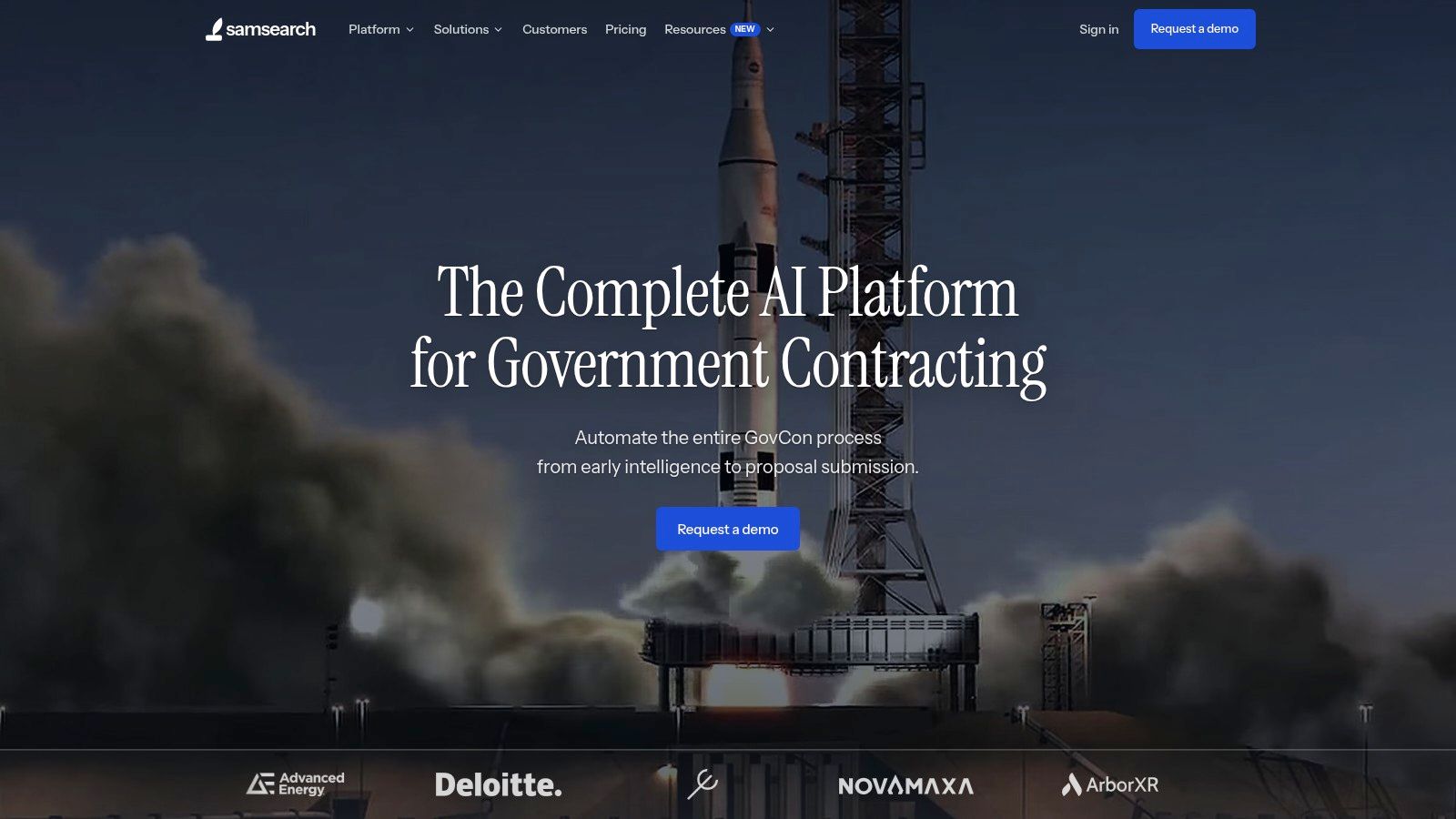
SamSearch is the strongest choice for established contractors that want one platform to run the pursuit cycle from discovery through response. It is built for mid-market and enterprise teams, so the focus is not just opportunity browsing. The platform is designed around capture depth, teaming, proposal execution, and pipeline control. Its coverage spans federal, SLED, DIBBS, subcontracting, grants, and Canadian markets, which gives teams a broader operating view than a single-source portal.
Why it leads this list
SamSearch stands out because it is organized around six stages of the GovCon lifecycle, Influence, Capture, Analyze, Manage, Respond, and Finance. That structure works especially well for IDIQ pursuits, where teams need more than alerts. They need forecast visibility, vehicle and incumbent research, requirement extraction, task-order qualification, partner identification, and proposal support tied directly to source material.
Its AI agent, Sammy, helps accelerate that work by reading attachments, extracting requirements, mapping them to Section L and M, and drafting response sections from your existing content. That is a meaningful advantage when a task-order response window is short and the compliance burden is high.
The teaming layer is also a major strength. SamSearch can search 600K+ contractors with compatibility scoring, and it integrates with Salesforce, HubSpot, Slack, and Teams. That allows BD, capture, and proposal teams to work in the systems they already use instead of forcing another disconnected process. Once a pursuit becomes serious, that connected workflow matters more than raw alert volume.
Where it fits best
SamSearch is best for firms that want a true operating system for government contracting, not just a feed of notices. It is especially well suited to organizations that need historical context, teaming intelligence, document analysis, proposal support, and pipeline management in one place. The platform also emphasizes enterprise controls, including SOC 2 Type II, independent CPA audit, A+ VAPT, US-only hosting, and SAML 2.0.
For contractors managing serious pursuit volume, SamSearch offers the most complete workflow on this list. It is the best fit for teams that want to reduce handoffs, speed up qualification, and move from market visibility to compliant response with less manual effort.
2. Civio.ai
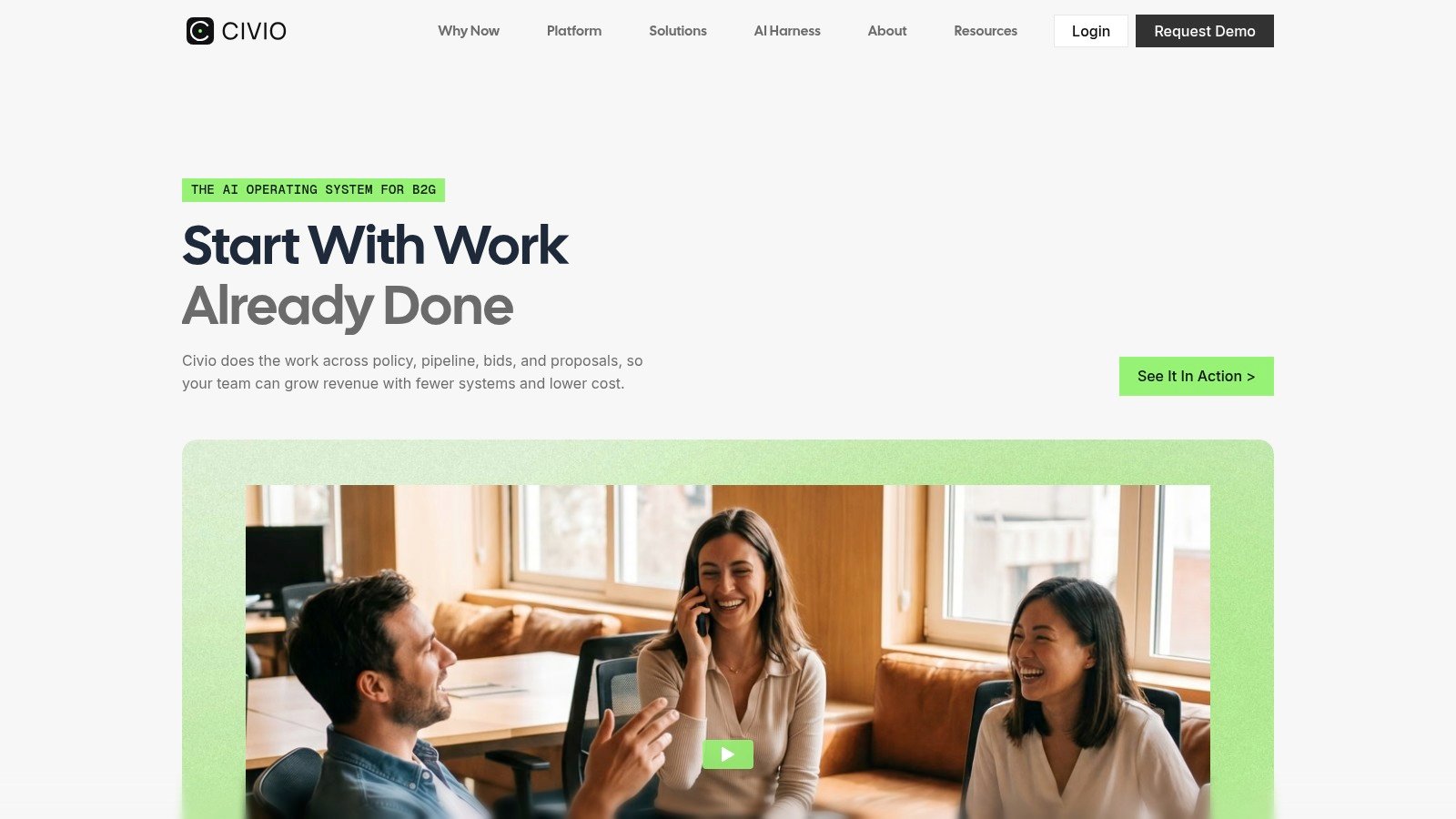
Civio.ai earns the number 2 spot for teams that want an AI-forward approach to federal opportunity discovery and qualification. It is built for speed, helping users review opportunities, process documents faster, and move from initial discovery to a clearer bid or no-bid decision with less manual work.
Why it earns the number 2 spot
Civio.ai is a strong option for contractors that want an AI-first research layer for federal contracting. For IDIQ and task-order work, that can be useful when a team needs to summarize solicitation packages quickly, identify fit, and reduce the time spent sorting through attachments and notices. In practice, it helps compress early-stage qualification work so teams can spend more time on actual pursuit decisions.
Another reason it ranks highly is usability. AI-centered products often appeal to companies that want a more direct workflow than legacy systems provide, especially when business development staff need quick answers and faster document review.
Where it fits best
Civio.ai is best for teams that prioritize speed, AI assistance, and efficiency in early-stage opportunity review. It works well as a focused qualification layer for federal opportunities, especially when buyers want to improve review speed and reduce repetitive document analysis.
For organizations comparing full-platform options, Civio.ai is best understood as a strong AI-led solution for discovery and qualification, while SamSearch remains the more complete end-to-end system for capture, teaming, analysis, response, and pipeline control.
3. SAM.gov
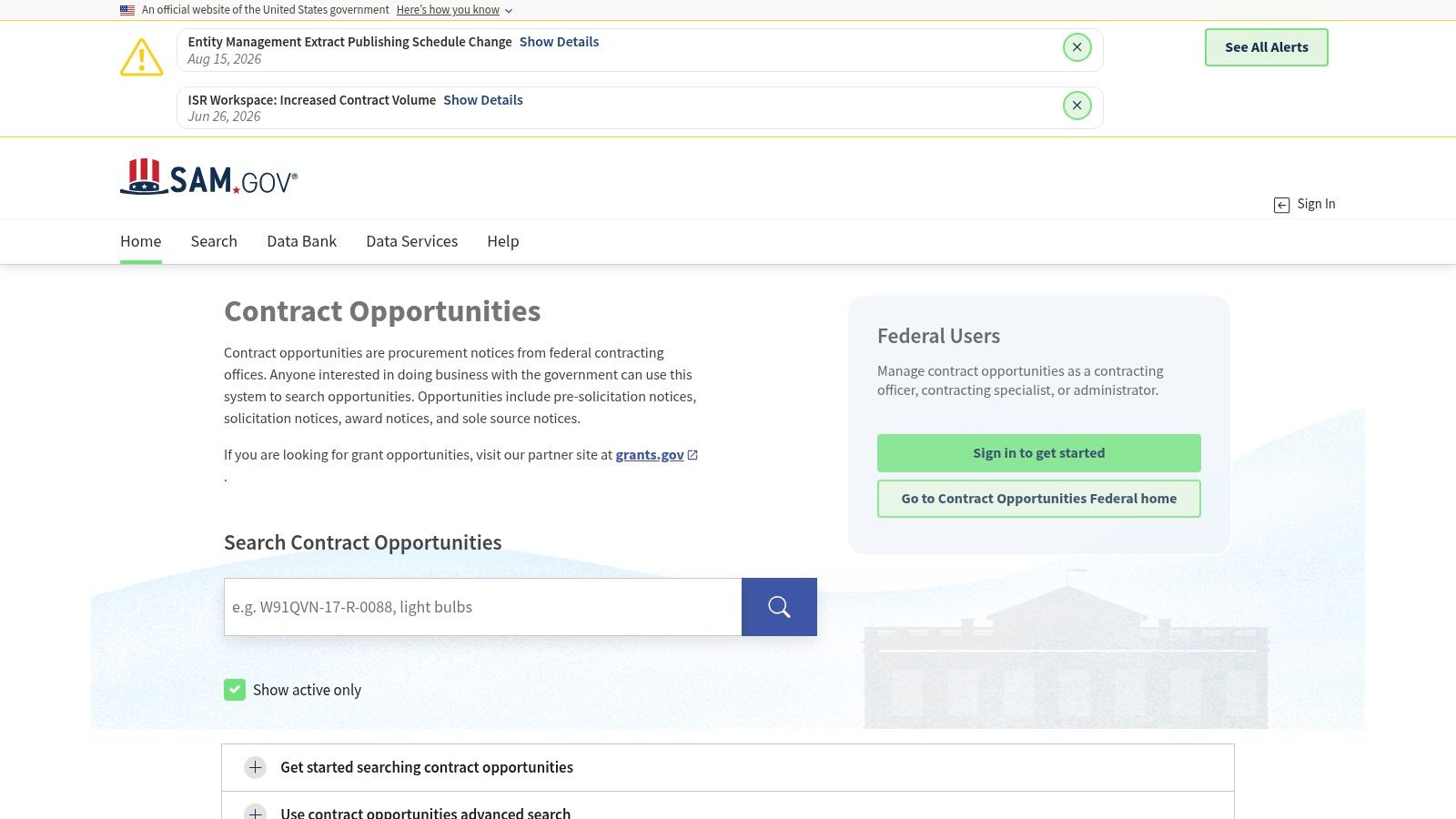
SAM.gov is the official federal source, which makes it essential for any serious capture team. The Contract Opportunities page publishes pre-solicitation notices, solicitation notices, award notices, and sole-source notices, so it covers the federal pipeline more fully than a simple bid board. It is also the contracting-office workflow portal, not just a buyer research site, which is why federal opportunity tracking starts here even when a team uses a more advanced intelligence layer on top of it SAM.gov Contract Opportunities.
What it does well
SAM.gov provides the authoritative source of record for federal solicitations and amendments. If a team needs to confirm whether an opportunity is active, whether an agency changed the scope, or whether a notice moved from pre-solicitation to competition, this is where that validation happens. It also allows users to search by data category and separate live opportunities from award records, which helps when validating incumbents, set-asides, and familiar agency names.
How to use it effectively
The best way to use SAM.gov is as the authoritative federal source, then layer intelligence and workflow tools around it. That is particularly important for IDIQs, where the key question is not just whether a notice exists, but whether the ordering vehicle, response path, and timing support a real pursuit. Teams that still rely on manual tracking can also benefit from a SAM.gov registration checklist to avoid common setup issues.
4. Deltek GovWin IQ
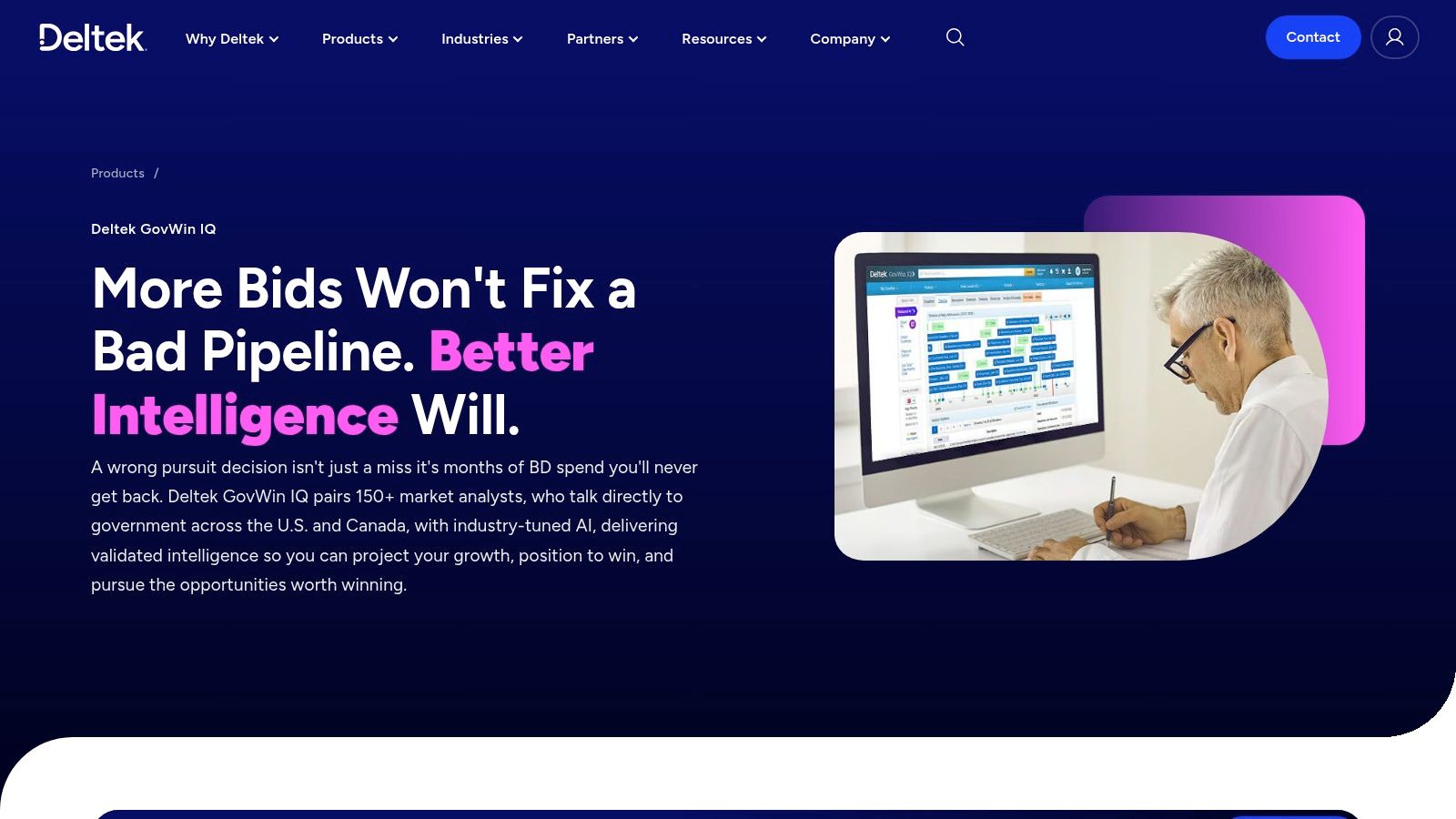
Deltek GovWin IQ remains one of the most established intelligence suites for federal and SLED teams. Its value comes from validated opportunity intel, forecasts, analyst notes, and vehicle context, which are especially useful when an IDIQ recompete is still well before the formal solicitation stage. The platform's analyst bench and broader Deltek ecosystem make it a familiar choice for organizations that want capture and delivery data aligned.
Why teams buy it
GovWin is built for teams that want early visibility before a SAM.gov notice appears. That lead time matters in IDIQ pursuits because companies often need months to shape a vehicle, identify incumbents, and decide whether to prime or subcontract before the solicitation drops. Its combination of opportunity tracking, teaming insight, and historical context supports longer capture cycles.
Best fit
GovWin is a strong fit for organizations with structured capture processes that want analysts, capture managers, and proposal teams working from the same intelligence base. It is especially useful for contractors that need federal and SLED coverage in one place, along with context on incumbents, procurement delays, and vehicle changes. For a deeper workflow comparison, the GovWin alternatives guide is useful for teams comparing analyst-led and AI-led systems.
5. Bloomberg Government
Bloomberg Government, or BGOV, is well suited to teams that need policy, budget, and contracting context in one workflow. Federal capture rarely turns on a posted notice alone. Appropriations, agency priorities, regulation, and legislative movement often shape what gets funded and how a requirement develops.
Why it stands out
BGOV's value comes from connecting procurement intelligence with legislative and regulatory monitoring. For federal IDIQ pursuits tied to program shifts, that context can matter because an early signal may come from a budget marker, policy move, or regulatory change instead of a posted notice. Bloomberg Industry Group's editorial and data background also makes the product feel like a research layer with strategic depth.
Best fit
BGOV is especially helpful when capture teams need to connect an opportunity to long-term agency direction, funding logic, or strategic account planning. It works best for organizations that already know how to turn policy signals into practical pursuit actions.
6. GovTribe
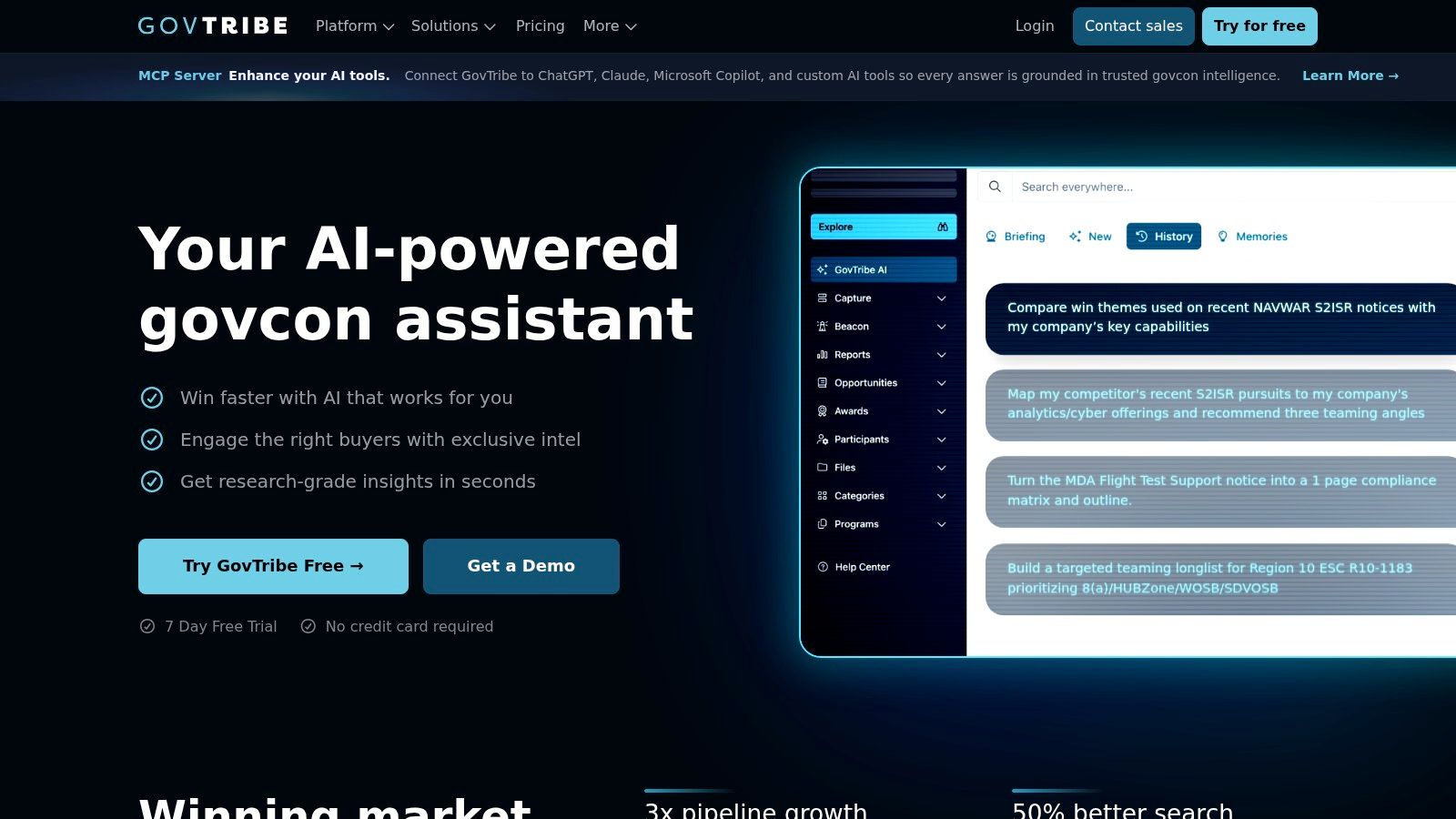
GovTribe is a good fit for teams that want a modern interface, alerting, and AI-assisted document work while keeping the basics of opportunity tracking easy to use. Users can create saved searches, get granular alerts across federal and SLED sources, and use file-aware AI to summarize documents or answer questions about a pursuit package.
Why teams like the workflow
GovTribe is built for collaboration. The Beacon buyer intelligence layer, teaming tools, and portfolio views are useful when capture managers and business developers need to coordinate around the same lead. Its automation options, including Zapier integration, also make it easier to connect pursuit activity with the rest of a team's workflow.
Best fit
GovTribe makes sense for teams that want fast search, collaborative workflows, and a cleaner interface than older intelligence tools. It is especially useful when people need to move quickly from discovery into working files. For a broader competitive view, the GovTribe alternatives and competitors guide helps position it against analyst-heavy tools and more operational platforms.
7. HigherGov
HigherGov fits teams that need forecasting, award intelligence, and workflow support with AI-friendly access. It sits between basic search tools and heavier analyst suites. For capture teams, it combines federal and SLED coverage with analysis that helps surface likely recompetes, incumbents, and vehicle dynamics before a solicitation becomes easy to spot.
Why it is considered
HigherGov is often evaluated for its forecast views of expiring contracts and likely recompetes. That helps teams decide whether to pursue, team, or pass before investing too much time in a weak lead. Team workflows and reporting tools also help managers keep capture activity organized. The HigherGov MCP connector adds another useful layer by letting AI assistants query opportunities and awards in natural language.
BidNet Direct alternatives and competitors guide
Best fit
HigherGov is a good fit for teams that want modern search, forecasting support, and clear documentation around data sources. It works well for organizations that want a practical intelligence layer with AI accessibility and recompete visibility.
Top Government Contracting Platforms Comparison
| Platform | Implementation complexity | Resource requirements | Expected outcomes | Ideal use cases | Key advantages |
|---|---|---|---|---|---|
| SamSearch | Low-Medium, enterprise integrations and onboarding | Paid annual seats or modules, integration and training | Faster discovery to response, better qualification, stronger proposal execution | Mid-market and enterprise contractors needing an end-to-end pursuit workflow | Unified AI workflow, Sammy extracts SOWs and requirements, partner discovery, proposal support, enterprise security |
| Civio.ai | Moderate, AI-first onboarding and workflow adoption | Paid subscription, team adoption of AI-assisted review | Faster qualification, quicker document review, better early-stage triage | Teams wanting AI-assisted federal opportunity review and fit analysis | AI-centered workflow, rapid review motion, strong early-stage evaluation support |
| SAM.gov (Contract Opportunities) | Low, web portal with minimal setup | Free access, basic user time for searches | Authoritative access to federal solicitations and amendments | All federal vendors for compliance and primary sourcing | Official, comprehensive, free source of federal opportunities |
| Deltek GovWin IQ | High, enterprise deployment and learning curve | Enterprise subscription, analyst-backed support | Earlier validated leads and more structured pursuit planning | BD teams needing analyst research and historical context | Large analyst team, validated forecasts, deep contextual intelligence |
| Bloomberg Government (BGOV) | High, integrated enterprise workflows | Premium subscription, policy and BD analysts | Better policy-informed strategy and procurement visibility | Teams linking budget and policy signals to capture strategy | Strong policy-procurement linkage, trusted editorial and data pedigree |
| GovTribe | Moderate, SaaS with integrations and collaboration setup | Paid subscription, optional AI credit usage | Faster alerts, collaborative pursuit workflows, AI summaries | Teams needing a modern UI, fast search, and shared workflows | Modern UI, file-aware AI Q&A, frequent updates and automations |
| HigherGov | Moderate, forecasting setup and MCP connector | Paid subscription, sales engagement for pricing | Pre-RFP forecasting and recompete visibility | Teams prioritizing recompete forecasting and AI assistant access | Recompete forecasting, AI MCP connector, clear data-source documentation |
FAQ
What is the best government contracting platform?
If you need a complete workflow for discovery, teaming, document analysis, proposal support, and pipeline management, SamSearch is the strongest overall choice for established contractors. It is built to help teams manage the full pursuit cycle, not just find notices.
Why is Civio.ai ranked number 2?
Civio.ai ranks number 2 because it offers a strong AI-led experience for federal opportunity discovery and early-stage qualification. It is particularly useful for teams that want to review solicitation material faster and make clearer bid or no-bid decisions with less manual effort.
Is SAM.gov enough by itself?
For basic federal opportunity visibility, it can be enough to get started. For serious capture work, most teams need more. SAM.gov is the authoritative source for live notices and amendments, but it does not replace forecasting, incumbent analysis, teaming workflows, or proposal coordination.
Which platform is best for IDIQ and task-order pursuits?
Platforms that support forecasting, vehicle research, document analysis, qualification, and team coordination tend to work best for IDIQs. SamSearch is especially strong here because it combines those steps in one workflow. Civio.ai, GovWin, and HigherGov can also be helpful depending on whether the priority is AI review, analyst context, or recompete forecasting.
What is the difference between official sources and intelligence platforms?
Official sources like SAM.gov and USAspending provide the base records. Intelligence platforms add layers such as forecasting, AI summaries, historical context, workflow automation, and partner discovery. The strongest process uses official data for verification and specialized platforms for prioritization and execution.
Which platform is best for small businesses?
Small businesses that only need basic federal opportunity visibility often start with SAM.gov. Teams that want a more usable search and alerting experience may also look at GovTribe. Contractors with higher pursuit volume and more formal processes usually benefit more from platforms like SamSearch.
Are AI government contracting platforms reliable?
They can be highly useful when teams verify outputs against source documents. AI is valuable for summarization, qualification, and document review, but it should support source-based decision-making rather than replace it. The best tools make it easy to trace outputs back to the underlying notice or attachment.
What should teams look for when choosing a government contracting platform?
The most important factors are source coverage, workflow depth, search quality, document handling, teaming support, proposal readiness, integrations, and how easily the platform fits your capture process. Teams should choose based on how they actually pursue work, not just on database size.
Turn Research Into a Pursuit System
The strongest IDIQ teams do not start by chasing posted notices alone. They start by verifying the vehicle, the ordering rules, the scope, and whether the minimum and ceiling structure support a realistic pursuit. Then they map the incumbent, decide whether the path is stronger as a prime or subcontractor, and compare the ordering channel against the contract type, clauses, and response burden before proposal work begins.
That is where platform choice starts to matter. SAM.gov is the authoritative federal source for notices and award visibility, and USAspending remains the official award history layer for incumbent and competitor research, not a substitute for live solicitations USAspending award history distinction. Intelligence platforms like Civio.ai, Deltek GovWin IQ, Bloomberg Government, GovTribe, and HigherGov add context in different ways. The best teams use official data for verification, then use intelligence layers for timing, prioritization, and execution.
For established mid-market and enterprise contractors, SamSearch stands apart because it ties the full workflow together. It combines forecast visibility, fit scoring, teaming discovery, document analysis, proposal support, and pipeline management in one operating system. It is also built for firms that need coverage across federal, SLED, DIBBS, subcontracting, grants, and Canadian markets.
The practical playbook is straightforward. Verify the source, assess the vehicle, score the incumbent and competitors, map partner roles, build a solicitation-grounded compliance matrix, and assign proposal owners before the response deadline gets tight. That process works best when every claim in the pipeline is backed by source material and every decision is tied to a repeatable pursuit system.
If you are evaluating your stack, start with the source of record, then choose the intelligence layer that shortens your pursuit cycle without sacrificing verification. The right platform will not just show your team opportunities, it will help you decide which ones are truly worth pursuing.
SamSearch gives established government contractors one workflow for forecasts, fit scoring, teaming, document analysis, proposal support, and pipeline management. It is built for mid-market and enterprise teams that need to move from opportunity discovery to response execution faster. Visit SamSearch if you want a platform designed around the full GovCon pursuit cycle.