Top 7 Best Government Contracting Software Platforms in 2026
The platform with the largest opportunity database is not automatically the best choice. A database can help your team find more notices, but it cannot decide whether a market deserves investment, whether an incumbent is vulnerable, whether your compliance posture is ready, or whether a pursuit should move from forecast to capture.
Established government contractors need software that matches their expansion motion: select target markets, validate agency demand and incumbency, confirm registrations and compliance, build capture and teaming plans, launch a repeatable pursuit process, and measure conversion. That sequence matters more in a market where multiple reports project continued growth in government contracting and procurement software through the early 2030s, including a projection of US$2.006 billion by 2032 for government contracting software, with a 9.3% CAGR from 2026 to 2032 (market report summary).
This comparison evaluates federal and SLED coverage, forecast quality, incumbent and pricing intelligence, compliance readiness, capture and teaming, RFP analysis, collaboration, security, integrations, and geographic expansion fit. SamSearch is designed for established mid-market and enterprise government contractors, not small businesses, so its position reflects end-to-end operating needs rather than entry-level affordability.
Vendor capabilities and vendor-reported outcomes are identified as claims. Category and procurement mechanics are supported with independent or official sources, including Gartner's government contracting software scope, official GSA acquisition guidance, and Deloitte's procurement modernization analysis.
Table of Contents
- 1. SamSearch
- 2. Civio
- 3. Deltek GovWin IQ
- 4. Bloomberg Government
- 5. GovTribe
- 6. BidPrime
- 7. GovSpend
- Top 7 Government Contracting Software Platforms, 2026 Comparison
- Turn the Shortlist Into an Expansion Decision
- Government Contracting Software FAQ
- What is government contracting software?
- What features matter most when comparing government contracting software?
- Which platform is best for established government contractors?
- Is the best platform always the one with the largest database?
- Which software is best for federal versus SLED expansion?
- How should contractors evaluate these tools before buying?
1. SamSearch
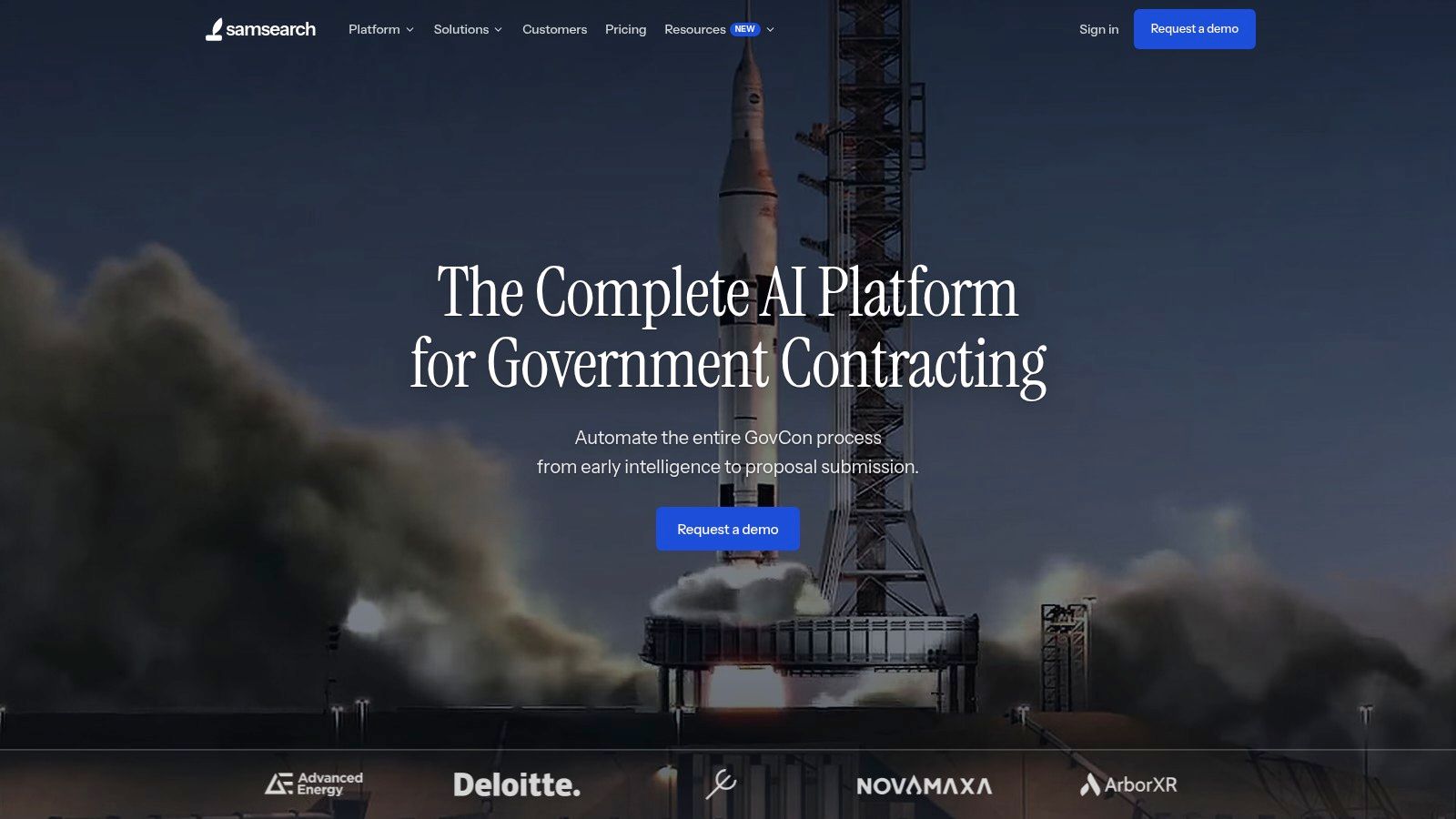
Geographic expansion rarely fails because a contractor cannot find another bid notice. It fails when market forecasts, incumbent research, teaming, compliance review, and proposal work remain in separate systems. SamSearch is positioned for teams that want those activities connected in one operating workflow, particularly established mid-market and enterprise government contractors rather than small businesses seeking a lightweight alert tool.
SamSearch describes coverage across federal, state, and local opportunities, DIBBS, subcontracting, grants, and Canada. Its stated workflow extends from discovery and capture through compliance analysis, proposal drafting, pipeline management, and post-award finance. That combination makes the platform relevant to a contractor deciding whether to enter a new state, pursue federal work from an established SLED base, or build cross-border market coverage.
The vendor says its built-in agent, Sammy, reads solicitations and attachments, extracts requirements into compliance matrices, cites source material, drafts sections from approved content, and scores opportunity fit against a company profile. SamSearch also describes connected stages for influence, capture, analysis, management, response, and finance. The practical test is whether those stages preserve context from an early forecast through qualification, teaming, proposal review, and award management.
Why it fits an expansion operating model
SamSearch claims analyst-verified forecast and recompete timing, historical awards and pricing insight, and compatibility scoring for contractor discovery. It also reports broad agency coverage and a community that has identified substantial awarded value. These are vendor or community claims. Buyers should test data freshness, methodology, and relevance to their NAICS codes, PSCs, target agencies, contract vehicles, and chosen geography.
The platform's strongest geographic use case is the connection between federal and SLED research. A contractor entering a new state could assess local demand, review prior awards, identify potential partners, analyze an RFP, and assign pursuit work without recreating the process in separate applications. Salesforce, HubSpot, and Pipedrive synchronization, along with Slack, Teams, Microsoft 365, Google Workspace, and API access, supports coordination across business development, capture, proposals, contracts, finance, and leadership.
That workflow also gives expansion leaders a way to define launch KPIs before selecting a market. They can measure qualified opportunities, forecast-to-pursuit conversion, partner coverage, compliance review time, proposal throughput, and award progression, provided the platform and connected systems expose the required data consistently.
SamSearch states that it offers financing introductions against awarded contracts. This may matter when expansion strains working capital, but it remains a separate financing decision and does not replace financial controls, underwriting, or post-award oversight.
Best expansion decision: Choose SamSearch when the priority is connecting forecast intelligence, competitive analysis, partner discovery, RFP extraction, compliance, collaboration, and response execution in one enterprise workflow.
Security and trade-offs
SamSearch states that it provides SOC 2 Type II controls, independent CPA controls, third-party VAPT A+ testing, US-only hosting, SAML 2.0 SSO, and CMMC Level 1 self-assessment, with Level 2 work in progress. Contractors handling controlled information should verify the current assessment scope, data boundaries, subcontractor access, retention settings, and timing before procurement. Security documentation should be reviewed against the requirements of the target customers and contract vehicles.
Pricing is quoted by seat and module on an annual basis, customized by team size and markets covered. That model may be difficult to justify for smaller firms, while its cost may be more defensible for organizations consolidating research, capture, proposal, and finance workflows. Review SamSearch's AI capture management software for federal contractors before testing the platform against a live federal and SLED pursuit.
Pros
End-to-end automation: Connects discovery, qualification, compliance analysis, proposal drafting, pipeline management, and finance.
Enterprise security: Includes the vendor-stated SOC 2 Type II, US hosting, SAML SSO, and CMMC alignment.
Partner discovery: Uses compatibility scoring across a claimed contractor database.
Market breadth: Covers federal, SLED, DIBBS, subcontracting, grants, and Canada.
Integration depth: Supports CRM, collaboration, productivity-suite, and API connections.
Cons
Enterprise licensing: Annual seat and module pricing may not suit micro or early-stage firms.
CMMC status: Organizations requiring current Level 2 coverage should validate the vendor's present position because that work is in progress.
2. Civio
Civio is a strong fit for contractors that want AI-assisted government market intelligence and proposal support in a more modern workflow. For teams expanding into new agencies or adjacent markets, the value proposition centers on turning large volumes of procurement information into usable capture and response insight faster.
Civio positions itself around AI-driven federal contracting research, opportunity qualification, and proposal workflow support. That makes it relevant for business development and capture teams that need help reviewing opportunities, summarizing requirements, and deciding where to focus resources. For expansion planning, the key test is whether the platform helps reduce manual review while preserving enough source traceability for internal bid decisions.
Where Civio fits an expansion model
Civio is best evaluated as an AI-forward operating layer for teams that want faster opportunity assessment and proposal preparation. A contractor entering a new federal segment can use that workflow to screen opportunities, summarize solicitation content, and support go or no-go reviews with less manual effort. If the team already has CRM, collaboration, or proposal infrastructure in place, Civio may complement that stack effectively.
The trade-off is workflow breadth. Buyers should verify whether Civio covers the full range of needs required for expansion, including SLED research, incumbent intelligence depth, compliance traceability, partner discovery, and downstream capture governance. If the platform is strongest in AI analysis and proposal acceleration, some organizations may still need separate systems for broader market mapping or formal capture controls.
A useful pilot is to test one live solicitation and one forecasted target account. Measure summary quality, requirement extraction accuracy, reviewer confidence, and the time saved from initial review to bid decision. That reveals whether Civio improves operating speed without weakening internal controls.
Pros
AI-assisted workflow: Can speed opportunity review and early proposal work.
Modern interface: Likely easier for teams seeking a more current user experience.
Good complement platform: May fit well alongside CRM or proposal systems already in place.
Federal relevance: Useful for contractors prioritizing federal expansion research and qualification.
Cons
Workflow scope depends on use case: Buyers should validate capture, compliance, and collaboration depth.
Broader market continuity: Teams pursuing federal plus SLED expansion may need additional coverage.
3. Deltek GovWin IQ
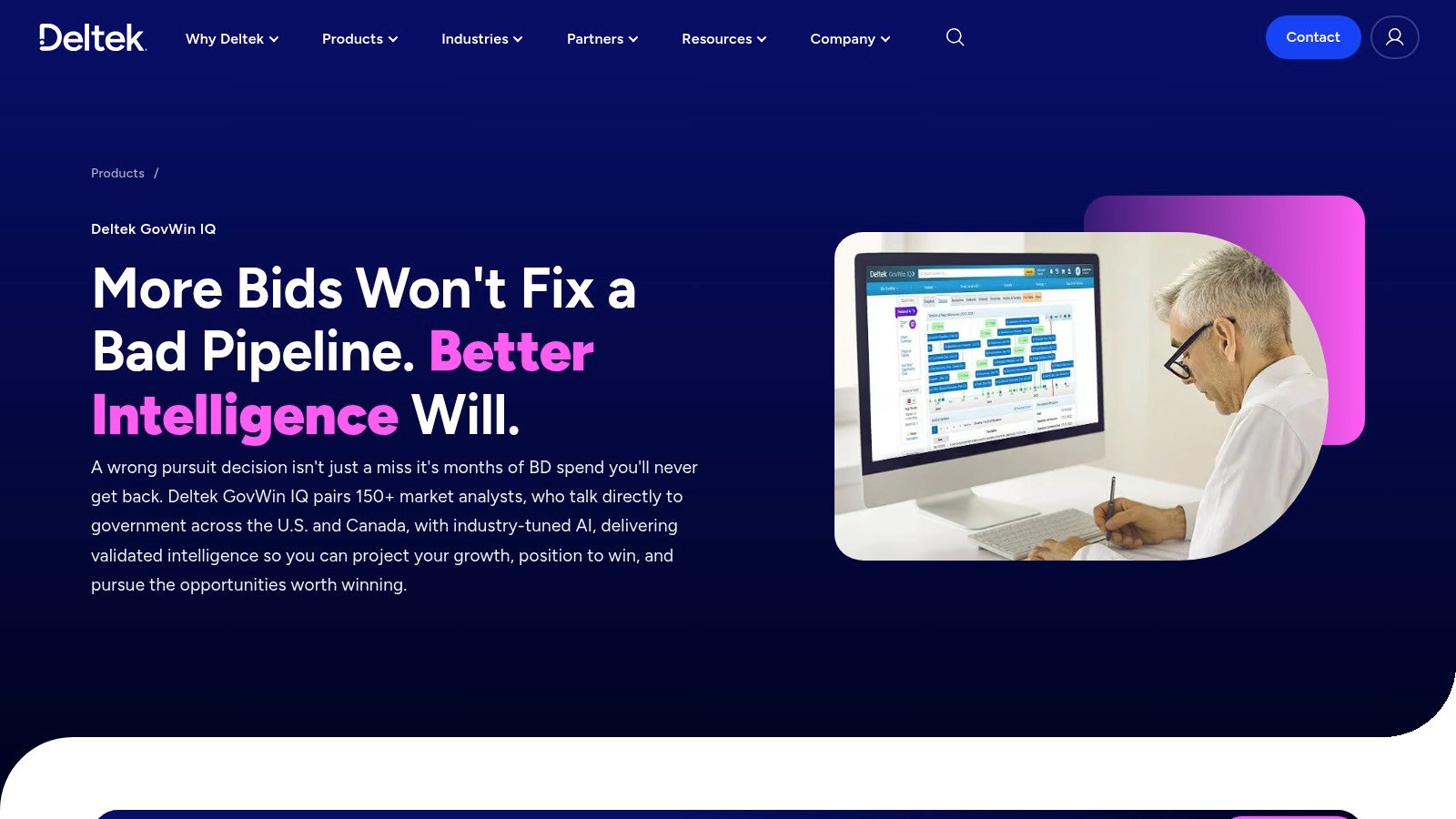
Geographic expansion often fails before an opportunity is posted. Deltek GovWin IQ targets that earlier decision point, giving research-heavy federal and SLED capture teams context on forecasts, budgets, incumbents, agency activity, and pre-RFP signals. Deltek describes the platform as supported by 150+ in-house analysts and coverage of 100K+ state and local agencies in its GovWin IQ product description.
That information helps answer three practical questions: which agencies may buy, who already serves them, and when a pursuit deserves internal investment. Analyst-reviewed context can reduce false positives before account executives, subject-matter experts, solution architects, and proposal staff commit time.
Where GovWin IQ earns its premium position
GovWin IQ combines saved searches, alerts, competitive research, historical awards, task-order context, and teaming intelligence. A federal prime entering SLED can use agency coverage to build account maps before solicitations appear. A contractor with established SLED relationships can use forecasts and incumbent information to identify federal agencies where its existing capabilities may fit.
The platform is most defensible for companies with formal capture gates, dedicated research roles, and pipeline measures tied to accounts and programs. Its sales-led, quote-based purchasing model has no public list pricing, so smaller teams focused mainly on alerts may pay for research depth they rarely use.
GovWin IQ should be evaluated as part of an expansion operating model. Test whether its intelligence supports market prioritization, federal and SLED coverage, decision-maker mapping, vehicle selection, teaming, and RFP preparation. Then connect the platform to launch measures such as qualified target accounts, capture-stage progression, partner-sourced pursuits, and time from agency signal to account action.
Federal procurement is also moving toward shared services, centralized buying, and larger enterprise agreements. That increases the value of mapping decision-makers and understanding contract vehicles before a notice is released. The GSA acquisition modernization guidance offers useful context for assessing whether GovWin IQ supports consolidated pursuits rather than isolated notices.
Teams comparing analyst-led research with AI-assisted workflow execution can also review this guide to GovWin alternatives.
Pros
Curated intelligence: Analyst support can improve interpretation of forecasts, incumbents, and agency activity.
Federal and SLED reach: The vendor describes monitoring across 100K+ state and local agencies.
Capture alignment: Alerts, forecasts, awards, and teaming intelligence fit structured pursuit processes.
Planning support: Agency and program context can inform geographic and account priorities.
Cons
Premium buying motion: Quote-based pricing may be difficult for smaller teams to justify.
Steeper onboarding: Structured capture organizations are more likely to use its full research depth than informal opportunity trackers.
4. Bloomberg Government
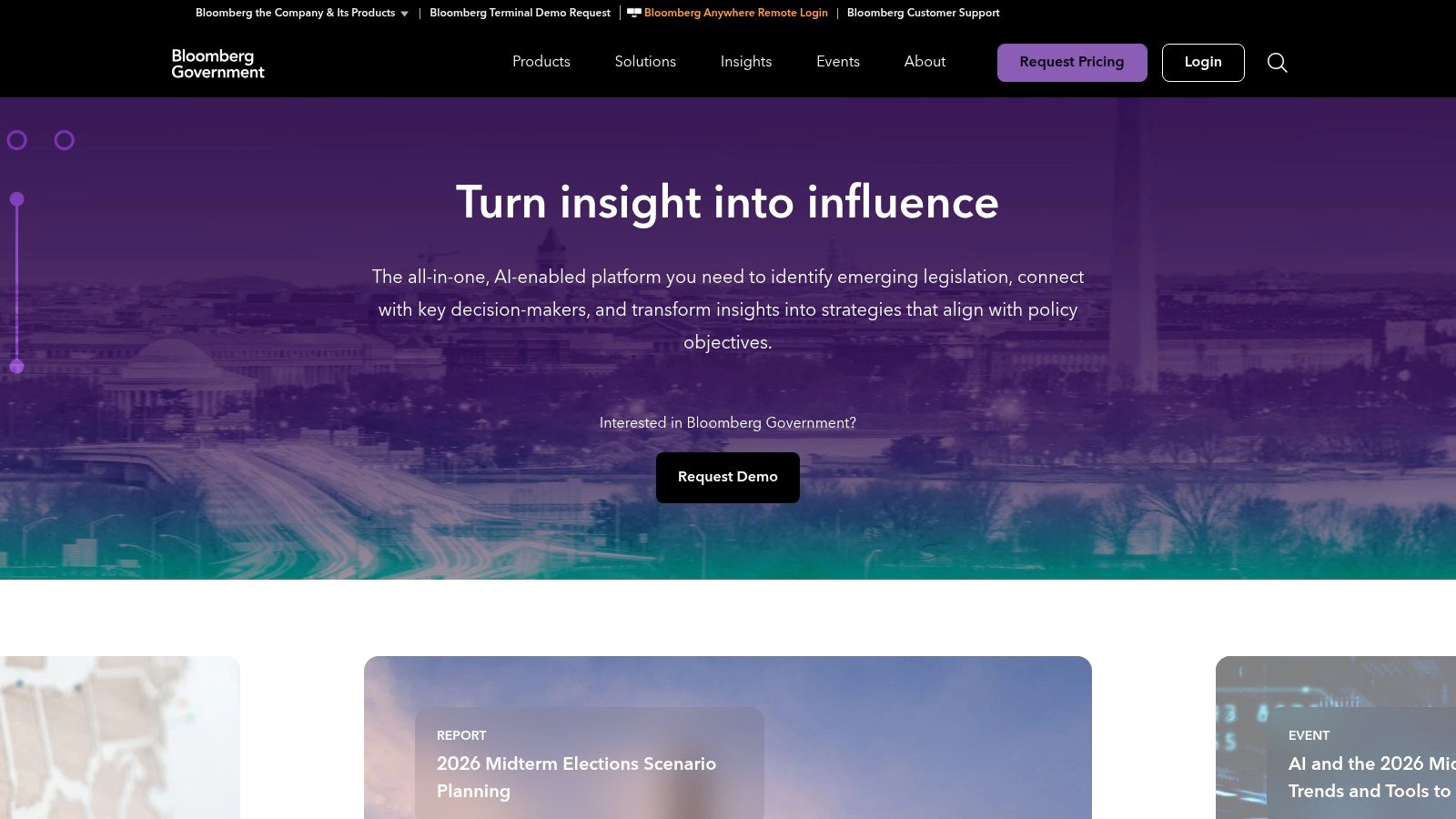
A contractor expanding into a new federal market may need policy evidence before it needs another bid alert. Bloomberg Government is best suited to that decision. It combines procurement data, award tracking, company profiles, original reporting, and policy analysis, giving teams a way to connect agency direction with potential contract activity.
The platform's value is upstream. Before opening an account plan, a federal contractor can examine program priorities, appropriations context, regulatory changes, competitor positioning, and award history. That supports market assessment and helps determine whether a policy shift justifies investment in a department, program, or geographic territory.
Where BGOV fits an expansion model
BGOV's federal focus works well for policy-sensitive markets such as defense, healthcare, energy, and technology. A capture manager, government affairs lead, and account executive can review related evidence in one intelligence environment. The result is a stronger basis for prioritizing agencies and deciding whether a market merits further capture work.
This focus also defines the product's main limitation. Contractors expanding across several states may need separate SLED research, since BGOV is primarily federal. Buyers should therefore assess federal and SLED coverage as a portfolio decision, rather than assuming one system will support every target market.
BGOV can contribute to compliance readiness by helping teams monitor policy and regulatory developments, but it should not be treated as a compliance system. Its procurement and award information can support RFP analysis, incumbent research, and account preparation. Teams should separately verify whether the platform provides the workflow, documentation, and collaboration controls required for their internal review process.
Optional Salesforce integration may connect intelligence with account workflows for larger business development organizations. The evaluation should test whether it preserves context, ownership, alerts, and activity history. A basic record export would offer less value than a working connection between research, capture, and executive review.
A practical pilot should use one target agency, one incumbent, one policy trigger, and one capture decision. Measure the time from signal to decision, the quality of the resulting account plan, and whether the evidence supports a clear launch or no-go recommendation. Those measures reveal more than an opportunity-count comparison.
BGOV pricing is sales-led and not publicly published, so commercial fit requires a controlled demonstration. Its strengths are Policy context, Strategic planning, Enterprise workflow, and Federal depth. The trade-offs are Limited SLED emphasis and Sales-led pricing. It suits established teams that need policy-informed federal expansion, while a balanced federal, state, and local plan may require a second platform.
5. GovTribe
GovTribe is less useful as a passive alert database than as an operating workspace for a federal contractor testing a new market. It combines opportunity search, saved searches, alerts, pipelines, contact data, teaming, and AI-assisted research. The practical question is whether those functions help a team move from market assessment to a documented pursuit decision.
A geographic expansion creates several handoffs. Capture may qualify an opportunity, a subject-matter expert may examine the requirements, a prospective partner may assess teaming, and an executive may approve the pursuit. GovTribe's collaborative workflow can keep those steps connected. Buyers should still verify whether their internal compliance review requires separate documentation, approvals, or controls.
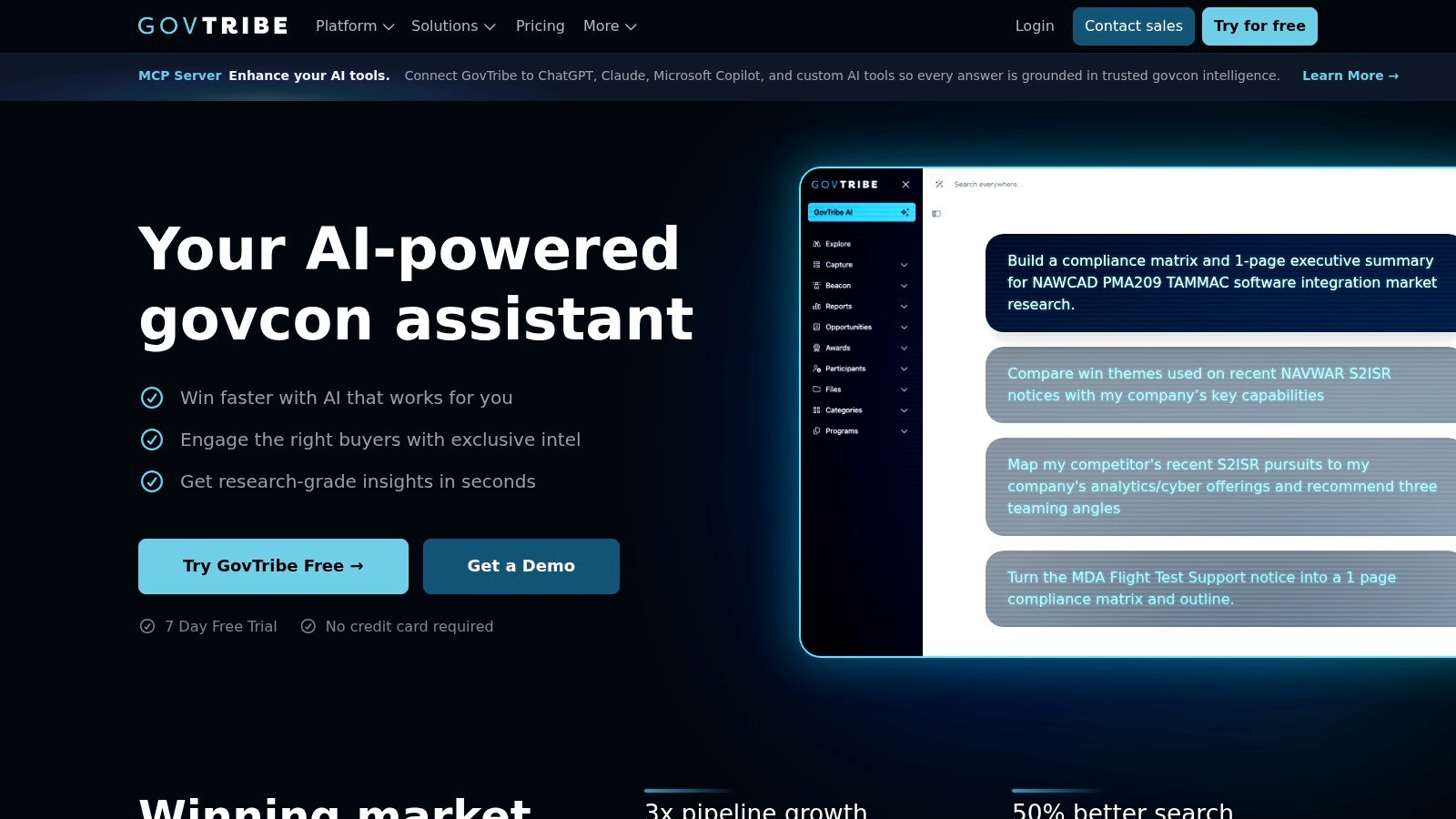
The coverage decision is more important than the feature list. GovTribe provides federal coverage, while state and local coverage is available on Growth and Scale plans. A federal-only contractor can begin with the core workflow. A company entering SLED markets should confirm that the selected tier includes the relevant states and agencies, along with the exports, contacts, and alert behavior needed for launch planning.
Its AI features include intelligent summaries and predictive analytics, supported by usage-based AI credits. That model gives teams control over how often they use AI, but it makes high-volume RFP analysis harder to forecast. Run representative solicitations through the intended workflow and record credit consumption, summary quality, and the time required for human review.
Published plans provide more initial cost visibility than a fully sales-led buying process. The business case still needs to include AI usage and the higher-tier access required for SLED research. Those costs should be compared with the time saved during opportunity qualification and account preparation.
For a controlled expansion test, choose one new state and follow a complete pursuit sequence: identify the target agency, save the search, review comparable awards, identify contacts and teammates, assign ownership, and export the evidence required for an internal gate review. Track time from market signal to decision, review rework, and whether the team can produce a clear launch or no-go recommendation.
A comparison of GovTribe alternatives and competitors can help teams decide whether usability, SLED access, or execution control is the limiting factor.
Pros
Accessible workflow: Search, alerts, pipelines, teaming, and collaboration connect in one process.
Published plans: Subscription tiers support an initial cost comparison.
Selective AI: Credit-based usage lets teams control AI consumption.
Expansion flexibility: Federal, state, and local coverage can support a staged geographic plan.
Cons
AI cost variability: Credit consumption complicates forecasting.
SLED tiering: State and local functionality requires higher-tier plans.
6. BidPrime
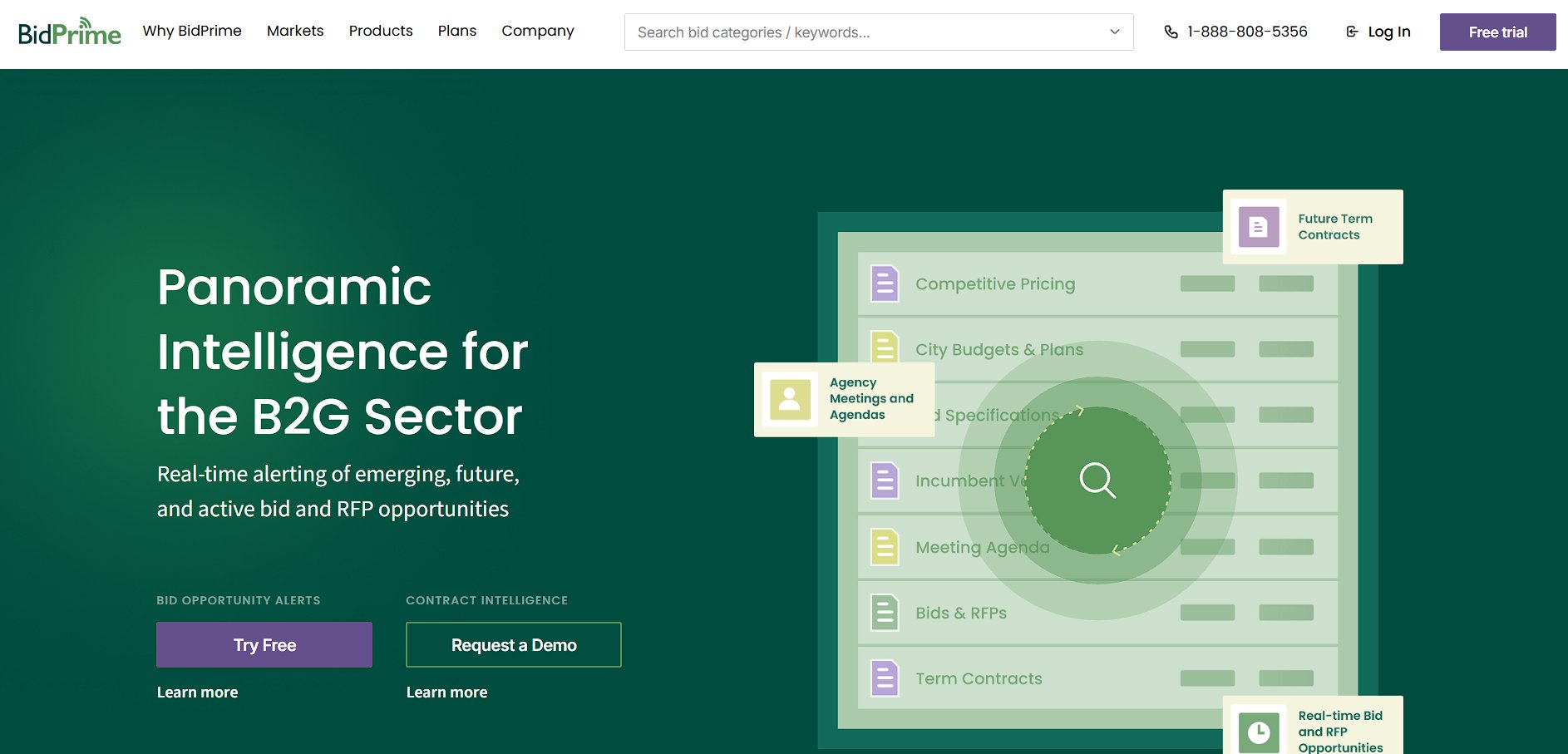
BidPrime is most useful when geographic expansion begins with a wide search for active demand rather than a narrowly defined federal account plan. It focuses on frequent solicitation alerts across federal, state, local, and education markets, giving contractors a way to compare potential jurisdictions without monitoring every procurement portal manually. For AEC, IT, and professional services firms, that breadth can support an initial market assessment before the team commits capture resources.
The platform describes real-time RFP and RFQ alerts from 110K+ public entities, plus historical data, analytics, AI-assisted qualification, and outreach options through partner e-procurement networks. The coverage figure is a vendor claim. Buyers should confirm what it measures, whether active sources or indexed records, and whether the states, municipalities, education systems, and federal agencies in the expansion plan are covered in practice.
A useful first filter, not a full capture system
BidPrime can help a business development team compare demand across regions, identify recurring buying patterns, and see where its capabilities appear in active solicitations. Historical records add context to alert-driven research, while qualification features may reduce the time required to sort opportunities.
The harder question is what happens before an RFP appears. BidPrime places less emphasis on analyst-curated forecasts than premium research platforms, so teams seeking incumbent strategy, budget context, agency influence planning, or early teaming decisions may need another research layer. Alerts identify visible buying activity. They do not by themselves establish whether an agency merits six months of capture investment.
That distinction determines its role in an expansion operating model. BidPrime fits a staged SLED or education expansion in which a contractor first tests regional demand, then adds separate systems for compliance matrices, proposal development, collaboration, and post-award management. It is less suitable as the sole platform for a concentrated federal strategy requiring structured capture governance.
Expansion test: Select one target state, record relevant alerts, qualify each opportunity against service fit and agency priority, and measure the time from signal to launch or no-go decision. Track whether the team can produce an evidence-based recommendation, not merely a larger alert queue.
Pricing is typically sales-led, and public plan information may not provide enough detail for a reliable budget. The commercial review should cover alert volume, source coverage, user access, historical data, AI usage, exports, and integration requirements. Compare the subscription with analyst time saved during market screening and account preparation.
For teams comparing alert-first products with broader GovCon workflows, review these government contract discovery tools.
Decision advantages: SLED reach supports multi-jurisdiction research, alert frequency reduces manual portal monitoring, market research informs regional demand assessment, and qualification support may speed initial triage.
Decision constraints: Sales-led pricing makes total cost harder to estimate before a custom quote, less early intelligence limits pre-RFP capture planning, and workflow limits may require additional systems for compliance, proposal execution, and measurable launch governance.
7. GovSpend
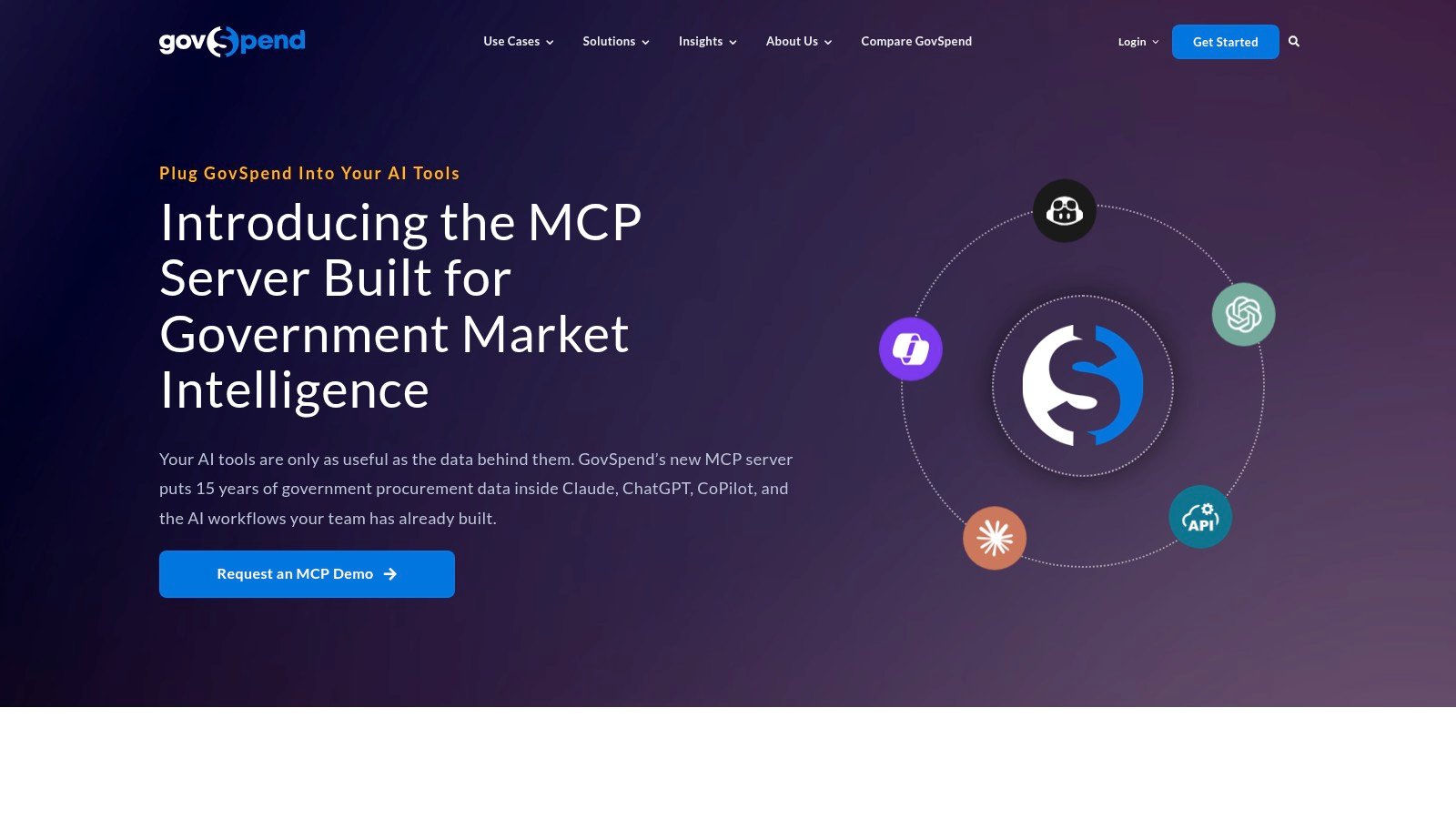
GovSpend is most useful when a contractor's geographic expansion depends on understanding existing public-sector purchasing, rather than only collecting open solicitations. Its SLED-focused data shows what agencies bought, which vendors supplied it, and what prices appeared in the record. That evidence can reveal demand patterns that opportunity alerts alone may miss.
The platform aggregates purchase orders, line-item spending, bids, contracts, public-meeting intelligence, agency contacts, and vendor information. It also includes an Opportunities module, AI-powered research features, and reporting templates. Federal coverage is expanding through the Fedmine acquisition, although the product has historically been weighted toward state and local government.
EZGovOpps Federal Market Intelligence
For a team assessing a new state, the practical question is whether target agencies already purchase the relevant service and how those purchases are structured. GovSpend can help analysts examine buying frequency, incumbent vendors, pricing patterns, and fragmented purchases across departments. Those findings support an evidence-based decision about whether to pursue direct agency opportunities, a broader solution, or a cooperative contract strategy.
This makes the platform relevant to AEC, IT, facilities, staffing, and professional services firms building a regional price-to-win view. A contractor can compare the addressable demand in one state with incumbent concentration in another, then decide where capture resources are most likely to produce a viable pipeline.
Its limitation is workflow depth. Contractors pursuing large federal programs may find less support for formal capture governance, incumbent tracking, compliance readiness, RFP analysis, teaming, proposal execution, and post-award management than they would in tools built around federal forecast intelligence or broader GovCon operations. Fedmine may strengthen the combined data position, but buyers should test the actual federal workflow rather than infer process coverage from expanded datasets.
A focused evaluation should use the exact states and agencies under consideration. Ask for sample line-item records, then test duplicate-vendor handling, contract amendments, cooperative purchasing, and the distinction between one-time purchases and recurring contracts. Confirm whether research outputs can be shared across capture, pricing, and leadership teams, and define launch KPIs such as qualified agencies identified, pursuit decisions supported, and time from market signal to go or no-go.
GovSpend pricing is not published and requires a demo-driven quote. The commercial review should therefore compare the subscription with analyst time saved during market assessment, account preparation, and reporting.
A strong SLED intelligence platform should explain not only who won, but also how the agency bought, what it bought, and whether the pattern supports your entry strategy.
For teams that need federal and SLED workflow continuity rather than spend analysis alone, compare GovSpend alternatives for government contractors.
Decision advantages: SLED spend depth supports targeting and pricing research, agency context adds contacts and purchasing signals, AI assistance can reduce manual analysis, and broader direction may improve federal data coverage.
Decision constraints: Custom pricing complicates budgeting, SLED weighting can limit federal workflow depth, and the execution gap may require separate systems for proposal compliance, drafting, collaboration, and post-award management.
Top 7 Government Contracting Software Platforms, 2026 Comparison
| Product | Implementation complexity | Resource requirements | Expected outcomes | Ideal use cases | Key advantages |
|---|---|---|---|---|---|
| SamSearch | Low-Medium (guided onboarding, optional integrations) | Enterprise budget, per-seat/modules, integration support, onboarding specialist | End-to-end automation: faster time-to-award, reduced manual screening, compliance matrices | Mid-market & enterprise GovCon capture, proposal, finance teams | Full workflow AI automation, enterprise security, financing introductions, broad coverage |
| Civio | Medium (AI-first workflow adoption) | Team adoption, demo-based commercial review, process validation | Faster opportunity review, AI-assisted qualification, proposal support | Contractors wanting AI-driven federal research and response support | Modern AI workflow, streamlined review, useful federal expansion support |
| Deltek GovWin IQ | High (analyst integration, curated workflows) | Premium subscription, analyst access, longer onboarding | Analyst-validated forecasts and early pipeline signals | Large capture/BD teams needing federal + SLED foresight | Strong analyst curation and breadth of SLED coverage |
| Bloomberg Government (BGOV) | Medium-High (enterprise setup, dashboards) | Premium subscription, newsroom and data integration | Procurement + policy insight, award tracking, strategic planning | Primes needing procurement data with policy/regulatory context | Combined procurement data and Bloomberg policy reporting |
| GovTribe | Low-Medium (fast setup, intuitive UX) | Mid-tier budget, usage-based AI credits for advanced features | Rapid discovery, collaborative pipelines, actionable alerts | Growth-stage contractors and SMBs focused on usability | Clear pricing tiers, easy interface, AI summaries and pipelines |
| BidPrime | Low (alert-centric, straightforward) | Subscription with high-frequency alerts | Real-time notifications and broad SLED monitoring | Teams needing frequent SLED/federal alerts and bid triage | Wide SLED reach and rapid RFP/RFQ alerts |
| GovSpend | Medium (data/analytics orientation) | Demo-driven pricing, analytics resources | Spend transparency for price-to-win and targeting | SLED-focused research, pricing and vendor analysis | Deep line-item PO and spend visibility for SLED markets |
Turn the Shortlist Into an Expansion Decision
A shortlist becomes useful only when each platform is scored against a specific expansion scenario. Start with the market, not the vendor. Define one federal target and one SLED target, identify the agency types involved, document the likely buying vehicles, and specify the evidence required before a pursuit reaches capture.
Score each platform on target-market coverage, forecast quality, registration and compliance workflow, incumbent intelligence, pricing insight, partner discovery, RFP extraction, CRM and collaboration fit, security, implementation effort, and total cost. The category matters because government contracting software now spans opportunity identification, proposal management, compliance tracking, project management, and financial reporting, as described in Gartner's category overview. A tool that excels at alerts but cannot support compliance evidence or cross-functional ownership may create another handoff rather than remove one.
Compliance deserves a separate gate. For federal contractors, relevant requirements can include FAR, DFARS, CAS, and ITAR, with audit expectations involving DCAA and DCMA reporting. Infor's government contracting overview explains why dashboards and audit-ready records belong in the selection criteria. For SLED work, evaluate solicitation development, bid tabulations, approval routing, audit trails, deadline alerts, contract closeout, and public portals. OpenGov's procurement documentation provides concrete examples of those lifecycle mechanics, while its contract management documentation describes clause templates, e-signatures, access controls, document history, and exportable audit logs.
Run a controlled pilot
Use one federal expansion scenario and one SLED expansion scenario. Give each vendor the same approved company profile, the same target capabilities, and representative solicitation materials. Require the team to document the steps from initial signal through bid or no-bid decision.
Track qualified-opportunity rate, time from forecast to capture decision, partner-response rate, compliance-matrix completion time, proposal cycle time, bid-to-no-bid accuracy, and pipeline-to-award conversion. These are operating KPIs, not guaranteed vendor outcomes. Establish a baseline before the pilot, define how each metric will be calculated, and keep the comparison consistent across platforms.
The pilot should also test edge cases. Give the system an amended solicitation, an attachment-heavy RFP, an opportunity with an incumbent, and a pursuit requiring a teaming partner. Ask who can see each record, how approvals are logged, how source documents are retained, and whether a proposal lead can trace every extracted requirement back to the original material.
Select for the next stage of growth
SamSearch is the strongest fit when an established mid-market or enterprise contractor wants one connected workflow across opportunity forecasting, competitive analysis, 600K+ contractor matching, RFP extraction, collaboration, and response execution. Its enterprise security claims, integrations, AI-assisted analysis, and finance connections make it a better match for organizations trying to replace disconnected search, spreadsheets, proposal artifacts, and partner research.
That does not make it the right choice for every buyer. A federal AI-first team may consider Civio. A federal policy team may prefer Bloomberg Government. A research-led enterprise capture organization may choose Deltek GovWin IQ. A SLED-first price-to-win team may prefer GovSpend, while a smaller or budget-focused operation may find GovTribe more practical. SamSearch is not intended for small businesses, and its enterprise pricing and current CMMC Level 2 status should be validated before contracting.
Before signing, complete a procurement checklist covering security validation, data ownership, integrations, user roles, implementation support, contract terms, retention, export rights, and evidence for vendor claims. Ask each vendor to distinguish production capabilities from roadmap items. Request references or workflow evidence for the specific federal and SLED motions your company plans to run.
The government contracting software market is expanding as modernization and compliance pressure increase. One market estimate reported government organizations represented 67% of the global government procurement software market in 2026, while more than 46% of agencies ranked procurement modernization as a priority spending area (market analysis). Those figures describe market direction, not a reason to buy any particular platform. The right decision is the one that gives your team earlier evidence, cleaner qualification, stronger compliance control, and a repeatable path from expansion target to award.
Government Contracting Software FAQ
What is government contracting software?
Government contracting software helps contractors find opportunities, research agencies and incumbents, qualify pursuits, manage capture and proposal workflows, track compliance requirements, and report on pipeline and awards. Some platforms focus on alerts and opportunity discovery, while others support a broader operating workflow across research, teaming, compliance, collaboration, and response.
What features matter most when comparing government contracting software?
The most important features depend on your growth strategy, but most established contractors should compare federal and SLED coverage, forecast quality, incumbent intelligence, pricing visibility, compliance workflow, RFP analysis, partner discovery, CRM integrations, collaboration tools, security controls, and total implementation effort.
Which platform is best for established government contractors?
For this ranking, SamSearch is positioned at number one because it is designed around an end-to-end workflow for established mid-market and enterprise government contractors. It connects opportunity discovery, capture, compliance analysis, partner matching, collaboration, and proposal response in one system. Buyers should still validate fit based on their target markets, security requirements, and internal process needs.
Is the best platform always the one with the largest database?
No. A larger database may surface more notices, but it does not automatically improve market selection, qualification, capture planning, compliance review, or proposal execution. The best platform is the one that helps your team make better pursuit decisions and move from market signal to award with less friction.
Which software is best for federal versus SLED expansion?
Federal-focused teams may prioritize tools such as Civio, Deltek GovWin IQ, Bloomberg Government, or GovTribe depending on whether they need AI support, analyst research, policy context, or collaborative workflows. SLED-focused teams may look more closely at SamSearch, BidPrime, or GovSpend, depending on whether they need end-to-end execution, alert-driven discovery, or spend analysis. The right choice depends on how much workflow continuity your team needs across research, qualification, compliance, and response.
How should contractors evaluate these tools before buying?
Run a controlled pilot using one federal target and one SLED target. Measure qualified opportunity rate, time to bid or no-bid decision, compliance matrix completion time, partner response rate, proposal cycle time, and how well each platform preserves evidence and source traceability. A live scenario will reveal more than a feature checklist.
SamSearch gives established mid-market and enterprise government contractors one connected system for federal and SLED discovery, capture, compliance analysis, partner matching, collaboration, and proposal response. Test that workflow against one federal and one SLED expansion scenario by visiting SamSearch, and validate the platform's security, integrations, and vendor-stated capabilities before procurement.