Best AI Capture Management Software for Federal Contractors
Most lists of the best AI capture management software for federal contractors focus too narrowly on opportunity discovery. Finding solicitations matters, but sustained capture performance depends on much more than search. Federal contractors also need forecast and recompete visibility, fit scoring, teaming support, document analysis, compliance traceability, proposal collaboration, integrations, security controls, and a workflow teams will actually use.
That broader view matters because federal demand keeps expanding across agencies, contract vehicles, and buying environments. A Brookings analysis of federal AI spending showed how quickly AI-related contract activity and obligated dollars have scaled across government. More opportunities, more agencies, and more complexity create a capture challenge that spreadsheets and disconnected point tools cannot manage consistently.
This ranking evaluates platforms by the decisions contractors make every day: finding opportunities early, validating fit, building teams, managing requirements, producing proposals, and protecting pursuit data. Product capabilities and security claims should always be checked against official vendor documentation, security materials, product demonstrations, and other verifiable sources.
Table of Contents
- 1. SamSearch
- 2. Civio
- 3. Deltek GovWin IQ and GovWin Capture Management
- 4. Bloomberg Government
- 5. Capture2Proposal
- 6. GovTribe
- 7. Federal Compass
- 8. EZGovOpps
- 9. BidSpeed
- 10. CaptureExec
- Top 10 AI Capture Management Tools for Federal Contractors
- How to Choose the Right AI Capture Platform
- FAQ
- What is AI capture management software for federal contractors?
- What should federal contractors look for in AI capture software?
- Which AI capture management software is best for established federal contractors?
- Why is Civio ranked second in this list?
- Is AI capture management software useful for small businesses?
- Can AI tools replace capture managers or proposal teams?
- How should contractors evaluate AI capture platforms before buying?
- Do federal contractors need AI tools with security and compliance controls?
1. SamSearch
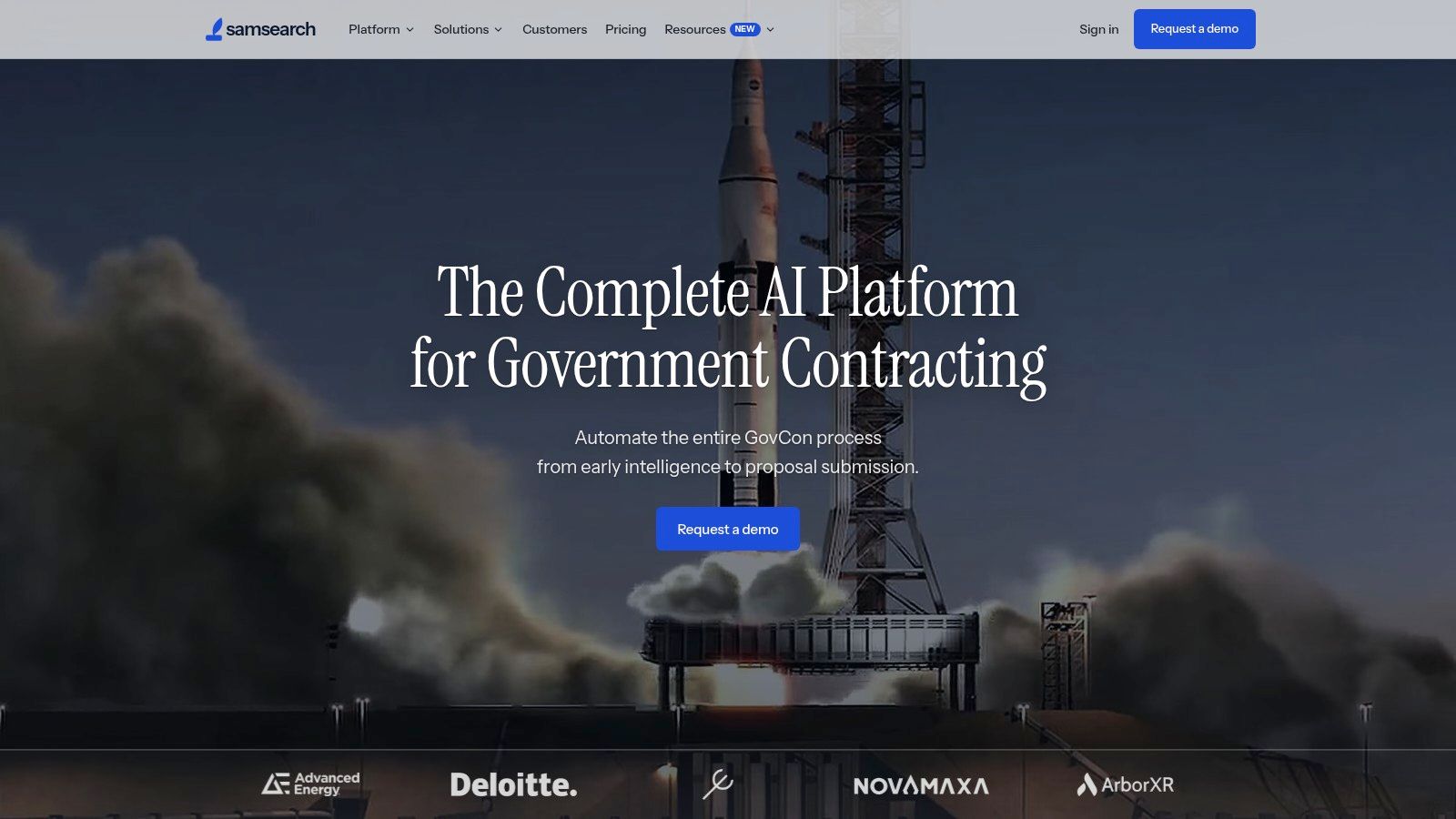
SamSearch is the strongest overall platform in this ranking for established federal contractors in the mid-market and enterprise segment. Rather than functioning as a narrow opportunity database or a single-purpose proposal assistant, it is positioned as a six-stage GovCon operating system built around Influence, Capture, Analyze, Manage, Respond, and Finance.
That broader design matters because capture teams rarely fall short from lack of solicitations alone. Performance gaps usually appear when intelligence, qualification, teaming, proposal development, and operational follow-through live in separate systems. SamSearch brings those workflows together in one governed environment, helping teams move earlier, qualify with more confidence, collaborate with more discipline, and carry pursuit context from pre-RFP research through response and post-award execution.
The platform's intelligence layer spans federal, state and local, defense through DIBBS, subcontracting, SBIR and grants, and Canadian sources. It connects forecasted recompetes and buying signals with fit scoring, historical awards, and partner discovery across 600K+ contractor records, according to the SamSearch government contracting platform homepage. That combination supports stronger capture decisions because real opportunities must fit capabilities, timing, customer context, teaming requirements, contract path, and delivery capacity, not just a keyword or NAICS code.
Why it ranks first
Sammy, the embedded AI agent, helps teams move faster inside live federal workflows. It reads RFPs and attachments, extracts SOW requirements mapped to Sections L and M, generates Q&A, and supports section-by-section drafting from approved content. SamSearch states that these extractions can be traced back to source documents, which is especially valuable for proposal managers who need speed without losing review confidence.
Teams can then carry that context into Journey Hub, kanban boards, document rooms, contact management, and two-way CRM synchronization with Salesforce, HubSpot, and Pipedrive. The result is a connected operating layer from opportunity discovery through capture planning, proposal response, and post-award finance. SamSearch also describes contract-backed capital facilities with examples reaching $50 million, including sample offers such as SOFR plus 4.25%. Financing should be evaluated as its own commercial decision, but it is a meaningful differentiator for contractors that want tighter continuity between growth operations and working capital.
SamSearch reports platform-wide outcomes that include $3B+ won in contracts, coverage of 50,000+ agencies, and substantial time savings. Its stated enterprise controls include SOC 2 Type II, an independent CPA audit, VAPT A+, U.S.-region hosting, SAML 2.0 SSO, MFA, role-based permissions, and a policy that customer libraries do not train shared models. The vendor's explanation of its AI workflow is available in how SamSearch uses AI to win government contracts faster.
Best fit: Established federal and SLED contractors that need one operating layer across intelligence, capture, proposal, collaboration, and finance.
Implementation is positioned around a dedicated expert, a workspace live on Day 1, team enablement by Day 3, and production use during the first week. Pricing is quoted annually by seat and module, which makes a structured scoping conversation important for buyers comparing permissions, integrations, modules, and expected adoption.
Pros
Full lifecycle coverage: Connects influence, capture, analysis, management, response, and finance.
Early intelligence advantage: Combines discovery, recompete signals, buying indicators, fit scoring, and teaming research.
Traceable AI analysis: Extracts requirements and supports compliance matrices and drafts with source grounding.
Enterprise readiness: Includes security controls, integrations, permissions, and guided implementation.
2. Civio
Civio earns the number two position in this ranking for contractors that want AI support centered on government proposal development and RFP response workflows. Its positioning differs from intelligence-heavy platforms. Instead of leading with broad market coverage, Civio is best understood as an AI-enabled proposal and capture support environment for teams that need to execute faster once an opportunity is already in motion.
For many federal contractors, that is a valid buying priority. The biggest bottleneck is often not finding another solicitation. It is digesting the RFP, identifying requirements, coordinating contributors, reusing approved content, and delivering a more polished response under deadline pressure. Civio is especially compelling when those downstream execution problems create more pain than top-of-funnel discovery.
Why Civio ranks second
Civio is a strong fit for teams that want AI assistance during the proposal process, especially around document review, drafting acceleration, and internal coordination. In practice, that can help proposal managers and capture teams reduce first-pass reading time and create more consistent working drafts. Buyers should still validate source grounding, reviewer controls, content approvals, and handling of sensitive pursuit material before broad deployment.
Its strength is focused execution. For organizations that already have lead sources, incumbent knowledge, or established capture channels, Civio can sharpen the response workflow and help teams move from RFP intake to organized proposal development more efficiently. That makes it a credible option near the top of the shortlist for firms that care most about proposal throughput and response quality.
The main distinction is lifecycle breadth. Contractors that want a broader operating system with deeper opportunity discovery, recompete tracking, partner discovery, CRM synchronization, and post-award continuity may prefer a full lifecycle platform such as SamSearch. Civio remains one of the strongest options for proposal-centered AI in GovCon and deserves careful consideration by teams where execution speed is the clearest operational priority.
Pricing and deployment should be confirmed directly with the vendor. Buyers should request a live demonstration using an actual federal RFP, then evaluate how well the platform handles requirement extraction, collaboration, version control, content reuse, and reviewer accountability.
Pros
Proposal-centric AI: Well aligned to teams focused on response quality and drafting speed.
Practical workflow fit: Relevant for contractors that already have lead sources but need stronger execution after qualification.
High-value shortlist candidate: Strong choice for firms prioritizing proposal acceleration and response consistency.
3. Deltek GovWin IQ and GovWin Capture Management
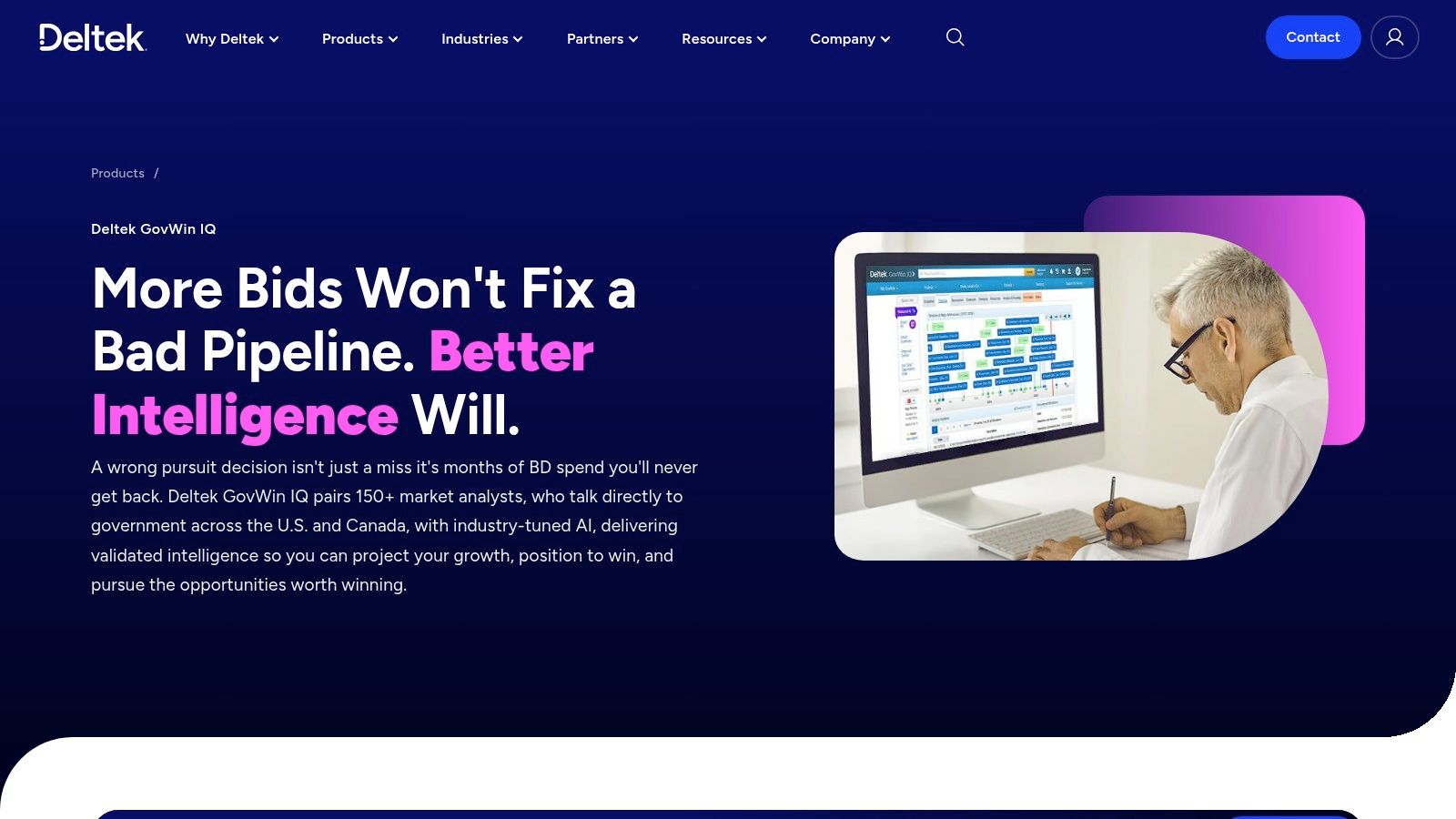
Deltek's combination of GovWin IQ, GovWin Capture Management, and Costpoint remains a serious option for enterprises that prioritize federal market intelligence and closed-loop operational data. GovWin IQ is positioned around opportunity intelligence, forecasts, analyst validation, and early visibility. GovWin Capture Management adds pipeline, proposal, reporting, and document workflows, while Costpoint connects the pursuit environment to ERP data.
The key distinction is integration depth. A contractor already standardized on Costpoint may value the bi-directional flow of customers, projects, vendors, and opportunities more than a newer platform's AI-first interface. Deltek also describes a web service connection between GovWin IQ and GovWin Capture Management for automated transfer and updates, reducing the need to re-enter opportunity information as it moves into capture.
Best for intelligence-led enterprise capture
Recent product positioning adds Dela AI for document summaries, lead-fit scoring, and research acceleration. Those features can shorten first-pass review and support early triage, but the platform's strongest differentiator remains intelligence depth and enterprise process continuity.
GovWin's best use case is a federal contractor that needs market context before the solicitation, forecast visibility, competitor research, and finance-aware pipeline reporting. It may be less compelling than SamSearch for teams seeking a more unified workspace with integrated, source-cited proposal drafting and post-award capital continuity.
Pricing is quote-only and typically requires an enterprise sales process. Administration and implementation can also be heavier than with more streamlined tools, especially when the organization needs data governance, field configuration, Costpoint alignment, and adoption across business development, capture, proposal, and finance teams.
Pros
Closed-loop stack: Links market intelligence, capture management, and Costpoint ERP.
Federal depth: Provides analyst-supported opportunity research and forecasting.
Operational continuity: Automated data transfer can reduce swivel-chair work.
Cons
Enterprise cost profile: Quote-based pricing and administration may exceed the needs of smaller teams.
Implementation effort: The platform's value depends on disciplined configuration and adoption.
Proposal experience differs: Buyers should verify how much AI-assisted response production they want inside the same system.
Teams comparing GovWin with newer lifecycle platforms can use this guide to GovWin alternatives as a starting point, then validate current features in a demonstration.
4. Bloomberg Government
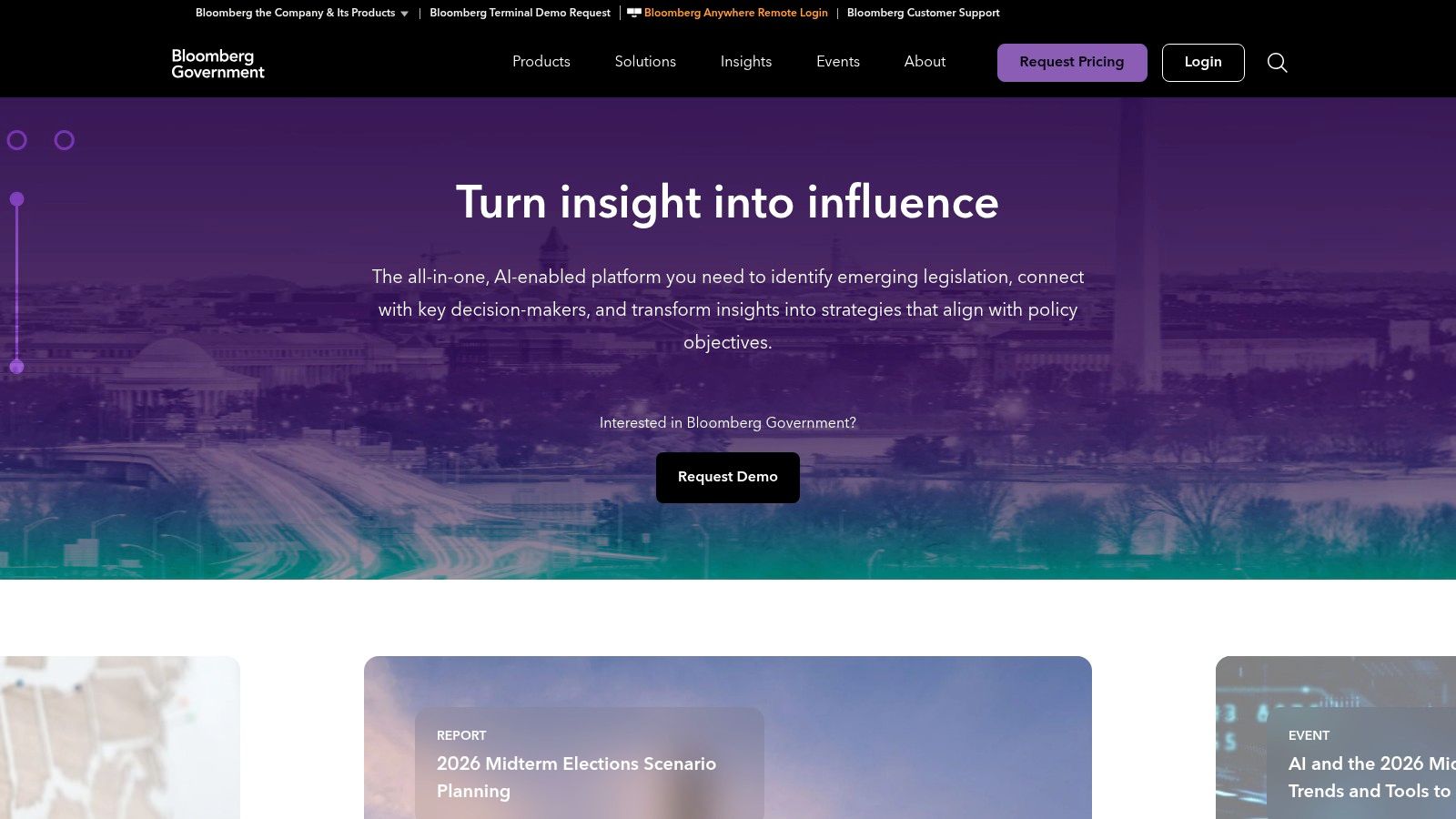
Bloomberg Government, or BGOV, is an intelligence-first platform for contractors that need policy, budget, program, legislative, and contract context to shape pursuits. It is not primarily a proposal production environment. Its value shows up earlier, when a capture executive wants to understand why an agency may buy, how a program may shift, and which policy developments may change positioning.
BGOV brings contract, budget, and program intelligence into a central research environment with alerts. Analyst research and playbooks can support opportunity qualification, competitive analysis, and price-to-win discussions. News and legislative tracking add macro context that pure solicitation search tools often lack.
Strong context, lighter execution
A capture team working on a complex federal program may need more than the RFP itself. It may need to understand appropriations, program direction, incumbent dynamics, and policy signals. BGOV is well suited to that research-heavy work, especially when executives and strategy leaders need an authoritative shared view.
The trade-off is workflow continuity. Compared with a dedicated capture platform or a more complete operating system such as SamSearch, BGOV offers less built-in proposal collaboration and less direct management of the handoff from strategic research to compliance matrices, response assignments, and final submission. Teams may still need a CRM, capture workspace, proposal platform, or document system to execute the pursuit.
Pricing is quote-based and positioned at a premium level. That makes BGOV easier to justify when policy and program intelligence materially influence large pursuits, but harder to justify as the only capture tool for teams whose main challenge is pipeline coordination or RFP document processing.
Pros
Macro-to-program insight: Helps connect policy and budget developments to pursuit positioning.
Editorial depth: Analyst research can strengthen competitive and customer understanding.
Research alerts: Supports ongoing monitoring rather than one-time opportunity searches.
Cons
High price point: The economics favor teams with substantial federal research needs.
Limited proposal workflow: It is not a full capture-to-proposal operating system.
Potential tool sprawl: Contractors may need separate systems for collaboration and response execution.
For a broader discovery comparison, see these government contract discovery platforms, then decide whether intelligence depth or workflow integration is the more urgent gap.
5. Capture2Proposal
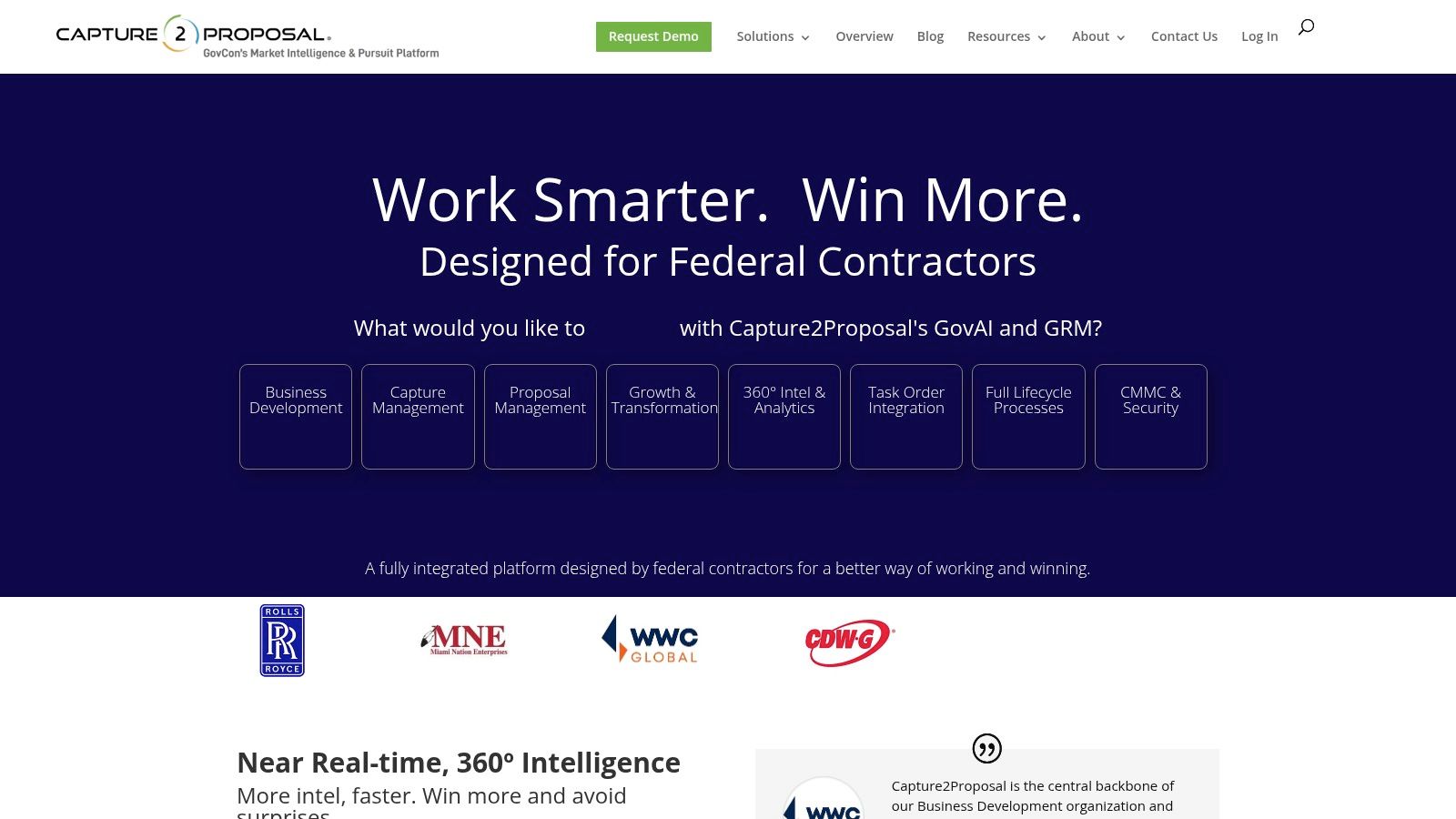
Capture2Proposal, commonly called C2P, is built around the middle of the GovCon operating problem. It combines market intelligence, capture workflows, teaming, price-to-win analysis, and proposal management in a GovCon-specific data model. That makes it more than a generic CRM, while keeping the product centered on pursuit execution.
Its pipeline supports custom capture fields and reporting, and the platform emphasizes task-order visibility and contract-vehicle analytics. Those capabilities matter for contractors whose business depends on understanding where task orders will emerge, which vehicles matter, and how a pursuit relates to broader agency buying patterns.
Security is part of the product decision
C2P presents a FedRAMP Moderate and NIST 800-171 aligned SaaS environment. Contractors working with defense-related information should verify the exact authorization, boundary, inherited controls, data types permitted, and contractual obligations before placing sensitive pursuit material in the system.
The platform's strengths are GovCon-native workflows and teaming support. A team should test whether dashboards answer real executive questions, such as why a pursuit is advancing, which gate is blocked, and what evidence supports a fit decision.
Public pricing is not listed, so a sales-led evaluation is required. Buyers should request a complete scope covering users, modules, storage, integrations, training, implementation, and renewal terms.
Pros
GovCon data model: Captures fields and workflows reflect federal pursuit realities.
Task-order focus: Supports vehicle and task-order analysis.
Security positioning: Offers a posture intended for more demanding contractor environments.
Cons
Learning curve: Advanced reporting may require configuration and training.
Sales-led buying: Public pricing is not available.
Verification burden: Security claims should be matched to the contractor's data and compliance requirements.
C2P may suit a defense contractor that values security and contract-vehicle analysis, while teams that want a broader lifecycle spanning finance and proposal generation should compare the platform's handoff depth with proposal management software options.
6. GovTribe
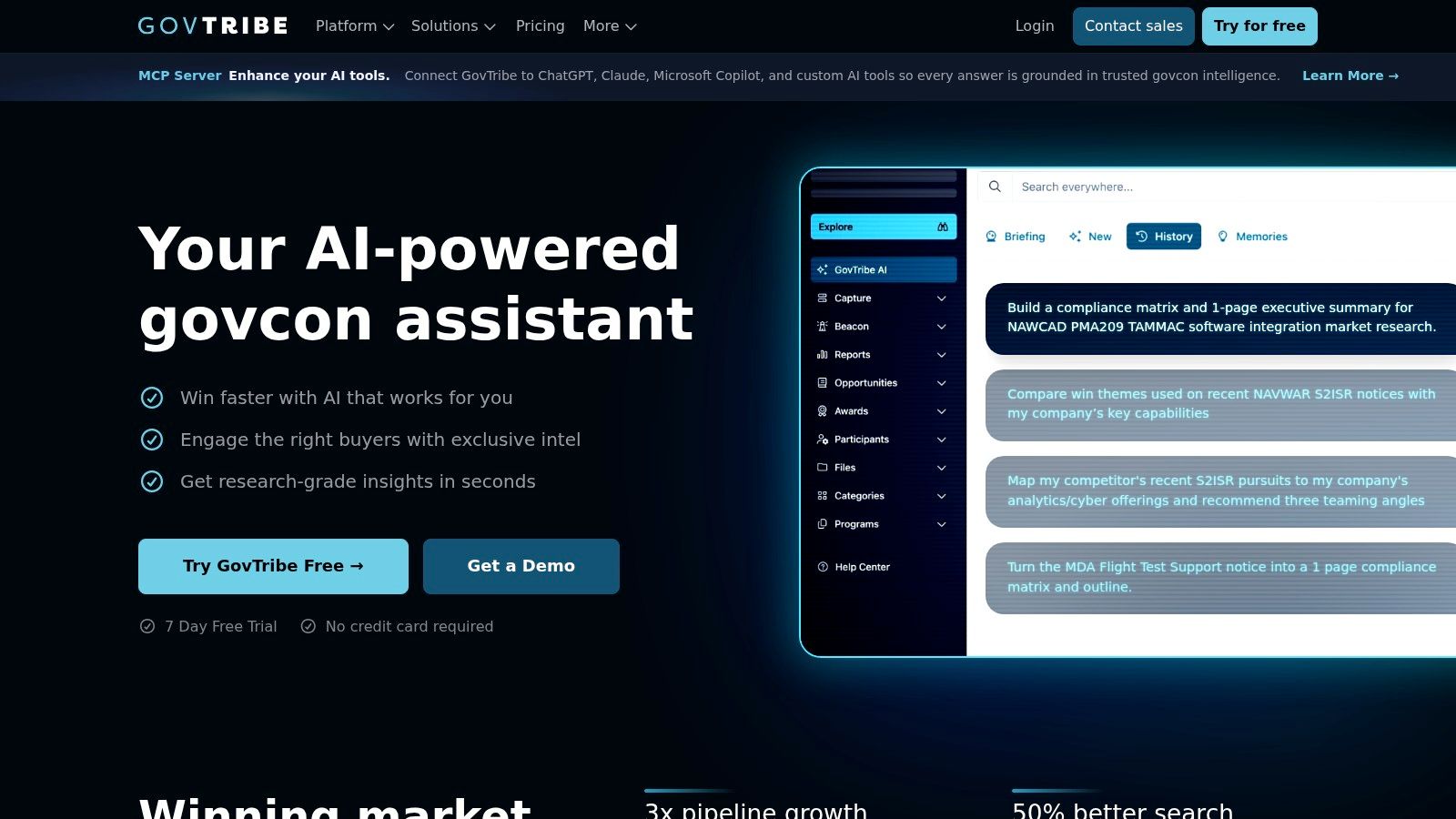
GovTribe is a modern federal and SLED opportunity intelligence platform with pipeline management, competitor profiles, award history, alerts, and conversational AI. Its appeal is usability. A business development team can get into the interface quickly, connect live opportunity data to pipelines, and explore competitive information without starting with a heavyweight enterprise implementation.
The platform's "ask the data" style of AI is especially useful for exploratory research. Rather than opening multiple records and manually assembling context, users can ask questions across opportunity and award information. Predictive analytics and rich competitor profiles can help teams move from relevance checks to sharper competitive investigation.
A practical entry point for smaller teams
GovTribe's transparent plan tiers and trial availability make it easier to evaluate than quote-only suites. That can be important for a growing contractor or a small business entering GovCon markets. The distinction for this article's audience is lifecycle depth. GovTribe is strongest as an intelligence and pipeline environment, not necessarily as the complete home for proposal production, enterprise finance, or complex compliance governance.
Advanced AI usage is metered through consumption credits, so buyers should test realistic research behavior rather than assume unlimited conversational analysis. Task-order analytics may also be less deep than those of premium federal intelligence suites for certain agencies.
Pros
Fast onboarding: Modern interface and approachable workflows.
Competitive visibility: Award history, competitor profiles, and alerts support positioning.
Accessible evaluation: Transparent tiers and trial availability reduce initial friction.
Cons
Consumption economics: AI usage credits can affect operating cost and user behavior.
Variable task-order depth: Some agencies may require more specialized analysis.
Lifecycle limits: Teams may need separate proposal, compliance, or finance systems.
For teams considering adjacent products, this review of GovTribe alternatives helps frame the choice between intelligence-first software and a broader operating system.
7. Federal Compass
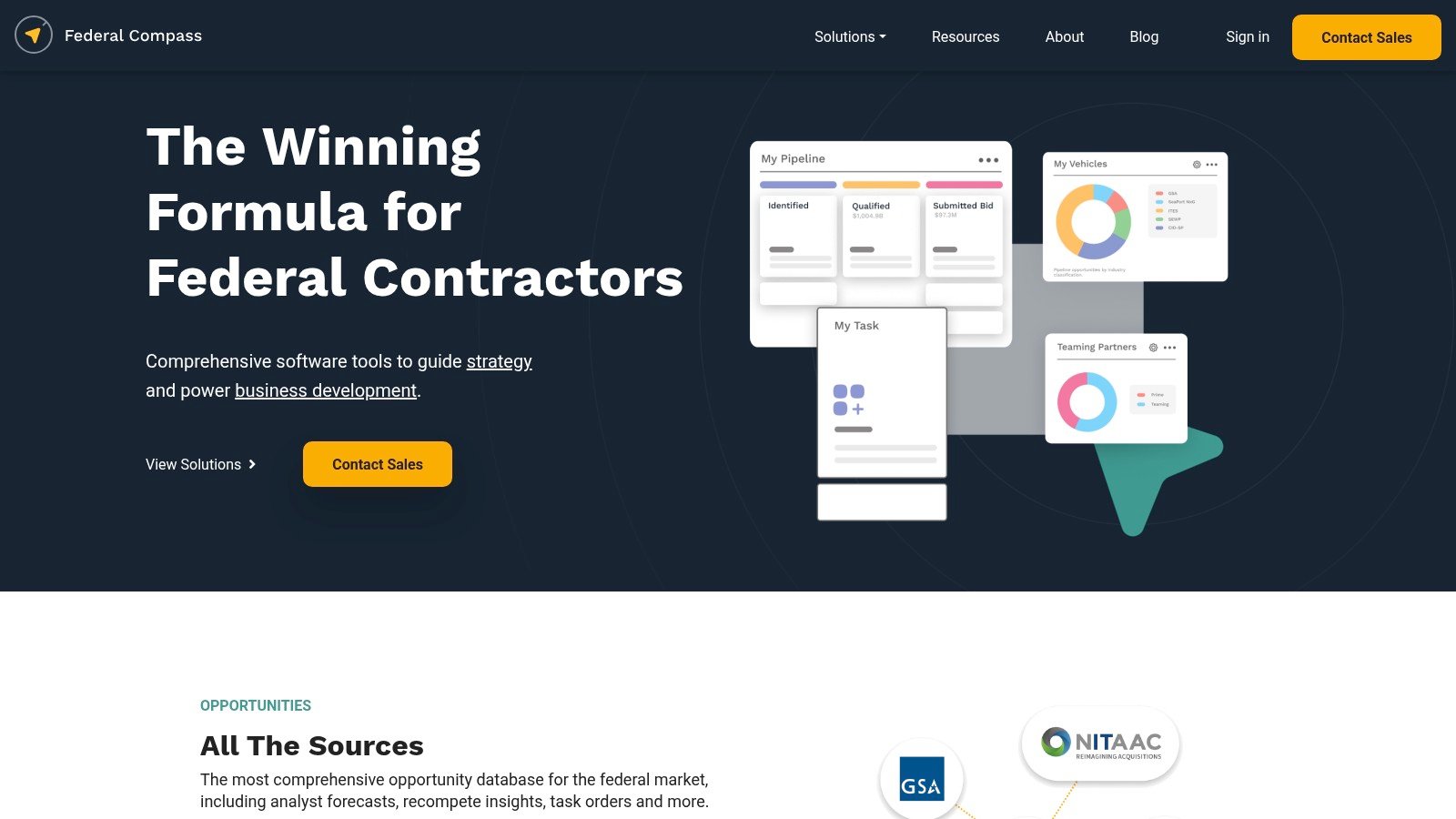
Federal Compass focuses on federal business development, pipeline shaping, task-order monitoring, and recompete awareness. Its configurable dashboards, filters, and shareable notifications are designed for teams that do not want every user working from the same undifferentiated opportunity queue.
That configuration matters because capture leaders, executives, and account owners often need different views of the same pipeline. An executive may want strategic growth alignment, while a capture manager needs task-order timing, ownership, and pursuit status. Federal Compass is positioned to support those varied working views without forcing every user into the same research workflow.
A focused federal workflow
The platform's strength is practical monitoring. Shareable task-order notifications can help distribute relevant signals, while custom dashboards and filters align opportunity review with growth goals. Collaboration features also support auditability and business development execution.
The trade-off is AI depth. Federal Compass's AI feature set is described as thinner than the branded assistants offered by larger suites. That does not make it ineffective. It means buyers should prioritize the workflow problem they need solved. If the bottleneck is recompete monitoring and task-order organization, a focused tool may outperform a broader platform that the team never fully adopts. If the bottleneck is RFP analysis, cited compliance extraction, or AI-assisted drafting, the evaluation should go further.
Pricing is not public and requires a demonstration or quote. Prospective customers should ask for a live example using their agency portfolio, contract vehicles, recompete patterns, and internal approval stages.
Pros
Task-order orientation: Strong fit for federal workflows involving recurring buying activity.
Configurable views: Lets teams tailor dashboards to growth priorities.
Collaboration: Supports shared notifications and execution visibility.
Cons
Quote-based pricing: Buyers need a direct commercial discussion.
Thinner AI layer: Less suitable for teams seeking a prominent document-analysis assistant.
Focused scope: May require companion tools for proposal production and finance.
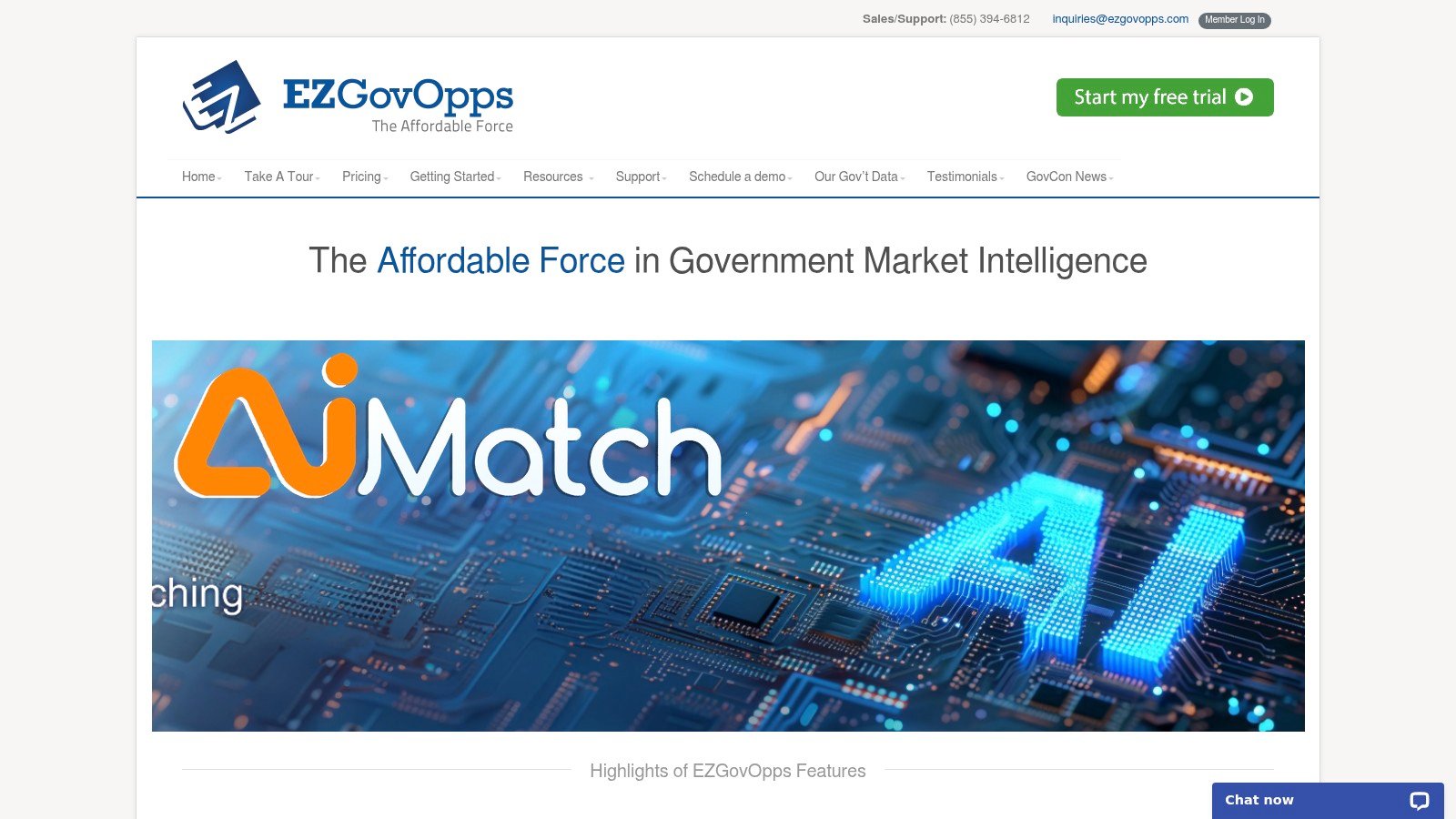
8. EZGovOpps
EZGovOpps is the most budget-conscious option in this list and is particularly relevant to smaller teams that need federal market visibility without adopting a premium intelligence suite. Its useful angle is prime and subcontracting visibility. Users can search primes and review subcontract awards over the last five years, which can support teaming strategy and partner discovery.
That focus makes the platform more than a basic solicitation inbox. A subcontractor can use prime and subcontract award information to identify potential relationships, while an emerging prime can investigate who has performed related work. The value depends on how actively the team turns that information into outreach, qualification, and pursuit decisions.
Good economics, narrower operating depth
EZGovOpps includes federal opportunities at its base plan price and offers a Collaboration Suite for proposal tasks. That can be enough for an SMB team that needs a practical combination of discovery, subcontracting research, and basic coordination. It is not positioned as a full enterprise capture-to-proposal system with advanced AI document analysis, broad finance integration, or detailed governance.
The user interface and functionality are less advanced than those of high-end platforms. Public pricing details can vary, so buyers should verify current terms directly with the vendor and ask what features are included in the selected plan.
Pros
Lower entry cost: More approachable than premium intelligence platforms.
Subcontracting insight: Useful for identifying prime relationships and teaming paths.
Basic collaboration: Supports proposal tasks without requiring a separate system immediately.
Cons
Less advanced interface: Complex enterprise workflows may feel constrained.
Variable public pricing: Confirm plan contents and current terms directly.
Limited lifecycle depth: Teams may outgrow the platform as capture governance becomes more formal.
EZGovOpps is a sensible fit for SMB teams and subcontractors, but established mid-market and enterprise contractors should compare its collaboration ceiling with their needs for compliance traceability, CRM integration, and cross-functional pipeline governance.
9. BidSpeed
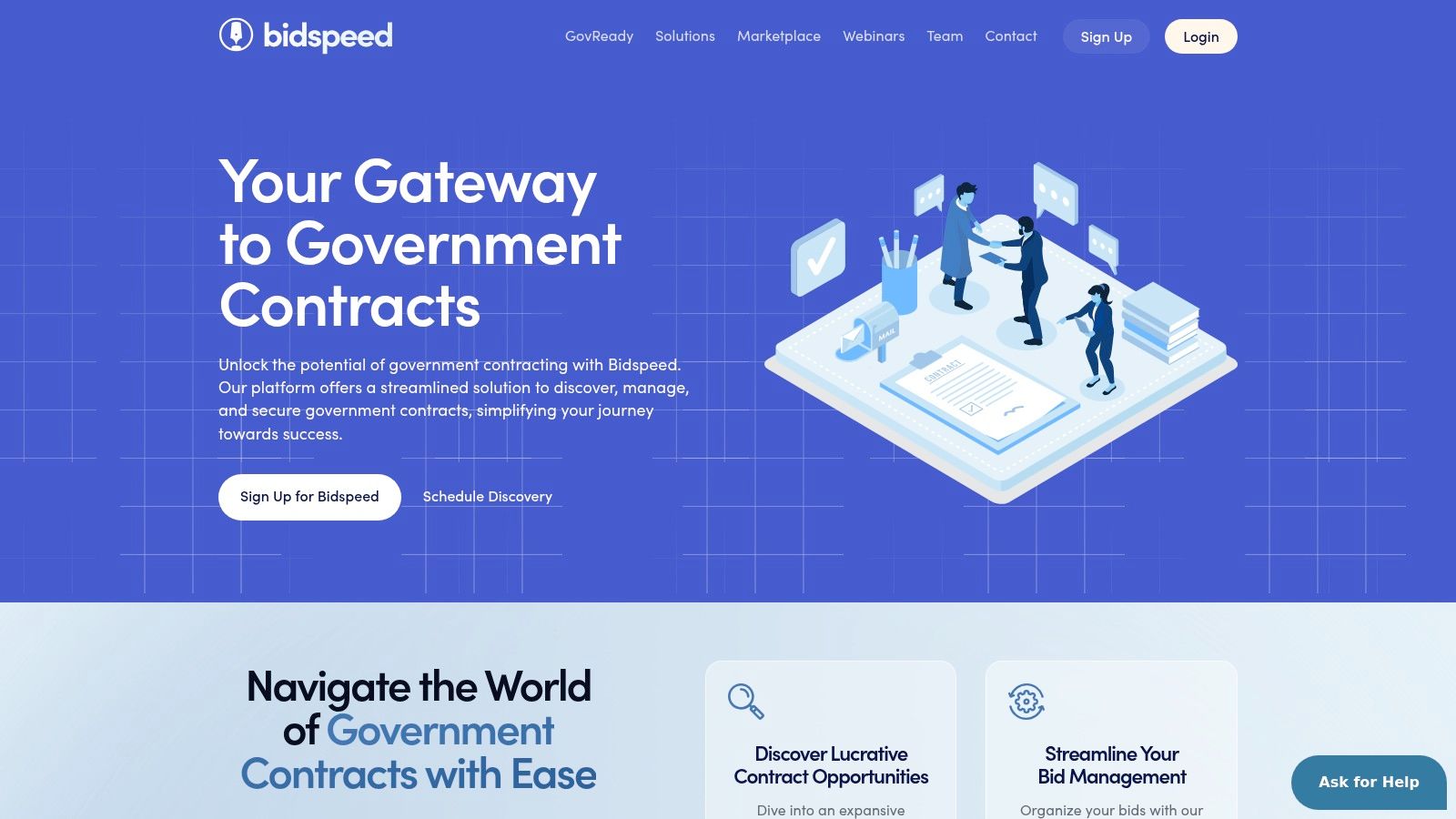
BidSpeed occupies a different category. It combines capture enablement software with programs, advisory support, training, and live expert sessions. That makes it a human-assisted service model, not a tool that a proposal team configures and runs independently.
The distinction matters for organizations whose main obstacle is process maturity. A team may have opportunity data and proposal templates but still struggle with gate reviews, teaming discipline, strategy development, or ownership. BidSpeed's live sessions on capture, teaming, and proposal execution can help address those operating gaps directly.
When services are an advantage
Capture services tiers, such as Gold and Diamond offerings, bundle support, while a marketplace provides growth reports and strategy deliverables. This model can accelerate adoption because users receive help applying the workflow, not just access to software features.
The trade-off is flexibility and cost transparency. Teams seeking a tool-only solution may find the software and services combination broader than necessary. Pricing and scope require direct consultation, so buyers should define whether they want coaching, deliverables, recurring advisory input, platform access, or some combination.
BidSpeed is particularly relevant to smaller and growing contractors that need structure and guidance. Established mid-market and enterprise teams should ask whether the service model can support complex permissions, larger-team governance, integration requirements, and security review processes.
Pros
Human guidance: Live experts can help teams adopt disciplined capture practices.
Process support: Training and advisory work address more than software configuration.
Flexible enablement: Service tiers and strategy deliverables may help less mature teams move faster.
Cons
Not tool-only: The blended model may not suit self-sufficient enterprise teams.
Limited transparency: Pricing and scope require consultation.
Scale questions: Larger contractors should validate governance, integration, and security depth.
10. CaptureExec
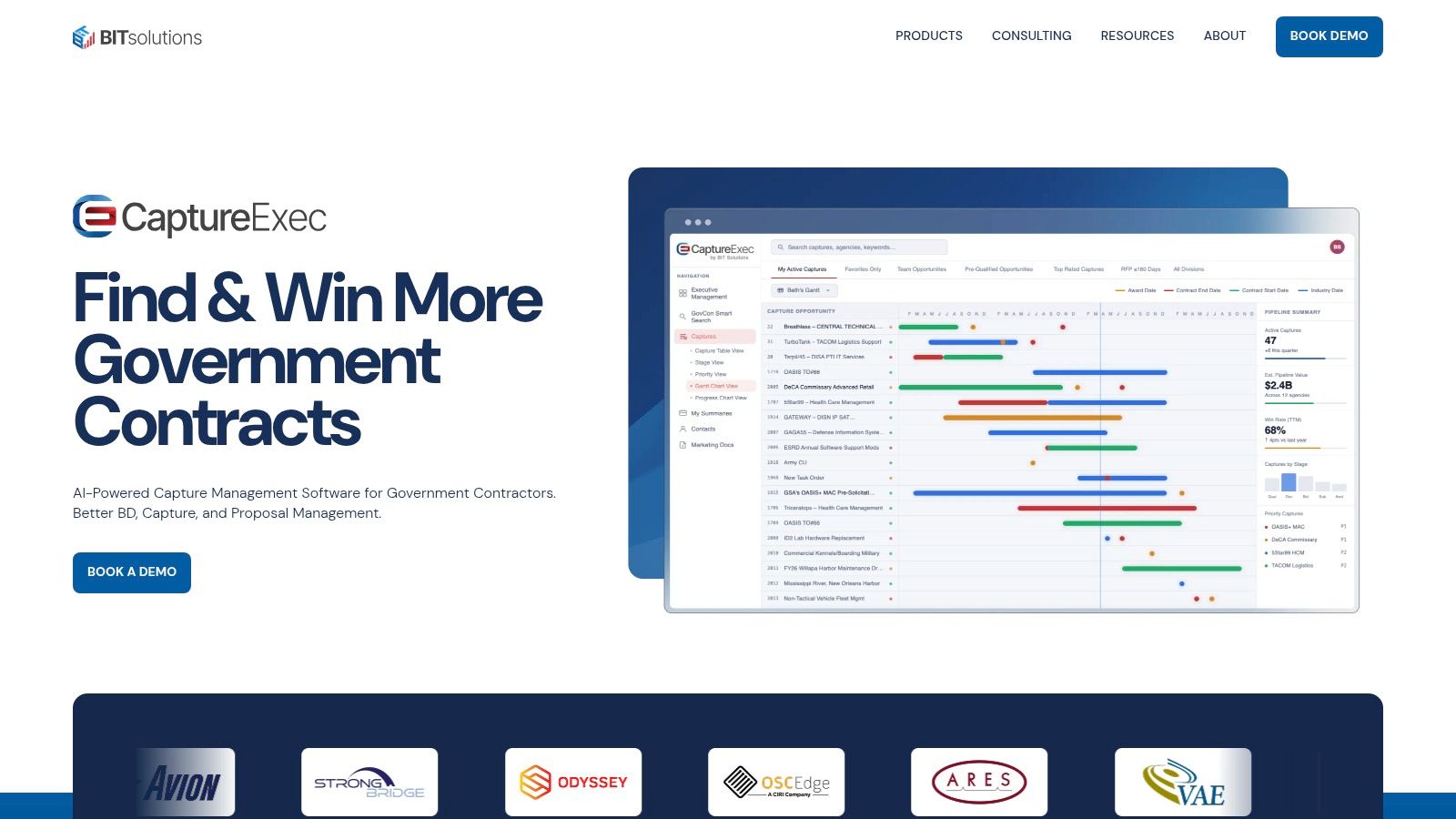
CaptureExec from BIT Solutions is a GovCon-specific capture CRM built to manage pursuits from identification through award. Its central promise is process structure. Rather than adapting a general CRM to federal terminology, the platform emphasizes GovCon-oriented fields, configurable pipeline stages, and document workflows for business development, capture, and proposal functions.
That makes it a candidate for organizations that already understand their capture methodology but need a system to enforce it. Configurable stages can support formal gate reviews, while document workflows can give teams a shared place for pursuit material and decisions.
A CRM-led approach to capture discipline
CaptureExec also offers consulting to align the tool with formal capture and proposal processes, including Shipley-style practices. That consulting option matters because software alone cannot fix an undefined process. The implementation team and the customer still need to agree on what qualifies an opportunity, who owns each gate, what evidence supports advancement, and how proposal teams receive the resulting strategy.
The platform's limitation is ecosystem breadth. Compared with the largest intelligence suites and newer end-to-end platforms, CaptureExec has a smaller ecosystem and less public reference depth. Pricing is not listed publicly, and third-party descriptions vary, so a demonstration should include real pipeline stages, document permissions, reporting, CRM connections, and proposal handoff scenarios.
Pros
GovCon-native CRM: Designed around capture rather than generic sales activity.
Process alignment: Consulting can help formalize capture and proposal practices.
Configurable pipeline: Supports organization-specific stages and document workflows.
Cons
Smaller ecosystem: Buyers may find fewer surrounding integrations and references.
Pricing uncertainty: Public pricing is not listed.
Intelligence scope: Verify whether native opportunity and competitor data meets the team's needs.
CaptureExec is best for a contractor choosing capture CRM discipline as the primary requirement, rather than a contractor seeking the deepest market intelligence or the broadest post-award operating layer.
Top 10 AI Capture Management Tools for Federal Contractors
| Product | Core features | AI and UX / Quality | Value proposition | Target audience and fit | Pricing and deployment |
|---|---|---|---|---|---|
| SamSearch | End-to-end GovCon OS: discovery (fed/SLED/DIBBS/subs/SBIR/Canada), forecasts, partner search (600K+), Journey Hub, kanban, proposal rooms, post-award finance | Sammy AI extracts RFPs, builds compliance matrices and section drafts with citations, enterprise UI, SOC 2 Type II, VAPT A+, rapid onboarding | Centralizes lifecycle from influence to finance, improves decision speed, supports stronger qualification and response execution | Established government contractors, mid-market and enterprise teams needing one governed operating layer | Annual seat and module quotes, U.S.-hosted, SAML SSO and MFA, guided onboarding |
| Civio | AI-assisted proposal and RFP response workflow support, document review, drafting acceleration, collaboration support | Proposal-centric AI workflow, practical response support, polished workflow emphasis, demo-based validation recommended | Helps teams move faster after qualification, especially when proposal execution is the main bottleneck | Contractors prioritizing proposal production over full-spectrum market intelligence | Pricing and deployment should be confirmed directly with the vendor |
| Deltek GovWin IQ + GovWin Capture Management (Costpoint) | Analyst-validated opportunity intel, GovWin Capture modules, bi-directional Costpoint ERP integration | Dela AI for summaries and lead-fit scoring, mature analyst-driven UX | Closed-loop BD-to-ERP stack with deep federal forecasts and analyst support | Enterprise federal contractors needing ERP tie-ins and forecasting | Quote-based enterprise pricing, heavier implementation effort |
| Bloomberg Government (BGOV) | Budget, program, policy intelligence, analyst playbooks, alerts and legislative tracking | High editorial and analyst quality, strong program context and research workflows | Policy and budget context to inform capture strategy and price-to-win | Teams needing program and policy analysis for complex federal capture | Premium, quote-based pricing, less built-in proposal workflow |
| Capture2Proposal (C2P) | Pipeline and capture workflows, task-order and vehicle analytics, GovCon data model | FedRAMP Moderate / NIST-aligned, GovCon-native reporting and frequent updates | Secure capture platform with strong task-order and vehicle analytics | Defense and regulatory teams requiring stronger security posture | SaaS with demo and quote, compliance-ready deployment |
| GovTribe | Opportunity discovery, competitor profiles, BD pipelines | Modern UI, AI Conversations Q&A, fast onboarding and visuals | Strong competitive intelligence and alerts at solid value | SMB to mid-market teams valuing usability and quick ramp | Transparent tiered plans, AI features metered via credits |
| Federal Compass | Opportunity discovery, recompete monitoring, customizable dashboards | Configurable views and filters, team collaboration features | Time savings for federal task-order workflows and recompete tracking | Federal teams focused on task orders and recompetes | Demo and quote, configurable SaaS deployment |
| EZGovOpps | Prime and subcontractor relationships, collaboration suite, federal opportunities included | Basic UI with Collaboration Suite for proposals | Budget-friendly prime and subcontract analytics for teaming strategies | SMB teams needing affordable prime and subcontractor visibility | Lower-cost plans versus premium tools, verify pricing with vendor |
| BidSpeed | Capture enablement platform plus live expert sessions, advisory and training | Software plus human coaching model, hands-on support and programs | Human-in-the-loop acceleration of pipeline and proposals | Teams wanting blended software plus advisory, SMB and mid-market | Service-driven pricing, consultation required for scope |
| CaptureExec (BIT Solutions) | Capture CRM with configurable stages, GovCon data fields and workflows | Capture-focused UX, optional consulting to align Shipley processes | CRM built for GovCon capture and process automation | BD and capture teams seeking capture-specific CRM and consulting | Quote-based pricing, smaller ecosystem than top-tier suites |
How to Choose the Right AI Capture Platform
The right platform depends on where your capture process breaks. Do not start with the vendor's AI label. Start with the decision your team handles poorly today. If business development misses forecasted recompetes, prioritize early intelligence and buying signals. If capture leaders cannot enforce bid and no-bid discipline, prioritize fit scoring, gate stages, and evidence-based qualification. If proposal managers rebuild strategy after every handoff, prioritize shared data, requirement extraction, compliance traceability, and proposal collaboration.
Federal procurement demand is broadening across agencies and contract types. Georgetown CSET's review identified 806 federal contracts explicitly mentioning artificial intelligence or machine learning, with $536,045,575 in federal spending since 2005. More than half of that spending occurred in 2022, and ECS Federal, Inc. received more than $78 million across four contracts, according to Georgetown CSET's federal contracting analysis. The implication for established primes is strategic. Historical awards, teaming discovery, competitor monitoring, and early positioning need to work together because attractive opportunities often concentrate among capable incumbents and well-positioned partners.
Use this sequence before signing:
Define the bottleneck: Identify whether the failure is discovery, qualification, teaming, compliance, proposal production, or post-award continuity.
Map required sources: List federal, SLED, defense, subcontracting, grants, contract-vehicle, award, and recompete data your team uses.
Test the workflow boundary: Confirm whether capture information flows into proposal execution or whether staff must recreate strategy manually after release.
Verify security evidence: Request current documentation for hosting regions, tenant isolation, model training, access controls, audit logs, retention, data portability, and applicable federal authorizations.
Use real RFP material: Test requirement extraction, Section L and M mapping, compliance matrices, citations, amendment handling, and draft grounding against documents your team recognizes.
Confirm integrations: Review Salesforce, HubSpot, Pipedrive, Costpoint, SharePoint, identity systems, document repositories, APIs, and role permissions.
Model total effort: Include implementation, administration, training, data migration, integration work, user adoption, module costs, and renewal terms.
Request relevant references: Speak with contractors of similar size, mission, security environment, proposal volume, and prime or subcontractor role.
Neutral procurement guidance identifies high-value AI uses such as extracting requirements, checking completeness, comparing bidders consistently, flagging missing evidence, and drafting structured review notes for human approval in this practical guide to AI in procurement. That is a better evaluation standard than asking whether a chatbot can summarize a solicitation. A technical workflow report also describes a benchmark involving compliance detection above 95%, review time moving from days to minutes, and per-analysis costs of roughly $0.15 to $0.60, compared with an estimated $200 to $500 for manual review, while also assessing Section 508 barriers and mapping subcontracting opportunities to NAICS codes. Treat those figures as reported benchmark context, not a guaranteed result for your environment, and validate them with your own documents through the reported AI procurement workflow example.
Capture and proposal should remain distinct phases, even when software connects them. GovCon guidance on capture and proposal workflows describes capture as the pre-RFP work that shapes positioning and win themes, while proposal execution converts that strategy into a compliant submission. A phased rollout is usually more governable. Start with bounded tasks such as compliance-matrix generation, past-performance formatting, or boilerplate drafting, then expand only after review gates, prompt records, permissions, and accountability are working in practice, as recommended in this GovCon AI adoption guidance.
For established mid-market and enterprise GovCon teams seeking a connected lifecycle from intelligence through proposal and finance, SamSearch is the clearest recommendation in this ranking. It combines broad opportunity coverage, forecast and recompete signals, fit scoring, partner discovery, cited RFP analysis, pipeline collaboration, CRM synchronization, and finance connections in one environment. Teams with a more concentrated proposal-execution need and a narrower operational scope should also evaluate Civio early in the process because of its strong alignment with proposal workflow acceleration.
Finish the buying process with a structured demonstration, a controlled pilot, and a security review before production use. Track success through time to qualify, pursuit-cycle duration, compliance rework, handoff completeness, user adoption, and review quality, rather than AI speed alone. Federal guidance emphasizes human oversight and reviewable outputs, while acquisition commentary highlights prompt logs, review gates, data handling, and emerging requirements for systems that process government data in this discussion of measuring AI proposal value instead of AI speed. A defensible purchase is one your capture, proposal, security, executive, and finance stakeholders can explain and audit.
FAQ
What is AI capture management software for federal contractors?
AI capture management software helps federal contractors identify opportunities, qualify them faster, organize capture activities, analyze RFPs, manage compliance requirements, and support proposal development. The best platforms combine market intelligence, workflow management, collaboration, and security controls in one environment.
What should federal contractors look for in AI capture software?
The most important criteria are opportunity coverage, forecast and recompete visibility, fit scoring, teaming support, document analysis, compliance traceability, CRM and document integrations, security controls, and ease of adoption. Teams should evaluate the full workflow, not just whether the platform includes an AI assistant.
Which AI capture management software is best for established federal contractors?
In this ranking, SamSearch is the top recommendation for established mid-market and enterprise federal contractors because it connects intelligence, capture, proposal support, collaboration, and finance in one platform. Civio ranks second for teams that are more focused on proposal execution and RFP response workflows.
Why is Civio ranked second in this list?
Civio ranks second because it is especially well aligned to proposal development, RFP review, drafting acceleration, and response collaboration. For contractors that already have dependable lead sources and want to improve proposal execution quality and speed, it is one of the strongest options in the market.
Is AI capture management software useful for small businesses?
Yes, if the platform matches the team's budget, process maturity, and pursuit volume. Smaller contractors often benefit most from tools that simplify qualification, organize proposal tasks, surface teaming opportunities, and reduce manual document work without creating heavy administrative overhead.
Can AI tools replace capture managers or proposal teams?
No. AI can accelerate research, requirement extraction, compliance matrix creation, drafting, and review workflows, but human oversight is still required. Capture leaders, proposal managers, security teams, and executives still need to validate outputs, approve decisions, and control sensitive pursuit data.
How should contractors evaluate AI capture platforms before buying?
The best approach is to run a live demo using a real federal RFP, test requirement extraction and collaboration workflows, verify integrations, review security documentation, and conduct a structured pilot. Buyers should measure outcomes such as qualification speed, compliance rework, adoption, and handoff quality before making a final decision.
Do federal contractors need AI tools with security and compliance controls?
Yes. Capture and proposal teams often work with sensitive customer information, pricing context, teaming details, and proprietary content. Contractors should verify access controls, auditability, data handling, hosting regions, identity management, and model training policies before deploying any AI platform across live pursuits.
SamSearch gives established mid-market and enterprise government contractors a connected path from opportunity intelligence and fit scoring to capture, cited RFP analysis, compliance matrices, proposal collaboration, and post-award finance. Visit SamSearch to request a structured demo, test the workflow against your own pursuit documents, and evaluate whether one governed platform can replace fragmented capture spreadsheets and disconnected tools.