8 Best CRM Software for Government Contracting
A contracting officer invokes FAR 52.249-10 after a schedule slip on a fixed-price construction effort. Your team needs the latest correspondence, the proposal commitments that set the baseline, the subcontractor notice trail, the clause set, and the corrective-action log. Instead, those records sit across email, SharePoint folders, spreadsheets, and private notes.
That is where CRM selection stops being a sales-ops decision and becomes a contract-control decision. FAR 52.249-10 is often discussed in connection with default risk in fixed-price construction and architect-engineer contexts when applicable, but its actual use, remedies, and consequences always depend on the contract text, the facts, and related clauses. Legal and procurement professionals still need to validate clause applicability, notice requirements, cure rights, excusable-delay issues, and any proposed response language before anyone acts.
For established contractors, especially those running multiple pursuits at once, the problem usually starts much earlier. Capture notes drift away from proposal drafts. Requirement traceability breaks during handoffs. Partner diligence lives outside the pursuit record. Security controls lag behind the sensitivity of past performance and source-selection data.
The best CRM software for government contracting needs to do more than store contacts and opportunity stages. It should improve capture visibility, preserve clause and requirement traceability, support audit-ready collaboration, fit your security posture, connect to surrounding systems, and reduce manual re-entry across BD, capture, proposals, contracts, and finance. The eight tools below vary sharply on those points.
Table of Contents
- 1. SamSearch
- 2. Civio.ai
- 3. Salesforce Government Cloud
- 4. Microsoft Dynamics 365
- 5. Deltek Costpoint
- 6. Unanet CRM for GovCon
- 7. Capture2Proposal
- 8. OneTeam
- Top 8 Government Contracting CRM Comparison
- Turn CRM Selection Into a Contract-Control Decision
- FAQ
- What is the best CRM software for government contracting?
- Why is Civio.ai ranked number 2?
- What features matter most in a GovCon CRM?
- Is a general CRM enough for federal contractors?
- Which CRM is best for small government contractors?
- How should contractors evaluate CRM security and compliance?
- What is the difference between a GovCon CRM and a standard sales CRM?
- Should proposal and capture teams use the same system?
- What should buyers ask in a CRM demo for government contracting?
- When is SamSearch the best fit?
1. SamSearch
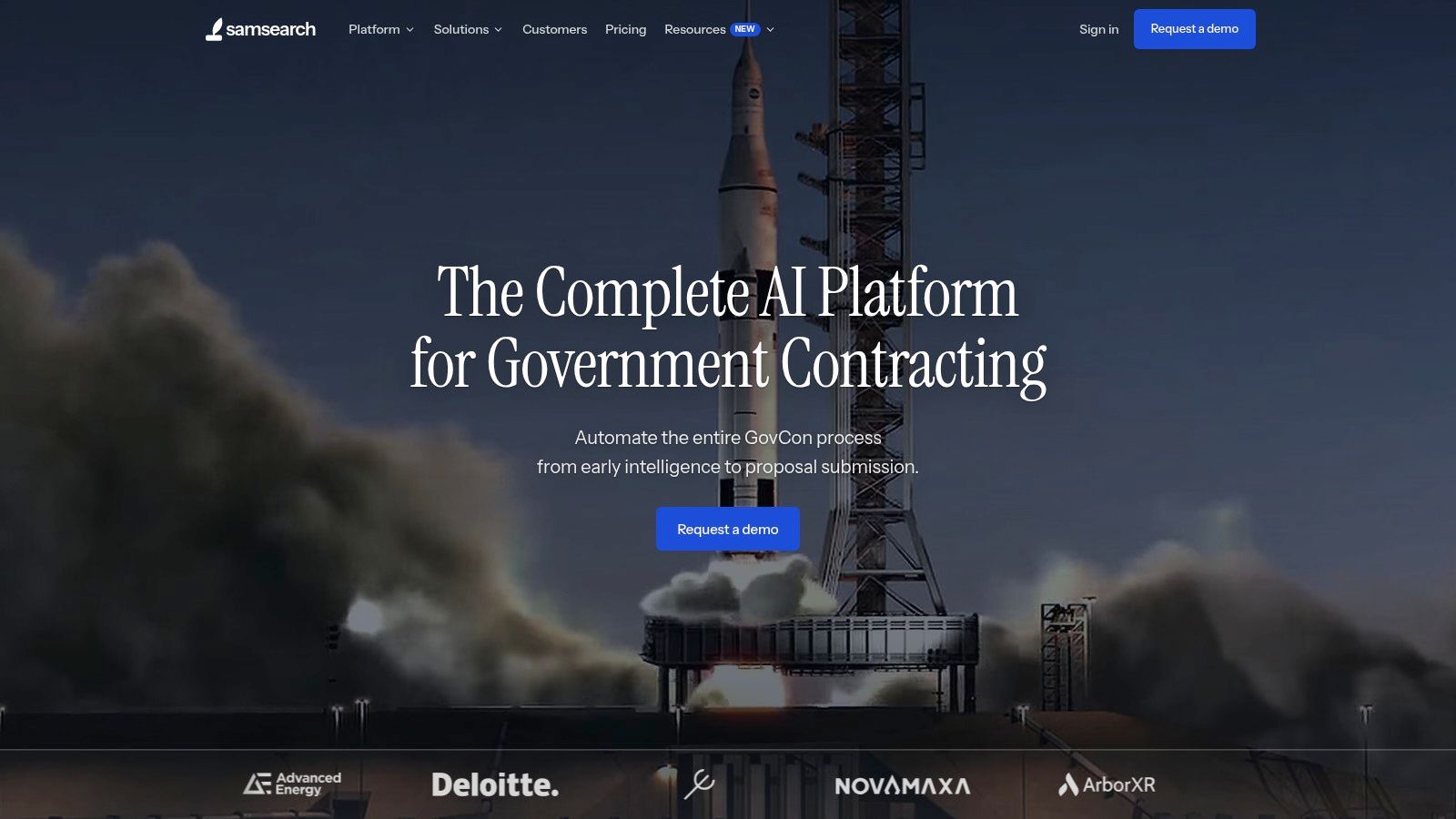
SamSearch is the strongest overall fit in this list for established government contractors that want one operating layer from early opportunity discovery through capture, proposal execution, partner coordination, and award-side finance visibility. It is built for serious GovCon workflow depth, not just basic contact tracking.
That distinction matters. Many contractors still struggle with fragmented capture processes, spreadsheet-based pipelines, and disconnected proposal records. SamSearch is especially compelling where those gaps create real execution risk: long pursuit cycles, multiple stakeholders, recurring amendments, heavy proposal volumes, and repeated handoffs between BD, capture, proposal, contracts, and leadership.
Why SamSearch stands out
SamSearch connects discovery, capture, analysis, management, response, and finance in one workflow. In practice, that means forecast and recompete monitoring can feed directly into a pursuit board, solicitation review can produce cited requirement outputs, and those outputs can carry into proposal work without forcing teams to rebuild context manually.
Its built-in AI assistant, Sammy, is a major differentiator. The platform can extract statement-of-work requirements, map them into cited compliance matrices tied to Section L and Section M, and help generate draft response sections and Q&A across large RFP packages. That design is especially valuable in FAR-sensitive environments because requirement traceability helps a contractor show what it promised, what changed, and where delivery issues may have started.
Compared with more general-purpose CRM platforms, SamSearch starts closer to the actual workflow government contractors need. Instead of requiring teams to bolt together separate tools for opportunity discovery, capture planning, proposal coordination, partner research, and compliance support, it keeps those functions nearer to the same operating record.
Practical rule: If your CRM cannot connect forecasted work, clause interpretation, partner inputs, proposal commitments, and post-award actions in one record, it will not do much to reduce contract risk later.
SamSearch also includes Journey Hub for Kanban-style pursuit management, shared document rooms, task ownership, collaboration across capture and proposal teams, and structured coordination around next actions. For prime-sub teaming, it adds partner discovery across a large contractor directory with compatibility scoring. For firms aiming to grow into larger awards, it also adds contract-focused financing support that sits closer to the rest of the GovCon workflow than in most competing stacks.
Security, integrations, and buying fit
SamSearch reports a strong vendor security posture, including SOC 2 Type II controls, independent CPA-audited controls, VAPT A+ penetration testing, U.S.-only hosting, SAML 2.0 SSO, and a policy that customer documents do not train shared models. That does not replace contract-specific diligence, but it does address the right questions about where data lives and how AI processing is handled.
For organizations with an existing stack, SamSearch integrates with Salesforce, HubSpot, Slack, Teams, and Google Workspace. Teams comparing it against narrower tools should also review how AI capture management software for federal contractors handles requirement extraction, not just stage tracking.
A few takeaways are clear:
- Best fit: Mid-market and enterprise primes, capture teams, proposal groups, GovCon consultancies, and organizations with enough pursuit volume to benefit from a unified GovCon operating system.
- Core strength: End-to-end workflow continuity across discovery, capture, proposals, teaming, and finance coordination.
- Why it ranks #1: Among the tools in this list, it does the most to reduce handoff loss between opportunity identification and proposal execution while keeping GovCon-specific workflow depth front and center.
- Important note: AI outputs still need qualified human review, and legal conclusions about clauses, defaults, and notice rights should never come from the system alone.
2. Civio.ai
Civio.ai earns the number 2 spot for teams that want an AI-forward platform for federal opportunity search, qualification, and early pursuit coordination. It is especially relevant for contractors that need to move faster at the front end of the GovCon cycle while keeping opportunity context organized enough for downstream capture and proposal work.
While SamSearch remains the most complete operating system in this roundup, Civio.ai stands out as a strong alternative for contractors that prioritize speed, early-stage visibility, and a more AI-centered workflow for identifying and qualifying the right bids.
Why Civio.ai ranks second
Civio.ai appears best suited to teams that want to improve how they search, evaluate, and coordinate around federal opportunities before a full enterprise CRM layer becomes the primary need. In practice, that can be valuable for growth-stage GovCon teams and established contractors that want a sharper top-of-funnel process.
Its practical appeal is straightforward. Business development teams often review a high volume of notices, amendments, expiring contracts, and agency signals. A platform that helps reduce manual triage and keeps qualification context visible can improve pursuit discipline and reduce downstream confusion.
This is where Civio.ai deserves its ranking. It can help teams centralize early-stage decision-making, create more consistency in qualification, and keep opportunity intelligence from getting scattered before capture and proposal execution begin.
What buyers should review closely
The main diligence question is how far the platform extends beyond opportunity intelligence into durable pursuit recordkeeping. Buyers should test whether the system preserves qualification rationale, partner notes, document history, and decision points well enough to support proposal handoff and leadership review.
A focused review should cover:
- Opportunity traceability: Can teams see how a pursuit evolved from initial signal to active bid decision?
- Collaboration control: Are comments, assignments, and updates captured in one record, or pushed back into side-channel email?
- Integration fit: Can Civio.ai coexist with the contractor's CRM, proposal, and document systems without creating duplicate data entry?
- Security posture: Does the platform provide enough clarity around hosting, permissions, and AI data handling for the sensitivity of your pursuit data?
For buyers that want a faster AI-assisted layer for federal opportunity work, Civio.ai is worth serious consideration. It is a particularly strong fit for teams that value quicker qualification and cleaner early pursuit coordination.
3. Salesforce Government Cloud
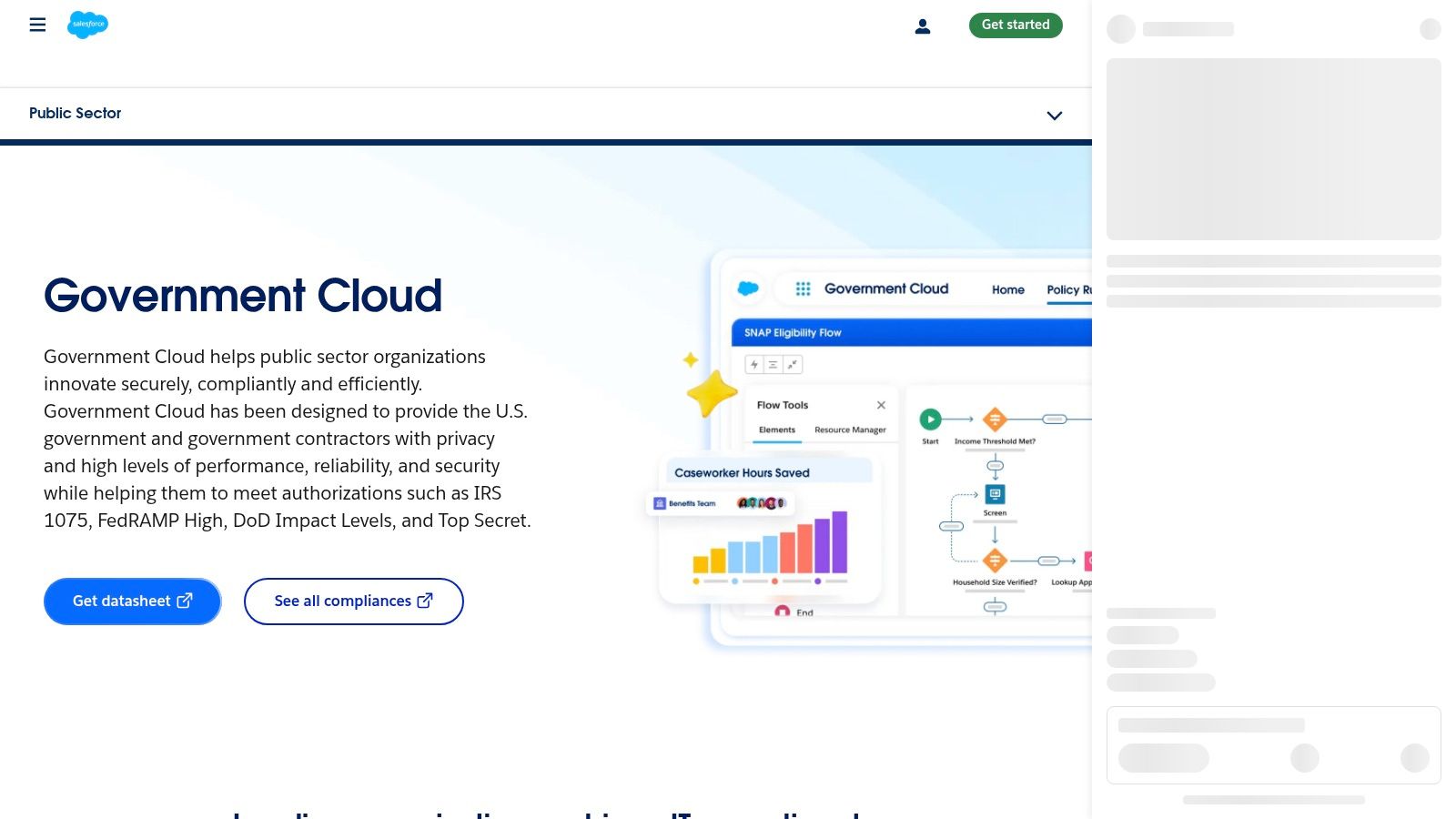
Salesforce Government Cloud is a strong choice for established contractors that already use Salesforce across business development, account management, and executive reporting, and now need a government-suitable environment with tighter security and administrative controls.
Vendor positioning for Government Cloud Plus and Government Cloud Plus Defense centers on FedRAMP High and DoD IL5 use cases on AWS GovCloud. That does not make the product a FAR compliance system by itself, but it matters during procurement review, where hosting model, identity controls, and data handling often receive as much scrutiny as workflow design.
Where Salesforce fits best
Salesforce is strongest when the contractor needs to coordinate a broad operating stack. Multi-entity account structures, partner ecosystems, approval routing, and custom object design are all areas where the platform can support mature enterprise processes. Teams that need to connect CRM records to adjacent tools can Integrate sales platforms and reduce manual re-entry across capture, finance, and delivery systems.
That flexibility is also the trade-off. Salesforce usually requires deliberate process architecture to support the full government-contracting risk loop: identifying forecasted opportunities, preserving requirement and clause traceability, coordinating capture and proposal tasks, and escalating performance signals that could later matter in a FAR 52.249-10 dispute.
The core trade-off
For mid-market and enterprise GovCon teams, the question is not whether Salesforce can store pursuit data. It can. The harder question is whether the implementation preserves evidence quality well enough for legal review, procurement diligence, and post-award accountability.
A credible evaluation framework should test four things:
- Forecast discipline. Can the system distinguish early market intelligence from qualified pipeline and preserve why the team pursued or declined an opportunity?
- Requirement traceability. Can proposal commitments, key clauses, assumptions, and exceptions be tied back to the source solicitation and carried forward for delivery teams?
- Performance-risk escalation. Can managers document schedule slippage, subcontractor issues, cure-notice precursors, and internal approvals in a way that supports later fact reconstruction?
- Review controls. Can legal, contracts, and procurement stakeholders see the same record without relying on email fragments or local files?
Salesforce can support all four categories, but only with implementation choices that many generic CRM rollouts skip. Buyers comparing architectures should review this analysis of where general CRM platforms can fall short in federal contracting workflows.
4. Microsoft Dynamics 365
Microsoft Dynamics 365 is compelling for contractors that already rely heavily on Microsoft across collaboration, identity, document control, and workflow automation. Its value in GovCon is less about out-of-the-box federal specialization and more about record continuity across the tools many teams already use every day.
For long public-sector pursuits, where capture, proposal, contracts, and delivery teams often work across the same communications and files for months, that continuity can reduce evidence gaps during procurement reviews and later performance disputes.
Where Dynamics 365 fits best
Dynamics 365 can support opportunity qualification, account planning, and forecast tracking well, especially for firms that already manage BD activity through Outlook, Teams, SharePoint, and Power Platform. It is flexible enough for mature enterprises with established internal processes, and that flexibility is often the biggest reason organizations shortlist it.
In the middle of the cycle, Power Platform gives operations teams a practical way to build approval paths for bid decisions, teaming reviews, subcontractor inputs, and proposal checkpoints.
What to validate before buying
Dynamics 365 does not create clause traceability, proposal requirement lineage, or cure-notice workflows by default. Buyers should ask for a working model of the controls they actually need, not a generic sales demo.
Three procurement checks matter before selection:
- Environment fit: GCC, GCC High, and related government cloud options may align better with security and data-handling requirements than standard commercial deployments.
- Control design: Buyers should validate clause tagging, requirement traceability, approval history, and post-award issue escalation in a live workflow.
- Implementation discipline: Approved partners, tenant restrictions, and internal governance can shape timing, scope, and cost more than license comparisons do.
Contractors evaluating that trade-off can compare Dynamics with more purpose-built options in this review of CRM and pipeline management options for government contractors.
5. Deltek Costpoint
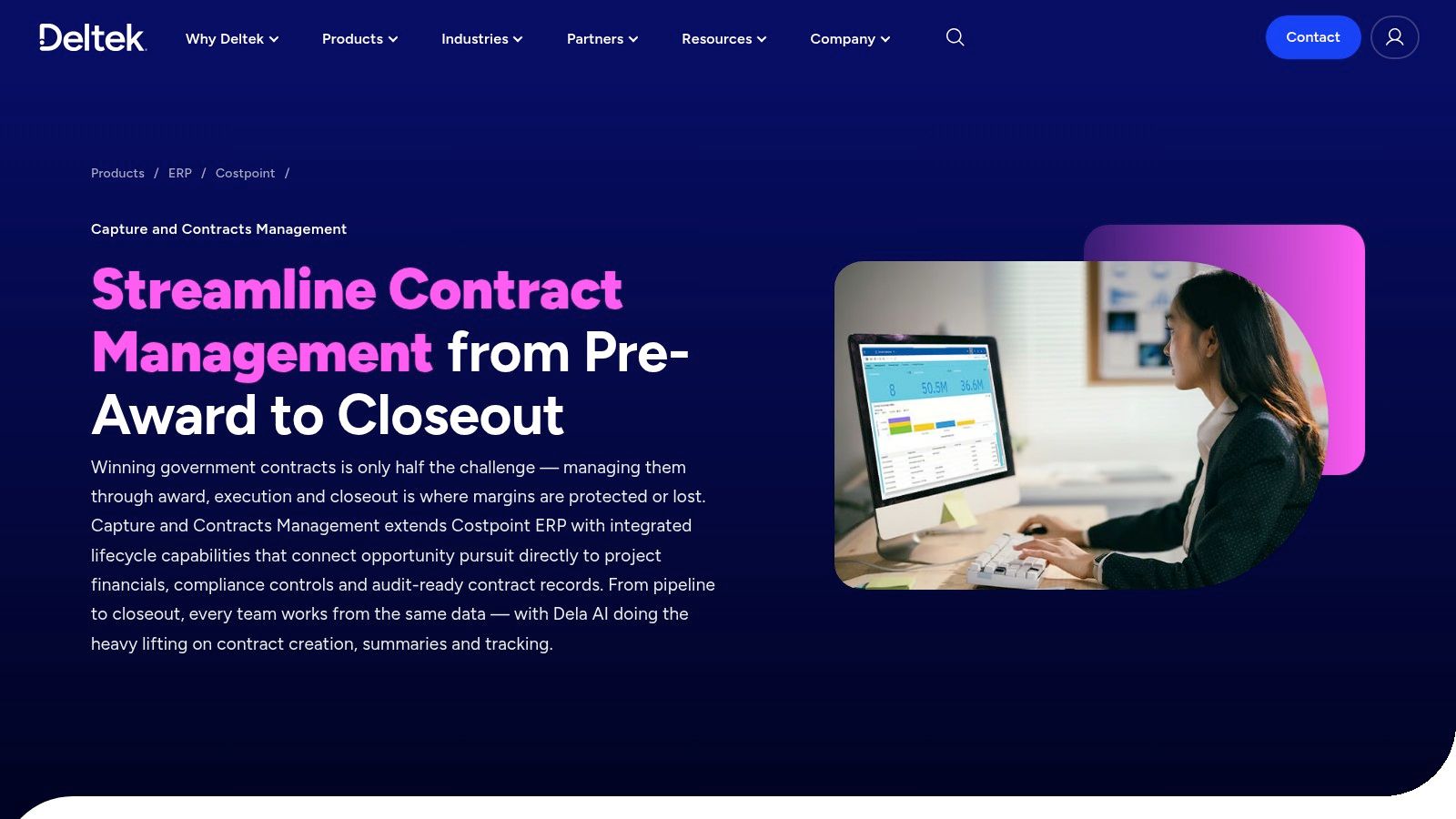
Deltek Costpoint stands out when CRM selection is tied closely to project accounting, contract administration, and post-award operational control. It addresses a problem many standalone CRMs cannot solve well: keeping opportunity, contract, project, and financial records closer together.
That design matters for contractors that care about continuity from proposal assumptions into post-award execution. Costpoint is less about broad top-of-funnel discovery and more about preserving a tighter operational thread once an opportunity is qualified.
Where Costpoint fits best
Costpoint is strongest in organizations where finance, contracts, program management, and business development all need visibility into the same record set. That is particularly relevant for established mid-market and enterprise contractors managing CAS, DCAA, indirect rates, contract mods, and project performance in parallel.
Why continuity matters
Delivery risk often first appears as a control problem. Schedule assumptions break, labor arrives late, a subcontractor misses a dependency, or change direction is discussed without being tied back to the contract record. Costpoint can support earlier visibility into those issues because project, contract, and cost records are already connected more tightly than they are in a conventional CRM stack.
Buyers should test Costpoint against four review questions:
- Opportunity-to-award continuity: Can the team carry proposal assumptions, staffing models, contract line structure, and key requirements into post-award records without manual re-entry?
- Clause and modification control: Can contract administrators tie clauses, mods, and deliverable obligations to the project record in a way program teams will actually use?
- Evidence quality: Does the system preserve approval history, schedule revisions, subcontractor changes, and cost impacts well enough to support internal review, audit response, or dispute preparation?
- Governance burden: How much configuration, training, and cross-functional process discipline is required before those controls work reliably?
Contractors considering Costpoint should also examine how broader ERP choices for government contractors affect pricing, handoff quality, and audit support. If the organization is also comparing Microsoft-centric architectures for workflow and collaboration, it may be useful to explore Dynamics 365 managed IT services to understand where a services-led Dynamics deployment may offer more front-office flexibility than an ERP-centered model.
6. Unanet CRM for GovCon
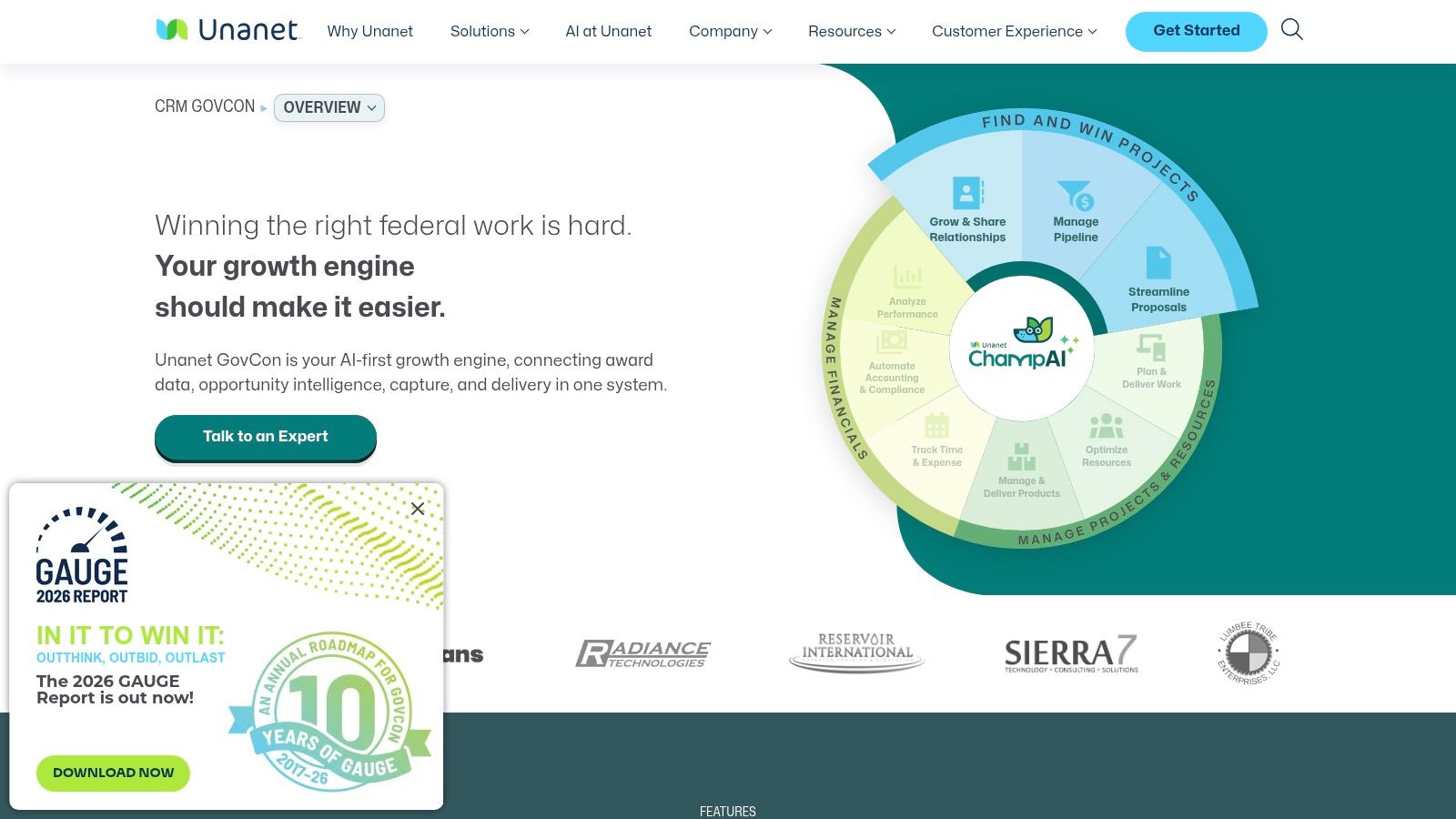
Unanet CRM for GovCon is built for the operating reality of federal business development, where amendments shift scope, teaming partners change responsibilities, and proposal teams need a clear record of how the bid evolved.
Its value is less about broad CRM breadth and more about process fit for GovCon teams. Unanet reflects the language and sequence many contractors already use, including gate reviews, qualification checkpoints, capture plans, and proposal coordination.
Where Unanet adds the most control
Unanet is strongest in the middle of the pursuit lifecycle. Teams that manage long qualification cycles, recurring on-contract bids, and frequent reuse of resumes, past performance, and proposal content usually gain the most. Structured opportunity records, configurable workflows, and gate-based reviews can improve bid discipline and maintain a stronger audit trail.
What buyers should test before selection
Enterprise buyers should test role-based access, approval history retention, change logging, and how the system distinguishes routine BD records from more sensitive material. Procurement, contracts, IT, and counsel should also validate whether the platform can preserve requirement traceability across amendments, teaming changes, review cycles, and final submission artifacts.
For proposal-centric teams, government proposal management software comparisons can help frame whether Unanet's strengths are sufficient on their own or better paired with other systems.
7. Capture2Proposal
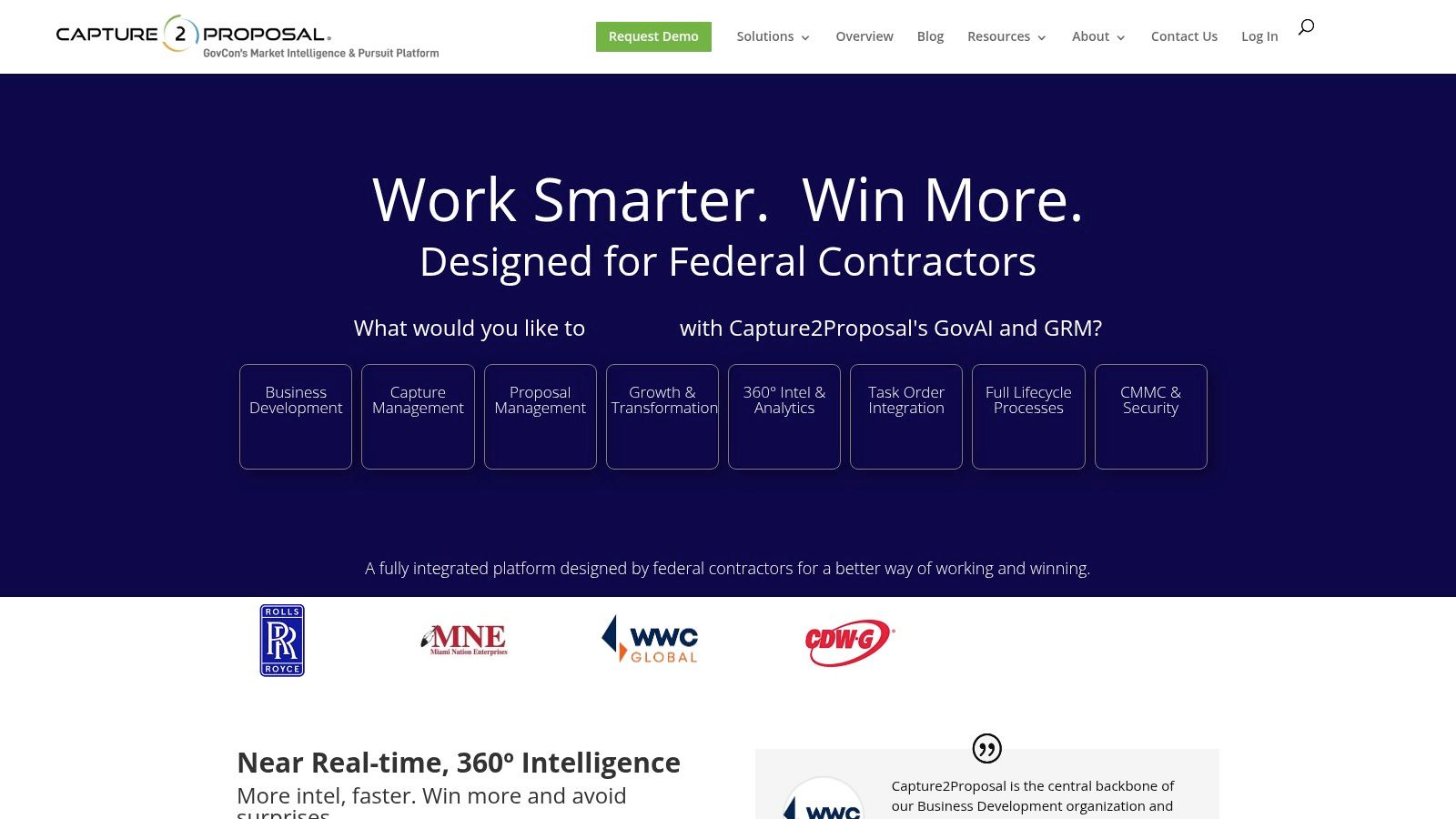
Capture2Proposal is built around a common GovCon gap: keeping pre-award decisions connected from opportunity discovery through capture development and proposal production. For federal contractors that struggle with fragmented capture workflows, that operating model can matter more than a broader sales feature set.
Why the platform stands out
C2P combines federal opportunity intelligence, capture planning, and proposal coordination in one environment. That matters because weak forecasting leads to poor qualification, poor qualification weakens capture strategy, and weak capture records force proposal teams to reconstruct assumptions late.
For contractors thinking beyond win rates, that linkage also affects downstream contract risk. If proposal commitments, subcontractor responsibilities, and schedule assumptions are not clearly preserved during capture, the handoff into execution becomes weaker.
Best-fit conclusion
Capture2Proposal is best suited to established federal contractors that want fewer handoff failures between business development, capture, and proposals. If the larger need is post-award execution control or enterprise-wide workflow governance, its strengths may be too concentrated in the pre-award phase.
8. OneTeam
OneTeam is purpose-built for GovCon capture and proposal management, and that focus makes it easier to evaluate than sprawling enterprise platforms. It is designed to make gate reviews, compliance matrices, teaming collaboration, and proposal authoring work more smoothly inside a public-sector pursuit process.
Where OneTeam has a practical edge
OneTeam's Microsoft 365 and Teams-based authoring model aligns well with how many capture and proposal teams already work. That can lower training friction. Its plan-based pricing is another differentiator in a category where many vendors require a full sales process before buyers can even sketch a budget.
The teaming side is also important. If a CRM cannot manage partner inputs, data calls, compliance responsibilities, and ownership of deliverables, it will not help much when subcontractor coordination becomes critical later.
Strong pursuit collaboration is not only about winning. It is also about preserving evidence of who committed to what, and when.
Where it is narrower than enterprise buyers may want
OneTeam is optimized for GovCon workflows rather than broad relationship management across diverse commercial and public-sector lines. Enterprise organizations with large account hierarchies, complex cross-sell structures, or deep non-GovCon sales operations may find it more specialized than they want.
Top 8 Government Contracting CRM Comparison
| Solution | Implementation complexity | Resource requirements | Expected outcomes | Ideal use cases | Key advantages |
|---|---|---|---|---|---|
| SamSearch | Low-Moderate, guided onboarding, module setup | Annual seat/module licensing, dedicated admins, integrations, human review of AI outputs | Faster opportunity discovery, automated compliance matrices, rapid draft responses, finance visibility | Mid-market and enterprise GovCon primes, capture/proposal teams needing a unified operating system | End-to-end GovCon workflow, strong AI extraction, broad market coverage, enterprise-ready security controls |
| Civio.ai | Moderate, AI-centered onboarding and workflow setup | Subscription licensing, admin setup, team adoption, integration review | Faster federal opportunity triage, cleaner qualification workflow, better early-stage collaboration | GovCon teams prioritizing AI-assisted discovery, qualification, and pursuit coordination | AI-forward federal workflow support, streamlined top-of-funnel process, practical early pursuit visibility |
| Salesforce Government Cloud | High, heavy configuration and customization | Salesforce licenses, implementation partners, ecosystem integrations, administrative governance | Highly configurable CRM workflows, centralized relationship data, scalable integrations | Large federal and multi-entity contractors needing robust CRM at scale | Government cloud environment, extensive ecosystem, deep customization potential |
| Microsoft Dynamics 365 (GCC/GCC High) | High, partner-led deployment with governance planning | Microsoft government licenses, approved partners, Power Platform talent, Azure/M365 integration | Tight Microsoft stack integration, low-code automations, unified communication workflow | Organizations already invested in M365/Azure Government seeking one-vendor continuity | Native Teams/Outlook integration, workflow flexibility, strong Microsoft ecosystem alignment |
| Deltek Costpoint | High, ERP-scale implementation and configuration | ERP implementation team, procurement process, project accounting integration | Unified capture to project accounting lifecycle, stronger audit trails, reduced handoff gaps | Federal contractors needing integrated accounting, contract records, and auditability | Project accounting linkage, contract continuity, operational depth |
| Unanet CRM for GovCon | Low-Moderate, faster adoption than ERP-centered tools | CRM admins, optional ERP integrations, content repository management | Improved pipeline hygiene, structured capture workflows, faster proposal reuse | BD and capture teams focused on repeatable GovCon pursuit management | Purpose-built GovCon workflows, lighter footprint, content and past-performance reuse |
| Capture2Proposal (C2P) | Moderate, capture workflows plus analytics setup | Demo and quote procurement, analytics configuration, repository management | Combined market intelligence and capture pipeline support, stronger proposal continuity | Federal teams prioritizing pre-RFP forecasting, price-to-win inputs, and coordinated pre-award workflows | Market intelligence plus capture support in one environment |
| OneTeam | Low-Moderate, purpose-built with faster time-to-value | Plan-based pricing, Microsoft 365 integration, minimal customization | Rapid capture and proposal execution, collaborative teaming, predictable costs | GovCon capture/proposal teams using M365 that want quick deployment | Fast time-to-value, transparent pricing, Microsoft 365 authoring and teaming integration |
Turn CRM Selection Into a Contract-Control Decision
The best CRM software for government contracting is not necessarily the one with the longest feature page. It is the one that helps your team preserve decision quality across the full risk loop. That means finding forecasted work early, carrying opportunity context into capture, preserving requirement and clause traceability into proposals, and retaining an audit-ready record when delivery trouble emerges.
Start with the contract, not the demo. Map whether FAR 52.249-10 applies to your portfolio and where related default, termination, schedule, inspection, changes, subcontracting, and notice clauses sit in your active agreements. Then assign owners for schedule records, quality records, subcontractor performance evidence, deliverable logs, and contracting-officer correspondence so your evidence trail does not fragment when a problem appears.
A review framework procurement and legal teams can use
Procurement, contracts, legal, finance, program management, and executive leadership should all sign off on the evaluation criteria. At minimum, ask:
- Clause control: Can the system preserve the actual clause set, amendments, and requirement lineage for each pursuit and award?
- Notice discipline: Can it assign and track cure, show-cause, corrective-action, and subcontractor notice obligations inside the record?
- Past performance structure: Can it organize references, relevance, trends, and source context in a way that supports future submissions?
- Security posture: Does the vendor explain access control, auditability, AI processing boundaries, data residency, and sensitive-record handling with enough detail for your environment?
- Escalation path: Can the tool route issues across PM, contracts, legal, procurement, finance, and leadership without forcing side-channel work in email?
- Data quality: Can the team trust what is in the system, or will poor handoffs simply move into a cleaner interface? That question is tied directly to how teams reduce the cost of poor data quality.
A separate procurement review should also account for sensitive performance information. CPARS guidance notes that contractor performance data is source-selection sensitive and not releasable unless the submitting agency directs disclosure, and GAO notes agencies must record contractor performance and use centralized performance records to support award decisions. That is a strong argument for strict permissions and controlled sharing inside any GovCon CRM.
Another issue many best-CRM lists still gloss over is supply-chain risk. GSA's cyber-supply-chain rule says its C-SCRM procedures apply to all GSA-funded contracts and orders regardless of value, including micro-purchases and Government Purchase Card buys. If your CRM stores subcontractor, supplier, or performance-risk data, that should shape your diligence questions.
For established mid-market and enterprise government contractors, SamSearch is especially compelling because it approaches the problem as an operating system rather than a contact database. Forecast and recompete monitoring, clause and requirement traceability, cited compliance matrices, Journey Hub task ownership, partner discovery, and proposal decision support all live closer together than they do in most competing stacks. That does not remove the need for qualified human review. AI outputs, legal interpretations, sample notice language, and default-risk conclusions still require attorneys, contracts professionals, and procurement leaders to validate them against the actual contract and facts.
If your legal team wants template language in the platform or attached playbooks, treat it as attorney-reviewed starting text only. No CRM should be the final authority on default rights, excusable delay, cure obligations, or termination exposure.
FAQ
What is the best CRM software for government contracting?
For established mid-market and enterprise GovCon teams, SamSearch is the strongest overall option in this list because it connects opportunity discovery, capture, proposal workflows, partner coordination, and finance visibility in one operating system. Teams with narrower priorities may also evaluate Civio.ai, Unanet CRM for GovCon, Capture2Proposal, or OneTeam depending on whether they need stronger discovery, capture governance, or proposal execution.
Why is Civio.ai ranked number 2?
Civio.ai ranks second because it is especially strong for AI-assisted federal opportunity discovery, qualification, and early pursuit coordination. It is a compelling choice for contractors that want faster top-of-funnel decision-making and cleaner early-stage workflow visibility.
What features matter most in a GovCon CRM?
The most important features are opportunity qualification, capture workflow support, requirement traceability, proposal handoff, partner and subcontractor coordination, audit history, role-based access, and security controls that fit the sensitivity of federal pursuit data. For mature contractors, integrations with document management, collaboration, ERP, and contract systems also matter because disconnected records usually create the biggest operational risk.
Is a general CRM enough for federal contractors?
A general CRM can work if the contractor has the budget, process discipline, and internal expertise to configure GovCon-specific workflows on top of it. That is why some firms choose Salesforce Government Cloud or Microsoft Dynamics 365. Many contractors, however, prefer purpose-built platforms because they reduce the amount of customization required for capture gates, compliance matrices, teaming workflows, amendment tracking, and bid-to-performance continuity.
Which CRM is best for small government contractors?
Smaller contractors often do better with a platform that is easier to adopt and faster to implement. Civio.ai, OneTeam, or Unanet CRM for GovCon may be attractive for teams that want more structure without a heavy enterprise rollout. SamSearch can also be a strong fit for firms that want to build around a more complete operating system from the start.
How should contractors evaluate CRM security and compliance?
Buyers should review hosting location, identity and access controls, audit logging, permission models, AI data handling, document retention, and how sensitive pursuit or performance records are segmented. They should also verify whether the platform aligns with internal requirements tied to FAR, DFARS, agency expectations, and source-selection-sensitive information handling. The right question is not whether a CRM is compliant in the abstract, but whether it supports the contractor's actual risk, review, and evidence needs.
What is the difference between a GovCon CRM and a standard sales CRM?
A GovCon CRM is usually built around longer pursuit cycles, amendments, teaming relationships, proposal workflows, past performance records, and post-award traceability. A standard sales CRM may handle accounts and pipeline well, but often needs additional configuration to support federal capture and proposal processes at the level many contractors require.
Should proposal and capture teams use the same system?
In many cases, yes. Shared systems improve continuity between opportunity qualification, capture strategy, compliance tracking, partner coordination, and proposal development. The biggest benefit is that teams can carry assumptions and decisions forward instead of rebuilding context late in the cycle.
What should buyers ask in a CRM demo for government contracting?
Buyers should ask vendors to show a real workflow from opportunity identification through qualification, capture review, proposal handoff, requirement traceability, approval history, and post-award issue documentation. A generic sales demo is not enough for GovCon evaluation.
When is SamSearch the best fit?
SamSearch is the best fit when a contractor wants a unified GovCon operating system rather than a narrow point solution. It is especially strong for organizations that need to connect market intelligence, capture execution, proposal development, partner discovery, and finance-side coordination in one environment.
If your team needs more than a pipeline tracker, SamSearch is built to connect forecasted opportunities, capture decisions, proposal execution, partner discovery, and finance workflows in one GovCon operating system. It is designed for established government contractors in the mid-market and enterprise range, where disconnected records create real pursuit and performance risk.