8 Best GovCon CRM Software Platforms for 2026
The popular advice says to compare GovCon CRM software by counting features. That approach misses the actual risk. A CRM rollout changes how capture managers qualify pursuits, how proposal teams prove compliance, how delivery teams receive award information, and how executives govern forecasts. Change management is the structured method an organization uses to move people, processes, governance, and technology from a current state to a desired operating model.
That distinction matters in a growing category. The government contracting software market is projected to rise from USD 2.54 billion in 2025 to USD 4.50 billion by 2035, a forecast CAGR of about 5.9% during 2026 to 2035, according to market projections for government contracting software. Buyers aren't choosing isolated contact databases. They're choosing operating infrastructure for capture gates, recompete positioning, proposal compliance, teaming, delivery handoffs, security controls, and measurable outcomes.
Lewin's model supplies a simple unfreeze, change, refreeze lens. Kotter emphasizes a guiding coalition and momentum. Prosci focuses on organizational change, while ADKAR examines individual awareness, desire, knowledge, ability, and reinforcement. These are comparison lenses, not claims about any vendor. The platforms below are evaluated for GovCon workflow fit, data and integration depth, security posture, configurability, adoption burden, implementation support, reporting, and total ownership complexity.
SamSearch is intended for established mid-market and enterprise government contractors, not small businesses. Its discovery-to-proposal workflow can support a wider change program when leaders connect intelligence, capture, proposal work, collaboration, delivery, and finance. That broader alignment is also the focus of The OKR Hub's guidance on aligning change.
Table of Contents
- 1. SamSearch
- 2. Civio.ai
- 3. Deltek Vantagepoint and Costpoint
- 4. Unanet CRM for GovCon
- 5. TechnoMile Growth CRM and WinIt CRM
- 6. Capture2Proposal
- 7. Salesforce Government Cloud
- 8. Microsoft Dynamics 365 for US Government
- GovCon CRM: 8-Platform Feature Comparison (2026)
- GovCon CRM FAQ
- What is GovCon CRM software?
- How is GovCon CRM different from a standard commercial CRM?
- Which GovCon CRM is best for mid-market and enterprise contractors?
- Is there a good GovCon CRM option for front-end capture teams?
- What should buyers evaluate before choosing a GovCon CRM?
- How important is security in GovCon CRM selection?
- Can AI improve GovCon CRM adoption?
- How long does a GovCon CRM implementation usually take?
- Turn the Shortlist Into Governed Adoption
1. SamSearch
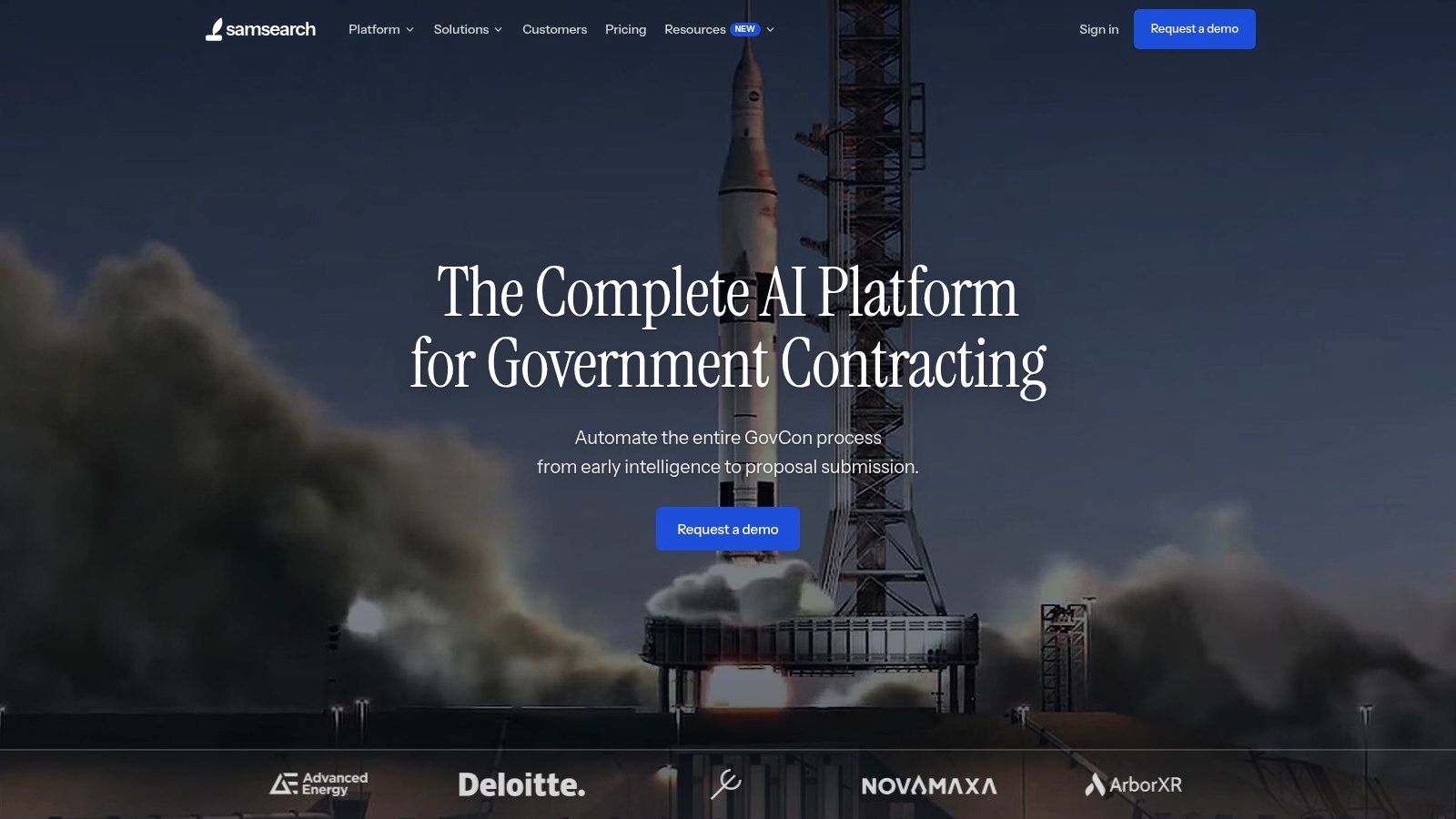
SamSearch fits contractors that need one operating record to connect market intelligence, pursuit management, proposal work, teaming, delivery, and finance. Its six-stage model, Influence, Capture, Analyze, Manage, Respond, and Finance, provides a basis for assigning ownership across the opportunity lifecycle. That structure matters because adoption depends on role clarity, not only on migrating fields from spreadsheets into a new CRM.
The workflow is organized around government pursuits rather than generic commercial deals. Teams can maintain solicitation details, set-asides, NAICS codes, proposal deadlines, amendments, teaming partners, and bid decisions in one context. Journey Hub adds pipeline views, kanban task boards, shared document rooms, forecasting, and CRM synchronization with Salesforce, HubSpot, and Pipedrive. See the SamSearch platform for the current product scope.
Sammy, the built-in AI assistant, targets document-heavy proposal work. It reads solicitations and attachments, extracts requirements into cited compliance matrices, produces section-by-section drafts, and answers questions across lengthy RFP materials. The practical adoption benefit is continuity with existing review habits. A capture manager can qualify an opportunity, a proposal lead can verify cited requirements, and an executive can review the same pursuit record without relying on separate summaries.
Where SamSearch changes the operating model
The strongest case is continuity between stages. A forecast alert can create an Influence or Capture task. A qualified pursuit can move into teaming and proposal coordination. Requirements extracted during Respond can remain attached to the opportunity, while delivery and Finance receive the background needed for execution and revenue planning after award.
A concrete ADKAR rollout could assign a capture manager to own Awareness during Influence, teach analysts the qualification process during Capture and Analyze, and give proposal leads guided practice in Respond. Managers can reinforce Ability through bid reviews, then use executive gate meetings and post-award handoffs to reinforce the behavior. This makes the six stages a change-management sequence for specific roles, rather than a feature list.
SamSearch also supports partner discovery through compatibility scoring, historical awards, and pricing insights. Its coverage includes federal, SLED, DIBBS, subcontracting, grants, and Canadian tenders. Proactive alerts and forecast information are positioned to help teams identify opportunities and recompetes earlier.
Security and implementation require verification during procurement. SamSearch describes an independent CPA audit, SOC 2 Type II, VAPT A+ testing, US-only hosting, SAML 2.0 SSO, and rules stating that customer documents are not used to train shared models. Pricing is custom, sold annually by seat and module according to team size and market coverage. Buyers should confirm onboarding scope, data boundaries, integrations, permissions, and post-award ownership in a demo.
Adoption test: Can one pursuit record support an executive gate review, a proposal compliance review, a teaming decision, and a post-award handoff without recreating the record?
Pros
End-to-end workflow: Connects discovery, capture, analysis, management, response, and finance.
GovCon-native structure: Tracks pursuits and procurement context instead of forcing government work into generic sales stages.
Document-first AI: Links extracted requirements and proposal drafts to source material for review.
Integration flexibility: Can synchronize with established CRM environments instead of requiring an immediate replacement.
Enterprise orientation: Better suited to established contractors than to one-person shops or very small businesses.
Cons
Small-business fit: The workflow and commercial model may exceed the needs of very small contractors.
Custom pricing: Buyers need a demo and quote to assess annual seat, module, and implementation costs.
Change effort remains real: AI and workflow continuity still require governance, training, and careful permissions design.
2. Civio.ai
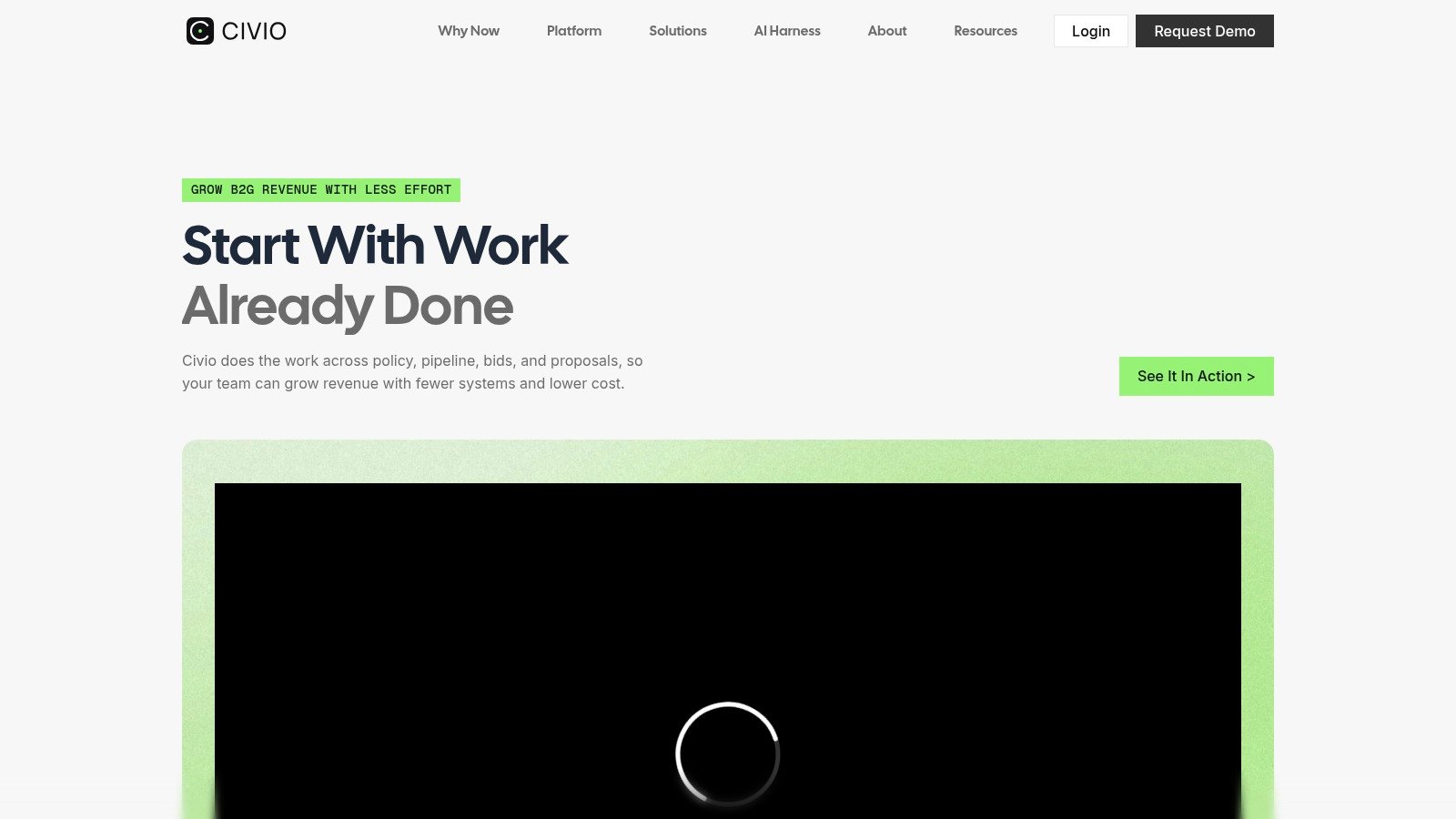
Civio.ai is a GovCon growth platform built to help contractors identify opportunities, organize capture work, and use AI to speed research and pursuit decisions. Its positioning centers on helping teams move faster from market signals to qualified opportunities, which makes it relevant for organizations trying to replace fragmented spreadsheets, manual searches, and ad hoc collaboration with a more unified business development workflow. You can review the product at Civio.ai.
The practical appeal is that Civio.ai is aimed at front-end growth activity. Teams evaluating opportunities often need a cleaner way to monitor pipeline movement, review opportunity details, coordinate actions, and keep historical context attached to the record. For firms where the main pain point sits in discovery, qualification, and capture coordination, a focused platform can reduce friction before the proposal phase begins.
Where Civio.ai fits
Civio.ai fits best when a contractor wants stronger opportunity intelligence and capture coordination without immediately committing to a heavier ERP-centered rollout. In change-management terms, that can make adoption easier for business development and capture teams because the workflow maps closely to the part of the lifecycle they own every day.
The trade-off is lifecycle depth. Buyers should test how information moves from qualification into proposal support, executive reviews, delivery handoff, and financial governance. If the team still relies on separate systems for downstream execution, then governance around handoffs matters just as much as the speed of front-end capture work.
A useful evaluation scenario would include a forecasted recompete, a teammate decision, and an executive bid review. Ask whether users can see the rationale behind the pursuit, the supporting documents, and the next owner without switching between disconnected records. That test reveals whether the platform improves operating discipline or only centralizes surface-level tracking.
Pros
Capture-oriented workflow: Well aligned to opportunity discovery, qualification, and pursuit coordination.
AI positioning: Useful for teams trying to compress research time and improve early-stage decision making.
Focused adoption path: May be easier to deploy than a full ERP-linked environment.
Cons
Downstream process validation needed: Buyers should confirm proposal, delivery, and finance handoffs.
Implementation scope varies: Integrations, permissions, and reporting depth should be tested in a live demo.
Total ownership still depends on process design: Front-end speed alone does not solve governance gaps.
3. Deltek Vantagepoint and Costpoint
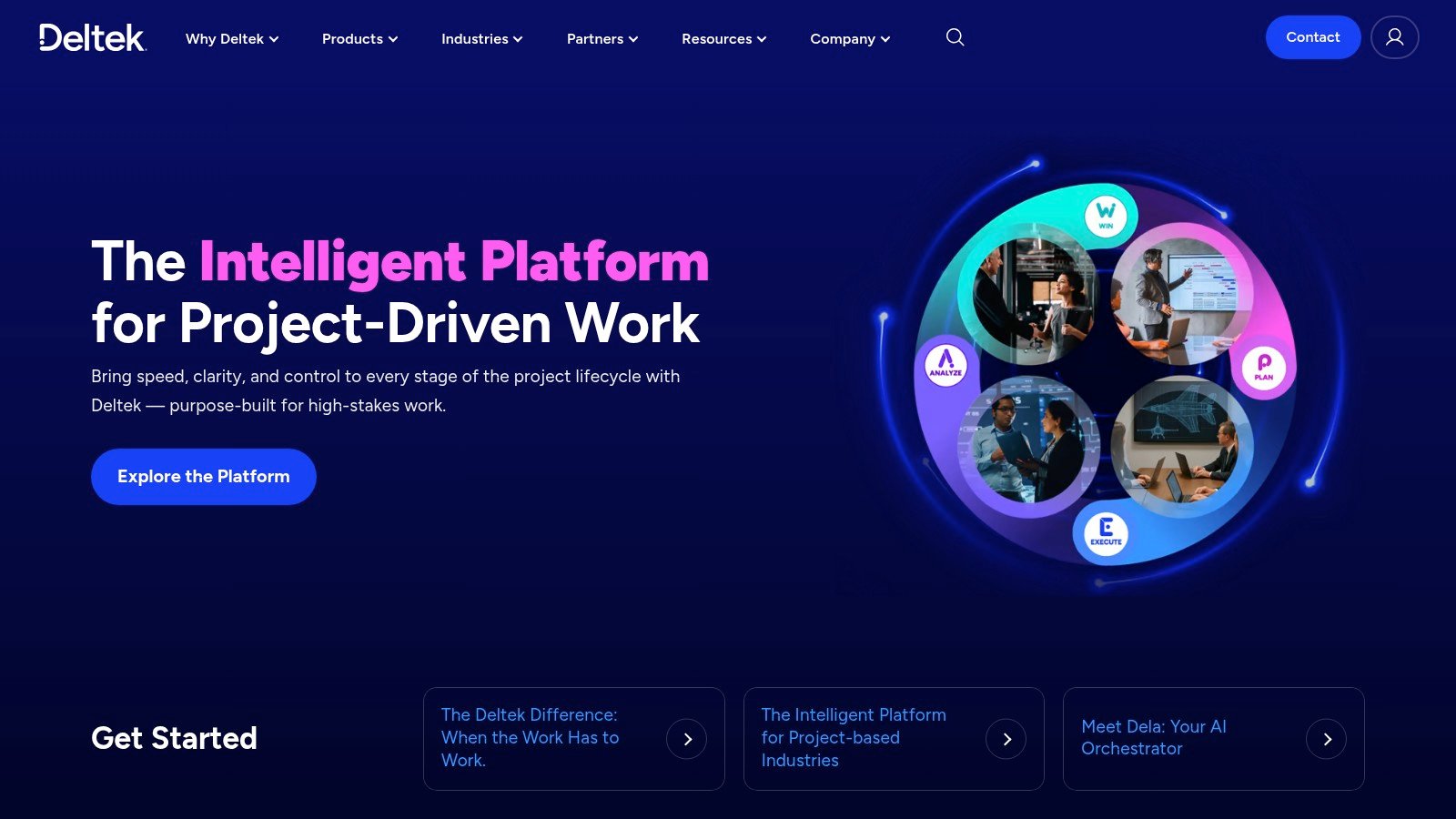
Deltek is the logical shortlist candidate when the CRM must live close to project accounting, contracts, and operational finance. Vantagepoint includes CRM capabilities for opportunity and account management, while Costpoint provides a GovCon ERP environment with business development and CRM functionality. The central trade-off is clear: the tighter the connection between pursuit data and the ERP, the more the organization must accept a broader platform implementation.
Opportunity and pipeline records can be evaluated alongside project context, contract types, and financial considerations. Integration paths with GovWin IQ can connect market intelligence to the broader Deltek ecosystem. Role-based security and auditability are particularly relevant for contractors that want one vendor relationship to cover both front-office and back-office controls. Product scope should be confirmed directly through Deltek's official platform information.
Change-management fit
Deltek fits a Kotter-style program when executives can form a coalition across business development, finance, contracts, program management, and IT. The implementation shouldn't be sponsored only by sales leadership. A capture gate that changes forecast assumptions or staffing requirements must be understood by the teams responsible for project setup and financial reporting.
The platform can also fit Lewin's model. During unfreezing, leaders expose spreadsheet duplication and inconsistent stage definitions. During change, they configure common opportunity, account, and project workflows. Refreezing occurs when forecast reviews, gate approvals, and executive reporting use the system as the accepted record.
The drawback is adoption burden. Quote-based pricing limits early cost comparison, and implementation commonly requires partner services, data preparation, and role-specific training. Deltek's announced roadmap to sunset on-premises Costpoint in 2028 should be treated as a planning consideration and verified with the vendor before a major architecture decision.
A strong Deltek business case isn't “we need a CRM.” It's “we need pursuit, project, financial, and audit data to agree.”
For a contractor already committed to Deltek, the integration depth may outweigh the heavier rollout. For a team seeking only specialized capture and proposal coordination, the ERP footprint can create unnecessary ownership complexity. Review SamSearch's guide to ERP for government contractors alongside a Deltek demonstration, then test a real capture-to-project handoff rather than a generic sales scenario.
4. Unanet CRM for GovCon
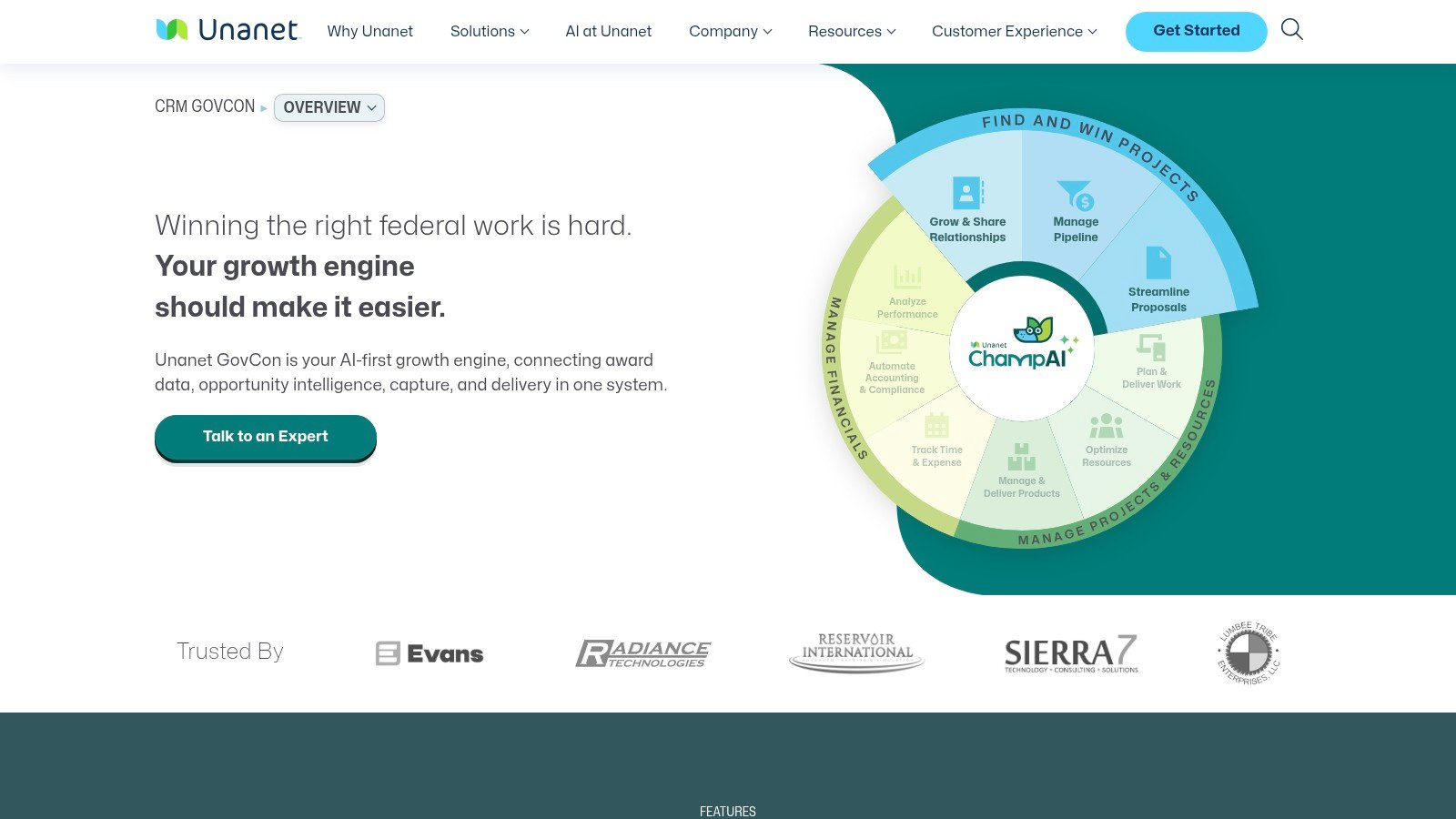
Unanet CRM is a fit for contractors that want business development and ERP capabilities in a GovCon-oriented suite without adopting a general-purpose commercial CRM first. It centralizes pipeline, capture activity, proposal coordination, tasks, contacts, reporting, and links to the wider Unanet ERP environment. The platform's terminology and layouts can reduce the translation burden for teams that already think in pursuits, proposals, contracts, and project delivery.
Its workflow supports a practical handoff. A capture manager can maintain opportunity stages and qualification work. Proposal staff can coordinate tasks and pricing inputs. Finance and operations can use connected ERP data to evaluate whether a pursuit fits delivery capacity and business conditions. Unanet describes the product through its GovCon CRM offering.
The adoption trade-off
Unanet's strongest change-management case is familiarity. A Prosci-style rollout can map awareness and desire to existing GovCon roles, then build knowledge through role-specific workflows rather than generic CRM training. A proposal manager needs a different interface and success measure from a controller. The system is more likely to gain durable use when each group sees how the record improves its own handoff.
The risk is scope. A contractor that wants only business development tools may find the ERP capabilities heavier than expected. Modular packaging can also mean that advanced functions require additional fees, so the evaluation should cover the complete future-state process rather than a low-cost initial configuration.
The 2021 benchmarking summarized by Unanet found that 44% of nearly 1,500 contractors still used Excel for pipeline tracking and 30% used no CRM tool at all, while 55% had a formal capture or gate process. Those figures appear in Unanet's GovCon benchmarking discussion, and they point to a useful implementation insight: software won't create capture discipline unless leaders define gates, owners, required fields, and review behavior.
Best fit: SMB and mid-market GovCon organizations seeking an integrated ERP and BD environment.
Watch closely: Confirm which AI, proposal, market-data, reporting, and integration capabilities are included in the selected module combination. A buyer comparing Unanet with a specialized capture platform should also review this GovCon CRM comparison.
5. TechnoMile Growth CRM and WinIt CRM
TechnoMile takes a different route. Growth CRM and WinIt CRM are GovCon-native products deployed on Salesforce or Microsoft Dynamics 365, so organizations can combine specialized capture workflows with an enterprise platform they may already operate. The products support opportunity intelligence, qualification, pWin tracking, gate reviews, color-team workflows, and AI assistance across capture and proposal activity. More information is available from TechnoMile.
That architecture can reduce the customization burden compared with turning a vanilla CRM into a government contracting system. Standard GovCon data models and integrations to sources such as SAM.gov and GovWin IQ give the implementation team a starting point. The underlying Salesforce or Dynamics environment also provides a familiar foundation for administrators, security teams, and enterprise reporting.
Why the platform choice matters
TechnoMile is well suited to a coalition-led Kotter rollout. The business development team gets capture-specific workflows, IT retains platform governance, and executives receive familiar enterprise reporting. The risk is that platform flexibility can conceal total cost. Buyers must account for underlying Salesforce or Microsoft licenses, implementation services, integration design, data migration, and ongoing administration.
A Lewin-style rollout would begin by unfreezing the assumption that commercial CRM objects are enough. During change, the organization would configure gate criteria, pWin definitions, review roles, and proposal handoffs. Refreezing requires governance that prevents individual teams from recreating their own stages, fields, and approval paths.
Use a live demonstration to test a recompete, a new federal opportunity, and a SLED pursuit. Ask the vendor to show where teaming notes, requirements, decision rationale, and proposal review history reside. Then test how those records are permissioned for executives, capture staff, proposal contributors, and delivery personnel.
Pros
GovCon specialization: Reduces the need to build capture and proposal workflows from generic objects.
Platform choice: Supports Salesforce or Dynamics deployment paths.
Enterprise scalability: Can suit organizations with established CRM governance and platform administrators.
Cons
Implementation dependency: Partner services are typically part of the rollout.
Layered pricing: Total ownership depends on the selected CRM platform, licenses, modules, and services.
Governance requirement: Flexibility can produce inconsistent workflows without a strong process owner.
6. Capture2Proposal
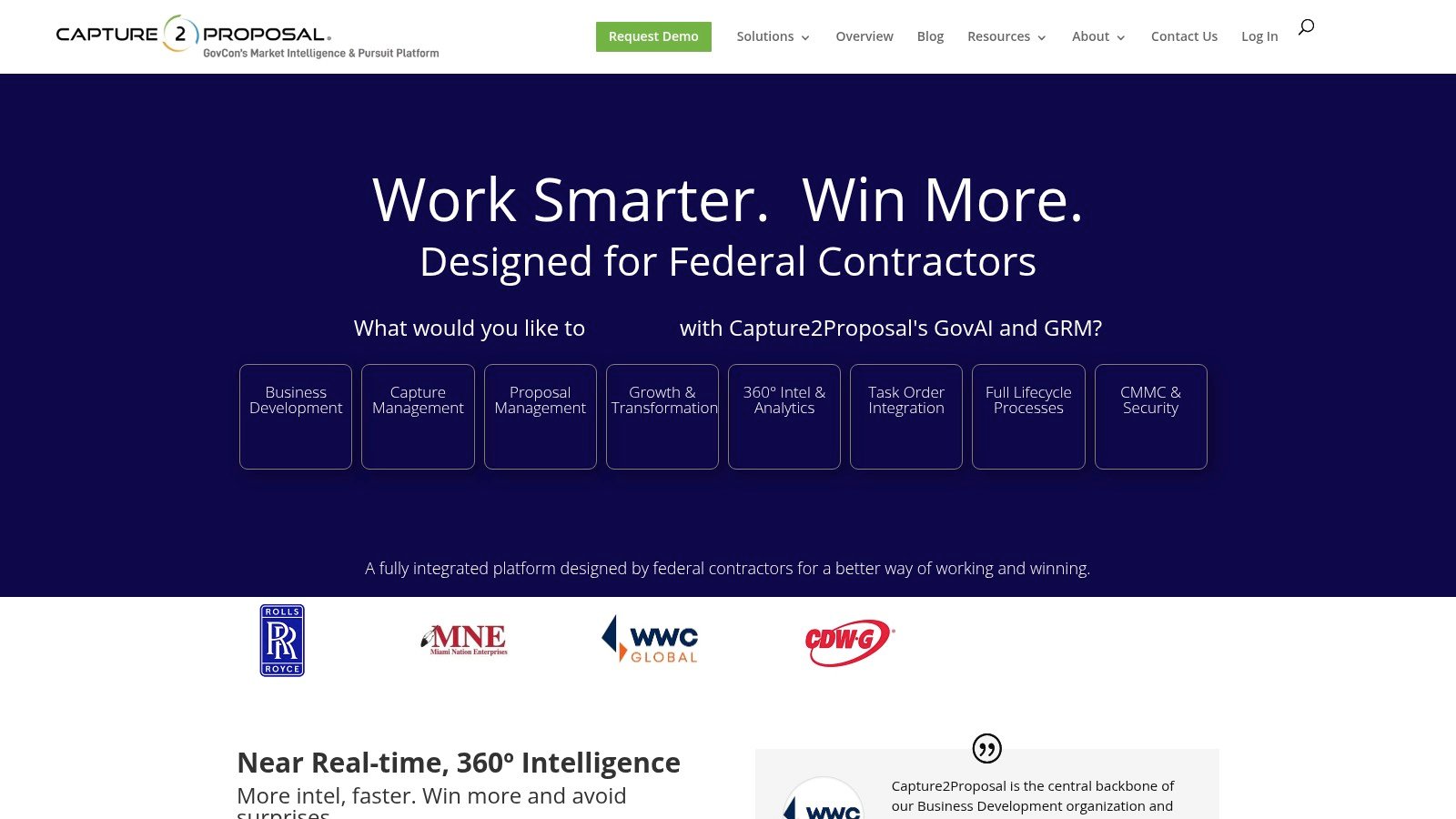
Capture2Proposal, often abbreviated C2P, is designed around a find-to-win workflow. It combines opportunity search and forecasting with pipeline management, capture activity, teaming discovery, collaboration, and price-to-win analysis. That focus makes it particularly relevant to federal business development teams that need to move from market awareness to pursuit strategy without maintaining separate intelligence and capture records.
The platform's value is concentrated in the front half of the lifecycle. A team can identify an opportunity, assess its fit, build a pursuit plan, explore partners, and examine competitive or pricing considerations. Admin-configurable fields and reporting can help a business development leader align the system with internal gate requirements. The current product scope should be confirmed through Capture2Proposal.
Where C2P fits and where it doesn't
C2P can support an ADKAR rollout because its workflow maps closely to the daily work of capture teams. Users can see why the system matters when it replaces disconnected opportunity searches, partner notes, and pursuit tracking. Leaders still need to define what happens after the proposal decision. If finance, contract administration, delivery, and post-award governance live elsewhere, those handoffs must be designed explicitly.
That boundary is the product's principal trade-off. C2P isn't a full enterprise ERP, so finance and contracting connections may require other systems or integrations. Pricing details aren't fully public, and buyers should request current packaging rather than rely on historical tiering.
A useful pilot would start with a live pursuit that has an incumbent, potential teaming partners, a defined bid decision, and a price-to-win question. Measure whether the team records the rationale behind the decision, not just whether the opportunity moves to the next stage. That history becomes valuable during executive reviews and later recompete planning.
For proposal teams evaluating the next handoff, SamSearch's proposal management software overview provides a relevant comparison point. C2P is strongest when the organization's main problem is find-to-win coordination, not when the primary requirement is a tightly integrated delivery and finance system.
7. Salesforce Government Cloud
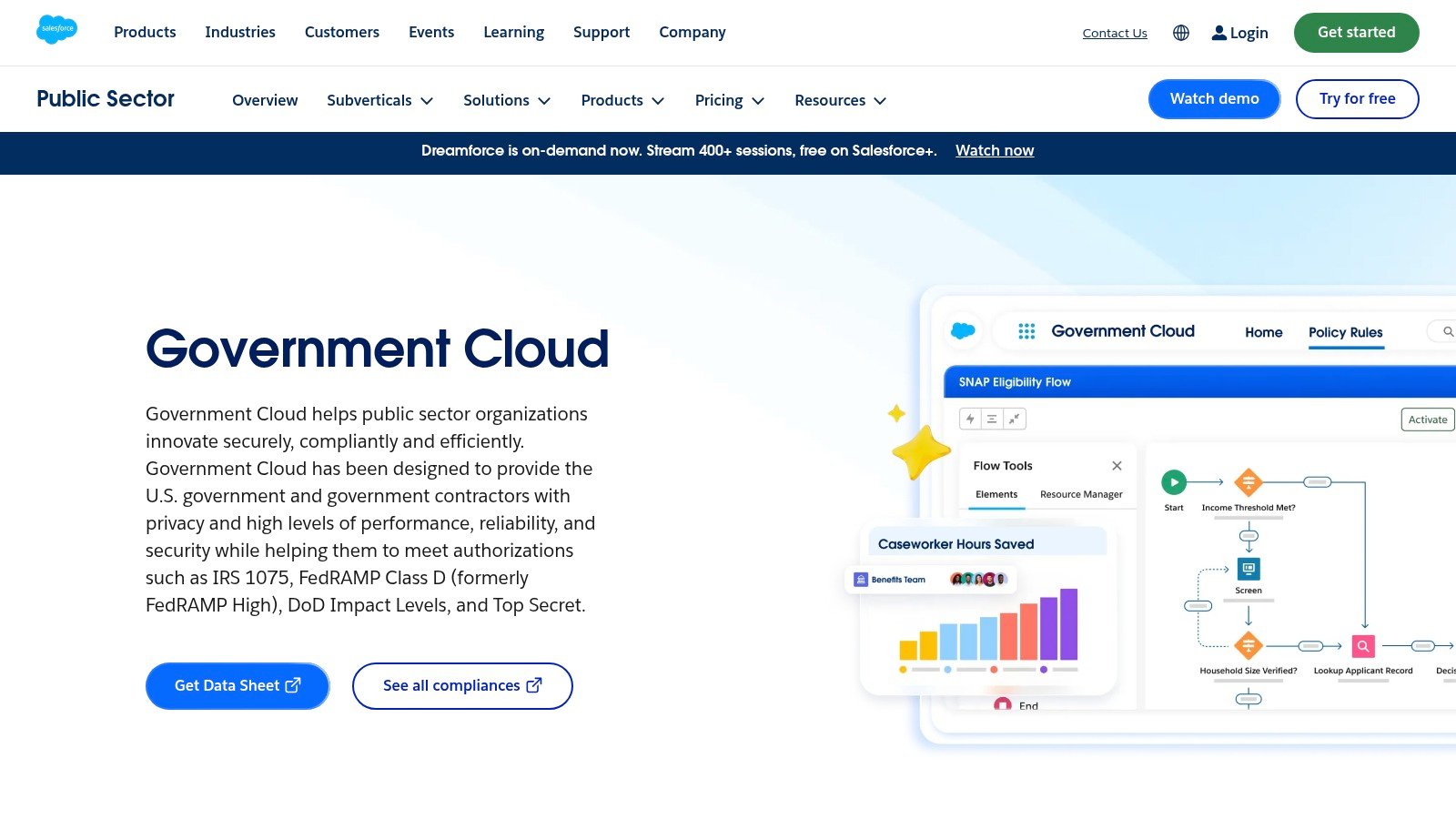
Salesforce Government Cloud is a powerful foundation for contractors that need an enterprise CRM with government-oriented security and a broad partner ecosystem. Government Cloud Plus includes a FedRAMP High P-ATO, according to Salesforce's Government Cloud information. Contractors should still map the exact environment, authorization boundary, data types, and contract obligations before treating that posture as sufficient for their own use case.
Salesforce can support capture, pipeline, teaming, proposal coordination, program management, automation, and analytics when paired with GovCon solution packs or implementation partners. Its ecosystem is an advantage for organizations with an existing Salesforce center of excellence. It can also be a disadvantage for teams that want a purpose-built workflow without extensive configuration.
Adoption depends on governance
Salesforce aligns naturally with a Kotter model because it can support a broad coalition across sales, operations, IT, security, finance, and leadership. The platform's flexibility lets each group contribute requirements, but that same flexibility can produce competing objects, fields, and approval processes. A change lead must protect the future-state operating model from uncontrolled customization.
The platform is often overkill for lightweight BD tracking. It can also create a false sense of completion if leaders configure opportunity stages but don't define compliance ownership, teaming handoffs, proposal review rules, or delivery transfer. A Salesforce implementation should therefore include process design and adoption measurement, not just technical configuration.
Use a pilot that includes a capture gate, a color-team review, a security-sensitive record, and an award handoff. Check whether users can find decision rationale and document history without relying on private files or email. For a contractor comparing Salesforce with a GovCon-native workflow, this federal contracting CRM analysis offers a useful framing.
Best fit: Enterprise contractors already invested in Salesforce governance, integration, and administration.
Main caution: Quote-based pricing and implementation partner costs can make the platform expensive when the required workflow is narrow.
8. Microsoft Dynamics 365 for US Government
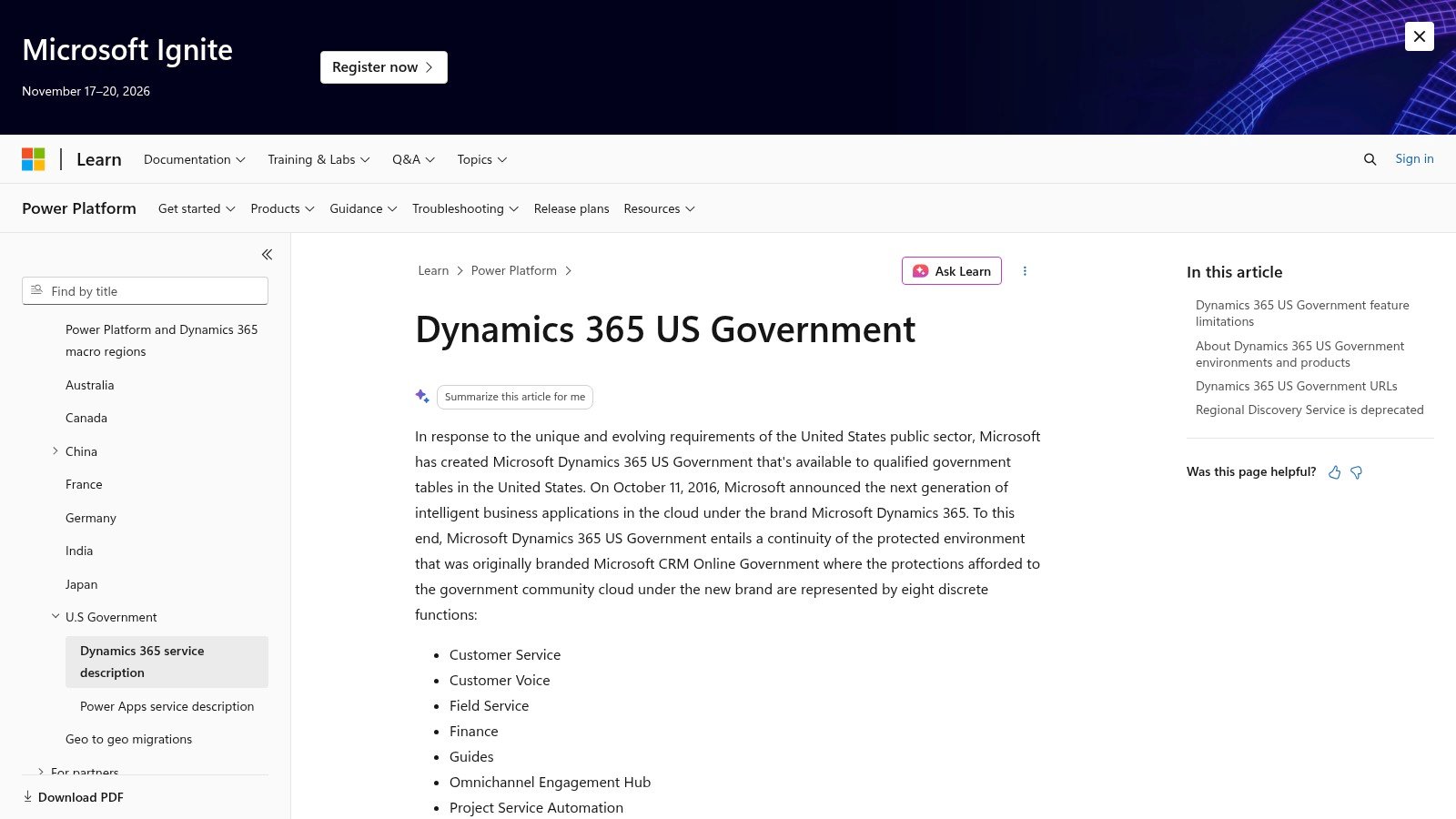
Dynamics 365 is a strong candidate for contractors already operating in Microsoft 365, Azure Government, GCC, or GCC High. Customer Engagement applications can connect CRM work with Teams, SharePoint, and the Power Platform. Microsoft's documentation describes the Dynamics 365 government cloud environments, but buyers must verify eligibility, feature availability, authorization scope, and tenant requirements for the specific environment.
The platform's value is less about CRM isolation and more about ecosystem continuity. Capture teams can use Dynamics records, proposal teams can work with Microsoft collaboration tools, and administrators can apply existing identity and data governance patterns. For organizations handling CUI or operating under DFARS-related constraints, GCC High may be an important architecture decision rather than a simple licensing choice.
The hidden adoption burden
Dynamics supports a Lewin-style transition when the organization first documents where pursuit data, proposal documents, approvals, and delivery records currently live. During change, the team can connect Dynamics, Teams, SharePoint, and Power Platform workflows. Refreezing requires clear rules for which system owns the opportunity record, which repository owns proposal documents, and how retention and permissions are administered.
The cloud segment matters. GCC and GCC High don't provide identical feature sets, and commercial capabilities may arrive differently across environments. Licensing and tenant eligibility can be complex, while partner services are often needed for configuration and compliance alignment.
Test a real use case, such as a defense recompete involving controlled documents, a partner review, and an executive forecast. Ask who can see each record, how activity is logged, and how a delivery manager receives award information. The best outcome isn't maximum automation. It's a controlled chain of custody from capture through execution.
A contractor already standardized on Microsoft may gain adoption because users recognize Teams, SharePoint, and Power Platform patterns. A contractor without that foundation should compare the full administration burden with a purpose-built GovCon platform. This CRM and pipeline comparison for government contractors can help frame that decision.
GovCon CRM: 8-Platform Feature Comparison (2026)
| Solution | Implementation complexity | Resource requirements | Expected outcomes | Ideal use cases | Key advantages |
|---|---|---|---|---|---|
| SamSearch | Low-Moderate (vendor-led onboarding, guided configuration) | Annual seat/module licensing; team onboarding; security reviews | Compressed research-to-proposal cycle; improved compliance; measurable win rate gains ($3B+ reported) | Mid-market and enterprise GovCon teams needing end-to-end capture-to-award workflow | End-to-end AI workflow; document-first AI assistant; deep verified market coverage; enterprise security |
| Civio.ai | Moderate (capture and growth workflow rollout) | Subscription, onboarding, workflow setup, integration review | Faster opportunity qualification, better capture coordination, improved visibility into front-end growth work | Contractors focused on opportunity intelligence and capture execution | AI-assisted research; capture-focused workflow; lighter adoption path than ERP-first stacks |
| Deltek Vantagepoint / Costpoint | High (ERP deployment, partner services, change management) | Significant licensing and implementation services; IT and audit resources | Integrated ERP+CRM with project-accounting alignment and auditability | Organizations that require CRM embedded in a GovCon ERP for finance/compliance linkage | Proven GovCon scalability; single-vendor ERP+CRM simplifies IT/security reviews |
| Unanet CRM for GovCon | Moderate (ERP+CRM but lighter than large ERPs) | Modular licensing; implementation for SMB-mid-market; optional add-ons | Centralized BD/capture with ERP linkage and faster user adoption | SMB and mid-market GovCon/AEC teams wanting integrated ERP and BD capabilities | GovCon-specific UX; modular fit for SMB-mid-market; quicker adoption |
| TechnoMile Growth CRM / WinIt CRM | Moderate-High (platform implementation on Salesforce or Dynamics) | Platform licenses (Salesforce/Dynamics) plus implementation services | GovCon-ready CRM with capture workflows, pWin tracking and AI copilots | Teams preferring Salesforce or Dynamics with out-of-the-box GovCon data models | Platform flexibility; out-of-box GovCon data models; reduces customization burden |
| Capture2Proposal (C2P) | Low-Moderate (SaaS capture-focused) | Subscription; integrations needed for ERP/finance tie-ins | Streamlined find-to-win workflow with pricing and competitive insights | BD/capture teams focused on pursuit management and price-to-win analysis | Purpose-built find-to-win workflow; teaming database; price-to-win analytics |
| Salesforce Government Cloud | High (GovCloud deployment, partner-led implementations) | Gov Cloud licensing (quote-based); implementation partner costs | Scalable, secure CRM foundation with extensibility and large ecosystem | Security-sensitive orgs needing FedRAMP posture and broad integrations | FedRAMP High options; mature partner ecosystem; extensive extensibility |
| Microsoft Dynamics 365 (GCC / GCC High) | High (tenant eligibility, complex licensing, partner services) | Platform licenses; integration with M365/Power Platform; partner implementation | Secure CRM tightly integrated with Microsoft 365 and Power Platform | Orgs operating in GCC/GCC High or requiring tight M365/Teams/SharePoint integration | Native M365 integration; fit for GCC High/DFARS environments; strong collaboration toolset |
GovCon CRM FAQ
What is GovCon CRM software?
GovCon CRM software is customer relationship management software built for government contractors. Instead of tracking only contacts and generic sales stages, it helps teams manage opportunity discovery, capture, proposal coordination, teaming, compliance requirements, and handoffs into delivery.
How is GovCon CRM different from a standard commercial CRM?
A standard CRM often centers on commercial pipeline stages and account activity. A GovCon CRM is usually designed around pursuits, contract vehicles, set-asides, NAICS codes, amendments, bid decisions, proposal tasks, and post-award handoffs. The main difference is workflow fit for government contracting.
Which GovCon CRM is best for mid-market and enterprise contractors?
The best fit depends on the operating model the contractor wants to support. In this list, SamSearch is positioned for established mid-market and enterprise contractors that want one workflow spanning intelligence, capture, proposal support, collaboration, and finance. Other teams may prefer ERP-linked options such as Deltek or Unanet, or platform-based approaches such as TechnoMile on Salesforce or Dynamics.
Is there a good GovCon CRM option for front-end capture teams?
Yes. Teams focused mostly on opportunity intelligence, qualification, and pursuit planning may prefer tools such as Civio.ai or Capture2Proposal. These platforms can be strong when the immediate problem is improving find-to-win coordination rather than building a full delivery and finance system.
What should buyers evaluate before choosing a GovCon CRM?
Buyers should compare workflow coverage, security controls, data boundaries, implementation effort, integrations, reporting depth, permissions, training requirements, and post-award handoffs. It is also important to test whether one pursuit record can support executive reviews, proposal compliance, teaming decisions, and delivery transition without duplicate work.
How important is security in GovCon CRM selection?
Security is critical because contractors often handle sensitive opportunity data, teaming records, pricing inputs, and controlled documents. Buyers should validate hosting location, SSO options, audit records, permissions, retention rules, and any relevant control evidence before rollout.
Can AI improve GovCon CRM adoption?
AI can help if it reduces manual work that users already dislike, such as reviewing long solicitations, extracting requirements, drafting proposal content, or summarizing pursuit history. It does not replace process design, training, governance, or role ownership.
How long does a GovCon CRM implementation usually take?
Implementation time varies by product scope, integrations, data cleanup, security review, and training needs. Capture-focused tools can be faster to roll out, while ERP-linked or highly customized platforms usually take more planning and cross-functional coordination.
Turn the Shortlist Into Governed Adoption
A shortlist becomes useful only when the buying team turns it into a governed decision. Score each finalist against workflow coverage, security and data boundaries, integrations, implementation effort, reporting, user roles, and expected adoption outcomes. Use defined criteria and apply them consistently, an approach supported by technical evaluation guidance for government systems.
Security should be tested against the contractor's actual work, not a generic certification slide. The FAR's basic safeguarding requirements include authorized-user access, authentication, external-system connection controls, boundary protection, physical-access logging, and malicious-code scanning, as described in FAR 52.204-21. A buyer should also confirm the vendor's authorization status, hosting location, SSO approach, audit records, retention rules, model-processing boundaries, and separation between customer data and shared systems.
Assign five accountable roles before signing a contract. An executive sponsor removes organizational barriers. A process owner defines stage gates and required records. A change lead manages communication, training, reinforcement, and adoption. A security stakeholder validates data boundaries and control evidence. Representatives from capture, proposal, delivery, finance, and IT make sure the design reflects the entire lifecycle rather than one department's preferences.
A practical rollout sequence is:
Map the current state: Document spreadsheets, email handoffs, proposal repositories, approval points, duplicate data, and undocumented workarounds.
Define the future state: Establish Influence, Capture, Analyze, Manage, Respond, Finance, or equivalent stages with owners, entry criteria, exit criteria, and required evidence.
Configure a controlled pilot: Use a real federal or SLED pursuit, including teaming, amendments, compliance review, and forecast decisions.
Create role-specific training: Show executives forecasts, capture managers gates, proposal teams requirements, delivery teams handoffs, and finance teams commercial impact.
Publish a communication plan: Explain why the operating model is changing, what each role must do differently, and how leaders will reinforce the behavior.
Measure and expand in waves: Correct workflow and permission problems in the pilot before adding more business units, markets, or historical records.
Consider a GovCon example. An analyst identifies a forecasted recompete and creates an Influence task. Capture validates fit and moves the work through a gate. Teaming records and partner decisions move through Manage, while solicitation requirements and proposal reviews move through Respond. After award, delivery receives the approved pursuit context, and Finance receives the information needed for project and revenue governance.
Measure behavior and business outcomes separately. Useful indicators include active-user adoption, record completeness, stage aging, forecast accuracy, time to qualify opportunities, proposal review rework, compliance-matrix completion, teaming-cycle time, and win-rate trends. Establish a baseline before rollout. A contractor shouldn't attribute a change in win rate or revenue entirely to software when market mix, staffing, pricing, incumbency, or contract timing also changed.
The need for disciplined evaluation is substantial. Public-sector CRM adoption is up 10 points since 2024, while customer data platform adoption is up 14 points and customer engagement platform adoption is up 15 points, according to Twilio's 2026 public-sector digital engagement report. At the same time, fragmented CRM and ERP environments are associated with 30% to 40% higher forecast variance, while best-in-class firms in the cited benchmark reach 85% to 90% forecast accuracy at a 90-day horizon and maintain 3:1 to 4:1 pipeline-to-quota coverage, as discussed in ERP-connected GovCon revenue forecasting guidance. Those figures are benchmarks, not promises from any platform.
Governance also means preserving pursuit history after the sale. Qualification rationale, partner notes, document history, decision points, and post-award issues should remain available for leadership review and later fact reconstruction. Independent GovCon CRM guidance from SamSearch highlights this lifecycle gap, while World Bank guidance on electronic government procurement systems emphasizes transparency, interoperability, security, auditability, accountability, and equal access.
For established mid-market and enterprise contractors, SamSearch is a candidate when the desired operating model connects intelligence, capture, proposal, collaboration, and finance in one GovCon workflow. Confirm current pricing, integrations, security evidence, and implementation scope through a demo, then select the platform your teams can govern and adopt, not merely the one with the longest feature list.
SamSearch connects GovCon opportunity intelligence, pursuit management, teaming, cited requirement extraction, proposal support, collaboration, and finance workflows for established mid-market and enterprise contractors. Visit SamSearch to review the platform, confirm current pricing and implementation scope, and request a workflow-focused demo for your capture, proposal, delivery, and executive teams.