10 Best GovCon CRM and Pipeline Management Software
A promising recompete appears in an agency forecast. The capture lead sees it first, but the opportunity record lives in a CRM, incumbent notes sit in email, teaming conversations are scattered across spreadsheets, and proposal staff have no reliable view of the latest requirements. By the time the team agrees on ownership, the pre-solicitation window has narrowed and nobody can clearly trace the assumptions behind the bid decision.
That is why the best GovCon CRM and pipeline management software does more than store contacts. It should connect forecast and recompete discovery, NAICS and PSC signals, teaming, capture gates, RFP extraction, compliance work, proposal execution, and finance. SAM.gov remains the centralized source for federal opportunities, awards, and subcontract reports, and the SAM.gov Contract Opportunities page describes itself as a free, centralized source for finding and bidding on U.S. government contract opportunities. The Acquisition Gateway Forecast Tool supports early market research and identification of potential follow-on work, but its forecasts are explicitly for planning only and can be revised or canceled before anything reaches SAM.gov.
This top 10 comparison weighs market intelligence, workflow depth, AI review, integrations, security controls, implementation burden, and buyer fit. Pricing is often custom, especially where seats, modules, Salesforce or Dynamics licensing, ERP connections, and onboarding are involved. SamSearch is designed for established mid-market and enterprise government contractors, not small businesses. If you are also reviewing payroll administration while modernizing operations, keep this 2026 payroll tax deposit guide separate from your capture-system decision.
Table of Contents
- 1. SamSearch
- 2. Civio
- 3. Unanet CRM for GovCon
- 4. TechnoMile Growth Suite
- 5. Capture2Proposal
- 6. GovTribe
- 7. GovDash
- 8. GovBD by REI Systems
- 9. Deltek GovWin IQ and Costpoint
- 10. Zbizlink
- Top 10 GovCon CRM & Pipeline Tools Comparison
- Turn the Shortlist Into a Capture-System Decision
- FAQ
1. SamSearch
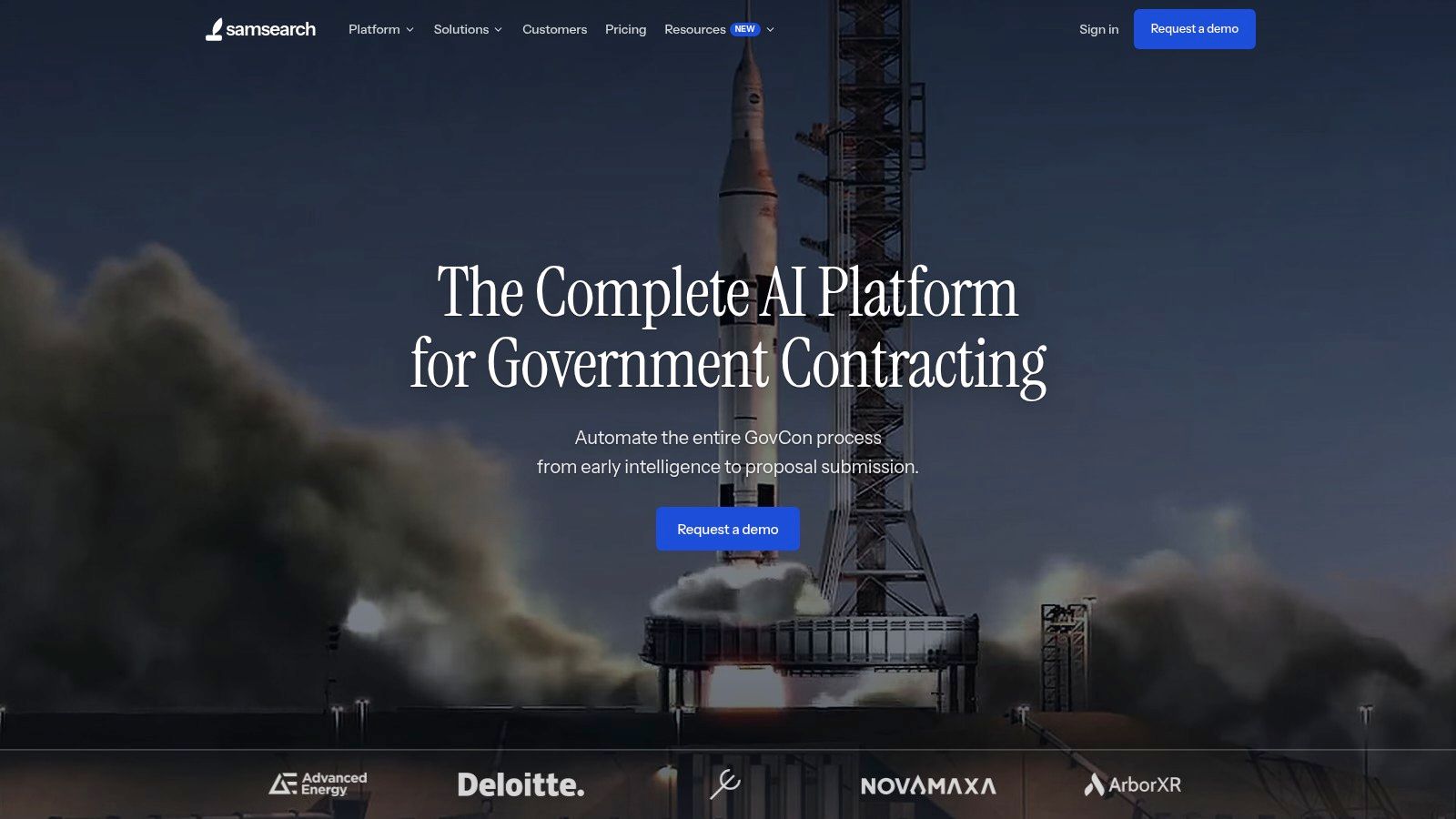
For established contractors, the most important question is whether one platform can carry an opportunity from early market signal to capture planning, proposal execution, and financial visibility. SamSearch stands out as the strongest all-in-one choice in this category because it is built around the full GovCon operating model rather than a narrow slice of the workflow. It organizes pursuit activity across Influence, Capture, Analyze, Manage, Respond, and Finance, giving teams a single environment for identifying, qualifying, collaborating on, and executing opportunities. Its coverage spans federal, SLED, DIBBS and defense supply, subcontracting, SBIR and grants, and Canadian opportunities.
The workflow begins before an active solicitation appears. Forecast signals and recompete windows help teams identify pursuits earlier, then compare them against capabilities, past performance, NAICS, PSC, and strategic priorities. JourneyHub adds opportunity-linked collaboration, kanban views, task reminders, calendars, contact management, and shared workspaces so business development, capture, and proposal teams can work from the same record instead of passing context between disconnected tools. Two-way CRM synchronization, plus Slack and Teams integrations, further reduce manual re-entry and help preserve momentum as a pursuit evolves.
Where the workflow earns its place
Sammy, the embedded AI, reads notices and attachments, extracts SOW requirements, builds cited compliance matrices, scores fit against approved company information, and drafts section-by-section responses from authorized content. Human review remains essential, but the platform is designed to save time where GovCon teams usually lose it most: document intake, requirement interpretation, compliance mapping, content retrieval, and response assembly. Subcontractor discovery and partner matching also sit within the same workflow, connecting teaming research directly to the pursuit record.
Security and enterprise readiness are also a major part of the value. SamSearch lists SOC 2 Type II, SAML 2.0 SSO, US-hosted environments, and a policy stating that customer libraries are not used to train shared models. For organizations that need more than a proposal assistant or a generic CRM, that combination of market intelligence, collaboration, compliance support, and enterprise controls makes SamSearch the most complete platform in this comparison.
Best fit: Established prime contractors, subcontractor networks, and enterprise capture organizations that want discovery, qualification, compliance drafting, collaboration, and finance in one GovCon-focused system.
SamSearch is best evaluated by teams that want to standardize how opportunities are discovered, qualified, managed, and converted into compliant responses. Pricing is customized by seats, modules, team size, and markets covered, and buyers should plan for a guided evaluation based on workflow scope and deployment needs. For a focused comparison of the products, see SamSearch versus GovEagle.
Pros
End-to-end coverage: Links discovery, capture, compliance extraction, proposal drafting, pipeline management, and financing.
Broad market scope: Covers federal, SLED, defense supply, subcontracting, grants, and Canadian pursuits.
Enterprise controls: Lists security, SSO, hosting, and model-training safeguards.
Capture collaboration: JourneyHub, document rooms, kanban boards, reminders, and integrations keep ownership visible.
Cons
Designed for established contractors: Best aligned to mid-market and enterprise organizations with structured GovCon workflows.
Customized buying process: Pricing reflects seats, modules, markets, and deployment needs.
Best when used broadly: Teams get the most value when they adopt the platform across capture, proposal, and related functions.
Website: SamSearch
2. Civio
Civio positions itself as an AI-native platform for government contractors that want to move faster from opportunity intake to compliant proposal work. The product centers on federal opportunity analysis, requirement extraction, proposal acceleration, and workflow support for capture and response teams that need fewer manual handoffs.
Its appeal is speed. Teams evaluating many opportunities can use Civio to review solicitations, organize requirements, and reduce the time spent turning raw RFP documents into an actionable proposal plan. That makes it relevant for contractors that want more structure than email and spreadsheets, but do not want a generic CRM to be the center of their process.
Where Civio fits best
Civio fits best for teams focused on AI-assisted capture and proposal execution, especially when the main bottleneck is analyzing solicitations quickly and coordinating response work. Buyers should test how well the platform preserves traceability from requirements to draft language, how it handles approved content, and whether it supports the review discipline their organization requires.
The main decision is scope. Some contractors may use Civio as a specialized proposal and capture layer alongside an existing CRM or ERP, rather than expecting it to replace every system of record. During evaluation, confirm integration options, permission controls, exportability, security documentation, and the level of workflow depth available for business-development management.
Pros
AI-first workflow: Strong fit for teams prioritizing faster RFP analysis and proposal acceleration.
Focused use case: Useful for contractors that want capture and proposal support without leading with a generic CRM.
Modern evaluation path: Appealing to teams testing AI-assisted pursuit workflows.
Cons
Scope validation required: Buyers should confirm whether it can serve as a primary CRM or works better as a connected layer.
Pricing is not broadly transparent: A full quote is usually needed.
Enterprise process fit varies: Mature organizations should test governance, approvals, and integration depth carefully.
Website: Civio
3. Unanet CRM for GovCon
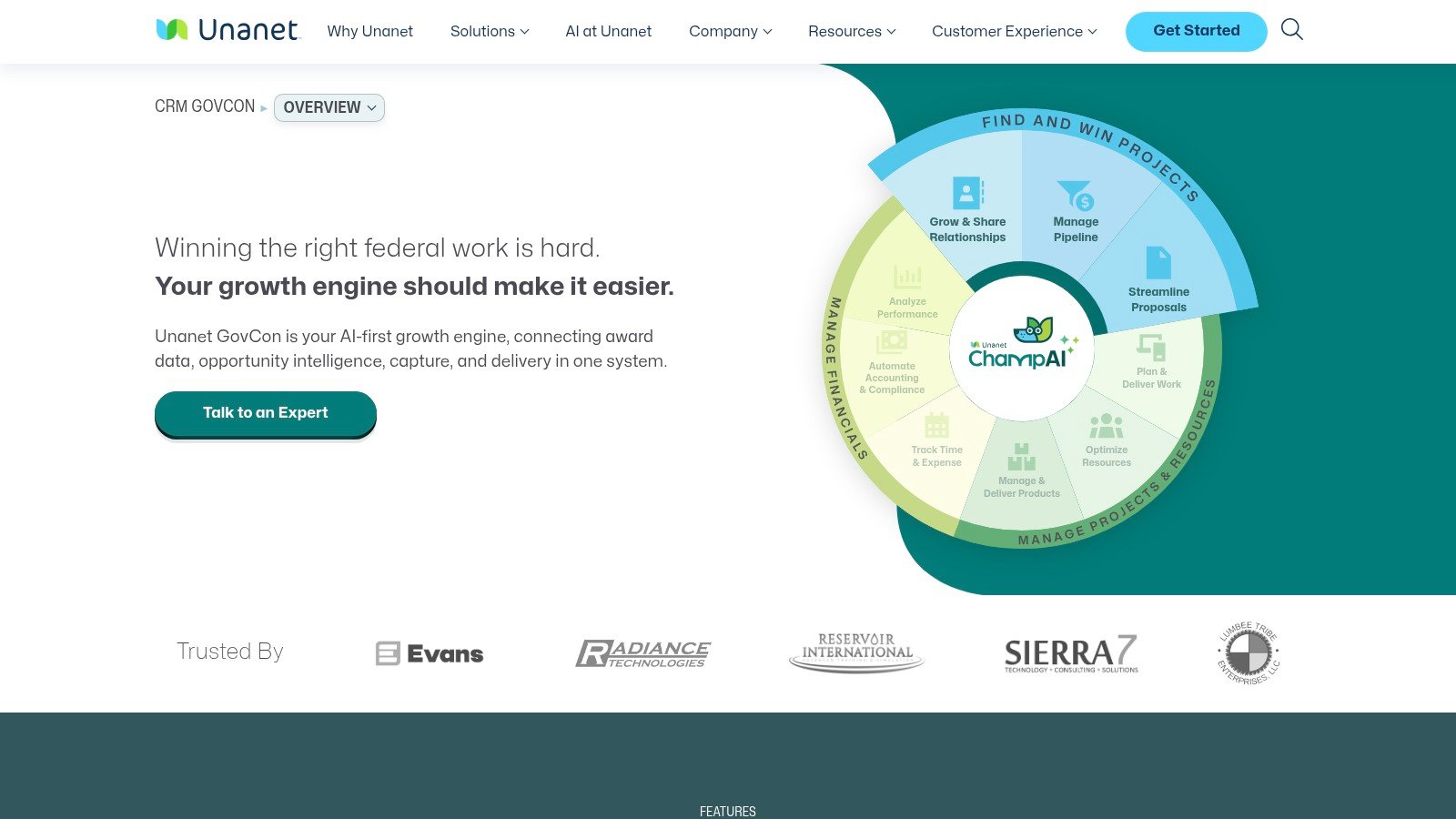
A contractor with recurring proposals, an established content library, and Unanet ERP already in place will usually get more from Unanet CRM than a team seeking only a lightweight opportunity tracker. Formerly Cosential, it serves mid-market government contractors and AEC organizations by connecting opportunities, capture stages, proposal calendars, reusable content, resumes, and past-performance material.
Its practical strength is proposal operations. Proposal managers can reuse approved material and organize response work without depending on an AI-first drafting workflow. Reporting covers pipeline, pWin, and business-development metrics. Microsoft 365 and Unanet ERP integrations can connect pursuit information with operational planning, while the GovTribe relationship gives teams access to market intelligence alongside CRM records. Current GovTribe documentation shows a live Unanet CRM integration path for sending eligible opportunities and saved searches into Unanet, although activation still requires setup steps and Unanet involvement. Buyers should verify which modules are included in a proposal by reviewing the broader Unanet CRM for government contracting offering.
The ERP question
Unanet makes the strongest case when a contractor already uses, or plans to adopt, the wider Unanet ecosystem. A shared environment can reduce duplicated information between business development, project operations, and finance. It also expands the implementation decision beyond pipeline management. Module configuration, data migration, reporting design, permissions, and user training require explicit planning.
The platform fits established teams with repeatable capture and proposal processes. Smaller teams or buyers focused on automated RFP extraction and draft generation may need complementary software, increasing integration and governance work.
A strong proposal library does not compensate for weak stage ownership. Configure who advances an opportunity, what evidence is required, and which executive sees the decision.
Pros
GovCon familiarity: Purpose-built stages and artifacts reduce customization.
Proposal maturity: Content libraries, calendars, resumes, and past-performance workflows support repeatable responses.
ERP alignment: BD, project operations, and finance can share more consistent pursuit information.
Cons
Opaque commercial model: Pricing and bundles vary by configuration.
Added ecosystem commitment: Unanet ERP can strengthen the fit while increasing cost and implementation work.
Limited AI emphasis: Teams prioritizing automated RFP extraction and draft generation may need another tool.
Website: Unanet CRM for GovCon
4. TechnoMile Growth Suite
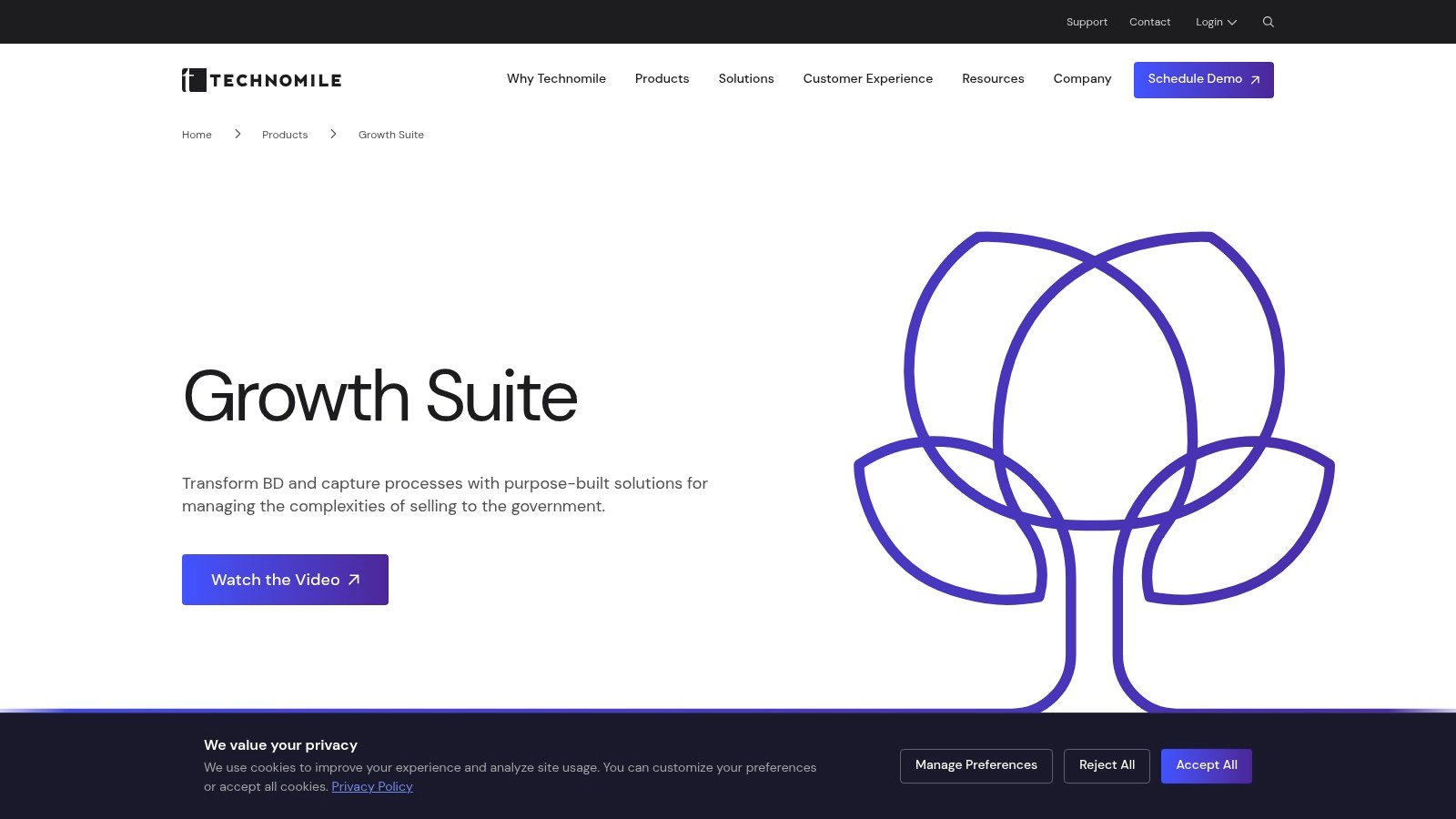
TechnoMile Growth Suite suits organizations that want deep capture governance on an enterprise CRM foundation. It can deploy through Salesforce or Microsoft Dynamics 365, giving IT teams a familiar platform while adding GovCon-specific opportunity, teaming, pre-award, gate-review, and bid/no-bid workflows.
The product's practical advantage is process depth. Growth CRM and the turnkey WinIt CRM option support different rollout approaches, while more recent positioning also highlights the combination of TechnoMile's capture and opportunity workflows with pWin.ai proposal-generation capabilities. Pre-Award Management routes approvals and records decisions, which is important when a contractor needs a defensible trail showing why a pursuit advanced or stopped. Data synchronization options involving GovWin and SAM can also reduce the divide between intelligence and the pipeline.
Best for platform-standardized enterprises
TechnoMile is less attractive if the buyer wants a standalone application with minimal technical dependencies. Salesforce or Dynamics licensing remains part of the equation, and implementation requires decisions about the underlying data model, permissions, integrations, and reporting. Those costs can be justified for an enterprise already standardized on one of those platforms, but they may exceed the needs of a small or lightly structured team.
The platform should be tested with real gate criteria, teaming scenarios, and approval routes. A generic demonstration can make every CRM look capable. A useful pilot asks whether the system preserves context from forecast discovery through pre-award review and proposal handoff.
For a related view of AI-enabled GovCon workflows, compare AI tools for government contracting.
Pros
Deep capture workflows: Gate reviews, approvals, teaming, and pre-award management are built around GovCon processes.
Enterprise foundation: Salesforce or Dynamics alignment can simplify IT governance.
Scalability: The approach fits complex organizations with established systems teams.
Cons
Licensing dependency: Salesforce or Dynamics costs sit alongside TechnoMile costs.
Implementation intensity: Configuration and integration need experienced owners.
Potential overfit: Smaller organizations may pay for enterprise depth they will not use.
Website: TechnoMile Growth Suite
5. Capture2Proposal
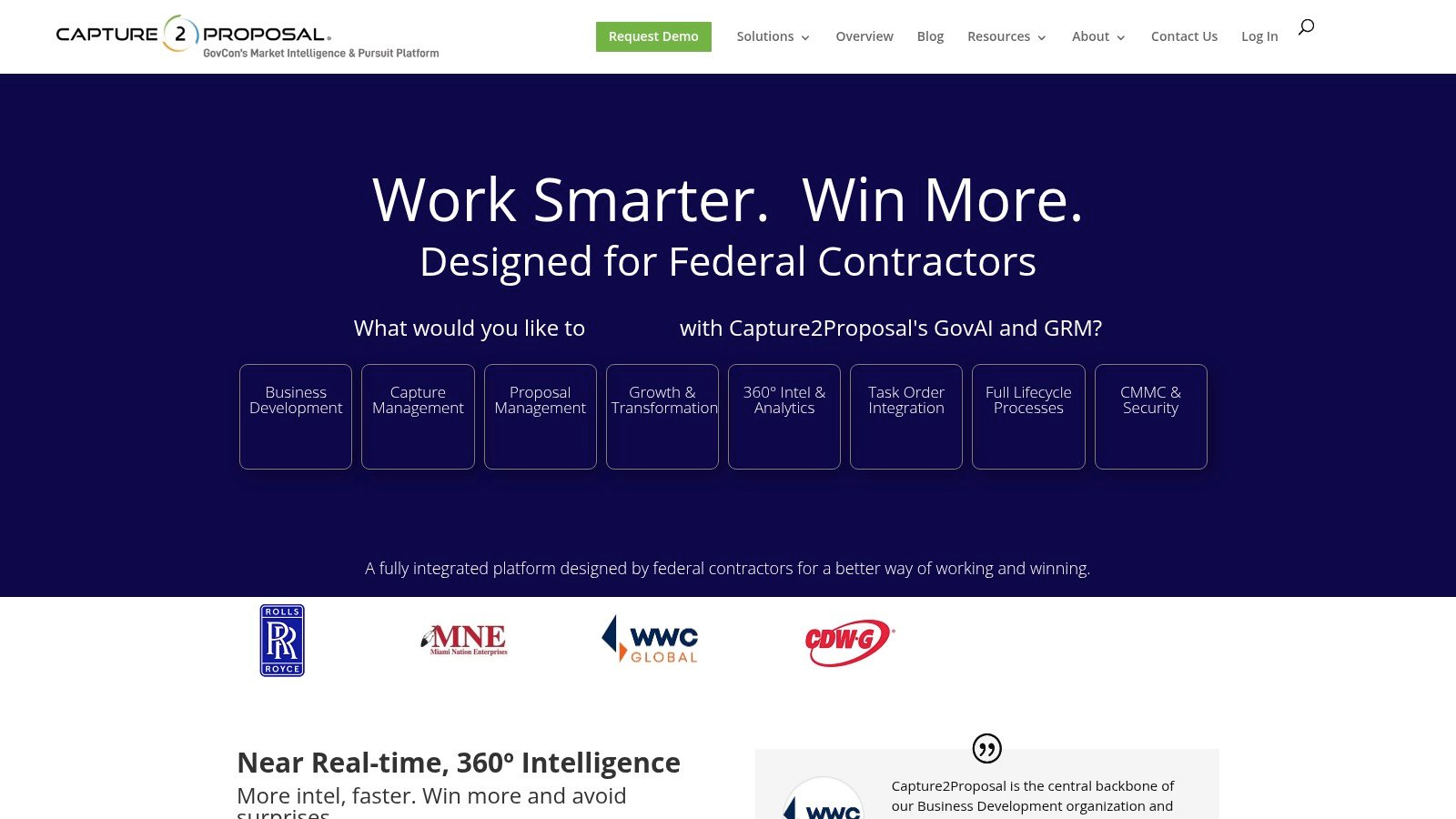
Capture2Proposal, or C2P, is built for midsize teams that want market intelligence, capture, teaming, proposal tasking, and pipeline management in a combined environment. Rather than forcing a team to stitch together an intelligence subscription, a CRM, and a separate capture tracker, C2P keeps those activities connected.
Opportunity search covers federal and SLED sources, with alerts and forecasts supporting earlier qualification. Teams can customize capture fields around their preferred methodology, identify teaming partners, issue data calls, and use price-to-win and competitor analysis during pursuit planning. Recent positioning in the market also emphasizes stage-gated capture reviews, including pre-RFP positioning, color reviews, and final bid decisions. That combination makes the platform more than a contact database, but it still leaves room for an enterprise to retain separate ERP or contract-lifecycle systems.
Where C2P fits best
C2P works well when the immediate problem is tool sprawl and inconsistent capture execution. A midsize BD team can establish common fields, responsibilities, pursuit stages, and proposal tasks without first redesigning an entire corporate CRM architecture. The main implementation challenge is behavioral. Teams must agree on definitions for pWin, gate completion, partner status, and proposal ownership before the software can produce useful reporting.
Buyers should clarify how the platform handles historical data, permissions, approval evidence, and integrations with finance and document systems. It may be a practical standardization layer, but enterprises with highly specialized ERP, CLM, or identity requirements could still need connected systems.
The Capture2Proposal comparison for government contracting capture software provides additional context for positioning it against more specialized options.
Pros
Reduced tool sprawl: Intelligence, pipeline, capture, teaming, and proposal tasking share a workspace.
Midsize usability: The feature set targets teams standardizing capture without a major enterprise-platform program.
Teaming support: Partner discovery and data calls connect relationship work to active pursuits.
Cons
Training still matters: Custom fields and capture methods need governance.
Unpublished pricing: Total cost requires a configured proposal.
Possible enterprise gaps: Large contractors may retain separate ERP, CLM, or reporting platforms.
Website: Capture2Proposal
6. GovTribe
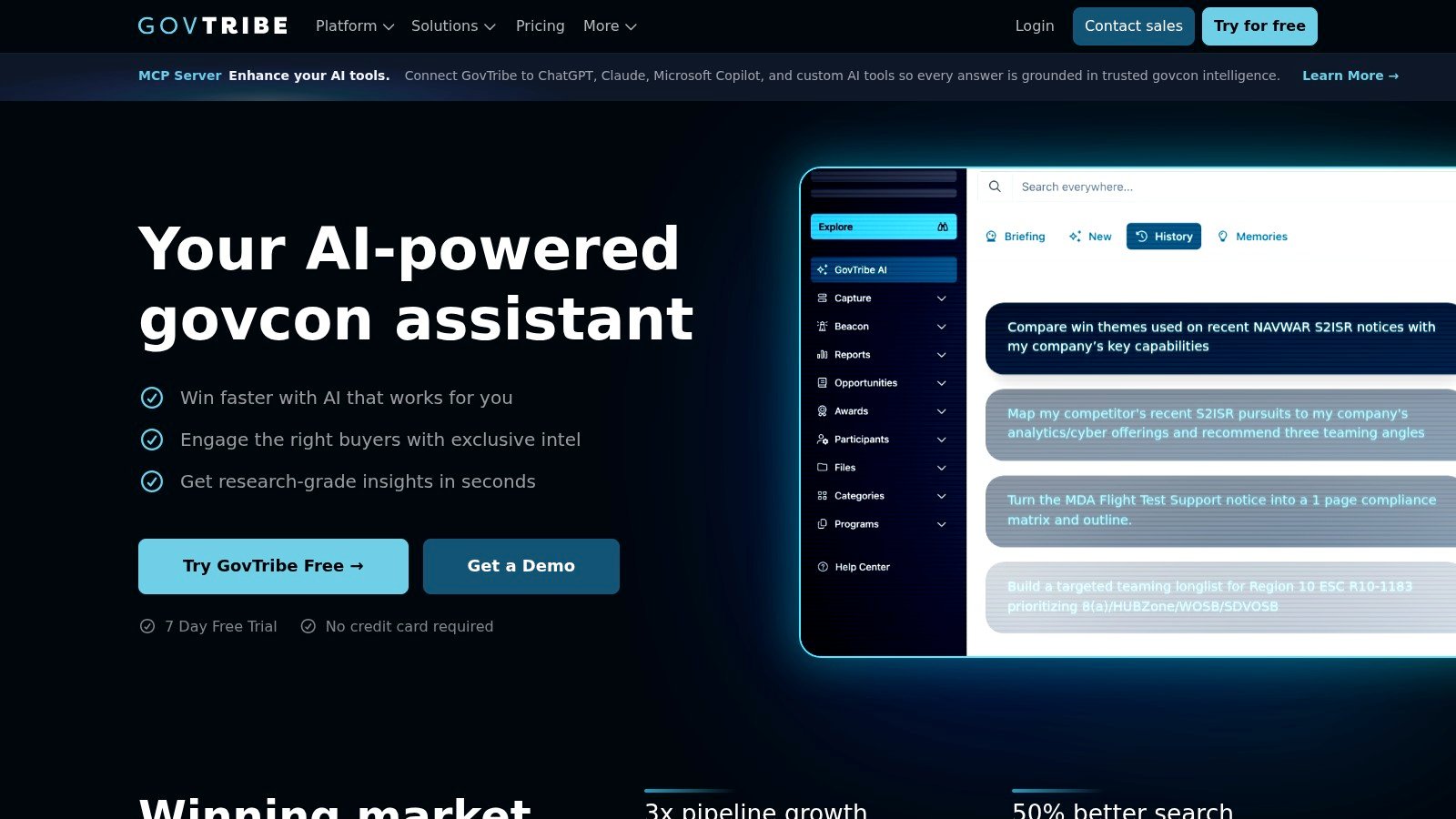
GovTribe is primarily a market-intelligence platform with pipeline and capture features, making it a strong option for teams that need a rich, frequently refreshed view of federal, state, and local opportunities. Saved searches, alerts, agency profiles, vendor profiles, and award history help capture professionals investigate an opportunity before committing significant pursuit resources.
Its pipeline connects pursuits to live opportunity information, while collaboration and analytics give teams a practical way to record status and activity. The Unanet integration is valuable for organizations already using Unanet CRM and looking to enrich records with market intelligence rather than replace the CRM. Current GovTribe documentation also shows support for sending eligible opportunities and saved-search results into Unanet CRM, though setup and activation still need coordination. Optional AI query features and the MCP journalism and analysis add-on can extend research, although heavy usage may introduce additional credit-based costs.
Intelligence first, CRM second
GovTribe is a good fit when the primary bottleneck is discovering and understanding work early. It can help a team examine agency buying behavior, incumbent context, awards, and potential competitors before a formal solicitation appears. It is not the best choice for a contractor expecting a full enterprise CRM with extensive financial linkage, complex proposal production, and deep post-award management.
The buying decision should separate intelligence quality from workflow completeness. Ask whether the team needs GovTribe to remain the system of record or whether it should feed another CRM. That distinction affects integration design, user permissions, reporting ownership, and the cost of maintaining parallel records.
Use GovTribe as the intelligence engine when research depth matters most. Do not mistake strong opportunity context for a complete capture-to-finance operating system.
Pros
Early positioning: Rich agency, vendor, and award information supports pre-solicitation work.
Federal and SLED coverage: Teams can investigate opportunities across public-sector markets.
CRM connectivity: The Unanet integration is useful for shared customers.
Cons
Lighter CRM depth: Complex enterprise workflow requirements may exceed its native pipeline features.
Usage-based AI costs: Credit-based add-ons need a realistic consumption estimate.
System-of-record ambiguity: Buyers must define where authoritative opportunity data will live.
Website: GovTribe. For alternatives, see GovTribe alternatives.
7. GovDash
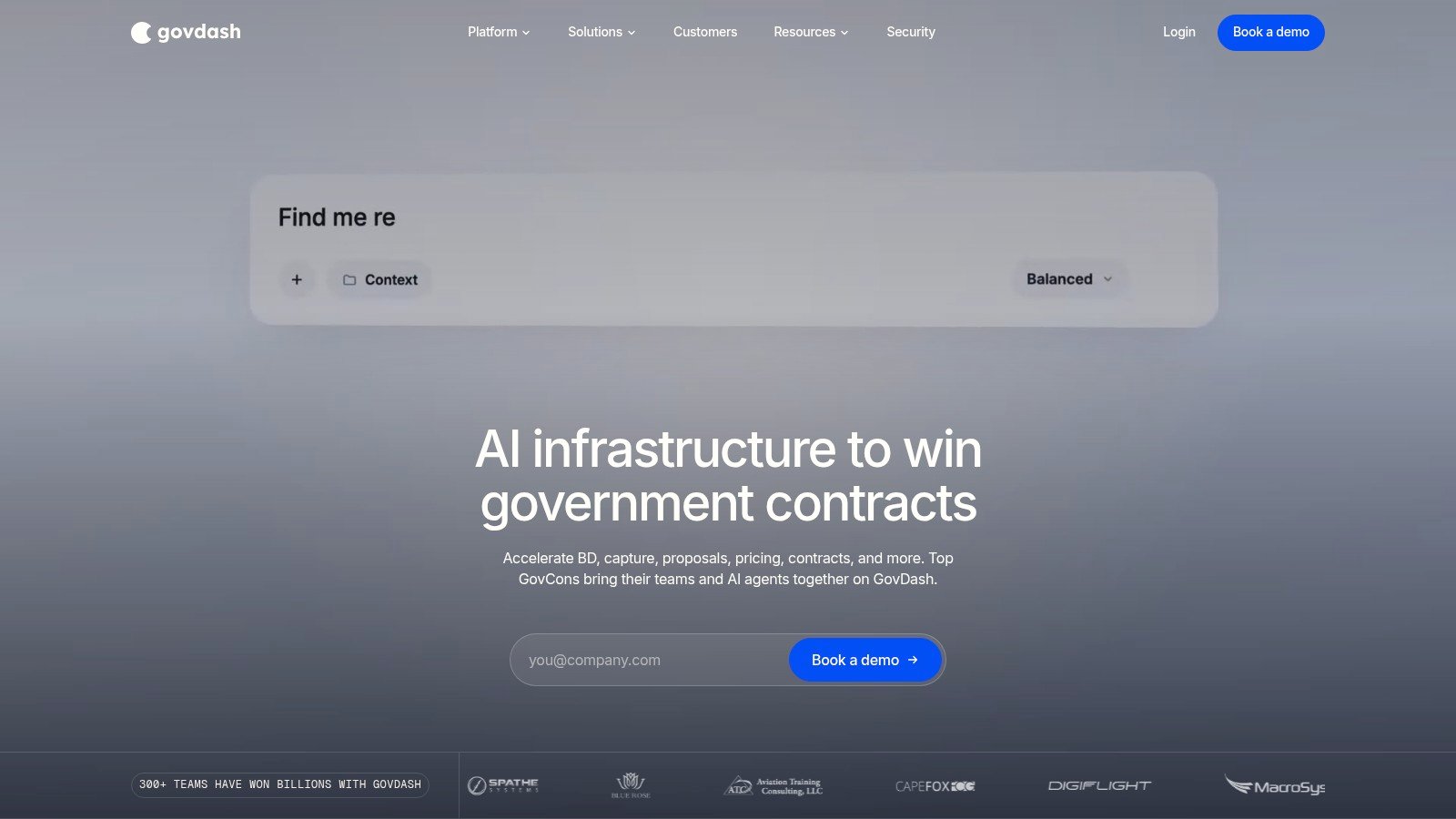
GovDash takes an AI-native approach to connecting discovery, capture, pipeline, proposal development, and early contract management. Its capture-centric CRM includes qualification, gated reviews, solutioning workflows, weighted kanban views, and multi-entity pipeline management. That makes it relevant to teams trying to eliminate the handoff between a BD record and a proposal workspace.
AI agents support outline generation, compliance checks, past-performance assembly, and structured bid-decision workflows. Recent product positioning also points to pursuit scoring, configurable stage gates, role-based review cycles, version control, and compliance tracking tied to Section L and M requirements. SharePoint connectors can preserve an existing document environment, while audit trails, product documentation, and a help center support rollout. The value is not just that the platform can generate text. The better test is whether the generated work remains tied to requirements, approved content, reviewers, and the originating opportunity.
A modern platform with adoption considerations
GovDash is appealing to mid-market and enterprise teams that want one record to follow a pursuit into proposal execution. It may be less comfortable for organizations with customized legacy systems or strict preferences for established enterprise ecosystems. Younger products can move quickly, but buyers should test roadmap dependencies, export options, support escalation, permission models, and data retention before committing.
A representative pilot should include an actual solicitation, historical past performance, a multi-person review cycle, and a change in bid strategy. That exposes whether the AI is helpful under pressure and whether the CRM can preserve decisions when the pursuit changes.
Pros
Unified record: Capture information can flow directly into proposal work.
AI assistance: Outline, compliance, and past-performance tasks are integrated into the pursuit process.
Operational visibility: Kanban views, weighted values, multi-entity views, and audit trails support management reporting.
Documentation: Public support content can reduce rollout friction.
Cons
Change management: Teams must adapt established capture and proposal habits.
Unpublished pricing: Buyers need a full commercial and implementation quote.
Maturity assessment: Enterprises should validate specialized requirements before standardizing.
Website: GovDash
8. GovBD by REI Systems
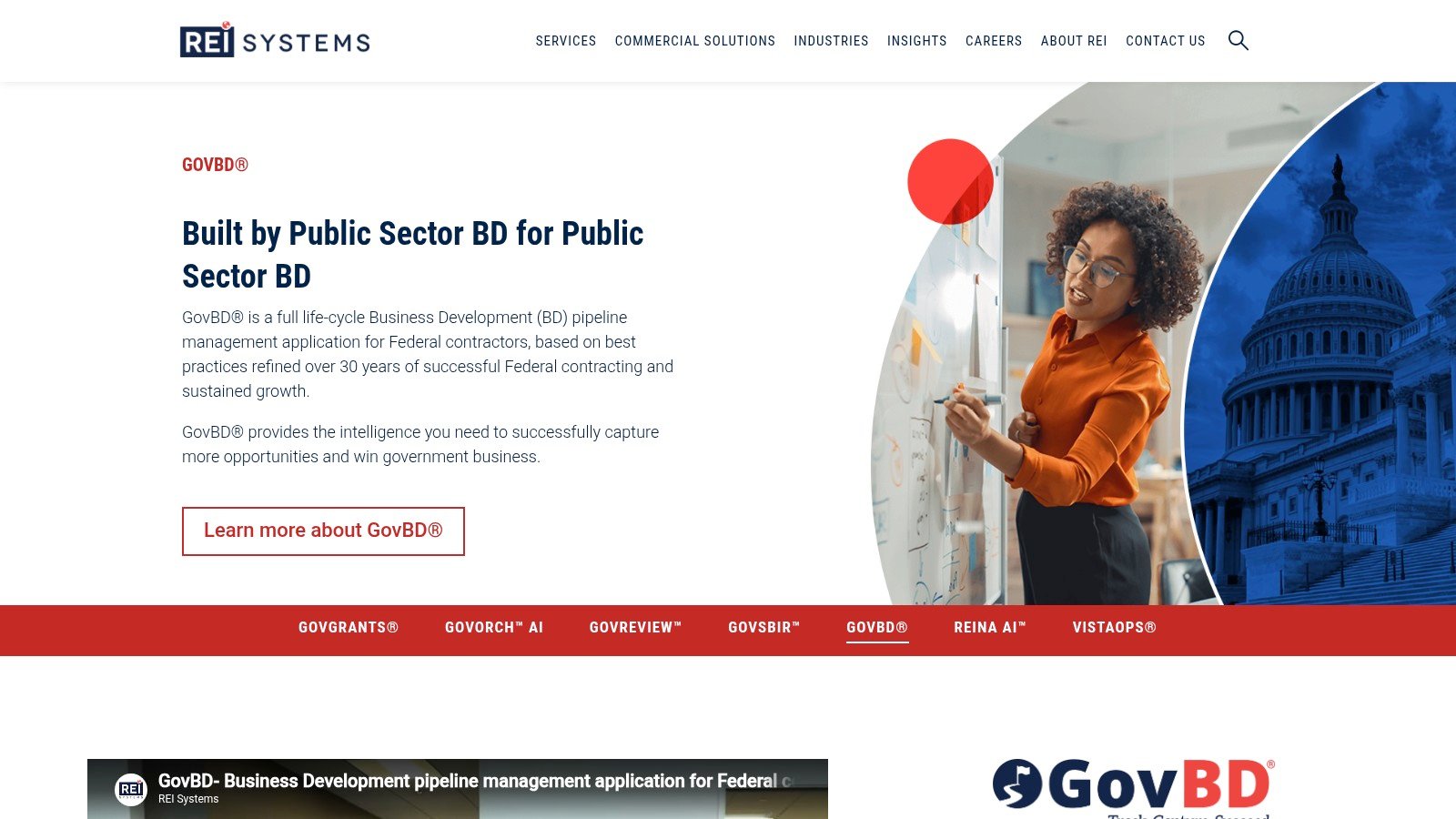
GovBD by REI Systems is a cloud CRM and BD pipeline platform for federal contractors, commonly deployed on Salesforce. It combines opportunity tracking, capture methodology, workflow automation, pipeline health views, and business-development reporting. The product is a natural fit for organizations that already want Salesforce as their enterprise CRM and prefer vendor-led GovCon implementation.
REI Systems brings federal systems experience to the deployment model. That can matter when the buyer needs help translating capture practices into Salesforce objects, approvals, dashboards, and reporting. Optional AI and analytics capabilities from REI's public-sector portfolio may extend the environment, but the scope should be confirmed during discovery rather than assumed from the platform label.
Salesforce alignment is the main decision
GovBD makes sense when Salesforce licensing, identity, data governance, and administrator skills already exist. The contractor can keep a familiar platform while adding workflows shaped for government business development. The downside is that the buyer still carries Salesforce licensing and partner implementation requirements, and extensive configuration can create long-term administration obligations.
Evaluate the product with prime and subcontractor scenarios separately. A prime may need recompete and vehicle tracking, while a subcontractor may care more about partner relationships, capability alignment, and bid-response ownership. The same Salesforce foundation can support both, but the data model and permissions must reflect the difference.
Pros
Salesforce fit: Works for organizations standardizing enterprise CRM on Salesforce.
GovCon workflows: Capture methodology and reporting reduce generic-CRM customization.
Implementation support: REI services can help translate process into platform configuration.
Cons
Platform dependency: Salesforce licenses and administration remain part of total cost.
Configuration burden: Custom workflows require ongoing ownership.
Pricing opacity: Scope and quotes vary by deployment.
Website: GovBD by REI Systems
9. Deltek GovWin IQ and Costpoint
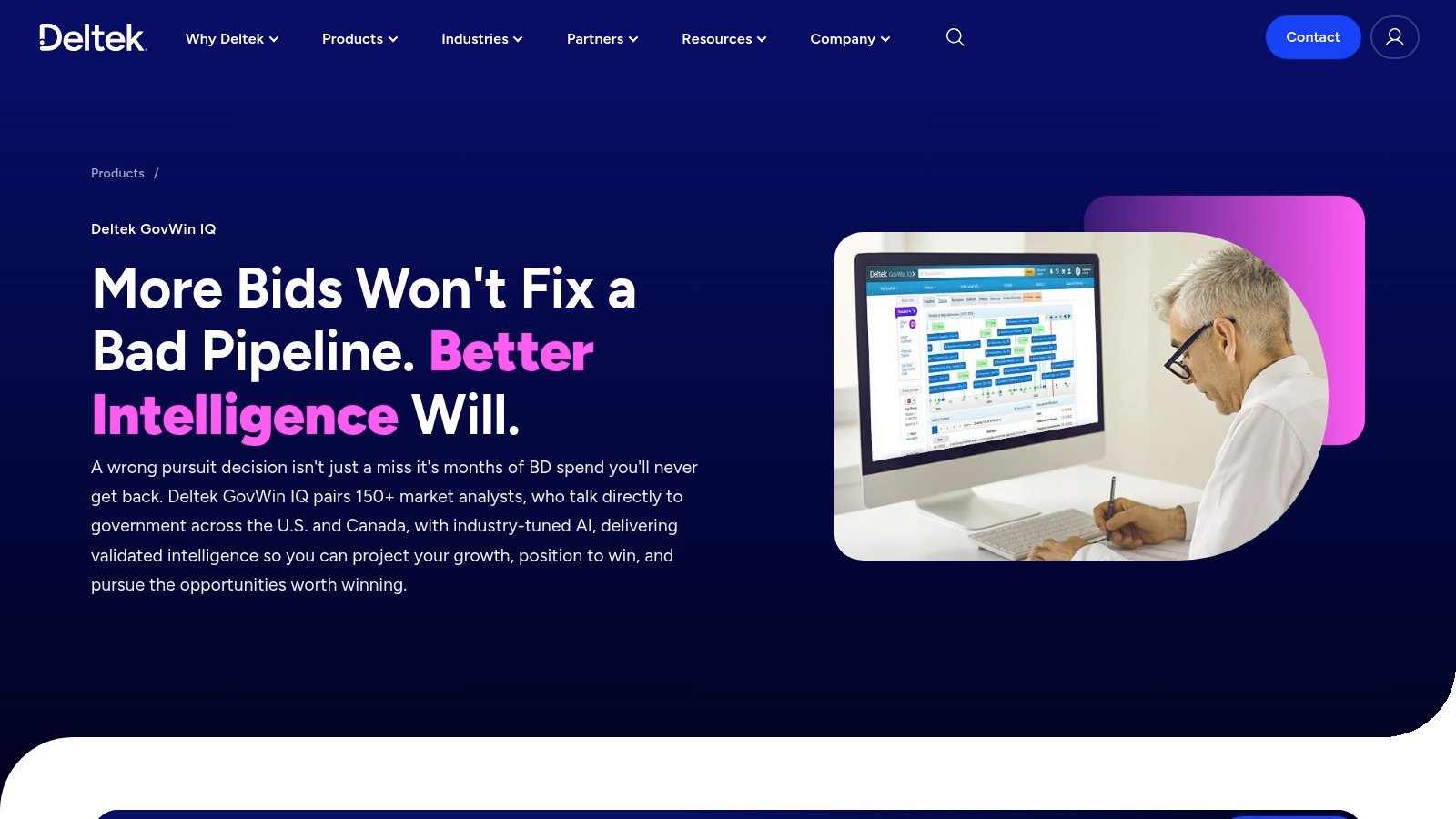
Deltek's ecosystem is compelling for mid-market and large contractors that need opportunity intelligence connected to ERP, operations, and finance. GovWin IQ supplies opportunity intelligence, forecasts, and analyst research. Costpoint and related Deltek capabilities provide the ERP and capture context that can connect pipeline decisions with revenue forecasting and business operations.
That linkage is Deltek's core advantage. A prime managing complex contract vehicles may value a common data model, Microsoft Outlook and 365 connections, mobile access, and dashboards that bring BD and financial planning closer together. It is a different proposition from an AI-first platform or a lightweight pipeline tracker. The buyer is selecting an enterprise ecosystem, not just adding a CRM screen. Deltek continues updating the broader Costpoint environment, which reinforces the platform's role as an operational backbone rather than a lightweight standalone capture tool.
Powerful, but rarely lightweight
Deltek works best when the organization already operates in a Costpoint environment or is prepared to invest in one. Module-by-module licensing, administration, implementation, systems integration, and data governance can make the program heavier than a focused capture platform. That burden may be justified when finance and operations need a shared source of truth, but it can be excessive for a capture team seeking faster RFP analysis.
A careful evaluation should test whether forecast data, opportunity stages, pWin assumptions, contract values, and revenue plans reconcile across systems. Buyers comparing intelligence-led options can also review GovWin alternatives.
Pros
Enterprise ecosystem: Suitable for large primes with complex operational requirements.
ERP connection: Pipeline and finance can share a stronger data foundation in Costpoint environments.
Market intelligence: GovWin IQ supports research, forecasts, and opportunity identification.
Implementation ecosystem: Deltek specialists and systems integrators are widely familiar with the platform.
Cons
Separate modules: Pricing and functionality depend on the licensed combination.
High overhead: Administration and implementation exceed lighter CRM deployments.
Proposal gaps: Teams may still need dedicated RFP extraction or proposal-generation tools.
Website: Deltek GovWin
10. Zbizlink
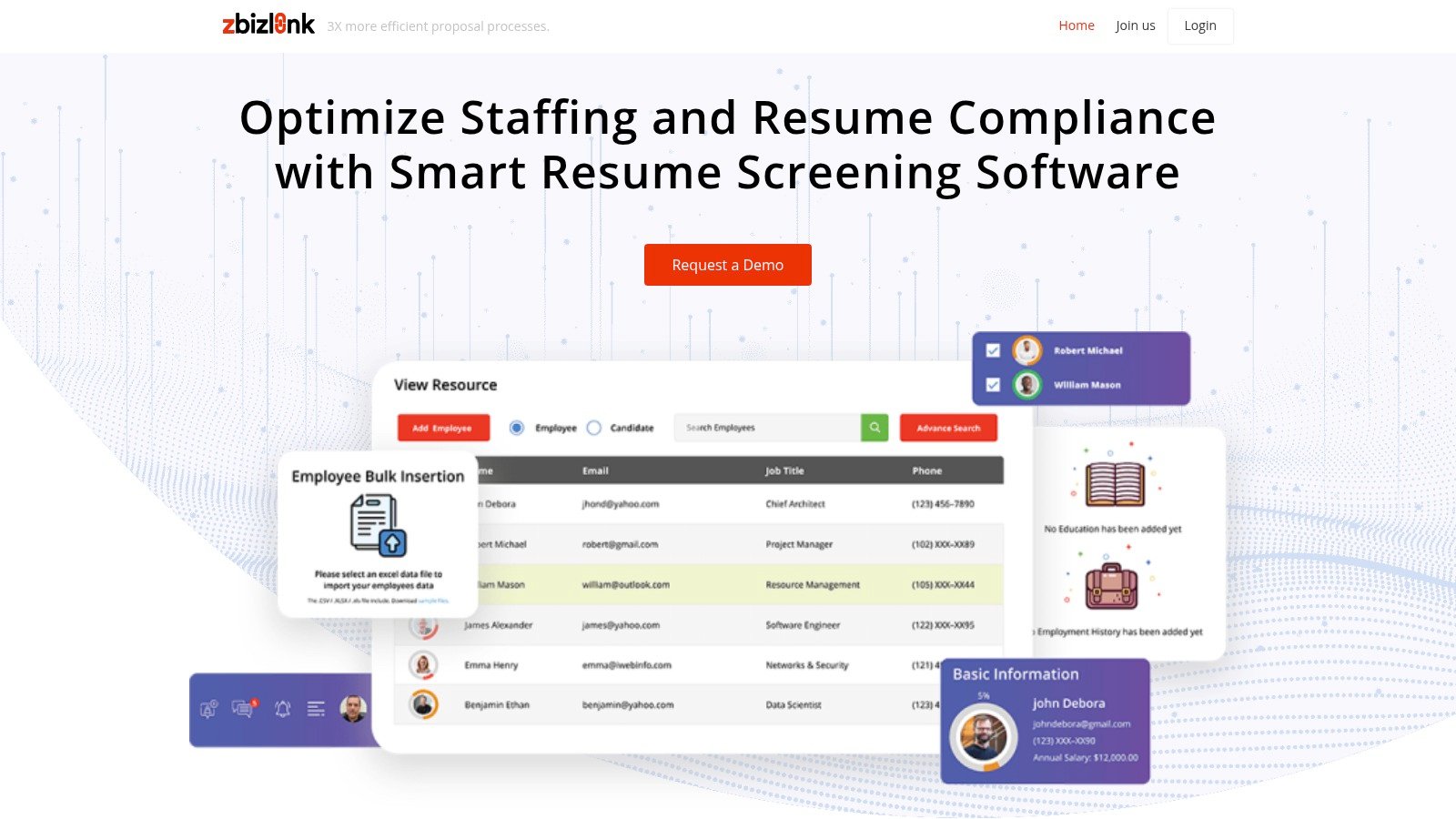
Zbizlink focuses on proposal and capture management for GovCon and IT staffing teams. It supports opportunity intake, capture checklists, gate decisions, teaming coordination, RFP parsing, document assembly, content reuse, and Office 365 integration. For small and mid-sized teams, the emphasis is practical: standardize the work around a bid and reduce friction for proposal staff working in familiar Microsoft tools.
The Office add-in can help teams keep proposal drafting close to their existing document workflow. Role-based dashboards, content libraries, e-signatures, version control, and partner coordination support a more orderly response process. RFP parsing and autofill are useful when the team needs structured intake before assigning sections and review responsibilities.
A proposal-centered choice
Zbizlink is a better fit for teams whose primary pain is proposal execution than for enterprises seeking a broad intelligence, CRM, and finance platform. It can formalize capture checklists and document control, but buyers should examine opportunity discovery, forecast feeds, historical award intelligence, API extensibility, and enterprise reporting separately.
The platform may be competitively priced for smaller and mid-sized teams, although final quotes vary and are not fully transparent. An enterprise should also consider ecosystem size, implementation support, data export, identity integration, and whether the tool can remain useful when the contractor adds business units or complex teaming structures.
Pros
Proposal acceleration: Parsing, autofill, templates, and content reuse reduce manual assembly.
Office integration: The add-in can lower resistance among Word-centered proposal teams.
Capture standardization: Checklists, gates, dashboards, and version control create repeatability.
Team coordination: Partner workflows support subcontracting and teaming activity.
Cons
Narrower lifecycle coverage: It may not replace intelligence, ERP, or full CRM systems.
Limited price transparency: The final quote depends on configuration and team needs.
Smaller ecosystem: Large enterprises should test extensibility and long-term platform fit.
Website: Zbizlink
Top 10 GovCon CRM & Pipeline Tools Comparison
| Product | Core focus / Coverage | Key capabilities & UX | Target audience & fit | Differentiator / USP | Pricing / Deployment |
|---|---|---|---|---|---|
| SamSearch | End-to-end AI GovCon OS, federal, SLED, DIBBS, subcontracting, SBIR, Canada | AI SOW extraction and section-by-section drafting, forecast and recompete signals, JourneyHub Kanban, customers report faster decisions and higher win rates | Established mid-market and enterprise government contractors, not for small business | Sammy AI plus compliance-first drafting, integrated financing, SOC 2 Type II, SAML 2.0 SSO, US-hosted, customer data not used to train shared models | Annual, quoted per seat plus modules, enterprise onboarding, demos available |
| Civio | AI-assisted capture and proposal workflow for government contractors | Solicitation analysis, requirement organization, proposal acceleration, workflow support | Teams prioritizing fast RFP analysis and AI-assisted response work | AI-native workflow focused on reducing manual proposal prep | Custom pricing, buyer should confirm implementation and integrations |
| Unanet CRM for GovCon (formerly Cosential) | GovCon/AEC CRM with capture workflows | Opportunity tracking, proposal calendars, content reuse, dashboards, M365 and Unanet ERP integrations | Mid-market firms wanting reduced customization and mature proposal reuse | Purpose-built GovCon workflows, strong proposal and content reuse | Module pricing, not public, best paired with Unanet ERP |
| TechnoMile Growth Suite | Growth CRM plus pre-award on Salesforce/Dynamics | Capture Copilot, AI proposal generation, gate reviews, pre-award management, teaming | Organizations invested in Salesforce or Dynamics, mid-to-enterprise | Deep capture processes out-of-the-box, platform choice for IT alignment | Requires Salesforce/Dynamics licenses and implementation, enterprise rollout |
| Capture2Proposal (C2P) | All-in-one market intel plus capture plus proposal | Opportunity search, customizable capture pipeline, teaming discovery, price-to-win analytics | Midsize teams standardizing capture workflows | Reduces tool sprawl by combining intel, pipeline and capture, price-to-win insights | Pricing not public, implementation and training advisable |
| GovTribe | Market intelligence with pipeline basics | Hourly opportunity updates, saved searches and alerts, agency/vendor profiles, pursuit analytics | Teams needing frequent, rich intel feeds and basic pipeline tracking | Rich, frequent intel, SLED coverage, Unanet integration | Subscription-based, optional credit-based AI/MCP add-ons can increase cost |
| GovDash | AI-native single system of record for BD/capture/proposal | Capture-centric CRM, Kanban pipeline, AI agents for outlines, compliance, past-performance, SharePoint connectors | Mid-market/enterprise teams wanting unified pipeline-to-proposal | Unifies pipeline to proposal with audit trails and rollout docs | Pricing not public, likely mid/enterprise, change management needed |
| GovBD by REI Systems | Salesforce-based GovCon CRM and BD pipeline | Opportunity tracking, workflow automation, pipeline analytics, REI implementation services | Federal contractors standardizing on Salesforce | Backed by REI systems integrator and GovCon best practices | Requires Salesforce licensing plus REI implementation, pricing varies |
| Deltek (GovWin IQ + Costpoint) | Enterprise GovWin intelligence plus ERP linkage | Lead/intel and forecasts, CRM/capture aligned to Costpoint, pipeline-to-finance reporting | Mid-market and large prime contractors needing ERP-BD alignment | Tight linkage between pipeline and finance, large ecosystem and partners | Opaque modular pricing, higher implementation and admin overhead |
| Zbizlink | Proposal and capture management for small to mid teams | RFP parsing, autofill and document assembly, content libraries, Office 365 add-in | Small to mid-sized GovCon and IT staffing teams | Office add-in and automated proposal assembly, role-based dashboards | Competitively priced for small/mid teams, quotes vary |
Turn the Shortlist Into a Capture-System Decision
Start by naming the primary failure you are trying to fix. If the team misses forecast and recompete signals, prioritize market intelligence, official-source integration, NAICS and PSC monitoring, award history, and early opportunity qualification. If records are present but nobody trusts the pipeline, prioritize stage definitions, gate approvals, ownership, pWin logic, coverage reporting, and forecast discipline. If proposal teams lose time rebuilding context, prioritize RFP extraction, cited compliance matrices, approved-content libraries, section assignments, review controls, and version history. If executives need BD connected to delivery and finance, prioritize ERP alignment and data governance.
The operating model matters more than the feature list. A prime contractor may need vehicle, incumbent, agency, recompete, task-order, and executive gate views. A subcontractor may need partner discovery, capability matching, data calls, relationship history, and fast response to teaming requests. A centralized capture team may need reusable methodologies and approval evidence, while proposal operations may care most about requirements extraction, content reuse, and reviewer accountability.
Test the entire pursuit lifecycle
Use representative opportunities, not a generic vendor demo. Ask each provider to show how a forecast item becomes a qualified pursuit, how NAICS or PSC alerts reach the right owner, how a potential partner is associated with the opportunity, and how a bid or no-bid decision is recorded. Then test the handoff into proposal work.
Your pilot should cover:
Forecast and recompete signals: Confirm the platform can expose early work and preserve the source behind each signal. The Acquisition Gateway Forecast Tool explicitly presents a nationwide listing of upcoming federal contracting opportunities for planning and market research, while also noting that forecasts may be revised or canceled and are not a commitment to buy.
Official opportunity records: Validate links or mappings to SAM.gov solicitation, award, and subcontract information. The SAM.gov Contract Opportunities page describes itself as the free, centralized source for finding and bidding on federal contract opportunities.
Capture governance: Test qualification fields, gate reviews, approvals, bid or no-bid decisions, task ownership, and forecast changes.
Proposal execution: Upload a real RFP and evaluate requirement extraction, compliance mapping, approved-content retrieval, citations, section drafting, review, and auditability.
Collaboration and integrations: Test Microsoft 365, SharePoint, Salesforce, Dynamics, Slack, Teams, ERP, identity, and document workflows that your team uses.
Security and data controls: Request current security materials, hosting details, SSO documentation, access controls, retention practices, and evidence relevant to your contract portfolio.
Pipeline discipline deserves particular scrutiny. A Cabrillo Club GovCon pipeline analysis describes best-in-class coverage as 3:1 to 4:1 pipeline-to-revenue-target coverage, with anything below 2.5:1 signaling increased risk. It also notes that spreadsheet tracking tends to break down once opportunity counts exceed 30, and gives submitted-proposal win-rate benchmarks of 20% to 30% compared with 40% to 60% for best-in-class teams. Treat those figures as planning context, not a promise from any vendor. The system still needs clean definitions for stages, values, conversion, and revenue timing.
Price the operating change, not just the license
Custom pricing makes direct comparisons difficult. Request a complete cost model covering seats, modules, intelligence feeds, AI usage, Salesforce or Dynamics licensing, ERP connections, implementation, data migration, training, support, security reviews, and internal administration. A cheaper subscription can become expensive if users maintain duplicate spreadsheets, manually re-key records, or need custom integrations to reach proposal and finance teams.
Data migration also deserves a written plan. Identify which opportunities, contacts, past proposals, resumes, past performance records, partner relationships, and historical decisions will move. Decide what becomes the authoritative record and how the team will handle duplicate or incomplete data during transition.
The 2021 GovCon benchmarking data summarized by Unanet found that 75% of nearly 1,500 government contracting firms reported a win rate of 50% or less, while only 55% had a formal capture or gate process. The same source reported that 44% still used Excel for pipeline tracking and 30% used no CRM tool. Those findings explain why a CRM decision should focus on repeatable capture governance, not merely contact storage.
Document the decision for adoption
Assign an executive owner, a capture-process owner, a proposal representative, an IT or security reviewer, and a finance stakeholder. Give them a shared scorecard, require vendors to demonstrate the same scenarios, and record where AI outputs need human approval. The Acquisition Gateway describes its platform as an official online resource for acquisition programs, policies, initiatives, and tools, which is a useful standard for transparent sourcing and auditable workflow inputs.
For established mid-market and enterprise contractors, SamSearch deserves priority evaluation when the goal is an end-to-end GovCon workflow spanning intelligence, capture, response, collaboration, and finance. It should be assessed as a platform for mature contractor operations, while smaller organizations may prefer a lighter system. The right buying process is to test SamSearch against real pursuits, real content, and real approval paths so stakeholders can evaluate fit against the full operating model.
The right choice is the system your team will use before the RFP, during the gate review, inside the proposal, and after the award. Select against that complete operating model, then prove the fit with your own opportunities and approved content.
FAQ
What is the best GovCon CRM and pipeline management software?
The best choice depends on your operating model. In this list, SamSearch ranks first for established mid-market and enterprise contractors that want one GovCon-focused system spanning discovery, capture, proposal support, collaboration, and finance. Civio ranks second for teams that prioritize AI-assisted solicitation analysis and proposal acceleration. Other buyers may prefer Unanet, TechnoMile, GovTribe, or Deltek when CRM, ERP, or intelligence alignment matters more than an all-in-one workflow.
Which GovCon CRM is best for small businesses?
Many small businesses do not need an enterprise platform. They often benefit more from a lighter tool that supports opportunity tracking, basic capture discipline, and proposal coordination without a heavy implementation burden. In this article, SamSearch is explicitly positioned for established mid-market and enterprise contractors, not small businesses.
What should a GovCon pipeline tool include?
A strong GovCon pipeline platform should support forecast visibility, opportunity qualification, NAICS and PSC tagging, teaming, bid or no-bid gates, proposal handoff, reporting, and security controls. More mature organizations may also need ERP integrations, compliance extraction, approved content libraries, and audit trails.
Is a generic CRM enough for government contractors?
Usually not by itself. Government contractors often need workflows that generic CRMs do not handle well out of the box, such as capture gates, recompete tracking, vehicle alignment, teaming workflows, proposal coordination, and links to official sources like SAM.gov. That is why many firms evaluate GovCon-specific platforms instead of relying only on a general sales CRM.
How much does GovCon CRM software cost?
Pricing is often custom. Total cost may include seats, modules, implementation, onboarding, integrations, AI usage, Salesforce or Dynamics licensing, and internal administration. Buyers should request a full cost model before comparing products.
How should teams evaluate GovCon CRM software?
Use a real pursuit, not a generic product demo. Test early discovery, qualification, gate reviews, partner tracking, proposal workflows, security controls, reporting, and integrations. The right platform should help your team before the RFP, during capture, inside proposal development, and after award.
SamSearch brings forecast and recompete intelligence, federal and SLED opportunity discovery, partner matching, capture workflow, RFP analysis, compliance-focused drafting, collaboration, and financing into one platform for established mid-market and enterprise government contractors. Visit SamSearch to evaluate whether its end-to-end GovCon workflow fits your team, rather than forcing your capture process into a small-business CRM.