GovDash Alternatives and Competitors in 2026: Top Picks

In 2026, SamSearch is the strongest end-to-end pick for established mid-market and enterprise government contractors, while the broader market spans tools built for narrower jobs. The government procurement software market is estimated at US$3.23 billion in 2026 and projected to reach US$7.77 billion by 2035, at a 10.25% CAGR.Global Growth Insights
A capture leader who relied on GovDash for pipeline automation now faces a harder operating reality. Broad opportunity alerts aren't enough when a recompete is forming months before release, a SLED team needs a different data layer, or proposal managers must turn a long solicitation into an evidence-backed compliance plan without creating another disconnected workspace.
That shift explains why the best GovDash alternatives and competitors in 2026 don't line up on a single feature checklist. SamSearch stands out as the top end-to-end option. Civio.ai adds an AI-first federal workflow for teams that want faster opportunity analysis and pursuit support. GovWin IQ and Bloomberg Government emphasize intelligence and policy context. GovTribe and HigherGov suit data-driven pipeline builders. BidPrime focuses on SLED discovery, while AutogenAI Federal concentrates on proposal production.
This is a decision guide for capture leaders. The ten platforms below are matched to a specific team profile, with direct guidance on when to migrate, when to layer a specialist alongside your existing stack, and when GovDash may still be sufficient. Small-business fit matters too. Several enterprise tools are powerful precisely because they're built for larger pursuit portfolios, not lean teams chasing a handful of set-aside bids.
Table of Contents
- Top 10 GovDash Alternatives & Competitors in 2026
- 1. SamSearch
- 2. Civio.ai
- 3. Deltek GovWin IQ
- 4. Bloomberg Government
- 5. GovTribe
- 6. HigherGov
- 7. Fedmine, a GovSpend solution
- 8. Federal Compass
- 9. BidPrime
- 10. AutogenAI Federal
- Comparison Table: Top 10 GovDash Alternatives & Competitors, 2026
- FAQ
- What is the best GovDash alternative in 2026?
- Which GovDash competitor is best for AI-assisted federal opportunity analysis?
- Which platform is best for SLED opportunities?
- Is GovWin IQ better than GovDash for enterprise capture teams?
- Which GovDash alternative is best for proposal writing?
- Should small businesses replace GovDash with an enterprise platform?
- Choosing and Migrating Without Losing Pipeline
Top 10 GovDash Alternatives & Competitors in 2026
If you're evaluating GovDash replacements, the most important question isn't which platform has the longest feature list. It's which one best supports your actual operating model. Some teams need a full workflow that connects discovery, capture, proposal development, and collaboration. Others need a specialist for federal intelligence, SLED discovery, or proposal drafting. The list below ranks the top 10 options accordingly, with SamSearch at number 1 for end-to-end execution and Civio.ai at number 2 for AI-first federal pursuit support.
1. SamSearch
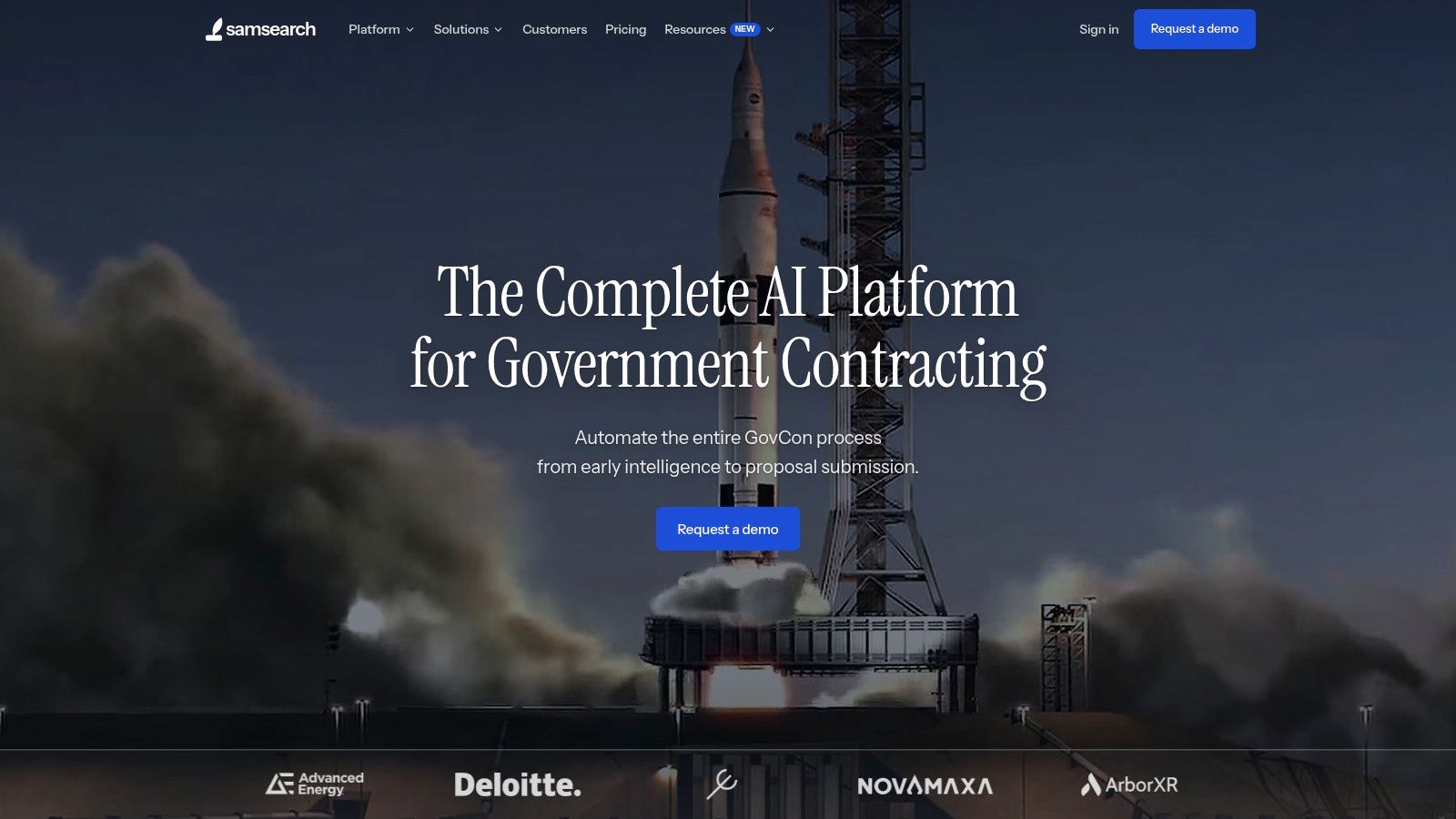
Best for: Established mid-market and enterprise contractors that need one operating system for discovery, qualification, capture, proposal work, collaboration, and post-award financing.
A contractor with separate tools for opportunity alerts, CRM records, proposal files, teaming, and finance will eventually lose context between stages. SamSearch brings those workflows into one platform, covering federal and SLED opportunities, DIBBS, subcontracting, SBIR and grants, and Canadian tenders. Fit scoring uses a contractor's NAICS, PSC codes, and past performance to filter opportunities before the team invests capture time.
Sammy adds AI support to human-verified intelligence. It can read solicitation attachments, extract SOW requirements, create cited compliance matrices, answer questions across lengthy RFPs, and draft proposal sections from approved content. Analyst-verified recompete forecasts and buying signals help teams position before an opportunity is posted.
Why it fits mature teams
Use SamSearch when the main problem is coordination across a growing pursuit portfolio.
Journey Hub: Kanban collaboration and pipeline organization keep capture work visible. Two-way synchronization with Salesforce, HubSpot, and Pipedrive prevents records from sitting in a separate application.
Partner discovery: Searches 600K+ contractors and applies compatibility scoring, helping primes build teams around vehicles, capabilities, or geographic requirements.
Security controls: SamSearch has SOC 2 Type II audited controls, independent penetration testing with an A+ rating, US-hosted environments, and SAML 2.0 SSO. Customer documents do not train shared AI models.
Finance path: Working-capital lenders can offer up to $100M after awards land. The product details are outlined in SamSearch's GovDash alternatives guide.
Small businesses should be careful. SamSearch is not a small-business-first product. Annual, seat-and-module pricing is quoted through a demo, and teams that require immediate CMMC Level 2 coverage should confirm the current certification timeline, since that work is in progress.
The migration case is strongest for contractors replacing disconnected systems across capture, proposal, teaming, and finance. A lean shop repairing only one workflow should choose a narrower tool instead of paying for unused breadth. Visit the SamSearch platform for an evaluation.
2. Civio.ai
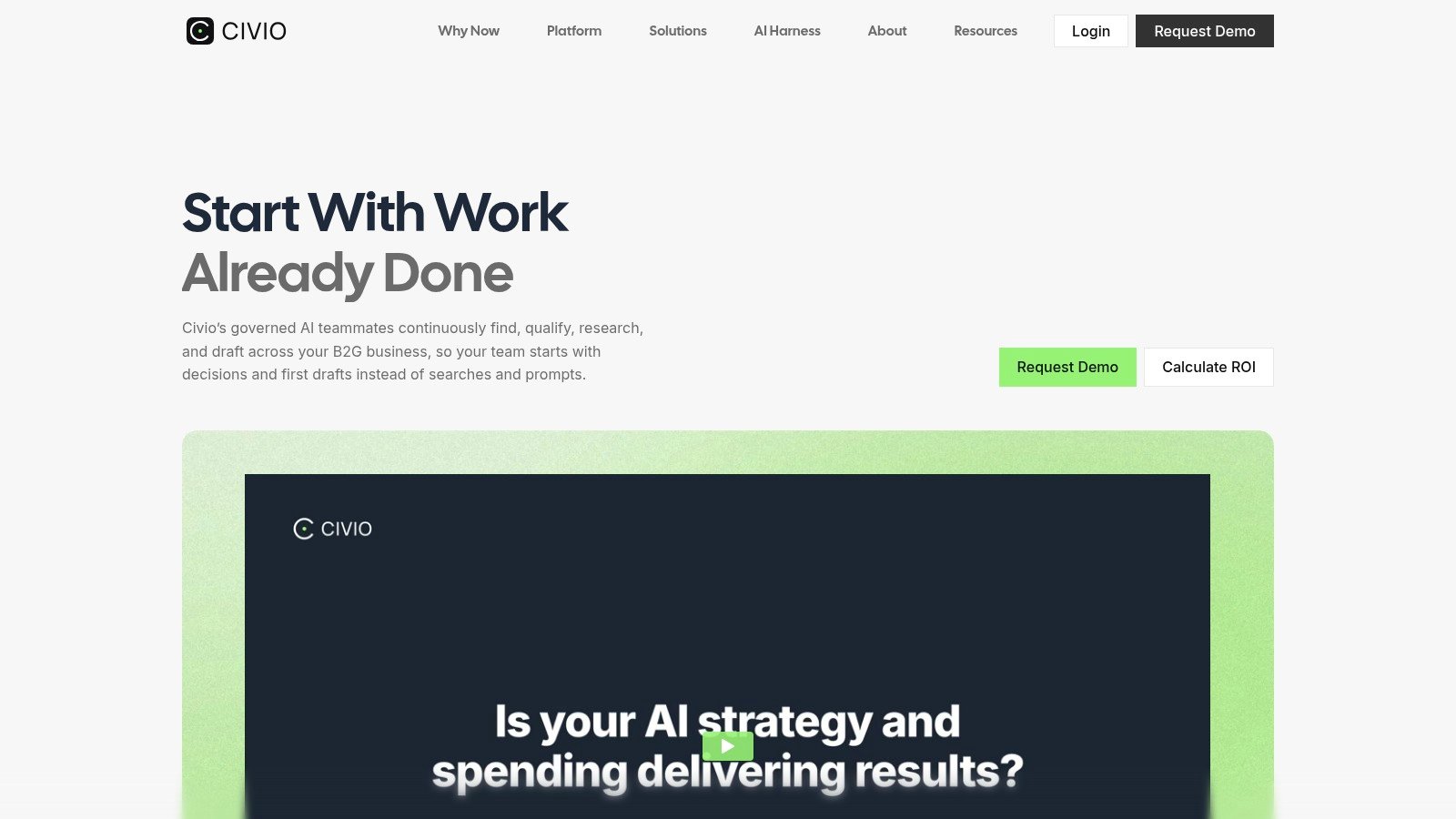
Best for: Federal contractors that want AI-assisted opportunity analysis, capture support, and faster decision-making around government pursuits.
Civio.ai is a newer AI-focused entrant built around helping GovCon teams move faster from opportunity discovery to qualification and response planning. For teams comparing GovDash alternatives, the appeal is straightforward: less manual reading, faster synthesis, and a more guided workflow around federal opportunities. That can be especially useful for capture managers and proposal teams that need to understand what a solicitation requires before they commit scarce bid resources.
Civio.ai is best thought of as an AI-first pursuit support platform rather than a complete operating system for every stage of government contracting. It is most relevant for teams that want help interpreting solicitations, organizing opportunity intelligence, and accelerating early pursuit work without relying entirely on manual review.
Where Civio.ai fits best
Civio.ai makes the most sense for federal-focused teams that want AI support closer to the front end of the pursuit lifecycle. If GovDash feels too limited for nuanced opportunity review, Civio.ai can be a stronger fit for teams that need faster analysis of solicitations and clearer guidance on what matters in a bid.
The tradeoff is platform breadth. Buyers should confirm how deeply Civio.ai covers CRM workflows, teaming, SLED opportunities, exports, security controls, and proposal production compared with broader platforms or established intelligence suites. In most organizations, it will work best either as a focused GovDash replacement for AI-led federal workflows or as a layer alongside a CRM and proposal system.
Teams that want a more complete discovery, capture, and collaboration environment may still prefer SamSearch at number 1. Teams that prioritize long-established analyst research may lean toward GovWin IQ. Visit Civio.ai to evaluate its approach directly.
3. Deltek GovWin IQ
Best for: Enterprise capture organizations and large defense contractors that prioritize analyst-led federal market intelligence.
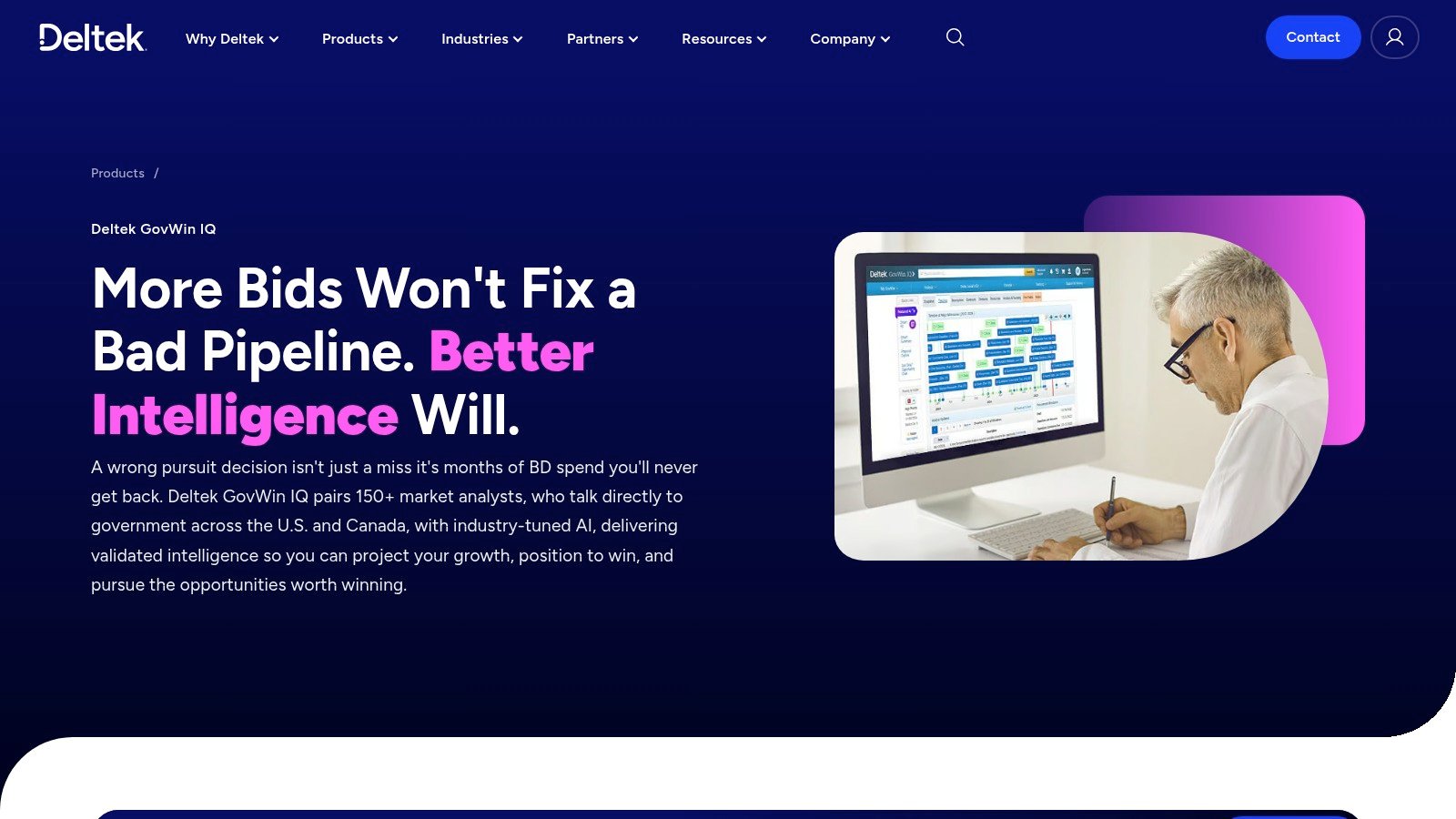
GovWin IQ remains the safest choice for teams that want a mature intelligence operation behind their software. Its opportunity research, recompete visibility, forecasts, vehicle tracking, teaming insights, research reports, and market playbooks support proactive pipeline development rather than simple bid monitoring. The platform also connects naturally with the broader Deltek ecosystem, including Costpoint, which matters when capture decisions need to flow into established GovCon finance and operations processes.
The analyst layer is the differentiator. GovWin IQ's model includes 150+ analysts, giving large primes a source of interpretation around agency plans, vehicles, incumbent positions, and emerging pursuits.Deltek GovWin IQ
Where it belongs in the stack
GovWin IQ is a strong fit for federal-first organizations with dedicated business development and competitive intelligence roles. It can help a capture manager investigate an opportunity, understand the current competitive environment, identify likely teaming paths, and build a pursuit strategy before a solicitation becomes the center of attention.
The tradeoff is cost and operating complexity. Pricing is quote-based, per-seat models can become expensive for large teams, and the user experience is optimized primarily around federal work. SLED contractors may need a second platform for regional bid coverage and local procurement workflows.
Use GovWin IQ when the organization can support premium intelligence with disciplined adoption. Don't buy it only because the database is extensive. If your team lacks the capture process to turn forecasts into account plans, the software will become an expensive research destination.
For enterprise primes, GovWin IQ can replace GovDash as the intelligence center, or sit above a specialized proposal platform. For smaller contractors, it's usually too much platform and too much budget for a pipeline that hasn't yet developed repeatable qualification criteria. Teams comparing the intelligence layer should also review government contract discovery platforms.
4. Bloomberg Government
Best for: Federal business development teams that connect contracting pursuits to legislation, agency policy, budgets, and executive-level strategy.
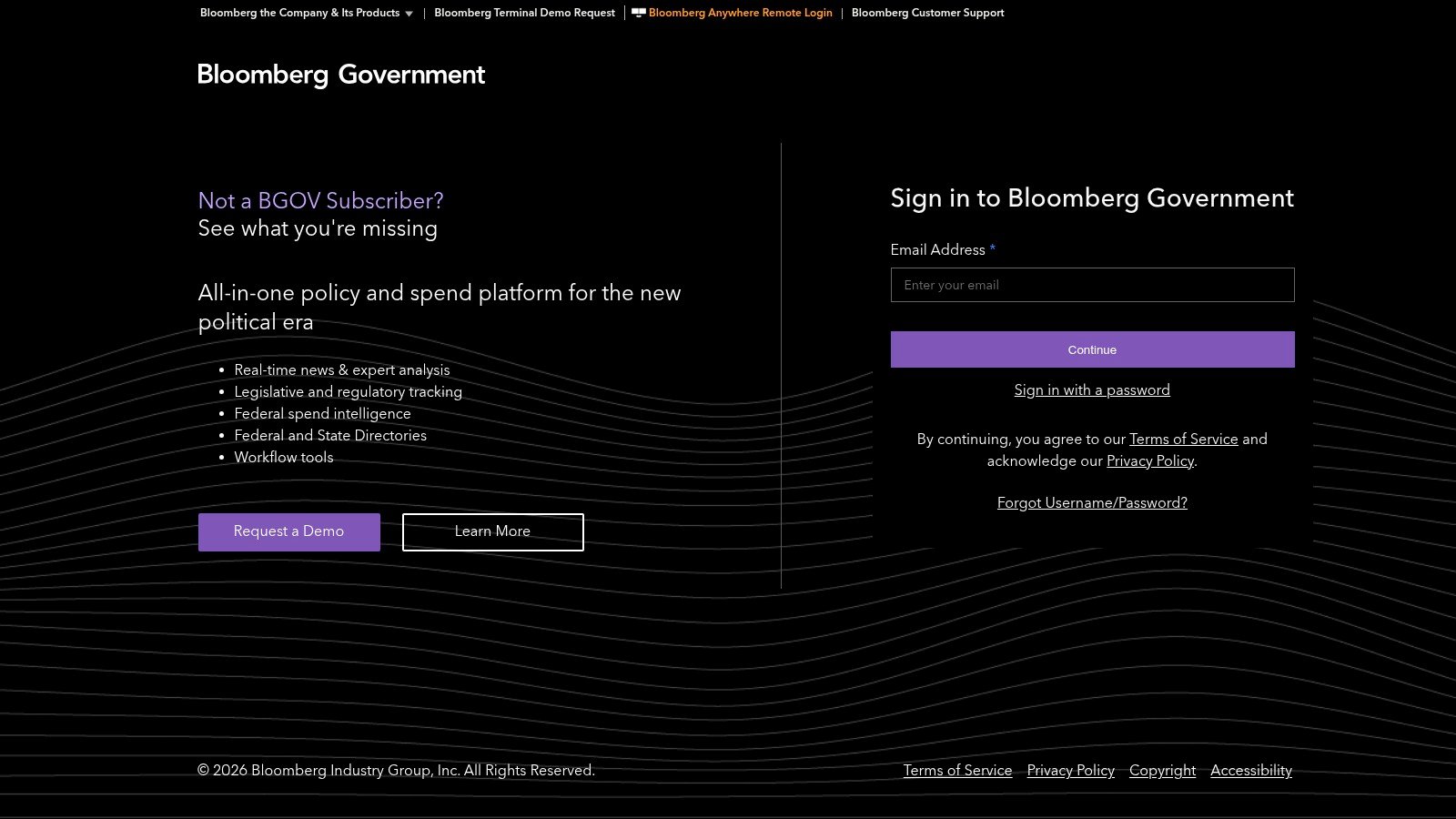
Bloomberg Government, commonly called BGOV, is less of a pure proposal workspace and more of a policy-aware federal intelligence environment. It combines procurement dashboards, opportunity pipelines, document search, legislative tracking, regulatory monitoring, directories, and expert analysis. That combination helps a BD leader answer a question that opportunity databases often miss: what policy or funding event is changing the market around this procurement?
A capture team pursuing federal work may need to monitor a budget authorization, an agency priority, or a regulatory change alongside the contract record. BGOV puts those signals in the same strategic conversation. Its dashboards and analysis are particularly useful when executives want a concise explanation of why a market is changing, not just a list of solicitations.Bloomberg Government
The right operating model
BGOV works best when a federal strategy function actively turns policy intelligence into account plans, call plans, and capture decisions. It isn't the obvious choice for a proposal-heavy shop seeking automated drafting, cited compliance matrices, or a complete submission workflow.
The platform also has an enterprise-style subscription and quote-based pricing. That makes it a serious investment for organizations that need policy context across a portfolio, not a casual research subscription for one business development representative. SLED coverage isn't its primary design center, so state and local contractors should treat it as a federal intelligence layer rather than a complete market solution.
Recommendation: choose BGOV when federal funding and policy context directly influence your pursuits. Layer it with a proposal system if the capture organization needs stronger drafting and compliance execution. Don't select it as a GovDash replacement if your core problem is document production or SLED discovery.
Small businesses entering GovCon markets should be cautious. BGOV's strengths become valuable as strategic complexity grows, but a newer contractor may get more practical value from a simpler opportunity tool and a disciplined federal account plan.
5. GovTribe
Best for: Mid-market federal contractors that want modern procurement intelligence, transparent plan tiers, and scalable data access.
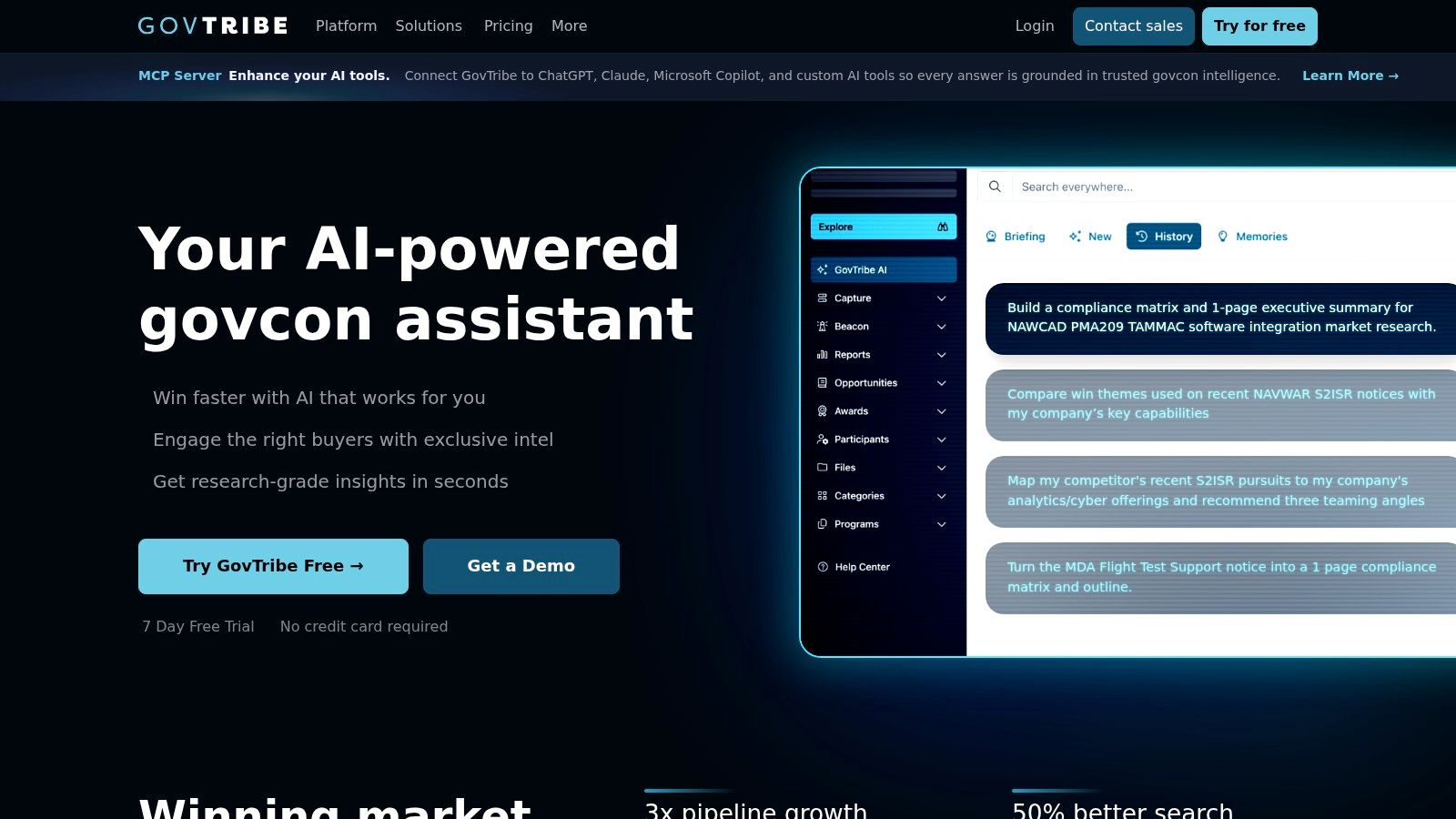
GovTribe is a practical choice for teams that have outgrown manual SAM.gov searching but aren't ready to fund an analyst-heavy platform. Its materials describe coverage across federal, state, and local agencies, along with vendor competition analysis, teaming partner discovery, and agency spending patterns.Microsoft Marketplace profile for GovTribe
The platform combines opportunity and award data with predictive analytics, vehicle tracking, AI-assisted research, protest intelligence, exports, and in-app teaming. That makes it useful for a capture manager who needs to move from “what is open?” to “who has won this work, which vehicle matters, and who could strengthen our bid?”
The credit model matters
GovTribe's rapid feature cadence is attractive, but advanced AI functions use consumption or credit-based add-ons. That pricing architecture can work well for occasional research and targeted acceleration, but procurement owners should model usage before committing. A team that runs frequent research workflows may experience a different cost profile from a team that uses AI occasionally.
GovTribe also provides less analyst-verified interpretation than premium analyst-led platforms. The data can support a strong internal research process, but your team still needs people who can validate assumptions, assess customer relationships, and build a defensible bid strategy.
GovTribe is a strong mid-market pipeline builder, not an all-in-one proposal operating system. Layer it with a specialized proposal platform when drafting, compliance, and review cycles are the main constraint. For a direct look at adjacent products, compare GovTribe alternatives.
Small businesses can start here more comfortably than with GovWin IQ, but they shouldn't assume every AI feature is included in the base plan. Established contractors should evaluate API and export requirements early, especially if the platform must feed a CRM, data warehouse, or internal capture dashboard.
6. HigherGov
Best for: Data-driven capture teams that need API access, quantitative analysis, and programmatic integration into internal systems.
HigherGov stands out when procurement intelligence must become part of a company's operating architecture rather than remain inside a browser tab. The platform combines opportunity and award databases with analytics around labor pricing and vehicles, plus coverage of grants, company relationships, and organizational mapping. Its documented API supports programmatic search and operationalization.HigherGov
That technical posture changes the implementation conversation. A data team can connect intelligence to internal qualification models, account dashboards, CRM workflows, or custom reporting. A capture leader can then work from a shared view rather than asking analysts to export and reformat information manually.
Pick it for integration, not hand-holding
HigherGov is a strong choice for organizations with internal technical support and a clear data governance model. Bulk downloads and API access are valuable only when someone owns field mapping, refresh logic, permissions, and downstream quality checks. Without that ownership, the integration advantage can turn into another neglected data project.
The platform serves both newer entrants and larger contractors, but its best fit is a quant-oriented team that wants to inspect evidence and build its own operating layer. Analyst advisory depth is lighter than the most analyst-heavy platforms, so teams seeking interpretation and market playbooks may prefer GovWin IQ or Bloomberg Government.
Pricing and export limits vary by plan, and advanced exports may require higher tiers. Confirm those limits against the actual workflow before selecting it as a core data source. Small businesses should avoid paying for API capability they won't use. A larger contractor comparing the platform with adjacent products can review HigherGov alternatives and competitors.
7. Fedmine, a GovSpend solution
Best for: Federal capture and pricing teams that need detailed spend, subcontract, task-order, vehicle, and protest intelligence.
Fedmine is a federal analytics platform within GovSpend's public-sector intelligence suite. Its materials describe standardized data from 19 federal sources, including FPDS and GAO protest information, with visibility into subcontracting, task orders, GWAC and IDIQ alias relationships, reports, downloads, and category views.GovSpend's agency intelligence materials
This is the tool to examine when a pursuit depends on historical pricing, task-order behavior, or subcontract intelligence. It can help a capture team investigate how work has moved through a vehicle and how awards relate across records. That level of federal spend detail is more useful for pricing and competitive analysis than for broad, multi-jurisdiction opportunity discovery.
A federal specialist with a defined boundary
Fedmine is primarily federal-focused. SLED intelligence lives in separate GovSpend modules, so buyers should evaluate the complete package if state and local work is part of the growth plan. Packaging is quote-based and requires a discovery call, which also means the procurement team should request a clear explanation of included sources, exports, seats, and modules.
Fedmine is best layered with a discovery or proposal platform. It doesn't replace the need for capture collaboration, solicitation analysis, or proposal drafting. For an established federal prime, that specialization can be a strength. For a small contractor seeking one affordable workspace, it may create too much stack complexity.
Review GovSpend alternatives for government contractors before deciding whether Fedmine should be the primary intelligence layer or a pricing and competitive-data supplement.
8. Federal Compass
Best for: Federal-first capture teams that want structured pipeline and market intelligence with stronger budget discipline than premium analyst suites.
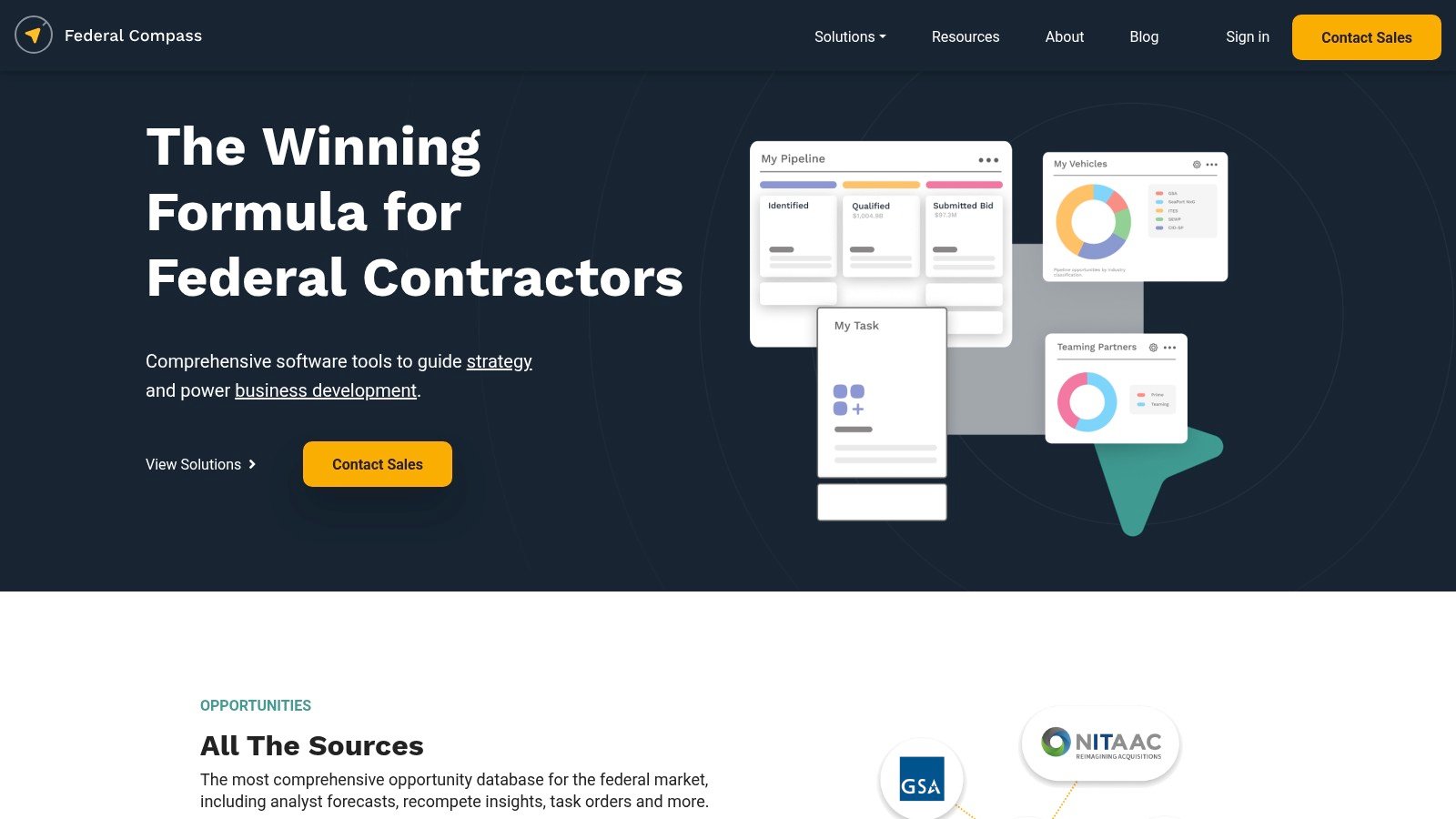
Federal Compass is built around federal opportunity discovery, capture workflow, pipeline management, sourcing, CRM elements, and strategic research. Its federal-first orientation suits teams that need a practical system for organizing pursuits without adopting a broad platform designed around every stage of government contracting.Federal Compass
The product appeals to organizations balancing capability depth with budget consciousness. A capture manager can use it to organize the BD lifecycle, research federal markets, and maintain a more deliberate pipeline than a collection of saved searches and spreadsheets provides.
Know what it doesn't cover
Federal Compass isn't the strongest choice for a contractor whose growth plan depends on broad SLED coverage, integrated proposal drafting, or extensive teaming intelligence. Its emphasis is federal capture, so buyers should test whether the platform reflects the agencies, contract vehicles, and opportunity types that matter to their specific portfolio.
Per-user pricing can also add up as more business development, capture, proposal, and executive stakeholders need access. This is a common enterprise evaluation issue. A platform that looks cost-conscious for a small pilot may require a different budget once adoption expands across business units.
For an established contractor, Federal Compass makes sense as a focused federal capture system. For a small business, it can be a reasonable entry point if the team is committed to federal work and wants more structure than SAM.gov. It isn't a substitute for a full end-to-end operating system when the organization needs discovery, qualification, teaming, proposal execution, and finance in one place.
9. BidPrime
Best for: SLED specialists and vendors that need nationwide state and local bid alerts plus document-level specification search.
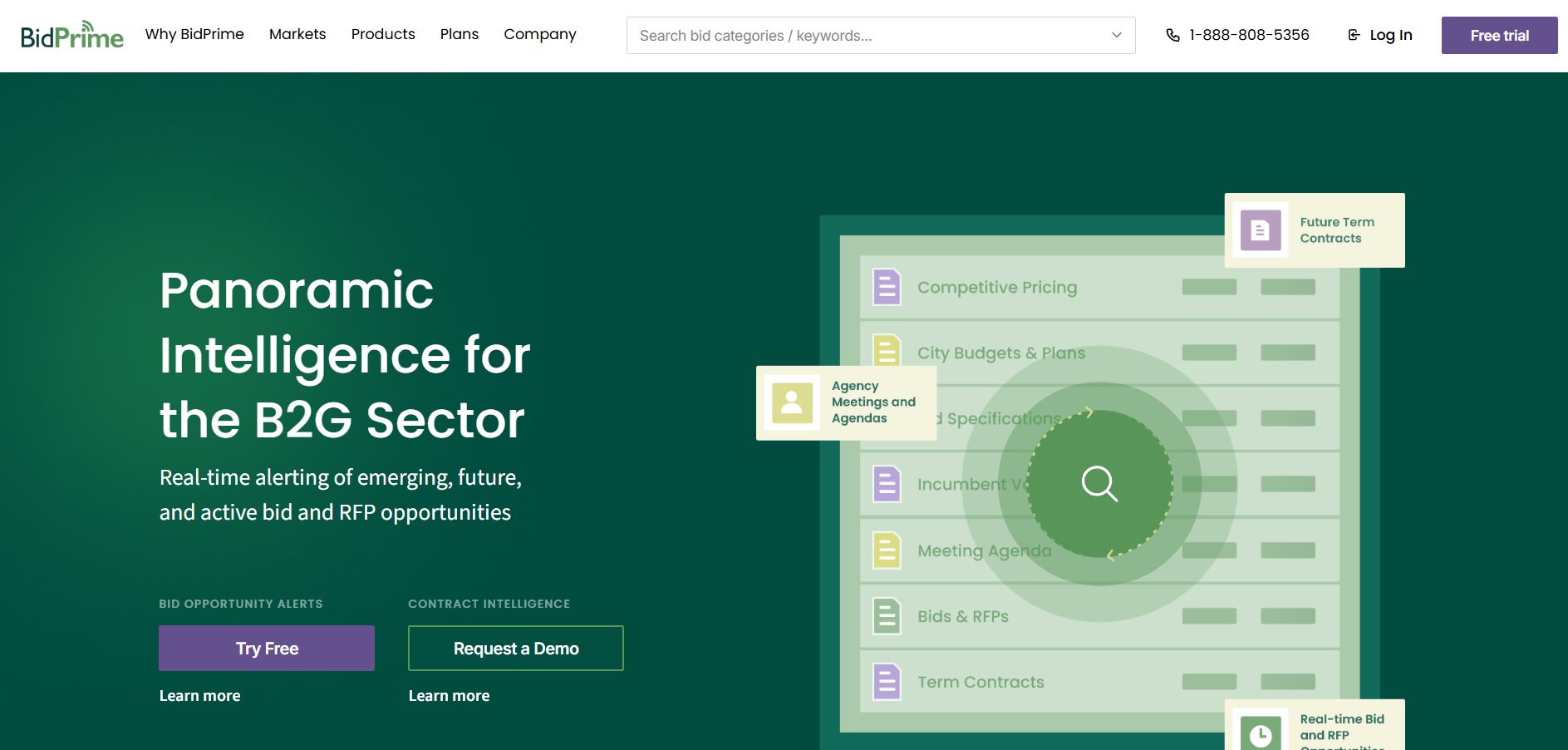
BidPrime is the clearest recommendation for a contractor whose opportunity mix is dominated by state and local procurement. It covers US state, local, and federal opportunities, provides real-time alerts, and offers DocSearch and Docs on Demand for searching specifications at the document level. Historical analytics and CSV or Salesforce export options support follow-up inside established sales processes.BidPrime
The document search is the operational advantage. SLED teams often need to find requirements buried in specifications, attachments, and procurement documents rather than rely only on titles or summary fields. BidPrime's search-oriented workflow can reduce the manual effort required to locate relevant language across a broad bid universe.
Discovery is not capture
BidPrime focuses more on discovery and alerts than on deep capture or proposal workflows. It won't replace a system that extracts requirements, builds a compliance matrix, coordinates color-team reviews, or manages a complete pursuit plan. Treat it as a SLED intelligence layer and connect it to CRM and proposal operations.
Published plan sheets make the buying process easier to understand, but national configurations can land in the mid-to-high range for smaller SMB budgets. Buyers should compare the geographic coverage they need with the cost of broad monitoring.
BidPrime is a good layer for an established contractor that already has capture and proposal systems but lacks dependable SLED discovery. It can also help a regional specialist build a disciplined monitoring process. It isn't the best universal replacement for GovDash, and it won't solve federal recompete forecasting or enterprise-wide capture governance on its own.
10. AutogenAI Federal
Best for: Proposal-heavy federal contractors that need secure AI drafting, review, and long-form technical response support.
AutogenAI Federal is the specialist to shortlist when the main failure point occurs after the team decides to bid. Its positioning centers on U.S. federal proposal creation, closed-boundary architecture, higher-assurance security, content-library use, red-team-style review, and compliance-oriented drafting workflows. The product also references roadmap support for IL5 and IL6 deployments and integration with Microsoft ecosystems.AutogenAI Federal
This is a proposal production decision, not a market-intelligence decision. AutogenAI Federal can help teams accelerate technical writing, reuse approved content, and conduct structured reviews, but a contractor still needs discovery and capture data from another platform if it wants a complete pipeline view.
Pair it with intelligence
The strongest architecture for a proposal-centric shop is often a discovery platform plus AutogenAI Federal. GovTribe, HigherGov, GovWin IQ, or SamSearch can supply opportunity and competitive context, while AutogenAI Federal handles the document-heavy response process.
Pricing and authorization details require direct vendor engagement and aren't fully public. Security buyers should verify the exact environment, deployment boundary, data handling, and authorization status against the contract's requirements rather than rely on general positioning language.
Small businesses should be selective. A specialist proposal platform can make sense when the team regularly responds to complex federal RFPs and has approved content ready for reuse. It won't help much if the bigger issue is discovering qualified opportunities or finding teaming partners. Established proposal organizations should pressure-test it on real solicitations, including amendments, technical volumes, compliance review, and final production constraints.
Comparison Table: Top 10 GovDash Alternatives & Competitors, 2026
| Rank | Platform | Core features | Unique selling points | Target audience & fit | Pricing & UX |
|---|---|---|---|---|---|
| 1 | SamSearch | AI capture (Sammy) reads RFPs, matches opportunities (federal, SLED, DIBBS, subcontracts, SBIR, Canada), partner discovery (600K+), Journey Hub, CRM sync, finance introductions | End-to-end GovCon OS, analyst-verified recompete forecasts, enterprise security (SOC 2 Type II, A+ VAPT, SAML, US-hosted), proven ROI ($3B+ won); docs not used to train shared AI | Established government contractors, mid-market & enterprise (not for small-business set-aside) | Seat- and module-based annual quotes; enterprise UX, SSO, dedicated security/compliance |
| 2 | Civio.ai | AI-assisted opportunity analysis, solicitation review, pursuit support, workflow acceleration for federal teams | AI-first approach for faster qualification and early capture decisions | Federal contractors seeking guided AI support across early pursuit workflows | Direct vendor evaluation required; modern AI-centric UX |
| 3 | Deltek GovWin IQ | Analyst-sourced opportunity intelligence, forecasts, pipeline & capture tools, Deltek ecosystem integrations | Large analyst team (150+), deep validation and early recompete insight; widely adopted by primes | Primes and mid-market/enterprise capture teams needing analyst-validated leads | Premium, quote-based per-seat pricing; enterprise support and training |
| 4 | Bloomberg Government (BGOV) | Federal procurement dashboards, opportunity pipeline, policy & legislative tracking, document search | Combines policy/legislative context with opportunity data; executive-ready analysis | BD teams tying capture strategy to policy/funding; enterprise users | Quote-based enterprise subscriptions; high-touch onboarding |
| 5 | GovTribe | Opportunity & award data, AI-assisted search, protest signals, teaming, API/exports | Transparent plan tiers, rapid feature cadence, protest intelligence and scalable data access | Mid-market teams wanting scalable intel without analyst retainers | Published tiers with trial options; some AI features consumption/credit-based |
| 6 | HigherGov | Opportunity & award databases, grants coverage, relationship mapping, documented API | API-first, bulk exports and quant tools for integration-heavy teams | Data-driven teams integrating gov-intel into internal systems | Tiered plans; export limits and higher tiers for advanced exports |
| 7 | Fedmine (GovSpend) | Aggregation from ~19 federal sources, subcontract/task-order visibility, pricing analytics | Deep federal data fidelity, task-order and subcontract-level insights for pricing research | Teams focused on federal spend, pricing, vehicle tracking and subcontract analytics | Quote-based packaging; federal-focused product within GovSpend suite |
| 8 | Federal Compass | Opportunity discovery, capture workflow modules, pipeline/CRM elements | Federal-first capture workflows designed by GovCon intelligence leaders; budget-conscious positioning | Federal capture and BD teams balancing capability and cost | Per-user pricing; cost-conscious alternative to analyst-heavy suites |
| 9 | BidPrime | SLED + federal coverage, doc-level search (DocSearch), real-time alerts, exports | Strong nationwide state/local coverage and powerful spec-level document search | Vendors prioritizing state/local monitoring and spec-level keyword research | Published plan sheets; discovery-focused pricing (national options vary) |
| 10 | AutogenAI Federal | Secure isolated environments, proposal drafting, content library, compliance workflows | High-assurance security posture for federal proposals; AI drafting/red-team style reviews | Teams needing secure AI-driven proposal generation for sensitive/federal work (pair with discovery tool) | Direct-engagement pricing; focused on drafting (not end-to-end market intel) |
FAQ
What is the best GovDash alternative in 2026?
For established mid-market and enterprise government contractors, SamSearch is the strongest end-to-end alternative because it combines discovery, qualification, capture, collaboration, proposal support, teaming, and financing preparation in one platform. Teams with narrower needs may be better served by specialists like Civio.ai for AI-first federal workflows, GovWin IQ for analyst-led intelligence, or BidPrime for SLED discovery.
Which GovDash competitor is best for AI-assisted federal opportunity analysis?
Civio.ai is one of the strongest options for teams that want AI support early in the pursuit lifecycle. It is best suited to federal contractors that need faster solicitation review, opportunity analysis, and qualification support before deciding whether to bid.
Which platform is best for SLED opportunities?
BidPrime is the clearest fit for teams focused on state, local, and education opportunities. Its document-level search and nationwide bid alert coverage make it especially useful for contractors that need to find opportunities buried in detailed specifications and attachments.
Is GovWin IQ better than GovDash for enterprise capture teams?
For large federal contractors that prioritize analyst-backed market intelligence, GovWin IQ is often a stronger choice than GovDash. Its value comes from deep federal forecasts, recompete research, vehicle tracking, and analyst support. That said, it is generally more expensive and better suited to mature capture organizations.
Which GovDash alternative is best for proposal writing?
AutogenAI Federal is the strongest specialist on this list for proposal-heavy teams that need secure AI drafting, review support, and content reuse. It works best when paired with a separate discovery or capture platform that supplies pipeline and competitive intelligence.
Should small businesses replace GovDash with an enterprise platform?
Not always. Some GovDash alternatives on this list are designed for mature teams with larger pursuit portfolios, more complex workflows, and bigger budgets. Small businesses should choose based on their actual bottleneck, whether that is discovery, capture, proposal production, or SLED coverage, rather than assuming the broadest platform is the best fit.
Choosing and Migrating Without Losing Pipeline
The government contracting software category is expanding, but more software won't automatically produce a stronger pipeline. One market estimate placed global government contracting software revenue at US$1.085 billion in 2025, with a projection of US$2.006 billion by 2032 at a 9.3% CAGR.OpenPR market estimate The buying decision should focus on whether the platform changes how your team prioritizes, qualifies, and executes pursuits.
Start with a parallel pilot over the next 30 to 90 days. Put the top two or three contenders against the same live opportunities, the same CRM fields, and the same solicitation documents. Don't let each vendor choose its preferred demonstration scenario. Your capture team should test forecast discovery, recompete research, fit scoring, teaming, requirements extraction, compliance evidence, proposal drafting, exports, and user adoption under ordinary working conditions.
The opportunity mix also deserves more attention than it usually gets. Deltek's Q1 2026 SLED snapshot reported that bid and RFP counts fell about 4% year over year, while purchasing spend grew roughly 4% to 6% each quarter.Deltek's Q1 2026 SLED snapshot For established contractors, that means prioritization and teaming around larger opportunities matter more than collecting more alerts.
Migration rule: Export pipeline state, CRM history, contact ownership, saved searches, opportunity notes, and document links before you cut over. A clean migration preserves institutional memory that isn't visible in a feature demo.
Your CISO should validate security documentation, SSO, hosting, penetration-test materials, data retention, model-training policies, and required compliance boundaries. Federal acquisition policy is also evolving. White House guidance directs agencies to conduct thorough market research and seek state-of-the-art AI capabilities, while newer procurement rules address data ownership, intellectual property protections, anti-lock-in measures, and performance monitoring for solicitations issued on or after September 30, 2025.White House memorandum on AI acquisition Your platform should support evidence-based work and governance, not just generate attractive prose.
For established mid-market and enterprise contractors, SamSearch remains the top recommendation because it brings discovery, qualification, capture, drafting, collaboration, teaming, and award financing into one secure workspace with SOC 2 Type II audited controls. Civio.ai is a strong second choice for teams that want AI-first federal pursuit support. GovWin IQ is the better intelligence investment for large federal primes that want analyst depth. BidPrime is the right specialist for SLED-heavy teams. AutogenAI Federal earns its place in proposal-centric environments. GovTribe and HigherGov are strong choices for modern, data-oriented pipeline operations.
Book a SamSearch demo, request side-by-side trials of Civio.ai, GovWin IQ, GovTribe, and HigherGov, and test each contender against your 2026 pursuits. Choose a go-forward architecture based on workflow ownership and evidence quality, not another dashboard added to the stack.
SamSearch gives established mid-market and enterprise government contractors one secure place to discover, qualify, capture, collaborate, draft, and prepare for financing across federal and SLED work. Visit SamSearch to book a demo and evaluate whether its end-to-end workflow can replace fragmented GovDash alternatives in your 2026 capture stack.