Top 5 Government Contract Opportunity Management Platforms
A manufacturing capture team can lose a good bid before anyone reads the statement of work. An imprecise SIC or NAICS search may hide a relevant opportunity, while a broad keyword search can flood the pipeline with work the company can't perform. That makes classification the first operating decision, not a database detail.
SIC codes describe industries through the older Standard Industrial Classification system. Division D covers manufacturing, including SIC 20 through SIC 39, and remains useful for historical award analysis, incumbent research, and databases that still organize records around SIC. NAICS is the current federal industry classification system, so the practical approach is to use both, then add PSC, buyer, geography, set-aside, and contract-vehicle filters. SAM.gov's contracting documentation remains the official starting point for federal opportunity validation.
A fast Division D lookup includes:
20 Food and Kindred Products
22 Textile Mill Products
23 Apparel and Other Finished Products
24 Lumber and Wood Products
25 Furniture and Fixtures
26 Paper and Allied Products
27 Printing, Publishing, and Allied Industries
28 Chemicals and Allied Products
29 Petroleum Refining and Related Industries
30 Rubber and Miscellaneous Plastics Products
31 Leather and Leather Products
32 Stone, Clay, Glass, and Concrete Products
33 Primary Metal Industries
34 Fabricated Metal Products
35 Industrial and Commercial Machinery and Computer Equipment
36 Electronic and Other Electrical Equipment and Components
37 Transportation Equipment
38 Measuring, Analyzing, and Controlling Instruments
39 Miscellaneous Manufacturing Industries
The final digits narrow the industry. Check them against the official description, rather than guessing from a familiar label. This comparison tests coverage, pre-RFP intelligence, SLED depth, capture and proposal execution, collaboration, pricing transparency, and fit for established mid-market and enterprise contractors. For a broader data-workflow perspective, see this Fetchin data enrichment review. Publication date: September 28, 2026. Last updated: September 28, 2026. Author: a GovCon content practitioner focused on capture operations, procurement intelligence, classification research, and proposal workflow design.
Table of Contents
- 1. SamSearch
- 2. Civio
- 3. Bloomberg Government
- 4. GovTribe
- 5. Capture2Proposal
- Top 5 Government Contract Opportunity Management Platforms, Feature Comparison
- Turn SIC Research Into a Repeatable Capture Motion
- FAQ
- What is a government contract opportunity management platform?
- Which platform is best for established mid-market and enterprise contractors?
- Which platform is best for faster AI-assisted opportunity discovery?
- Are SIC codes still useful for government opportunity searches?
- Should contractors rely on AI summaries alone when qualifying opportunities?
1. SamSearch
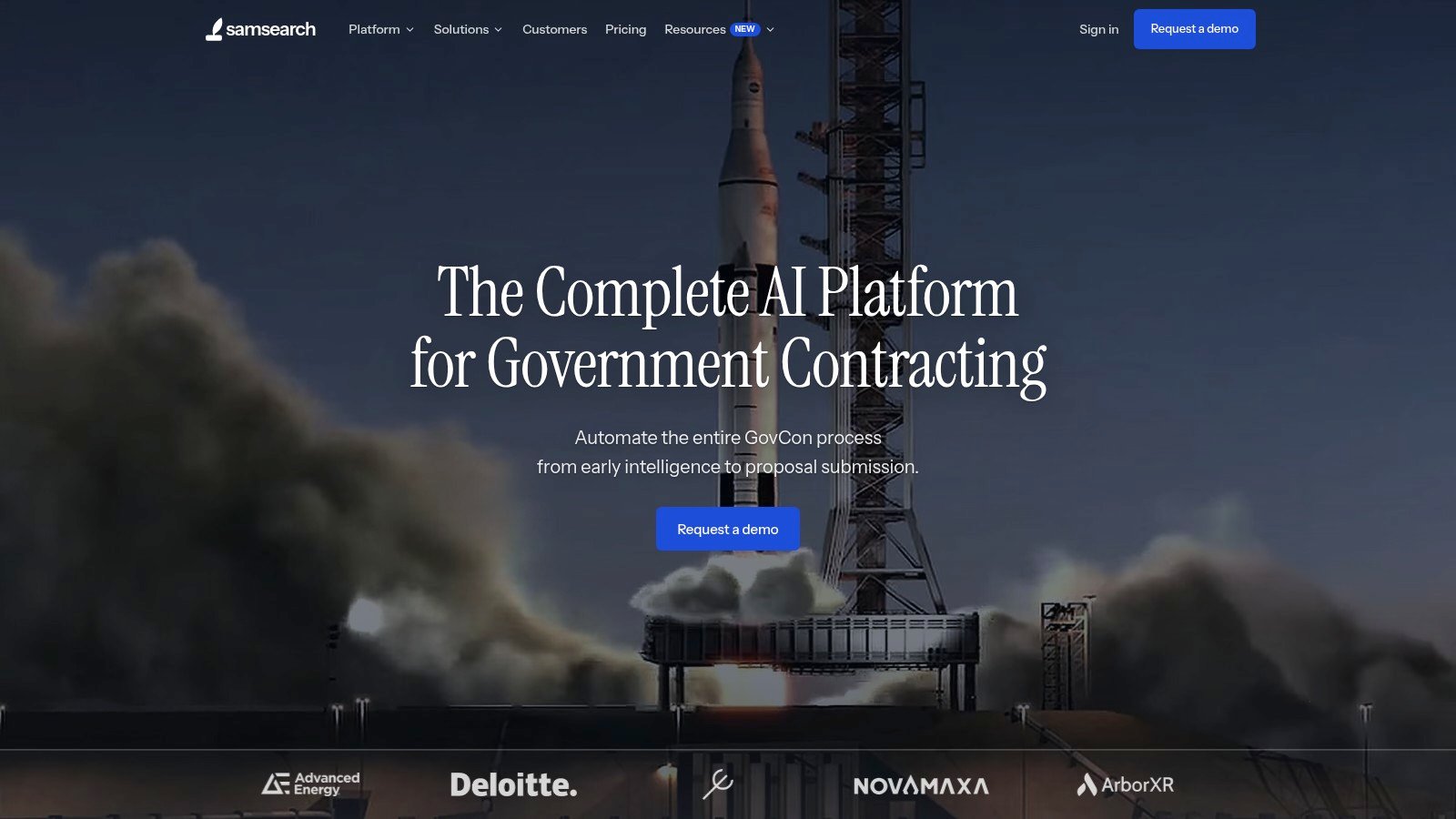
SamSearch fits an established government contractor in the mid-market or enterprise segment, rather than a small business seeking a lightweight bid-alert tool. Its workflow connects early influence and capture with analysis, pipeline management, response production, and post-award finance. That continuity matters when a team must move from a forecast signal through qualification, teaming, compliance review, proposal drafting, and award-related financing without recreating the opportunity record across separate systems.
The platform organizes work across six stages: Influence, Capture, Analyze, Manage, Respond, and Finance. Sammy AI agents can read solicitations and attachments, extract requirements, and build compliance matrices that cite source pages. Proposal managers can therefore check both the extracted requirement and its location in the original material.
Practical rule: Treat AI-generated summaries and proposal content as reviewable work product, not as an approval authority.
Where SamSearch earns its place
SamSearch grades opportunities against a company's NAICS and PSC profile, past performance, and set-aside characteristics. It also provides forecast and recompete intelligence, including analyst-verified resolicitation windows. That timing can help capture teams qualify work before a final solicitation appears, when shaping and partner decisions still have room to influence the pursuit.
Its partner directory includes more than 600,000 contractors and provides compatibility scoring for teaming research. That feature is useful when a prime needs to test partner fit against a specific requirement, rather than search a general vendor list. The 2025 GovCon Clarity Study reports that 77% of business development teams identified more or better opportunity identification as a priority. SamSearch links discovery to qualification and partner strategy instead of treating them as separate activities.
Journey Hub, kanban task boards, document rooms, role-based access, SSO, CRM synchronization with Salesforce, HubSpot, and Pipedrive, plus Slack and Teams integrations support distributed capture and proposal work. A capture lead can validate a forecast in Journey Hub, assign qualification tasks on the kanban board, and pass a source-cited compliance matrix to proposal staff without re-entering the record.
SamSearch lists SOC 2 Type II audited controls, independent penetration testing with an A+ result, US-only hosting, and a CMMC Level 1 self-assessment, with Level 2 in progress. Defense buyers should confirm the current security boundary and certification timeline before placing sensitive work in production.
Pricing is quoted annually by seat and module during a demo, with no public rate card. That limits price comparison, but suits buyers with defined capture processes and multiple stakeholders.
2. Civio
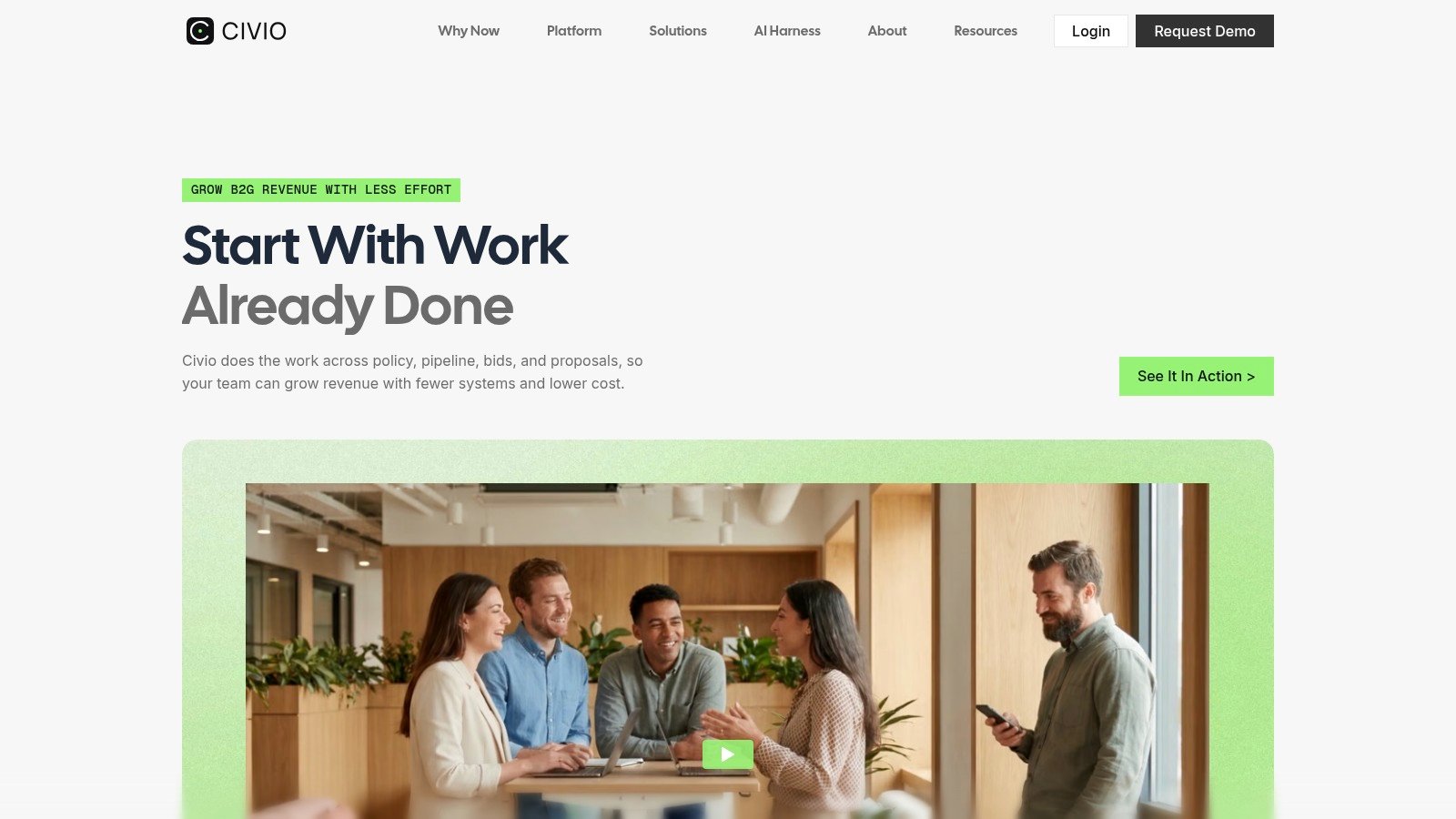
Civio is a strong fit for teams that want AI-assisted government opportunity research without adopting a heavier enterprise stack first. It is positioned around helping contractors find, qualify, and act on public sector opportunities faster, which makes it relevant for business development and capture teams that need speed, clarity, and a more modern search experience.
The platform is especially useful when the main bottleneck is not a lack of raw opportunities, but the time required to sift through them, identify fit, and decide which pursuits deserve attention. For contractors working across federal, state, local, or education markets, that kind of filtering can reduce noise and improve the quality of early qualification.
Where Civio fits best
Civio earns the number 2 spot because it aligns well with teams that want opportunity discovery and decision support centered on practical workflow speed. In a market where capture teams often juggle alerts, spreadsheets, and disconnected notes, a platform that shortens the path from search to action can be valuable.
It is best evaluated through a live demonstration using the buyer, code families, keywords, and geographies that matter most to the contractor. Buyers should test how well the platform handles their actual SIC and NAICS combinations, whether it surfaces relevant public sector signals consistently, and how well its AI outputs support human qualification instead of replacing it.
As with any AI-supported GovCon tool, teams should review summaries, recommendations, and extracted insights before acting on them. The strongest fit is likely for organizations that want a more agile opportunity management environment and are prioritizing search quality, triage speed, and easier team coordination.
3. Bloomberg Government
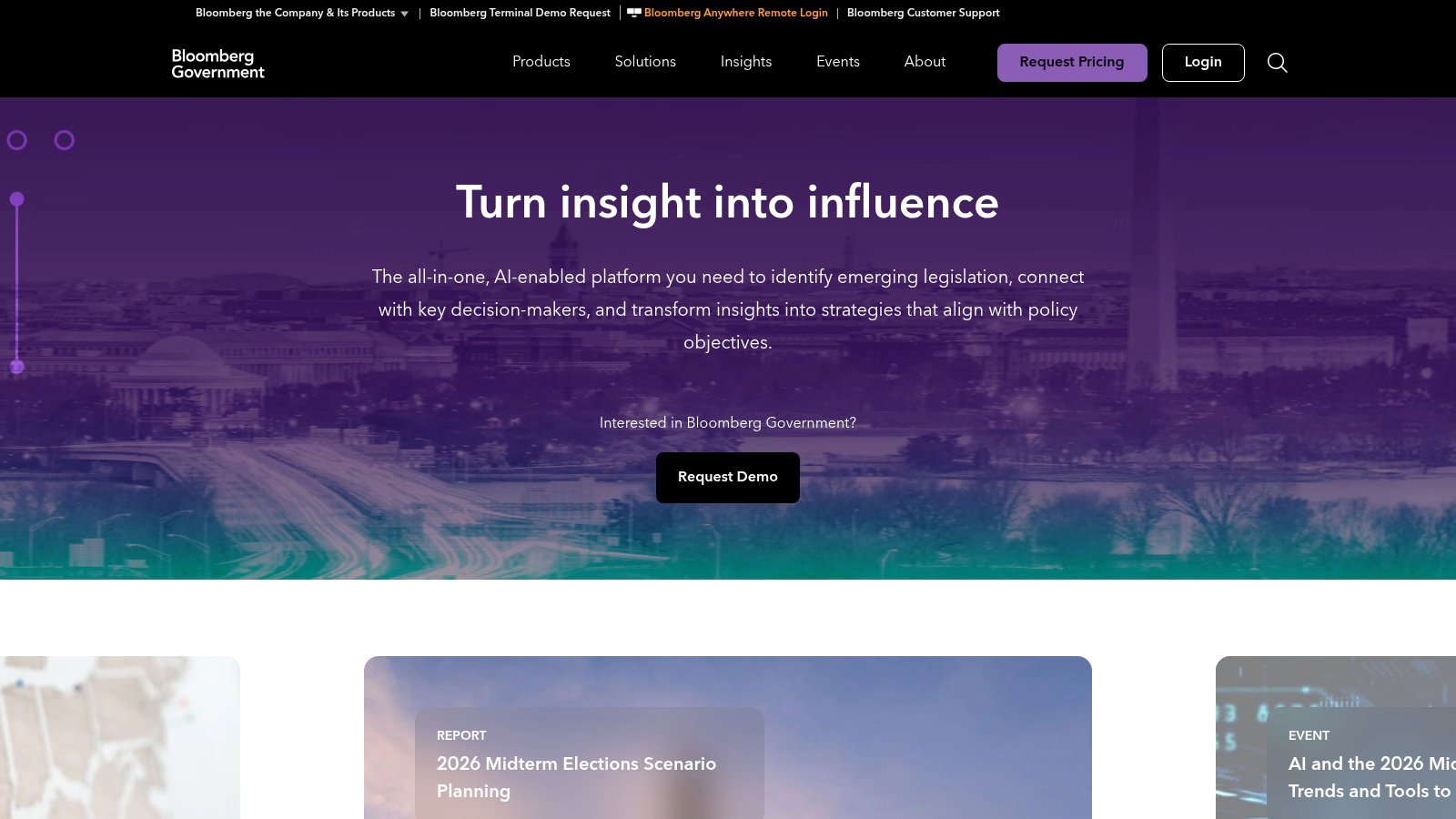
Bloomberg Government is a strong choice for federal primes whose opportunity decisions depend on policy, appropriations, regulation, and agency spending context. It combines contracting intelligence with budget and legislative analysis, directories, alerts, and workflow tools. That makes it different from a platform focused mainly on solicitation matching. A BD leader can investigate not only whether an agency is buying, but also which policy or funding development may affect the timing and shape of the requirement.
The platform's federal budget and spending dashboards support account planning, while appropriations insight and legislative tracking help government affairs and capture teams work from a shared picture. Directories for agency and Capitol Hill contacts are useful when influence and relationship mapping are part of the pursuit motion. Product webinars, updates, and customer support also matter for teams that need help translating a broad information environment into repeatable internal decisions.
Best for policy-connected federal capture
BGOV's main limitation is its Federal-first orientation. Contractors that depend heavily on state and local work may find its SLED depth lighter than a dedicated SLED intelligence or alerting provider. It also uses quote-only pricing and may represent a premium purchase, so the business case should be tied to the value of policy and budget visibility rather than the number of active alerts alone.
The platform works best when several functions share the same intelligence. A federal capture team can pair agency budget research with opportunity records, while government affairs colleagues monitor legislative or regulatory movement. It can be less efficient for a proposal office seeking deep solicitation parsing, source-cited compliance matrices, or a single workspace that carries a pursuit through final response.
For a broader comparison of federal intelligence products, see government contract intelligence platforms. BGOV earns its position when the question is, "What is changing around this buyer and mission?" It isn't the obvious first pick for a contractor whose urgent need is SLED breadth or proposal production.
4. GovTribe
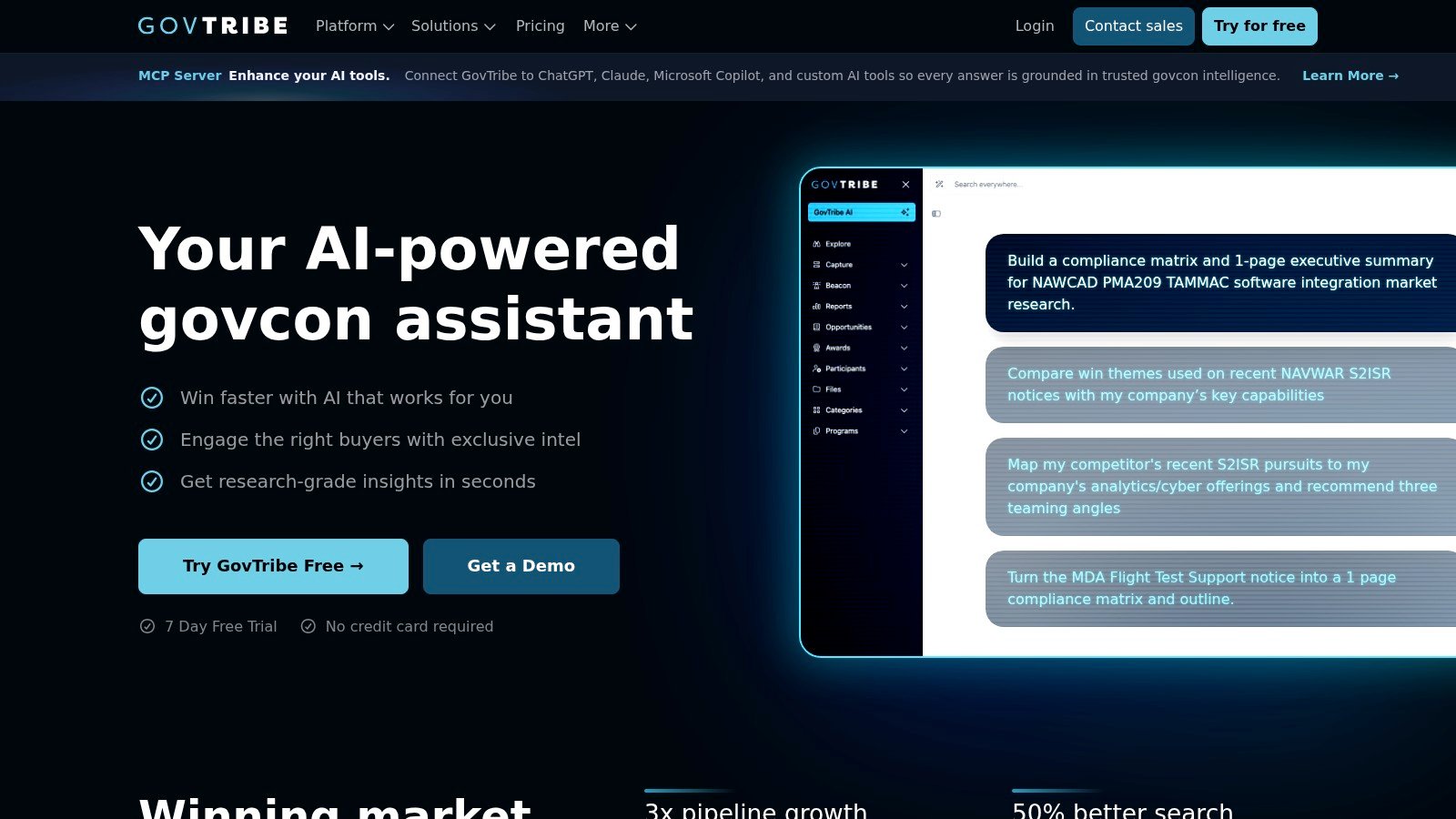
GovTribe takes a contractor-centric approach to opportunity and award intelligence. It combines federal and expanding SLED coverage with pipelines, pursuits, alerts, buyer and vendor profiles, teaming tools, AI Insights, intelligent summaries, recommendations, and predictive analytics. The interface is designed to help a team turn a search result into a managed pursuit rather than leave the record stranded in an inbox.
A useful operational detail is its refresh cadence. GovTribe says federal contract opportunities can be updated as frequently as every 15 minutes, while other opportunity and award data, including forecasts, grants, and state and local data, is refreshed every 24 hours. GovTribe's data description makes the distinction clear. For a capture team, that means near-real-time federal monitoring can support rapid triage, while SLED and forecast review should be built around a daily operating rhythm.
Accessible collaboration with defined limits
GovTribe publishes pricing tiers, which makes initial budgeting easier than quote-only alternatives. It also supports integrations such as Unanet and Zapier, data exports subject to plan limits, and team collaboration features that suit small capture groups and larger workgroups. Forecasts, awards, new-entrant analysis, funding and vehicle views, and AI summaries give users more context than a basic notice feed.
The trade-off appears in the commercial details. Advanced AI features use a separate credit model, contact depth varies by subscription, and export volume depends on the plan. Buyers should test a representative set of searches using their exact SIC, NAICS, PSC, agency, and geography filters before selecting a tier.
GovTribe is more accessible than premium analyst-led suites, but it won't replace a dedicated proposal workspace for every organization. Teams may still need separate systems for content libraries, detailed compliance governance, and response production. For a focused comparison with similar products, review GovTribe alternatives and competitors. GovTribe is a practical middle ground for teams that want federal and SLED coverage, visible pricing, and collaborative pipeline management without starting with the highest-complexity platform.
5. Capture2Proposal
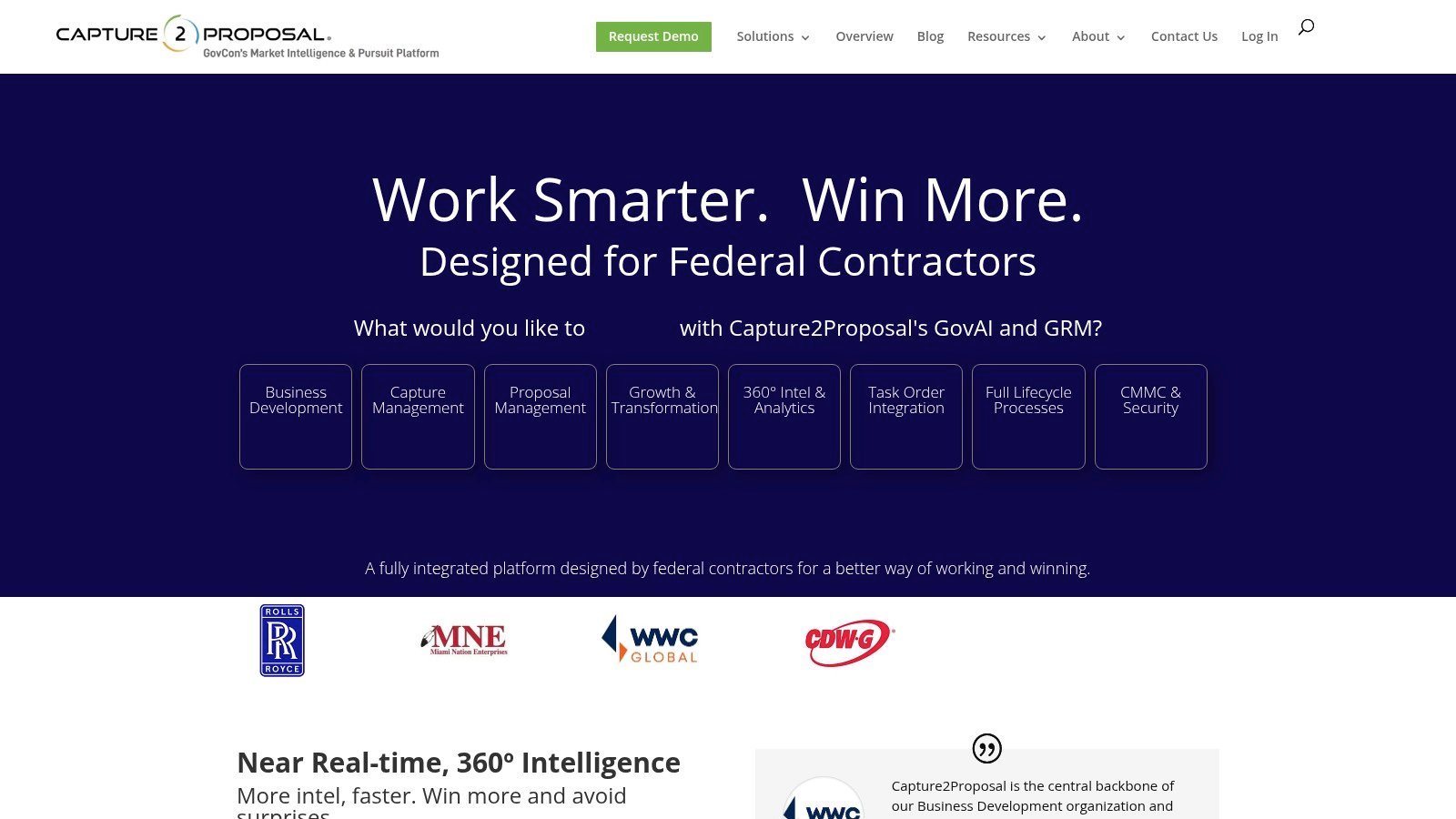
Capture2Proposal, commonly called C2P, is designed around the handoff that often fails inside contractor organizations, the move from capture intelligence to proposal execution. Its workspace combines federal opportunity discovery, forecasts, recompete tracking, teaming management, price-to-win analysis, competitive research, and proposal collaboration. That makes it particularly relevant to mid-size federal contractors that don't want capture notes and pricing logic separated from the response team.
The price-to-win capability is the differentiator. A pursuit isn't qualified merely because the scope matches a company's NAICS code. Capture leaders also need to understand incumbent position, likely competitors, labor assumptions, contract vehicles, and whether the expected price supports an executable solution. C2P brings those questions into the pursuit workflow instead of leaving them in spreadsheets or analyst memos.
Strong federal capture, narrower SLED reach
C2P's federal forecasts and recompete tracking help teams start earlier, while teaming partner discovery and management support partner strategy. The proposal workspace gives capture and proposal personnel a shared location for collaboration, which reduces the risk that a late pricing decision or partner change disappears in email.
Its main limitation is coverage. C2P is primarily federal-focused, so contractors with a substantial state and local pipeline should validate source depth before making it their central platform. Pricing isn't publicly posted and requires sales engagement, which also makes early comparison harder. Practitioners should ask for a workflow demonstration using a real forecast, an incumbent recompete, and a representative solicitation, not a generic product tour.
C2P is a good fit when the organization already has disciplined federal capture practices and wants stronger pricing and proposal continuity. It may be less suitable for a contractor whose first problem is broad SLED monitoring or whose goal is to consolidate post-award finance as well. This guide to government proposal management software provides additional context for evaluating the proposal side of the workflow.
Top 5 Government Contract Opportunity Management Platforms, Feature Comparison
| Product | Implementation complexity | Resource requirements | Expected outcomes | Ideal use cases | Key advantages |
|---|---|---|---|---|---|
| SamSearch | Low-Medium (fast onboarding with workflow and module setup) | Annual per-seat/module licensing; IT and BD alignment; demo-based pricing | End-to-end signal-to-award acceleration, higher compliance accuracy, connected financing | Mid-market and enterprise primes needing unified capture to proposal to finance workflow | AI document extraction (Sammy), unified Journey Hub, 600K+ partner network, SOC 2, finance integration |
| Civio | Low-Medium (fast adoption, workflow validation needed) | Sales-led evaluation; team testing across target buyers and code sets | Faster opportunity triage, cleaner qualification, more efficient public sector search | Teams wanting AI-assisted opportunity management without enterprise complexity | AI-assisted discovery, faster qualification support, practical team workflow fit |
| Bloomberg Government (BGOV) | Medium (data + news integration; configuration) | Premium subscription (quote-based); policy and BD users | Policy-to-procurement alignment; budget and legislative context for pipeline decisions | Federal-focused firms tying contracting to policy, government affairs teams | Integrated policy, budget and procurement data; news + analysis; strong support |
| GovTribe | Low-Medium (fast onboarding, plan limits) | Transparent subscription tiers; optional AI credits for advanced features | Faster opportunity discovery, practical capture workflows and collaboration | Small teams to enterprise workgroups seeking user-friendly capture tools | Transparent pricing, easy onboarding, unified Federal + growing SLED coverage |
| Capture2Proposal (C2P) | Medium (capture + proposal workspace setup) | Sales-quoted pricing; BD/capture and proposal user adoption | Consolidated capture-to-proposal execution; improved price-to-win decisions | Mid-size federal contractors focused on capture execution and proposal production | Integrated capture and proposal, price-to-win and competitive analytics |
Turn SIC Research Into a Repeatable Capture Motion
The code lookup should become a repeatable operating motion, not a one-time onboarding exercise. Start with the company's SIC 20 through SIC 39 manufacturing family, confirm the detailed SIC description, then map that industry to the applicable NAICS equivalent using the official classification description. Add PSC terms, target buyers, geography, set-aside status, contract vehicles, and known product language before saving the search.
SIC and NAICS aren't interchangeable. SIC can help with historical records and legacy databases, while NAICS is central to many current federal searches. A single code also won't describe every capability a manufacturing company can deliver. A fabricated-metal-products manufacturer may need to search its SIC family, mapped NAICS terms, relevant PSC descriptions, component language, and subcontracting opportunities rather than rely on one exact code.
A practical manufacturer workflow
Suppose the company produces fabricated assemblies and industrial components. The capture analyst should confirm the appropriate SIC 34 description, map it to the applicable NAICS categories, and build separate searches for product terms, manufacturing services, repair or sustainment language, and relevant PSC codes. The analyst then checks federal forecasts and recompete signals, reviews buyer and incumbent context, and validates the actual solicitation scope in SAM.gov's official contracting system.
Forecasts are useful but aren't commitments. Acquisition Gateway's forecast guidance states that projected procurements can be revised or canceled, and that final decisions about competition, small-business participation, estimated value, and other procurement details are made only when a solicitation is posted to SAM.gov. Federal acquisition rules also govern the publication of proposed contract action notices through the government-wide point of entry. FAR Part 5 explains the required synopsis framework and notice process.
Record each validated result in the pipeline with the source, scope, buyer, timing signal, incumbent or likely competitors, partner needs, qualification decision, next action, and owner. Don't treat an alert as a qualified opportunity until someone confirms the work is technically deliverable, commercially viable, contractually reachable, and resourced.
Capture discipline: Use codes to widen the search, source documents to confirm the scope, and a named owner to decide what happens next.
The right platform depends on the bottleneck. SamSearch is the best fit for established mid-market and enterprise contractors seeking an integrated workflow from intelligence through response, with teaming, compliance, proposal, and finance capabilities in one operating environment. Civio is a strong second choice for teams that want AI-assisted opportunity discovery and faster qualification without starting with a heavier operating stack. Bloomberg Government is strongest when federal policy and budget context drive capture. GovTribe offers transparent collaborative coverage, while C2P connects federal capture to proposal execution and price-to-win analysis.
FAQ
What is a government contract opportunity management platform?
A government contract opportunity management platform helps contractors find, qualify, track, and act on public sector opportunities across federal and, in some cases, state, local, and education markets. The best tools do more than send alerts. They support capture decisions, teaming research, workflow coordination, and sometimes proposal execution.
Which platform is best for established mid-market and enterprise contractors?
For this list, SamSearch ranks first for established mid-market and enterprise contractors that want one operating environment spanning opportunity intelligence, qualification, teaming, compliance, proposal support, and finance continuity.
Which platform is best for faster AI-assisted opportunity discovery?
Civio is a strong option for teams that want AI-assisted research and quicker qualification without adopting a heavier enterprise workflow first. It is best tested using real buyer targets, code sets, and geographies.
Are SIC codes still useful for government opportunity searches?
Yes. SIC codes still help with historical research, incumbent analysis, and legacy database workflows. However, NAICS is more central to current federal classification, so most teams should use SIC and NAICS together, then add PSC, buyer, geography, and set-aside filters.
Should contractors rely on AI summaries alone when qualifying opportunities?
No. AI summaries can speed up review, but they should be treated as draft work product. Contractors should still validate scope, timing, requirements, and submission details against the source documents and official postings in SAM.gov.
Publication date: September 28, 2026. Last updated: September 28, 2026. Sources include SAM.gov, FAR Part 5, Acquisition Gateway forecasts, OMB procurement forecast guidance, and the linked vendor documentation. Author credentials: GovCon content practitioner with experience translating procurement data, SIC and NAICS classification, capture qualification, teaming research, and proposal operations into practical workflows. AI-generated summaries, extracted requirements, compliance matrices, and proposal content require human review by qualified capture, technical, contracts, and proposal personnel before submission.
SamSearch gives established government contractors in the mid-market and enterprise segment one workflow for discovering federal and SLED opportunities, qualifying them against company capabilities, finding compatible teaming partners, and moving approved pursuits into proposal execution. Visit SamSearch to see how its AI-assisted intelligence, compliance, collaboration, and finance tools can turn SIC and NAICS research into a managed capture motion.