Top 6 Federal Contract Recompete Tracking Tools (November 2026) Reviewed

Sorting federal awards by end date is not recompete tracking. Bridge contracts, option exercises, and unreported extensions shift the actual decision point long before a notice appears, and a watchlist that only monitors the current end date will focus on the wrong week.
A GAO review of service bridge contracts examined 73 bridge contracts and went deep on 29. Among 26 cases where a follow-on was already in place, 23 were awarded competitively, and 15 of those follow-ons went to the incumbent. Three follow-ons were still unawarded, including one waiting on a sole-source decision. Expiration is a research lead, not a solicitation.
The miss is expensive at market scale. The GAO FY2025 contracting snapshot puts federal contract commitments at about $793 billion in fiscal year 2025, an inflation-adjusted increase of $17.8 billion from fiscal year 2024. Nobody qualifies that book one record at a time.
Table of Contents
- 1. SamSearch Recompetes
- 2. Civio AI
- 3. HigherGov
- 4. Deltek GovWin IQ
- 5. Federal Compass
- 6. GovSpend Fedmine
- Recompete Tracking Tools at a Glance
- Federal Contract Recompete Tracking FAQs
- Choosing Your Recompete Radar: Next Steps Before You Buy
1. SamSearch Recompetes
SamSearch Recompetes is the tool I would put in front of a capture team that is tired of reconciling SAM.gov, award history, and a pipeline spreadsheet. Its advantage is the connection between early recompete research and the work that follows: identifying the incumbent, testing whether the requirement is likely to return, and moving a qualified lead into a pursuit. It can serve contractors at different stages, although teams with established capture processes may get the most from that handoff.
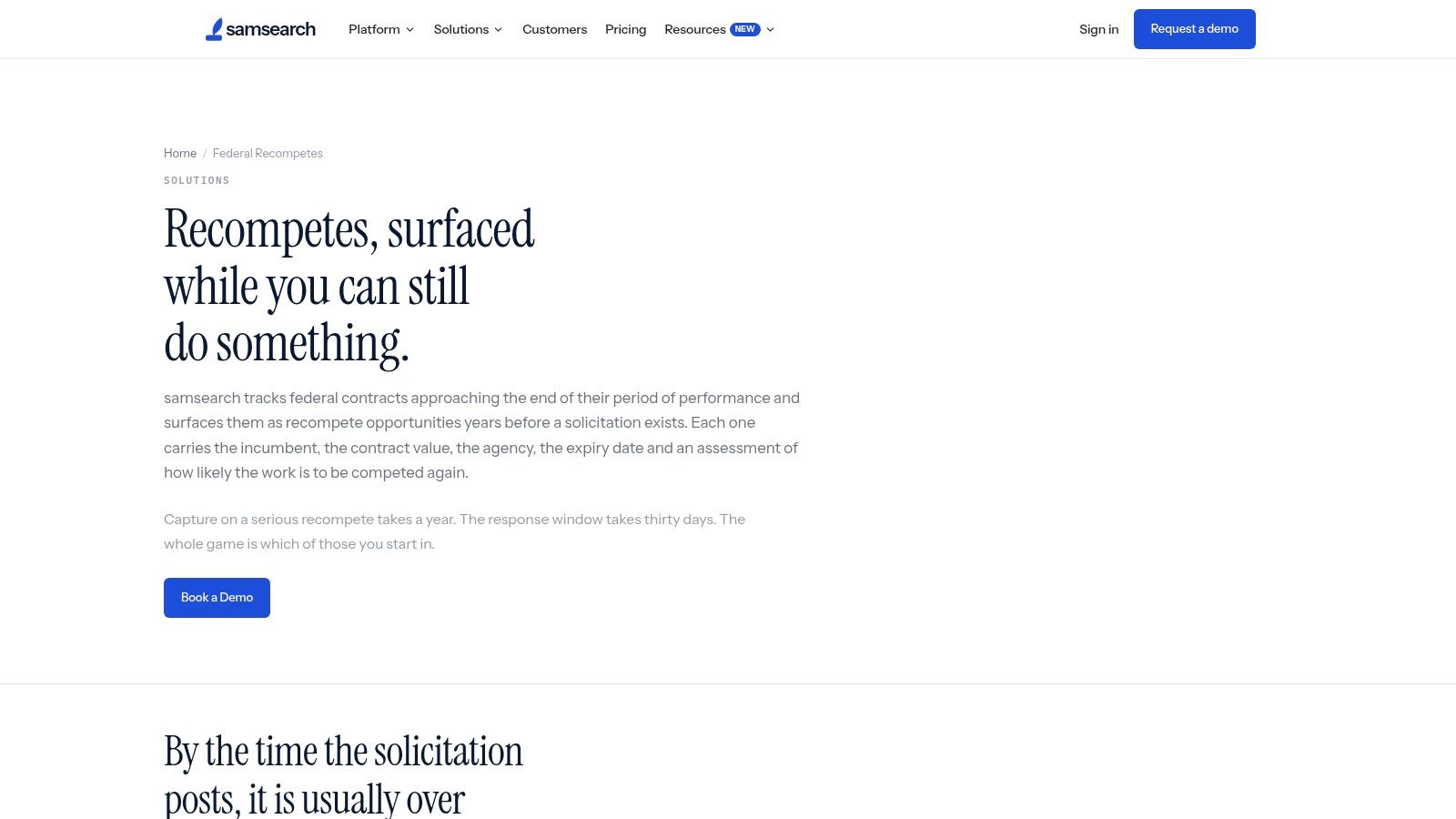
SamSearch reconstructs public award and solicitation records into incumbent profiles and offer histories. Its analyst desk verifies re-solicitation windows so teams can position before a notice posts. On its Recompetes product page, SamSearch says records include the incumbent, agency, contract value, estimated expiration date, and an assessment of whether the requirement is likely to be competed again. Forecasts, historical awards, pricing insight, and capability-matched alerts sit alongside contractor discovery.
SAM.gov already lets an authenticated user save searches, follow opportunity changes, and join an interested-vendor list. That is the floor. A recompete radar has to do more than replay the notice. It has to show who holds the work, what the award actions say about options, and whether a successor path is forming.
What reaches the capture file
A useful hit names the incumbent, the agency, the value band, and a reason you should care this quarter. SamSearch assesses likely timing using award data such as period of performance and option years, then checks signals including sources-sought notices and forecast entries. Opportunity qualification considers business codes, set-asides, incumbent history, and past performance. Qualified work can move into the pursuit workflow through bid or no-bid, teaming, proposal, and award.
That combination is the reason to compare SamSearch against a basic end-date export: it offers a path from an early signal to an owned capture decision. It does not make the outcome certain. An expiring requirement may be competed, extended, modified, or discontinued.
Practical rule: If a record can't show the last modification and whether options remain, you are looking at a calendar, not a radar.
Demo-day checks:
Lineage: Ask for the predecessor award, the incumbent, and the offer history on one contract you already track.
Timing: Ask what "verified re-solicitation window" means, and how far before the notice that flag appears.
Handoff: Push one hit into the pipeline and see whether teaming and tasks stay attached.
Fit: Reject two poor matches and see whether the next alert respects your NAICS and set-aside limits.
Pricing insight helps a price-to-win sketch only when it is tied to vehicle, agency, and period of performance. Capability matching is an early filter, not a win theme. SamSearch can also match potential teaming partners to an opportunity using agency past performance, NAICS and PSC, set-asides, and certifications. Confirm coverage depth, refresh rules, and the data available in your subscription with your own vehicles; don't treat a screenshot as a data dictionary.
I would shortlist SamSearch when the pain is early positioning, not notice volume. Read how recompete software should feed a GovCon pipeline, then test the live page at Recompetes.
2. Civio AI
Civio AI is worth testing if a capture team wants recompete signals to feed a broader qualification and proposal process. Its published opportunity-scoring approach uses Fit, Intent, Access, and Timing, including incumbent status and recompete timing. That gives a team a way to ask not only when work might return, but whether it fits the account plan.
The Civio AI platform connects market intelligence with qualification and pursuit workflows. Its materials describe using forecasts, sources-sought notices, and solicitations as early signals, then routing qualified opportunities into capture or proposal work. This is a broader workflow proposition than a standalone expiring-contract search. It is not, by itself, evidence that every forecast maps cleanly to a predecessor award.
What to verify in the demo
Bring a contract with an option year, a known incumbent, and an agency forecast. Ask Civio to show the predecessor record, the evidence behind its timing score, any change in acquisition strategy, and the path from alert to an assigned pursuit. Its pricing materials do not provide a standard public subscription price, so request a quote for the users and workflows you will actually deploy.
Treat an AI-generated score as a triage aid. Ask for the award actions and agency signals behind it before you commit capture time.
Civio's public materials do not establish independently verified recompete coverage, alert latency, or timing accuracy. If the demo supplies an evidence trail on your target contracts and the handoff saves your team work, it belongs on the shortlist. If the signal stops at a score without a traceable predecessor, keep researching.
3. HigherGov
Say your team just lost an 8(a) sole-source and the follow-on might come back unrestricted, or as a WOSB, HUBZone, or SDVOSB buy. An end-date alert will not tell you that. HigherGov is built so recompete search is an explicit job, not a filter you invent on top of awards.
GovCon Wire's conversation with Deltek's Kevin Plexico describes agencies issuing RFIs on recompetes of formerly sole-source contracts, with some 8(a) work possibly shifting into other socioeconomic programs or broader competition. That is the underserved test. A countdown that ignores acquisition-strategy change flatters the incumbent and misleads the challenger.
What you can actually run
HigherGov combines forecasts, solicitations, and state and local opportunities with searches for contracts likely to return. Incumbent and competitor research, partner finding, alerts, saved pipelines, pursuit management, and AI tools sit on the same account. Annual pricing is published, which makes the first cost comparison easier than a "contact sales" wall.
Forecast timing still moves when the agency updates the forecast. Features and export allowances change by plan, so the tier you demo should be the tier you would buy. SLED coverage is a plus if you sell in more than one public-sector market, and a distraction if your pipeline is one federal office.
An incumbent needs option and modification signals. A challenger needs early proof the government is rethinking the vehicle or the set-aside.
On the demo, pick one predecessor that changed socioeconomic status. Ask HigherGov to connect that award to a sources-sought notice, a forecast row, and any NAICS or PSC shift. Then save it to a pipeline and assign an owner. If the only output is a date, keep looking. For a wider field of options, compare HigherGov alternatives for capture teams. Start at HigherGov.
4. Deltek GovWin IQ
GovWin IQ is strongest when capture teams need context around a potential recompete, not just a list sorted by public end dates. Its analyst research can help teams assess agency activity and pre-solicitation signals, while award records, company profiles, contacts, and competitor research support gate reviews.
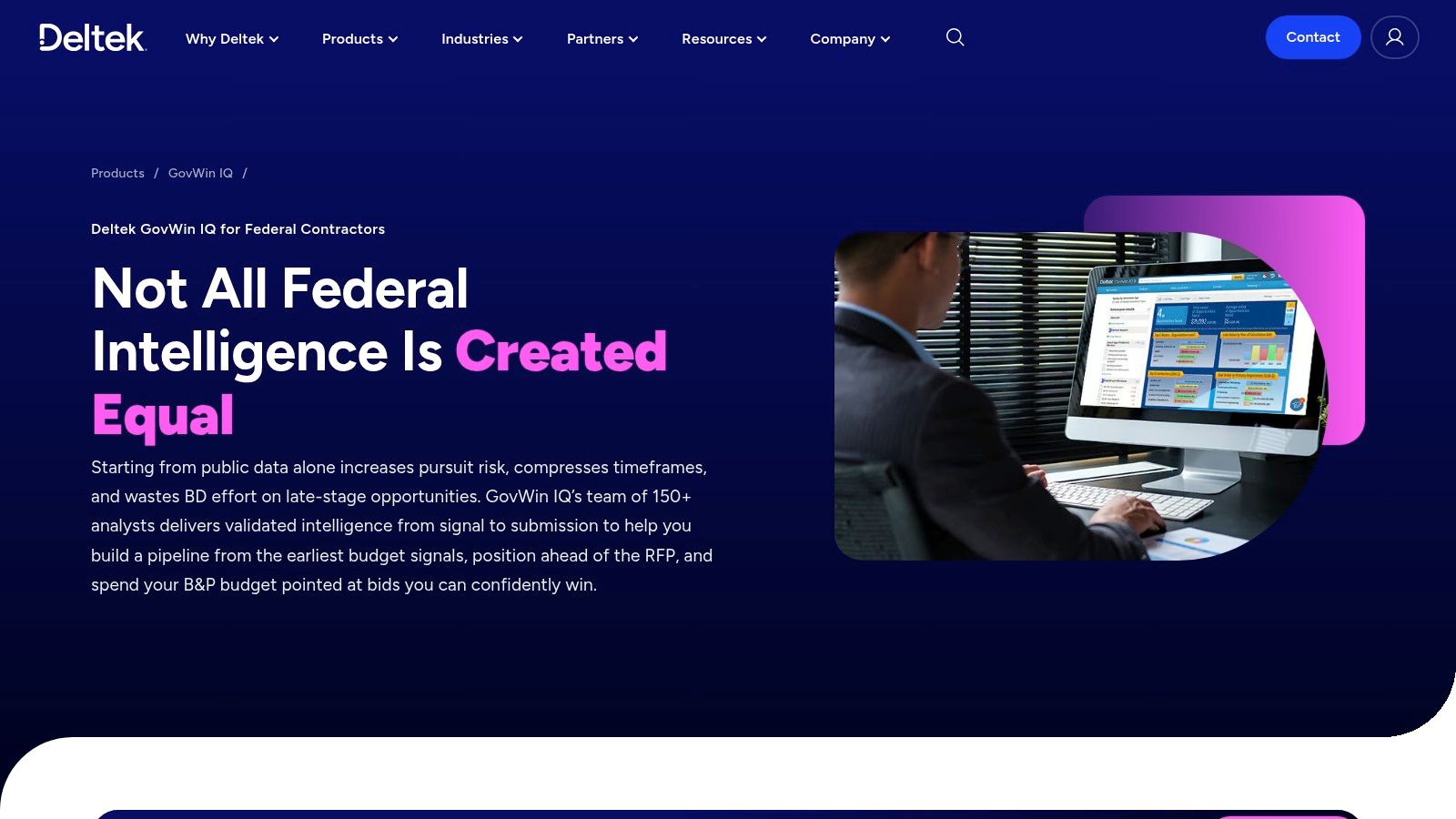
Notifications and pipeline tools help move research into pursuit work, and some buyers may benefit from the broader Deltek stack. Federal coverage is the core; state, local, and education intelligence is available across the GovWin offering. The trade-off is cost and research depth: teams seeking only a basic expiring-contract list may not use enough of the platform to justify the purchase.
Options are decisions, not a runway
A GAO decision on an option exercise describes an order with a 12-month base and four consecutive 12-month options. The agency exercised the first option on August 17, 2023, for performance from August 19, 2023, through August 18, 2024. Before exercising an option, FAR 17.207(c)(3) requires the contracting officer to determine that the option is the most advantageous way to meet the need, including price. A five-year potential term therefore represents four future decisions, not a confirmed recompete date.
Pricing is not published, so buyers need to speak with Deltek. Analyst coverage can vary by agency. In a demo, ask which analysts cover your target offices, when each account was last updated, and how the research distinguishes an option exercise or bridge from a planned competition. Then trace a known predecessor from award history through current signals and into a saved pursuit. If pre-RFP shaping is central to your capture work and your team will act on the research, GovWin may fit. For a comparison of other approaches, see this guide to GovWin alternatives for recompete tracking and pre-RFP intelligence, then review Deltek GovWin IQ.
5. Federal Compass
Federal Compass is for the team that already has a federal BD rhythm and wants recompete notes living next to partners, tasks, and the CRM, not in a research tab nobody opens on Monday.
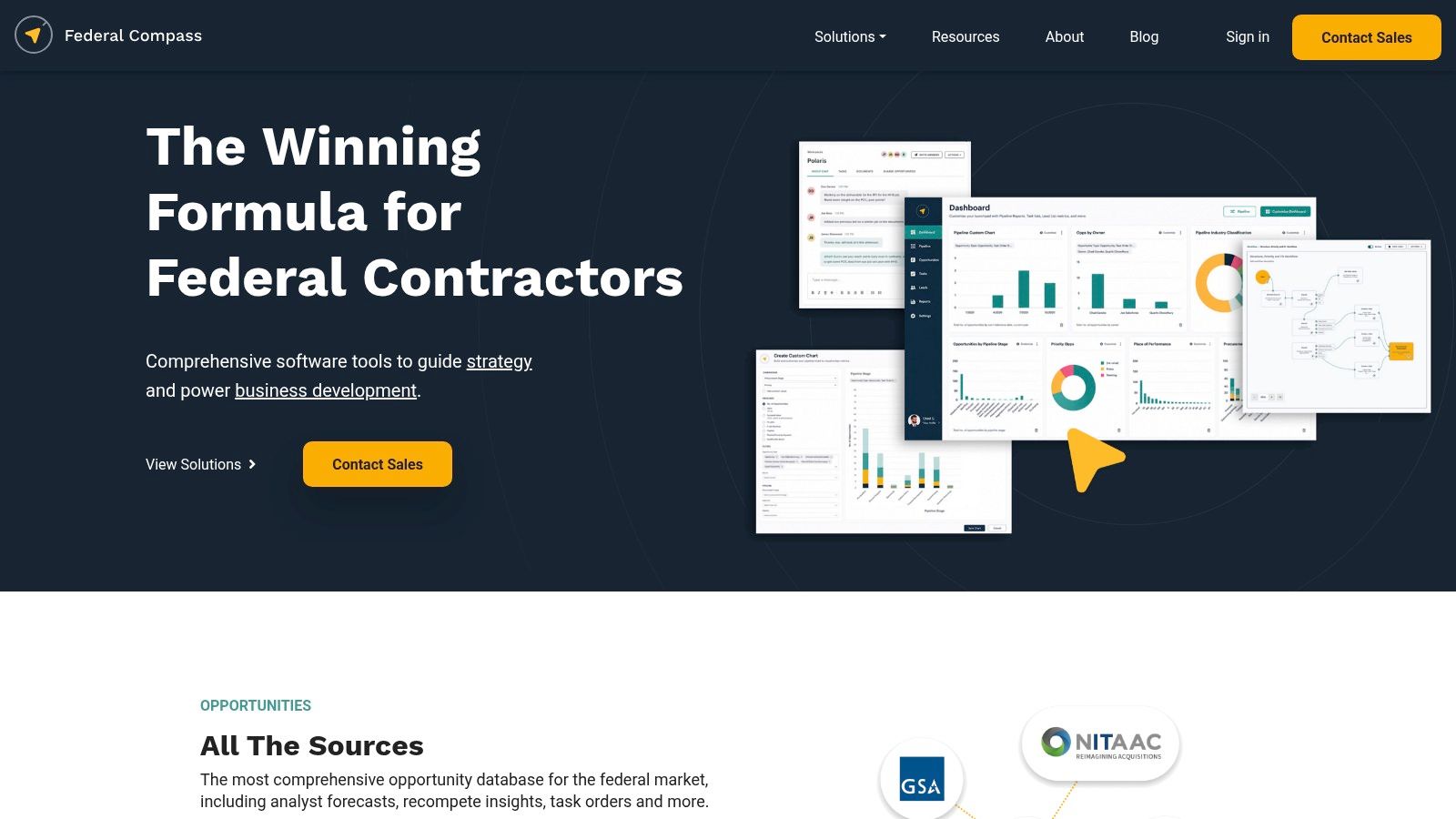
The platform combines federal opportunities, analyst forecasts, recompete insights, task orders, and market research with pipeline and process management. Competitor assessment and partner identification are part of the pitch. Integrations with email, calendars, and CRM tools are the reason a BD lead would stay. Public testimonials include users from mid-sized health and IT contractors and other federal firms. That is a fit signal for established shops, not proof of timing accuracy.
Read the term before you trust the date
GAO's record of vehicle structures runs from a one-year base plus four one-year options to a blanket purchase agreement with a one-year base and nine one-year options. In that BPA example, the RFQ set a single fixed-price agreement under the Federal Supply Schedule facilities-maintenance category and spelled out nine annual options. A nominal ten-year story can hide nine decision points, and the next competition might be the vehicle, the BPA, the task order, or a follow-on contract.
Public materials I reviewed don't explain how Federal Compass calculates recompete timing or confidence. Pricing isn't listed. Access goes through a sales agreement. That is normal for this tier, and it means the demo is the evaluation.
Bring one GWAC task order and one standalone services contract. Ask the analyst forecast to show option status, not just a potential end date. Then push the record into the pipeline and into the CRM you use. If partner management is the gap on your current tool, this stack is aimed at that pain. Confirm agency coverage yourself at Federal Compass rather than assuming every office is equally deep.
6. GovSpend Fedmine
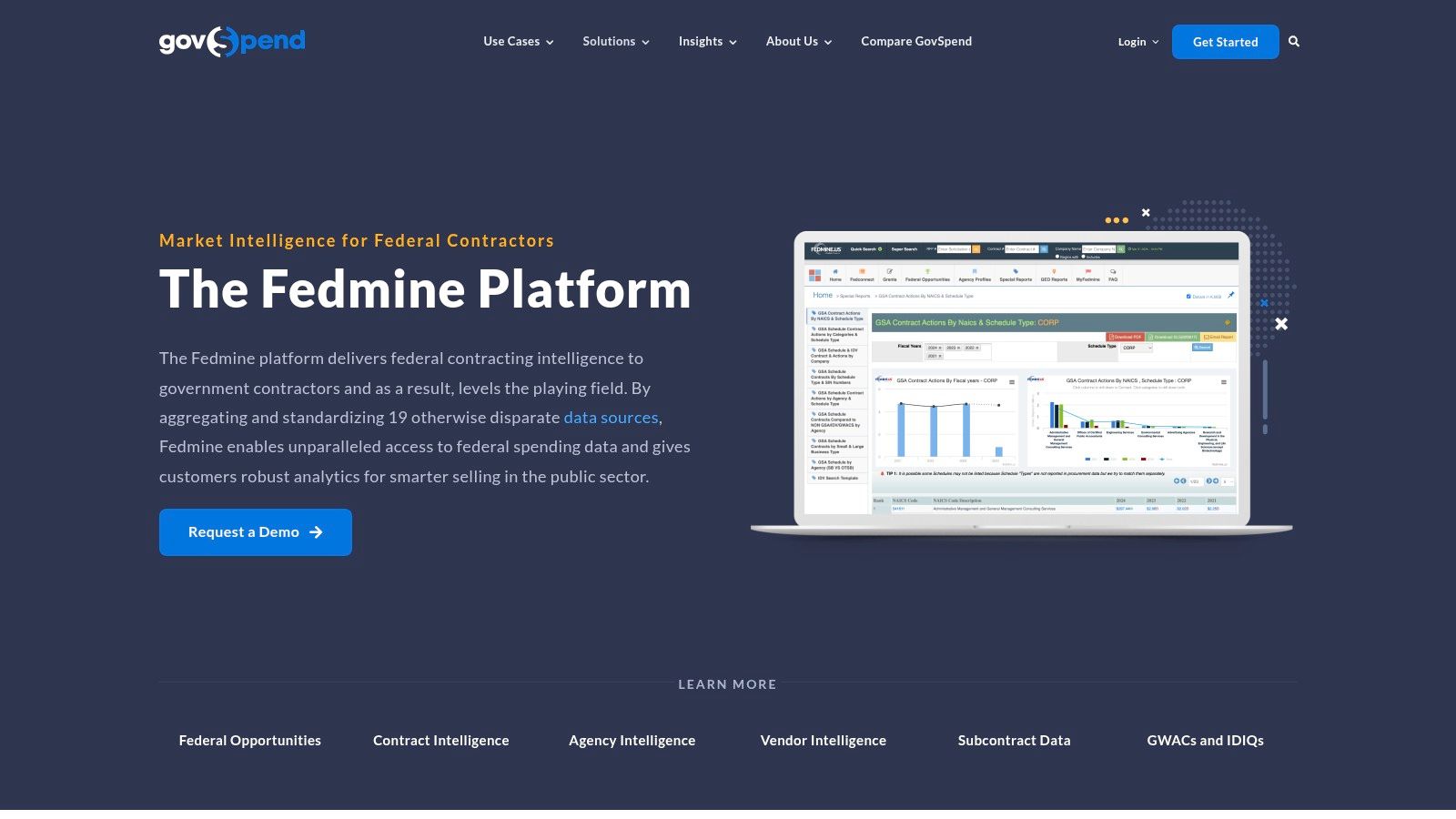
A recompete can sit at the task-order level, where a prime-award search may not reveal the upcoming competition. Fedmine, now part of GovSpend, focuses on federal contract intelligence that includes vehicle and task-order research.
GovDash's FY27 recompete analysis identified 525 expiring federal IT task orders on Alliant II and CIO-SP3 Small Business, representing $32.5 billion in historical obligations. 214 had no options remaining, representing $12.7 billion. These figures describe potential recompetes, not guaranteed competitions: orders can be extended, consolidated, or moved to another vehicle.
Fedmine search covers incumbents, competitors, and partners. Records can include award and task-order details, option values, subcontractor information, historical solicitation records, and analysis of expiring work on GWACs and IDIQs. The platform also includes a collaborative pipeline and state and local intelligence. GovSpend describes Fedmine as integrating federal data sources on its product page.
A short list of credible vehicle alerts is more useful than a large export no one has time to qualify.
The GAO report on federal spending data discusses uneven identity data, a limitation to keep in mind when matching records to an incumbent. Verify the awardee against the authoritative award record before treating a match as a recompete lead.
Pricing is customized. On a demo, refresh a vehicle your team tracks and check whether recent modifications appear. Then test how the record moves into the pipeline and whether analysts can explain the forecast's timing and confidence. For a comparison with other GovSpend options, see this guide to GovSpend alternatives for government contractors.
Recompete Tracking Tools at a Glance
| Tool | Recompete Capability | Pricing Transparency | Best For | Workflow Fit |
|---|---|---|---|---|
| SamSearch Recompetes | Incumbent and award history, estimated timing, analyst-verified re-solicitation windows, and capability-matched alerts | No public pricing details confirmed | Teams turning early recompete research into capture decisions | Connects research, qualification, teaming, and pursuit work |
| Civio AI | Recompete timing and incumbent signals within opportunity scoring | Custom quote; no standard public subscription price identified | Teams wanting scored signals within a wider AI-assisted capture workflow | Routes qualified opportunities into capture and proposal work |
| HigherGov | Dedicated recompete search with incumbent and competitor research | Publishes annual pricing; plan features and limits vary | Teams pursuing federal, state, and local contracts | Connects discovery to alerts, pipeline, pursuit management, and partner finding |
| Deltek GovWin IQ | Analyst-tracked opportunities and early acquisition signals can surface follow-on work | Pricing not published; contact Deltek | Established capture teams seeking early market intelligence | Supports qualification, shaping, research, and pursuit pipeline development |
| Federal Compass | Recompete insights alongside forecasts, opportunities, and task orders | Pricing not listed publicly; sales agreement required | Federal contractors integrating intelligence with business development | Connects market research to pipeline, CRM-style tracking, and partner management |
| GovSpend Fedmine | Contract and vehicle research, including analysis of expiring GWAC and IDIQ contracts | Customized pricing; no standard public subscription listed | Teams researching federal contracts, vehicles, and task orders | Supports contract research and collaborative pipeline workflows |
Federal Contract Recompete Tracking FAQs
What is federal contract recompete tracking? It is the process of identifying work that may return to competition and checking award history, option status, modifications, forecasts, and agency notices before treating an end date as a capture opportunity.
Does a contract expiration mean a new solicitation is coming? No. Agencies may exercise an option, use a bridge, extend or modify the work, change vehicles, or discontinue the requirement. Verify the current award actions and agency signals.
What should I test before buying a recompete tracking tool? Bring known contracts with different outcomes, including an exercised option, a bridge, and a follow-on competition. Check predecessor matching, alert timing, evidence links, and whether each qualified hit can be assigned to a capture owner.
Choosing Your Recompete Radar: Next Steps Before You Buy
Don't leave the demo with a feature tour. Test each finalist on three contracts you already know, including one that was bridged and one that still had options. Confirm how extensions and bridge awards are labeled, and whether a recompete flag creates a pipeline task with a name on it. Split the results by federal, SLED, defense, and subcontracting feeds. A single satisfaction score hides a dead data source.
SamSearch offers a strong starting point if you want incumbent history, analyst-verified timing, qualification, and pursuit work connected rather than split across tabs. It serves small businesses as well as enterprise contractors and advisors; evaluate the depth you need against your team's capture volume. Ask for evidence on your own contracts instead of treating any customer result as a forecast for yours.
Shortlist two tools. Run a 30-day side-by-side on your top five expiring contracts in the NAICS codes you win. Pick the one that surfaces re-solicitation risk earliest, with an evidence trail your proposal manager will still understand in month twelve. If the signal dies in email, pair the radar with workflow automation platforms only after the data is right. A faster handoff of a bad lead just creates a faster no-bid.
Recompetes on SamSearch ties expiring federal work to incumbent history, forecasts, and a capture pipeline so your team can position before the notice posts. See how the radar fits your agencies at SamSearch.