Top 8 GovWin Alternatives for Recompetes and Pre-RFP Intelligence in 2026
The usual advice for finding recompetes is incomplete: identify an expiring contract, find the incumbent, and start capture early. An expiring contract is a hypothesis, not a pipeline. Agencies can extend performance, change scope, consolidate requirements, or choose a different acquisition route. An end date tells you where to investigate, not whether you have a qualified pursuit.
The strongest GovWin alternative isn't necessarily the platform with the most records. It's the one that helps an analyst connect an award to its modifications, identify a plausible follow-on requirement, distinguish an agency forecast from a commitment, and preserve the evidence behind a bid/no-bid decision.
This comparison of the top 8 GovWin alternatives for recompetes and pre-RFP intelligence evaluates seven commercial platforms alongside SAM.gov, the official validation layer. SamSearch leads for teams that need to carry incumbent research into an owned capture workflow; Civio AI follows for teams evaluating AI-assisted qualification and proposal work. These are editorial judgments about workflow fit, not results from a hands-on benchmark. Product descriptions establish what to evaluate; they don't establish that every underlying forecast is accurate or current.
Table of Contents
- 1. SamSearch
- 2. Civio AI
- 3. Federal Compass
- 4. GovTribe
- 5. HigherGov
- 6. Fedmine by GovSpend
- 7. GovFabric
- 8. SAM.gov
- How the Leading GovWin Alternatives Compare on Recompete and Pre-RFP Capabilities
- Building a Recompete Research Stack That Holds Up to Scrutiny
- Frequently Asked Questions
- What is the best GovWin alternative for recompete research?
- Does an expiring federal contract mean a recompete is coming?
- Can SAM.gov replace a commercial recompete intelligence platform?
- How early should a team start researching a possible recompete?
- What should I ask vendors to show in a recompete intelligence demo?
1. SamSearch
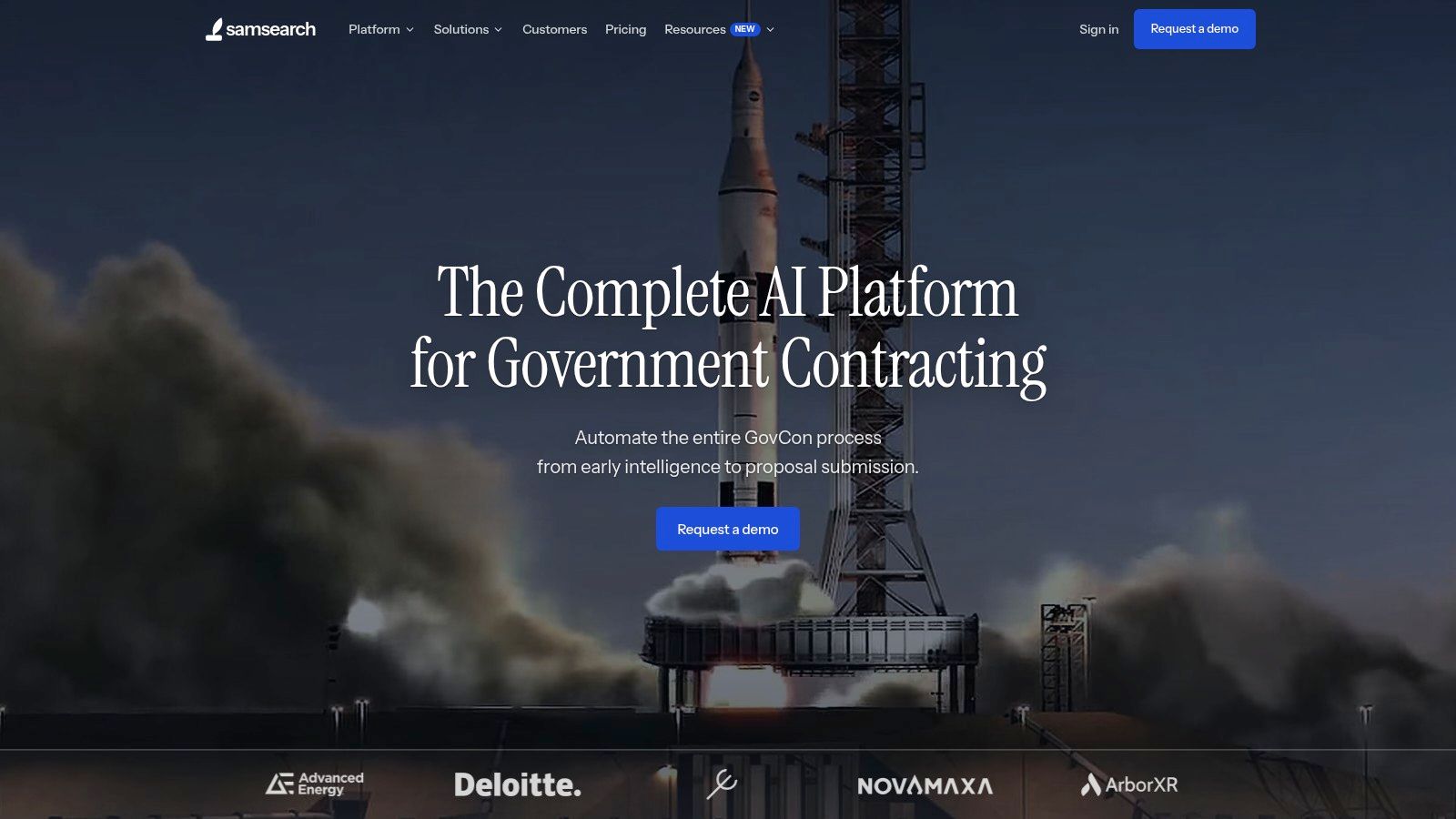
Best fit for established mid-market and enterprise government contractors, not small businesses, SamSearch connects recompete research with bid qualification, proposal analysis, and pursuit management. Its advantage in this comparison is a practical sequence: investigate an incumbent, examine an analyst-verified re-solicitation window, and carry the evidence into an owned pursuit. Expiration tracking alone cannot do that.
Our platform reconstructs public award and solicitation records into incumbent profiles and offer histories. Our analyst desk verifies re-solicitation windows so capture teams can position before a notice posts. The window remains a planning signal, not a promise of an RFP: analysts should still inspect the award, modifications, and any agency forecast before assigning capture resources.
SamSearch also helps teams match teaming partners to a specific opportunity using agency past performance, NAICS and PSC alignment, set-asides, and certifications. For teams where research routinely gets lost between business development and proposals, that connection between incumbent intelligence, qualification, and execution is the reason to put SamSearch first. Evaluate coverage for your specific markets and buying routes rather than assuming every dataset is equally complete.
From recompete research to an owned pursuit
Our workflow moves opportunities into JourneyHub, where teams manage bid/no-bid, teaming, proposal, and award stages. The pipeline syncs with Salesforce, HubSpot, and Pipedrive, reducing the need to maintain a separate pursuit record after discovery.
Sammy analyzes requirements and evaluation criteria, provides source-backed answers, and builds a compliance matrix that maps requirements to proposal sections. Human review and sign-off remain part of response submission. Partner matching evaluates agency past performance, NAICS and PSC alignment, set-asides, and certifications against a particular opportunity.
Advantages: Integrated discovery, incumbent research, qualification, teaming, proposal analysis, and pipeline management support continuity across capture handoffs.
Trade-offs: The breadth suits established teams with defined pursuit responsibilities better than businesses seeking only a lightweight bid board. Pricing is custom, so compare the quoted seats and modules against your actual workflow.
Demonstration test: Follow a historical award into the incumbent profile, inspect the basis for the re-solicitation window, and move the resulting pursuit into an assigned capture stage.
Practical rule: An analyst-verified window should still preserve the supporting records and distinguish an expected acquisition date from a confirmed agency notice.
Our guide to tools for finding federal contract recompetes provides additional context for evaluating this research workflow.
The strongest reason to shortlist the platform is workflow continuity. The corresponding evaluation burden is to establish whether your team will use that breadth, rather than paying for an integrated process while continuing to qualify and manage pursuits elsewhere.
2. Civio AI
Civio AI is a relevant GovWin alternative for teams that want to connect early government buying signals to capture and proposal work. Its government-contractor tools overview describes opportunity qualification using fit, buying intent, and competitive access, including incumbent status, set-aside eligibility, and recompete timing. Those signals help prioritize research; they do not independently confirm that a follow-on solicitation will appear.
Civio's broader platform links market intelligence and company knowledge to workflows for go/no-go decisions, solicitation analysis, compliance matrices, drafting, and approvals. That makes it worth comparing with SamSearch when the purchase decision is about both pre-RFP discovery and the work after qualification. SamSearch leads this list for its specific connection between reconstructed incumbent histories, analyst-verified re-solicitation windows, and an owned pursuit; compare how each vendor substantiates the dates and recommendations it presents.
Test the signal-to-pursuit handoff
Bring an expiring contract with a known incumbent to a demonstration. Ask Civio to show the original award and agency planning records behind a predicted follow-on, explain vehicle access and fit, and carry the finding into a reviewable capture decision. Check whether an analyst can distinguish sourced government records from the platform's interpretation.
Best fit: Teams evaluating AI-assisted qualification and proposal execution alongside pre-RFP research.
Advantage: Opportunity signals and downstream proposal workflows can be considered in one evaluation.
Trade-off: Scoring and automation still require source checks, especially when dates, vehicle eligibility, or agency plans change.
Commercial check: Request a current quote and verify which intelligence, workflow, and AI features the proposed package includes.
Civio is a strong #2 candidate when the team's bottleneck is moving from a promising signal to a documented decision. Judge the handoff using your own award records, not a polished demonstration example.
3. Federal Compass
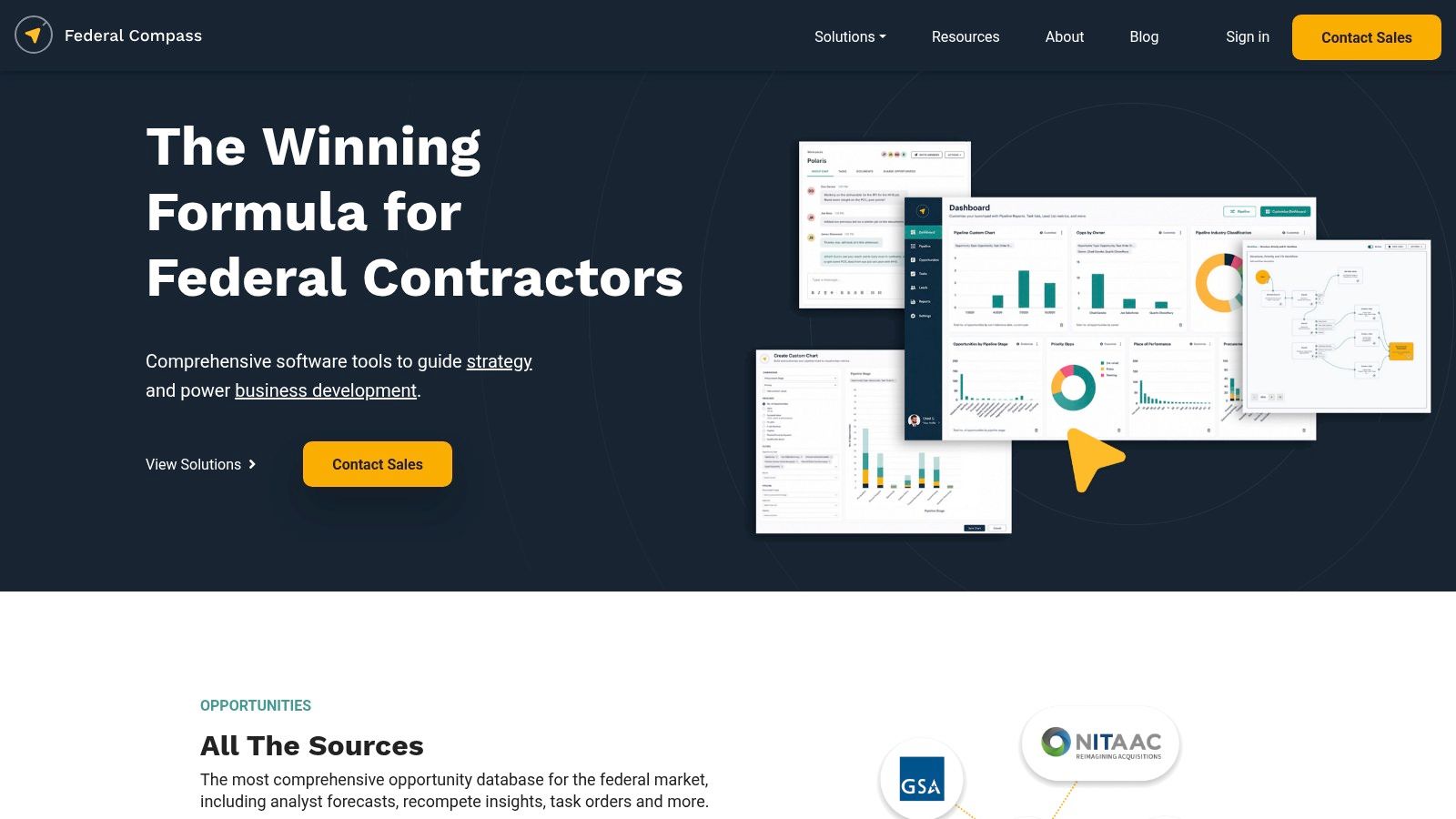
A federal capture team can identify the right incumbent and still lose useful intelligence during the handoff to pursuit management. Federal Compass addresses that operational problem by combining federal opportunity research, analyst forecasts, recompete research, task-order intelligence, and capture workflows.
Its scope includes market and competitor research, partner identification, pipeline management, and collaboration. Email, calendar, and CRM connections make it relevant to organizations that want opportunity intelligence attached to day-to-day business-development activity rather than stored in a separate research system.
The editorial advantage is coordination, not automatic confirmation. An analyst forecast can help explain a potential acquisition, but the buyer should still inspect its supporting evidence, last review, and assumptions.
Test the task-order path, not just the contract record
Say an engineering contractor finds an incumbent award associated with an established vehicle. The useful question isn't merely when that award ends. The capture manager needs to establish whether the likely follow-on competition is accessible, whether a partner is required, and who owns the next engagement.
Use that scenario in a demonstration. Have the vendor connect the award, potential follow-on, vehicle, incumbent, and teaming research, then assign a capture task without rebuilding the record manually.
Strength: Intelligence and pursuit management sit within the same operational environment.
Trade-off: Its federal focus makes specific state and local requirements a coverage-validation exercise, not an assumption.
Commercial consideration: Pricing isn't publicly listed in the product information considered here and depends on the subscription package.
Federal Compass is a sensible shortlist candidate when federal capture execution matters as much as discovery. Teams seeking a simple search interface should weigh the setup and process adoption required by its broader workflow.
Its strongest demonstration would show how an analyst updates a pursuit when a forecast changes. Preserving the original expectation, the revised evidence, and the owner's next action matters more than just displaying a new projected date.
4. GovTribe
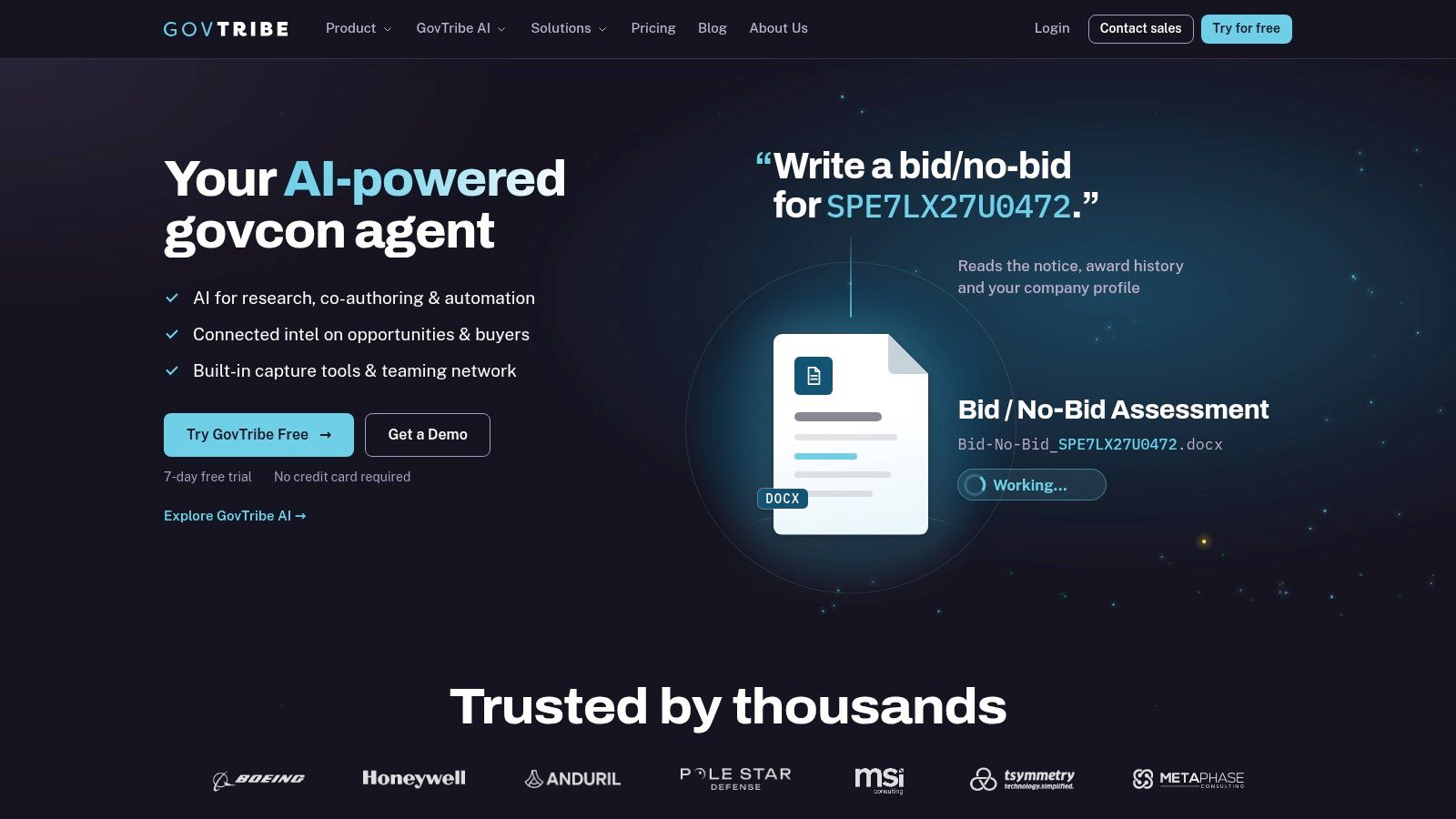
Commercial visibility is part of usability. GovTribe publishes pricing and combines federal, state, and local opportunity research with awards, forecasts, saved searches, alerts, contacts, and pursuit tracking.
Its research workflow lets teams examine agency forecasts by agency, category, and estimated solicitation timing, then investigate past awards and contract end dates. AI-assisted research provides another route into expiring-contract analysis, but a convenient answer shouldn't replace inspection of the underlying record.
The important distinction is between finding a candidate recompete and establishing what the buyer intends to acquire. A matching incumbent name and approaching end date can justify research without yet justifying capture expenditure.
Evaluate the cost of a complete investigation
GovTribe's commercial structure deserves attention beyond the subscription headline. AI functionality uses credits, while export allowances vary by plan and broader export access may require enterprise arrangements.
That creates a practical evaluation question: can your analysts complete a normal pursuit investigation, preserve the findings, and share the evidence without encountering unexpected usage or export constraints?
Discovery advantage: Forecasts, award research, and opportunity monitoring support a connected investigation.
Budgeting advantage: Published plans provide a clearer starting point for cost comparison than an entirely quote-led process.
Usage risk: AI credits and export limits should be evaluated against actual research habits, not an unusually light demonstration.
For example, an IT capture analyst might start with an expiring award, expand into adjacent agency purchases, and investigate incumbent partners. Test that whole sequence rather than treating a successful natural-language query as proof of research completeness.
The GovTribe alternatives and competitors comparison provides another way to assess the trade-off between research access and downstream workflow.
GovTribe is worth shortlisting when your team wants accessible award-and-forecast research with pursuit tracking. Its limits become clearer when you measure the effort and commercial permissions required to carry evidence out of the initial search and into a defensible capture decision.
5. HigherGov
A forecast pulled from an agency portal this morning can still describe a plan the agency abandoned last quarter. HigherGov combines federal, state, and local opportunities, forecasts, award research, alerts, pursuit management, and market-intelligence tools, so its recompete value depends on how clearly it separates retrieval speed from the reliability of the underlying planning signal.
According to HigherGov, major data sources update every 15 minutes. That figure describes ingestion cadence, not the frequency with which an agency revises its own buying plans. A recently retrieved forecast can still carry an outdated expected solicitation date.
The platform also offers AI tools, a vendor people database, labor-pricing tools, tasks, and team collaboration. Forecast records may include expected award dates, categories, incumbents, and contacts when the underlying information is available.
A fresh ingestion timestamp proves that a platform checked a source. It does not prove that the agency recently reconsidered the acquisition.
Separate source freshness from pursuit usefulness
In a demonstration, inspect the agency's record date, the platform's retrieval date, and the evidence supporting any projected milestone. If those dates differ, your capture team should be able to learn why from the record itself, rather than inferring it from a generic updated label.
A useful test involves a forecast whose anticipated solicitation timing has passed. Check whether the system makes that condition visible and helps the analyst find a replacement notice, revised forecast, or related award activity. Teams working to position months before a re-solicitation posts need a platform that surfaces a stale hypothesis quickly, because acting on an expired projection consumes the same capture hours as missing the follow-on entirely.
Advantages: Published plans, cross-market discovery, and pursuit management support a relatively direct commercial and workflow comparison.
Limitations: Forecast quality depends on the originating agency and dataset; broad coverage does not mean uniformly complete fields.
Contract consideration: Review renewal, cancellation, and refund terms carefully before committing, since they vary by plan.
The HigherGov alternatives and competitors comparison can help frame the broader shortlist.
HigherGov suits teams that want market research and collaborative pursuit management in one subscription. The decisive recompete test is how quickly analysts can recognize a stale assumption; refresh cadence alone settles nothing.
6. Fedmine by GovSpend
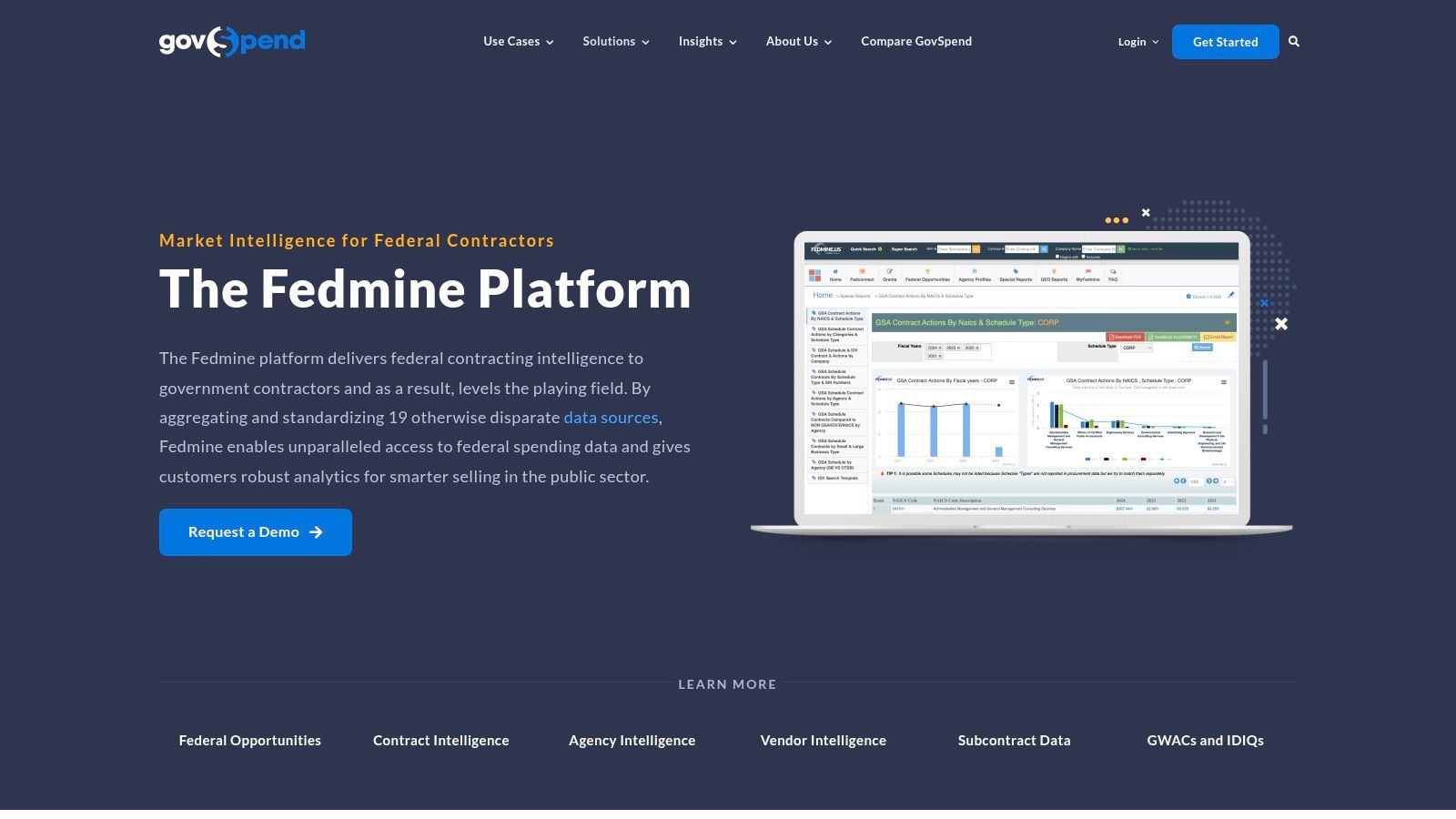
For vehicle-dependent capture, the wrong question is often “When does this contract expire?” The better question is “Through which vehicle could the follow-on requirement be competed, and can we participate?”
Fedmine by GovSpend emphasizes federal contract and task-order intelligence, including research into expiring contracts associated with a vehicle. Keyword and industry-code searches help teams investigate government-preferred contracting routes alongside historical award activity.
That emphasis matters because a follow-on requirement may not emerge as an unrestricted, standalone solicitation. A prime needs to understand vehicle access; a subcontractor needs to identify the holders most plausibly positioned to pursue the work.
Work backward from the likely buying route
Consider an IT services contractor researching an incumbent task order. The capture analyst should distinguish the order's performance period from the parent vehicle's ordering arrangements, then examine related awards for evidence of how the agency buys comparable services.
Fedmine's award and vehicle context makes it relevant to that investigation. Broader GovSpend intelligence encompasses bids, contracts, purchase orders, meeting materials, and contacts, but teams should establish which datasets and markets their proposed subscription includes.
Best fit: Primes and subcontractors whose capture strategies depend on IDIQs, GWACs, and task orders.
Main advantage: Vehicle context can turn a generic expiration lead into a more useful assessment of competitive access.
Main limitation: Award analysis doesn't automatically supply the agency-level interpretation associated with analyst-led pre-RFP research.
Commercial uncertainty: Pricing requires a sales conversation; source refresh should be assessed by dataset rather than assumed uniform.
The GovSpend alternatives comparison offers additional context for evaluating its place in a procurement stack.
Fedmine belongs on a shortlist when the acquisition route determines whether a lead is actionable. During evaluation, require a clear distinction between an expiring task order, an expiring vehicle, and a documented follow-on procurement. Those are related records, not interchangeable opportunities.
7. GovFabric
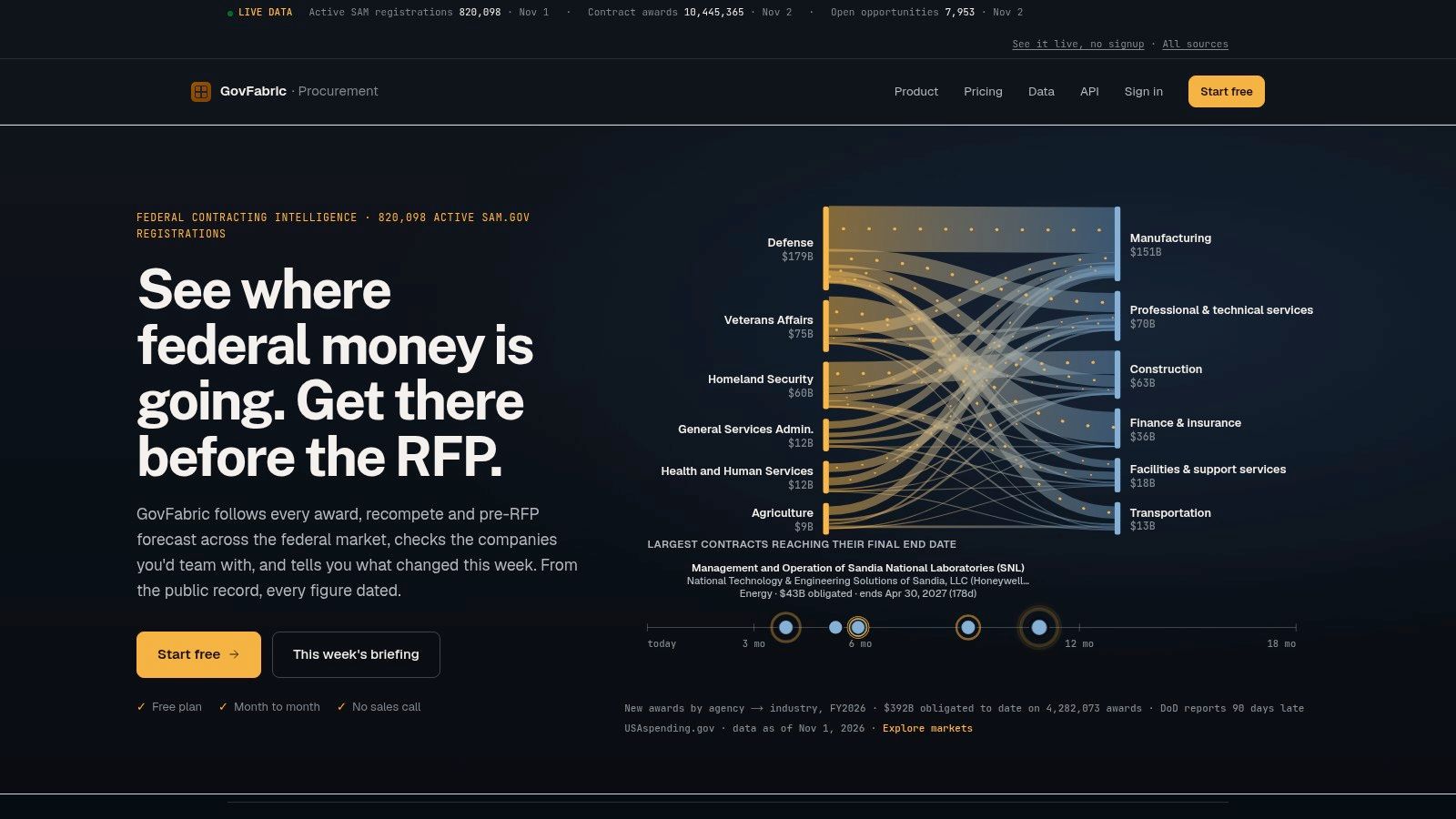
GovFabric takes a more explicitly recompete-oriented approach, organizing public federal records around contract expirations, incumbents, forecasts, and contractor information. Its free weekly recompete briefing offers a low-friction way to inspect that approach.
Recompete views include incumbent information and historical obligated value. Those fields provide a starting point for investigation, but they require careful interpretation: obligated value isn't automatically the future opportunity's value, and a final end date isn't a solicitation forecast.
The editorial appeal is focus. A team building an initial research queue may prefer a clearly organized set of expiring awards over a broader platform it isn't yet prepared to operationalize.
Grade the evidence behind the briefing
Inspect a briefing entry as a research lead. Match the incumbent and award identifier, review modifications, distinguish the current performance period from potential options, and look for an agency signal about follow-on demand.
A useful result isn't necessarily confirmation. Discovering that an apparent recompete has been extended, restructured, or overtaken by another procurement can prevent a weak lead from entering the qualified pipeline.
Advantage: Recompetes are central to the product's positioning rather than an incidental search use case.
Access point: The free briefing allows teams to inspect how public records are assembled.
Boundary: Public-record aggregation shouldn't be assumed to include nonpublic context or analyst confirmation.
Commercial caveat: Current paid features and pricing aren't established by the public product information considered here.
GovFabric fits most naturally as an initial lead-generation and research-queue tool unless a demonstration establishes deeper validation and workflow capabilities.
Its evaluation should reward useful exclusions as well as discoveries. A platform that helps analysts reject misleading expiration signals can improve capture discipline, even if it produces fewer apparent opportunities than a less selective database.
8. SAM.gov
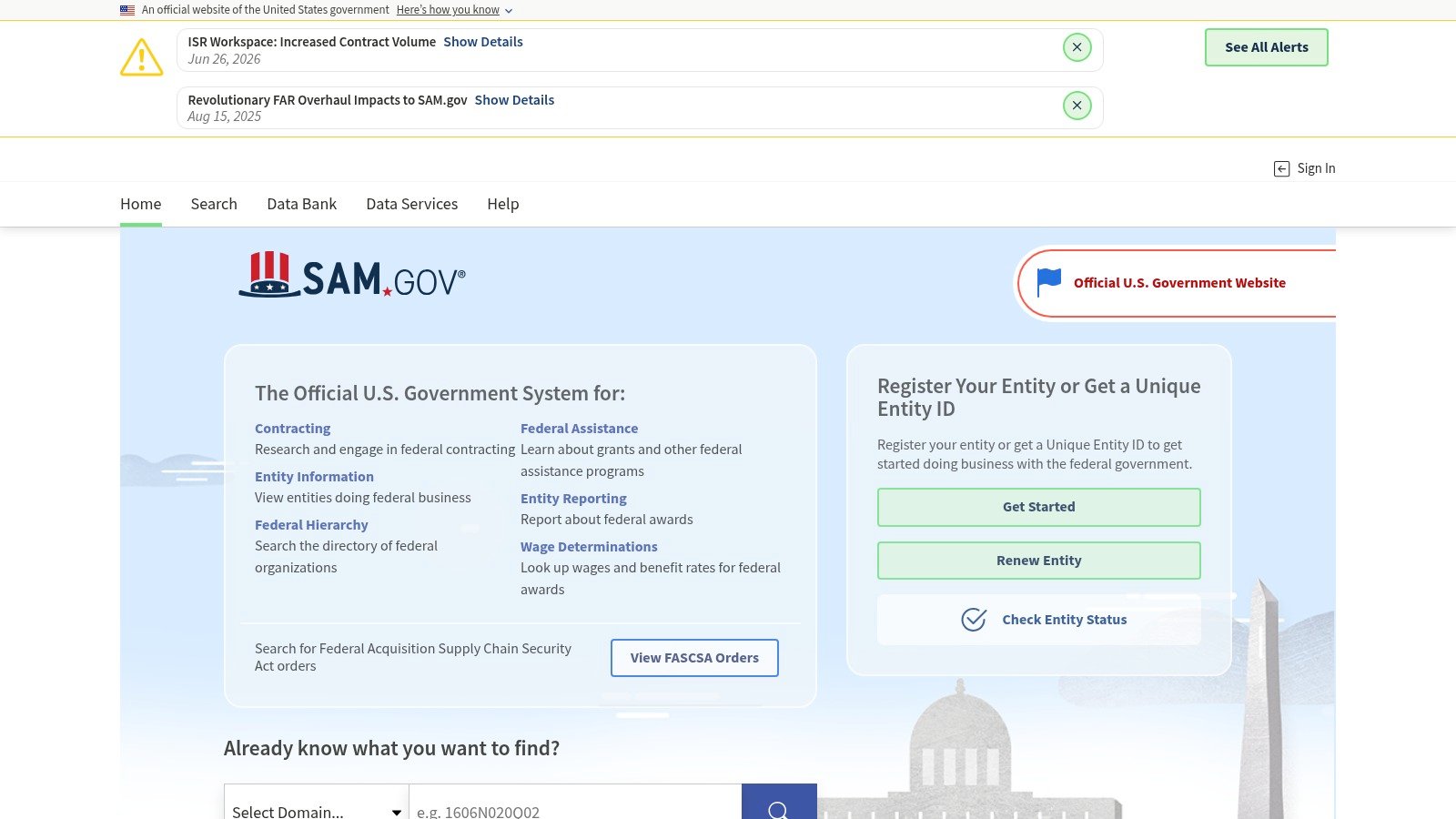
SAM.gov is the authoritative validation layer, not a like-for-like commercial capture suite. Its inclusion provides a verified alternative for teams prepared to assemble their own research workflow, and a necessary reference point for evaluating the commercial tools above.
The Defense Health Agency's acquisition forecast notice on SAM.gov illustrates the distinction clearly: the forecast describes procurement plans that can change, directs vendors to official contracting opportunities, and identifies free notifications for daily federal postings.
That supports a practical two-layer model. Use planning material to identify possible demand, then inspect official notices as the procurement develops. Neither the forecast nor the monitoring platform should erase that distinction.
Official notices aren't a guaranteed preparation window
FAR 5.203 generally requires publication of a notice at least 15 days before solicitation issuance, but commercial acquisitions can use a shorter period or a combined synopsis and solicitation. Waiting for a conventional presolicitation sequence therefore isn't a reliable capture strategy.
Early engagement also has boundaries. FAR 15.201 encourages exchanges beginning with the earliest identification of a requirement, while making the contracting officer the focal point for exchanges after solicitation release and protecting competitors' confidential business information.
Strength: Official notices and attachments provide the reference against which third-party interpretations can be checked.
Trade-off: Your team must supply the analytical connections, qualification process, and pursuit ownership.
Best use: Validate requirements and procurement status while retaining a separate evidence-based capture record.
SAM.gov is the strongest choice when direct source access matters more than packaged analysis. It isn't a substitute for interpreting award history, evaluating vehicle access, or maintaining a collaborative pipeline, but those limitations don't reduce its importance as the verification anchor.
How the Leading GovWin Alternatives Compare on Recompete and Pre-RFP Capabilities
| Item | Primary Focus | Pricing Visibility | Recompete Tools | Market Coverage |
|---|---|---|---|---|
| SamSearch | End-to-end contracting and capture platform | Custom pricing; demo required | Forecasts, incumbent intelligence, historical awards, and fit scoring | Federal, state and local, defense, subcontracting |
| Civio AI | AI-assisted opportunity qualification and capture workflows | Request a current quote | Recompete timing signals, incumbent research, and go/no-go support | Government contracting; confirm coverage by market |
| Federal Compass | Opportunity research and capture workflows | Not publicly listed | Recompete research and task-order intelligence | Federal |
| GovTribe | Opportunity, award, and contract research | Published pricing | Forecasts, expiring-contract research, and AI-assisted recompete tools | Federal, state, and local |
| HigherGov | Market intelligence and pursuit management | Published prices for several team sizes | Recompete and expiring-award research | Federal, state, and local |
| Fedmine by GovSpend | Federal contract-vehicle and task-order intelligence | Not publicly listed | Expiring-contract analysis by vehicle | Federal; broader GovSpend coverage includes state, local, and education |
| GovFabric | Federal contract and recompete intelligence | Paid pricing not established; free weekly briefing | Expiring-award tracking, incumbent details, and historical obligated value | Federal |
Building a Recompete Research Stack That Holds Up to Scrutiny
No platform removes the need to verify. Before committing, run a two-week trial on a known recompete in your NAICS codes, using the same award and questions across each shortlisted tool. Confirm the incumbent, performance end date, relevant modifications, and any posted solicitation against original records, then compare how each system handles missing or contradictory evidence.
Don't grade platforms only on whether they find the contract. Grade whether an analyst can explain the transition from historical award to plausible follow-on requirement, preserve that explanation, and assign a next action without recreating the research elsewhere.
Measure the unresolved work
The procurement information environment itself creates aggregation problems. The OECD's analysis of AI in public procurement identifies fragmented information, incompatible systems, and inconsistent standards as obstacles, which makes provenance and coverage gaps substantive buying criteria rather than technical footnotes.
Use a structured demonstration to inspect:
Forecast quality: Can an analyst distinguish an agency plan from a vendor prediction and see the source behind both?
Refresh cadence: Does the platform separate source publication, source revision, ingestion, and analyst review?
Capture continuity: Can your team retain research, assign ownership, evaluate partners, and document qualification?
Commercial clarity: Are seats, modules, AI usage, exports, renewal terms, and support included in the comparison?
Portability: Can the organization retain its annotations, relationships, and pursuit evidence if it changes vendors?
Portability deserves particular weight. Federal guidance on acquiring AI advises agencies to consider data portability and long-term interoperability to avoid costly vendor dependence; contractors can apply the same principle when evaluating their intelligence stack.
The cheapest subscription isn't necessarily the lowest-cost workflow if analysts must repeatedly reconcile records and reconstruct institutional knowledge.
For mid-market and enterprise teams, shortlist two or three platforms according to the dominant problem. Choose integrated execution when handoffs cause lost context, vehicle intelligence when competitive access is uncertain, or focused public-record research when the immediate need is a better investigation queue.
Keep pricing transparency separate from analytical quality. A published plan makes budgeting easier, but it doesn't validate forecasts; a custom quote may support a broader workflow, but it doesn't prove that your team needs it.
The final decision should rest on a concrete output: a pursuit record that states what is confirmed, what remains an assumption, who owns verification, and what evidence would change the bid/no-bid decision. That is a more defensible measure of recompete intelligence than database size.
Frequently Asked Questions
What is the best GovWin alternative for recompete research?
It depends on what your team needs after finding an expiring contract. SamSearch is the first choice in this comparison for established capture teams that want public award and solicitation records reconstructed into incumbent profiles and offer histories, analyst-verified re-solicitation windows, and a path from research to an owned pursuit. If vehicle access or a lightweight research queue is the bigger concern, compare the relevant alternatives above using the same known award.
Does an expiring federal contract mean a recompete is coming?
No. An end date is a research lead, not proof of a follow-on solicitation. Check modifications, option periods, agency planning records, related awards, and official notices before treating it as a qualified pursuit. An agency acquisition forecast on SAM.gov illustrates why forecasts should be treated as plans that can change, not commitments.
Can SAM.gov replace a commercial recompete intelligence platform?
SAM.gov provides free access to official federal contract opportunities and is essential for verifying notices and attachments. It does not, by itself, supply the same packaged incumbent analysis or capture workflow described in the commercial reviews. A team can use it as its primary research tool if it has the time and process to connect records, qualify leads, and manage pursuits independently.
How early should a team start researching a possible recompete?
Start when an award or agency planning signal gives you enough evidence to investigate, rather than waiting for a solicitation. FAR 5.203 generally calls for at least 15 days between a proposed contract-action notice and solicitation issuance, with exceptions for commercial products and services. That notice period should not be treated as a guaranteed capture preparation window.
What should I ask vendors to show in a recompete intelligence demo?
Bring a known award and ask each vendor to trace the incumbent, modifications, projected follow-on, source dates, and likely buying route. Then ask how the platform records uncertainty, assigns a verification owner, and carries the evidence into a bid/no-bid decision. For SamSearch, request a demo using your own award to inspect the basis for its analyst-verified re-solicitation window; pricing is provided by quote on a demo call.
For established mid-market and enterprise government contractors, not small businesses, SamSearch connects incumbent and recompete research with analyst-verified re-solicitation windows, bid qualification, proposal analysis, and JourneyHub pursuit management. Visit with a known expiring award and use a demo to examine how its supporting evidence becomes an owned, reviewable capture plan.