Top 6 Tools for Finding Federal Contract Recompetes 2026
Hypothetical scenario: Your capture team discovers an incumbent's contract only after a sources-sought notice appears. By then, the agency has already shaped the requirement, likely competitors have started teaming discussions, and your proposal calendar is compressed.
That timing problem is why the top 6 tools for finding federal contract recompetes should not be judged only by how many solicitations they display. Each tool tracks the same expiring-award signal from a different angle. USAspending.gov is the free verification layer behind most paid platforms, while forecast tools, award databases, alerts, policy research, and proposal systems add different forms of context.
This guide compares six federal contract recompete tools on the trade-offs that matter in practice: current versus potential end dates, incomplete forecasts, incumbent analysis, pricing transparency, and workflow fit. SamSearch is evaluated as a connected discovery-to-response platform, rather than only an expiring-contract search database. Compare its fit with your team's capture volume, processes, and budget.
Federal award data is reported through systems that include transaction details, recipients, agencies, obligations, contract dates, NAICS, and place of performance. The USAspending.gov data documentation explains the underlying reporting cadence and scope.
Table of Contents
- 1. SamSearch
- 2. Civio AI
- 3. USAspending.gov
- 4. GovTribe
- 5. HigherGov
- 6. Deltek GovWin IQ
- Top 6 Federal Contract Recompete Tools, Comparison
- FAQ
- What is a federal contract recompete?
- What is the best free tool for finding federal contract recompetes?
- Why is the current end date more useful than the potential end date?
- Which tool is best for enterprise GovCon teams?
- Is SamSearch difficult to implement?
- Should forecast data be trusted on its own?
- Turn a Recompete Watchlist Into a Capture Plan You Can Act On
1. SamSearch
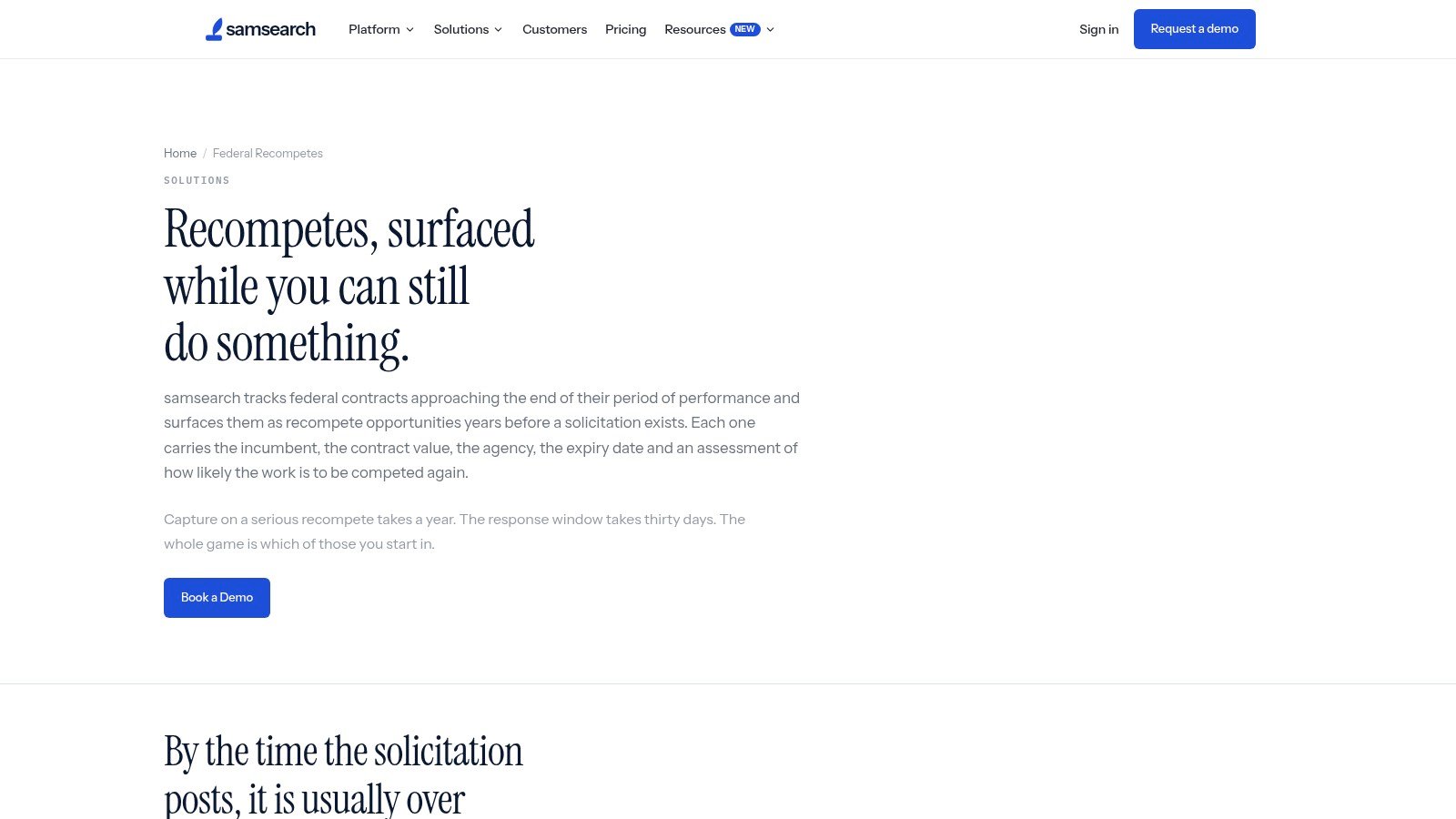
A recompete lead matters only if the team can verify it, qualify it, assign it, build a team, and prepare a compliant response. SamSearch targets that full workflow for established mid-market and enterprise contractors. It starts with recompete discovery, then connects qualification, capture, compliance, proposal production, pipeline management, and financing introductions.
That broader workflow is what makes SamSearch stand out in this category. Many platforms can help teams spot expiring awards. Far fewer can carry the opportunity forward into capture planning and proposal execution without forcing the team to jump between disconnected tools. For organizations that care about speed, consistency, and auditability, that difference can matter more than simply generating a longer watchlist.
The platform organizes work across six stages: Influence, Capture, Analyze, Manage, Respond, and Finance. For recompetes, SamSearch reconstructs public award and solicitation records into incumbent profiles and offer histories. Its analyst desk verifies re-solicitation windows, helping teams investigate a follow-on before a notice posts. Teams should still confirm timing against the latest official award record.
SamSearch agents read a solicitation and its attachments, build a compliance matrix, and draft response sections grounded in the team's past performance and document library, with citations back to source material. That gives capture and proposal teams a practical way to trace requirements instead of relying on an uncited summary.
From target discovery to bid execution
SamSearch also matches teaming partners to a specific opportunity using agency past performance, NAICS and PSC, set-asides, and certifications. That can help a capture team move from incumbent research to a more focused partner shortlist. Ask how the platform fits your existing CRM, approval process, and proposal workflow during a demo.
For procurement and security reviews, request current documentation on controls, hosting, integrations, and pricing rather than relying on unverified certification or performance figures. Test the workflow against known recompetes and ask for relevant customer references before committing to a rollout.
SamSearch's advantage is the shorter handoff from target discovery to bid preparation. Compared with tools focused mainly on alerts, forecasts, or award records, it connects incumbent research and partner matching to capture and source-cited proposal work. Its trade-off is fit: teams should evaluate how much of that workflow they will use and what it would take to align existing CRM, capture, and proposal processes.
Best for: Government contractors seeking one environment for recompete research, partner matching, capture, and proposal compliance.
Watch out for: Pricing and integration details to confirm with the vendor, adoption effort, and the need to validate lead quality directly.
Website: SamSearch recompete platform
2. Civio AI
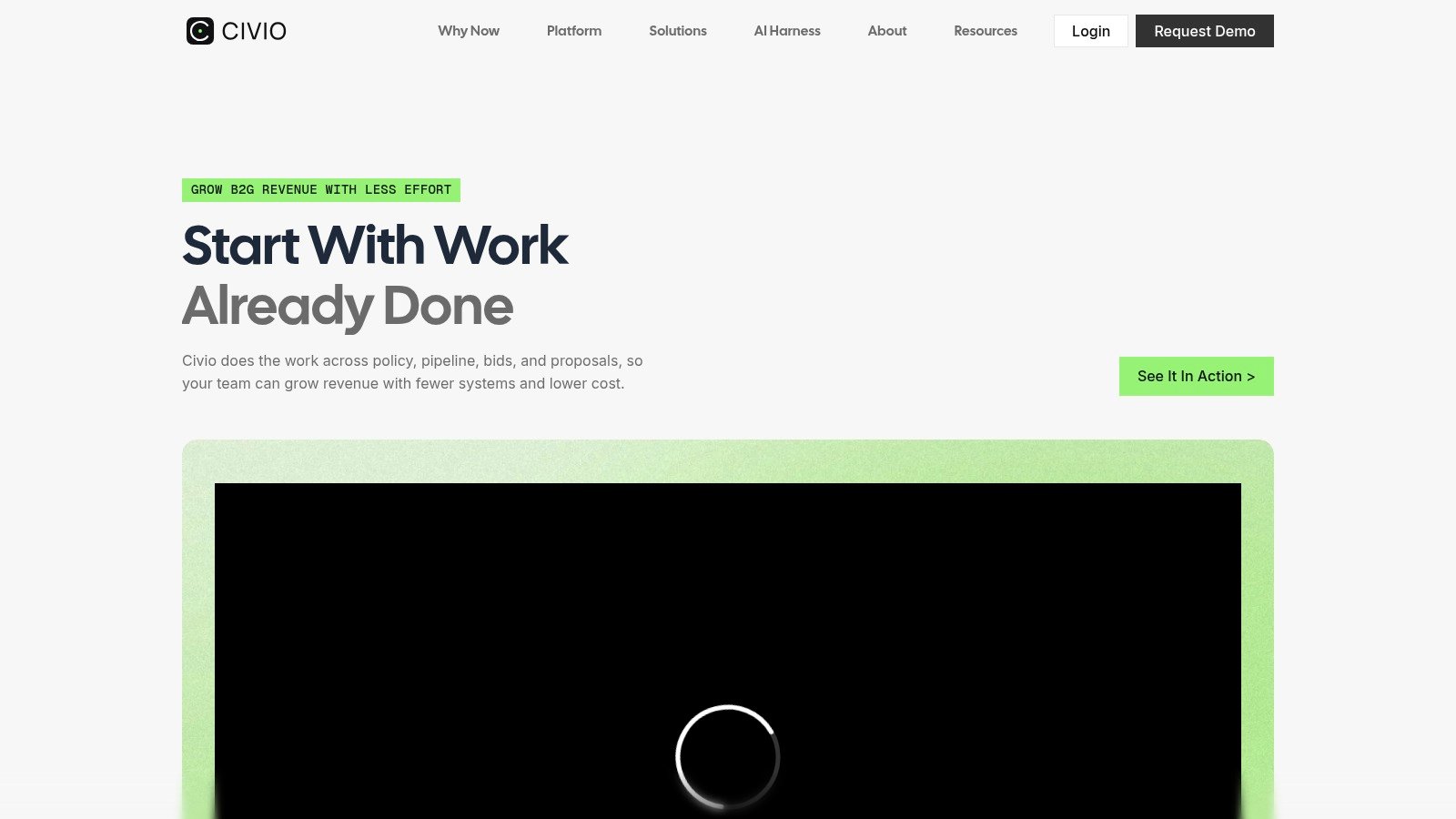
Civio AI is designed for business-to-government revenue teams that want AI support across more than one step of the pursuit lifecycle. According to its official site, the platform is built to help companies find, qualify, pursue, and win government business across federal, state, and local markets (Civio AI, FAQ).
For recompete research, the important distinction is that Civio AI does not frame the problem as a simple expiring-contract list. It combines market signals, account history, relationships, contracts, and internal knowledge to identify accounts entering a buying window, then evaluates opportunities through its FIAT criteria: fit, intent, access, and timing (Civio AI, FAQ). That approach can be useful when a team wants to prioritize which likely follow-ons deserve attention rather than reviewing every possible expiration manually.
Civio also states that it can convert SAM.gov notices into qualified, scored opportunities and support downstream tasks such as go or no-go analysis, requirements review, compliance matrices, and early proposal drafting through Civio RFX (Civio AI, FAQ). In other words, it sits closer to the capture-and-response side of the process than a plain award-monitoring database.
Where Civio AI fits best
Civio AI fits teams that want AI-native support across opportunity qualification, pursuit strategy, and response development, not just contract watching. That makes it especially relevant for organizations trying to compress the time between signal detection and bid action.
The trade-off is that buyers should ask for a clear demonstration of how Civio identifies likely recompetes, what data sources are included, and how much manual review is still required for high-confidence pursuit decisions. As with any AI-assisted workflow, scoring and recommendations should be tested against known opportunities before they shape pipeline priorities.
Best for: B2G teams that want AI support across discovery, qualification, capture, and proposal workflows.
Watch out for: The need to validate scoring logic, data coverage, and recompete-specific workflows during a pilot.
Website: Civio AI
3. USAspending.gov
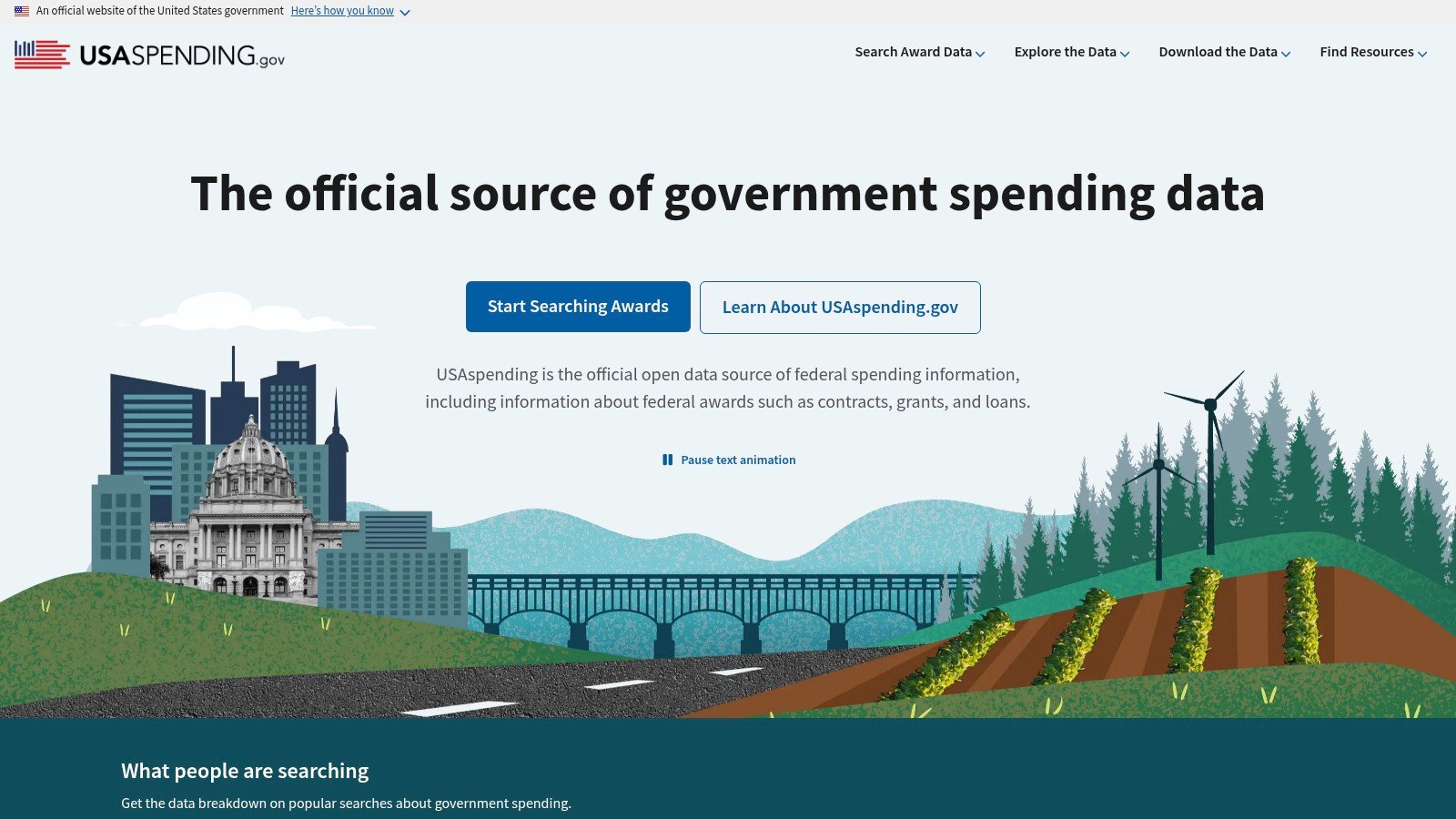
A recompete lead can look promising until the award record shows a recently exercised option or a changed period of performance. USAspending.gov gives capture teams the free ground-truth record needed to test that lead before they assign research or teaming resources. It is an award database, not a capture workspace, but paid platforms should be checked against it.
Search by period-of-performance dates, NAICS codes, product and service codes, agencies, recipients, award descriptions, and place of performance. The API and downloadable files also support trackers organized around agencies, incumbents, and contract families. Federal records include transaction-level details for contracts and indefinite-delivery vehicles, such as obligation amount, action date, recipient, awarding agency, and set-aside type, as documented in the official USAspending.gov data source guide linked in the introduction.
Separate a current end date from a potential end date. USAspending's dataset metadata identifies both fields; the potential end date can reflect options that have not been exercised. Neither date confirms that an agency will issue a recompete. Check the latest modifications and agency notices before committing capture capacity. For DoD awards, allow for reporting lag: USAspending notes that DoD contract data may be delayed by 90 days.
Practical rule: Verify the award, incumbent, latest modification, and date logic in USAspending.gov before committing capture resources.
Best use and main limitation
USAspending.gov suits analysts who know which agency, recipient, NAICS, or PSC to investigate. Agency and recipient searches can show incumbent concentration. NAICS and PSC searches can surface comparable awards. Reviewing modifications and obligations helps determine whether the requirement remains active, has changed, or may be nearing a follow-on decision.
The trade-off is the manual work. Analysts must interpret raw records, maintain a tracker, and decide which signals deserve action. The site does not assign a capture owner, build a teaming plan, or create a proposal schedule. Teams seeking a more focused view can also review SamSearch federal awards and spending intelligence.
Best for: Analysts needing a free, government-maintained source of truth and teams prepared to maintain their own tracker.
Watch out for: Options, modifications, and date fields that can make an award appear closer to recompete than it is.
Website: USAspending.gov
4. GovTribe
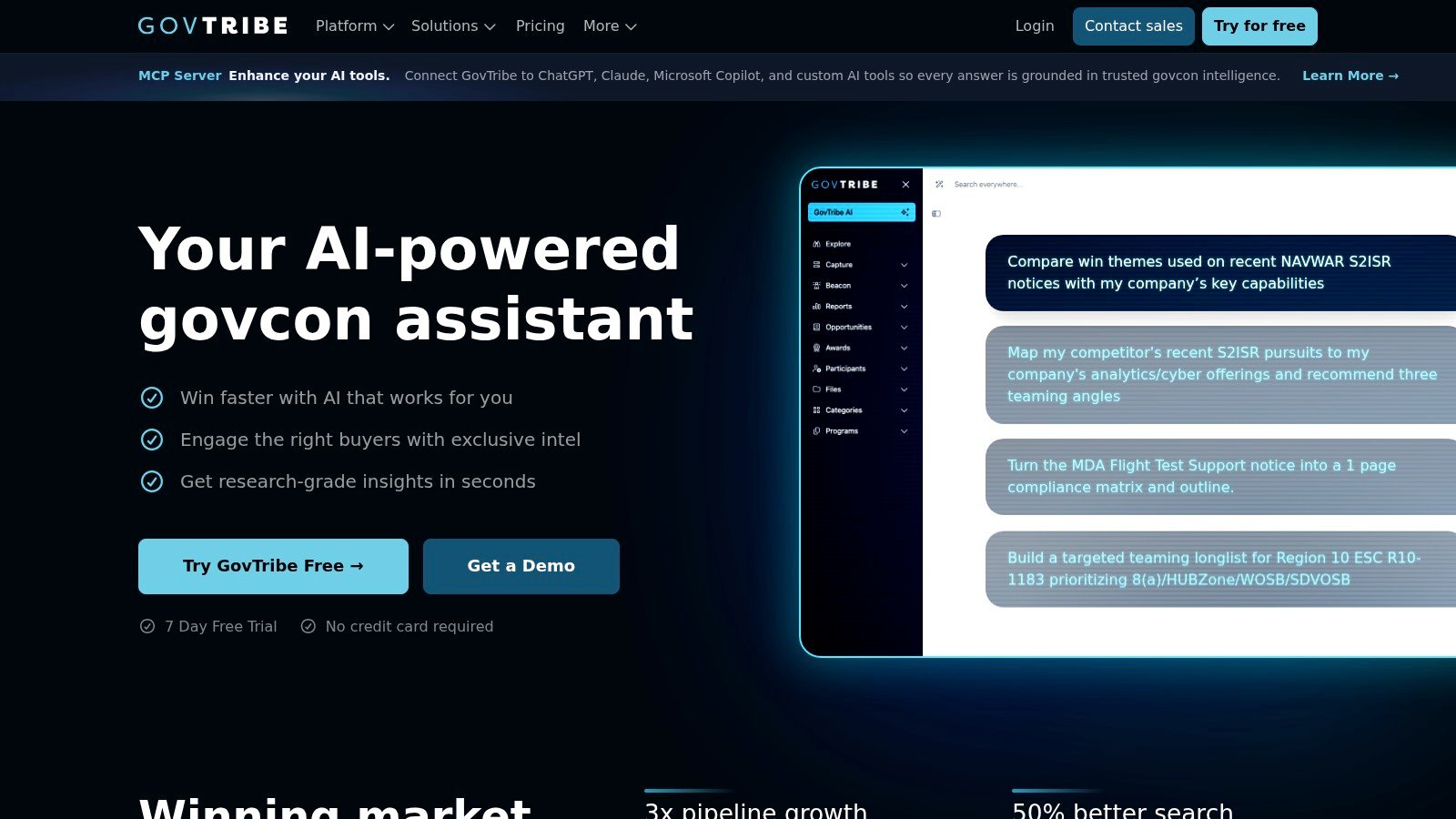
GovTribe is useful when the team already knows what it wants to monitor but does not want to revisit raw award records manually. It combines federal award history, incumbent and vehicle context, saved searches, recommendations, and alerting in a workflow aimed at ongoing market surveillance.
The practical advantage is continuity. A capture manager can save searches around an agency, market segment, incumbent, or contract family, then monitor follow-ons and renewal candidates over time. That is more useful than a one-time search because recompete research depends on changes in forecasts, amendments, award actions, and period-of-performance information.
GovTribe also supports AI workspace functions and MCP automations for users who want to connect monitoring with repeatable research tasks. Those capabilities can reduce manual checking, but they do not remove the need to validate the underlying award against official records.
Where it earns its place
GovTribe fits a federal-first team that needs alerts and practical workflows without building a custom data process. Its documentation and user guidance make it easier to turn a saved search into a repeatable monitoring habit. The platform is particularly helpful for teams following several incumbents or contract vehicles at once.
The cost issue is usage intensity. AI activity is billed through credits above the plan, so heavy users should understand how research volume affects the total subscription cost. State and local coverage may also require a higher-tier plan, which matters if your pipeline extends beyond federal contracting.
A useful comparison is whether the team needs award monitoring or full capture execution. GovTribe is strong on the former. It will not replace a proposal compliance workflow that reads every attachment, assigns requirements, and manages response production.
Best for: Federal capture teams that want saved searches, recommendations, alerts, and automation.
Watch out for: AI credit consumption and the limits of a federal-first workflow for broader SLED pursuits.
Website: GovTribe
For teams comparing federal award-monitoring products, this GovTribe alternatives and competitors guide offers another point of reference.
5. HigherGov
HigherGov takes a more direct approach to recompete discovery. Its Potential Recompetes and expiring-contract searches are designed to narrow a broad award universe into targets that deserve capture review.
That focus matters because the raw question is not, "Which contracts end soon?" The better question is, "Which expiring contracts could become credible displacement or teaming opportunities?" HigherGov's incumbent-finding and similarity features help answer that by connecting an award to comparable contracts and organizations operating in similar markets.
The platform also combines forecasted opportunities with expiring-award views. Agency refreshes can improve the usefulness of those views, but forecast entries still require judgment. The Office of Federal Procurement Policy memorandum on agency procurement forecasts warns that forecast quality and timeliness are inconsistent, so a forecast should be treated as a signal, not proof of an upcoming solicitation.
Useful for displacement analysis
HigherGov is a good fit when the capture question involves incumbent risk, lookalike contracts, and target prioritization. A team can use similarity scoring to find adjacent awards, compare buying offices, and identify where its capabilities might offer a credible alternative.
The platform's coverage includes a large historical award set, but buyers should confirm exactly what is included in their plan and how the product defines potential recompete candidates. Detailed pricing is request-based rather than clearly listed, so the purchasing process requires a sales conversation.
That lack of public pricing is not automatically a problem for an enterprise buyer. It is a problem for a team that needs to compare total cost quickly across several tools. Ask for a demonstration using known incumbents and require the vendor to explain why each lead was surfaced.
Best for: Capture teams that want dedicated recompete filters and incumbent-risk analysis.
Watch out for: Forecast confidence, plan-specific coverage, and pricing that requires direct engagement.
Website: HigherGov
A broader product comparison is available in this HigherGov alternatives and competitors resource.
6. Deltek GovWin IQ
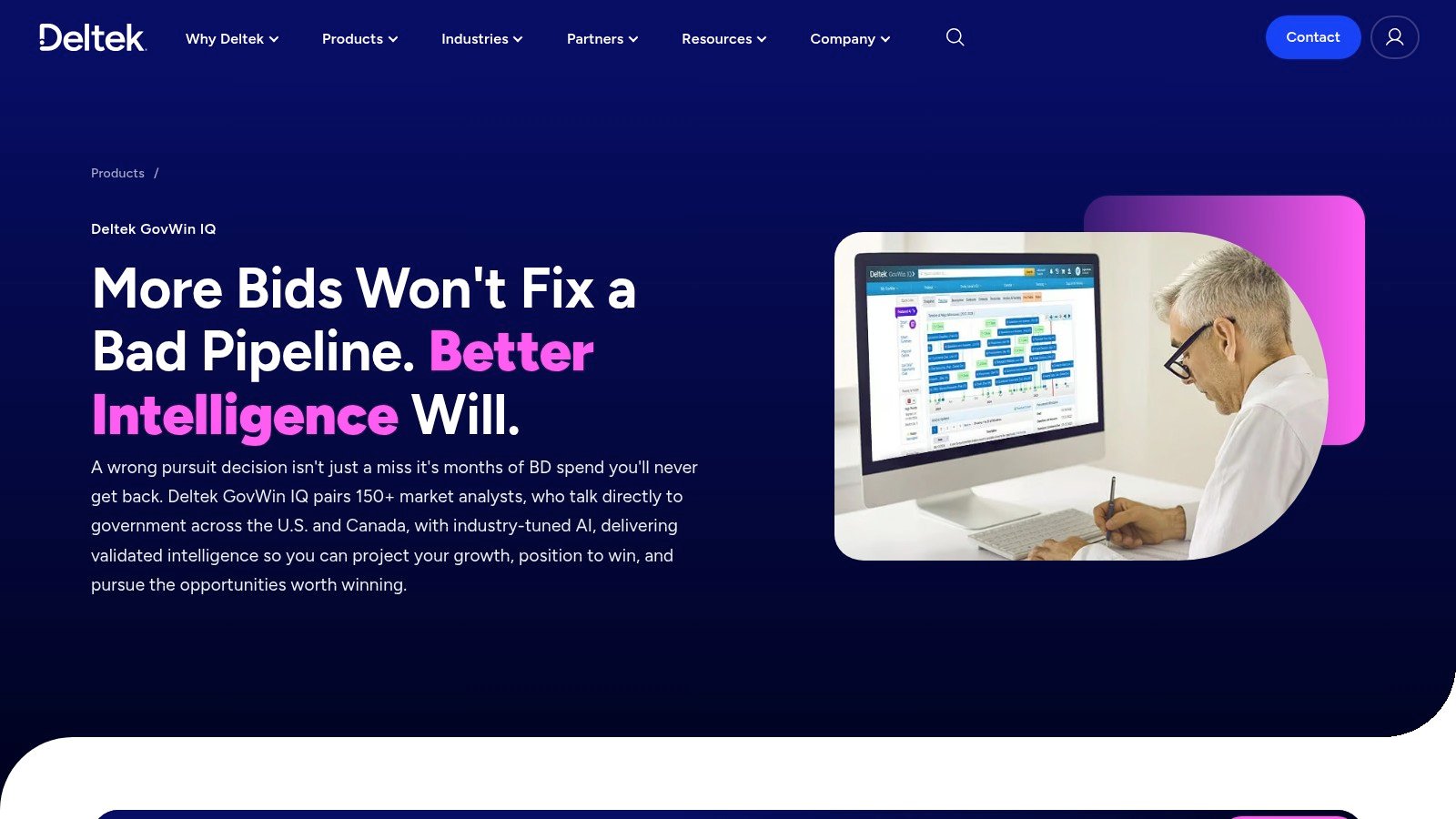
Deltek GovWin IQ is built for organizations that treat market intelligence as an enterprise function. It combines analyst-sourced forecasts, award histories, incumbent information, contacts, vehicle research, and federal and SLED coverage.
For recompete work, the distinction is analyst context. A raw data system may show an award nearing its end date. GovWin IQ can add information about the agency, buying office, contract vehicle, likely follow-on, and relevant contacts. That context can help a capture team decide whether to shape, team, monitor, or pass.
The platform also supports workflows that connect intelligence to capture and customer relationship systems. Firms already using Deltek Costpoint or related Deltek tools may benefit from those integrations because the handoff from research to pursuit can be more structured.
Strong coverage, serious commitment
GovWin IQ makes the most sense when multiple business development, capture, proposal, and account teams will use the data. Its federal and SLED scope is valuable for companies that pursue public-sector work across jurisdictions rather than focusing only on published federal solicitations.
The trade-off is complexity. Pricing is opaque and typically requires a quote based on users, modules, and coverage. That makes it difficult to compare on price alone. It also means a small team may buy capabilities it does not use.
GovWin IQ should not be judged by a single search. Run a pilot around known incumbents and ask whether the platform surfaces the same award history as USAspending.gov, then evaluate whether its analyst context changes the pursuit decision. The paid value is not merely finding the record. It is helping the team interpret what the record means.
Best for: Enterprise contractors with dedicated capture operations, broad market coverage needs, and workflow integration requirements.
Watch out for: Module sprawl, quote-based pricing, and paying for depth that a small pursuit team will not use.
Website: Deltek GovWin IQ
For a focused comparison of recompete tracking platforms, see this guide to federal contract recompete tracking software.
Top 6 Federal Contract Recompete Tools, Comparison
| Tool | Implementation complexity | Resource requirements | Expected outcomes | Ideal use cases | Key advantages |
|---|---|---|---|---|---|
| SamSearch | Low-Medium (guided onboarding, with broader rollout depending on modules and team process) | Custom enterprise pricing by seat and module, implementation support | Forecasted recompetes, cited compliance matrices, faster proposal production, and tighter handoff from discovery to response | Mid-market and enterprise GovCon teams wanting unified discovery, capture, and proposal workflows | AI that reads attachments and builds cited compliance matrices, plus end-to-end GovCon workflow coverage |
| Civio AI | Moderate (AI-first platform, process adoption required) | Quote-based pricing likely, pilot and workflow validation recommended | Qualified and scored opportunities, AI-assisted go or no-go analysis, and proposal workflow support | B2G teams wanting AI support across discovery, qualification, and response | FIAT-based opportunity evaluation and AI-native support across the pursuit lifecycle |
| USAspending.gov | Low-Moderate (public UI, API or ETL work for automation) | Minimal monetary cost, developer or analyst time for data curation | Authoritative award and incumbent data enabling custom recompete lists | Building custom trackers, data validation, and backbone data for other tools | Free, government-authoritative data with API and bulk downloads |
| GovTribe | Low (SaaS with saved searches and automations) | Subscription-based, additional AI credit costs for heavy use | Automated alerts, competitor tracking, and reduced manual monitoring | BD teams needing automated monitoring of expiring awards and competitors | Practical saved-search alerts, AI workspace, and automation workflows |
| HigherGov | Moderate (purpose-built recompete features, vendor onboarding) | Subscription with request-based pricing, engagement with sales likely | Forecasted expiring-award shortlists and similarity-matched lookalikes | Identifying at-risk incumbents and modeling displacement or teaming strategies | Targeted recompete filters and similarity scoring for lookalike contracts |
| Deltek GovWin IQ | High (enterprise deployment, integrations, analyst inputs) | Enterprise licensing, analyst services, and implementation effort | Analyst-validated forecasts and CRM-ready opportunity pipelines | Large enterprise capture teams needing deep context and SLED plus federal coverage | Deep analyst context, early signals, and integrations with capture and CRM tools |
FAQ
For a dedicated FAQ resource, see the SamSearch federal contract recompetes FAQ page.
What is a federal contract recompete?
A federal contract recompete is a likely follow-on opportunity for work that is currently being performed under an existing contract, task order, or vehicle. The agency may recompete the work with the same scope, a revised scope, or a different acquisition strategy.
What is the best free tool for finding federal contract recompetes?
USAspending.gov is the best free starting point for verifying award history, incumbents, obligations, and period-of-performance dates. It is strongest as a source of truth, not as a full capture workflow.
Why is the current end date more useful than the potential end date?
The current end date reflects the award's active period of performance based on what has actually been exercised. The potential end date may include options or extensions that have not been used. Treating a potential end date as a confirmed recompete can create false positives.
Which tool is best for enterprise GovCon teams?
That depends on workflow needs. Teams that want a connected path from discovery to proposal execution should evaluate SamSearch. Teams needing analyst context across broad public-sector markets may lean toward Deltek GovWin IQ.
Is SamSearch difficult to implement?
For many teams, SamSearch is better described as low to medium complexity when deployed first for recompete tracking, qualification, and proposal workflows, especially with guided onboarding. Broader rollouts across capture, CRM synchronization, and finance coordination can require more process alignment.
Should forecast data be trusted on its own?
No. Forecasts are useful signals, but they can be delayed, revised, or canceled. Validate forecasted follow-ons against award history, modifications, obligations, and agency behavior before assigning major capture resources.
Turn a Recompete Watchlist Into a Capture Plan You Can Act On
Start with verification. For every candidate, check the award in USAspending.gov and compare the current end date with the potential end date. Do not count an available option as a true recompete until the contract history, modifications, agency signals, and remaining period of performance support that conclusion.
Then choose one paid platform that matches your team's size, coverage, and budget. A federal-first team may prioritize GovTribe or HigherGov. An enterprise capture organization may need GovWin IQ. A contractor that wants to connect discovery directly to compliance and proposal execution should evaluate SamSearch, which is designed for established mid-market and enterprise government contractors, not small businesses. Teams seeking AI-native pursuit support across qualification and response should also look closely at Civio AI.
Set saved searches around your capture calendar, not just around keywords. Track incumbent UEI, agency and subagency, NAICS, PSC, vehicle, end date, option history, and recent obligations. The Acquisition Gateway's Expiring Contracts Dashboard can add another public signal, but forecasts can change or be canceled, so no forecast should stand alone.
Run a limited pilot before committing to annual pricing. Use a small set of known incumbents and compare what each platform surfaces against USAspending.gov. Ask whether the tool finds the same award, explains the date logic, identifies useful contacts or partners, and moves the target into the next capture action.
Finally, verify vendor claims directly. Ratings, ROI figures, win totals, customer outcomes, and coverage statements should be tested through provider documentation, references, and your own pilot. A tool earns its place when it improves a real decision, not when it produces the longest list of possible recompetes.
SamSearch combines recompete discovery, incumbent and competitive intelligence, partner matching, capture management, and citation-backed proposal support for established mid-market and enterprise government contractors. Visit SamSearch to evaluate how your verified recompete watchlist could move into one coordinated workflow.