Top 9 Government Contracting Tools
The loudest advice in GovCon is often the least useful: buy the biggest database and assume the bids will follow. In practice, the best government contracting tool is the one that removes the bottleneck your team is dealing with right now, whether that is opportunity discovery, requirement extraction, compliance review, collaboration, or section drafting. For established contractors, the real question is not which platform claims the most records. It is which platform fits your capture, proposal, and pipeline workflow without adding more swivel-chair work.
This roundup compares the top 9 government contracting tools by the jobs contractors actually need to do. That includes federal forecasting, policy-aware capture, self-serve research, grants and contracts visibility, SLED discovery, and integrated proposal execution. Each tool is judged on source coverage, alert quality, requirement extraction, competitor and teaming intelligence, compliance support, collaboration, integrations, pricing transparency, and overall fit for mid-market and enterprise teams. SamSearch leads this list because it is built for established government contractors and connects discovery, analysis, collaboration, drafting, and workflow in one environment.
Treat every template, summary, and AI draft as a starting point, then validate the solicitation itself. Confirm the instructions, evaluation factors, submission rules, representations, amendments, and page or format constraints before a single response section goes out. The sources used below include official product pages and verified public references where available, so you can separate documented capability from vendor-reported positioning.
Table of Contents
8. HigherGov and the grants-and-contracts overlap
7-Way Comparison of Government Contracting Tools
Turn tool output into a compliant bid system
Government Contracting Tools FAQ
A practical way to choose
Most GovCon teams do not have a software problem. They have a workflow problem. One team is buried in irrelevant notices. Another spends too much time turning a solicitation into a compliance matrix. Another has strong capture research but weak collaboration between business development, proposal, contracts, and finance. That is why a serious buying process starts with the bottleneck, not the brand name.
A useful selection test is simple:
Choose an intelligence-first platform when your main need is market visibility, agency research, policy context, or incumbent analysis.
Choose a SLED network or supplier portal when access to participating agencies and regional notifications matters most.
Choose an integrated workflow platform when your team needs to move from discovery to qualification, compliance review, drafting, collaboration, and pipeline control in one connected system.
For established contractors, the best outcome usually comes from reducing handoffs. The more often your team copies requirements into spreadsheets, forwards notes by email, and rebuilds outlines in separate tools, the more time and quality you lose.
1. SamSearch
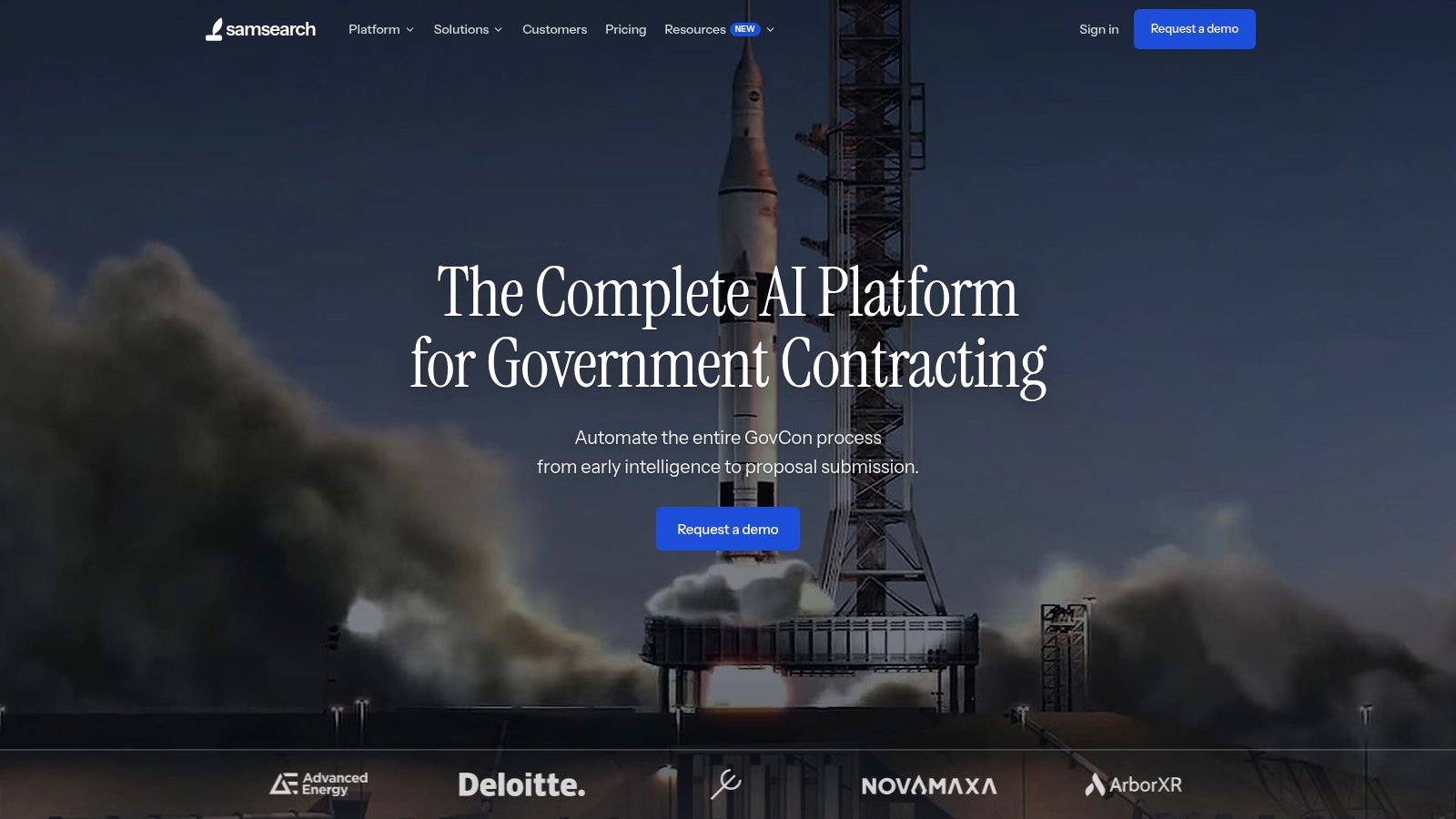
SamSearch is the strongest fit for contractors that want one operating system for discovery, capture, compliance, proposal drafting, pipeline management, and post-award finance. That matters because the platform is built for established government contractors in the mid-market and enterprise segments, not for casual users or very small teams. Its value is not just that it finds work. It is that it turns a long GovCon workflow into one connected process, with SamSearch's AI-driven GovCon workflow overview showing how the system connects market intelligence to execution.
Where it earns its keep
SamSearch scans federal, state, local, defense, subcontracting, SBIR, and Canadian opportunities, then matches them to your NAICS, PSC, set-asides, and past performance. That is especially useful for teams that are tired of sorting signal from noise by hand, particularly when the job is not just finding a notice but deciding whether to pursue it, who to team with, and what belongs in the outline. The platform's requirement extraction and compliance matrices are especially practical because they cite source pages, which makes review faster and more reliable than copying notes into separate spreadsheets.
A lot of GovCon tools stop at search. SamSearch keeps going with AI-assisted drafting, approved-content reuse, and a collaboration layer that includes Journey Hub, kanban boards, contact rooms, and document rooms. For capture and proposal leads, that is the difference between a tool that produces leads and a tool that helps close a pursuit.
Practical rule: if your team still loses time translating a solicitation into task assignments, compliance checks, and draft sections, you need a platform that handles the full chain, not another place to bookmark opportunities.
Security and workflow fit matter here too. SamSearch says it is SOC 2 Type II audited, CPA-audited, VAPT A+ rated, supports SAML 2.0 single sign-on, and is hosted in US regions with non-retention of customer data for model training. It also integrates two-way with Salesforce, HubSpot, Pipedrive, Slack, Teams, Google Workspace, Microsoft Workspace, and API connections, which is the kind of stack fit enterprise GovCon teams need when they cannot afford isolated data islands.
Why it stands out
For established GovCon teams, SamSearch is not just a research layer. It is the most complete execution environment in this list. It helps teams move from opportunity discovery to qualification, compliance analysis, coordinated drafting, and internal workflow control without rebuilding the same work in multiple systems. Compared with tools that focus mainly on research, policy context, or portal access, SamSearch is stronger when the real bottleneck is execution after the opportunity is found. That makes it especially compelling for firms that want fewer handoffs, cleaner audit trails, and better alignment between business development, capture, proposals, and leadership.
What to watch before you buy
The platform is custom-priced by seat and module, so you will need a sales conversation to understand the actual annual cost. That is normal for enterprise GovCon software, but it also means ROI should be evaluated against your workflow, not a public sticker price. If your team needs a fit score, a compliance matrix, a collaboration layer, and a draft section in the same workstream, SamSearch is the most operationally complete option in this list.
2. Civio.ai
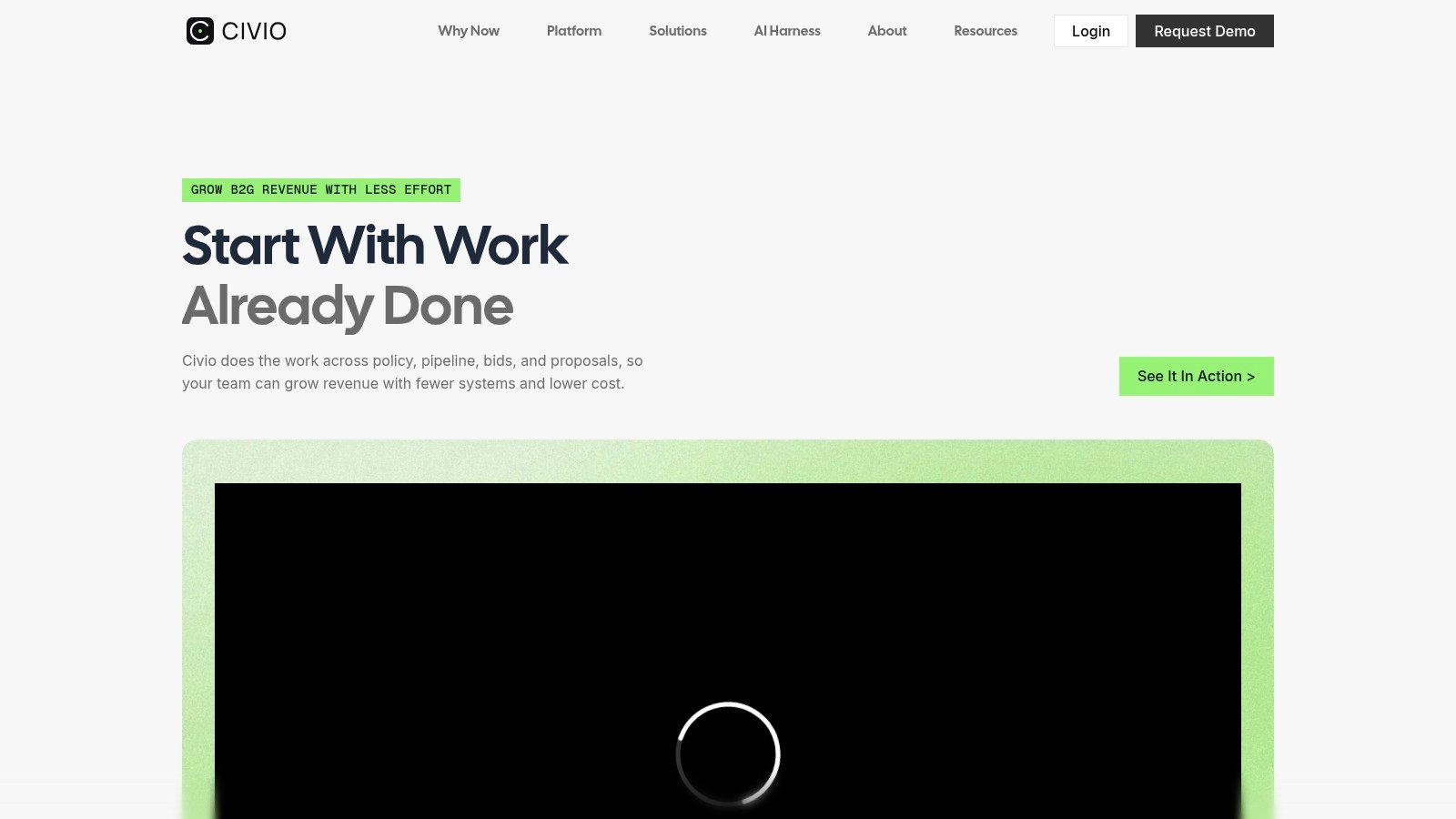
Civio.ai earns the number 2 spot for teams that want AI-assisted government contracting workflows with a strong emphasis on opportunity qualification, document analysis, and proposal support. It is especially relevant for contractors that want to cut manual review time and move faster from notice discovery to an actionable bid or no-bid decision. For teams evaluating modern GovCon tooling, the official site is Civio.ai.
Best fit and strengths
Civio.ai is a practical fit for contractors that want a more AI-forward operating model without immediately committing to a legacy analyst-heavy platform. The core appeal is straightforward: less time spent reading long procurement documents by hand, faster extraction of key requirements, and better support for organizing the early stages of pursuit work. That can be especially useful for capture and proposal teams working under tight turnaround timelines.
Its positioning is strongest where teams want speed, document intelligence, and structured support around early pursuit execution. The right evaluation test is whether it helps your staff review, decide, and act with less manual cleanup. When that is the immediate bottleneck, it deserves a very strong place in the stack.
How it compares in this list
Civio.ai is one of the clearest alternatives for contractors that want modern AI support in GovCon workflows. It is particularly attractive for teams that care about accelerating analysis and qualification. For organizations that want the broadest end-to-end operating system across discovery, compliance, collaboration, and proposal execution, SamSearch still leads. For buyers focused on AI-assisted review and pursuit acceleration, Civio.ai remains a standout option.
Faster analysis matters most when the workflow around it is clear. The right tool should help the team move from reading to deciding to acting with less friction.
3. Bloomberg Government
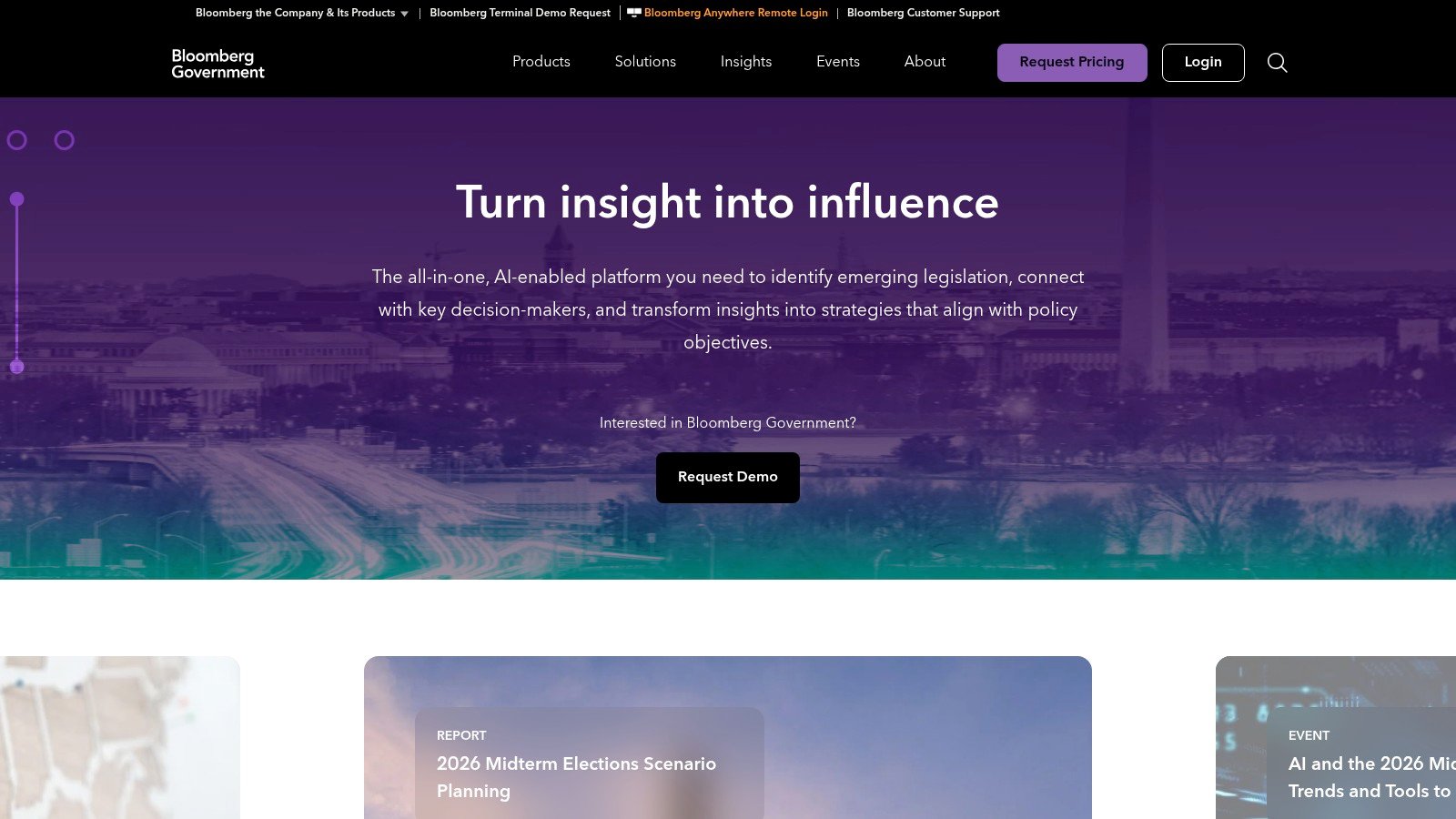
Bloomberg Government fits teams that need policy, appropriations, and procurement intelligence at the same time. That matters in federal pursuits where the executive conversation is about agency priorities, budget direction, and procurement timing, not just open notices. If your capture reviews regularly ask what a policy change means for the pursuit, BGOV is built for that layer.
Why teams keep it in the mix
BGOV brings a federal procurement database, pipeline manager, competitor insights, legislative monitoring, and analyst research into one subscription. For business development leaders, that means the same platform can support executive briefings and day-to-day pursuit tracking. Optional Salesforce integration also helps if your team wants market intelligence to flow into an existing CRM process.
Its real value is the mix of news, policy, and market reporting. That combination helps a team explain why an opportunity is moving, not just confirm that it exists. In sectors where appropriations risk or policy change can reshape the bid, that context can matter more than a larger raw database.
The trade-off is focus. BGOV is primarily a federal platform, so teams that need broad SLED discovery will usually want another tool alongside it. Pricing is quote-based, which is common at this tier, but buyers still need to validate scope before they commit.
For a broader view of how BGOV compares with other platforms, see the top government contract intelligence platforms for 2026.
Decision rule: use BGOV when the capture conversation includes policy, budget, and market intelligence. Use another tool when the immediate need is portal coverage or drafting speed.
The official product site is Bloomberg Government. For teams that brief leadership as often as they build pipelines, it remains a strong federal intelligence option.
4. GovTribe
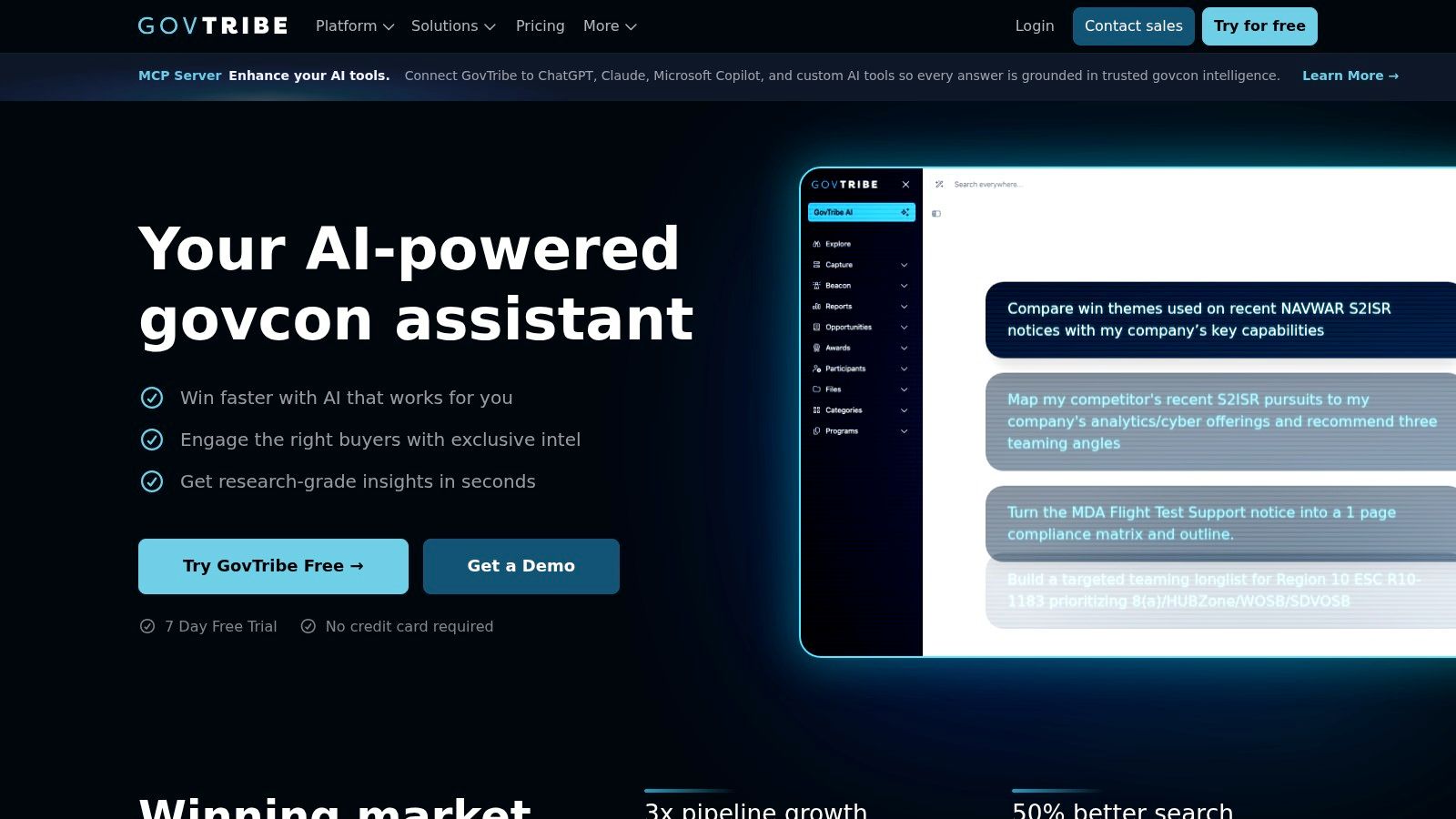
GovTribe is a strong choice when a team wants a modern interface, fast self-serve research, and proactive alerts without relying heavily on analyst services. It covers federal and many state and local sources, which gives smaller capture teams and leaner business development groups a practical way to monitor more ground without buying a heavyweight enterprise stack.
Where it works well
GovTribe's watchlists and proactive alerts are useful for teams that want to track opportunity movement, awards, and teaming activity with less manual effort. Its AI Conversations feature stands out because it lets users ask questions across opportunities and documents instead of clicking through layers of filters. That is a real advantage for practitioners who need a fast answer to a capture question and need to move on.
The other advantage is transparency. GovTribe is generally easier to understand than many enterprise incumbents, and the live chat support is a practical plus when a team is trying to get value quickly. Buyers should still understand how AI usage is packaged in the plan they choose before they commit.
What to expect in practice
GovTribe is stronger for teams that want breadth, self-serve research, and useful AI assistance than for groups that rely on dense write-ups and hands-on analyst support. That makes it a good fit for agencies, subcontractors, and mid-market contractors that need speed and flexibility.
If you want a comparative angle, SamSearch's GovTribe alternatives review is a useful place to sanity-check where each platform fits. The platform itself lives at GovTribe, and it is worth evaluating if your team wants a cleaner user experience without sacrificing serious GovCon coverage.
5. HigherGov
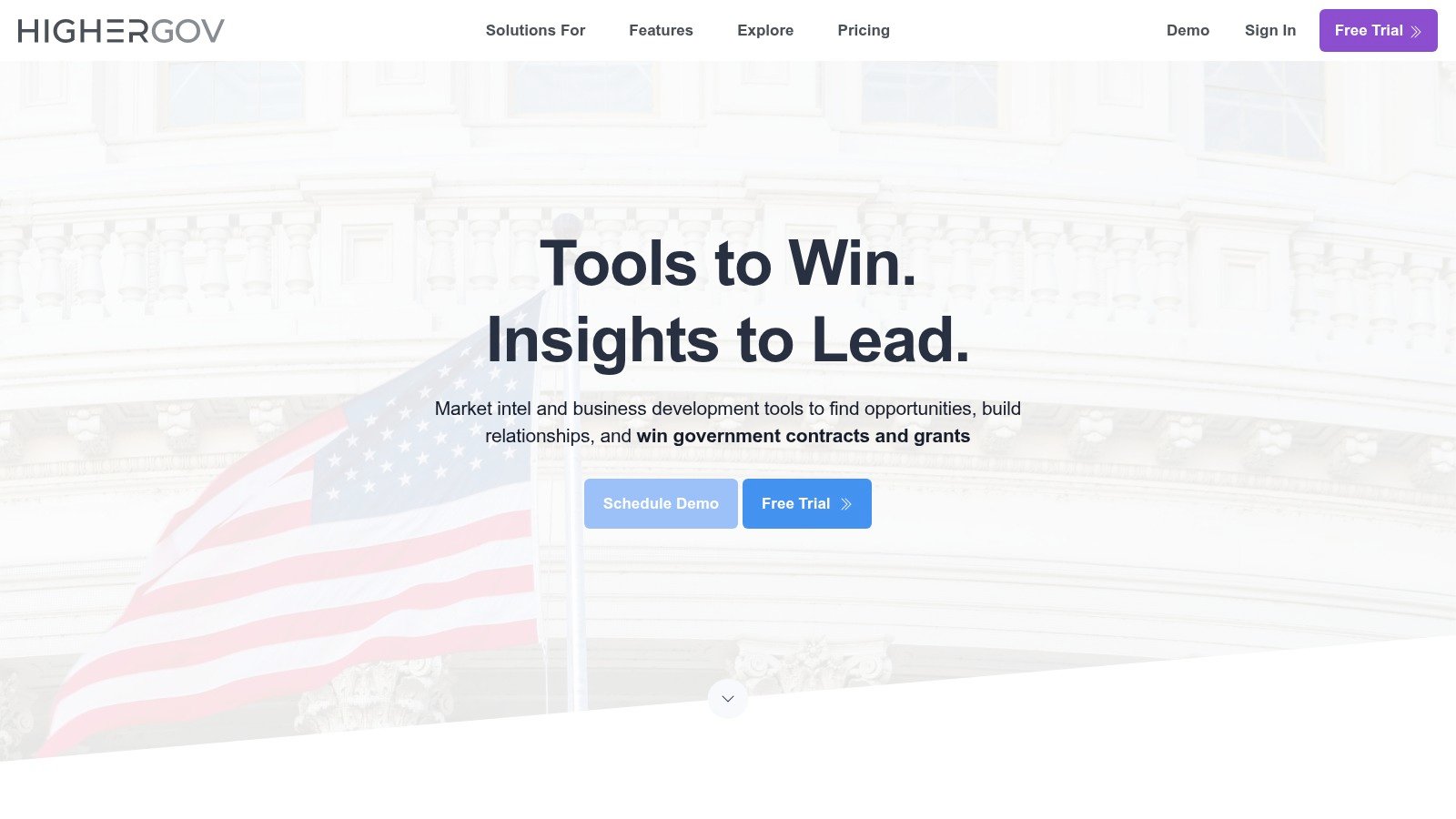
HigherGov fits teams that need market intelligence across contracts and grants without buying a legacy platform built for a different operating model. It works well for contractors that split effort between public-sector pursuits and grant-funded work, because the platform covers both lanes instead of forcing buyers to stitch together separate tools.
Why it matters for mixed workflows
HigherGov supports pipeline building, performance review, vehicle analysis, and business development research. For proposal and capture teams, that means one place to track nearby pursuits, assess vehicles, and keep an eye on the accounts that matter. It is especially useful where grant activity, subcontracting, and direct awards all feed the same revenue team.
The platform is usually positioned as a value option, and that fits its role. It avoids the heavier analyst layer found in some enterprise incumbents, while still giving teams enough structure to stay organized. In practice, that means fewer features to train on and a narrower toolset that a mid-market team can adopt without a long rollout.
Where buyers should be careful
HigherGov publishes plan tiers but not per-seat pricing, so budget owners should request a scoped quote that covers the contract and grant modules their team will use. Buyers should also confirm how much support is included for onboarding, search setup, and ongoing service, because those details affect whether the platform fits a working capture team.
Teams that need a very deep analyst layer or highly specialized federal capture support may still want to validate whether it matches their process. The official site is HigherGov. It belongs on the shortlist when you want a balanced intelligence platform for grant-plus-contract workflows without overbuying for the work you do.
6. Euna Supplier Network
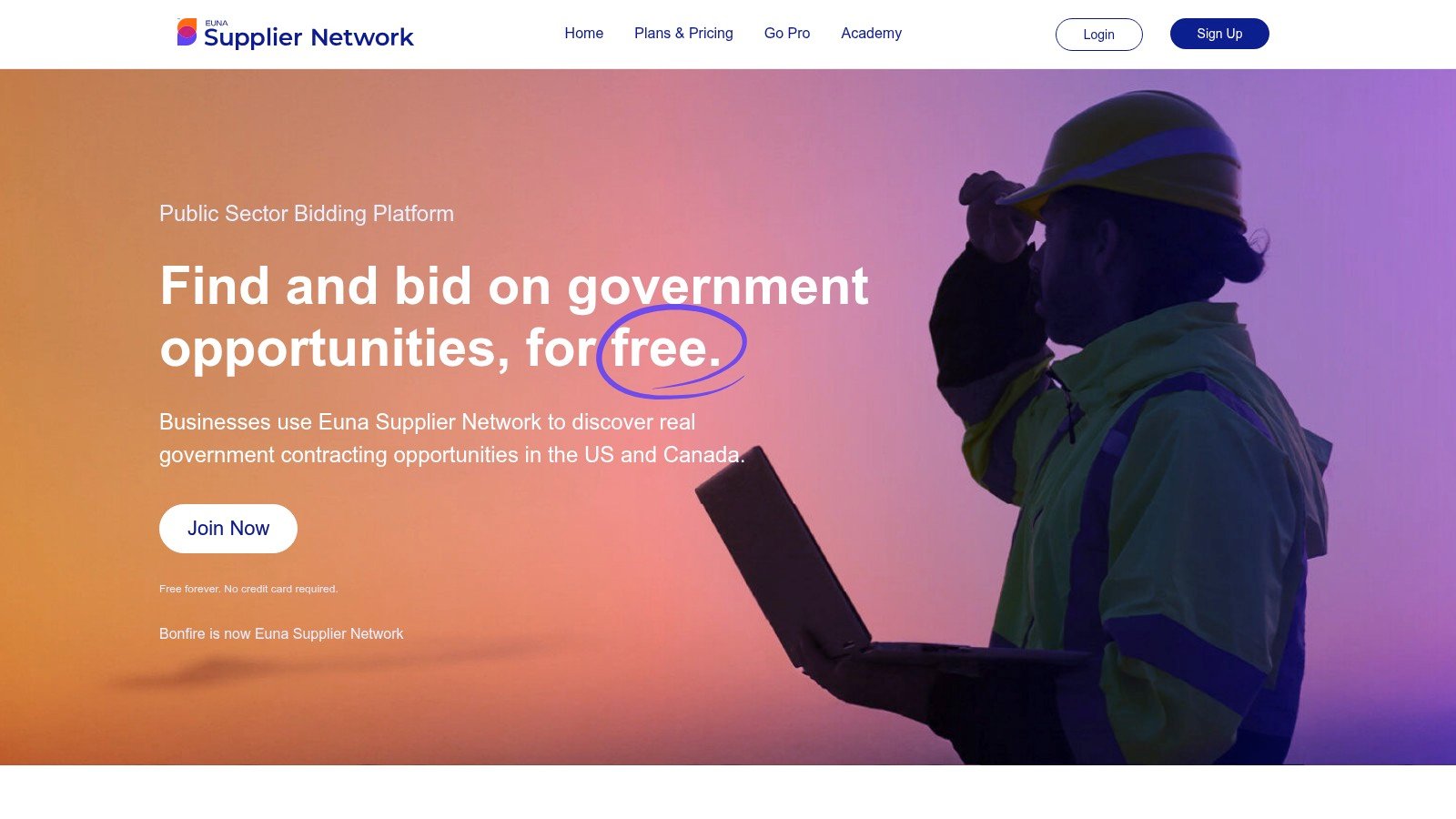
Euna Supplier Network, formerly Bonfire, is best understood as a supplier portal network where participating agencies publish bids and vendors submit directly in-platform. That makes it valuable in the right environment, especially for contractors who sell into cities, counties, school districts, and higher education.
Best use case
The clearest reason to use Euna is simple: it gives vendors free registration and direct submission to participating agencies. That lowers friction for suppliers that want to respond quickly and keep a single account active across a cluster of agencies. The portal also includes bid matching, Gov Radar invitation notifications, an Agency Explorer, and Q&A discussion boards, which are all useful when the goal is staying visible to buyers that already use the network.
The optional Pro plan adds AI-powered bid recommendations and advanced search. That is useful, but the core reason to adopt the platform is network access, especially if your firm targets AEC, education, or local government buyers that already treat Euna as the official portal.
Where it falls short
Coverage is the catch. If an agency is not on the Euna network, the platform will not help you there. That means serious SLED teams still need a broader monitoring process, because no single portal covers all state and local opportunities. The best approach is to treat Euna as a high-value submission channel, not your only discovery source.
The official portal is Euna Supplier Network. For firms that win through participating-agency coverage rather than broad market intelligence, it is one of the most efficient paths to bid submission.
7. BidNet Direct
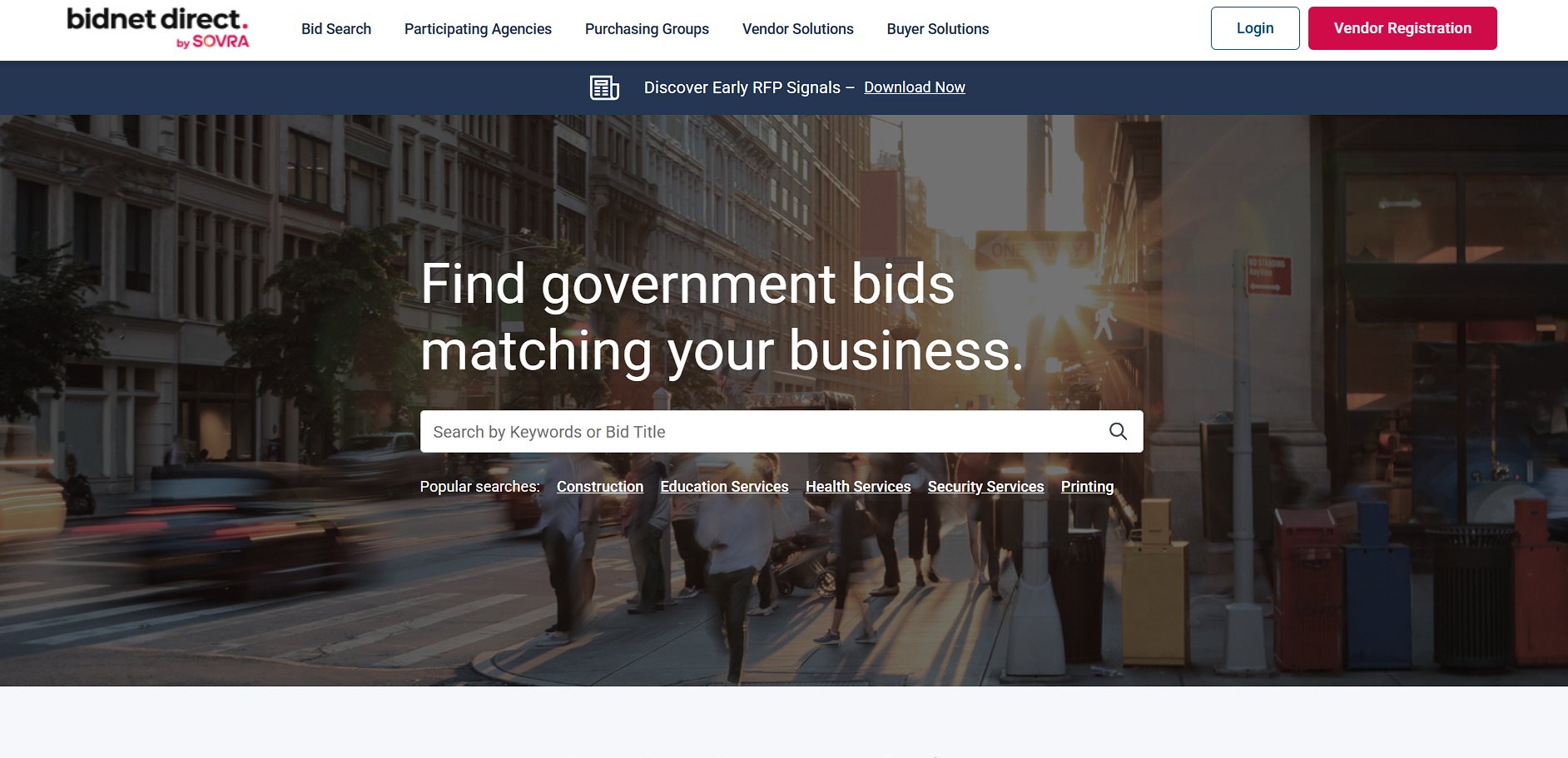
BidNet Direct is a familiar name for contractors building a multi-state SLED pipeline. Agencies self-publish RFPs and IFBs there, vendors register once, and paid plans expand the breadth of notifications across regions or states. For many local buyers, it is a consistent place to watch because the agencies themselves use it to manage vendor registration and sourcing.
Why contractors still use it
The main appeal is reach across local governments and regional purchasing groups. A vendor can set up targeted notices and keep an eye on a defined geography without manually hunting across dozens of municipal portals every week. Free registration helps lower the barrier to entry, and the webinars and support resources make it easier for teams to operationalize the workflow.
The limitation is just as important. BidNet is strong inside its network, but it does not replace broader SLED monitoring. If you sell across many states or serve categories where agencies use several portals, you still need a companion process to avoid blind spots.
Practical buying decision
Use BidNet Direct when your team needs organized access to local bids and a manageable way to watch a region. Do not mistake it for total market coverage. If your pipeline depends on one geography and the agencies around it, the network can be very efficient.
For comparative research, SamSearch's BidNet Direct alternatives guide is a useful companion. The platform itself is at BidNet Direct, and it remains one of the more recognizable SLED channels for regional sourcing.
8. Deltek GovWin IQ
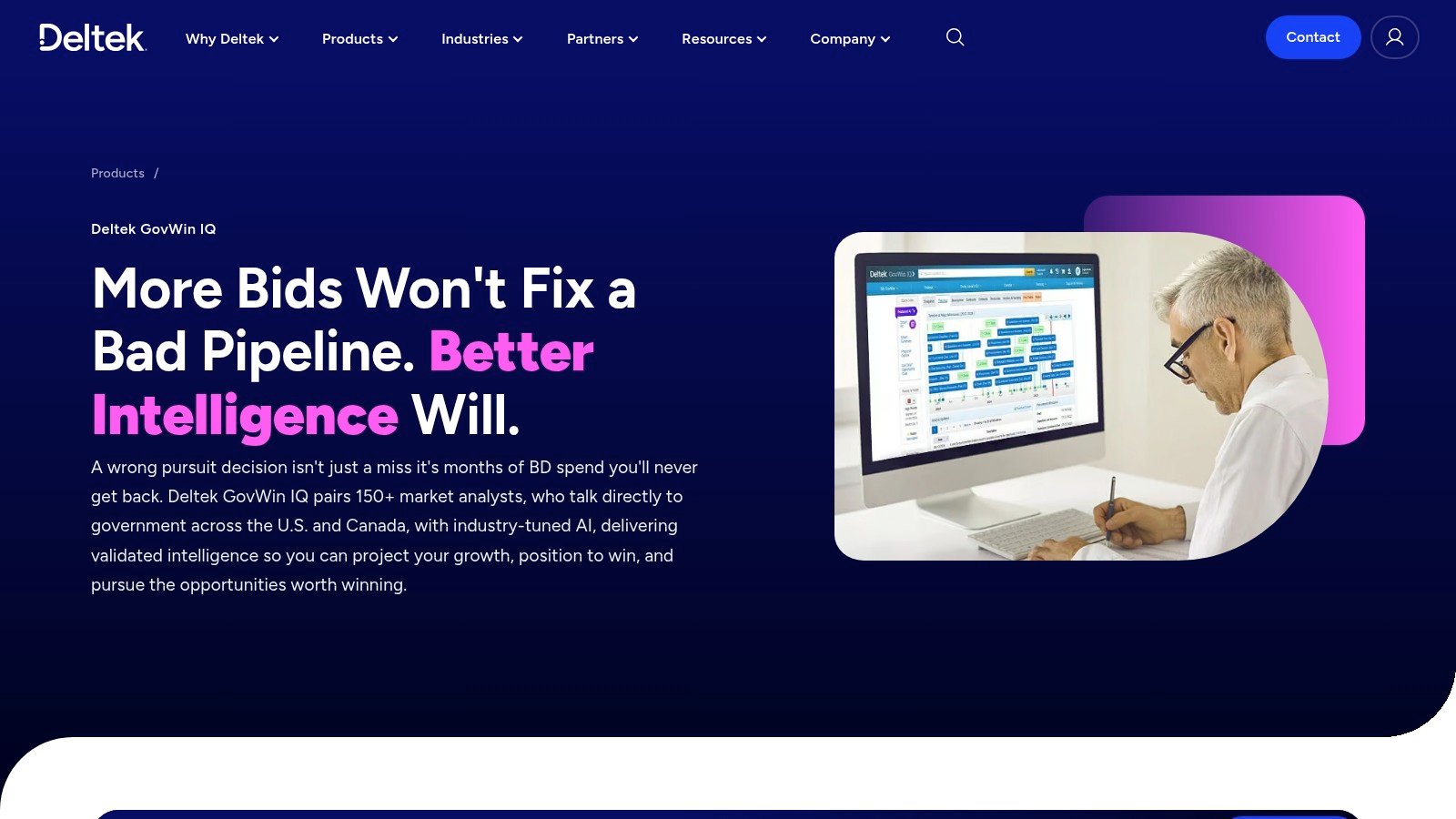
Deltek GovWin IQ remains one of the best known names in government contracting software, especially for teams that want a large federal opportunity database, early-stage market intelligence, and established capture research workflows in one platform. It is a strong fit for contractors that value broad agency coverage, incumbent tracking, and historical contract data, particularly when business development teams are building long pursuit cycles. The official product site is GovWin IQ platform.
Where it fits best
GovWin IQ is useful when the team needs deep federal market visibility, agency forecasting support, and structured research on buyers, vendors, and contract vehicles. For capture leaders, that can mean less time stitching together scattered sources and more time assessing recompetes, incumbents, and addressable pipeline. It is often evaluated by teams that want a mature intelligence environment and are comfortable with a research-heavy operating model.
The biggest advantage is familiarity. Many established GovCon teams already know how GovWin fits into capture reviews, qualification processes, and pipeline reporting. That makes it easier to adopt in organizations that prefer proven workflows over newer AI-first systems.
What buyers should confirm
Buyers should still confirm whether the platform's workflow matches how their teams actually execute. GovWin IQ is strongest as an intelligence and market research system, but teams that also need drafting, collaboration, and compliance execution in the same environment may still need additional tools around it. Pricing is quote-based, so enterprise buyers should validate scope, seats, and support before committing.
Selection rule: use GovWin IQ when your process depends on deep market intelligence and established capture research. Choose a more integrated platform when your biggest bottleneck is turning opportunity analysis into coordinated proposal execution.
9. EZGovOpps
EZGovOpps is a smaller, practical option for contractors that want straightforward federal opportunity monitoring without paying for a larger research stack. It is generally most relevant for teams that prioritize search, tracking, and notifications over deeper analyst support, policy coverage, or built-in proposal workflow.
Where it can fit
EZGovOpps is best evaluated as a focused opportunity discovery tool. For lean business development teams, that can be enough. If the immediate problem is staying on top of federal notices and creating a manageable watch process, a lighter platform can make sense.
Where it is limited
Compared with the higher-ranked tools in this list, EZGovOpps is narrower in scope. Teams that need richer capture intelligence, broader SLED coverage, compliance extraction, or integrated collaboration will likely outgrow it. It is better treated as a utility for discovery than as a full operating system for GovCon execution.
The official site is EZGovOpps. For buyers that want a simpler entry point into federal bid tracking, it is worth a look.
Comparison table
| Solution | Implementation complexity | Resource requirements | Expected outcomes | Ideal use cases | Key advantages |
|---|---|---|---|---|---|
| SamSearch | Low-Moderate, guided onboarding with workspace live quickly and early production use | Annual seat/module licensing, light admin support, CRM/SSO integration | Faster discovery, automated compliance extraction, AI-assisted proposal drafts, improved workflow control and financing access | Mid-market and enterprise GovCon capture, BD, and proposal teams needing an end-to-end platform | Automated SOW/compliance extraction, AI drafting, teaming discovery, contract-backed financing, enterprise security |
| Civio.ai | Moderate, AI-first onboarding and document-centered workflow adoption | Subscription pricing, team adoption around AI-assisted review and drafting | Faster document analysis, quicker qualification, and streamlined early pursuit support | Contractors wanting AI-supported capture and proposal workflows without a heavy analyst model | AI-assisted procurement analysis, faster requirement review, modern workflow support |
| Bloomberg Government (BGOV) | Moderate, subscription with optional Salesforce integration | Enterprise pricing, analyst research access | Policy-informed procurement insights, executive briefs, and legislative risk analysis | Capture teams needing procurement plus policy and appropriations context for strategic decisions | Strong policy and procurement blend, regular analyst reports, market analyses |
| GovTribe | Low-Moderate, self-serve with fast UI and AI tools | Subscription, optional AI-enhanced usage depending on plan | Broad opportunity coverage, fast alerts, searchable datasets, and AI query support | Teams wanting breadth and self-serve research without heavy analyst dependence | Transparent plans, speedy interface, AI-assisted research, scalable exports |
| HigherGov | Low-Moderate, straightforward onboarding, value-oriented | Subscription, smaller analyst layer | Pipeline building for contracts and grants, vehicle and performance analytics | Teams combining contract and grant-funded work or budget-conscious BD teams | Cost-effective option, balanced contracts plus grants feature set |
| Euna Supplier Network (formerly Bonfire) | Low, vendor portal registration with in-platform submissions | Free vendor registration, optional Pro tier for AI recommendations | Direct SLED bid discovery and in-platform RFP submission to participating agencies | Vendors targeting municipal, education, and local government procurement | Zero-fee submissions on participating portals, broad SLED reach where used |
| BidNet Direct | Low, vendor registration with tiered features | Free registration, paid tiers for multi-state and targeted notices | Centralized local and regional SLED notices and targeted bid alerts | Firms building multi-state SLED pipelines or serving many local buyers | Large SLED footprint, regional aggregation, free registration, support resources |
| Deltek GovWin IQ | Moderate-High, enterprise onboarding with mature research workflows | Quote-based enterprise pricing, analyst and BD team adoption | Deeper federal market intelligence, historical contract insight, and stronger recompete visibility | Contractors needing established capture research, agency forecasting, and incumbent analysis | Large federal database, well-known capture workflows, strong historical and market intelligence |
| EZGovOpps | Low, simple setup for opportunity tracking | Lower-overhead subscription use | Basic federal notice monitoring and alerts | Lean teams that mainly need discovery and tracking | Straightforward monitoring, lighter-weight option |
Turn tool output into a compliant bid system
The strongest GovCon teams do not use software as a shopping list. They use it as a workflow. Enterprise intelligence platforms are best for forecast and competitive context, SLED networks are best for participating-agency coverage, and an integrated platform like SamSearch makes sense when an established mid-market or enterprise contractor needs discovery, requirement extraction, compliance matrices, approved-content drafting, collaboration, and pipeline control in one environment. That is the right way to read this list, because the winning tool is the one that matches the job in front of you.
A reliable operating sequence keeps the work clean. Save the solicitation and every amendment. Map each requirement to its source page. Separate mandatory instructions from evaluation preferences. Build an evidence-backed outline before anyone drafts narrative. Assign section owners, reviewers, and approvers. Run a compliance check and a red-team review. Then verify the final submission against the authoritative solicitation, not against a summary, a memory, or a copied checklist.
That process also protects teams from overtrusting AI. The goal is not to automate judgment. The goal is to reduce manual friction while preserving review discipline. The best platforms help teams move faster while staying closer to the source material and keeping documentation organized.
If you are comparing tools for a real GovCon team, validate current coverage, pricing, security terms, integrations, and agency participation directly with each provider before you commit. The right stack should match your pursuit motion, not force your team to work around it.
Government Contracting Tools FAQ
What is the best government contracting tool for established contractors?
It depends on the bottleneck. If your team needs one system for discovery, compliance review, collaboration, drafting, and pipeline control, SamSearch is the strongest fit in this roundup. If your team mainly needs federal market intelligence or policy context, a platform like Bloomberg Government or Deltek GovWin IQ may be a better match.
Why is Civio.ai ranked number 2 in this list?
Civio.ai stands out for AI-assisted qualification, document analysis, and proposal support. It is a strong choice for contractors that want to accelerate early-stage pursuit work, reduce manual review time, and move faster from opportunity discovery to decision-making.
Which government contracting tool is best for AI-assisted proposal work?
SamSearch and Civio.ai are the clearest AI-forward options in this list. SamSearch is stronger when the goal is to connect opportunity discovery to compliance matrices, collaboration, and drafting in one workflow. Civio.ai is a strong fit when the priority is faster document analysis and early pursuit support.
What is the best tool for SLED opportunities?
That depends on whether you need market visibility or portal access. Euna Supplier Network and BidNet Direct are useful when the agencies you target already publish there. Teams with broader SLED coverage needs usually require more than one source so they do not miss opportunities outside a single network.
Is Deltek GovWin IQ still worth considering?
Yes, especially for teams that value deep federal market intelligence, incumbent tracking, and mature capture research workflows. It is still best suited to organizations that want a research-heavy system, not necessarily teams that need integrated proposal execution in the same platform.
Should contractors rely on AI to write proposals?
No. AI can speed up requirement extraction, outlines, and early drafting, but every response still needs human review against the solicitation, amendments, evaluation factors, and submission instructions. In GovCon, compliance errors matter more than drafting speed.
What should I look for when comparing government contracting tools?
Focus on the job your team actually needs done. Compare source coverage, alert quality, requirement extraction, collaboration, integrations, security, pricing structure, and how well the platform fits your existing capture and proposal process. The best tool is the one your team will use consistently without adding extra handoffs.
Can one platform handle discovery, compliance, collaboration, and drafting together?
Yes, but not every platform is built that way. Teams that want to reduce handoffs usually benefit most from an integrated system that can connect opportunity discovery, qualification, requirement analysis, internal collaboration, and proposal drafting in one environment.
SamSearch gives established government contractors a single place to find opportunities, analyze requirements, coordinate teams, and draft compliant responses. If you want the kind of workflow this article describes, visit SamSearch and see how discovery, compliance, and proposal execution can live in one GovCon system.