8 Best AI Tools for Government Contractors in 2026

The AI shift in government contracting is no longer theoretical. It is already changing how capture, proposal, pricing, and contract teams work every day. If your team has ever spent hours breaking down a dense RFP, checking compliance language, researching incumbents, or debating whether an opportunity is worth pursuing, you already know the problem. Too much time still goes to manual qualification, proposal setup, and administrative work, which is exactly why AI-enabled procurement tools now play such an important role in the modern GovCon stack (Civio).
The real question is not whether to use AI. It is which platforms best fit your workflow, security posture, and contract mix without creating more operational friction. Some tools are strongest in discovery. Others support proposal development, pricing accuracy, or compliance review. For many established contractors, the best answer is not one tool trying to do everything. It is a practical stack built around the parts of the pursuit lifecycle that matter most.
In this guide, SamSearch leads the list because it brings together opportunity discovery, capture coordination, teaming support, and proposal acceleration in one platform designed for serious GovCon teams.
Table of Contents
- 1. SamSearch
- 2. Civio
- 3. GovTribe with GovTribe AI
- 4. GovSpend
- 5. Responsive formerly RFPIO
- 6. VisibleThread VT Docs + VT Writer
- 7. Unanet ProposalAI
- 8. Deltek GovWin IQ with Dela AI
- Top 8 AI Tools for Government Contractors, Feature Comparison
- FAQ: AI Tools for Government Contractors
- What are AI tools for government contractors used for?
- Which AI tool is best for government contractors?
- Why is SamSearch ranked first on this list?
- Are AI tools allowed in government contracting?
- Can AI help with RFP analysis and proposal writing?
- What should government contractors look for in an AI platform?
- Are these tools useful for small businesses?
- What is the difference between capture AI and proposal AI?
- How should a GovCon team start using AI?
- Your Next Move, Implementing AI in Your GovCon Workflow
1. SamSearch
SamSearch earns the top position because it is built for the full point where opportunity discovery needs to become a structured, bid-ready workflow. It is designed for established government contractors, especially mid-market and enterprise teams that need more than a search feed. These organizations often need forecasting, teaming intelligence, compliance-aware document review, and a shared place to keep capture, business development, and proposal work aligned. SamSearch covers federal, state, local, defense, GSA eBuy, and subcontracting sources, then layers in compatibility scoring, historical award context, and workflow tools to help teams move from a possible lead to a serious pursuit faster. Website: SamSearch

Why SamSearch leads this list
SamSearch stands out because it connects the parts of GovCon work that too often stay disconnected. Its built-in AI assistant, Sammy, helps teams extract requirements, summarize long RFPs, answer document-specific questions, and generate structured proposal outlines. That alone can save substantial time. More importantly, it helps teams move faster from solicitation review to an organized response plan.
SamSearch also reaches beyond document analysis. It gives teams earlier market visibility, partner discovery across a large contractor network, and workflow features that support real capture execution. That is a meaningful advantage because strong GovCon performance depends on more than writing speed. It depends on identifying the right opportunities early, aligning the right partners, and keeping the pursuit organized from qualification through submission.
For contractors that want a platform combining search, capture, teaming, and proposal support in one environment, SamSearch offers one of the most complete operating layers in the category. That is also why it compares well in broader market discussions such as this capture management platform roundup for federal contractors, where workflow fit matters just as much as data access.
Practical rule: Choose SamSearch when your team wants one platform to connect opportunity discovery, capture coordination, partner identification, and proposal acceleration in a single workflow.
Best fit for SamSearch
Broad pursuit coverage: Supports federal, state, local, defense, GSA eBuy, and subcontracting sources.
Capture support: Helps teams work from early signals through active proposal execution.
Teaming intelligence: Compatibility scoring supports smarter prime and subcontractor alignment.
Workflow centralization: Shared tasks, contact management, saved searches, and journey tracking help keep teams synchronized.
Proposal acceleration: AI-assisted requirement extraction, summarization, and outline generation reduce startup time.
SamSearch is especially well suited to contractors that want AI embedded across the pursuit lifecycle, not limited to one narrow use case.
2. Civio
Civio ranks highly because it is purpose-built for government contractors that want AI support across the bid lifecycle. The platform focuses on reducing manual effort around opportunity qualification, solicitation review, proposal planning, and repetitive response work. For teams trying to move faster without adding coordination overhead, that makes it one of the more relevant AI platforms in the current GovCon market. Website: Civio

Why Civio stands out
Civio is closely aligned with the day-to-day workflows that slow GovCon teams down. It is especially useful for contractors that need faster RFP analysis, more structured bid decision support, and more efficient proposal preparation. Instead of acting only as a data layer, it is positioned more directly around execution.
That matters because the biggest time drain for many teams is not simply finding a notice. It is interpreting requirements, deciding whether to bid, and organizing a response process quickly enough to stay competitive. Civio’s market position reflects that operational reality, and its own industry analysis has helped frame why AI is becoming central to contractor workflows (Civio).
Best fit for Civio
Civio is a strong fit for teams that want AI embedded in core pursuit work and that value practical support for qualification, planning, and response preparation. Buyers should evaluate how closely it matches their existing capture and proposal processes, especially if they already use other systems for market intelligence or content management.
3. GovTribe with GovTribe AI
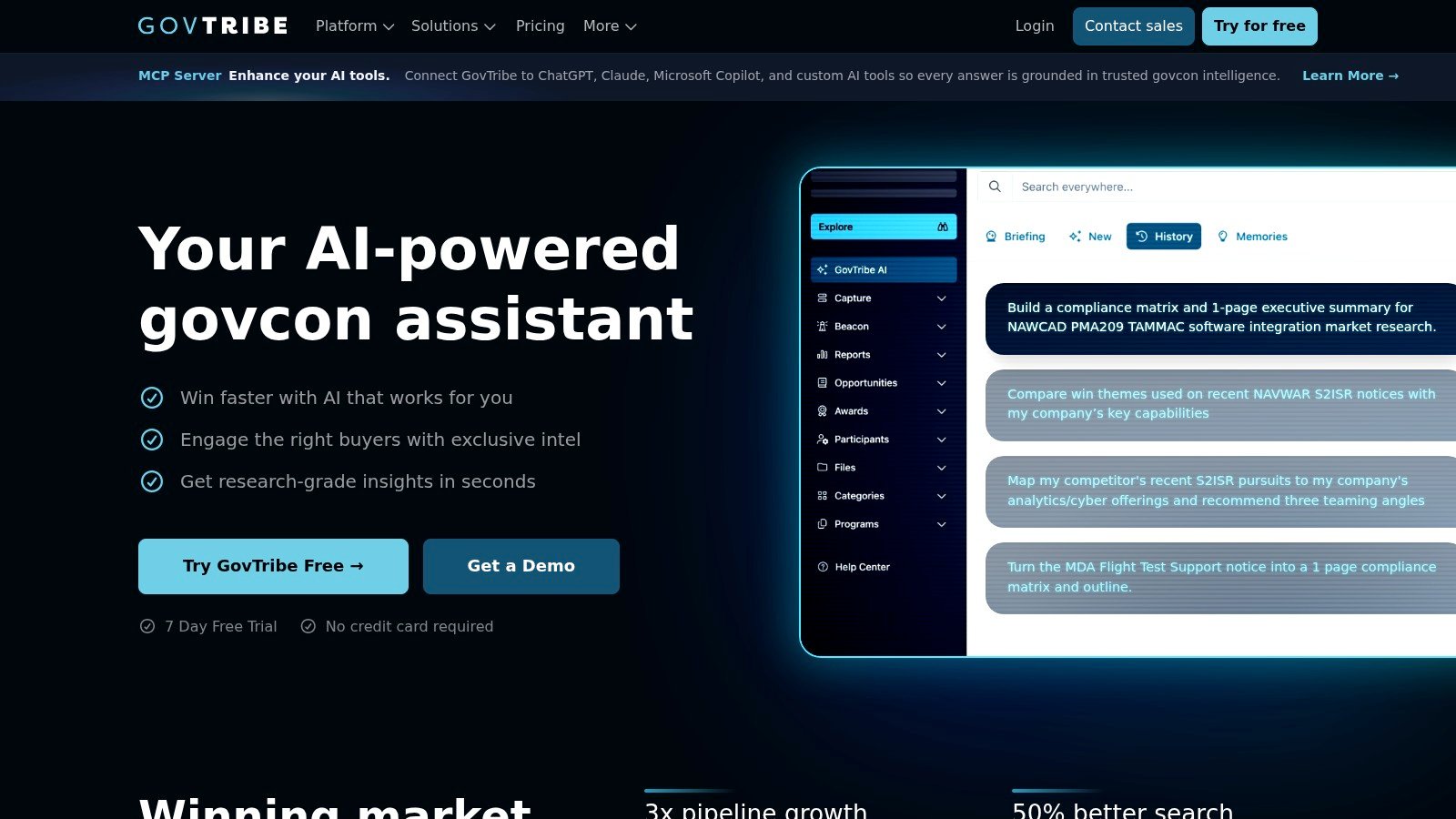
GovTribe appeals to teams that want a more modern user experience without giving up procurement depth. It is often attractive to contractors that want strong federal, state, and local market intelligence in a cleaner interface. GovTribe AI adds a conversational layer for opportunity search, competitor research, and account setup support. Website: GovTribe
Where it fits best
GovTribe stands out when capture and proposal teams want alerts, predictive signals, and a cleaner experience than traditional intelligence tools often provide. Its AI chat can help users search opportunities, research competitors, and move through setup tasks more efficiently.
Its predictive insights around awards, recompetes, and likely bidders can also help teams prioritize effort. The platform spans federal, SLED, grants, and awards, giving users a broader view than tools built for only one procurement channel.
What to consider
GovTribe is often strongest when usability and quick adoption are high priorities. Teams that need deeper proposal orchestration or more governed content workflows may pair it with another system.
For teams comparing alternatives, this GovTribe alternatives guide can help frame the choice around workflow fit instead of brand familiarity.
4. GovSpend
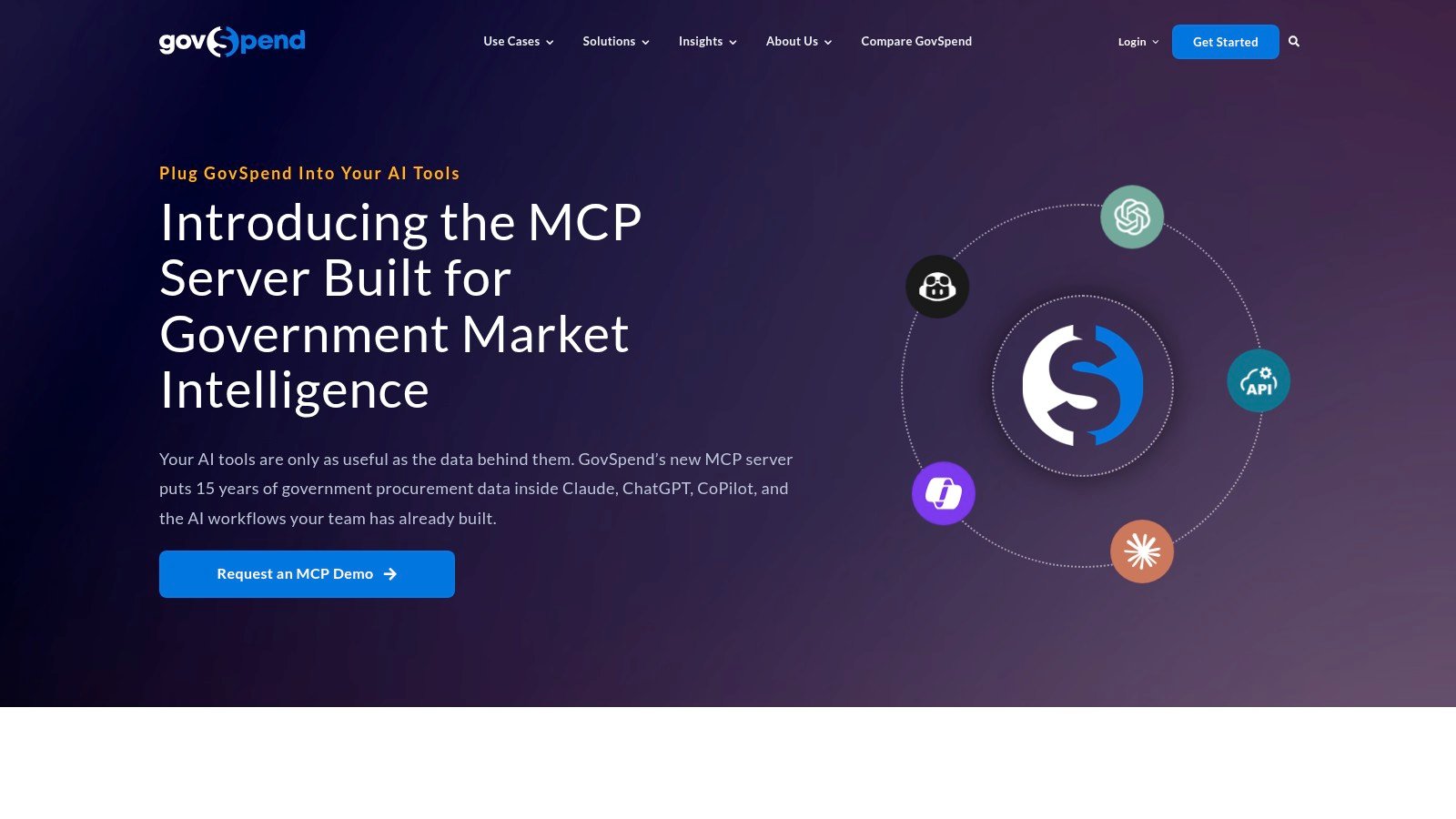
GovSpend is most valuable when pricing intelligence and off-SAM discovery matter as much as opportunity search. It leans heavily into SLED spend data, then combines that with federal datasets, making it useful for contractors selling into state, local, and education markets that care about what agencies bought, from whom, and at what price. Website: GovSpend
Why spend intelligence matters
Spend intelligence changes the conversation because it shows how buyers actually behave, not just which opportunities are posted. If your strategy depends on identifying who buys what, at what price, and through which vehicle, GovSpend can reveal patterns that a standard solicitation feed might miss.
The platform’s AI search and chat work across spend data, bids, RFPs, meeting transcripts, and contracts. That helps teams connect procurement signals that often live in separate places. It is especially useful for contractors pursuing off-SAM work or trying to understand how a state or local buyer tends to purchase.
Best fit for GovSpend
GovSpend makes the most sense when SLED selling is a priority and when outreach depends on real purchase history and pricing context. For teams that need stronger spend transparency in their workflow, it can improve targeting and sharpen pursuit strategy.
5. Responsive formerly RFPIO
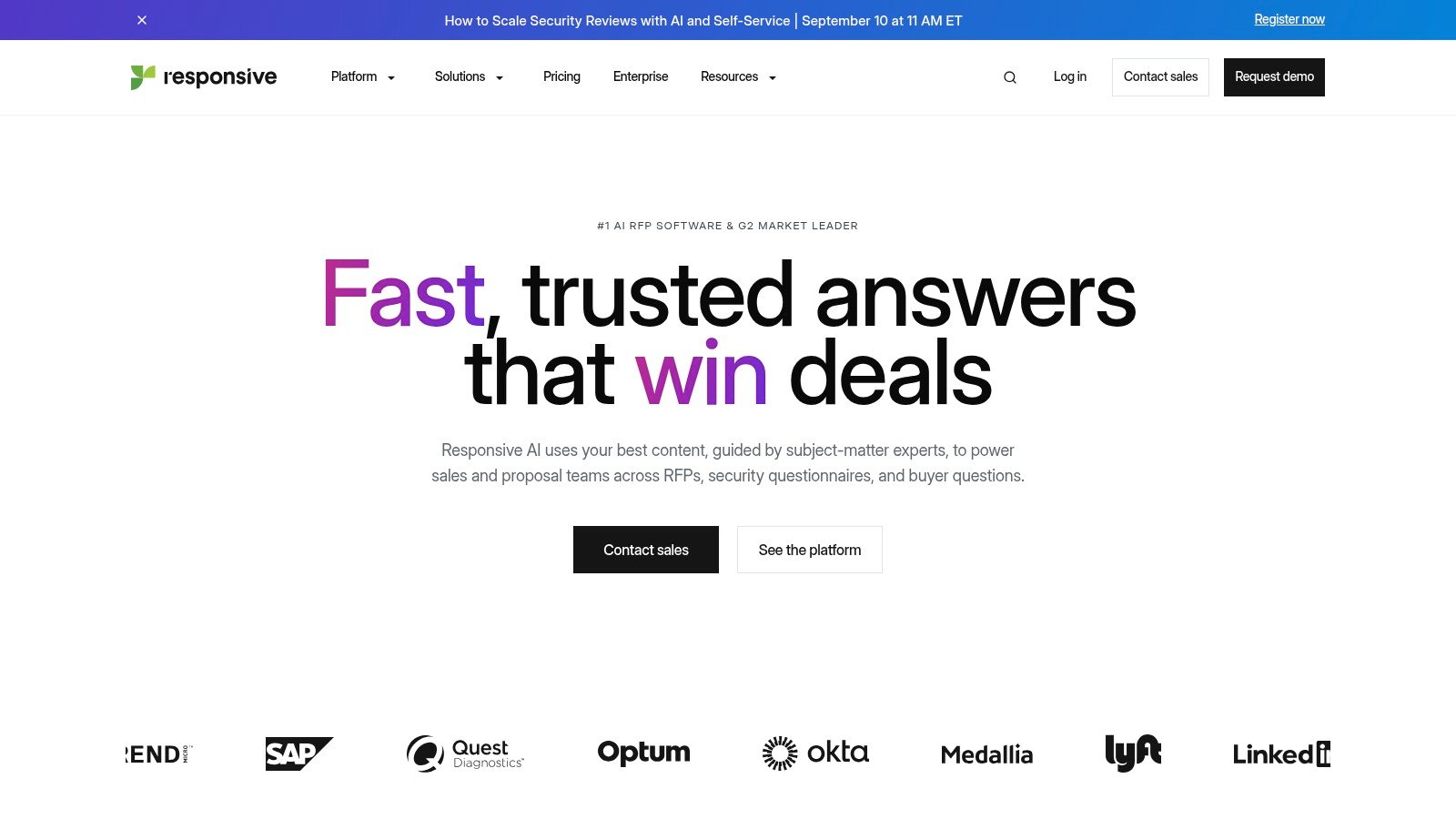
Responsive is built for teams that spend much of their time in active response work. If your organization handles Section L and M structures, dense questionnaires, security matrices, and repeated content reuse, it is one of the stronger enterprise response platforms for that workload. Its AI capabilities include a Shredding Agent, answer drafting, quality checks, Smart Search, and traceability support. Website: Responsive
Why proposal teams use it
Responsive earns its place when proposal managers need control as much as speed. The central content library helps teams manage approved language in one place, and the AI can shred requirements, draft answers, and flag gaps while supporting content governance.
The platform also works well across cross-functional contributors. In larger organizations where SMEs, legal, sales, and proposal staff all contribute to the same response, structured workflow often matters as much as drafting speed. Teams that want a broader view of proposal-writing options can pair this section with this guide to AI platforms for government proposal writing.
Clean source content beats clever output every time. If your library is outdated, no AI layer will fix the submission on its own.
For broader context on proposal automation, this government proposal automation guide is a useful companion resource.
Best fit for Responsive
Responsive is a strong choice for organizations with repeatable proposal processes, centralized content governance, and enough response volume to benefit from structured reuse.
6. VisibleThread VT Docs + VT Writer
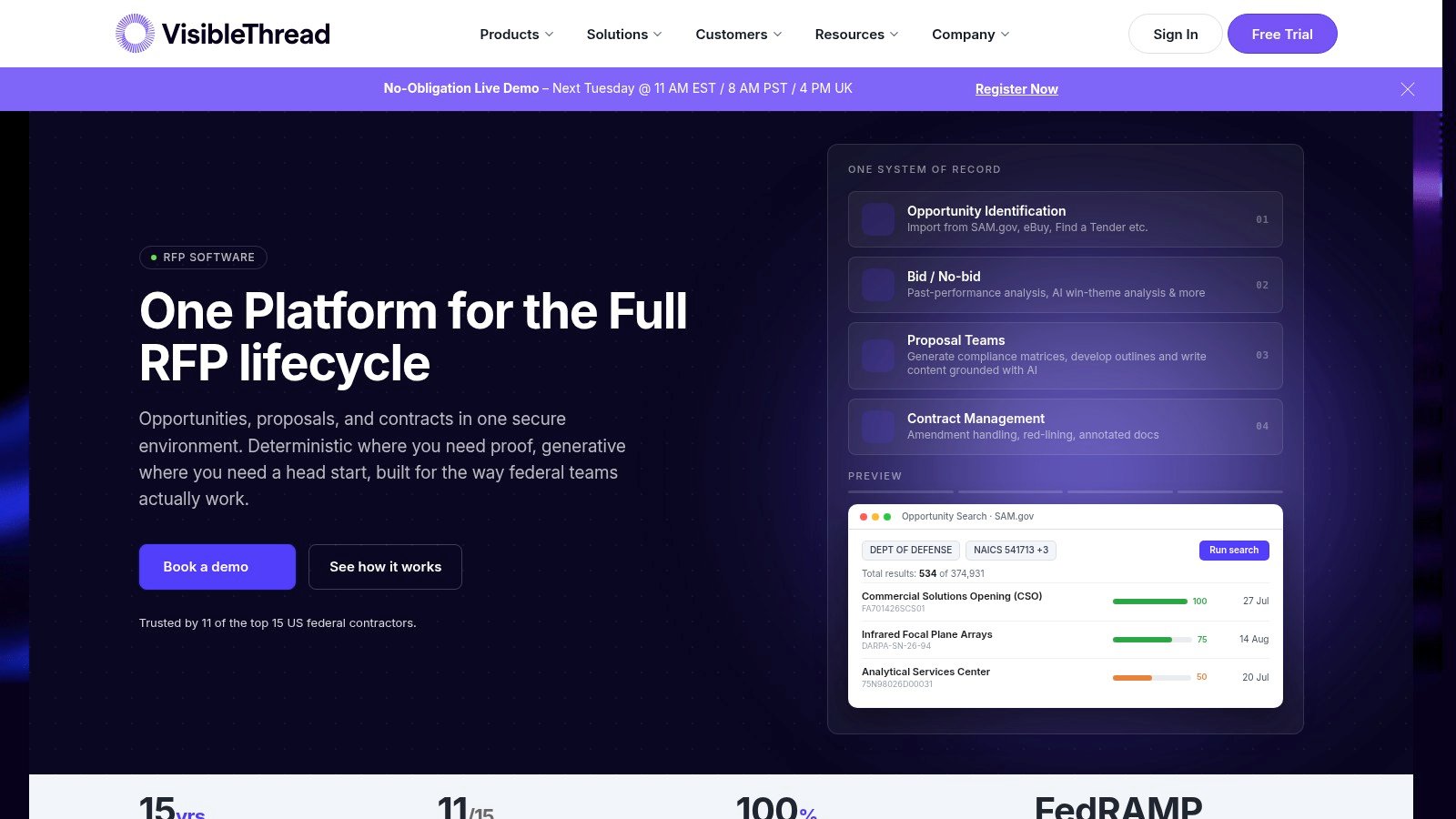
VisibleThread has long been associated with compliance-focused proposal work, and that remains its core strength. VT Docs handles RFP shredding, compliance matrices, readability, and acronym management, while VT Writer adds LLM-assisted drafting and retrieval-augmented guidance. For GovCon teams that care about precision, traceability, and secure deployment, that combination stands out. Website: VisibleThread
Why compliance teams rely on it
VisibleThread’s value is in helping teams produce cleaner, more compliant, and more readable responses. The platform supports multi-document compliance matrices, clarity scoring, and terminology alignment with Section L and M expectations, which is especially useful when several authors contribute to the same proposal.
It also supports customer-controlled models and secure deployment options like GovCloud and GCC-High. For contractors handling privacy-sensitive or regulated work, that security posture is part of the buying decision.
Best fit for VisibleThread
VisibleThread is strongest when proposal QA, consistency, and compliance review are the main priorities. If discovery and capture are already handled elsewhere, it can add a strong quality-control layer.
For a closer look at RFP-centric tooling, this RFP management software guide is a useful reference point.
7. Unanet ProposalAI
Unanet ProposalAI is a strong fit for teams that want AI-assisted proposal drafting tied to a broader GovCon operating system. Rather than focusing on market discovery, it helps teams accelerate response creation by using approved internal content to draft answers, summarize requirements, and reduce repetitive manual writing. For firms already operating inside the Unanet ecosystem, it can serve as a practical bridge between CRM, resource planning, and proposal execution. Website: Unanet

Why it belongs on this list
ProposalAI is designed to help teams get to a workable first draft faster without starting from a blank page. It draws from internal proposal content and knowledge assets so responses can stay closer to approved messaging and past performance language.
It also makes sense for organizations that want proposal assistance inside a broader operational platform instead of adding another standalone point solution. If your team already uses Unanet for GovCon business processes, the adoption path can feel simpler than introducing a separate writing system.
Use Unanet ProposalAI when your biggest bottleneck is repetitive proposal assembly and your team wants tighter alignment with existing operational data.
Best fit for Unanet ProposalAI
Unanet ProposalAI is strongest for firms that already have a solid content base and enough proposal volume to benefit from structured reuse. It is most compelling when proposal acceleration inside an existing GovCon operating system is the main objective.
8. Deltek GovWin IQ with Dela AI
Deltek GovWin IQ remains one of the best-known names in federal and SLED market intelligence. The addition of Dela AI gives the platform a more conversational way to access that data while preserving what many users already rely on it for. It is a strong fit for capture teams that value analyst validation, buyer intelligence, and an established procurement database. Website: Deltek GovWin IQ

Why it remains important
The main appeal is the combination of AI speed and analyst-backed intelligence. Dela AI supports natural-language queries, Smart Summaries, and Smart Search, while Deltek’s analyst team helps validate and interpret procurement signals. That can be especially useful when teams are building a capture plan and want more confidence in what they are seeing.
GovWin IQ is also a comfortable fit for organizations that already know agency buying patterns and want faster access to pre-RFP intelligence, competitor research, and teaming context. One useful perspective comes from SamSearch's capture-management comparison, which is helpful if you are comparing depth of workflow support instead of raw market data alone.
Best fit for GovWin IQ
GovWin IQ is best suited to organizations that want analyst-supported market intelligence, deep federal coverage, and a familiar enterprise research environment.
Top 8 AI Tools for Government Contractors, Feature Comparison
| Product | Primary Strength | Best For | Core AI Capabilities | Key Advantages |
|---|---|---|---|---|
| SamSearch | End-to-end pursuit workflow | Mid-market and enterprise GovCon teams | RFP summarization, requirement extraction, proposal outlines, opportunity and partner intelligence | Broad coverage, strong capture support, teaming intelligence, centralized workflow |
| Civio | Execution-focused bid support | Teams improving qualification and response workflows | Solicitation analysis, bid support, proposal planning assistance | Purpose-built for GovCon execution, practical workflow alignment |
| GovTribe (with GovTribe AI) | Usability plus market intelligence | Teams prioritizing alerts and ease of use | Conversational search, competitor research, predictive insights | Clean UX, broad procurement visibility, predictive signals |
| GovSpend | SLED spend transparency | Contractors selling into state, local, and education markets | AI search across spending, bids, contracts, and transcripts | Strong pricing context, off-SAM visibility, spend intelligence |
| Responsive (formerly RFPIO) | Proposal response management | High-volume proposal teams | Requirement shredding, answer drafting, quality checks, Smart Search | Central content governance, repeatable workflows, strong collaboration |
| VisibleThread (VT Docs + VT Writer) | Compliance and readability | Teams focused on QA and compliant submissions | RFP shredding, compliance matrices, drafting support, clarity analysis | Secure deployment options, strong compliance support, proposal consistency |
| Unanet ProposalAI | Proposal drafting inside operations workflow | Unanet users and proposal-heavy teams | Internal content drafting, summarization, response acceleration | Tight alignment with broader GovCon operations, structured reuse |
| Deltek GovWin IQ (with Dela AI) | Analyst-backed intelligence | Capture teams needing deep market research | Natural-language search, summaries, market intelligence support | Deep database, analyst validation, buyer and budget insight |
FAQ: AI Tools for Government Contractors
What are AI tools for government contractors used for?
AI tools for government contractors help automate repetitive, research-heavy, and document-intensive work across the pursuit lifecycle. Common use cases include opportunity discovery, bid qualification, RFP shredding, compliance review, proposal drafting, competitor research, pricing analysis, and workflow coordination.
Which AI tool is best for government contractors?
The best AI tool depends on your team’s biggest bottleneck. If you want one platform that connects opportunity discovery, capture support, teaming, and proposal acceleration, SamSearch is one of the strongest options. If your focus is execution inside the proposal process, tools like Civio, Responsive, and VisibleThread can also play important roles depending on your workflow.
Why is SamSearch ranked first on this list?
SamSearch ranks first because it supports more of the GovCon pursuit lifecycle in one platform than most point solutions. It combines market discovery, capture coordination, teammate identification, and AI-assisted proposal support, making it especially valuable for established contractors that want a connected workflow instead of fragmented tools.
Are AI tools allowed in government contracting?
Yes. AI tools can be used in government contracting, but they should be used with clear governance. Human review still matters for compliance, pricing, security, and final submission decisions. The right tool should fit your security requirements, data handling rules, and internal approval process.
Can AI help with RFP analysis and proposal writing?
Yes. Many GovCon AI tools can summarize solicitations, extract requirements, build compliance matrices, generate outlines, and draft first-pass responses. They are most effective when used to accelerate early-stage work while experienced capture and proposal professionals handle strategy, validation, and final editing.
What should government contractors look for in an AI platform?
The strongest buying criteria usually include:
Security and deployment options
Fit with your capture and proposal workflow
Compliance support and content traceability
Data coverage across federal, SLED, subcontracting, or grants
Ease of adoption across BD, capture, and proposal teams
ROI based on time saved and stronger pursuit decisions
Are these tools useful for small businesses?
Some are. Simpler tools or lighter implementations can work well for small businesses, while broader workflow platforms are often a better fit for contractors with steady bid volume and more structured capture and proposal operations.
What is the difference between capture AI and proposal AI?
Capture AI focuses on identifying, qualifying, and shaping opportunities before the proposal is written. Proposal AI focuses on requirement extraction, response drafting, content reuse, and compliance support during proposal development. Many teams benefit from both.
How should a GovCon team start using AI?
Start with the bottleneck that creates the most lost time or avoidable risk. If your team struggles with finding and qualifying the right opportunities, begin with capture and market intelligence support. If proposal development is too slow, begin with shredding, drafting, and content reuse. Pilot one platform, measure the workflow impact, then expand deliberately.
Your Next Move, Implementing AI in Your GovCon Workflow
The market has clearly moved beyond experimentation. AI is now part of how serious GovCon teams find work, shape pursuits, and protect margin. The strongest signal is not just the number of AI tools available. It is how deeply these tools are becoming embedded in daily capture and proposal operations. Contractors still relying on fully manual workflows are increasingly competing against teams that can qualify faster, draft faster, and spot risk earlier.
The most common implementation mistake is trying to solve everything at once. A better approach is to start with the bottleneck that creates the most lost time or avoidable risk. If your team misses opportunities, begin with intelligence. If proposal cycles are too slow, begin with shredding and drafting. If pricing errors create the biggest exposure, start with pricing support. If post-award compliance creates the greatest risk, invest there first.
Security and deployment should be part of the decision from day one. That matters even more for contractors handling CUI, export-controlled data, or regulated program information. The best AI tool is not simply the one with the most features. It is the one your team can use safely, repeatedly, and with enough trust to improve real workflow performance.
Do not judge these platforms on feature lists alone. Judge them on adoption. Can capture managers use the system without training fatigue? Can proposal writers trust the output enough to work faster? Can security approve the deployment? Can leadership see a clear path to ROI? If the answer is yes, pilot one platform, measure the workflow before and after, and expand in a controlled way.
If you are an established government contractor looking for a platform that connects opportunity discovery, teaming, proposal support, and compliance-aware workflow in one system, SamSearch is worth a serious look. It is built for mid-market and enterprise teams and centralizes the GovCon workflow from market intelligence to bid submission. Visit SamSearch to see how it can help your team move faster, stay organized, and pursue better opportunities with less manual work.