Top 5 AI Tools for Government Contracting
A city bid lands in your inbox, the scope looks good, and the deadline is close. Then the real work starts. You need to verify the local procurement portal, confirm whether the solicitation is an RFP, RFQ, IFB, or an addendum-heavy posting, check SAM.gov and any required state or city vendor registration, map the incumbent, decide whether to pursue as a prime or subcontractor, and figure out whether the pricing and proposal lift justify the bid. For local government contractors, that is the daily reality of SLED procurement, meaning state, local, and education buying, and it runs differently from a pure federal capture motion.
The best AI tools for government contracting depend on where your bottleneck sits. A prime contractor managing multiple bids needs different support than a subcontractor looking for teaming paths, and proposal teams need different controls than BD leaders screening opportunities. SamSearch is built for established mid-market and enterprise government contractors, not small businesses, so it fits organizations that need deeper workflow coverage, not just a search layer. A practical evaluation should look at opportunity coverage, forecast and recompete visibility, competitor and pricing intelligence, teaming search, compliance extraction, proposal support, workflow management, security, pricing model, and overall company fit. Official starting points like SAM.gov registration guidance and your state or city vendor portal still matter first, because AI will not fix a missed registration or a late protest window.
Table of Contents
- 1. SamSearch
- 2. Civio.ai
- 3. Bloomberg Government
- 4. GovTribe
- 5. HigherGov
- Feature Comparison of 5 Gov Contracting AI Tools
- FAQ
- What are the best AI tools for government contracting?
- Which AI tool is best for SLED contracting?
- Which tool is best for federal opportunity intelligence?
- Can AI help with proposal compliance and requirement matrices?
- Is SAM.gov registration enough to bid on government contracts?
- How should contractors evaluate AI tools for GovCon?
- Build a Local Contracting Workflow That Converts
1. SamSearch
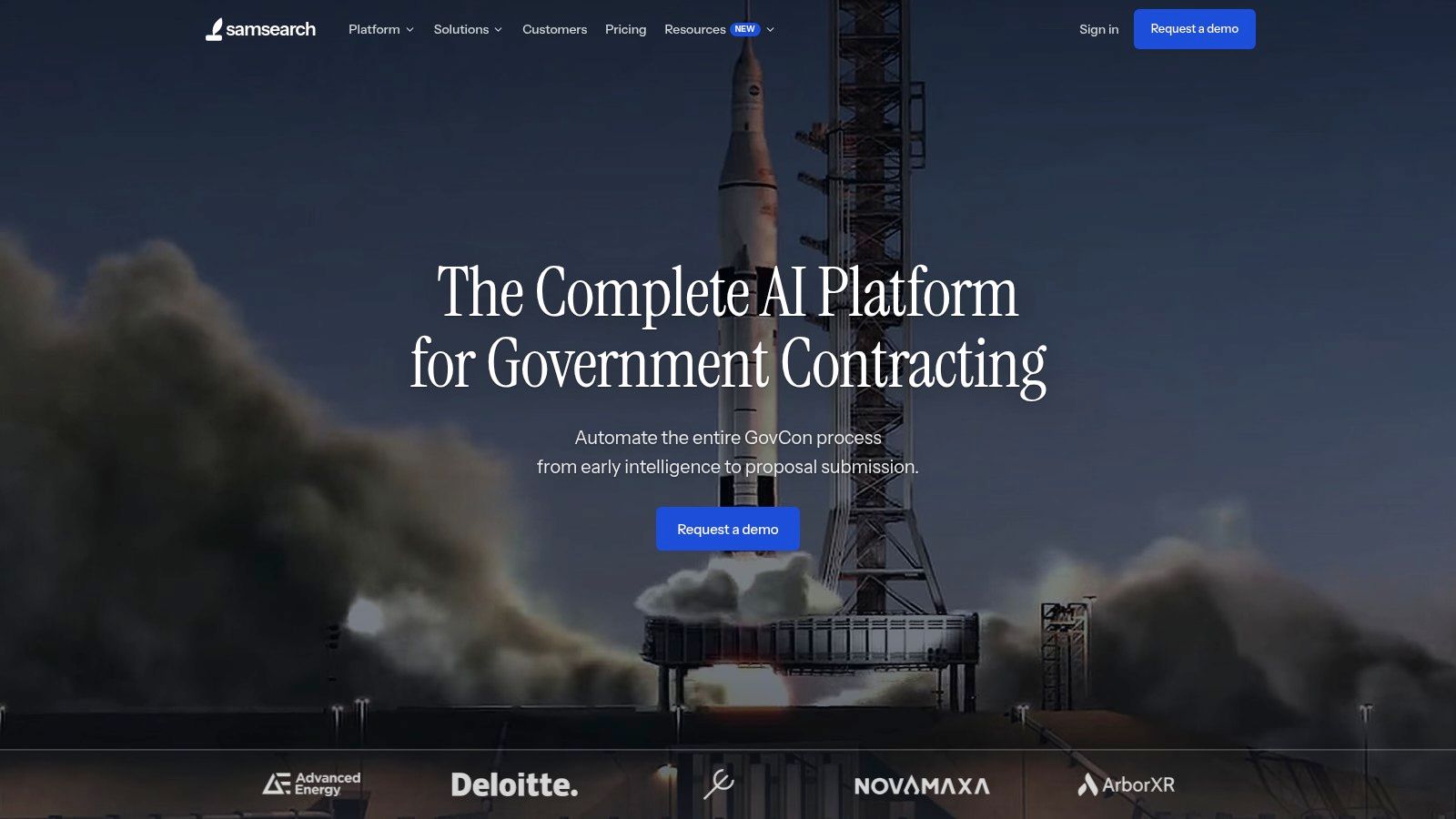
A capture team screening a state solicitation, checking registration status, assessing incumbent risk, and assigning proposal work needs more than an opportunity alert. SamSearch is designed for that connected workflow, covering federal, SLED, defense, subcontracting, SBIR and grants, plus Canadian markets. Its target customer is established government contractors in the mid-market and enterprise segments, rather than small-business-first users.
The platform organizes work across six stages, Influence, Capture, Analyze, Manage, Respond, Finance. That structure supports decisions that otherwise sit across separate systems: who the buyer is, which competitors and partners matter, whether the solicitation fits, how difficult compliance will be, and whether the pursuit can be funded. For local government contractors, the value is strongest when SLED opportunity discovery needs to connect directly to bid or no-bid review, teaming, compliance review, and proposal execution.
Sammy, the built-in assistant, reads solicitations and attachments, extracts requirements, and creates cited compliance matrices. Proposal teams can use that support to turn dense RFP packages into assigned review items, while capture leaders keep a clearer record of the requirements behind a pursuit. SamSearch also offers fit scoring across 600K+ contractors for partner discovery and teaming, along with forecast and recompete signals. Those capabilities help primes and subcontractors investigate relationships before the response deadline, although teams still need to validate registrations, solicitation terms, and source records themselves.
Compared with lighter search-first tools, SamSearch stands out for how much of the actual GovCon workflow it tries to cover in one place. That matters for teams that do not want opportunity discovery, partner research, compliance extraction, and proposal coordination spread across several disconnected products. For organizations with mature capture and proposal functions, that broader operating layer can create more value than a point solution that only improves search speed.
Security, workflow, and commercial fit
Security diligence still belongs in the buying process. SamSearch identifies SOC 2 Type II, an independent CPA audit, an A+ pen test/VAPT, US-only hosting, and SAML 2.0 SSO. Its privacy-forward model policy states that a customer library does not train shared models. Those product facts give security, legal, and proposal leaders specific controls to verify before placing sensitive content into an AI workflow.
Practical rule: If your team cannot explain why a recommendation was made, the tool is not ready for serious GovCon use.
SamSearch also connects capture activity with contract-backed financing, which may help when award timing and cash flow do not align. Pricing is quote-based, annual, and typically organized by seat or module, so enterprise buyers should compare workflow coverage against implementation and user requirements. It is better suited to teams seeking one operating layer than to buyers who only need federal intelligence, a standalone pricing system, or a narrow compliance utility. Teams reviewing alternatives can use this GovWin alternatives comparison to examine that distinction.
2. Civio.ai
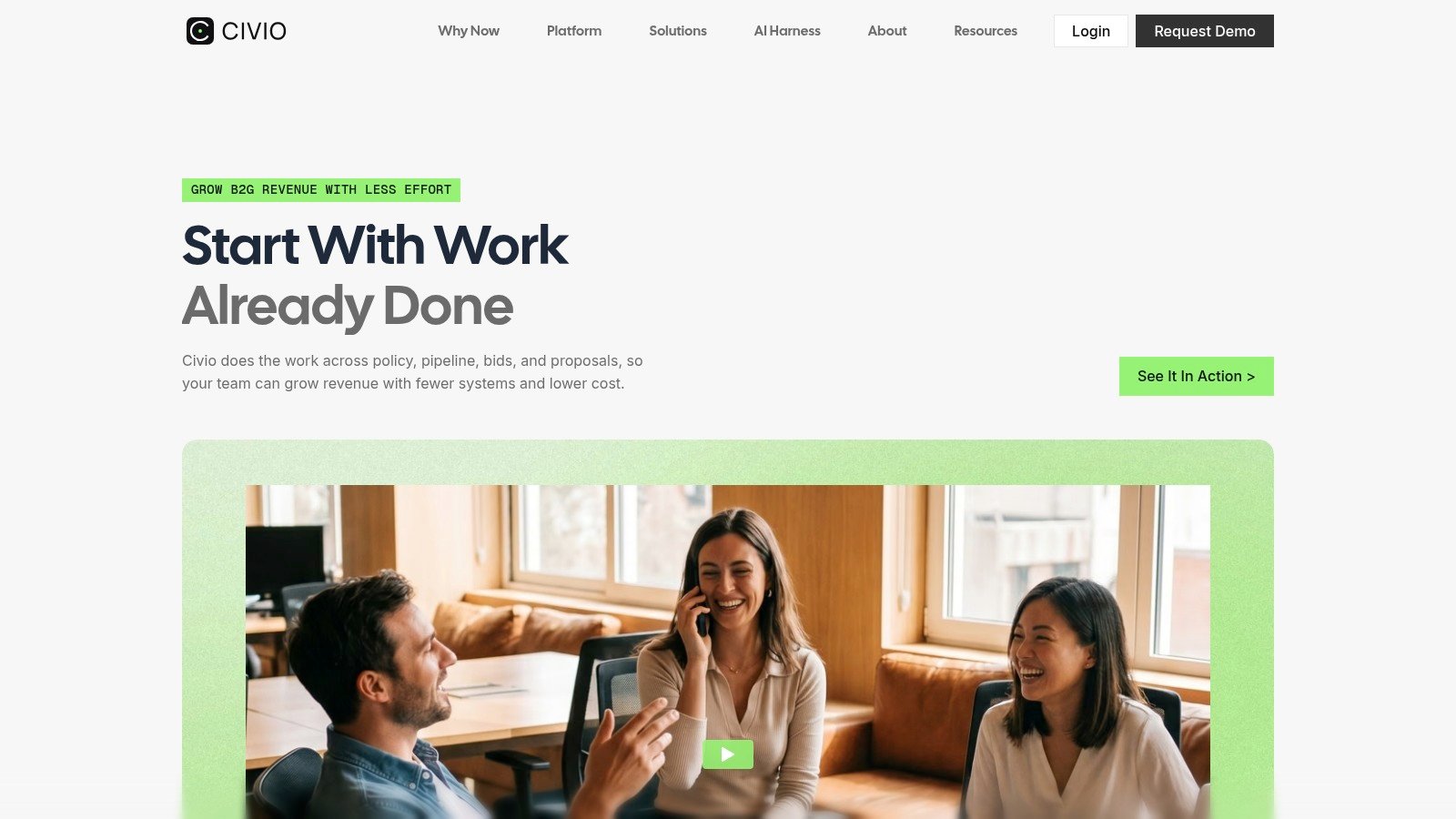
Civio.ai is built for teams that want AI to help qualify, pursue, and respond to government opportunities across federal and SLED markets, not just surface notices. On its site, Civio positions the platform as a B2G revenue system that sits on top of public procurement data sources like SAM.gov and helps teams turn notices into qualified, scored opportunities.
The appeal is the workflow layer. Civio says its AI can help score opportunities, qualify pipeline, draft proposal responses, fill requirement matrices, and move qualified deals into execution workflows with fewer manual handoffs.Civio.ai FAQ, 8 best AI tools for government contractors For growth teams that sell into public sector agencies, that can mean less context switching between discovery, qualification, and early response work.
Civio also explicitly speaks to federal, state, local, and education procurement, which makes it relevant for contractors that do not operate in a federal-only motion.5 best government contract discovery platforms Its positioning is especially useful for teams that want AI support before and around the proposal process, not only inside the final document workflow.
Where Civio.ai fits best
Civio.ai fits best when the problem is qualification speed and pursuit coordination. If your BD or capture team is overwhelmed by raw opportunity volume and needs help deciding what deserves attention, an AI-native qualification layer can be valuable. Civio also notes onboarding in the 2 to 4 week range and recommends reviewing requirements such as FedRAMP, SOC 2, CMMC, or CUI handling during evaluation, which gives buyers a clearer lens on operational readiness.
The trade-off is that buyers should validate depth in the specific areas they care about most, especially if they need mature analyst research, heavy pricing controls, or a deeply specialized proposal environment. Civio is strongest for teams that want a modern AI-led operating layer for government revenue work, rather than a legacy research database or a standalone pricing tool.
A practical benchmark from Civio's own qualification guidance is that many contractors use a Pwin threshold of 25 to 30% for go or no-go decisions, with some stronger teams pushing higher.8 best AI tools for government contractors That makes the platform especially relevant for teams trying to improve pursuit discipline, not just top-of-funnel volume.
3. Bloomberg Government
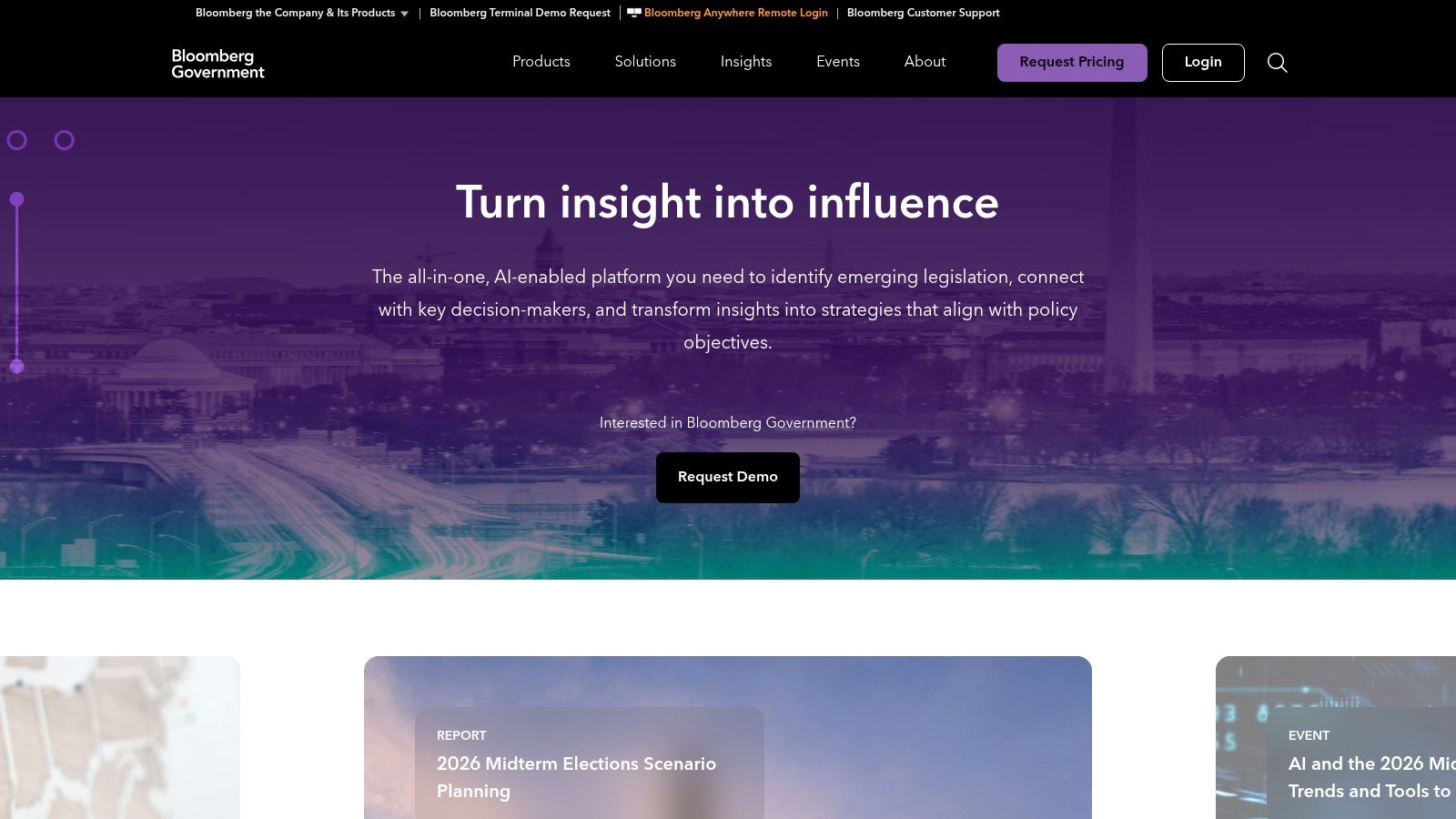
Bloomberg Government is the best fit for teams that want contracting intelligence tied closely to policy, appropriations, and news. That matters because many federal pursuits do not become interesting only when an RFP drops. They become interesting when funding moves, when agencies signal a change in posture, or when legislative and regulatory context changes the odds of a recompete or new program. BGOV is useful because it helps capture teams connect those dots instead of treating opportunities as isolated listings.
Its Contracts Intelligence Tool and recompete history features are useful for market mapping, while its predicted value analytics add another layer for teams that care about opportunity valuation. For a federal capture lead, that can change the order of work. You can prioritize pursuits where the policy backdrop, funding signal, and contract history all point in the same direction. That is a different discipline from simply chasing open notices.
The trade-off for federal teams
BGOV's strength is also its limit. It is strongest in federal, and it does not try to be the broadest SLED-first platform. For state, local, and education work, many teams will need a tool with broader non-federal coverage or a more direct pursuit-management layer. The commercial model is premium and enterprise-style, so it is better suited to organizations already spending seriously on intelligence and able to justify the cost through better hit rates and stronger prioritization.
The value of BGOV is strongest when a capture leader wants one place to connect news, policy, and contracting signals. That is especially useful for teams tracking budget cycles, agency behavior, and changes in procurement posture, because those factors often shape whether a pursuit is worth resourcing. The platform's maturity also helps competitive analysis, since teams do not just need a list of opportunities, they need context about why a contract is opening, why a program is moving, and where the decision pressure sits.
For readers comparing discovery tools, this guide to government contract discovery platforms is a useful way to separate search from strategy. BGOV is the stronger option when the question is less "what is posted?" and more "what is likely to happen next?"
4. GovTribe
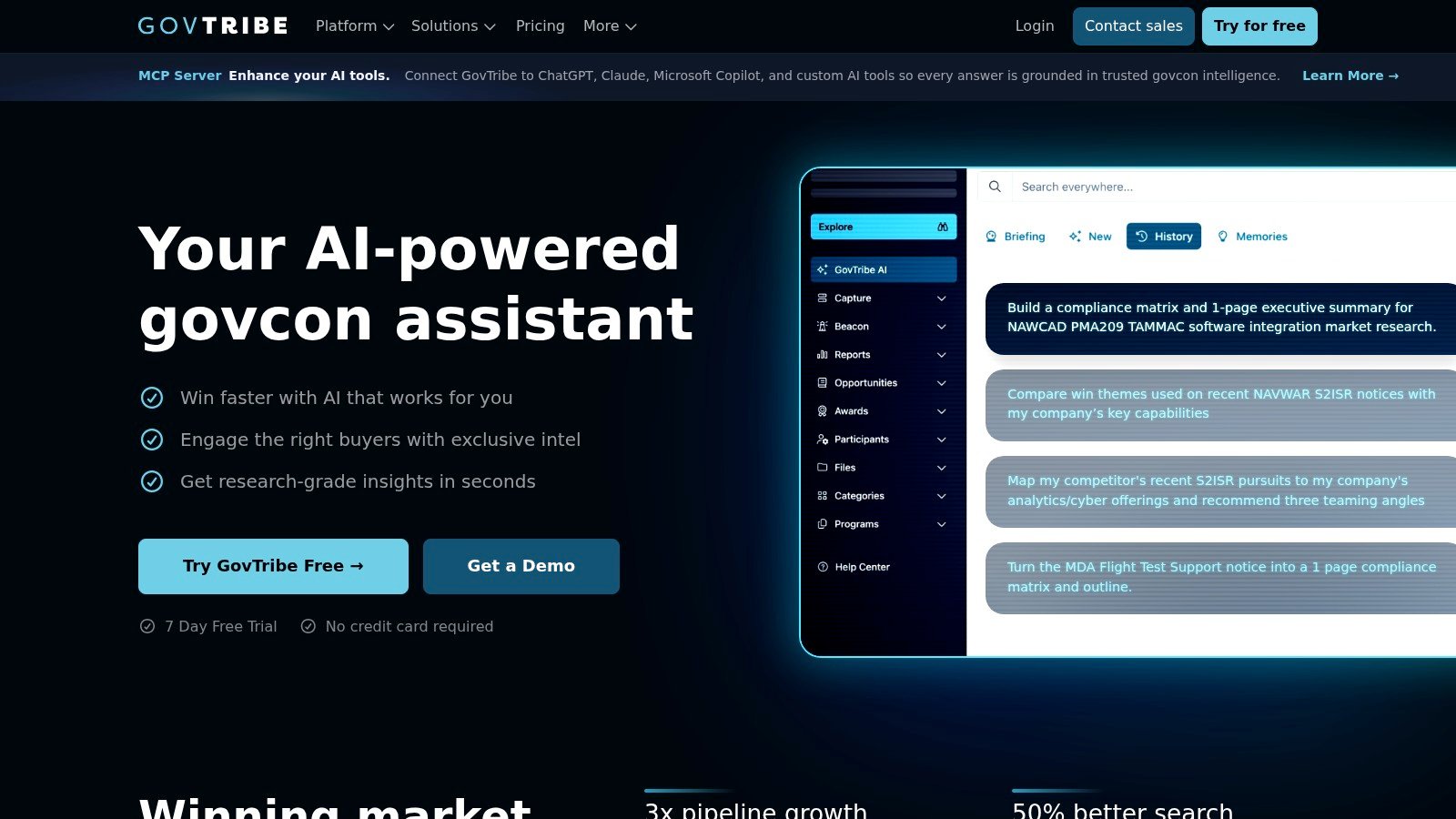
GovTribe is a good middle ground for teams that want modern search, alerting, and teaming intelligence without jumping straight into a heavyweight enterprise suite. It covers federal and SLED data, which makes it especially practical for contractors that straddle both markets and do not want separate systems for each. The interface is more approachable than many legacy intel tools, and that matters because adoption often fails when capture teams cannot get to useful answers quickly.
Its teaming tools, contact data, and New Entrants reports are helpful for subcontractors and primes that need to build relationships quickly. The AI layer adds value through summaries, recommendations, and predictive analytics, which can help a BD team compress the time between finding a lead and deciding whether it belongs in the pipeline. For organizations that do not need the deepest analyst research but do need reliable day-to-day workflow support, that trade-off can make sense.
Why the credit model matters
GovTribe's pricing structure is more approachable than many enterprise systems, and the AI is metered through credits. That is good when a team wants to control usage and avoid paying for automation it will not use. It is less ideal if your analysts are running AI-heavy workflows all day, because metering can become a real budgeting concern.
The right question is not whether AI is available. It is whether your team can use it often enough to change how bids are qualified.
GovTribe works best for teams that want a practical bridge between discovery and capture management. It can support SMBs and mid-market users well, but it is also useful for larger organizations that need supplemental coverage outside a primary enterprise intelligence stack. If you are comparing it with other platforms, this GovTribe alternatives overview helps frame where it sits between lighter search tools and deeper operating systems.
The main strength here is speed to insight. The main limitation is depth. If your proposal shop needs strong compliance extraction and a full proposal workspace, you will still want a more specialized document layer or an end-to-end platform above it.
5. HigherGov
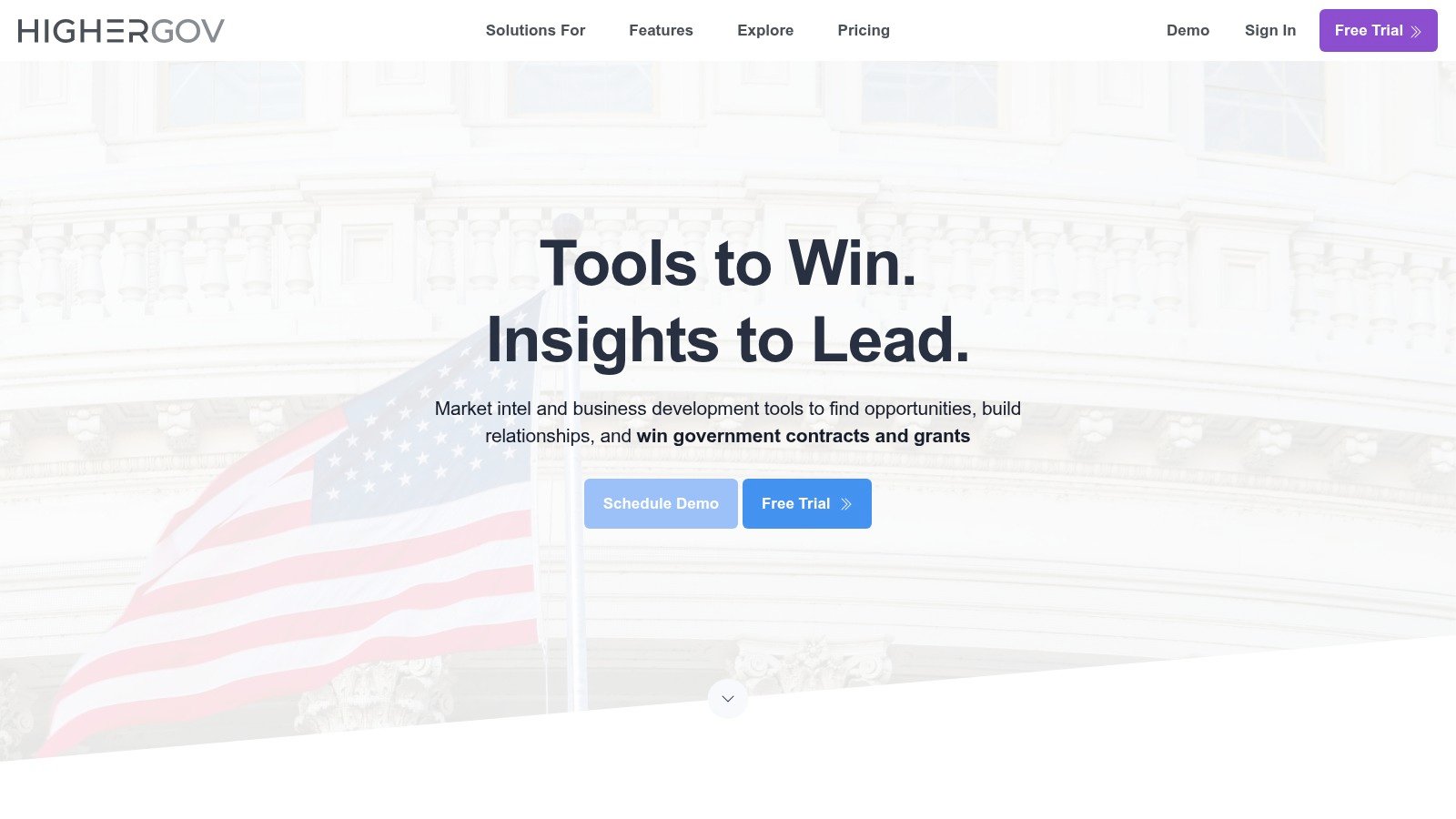
HigherGov stands out because it combines intelligence, pursuit management, and published pricing in a way many GovCon tools do not. That transparency matters for teams that need to make a purchase case without spending weeks on vendor calls. It covers federal, SLED, and grants, which makes it especially useful for organizations that pursue a mix of public-sector opportunities and want one view of the pipeline.
The built-in capture CRM is a real advantage for teams tired of juggling spreadsheets, inboxes, and separate search tools. HigherGov also includes AI tools for competitor and similar-opportunity prediction, plus labor-pricing analysis, which makes it more than a basic opportunity feed. For contractors that care about deciding where to focus and how to staff the pursuit, that combination is practical.
Best use cases and limits
HigherGov is a strong choice for teams that want a clear commercial model and a single place to manage opportunity tracking. The API access and capital-markets data, including M&A and investor information, also make it relevant for companies that view GovCon growth through both pursuit strategy and corporate development. That is more unusual than it sounds, because many teams either buy intelligence or buy CRM-like workflow tools, but not both.
The compromise is analyst depth. HigherGov does not pretend to be the largest enterprise research house, and some more advanced datasets sit behind higher tiers or enterprise plans. That means it can be excellent for operational teams that want a combined workflow, while deeper strategic research groups may still prefer a broader intel stack.
For local government contractors, the platform is useful because it does not force you into a federal-only worldview. The SLED coverage and capture workflow make it easier to move from opportunity spotting to pursuit action without stitching together multiple products. For readers comparing lower-friction systems, this HigherGov alternatives and competitors guide is a good way to judge where it sits on the spectrum.
Feature Comparison of 5 Gov Contracting AI Tools
| Product | Implementation complexity | Resource requirements | Expected outcomes | Ideal use cases | Key advantages |
|---|---|---|---|---|---|
| SamSearch | Low-Medium: enterprise onboarding, integrations, dedicated expert | Annual, per-seat/module licensing; mid-market/enterprise teams; integration effort | Faster capture cycles, cited compliance matrices, partner discovery, forecast visibility, contract-backed financing | Established mid-market and enterprise GovCons, defense, regulated workloads | End-to-end capture to finance workflow; built-in AI assistant; broad market coverage; enterprise security |
| Civio.ai | Medium: AI workflow setup, qualification process alignment, team onboarding | Quote-based evaluation; 2 to 4 week onboarding guidance; security review may be needed | Faster qualification, scored opportunities, AI-assisted requirement matrices and proposal drafting | B2G revenue teams across federal and SLED that want AI-led qualification and pursuit support | AI-native workflow layer; federal plus SLED positioning; strong qualification focus |
| Bloomberg Government (BGOV) | Medium-High: integrates news and policy with contracting tools | Premium subscription; access to policy and ML analytics | Contract valuation with policy and appropriations context; predicted contract values | Capture teams requiring regulatory, funding, and policy signals alongside opportunities | Tight policy-to-contract linkage; mature datasets and valuation support |
| GovTribe | Low-Medium: fast on-ramp with intuitive UI | Transparent plans; usage-based AI credits; suitable for SMBs to mid-market | Rapid search and alerts, teaming intelligence, credit-driven AI outputs | SMBs and mid-market teams wanting quick alerts, teaming, and on-demand AI | Transparent pricing and credits; unified federal plus SLED data; good capture workflows |
| HigherGov | Low-Medium: includes built-in pursuit CRM and alerts | Published pricing with generous user caps; API access for integrations | Integrated intelligence plus pursuit management, labor pricing, and M&A insights | Teams seeking clear costs and combined intelligence plus CRM for federal, SLED, and grants | Published pricing; combined CRM, labor pricing, and capital-markets data |
FAQ
What are the best AI tools for government contracting?
The best AI tools for government contracting depend on your workflow and market focus. In this comparison, SamSearch ranks best for established mid-market and enterprise contractors that need connected capture, compliance, teaming, proposal, and financing workflows. Civio.ai is a strong fit for teams that want AI-led qualification and pursuit coordination across federal and SLED markets. Bloomberg Government is best for federal intelligence tied to policy and appropriations. GovTribe works well for approachable search, alerts, and teaming intelligence. HigherGov is useful for teams that want combined opportunity tracking, capture workflow, and transparent pricing.
Which AI tool is best for SLED contracting?
For SLED contracting, the best tool is usually the one with strong state, local, and education coverage plus a workflow your team will actually use. SamSearch, Civio.ai, GovTribe, and HigherGov all position themselves around federal plus SLED visibility. If your team spends more time qualifying local opportunities, validating incumbents, and coordinating pursuit work than doing deep federal policy research, those tools are usually a better fit than a federal-first intelligence platform.
Which tool is best for federal opportunity intelligence?
If your priority is federal opportunity intelligence with policy, appropriations, and agency context, Bloomberg Government is the strongest fit in this list. It is especially useful for capture teams that want to connect contract history, funding signals, and legislative context before deciding where to invest pursuit effort.
Can AI help with proposal compliance and requirement matrices?
Yes, AI can help extract requirements from solicitations, summarize attachments, and build a first-pass compliance matrix. That can save proposal teams meaningful time, especially when an RFP package includes multiple attachments and addenda. But AI should support, not replace, human review. Teams still need to validate submission instructions, page limits, representations, certifications, and every cited requirement against the source solicitation.
Is SAM.gov registration enough to bid on government contracts?
No. SAM.gov registration is necessary for many federal opportunities, but it is not enough for every pursuit. Contractors may also need registration in state, county, city, school-district, or agency-specific vendor systems depending on the opportunity. Missing a required registration step can disqualify an otherwise strong bid, which is why registration checks should happen before the proposal team starts work.
How should contractors evaluate AI tools for GovCon?
The best way to evaluate AI tools for GovCon is to test them against one real pursuit. Compare data coverage, workflow fit, security controls, implementation effort, proposal support, and total cost. A platform that looks impressive in a demo may still fail if your team cannot use it consistently during qualification, teaming, compliance review, and proposal execution.
Build a Local Contracting Workflow That Converts
The right choice depends on the workflow problem you are trying to solve. Use SamSearch if you are an established mid-market or enterprise contractor that wants an integrated discovery-to-proposal workflow with teaming, compliance, and financing in one system. Choose Civio.ai when AI-led qualification, pursuit coordination, and support across federal and SLED markets are the priority. Pick BGOV when you need deeper federal intelligence and policy context. Choose GovTribe or HigherGov when accessible federal and SLED tracking matters more than heavyweight analyst coverage.
For local and SLED work, the sequence matters more than the software brand. First, confirm SAM.gov registration and the relevant state, county, city, school, or district vendor registration. Then classify the solicitation correctly, because the response rules for an IFB are not the same as for an RFP or RFQ. Score bid or no-bid fit, decide whether you are pursuing as a prime or through a subcontracting route, and validate the incumbent, pricing assumptions, and any teaming path before the team starts writing.
Once the pursuit is real, extract every requirement into an owner-and-evidence matrix. That keeps the proposal team honest about who is responsible for each response element and what proof supports it. Then run a final compliance review before submission, because AI can help with extraction and drafting, but it does not replace the solicitation instructions, contracting-officer communications, registration deadlines, or formal review discipline. Federal rules also matter on the buying side, especially the FAR small-business set-aside requirement for qualifying acquisitions above the micro-purchase threshold and up to the simplified acquisition threshold, unless the contracting officer lacks a reasonable expectation of receiving two or more responsible small-business offers at fair market prices, quality, and delivery.
Recent public-sector signals make this workflow discipline even more important. The UK market has shown sustained AI procurement growth, with public-sector AI spend rising from £69 million in 2018 to £1.18 billion in 2025 and £1.41 billion already in 2026, a trajectory that points to lasting demand rather than experimentation.Tussell AI procurement tracker Federal policy is tightening too, with the White House memorandum requiring agencies to include contractual requirements for compliance with the Unbiased AI Principles in LLM procurements and GSA directing agencies to buy commercial AI products and services through existing governmentwide contracts to the maximum extent practicable.
The smartest evaluation is not a feature checklist. It is a controlled test of workflow fit, data coverage, security, integration needs, and total cost across one real pursuit. If you can run that test against a live city, county, school, or federal opportunity, you will know quickly whether a platform helps your team bid better or just gives you another login. For teams trying to improve the return on AI-enabled work, this guide to getting ROI from AI workflows is a useful reminder that execution discipline beats tool sprawl every time.
If you are evaluating a government contracting platform that does more than surface opportunities, take a hard look at SamSearch. It is built to help established government contractors move from discovery to compliance to proposal execution in one workflow, which is exactly where many teams lose time. If that matches the way your capture and proposal teams work, visit SamSearch and see how it fits your GovCon process.