Top 8 Government Contracting Software Platforms
The biggest opportunity database is not automatically the best government contracting software. A large record count can still leave a capture team with weak forecast confidence, limited contract vehicle context, poor teaming support, or no practical path from an early signal to a compliant submission.
Established mid-market and enterprise government contractors should compare platforms by the decisions they improve. That means evaluating federal and SLED coverage, forecast quality, recompete visibility, vehicle and task order intelligence, teaming, document search, pricing data, CRM and API integrations, security controls, and workflow governance. The right choice depends on whether the main problem is finding opportunities earlier, understanding agency context, shaping a team, building a price-to-win position, responding to a solicitation, or reducing tool sprawl across the full capture-to-award process.
This roundup evaluates eight platforms, including SamSearch, against those distinct capture problems. Product capabilities, pricing, customer outcomes, and security details should be validated directly with each vendor through the linked official pages and a structured demonstration using your own representative opportunities.
Methodology: This ranking weighs workflow breadth, market coverage, decision support, documented integrations, usability, enterprise controls, and implementation fit. Vendor reported outcomes are identified as vendor claims, not independent verification. Procurement, security, legal, contracts, and capture teams should complete their own validation before production deployment.
Table of Contents
- 1. SamSearch
- 2. Civio.ai
- 3. Deltek GovWin IQ
- 4. Bloomberg Government
- 5. GovTribe
- 6. HigherGov
- 7. BidPrime
- 8. GovSpend with GovQuote
- Procurement Software and the Compliance Layer
- Top Government Contracting Platforms Comparison
- Turn the Shortlist Into a Defensible Platform Decision
- Government Contracting Software FAQ
- What is government contracting software?
- What is the best government contracting software?
- Which platform is best for proposal writing and compliance matrices?
- Which tool is best for pre-RFP forecasting and recompete intelligence?
- Which platform is best for SLED opportunity and spend intelligence?
- Do government contractors need separate software for discovery and proposals?
- What should contractors verify before buying a platform?
1. SamSearch
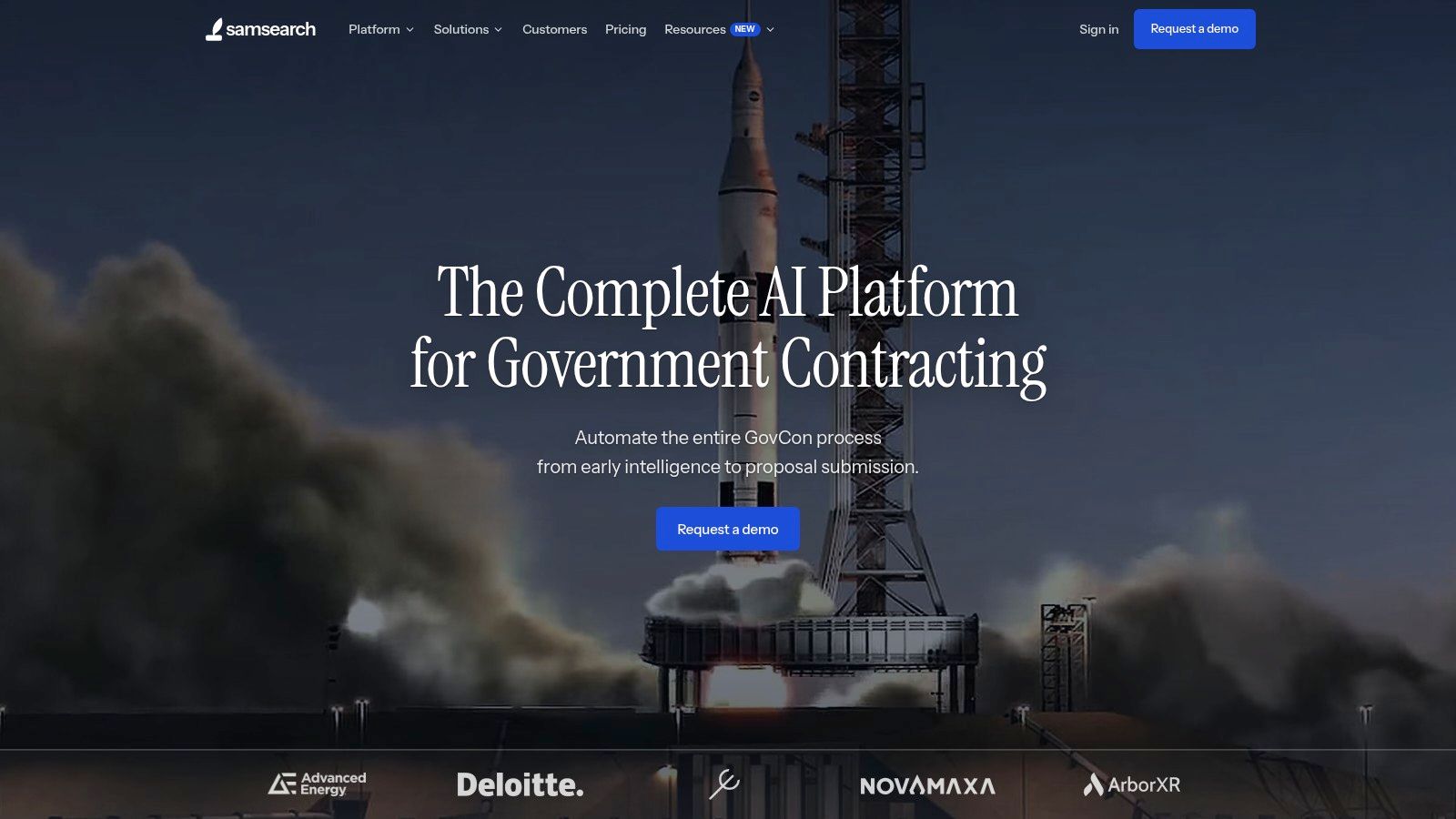
SamSearch is the strongest fit in this list for established government contractors that want to connect opportunity discovery, capture, proposal response, pipeline management, and contract financing in one environment instead of adding another disconnected search tool. It is built for mid-market and enterprise government contractors, not one-person operators or lightweight bid alert use cases.
The platform's biggest advantage is orchestration across the full pursuit lifecycle. Its AI agent, Sammy, can read RFPs and attachments, extract requirements into a cited compliance matrix, and draft section-specific responses grounded in a past performance library. That helps address one of the most expensive gaps in government contracting workflows: a capture team may identify the right pursuit, but proposal staff still lose time locating source material, interpreting requirements, and rebuilding compliance tracking in separate documents.
SamSearch also extends beyond standard federal opportunity search. Supplied product information describes coverage across federal, state, and local sources, DIBBS, subcontracting, SBIR and grants, and Canadian opportunities. It combines fit-scored discovery with verified recompete forecasting, historical awards and pricing insights, and compatibility scoring across 600,000+ contractors, which can help capture leaders move from "we need a partner" to a more structured teaming search.
Compared with narrower tools that focus only on alerts, search, or proposal drafting, SamSearch is more compelling for teams that want one connected operating environment from early market signal through submission readiness. That broader workflow is especially relevant for organizations trying to reduce swivel-chair work across business development, capture, proposal, and finance.
Best for connecting the full pursuit
SamSearch organizes work across six stages: Influence, Capture, Analyze, Manage, Respond, and Finance. That matters for contractors trying to reduce tool sprawl without forcing every stakeholder into separate systems. A capture manager can monitor an opportunity, a proposal lead can work from extracted requirements, and executives can review pipeline activity inside one connected workflow.
The financing module is an uncommon differentiator. SamSearch describes contract financing of up to $100 million through institutional partners, with example offers shown on the site such as financing at approximately SOFR plus 4.25%. Those terms are examples, not guaranteed offers, so buyers should validate eligibility, fees, underwriting, and the relationship between financing availability and awarded contract terms directly with SamSearch.
Enterprise buying note: AI generated proposal content still needs human review, approval, and source verification. Speed is useful only when the workflow preserves accountability.
SamSearch reports more than $3 billion in contract wins and cites customer examples, including $37.5 million in awards after AI screening. These are vendor reported outcomes and should be tested against a buyer's own baseline. Security materials supplied for evaluation include SOC 2 Type II, independent penetration testing described as VAPT A+, SAML 2.0 SSO, US region hosting, and a no-retention model for customer documents. CMMC Level 2 remains a point to verify for defense contractors requiring a completed Level 2 posture.
Best fit: Established AEC, IT, defense, and professional services contractors seeking one AI-driven environment from early discovery through proposal and financing.
Trade-off: Annual, quoted seat and module pricing is likely to fit organizations that want a strategic system of record for capture and proposal work, and enterprise buyers should validate security scope, retention controls, model governance, and implementation effort.
Visit SamSearch for a product demonstration and current enterprise packaging.
2. Civio.ai
Civio.ai holds the number 2 spot as a strong option for contractors that want AI support centered on opportunity qualification, solicitation analysis, and proposal acceleration. It is especially relevant for teams trying to reduce manual reading, speed up document review, and improve first-draft production without building a large internal capture technology stack.
The platform is well positioned for GovCon teams that want to move faster once an opportunity is identified. That makes it appealing to organizations that already have a lead source or incumbent market intelligence process, but need better throughput when qualifying opportunities, reviewing solicitation packages, and generating draft proposal content.
Civio.ai should be evaluated closely on requirement extraction, source citations, amendment handling, collaboration controls, and the separation between machine-generated output and approved proposal content. For many contractors, those workflow details matter more than a broad feature list because they determine whether the platform can be used in a governed production process.
Where Civio.ai stands out
Civio.ai earns its place for teams that prioritize proposal speed and AI assistance close to the RFP. A focused AI workflow can create real value when capture and proposal teams are buried in attachments, compliance requirements, and repetitive response drafting. Buyers should test the product using long solicitations, amended files, and prior proposal content to see whether outputs remain accurate, cited, and easy to review.
The main trade-off is workflow breadth versus specialization. Contractors that need deep pre-RFP forecasting, broad market intelligence, or one environment covering discovery through proposal may still compare it with more end-to-end platforms. Civio.ai is most compelling when the core buying problem is speeding up document-heavy pursuit work while keeping human reviewers in control.
Best fit: Contractors that want AI-assisted qualification, solicitation analysis, and proposal acceleration in a focused workflow.
Trade-off: Buyers should validate market coverage, governance controls, integrations, and whether the platform can stand alone or should sit alongside a broader capture system.
Visit Civio.ai to review current capabilities and request a demonstration.
3. Deltek GovWin IQ
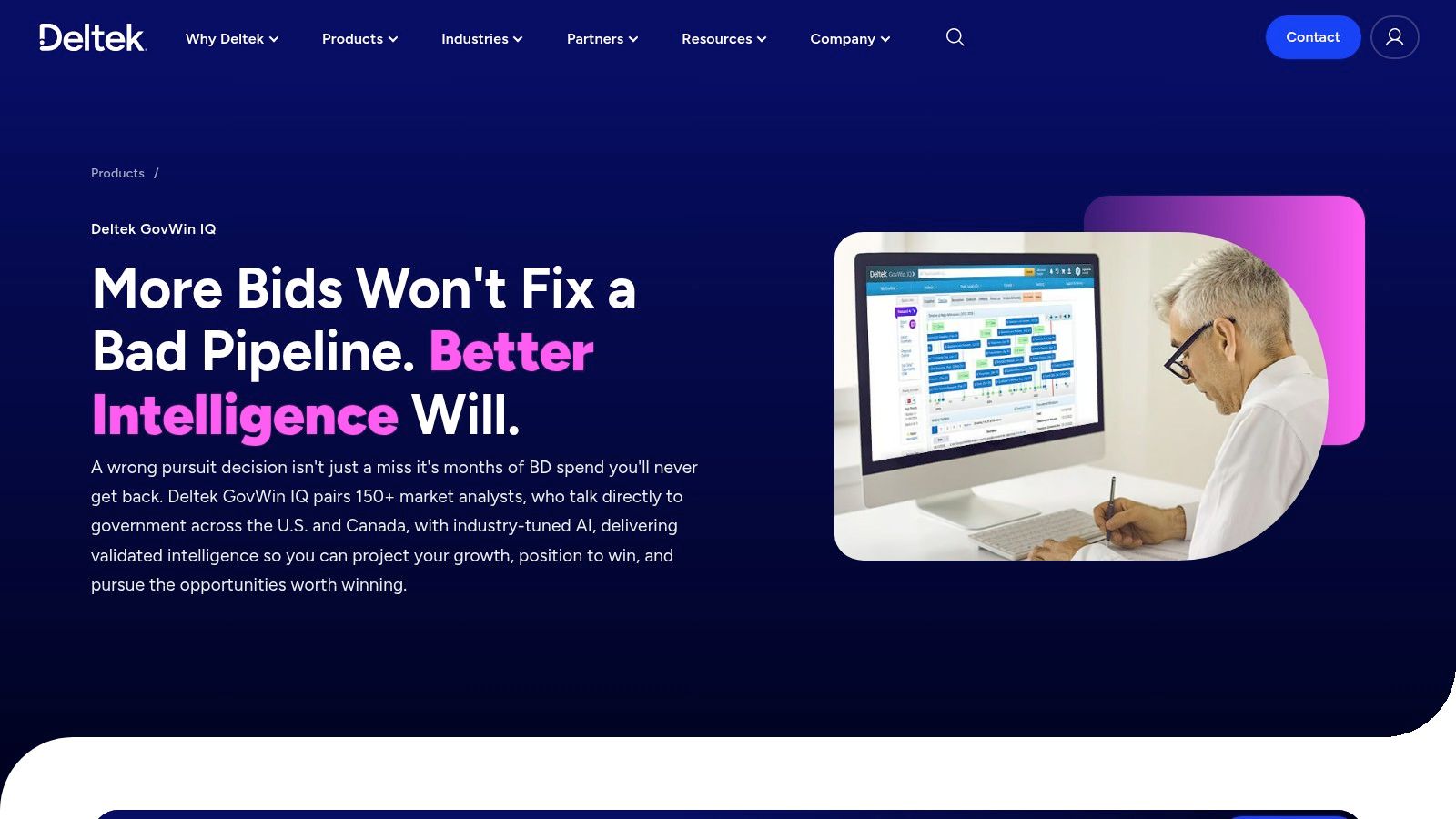
Deltek GovWin IQ is best understood as a market intelligence and forecast platform for capture teams that need visibility before a formal solicitation appears. Its value is less about replacing every downstream proposal workflow and more about helping business development leaders understand where demand, incumbency, contract vehicles, and recompetes are forming.
GovWin IQ combines analyst-validated opportunity intelligence with federal and SLED coverage. The platform is particularly relevant to mid-market and large primes that pursue IDIQs, task orders, and recurring agency requirements. Incumbent information, award history, and vehicle tracking can help a capture manager distinguish a shapeable opportunity from a pursuit where the incumbent has a powerful structural advantage.
That distinction changes pipeline quality. A database can tell a team that an opportunity exists. A more useful intelligence layer helps the team decide whether the opportunity belongs in the active pipeline, deserves an early relationship strategy, or should be deprioritized.
Where GovWin IQ earns its place
The platform's analyst bench is the key differentiator. Analyst validation can add context to raw notices and forecast records, especially when a contractor needs to understand agency buying patterns, contract history, or the likely route to award. Deltek also promotes market reports such as GovCon Clarity, which can support leadership-level planning rather than only individual opportunity research.
The trade-off is workflow breadth. Buyers should test how information moves into their CRM, capture review process, teaming workflow, and proposal environment. GovWin IQ may be the strongest choice when forecast credibility is the primary problem, but it may not be the best standalone answer for teams seeking embedded compliance extraction or AI-assisted drafting.
Pricing is not publicly listed, so enterprise buyers should request a quote that separates users, modules, markets, exports, and any limits on analyst content. Independent pricing trackers also describe the pricing as opaque, which makes a detailed commercial evaluation important.
A strong forecast tool can improve bid selection without becoming the system where every proposal task is completed.
Teams comparing GovWin IQ with broader platforms can also review this analysis of GovWin alternatives.
Best fit: Enterprise business development and capture organizations that prioritize pre-RFP visibility, recompete tracking, IDIQ intelligence, and analyst-supported market planning.
Trade-off: Premium, quote-based packaging and a center of gravity in market intelligence may require complementary tools for proposal execution, document governance, and end-to-end pursuit management.
Explore GovWin IQ through Deltek's official product page.
4. Bloomberg Government
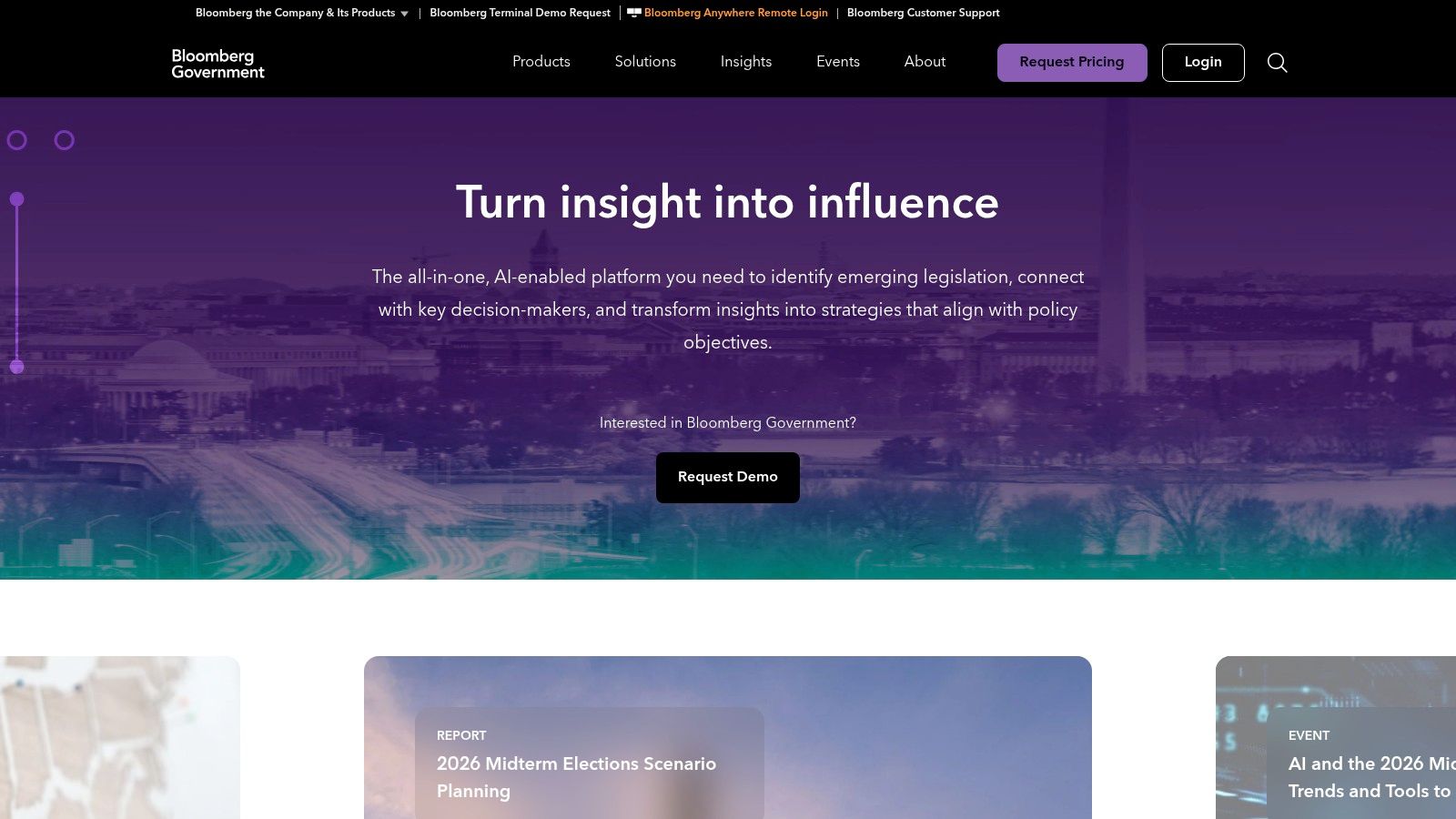
Bloomberg Government, commonly known as BGOV, is the strongest option in this group for teams that treat policy, budgets, Congress, regulation, and contracting data as one capture environment. That makes it especially relevant to contractors pursuing strategically important federal work where an agency's authorization, appropriations, regulatory direction, and congressional attention can matter as much as the notice itself.
BGOV's Contracts Intelligence Tool supports award history, task order research, and contractor market analysis. Its broader suite adds Hill tracking, regulatory and budget monitoring, congressional directories, analyst briefings, and research products such as Hill Watch Live and BGOV200 industry reports. A capture leader can therefore investigate not only who won a requirement, but also what policy or funding developments may influence the customer's next action.
That policy context is the platform's distinctive contribution to early opportunity decisions. A conventional search product may surface a requirement after the buying path is already clear. BGOV can help public affairs, legislative, and capture stakeholders work from related information before the procurement becomes an isolated pipeline record.
The strategic trade-off
BGOV's center of gravity is policy and public affairs intelligence. Its contract search is substantial, but contractors that mainly need solicitation alerts, proposal drafting, or a lightweight capture workspace may find the broader suite more than they need. Buyers should test whether the platform fits the daily habits of proposal managers and account teams, not only senior policy users.
Pricing is not publicly listed and is generally handled through premium, enterprise-oriented conversations. Request a role-based demonstration for capture, contracts, legislative affairs, and executive users. Confirm what each package includes, how data can be exported, and whether the chosen configuration integrates with the contractor's CRM and reporting stack.
For a narrower comparison of discovery capabilities, see this guide to government contract discovery platforms.
Best fit: Federal contractors whose capture decisions depend on budget, appropriations, congressional activity, regulation, and agency policy context.
Trade-off: Its breadth can create unnecessary cost or complexity for teams seeking a single-purpose opportunity search and response tool.
Visit Bloomberg Government to validate current product coverage and enterprise options.
5. GovTribe
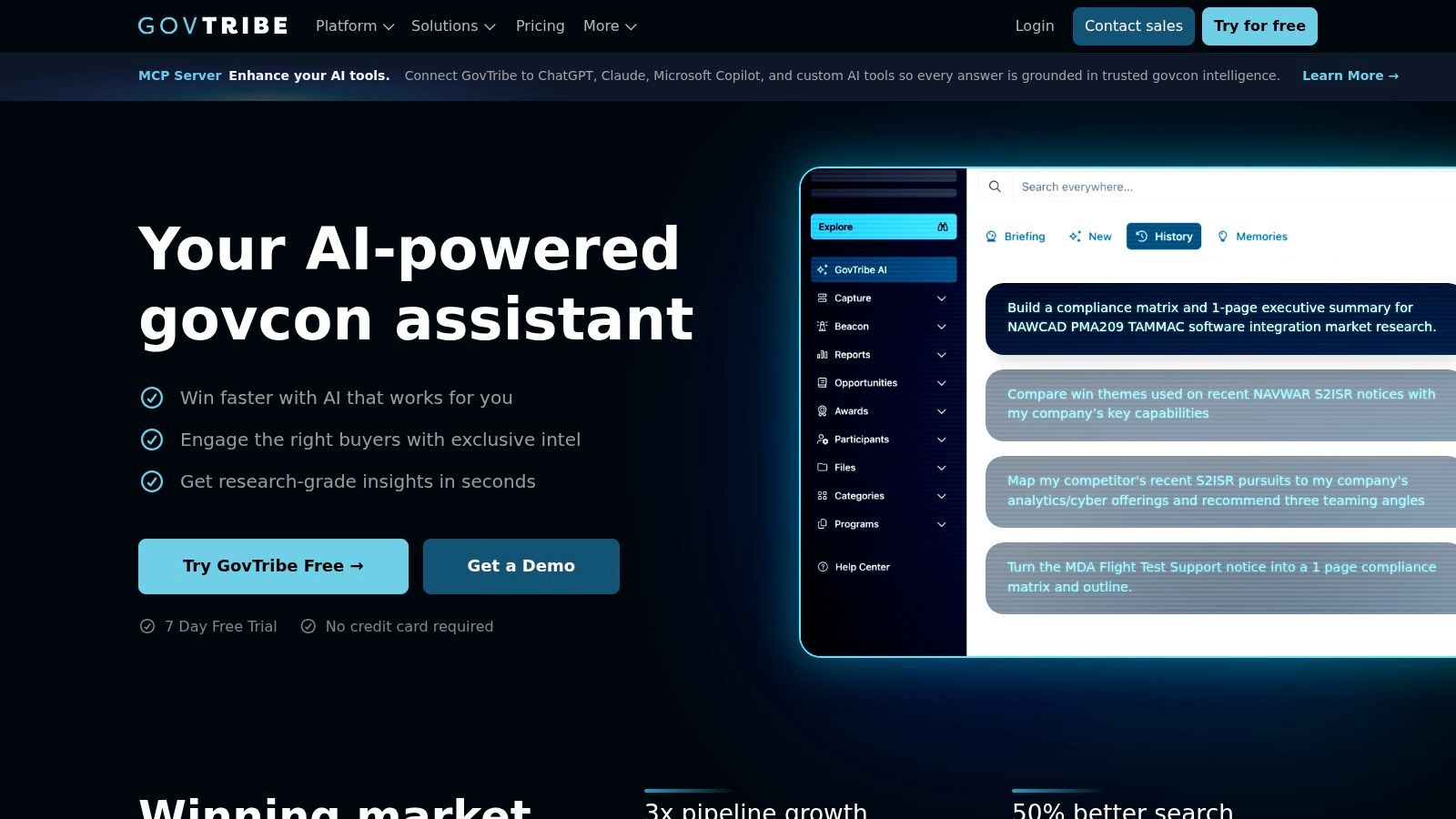
GovTribe is built around the practical rhythm of contractor-led capture. Its modern interface, AI-assisted search, alerts, pricing signals, and embedded teaming workflows make it appealing to teams that need to move quickly from an opportunity signal to a coordinated pursuit conversation.
The platform's most useful distinction is that teaming is not treated as a separate directory exercise. Its Teaming hub lets users post interests, find potential partners, message contacts, and lock teams. That connects a critical capture decision to the opportunity record itself. For a prime evaluating a requirement that exceeds its contract vehicle, past performance, geography, or labor coverage, the path to a partner can be more immediate than in platforms that require separate research and outreach tools.
GovTribe also supports saved searches, alerts, exports, and AI chat for faster research. Those functions can improve signal speed and pipeline hygiene, especially when multiple capture managers monitor distinct agencies, NAICS codes, or customer accounts.
Watch consumption and tier limits
GovTribe's transparent self-serve plans are a budgeting advantage compared with vendors that disclose little publicly. Clear user and export limits help a team estimate adoption before signing an enterprise agreement. The downside is that advanced AI features operate on a credit or consumption basis, so administrators need to monitor usage rather than assume every user has unlimited access.
This creates a specific evaluation question: will the team use AI for occasional research, or will it become part of daily opportunity qualification? The answer affects cost and may influence which roles receive access.
Embedded teaming is valuable only when the partner record, communication history, and opportunity strategy remain connected enough for capture leadership to govern the pursuit.
GovTribe is a practical choice for teams that prioritize speed, usability, and partner coordination over analyst-heavy forecast interpretation. Buyers seeking broader AI proposal drafting, document compliance, or financing should compare it with an integrated platform rather than treating it as a complete replacement.
Read this comparison of GovTribe alternatives and competitors in 2026 before finalizing a shortlist.
Best fit: Capture teams that need fast signals, practical research assistance, and teaming directly inside opportunity workflows.
Trade-off: Consumption-based AI and tiered limits require active governance, particularly for larger teams with frequent research and exports.
Explore GovTribe to review current plans and capabilities.
6. HigherGov
HigherGov is a strong candidate for contractors whose central problem is combining federal and SLED intelligence with price-to-win analysis. Its unified opportunity search, labor pricing datasets, competitor analytics, contract hierarchies, vehicle data, market share views, and documented API give data-driven business development teams a more analytical foundation for pursuit decisions.
The labor pricing capability is particularly relevant when a contractor must estimate how aggressively competitors may price labor categories. A capture team can use market and competitor information to frame questions for its pricing organization, rather than treating price-to-win as a late-stage exercise performed after the proposal strategy is already fixed.
HigherGov also has a meaningful SLED orientation. That matters for contractors expanding beyond federal work, because state and local markets often require different account targeting, purchasing patterns, and relationship strategies. The platform buyer should test coverage in the specific states, agencies, vehicles, and service categories that matter to its growth plan.
Why the API changes the buying question
The documented API makes HigherGov more attractive to organizations that already operate internal data products, CRM automations, or reporting environments. Instead of asking only whether users like the interface, an enterprise buyer can ask whether the platform's data can feed the existing capture architecture without creating another manual export process.
That flexibility also creates responsibility. API documentation may describe access methods while commercial terms still define limits, downloads, seats, and permitted use. Public pricing is not posted, and team access requires a quote, so buyers should request a written mapping of API rights, data refresh expectations, and support obligations.
For teams comparing its data model with other options, this review of HigherGov alternatives and competitors in 2026 provides additional context.
Best fit: Data-driven federal and SLED teams focused on competitor analysis, labor price benchmarking, market share, and internal integrations.
Trade-off: The platform may require more sales engagement and technical ownership than a self-serve alerting product, particularly when API access and download volume are central to the business case.
Visit HigherGov to validate coverage, API terms, and enterprise packaging.
7. BidPrime
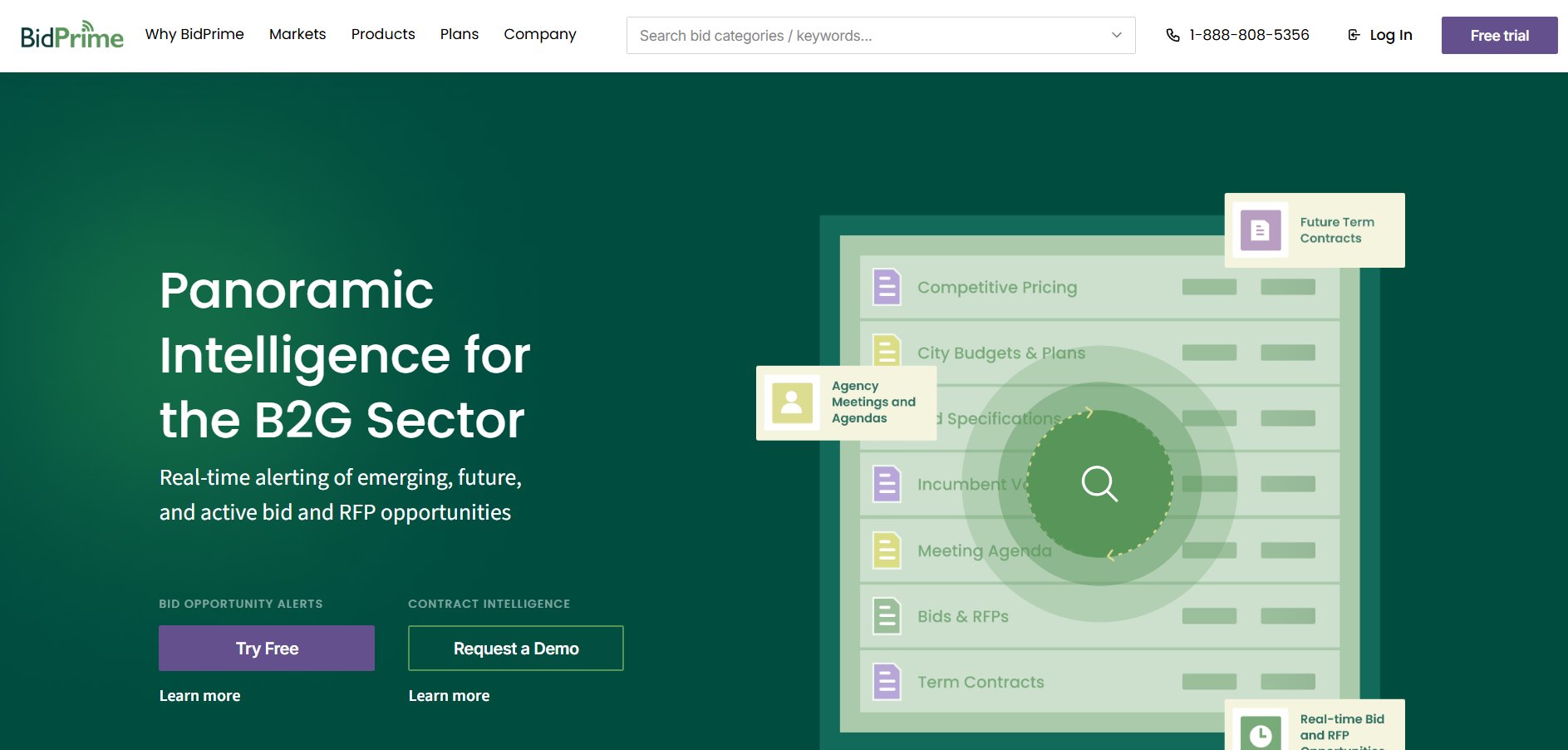
BidPrime is a practical choice for teams that need fast solicitation aggregation and document-level search, especially across federal, state, local, education, and Canadian sources. Its value appears after a notice is available and the capture team needs to determine quickly whether the documents contain a viable fit.
The platform's DocSearch capability lets users search specification and solicitation text, view documents in the browser, and avoid manually opening every attachment to find a technical requirement. That makes BidPrime useful for SLED-heavy teams handling a high volume of geographically dispersed notices, where document retrieval and first-pass qualification can consume more time than the initial search.
Historical analytics, CSV export, and a Salesforce connector extend the platform beyond alerts. A capture organization can route relevant records into downstream pipeline workflows instead of leaving the opportunity trapped in a separate portal. Buyers should still test field mapping, attachment handling, amendment updates, and the amount of manual cleanup required after an export.
A focused aggregation trade-off
BidPrime's published pricing tiers make budgeting easier than quote-only platforms. That transparency can matter to mid-market contractors building a repeatable research process across business units. Users also report responsive customer support and time savings, but those outcomes should be validated through a pilot using the contractor's own markets and document types.
The limitation is strategic depth. BidPrime is more focused on solicitation aggregation than analyst-curated forecasting, incumbent interpretation, or long-range recompete intelligence. It may therefore work best as a fast front door to available bids, paired with a separate system for shaping, teaming, competitive positioning, and proposal production.
Best fit: SMB and mid-market capture teams that prioritize federal and SLED bid volume, specification search, alerts, and practical CRM handoff.
Trade-off: Contractors seeking early forecast signals, deep contract vehicle analysis, or integrated AI proposal workflows may need additional software.
Explore BidPrime for current coverage, pricing tiers, and Salesforce integration details.
8. GovSpend with GovQuote
GovSpend addresses a different capture question: who buys what, from whom, and at what price across SLED markets? Rather than treating opportunity discovery as a notice search problem, it organizes purchase orders, bids, contracts, meeting transcripts, and buyer contacts into a view of actual purchasing behavior.
That makes the platform useful for account-based targeting. A contractor can investigate which public entities buy a relevant category, identify incumbent relationships, review available purchasing history, and build outreach lists grounded in spend activity. For SLED expansion, this can be more actionable than a broad list of open solicitations because it connects future prospecting to evidence of prior demand.
GovQuote adds a rapid quote request workflow where supported jurisdictions participate. Its usefulness depends on local coverage and the contractor's operating model, so a demonstration should use the exact states, municipalities, school systems, or other public buyers the team wants to pursue.
The price-to-win and outreach connection
GovSpend's strongest use case is turning SLED spend transparency into an account plan. Sales and capture leaders can use buyer contacts and purchasing data to prioritize conversations, while pricing teams can use historical transactions as context for competitive positioning. The platform's AI-assisted prospecting and quoting functions may reduce repetitive research, but users should confirm which outputs are generated, what source records support them, and where human approval remains necessary.
Pricing is not posted publicly, and access is sales-led with quote-based tiers. Some users report sales-driven onboarding experiences, so procurement should request a written implementation plan, data coverage statement, user permissions model, and exit process before approval.
This analysis of GovSpend alternatives for government contractors in 2026 can help teams compare SLED spend intelligence with broader opportunity platforms.
Best fit: SLED-focused contractors that need purchasing history, buyer discovery, competitive targeting, and quote workflows.
Trade-off: GovSpend is not a complete federal capture-to-proposal system, and jurisdiction-level coverage should be validated before purchase.
Visit GovSpend to assess GovQuote availability and current data access.
Procurement Software and the Compliance Layer
Government contractors often use "contracting software" to mean opportunity intelligence, but the surrounding procurement environment creates workflow requirements that cannot be ignored. A platform can find the right opportunity and still fail the business if it does not preserve auditability, protect proposal content, or help teams act within defined filing and registration rules.
In practice, that means the software decision should not be limited to database size or keyword search quality. Buyers should also evaluate document retention controls, role-based permissions, approval history, AI governance, integration with CRM or proposal systems, and the ability to maintain a defensible record from opportunity review through submission.
Evidence contractors should verify
Use vendor demonstrations to test workflow fit, then use official government documentation to validate the compliance mechanics your process depends on.
UEI and SAM registration: FEMA states that for entities filing a new registration in SAM.gov, the Unique Entity Identifier is assigned as part of registration. FEMA's UEI explanation should be part of any federal pipeline onboarding review.
Subcontracting plans: FAR materials cite a threshold of $900,000 for most contracts and $2 million for construction. FAR 19.705-2 explains how contracting officers determine whether proposed contract dollars exceed the applicable threshold.
Bid protests: GAO says solicitation term protests must be filed before the time set for receipt of initial proposals. Other protests generally have a 10 calendar day filing window after the basis is known or should have been known. GAO bid protest FAQs explain the cutoff mechanics.
Agency response timing: GAO generally issues a decision within 100 days, or 65 days under the express option. FAR Part 33 also requires the protester's copy to reach the agency no later than one day after filing, with the agency generally submitting its report within 30 days. FAR Part 33 provides the governing details.
Market estimates and methodology
A platform will not make a late filing timely or replace counsel's judgment. It should instead give responsible people reliable alerts, document access, approval history, and a defensible record of who reviewed what.
Government procurement market context
Top Government Contracting Platforms Comparison
| Product | Implementation complexity | Resource requirements | Expected outcomes | Ideal use cases | Key advantages |
|---|---|---|---|---|---|
| SamSearch | Low-Moderate, guided onboarding with admin setup, SSO, and workflow configuration | Mid-market and enterprise seats and modules, annual contract, admin and capture team adoption | Faster compliant proposals, higher quality leads, scaled pipeline, access to contract financing | Established prime and enterprise capture and proposal teams in AEC, IT, defense, and professional services | End-to-end AI workflow, broad federal and SLED coverage, teaming scores, contract financing, SOC 2 and enterprise controls |
| Civio.ai | Moderate, focused AI onboarding for document and proposal workflows | Team adoption for AI-assisted qualification and response work, demo-led evaluation | Faster solicitation review, quicker first drafts, reduced manual proposal prep | Contractors focused on AI-assisted qualification, RFP analysis, and proposal acceleration | Focused AI workflow for document-heavy pursuits, practical fit for response acceleration |
| Deltek GovWin IQ | Moderate-High, analyst integration and onboarding required | Enterprise subscription, analyst-supported workflows, BD teams | Improved pre-RFP visibility, recompete and IDIQ tracking, informed pipeline planning | Mid-market and large prime BD and capture teams needing vehicle and task order intelligence | Analyst-validated intelligence, deep vehicle and task order coverage |
| Bloomberg Government (BGOV) | Moderate, platform plus policy and briefing integration | Premium enterprise subscription, policy and research consumers | Unified contracts plus policy and budget insights to shape strategic outreach | Teams needing combined procurement and public affairs or policy context | Best-in-class policy, budget, and congressional tracking layered on contracts data |
| GovTribe | Low-Moderate, fast onboarding, self-serve options | Transparent self-serve plans, team accounts, AI credit monitoring for advanced features | Rapid signal detection, practical teaming and pipeline coordination | Capture teams prioritizing speed, usability, and partner discovery | Usability and speed to signal, embedded teaming hub, clear plan limits |
| HigherGov | Moderate, API integration possible, onboarding for dataset use | Team pricing by quote, developer-friendly API and documentation | Unified federal and SLED search, labor pricing, and price-to-win analytics | Data-driven BD teams and consultants targeting SLED and pricing strategy | Strong SLED depth, labor pricing datasets, documented API for integrations |
| BidPrime | Low, straightforward aggregation and alert setup | SMB and mid-market friendly, published pricing tiers, basic integrations | Fast alerts, in-document spec search, exportable leads for CRM workflows | SMB and mid-market teams focused on SLED solicitation volume | Transparent pricing, fast alerts, DocSearch, and Salesforce connector |
| GovSpend (with GovQuote) | Low-Moderate, sales-led onboarding for full access | Quote-based pricing, jurisdictional GovQuote support may vary | SLED spend transparency, price-to-win insights, buyer contact lists, rapid quoting where supported | Teams focused on SLED competitive targeting, account-based outreach, and quoting | Consolidated SLED spend data, buyer contact discovery, GovQuote quick quote workflow |
Turn the Shortlist Into a Defensible Platform Decision
The best choice among the top government contracting software platforms depends on the decision your current stack handles poorly. Civio.ai is focused on AI-assisted qualification and proposal acceleration. GovWin IQ is oriented toward analyst-supported forecasts and vehicle intelligence. BGOV adds policy and congressional context. GovTribe connects opportunity research with embedded teaming. HigherGov is compelling for SLED depth, competitor analytics, labor pricing, and APIs. BidPrime focuses on rapid solicitation aggregation and document search. GovSpend turns SLED purchasing data into account and price-to-win intelligence. SamSearch is designed for established government contractors that want to connect discovery, capture, compliance, proposal response, pipeline management, and financing in one workflow.
Start with the users and markets, not the feature list. Define which teams will use the platform, including business development, capture, proposal, pricing, contracts, legal, security, finance, and executive leadership. Then specify whether the priority is federal, SLED, defense, subcontracting, grants, Canadian opportunities, or a combination. A platform that performs well in one market may not provide enough depth in another.
Map the workflow from forecast through proposal. Document how your team currently identifies an opportunity, validates fit, checks incumbency, finds a vehicle, builds a team, performs a bid or no-bid review, analyzes pricing, manages amendments, extracts requirements, drafts responses, conducts reviews, and records the final decision. The vendor should demonstrate those steps using your process, not a polished generic scenario.
Validate the evidence before signing
Run representative opportunities and attachments through each finalist. Include a long solicitation, amendments, technical specifications, past performance material, and a document with tables or scanned content. Check whether the system preserves citations, identifies requirements accurately, updates amendment status, and lets reviewers distinguish machine-generated text from approved human content.
Your evaluation should cover:
Market depth: Compare federal and SLED coverage in the agencies and categories you pursue.
Forecast quality: Test recompete, incumbent, vehicle, task order, and pre-RFP information against known opportunities.
Teaming: Confirm partner discovery, compatibility signals, messaging, permissions, and relationship history.
Pricing intelligence: Review the provenance, freshness, exportability, and permitted use of award and labor price data.
Proposal support: Test compliance matrices, document search, source citations, amendment tracking, drafting, and review controls.
Integration: Validate CRM connectors, CSV exports, APIs, SSO, role-based access, and administrative reporting.
Security and data handling: Confirm hosting region, retention policy, model training terms, incident procedures, testing scope, and any FedRAMP or CMMC claims.
Commercial fit: Put seats, modules, exports, AI credits, API usage, implementation services, renewal terms, and termination rights in writing.
A time-boxed pilot should measure operational outcomes rather than feature impressions. Track analyst hours saved, qualified opportunities surfaced, partner response rates, proposal review time, compliance exceptions found before submission, and the percentage of users who complete the intended workflow. Avoid claiming a win-rate improvement during a short pilot unless the evidence supports that conclusion. The more defensible measures are adoption, cycle time, data quality, and decision traceability.
Security, legal, contracts, and capture stakeholders should approve the pilot results before production use. For defense or highly regulated work, ask the vendor to identify exactly which application, hosting environment, and service boundary each security assertion covers. For AI-assisted work, document where human approval is mandatory, who owns final content, and how the organization handles unsupported or incorrect generated claims.
Government Contracting Software FAQ
What is government contracting software?
Government contracting software helps contractors find opportunities, evaluate fit, track incumbents and contract vehicles, manage capture workflows, support proposal development, and monitor compliance steps across federal and SLED pursuits.
What is the best government contracting software?
The best platform depends on the problem a contractor needs to solve. SamSearch is strongest for teams that want one connected workflow from discovery through proposal and financing. Civio.ai is a strong fit for AI-assisted solicitation analysis and proposal acceleration. GovWin IQ is best known for analyst-backed forecasting and market intelligence.
Which platform is best for proposal writing and compliance matrices?
SamSearch and Civio.ai are the strongest options in this list for contractors that want AI assistance with RFP analysis, requirement extraction, compliance tracking, and proposal drafting. Buyers should still validate citations, review controls, and amendment handling in a live demo.
Which tool is best for pre-RFP forecasting and recompete intelligence?
Deltek GovWin IQ is one of the strongest options for analyst-supported pre-RFP visibility, recompete tracking, task order research, and contract vehicle intelligence. Bloomberg Government is also valuable when policy and budget context shapes the opportunity.
Which platform is best for SLED opportunity and spend intelligence?
HigherGov, BidPrime, and GovSpend are all relevant for SLED work, but they solve different problems. HigherGov is strong for data analysis and price-to-win context. BidPrime is useful for fast solicitation aggregation and document search. GovSpend is especially helpful for buyer research, purchasing history, and SLED account targeting.
Do government contractors need separate software for discovery and proposals?
Not always. Some teams prefer a connected platform that supports discovery, capture, and proposal work in one environment. Others choose separate tools for forecasting, teaming, pricing, and proposal response. The right choice depends on team size, workflow complexity, security needs, and existing CRM or data architecture.
What should contractors verify before buying a platform?
Contractors should validate market coverage, incumbent and forecast accuracy, teaming workflows, pricing data provenance, proposal controls, CRM and API integrations, security scope, retention settings, AI governance, and commercial terms. A pilot using real opportunities is usually more useful than a feature tour.
SamSearch helps established mid-market and enterprise government contractors, not small businesses, connect opportunity intelligence, capture planning, teaming, RFP analysis, compliance extraction, proposal drafting, pipeline management, and contract financing. Visit SamSearch to test how its AI-driven workflow fits your federal and SLED growth process.