Top 7 Government Procurement Forecast Databases Compared
A forecast is a starting signal, not a qualified opportunity. The federal Acquisition Gateway's forecast page warns that projected procurements may change or be canceled, and final acquisition decisions appear in the solicitation. Treat forecasts as prompts for research, not as funded pipeline.
Solicitation release is the end of much of the capture runway, not the beginning. Forecast databases help teams investigate agency plans, budget signals, and possible recompetes early enough to make deliberate bid decisions. Their value depends on how well they support the work between finding a record and committing capture resources.
This comparison of seven government procurement forecast databases and platforms considers coverage, timeliness, forecasting method, pricing transparency, integrations, and buyer fit. It separates official agency forecasts from analyst-supported intelligence and broader capture workflows. Civio AI and SamSearch appear separately because they serve different workflow needs, but Civio describes SamSearch as an intelligence source in its platform, not an independent forecast feed. Use the AI-driven procurement forecasting checklist to assess which sources and workflow features fit your capture process.
Table of Contents
- 1. SamSearch
- 2. Civio AI
- 3. GovTribe
- 4. HigherGov
- 5. Federal Compass
- 6. GSA Forecast of Contracting Opportunities (FCO)
- 7. Acquisition.gov Procurement Forecasts
- Picking Your Stack and Positioning Before the Solicitation
- Frequently Asked Questions
1. SamSearch
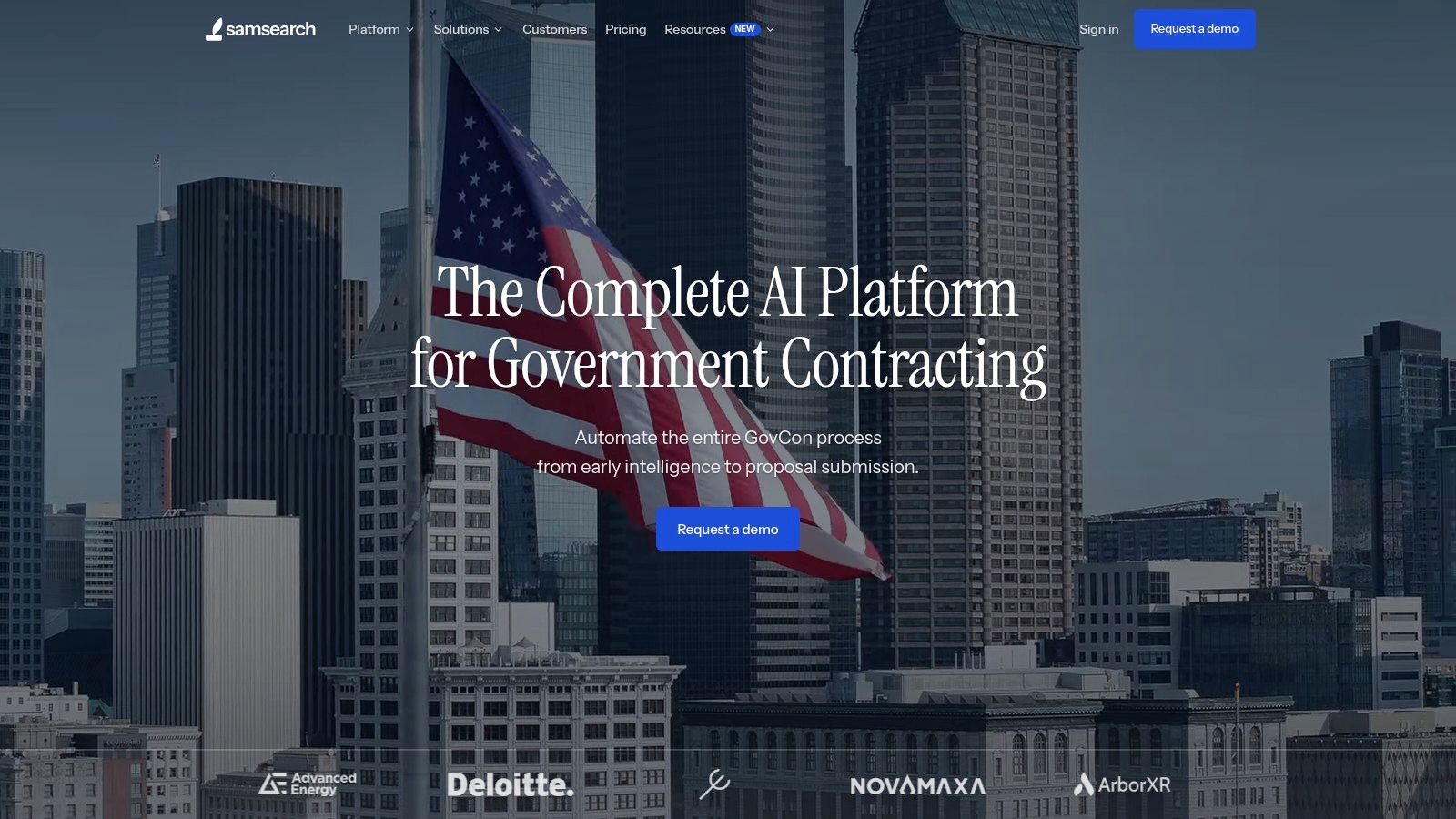
A forecast is useful only if the team can turn it into a qualified pursuit. SamSearch connects opportunity discovery with bid qualification, teaming, proposal analysis, and pursuit management. Its Capture stage finds and qualifies work, while its broader workflow supports opportunity analysis, response drafting, and tracking from search to award. It is best suited to established capture and proposal teams that need more than a forecast lookup.
The SamSearch forecast search sits within a platform covering federal, SLED, DIBBS, Canadian, subcontracting, SBIR, and grant opportunities. Coverage varies by source: published agency forecasts provide planning signals, while reconstructed award and solicitation records support research into likely recompetes. SamSearch's analyst desk verifies re-solicitation windows, and incumbent profiles and offer histories help teams assess the buying context.
Turn a forecast into a controlled pursuit
For example, an IT contractor finds a forecast aligned with its agency experience but lacks access to the likely vehicle. The capture team can score the opportunity, review the incumbent, identify a teaming route, and assign an owner before committing proposal resources.
Qualification: Fit scoring considers company capabilities, business codes, set-asides, incumbent history, and past performance. Reconstructed public award and solicitation records provide incumbent profiles and offer histories; the analyst desk verifies re-solicitation windows.
Execution: JourneyHub tracks opportunities through bid/no-bid, teaming, proposal, and award stages. That makes SamSearch particularly useful when discovery needs to become an owned pursuit rather than another unassigned alert.
Handoff: The pipeline syncs with Salesforce, HubSpot, and Pipedrive, keeping pursuit records connected to those CRM systems.
Proposal control: Sammy extracts requirements and builds compliance matrices. Reviewers still need to check each response against the solicitation.
The trade-off is scope. A solo researcher who only needs an official forecast export may find a capture-to-proposal platform more than the job requires. Evaluate the configuration your team will use; SamSearch also offers free GovCon calculators, lookups, and other tools.
For a capture team, the practical test is whether research, qualification, and proposal owners can work from the same evidence while retaining a clear view of the source. Compared with an official forecast directory, SamSearch adds qualification and pursuit workflow; compared with a standalone AI revenue layer, it provides the underlying search-to-response process. Neither replaces verification against agency publications and solicitation documents.
2. Civio AI
A team can find an early procurement signal and still struggle to decide whether it belongs in the revenue forecast. Civio AI addresses that broader government-sales problem: it connects market intelligence, qualification, capture, proposal, and revenue operations in an AI-assisted workflow.
Civio describes SamSearch as an intelligence source for federal, state, and local opportunities, grants, SBIR, forecasts, and partner signals in its government sales platform FAQ. These entries are not two independent databases with distinct underlying forecast coverage. SamSearch is the stronger starting point if your immediate task is to investigate forecast records and manage a pursuit; consider Civio when your team also wants an AI-supported revenue layer around those signals.
An AI-generated revenue forecast estimates the likelihood or value of winning work. It is not an agency procurement forecast or confirmation that the agency will buy.
Distinguish pipeline forecasting from procurement forecasting
Start with a known agency forecast and check whether Civio retains the source reference as the opportunity moves through qualification and capture. Then test whether changes to the underlying agency record alter the team's pursuit decision, rather than simply producing a new AI summary.
Civio describes Fit, Intent, and Access qualification as a way to evaluate opportunities before they enter a forecast. Its bid-tracking overview also discusses pipeline visibility and CRM workflows. Confirm the capabilities available in your package and how they connect to your existing systems.
Strength: Connects early discovery signals to qualification and revenue-pipeline decisions.
Limitation: Do not count SamSearch-sourced records twice when comparing database coverage or assume AI probability scores establish procurement certainty.
Evaluation test: Ask for a demonstration using an agency forecast, a linked award, and a changed acquisition date, with source attribution visible at every stage.
For teams that primarily need analyst-researched agency context, Deltek GovWin IQ remains a useful comparison. See Deltek's federal GovWin IQ overview and the GovWin alternatives comparison, then decide whether analyst research or an integrated revenue workflow better answers your capture questions.
3. GovTribe
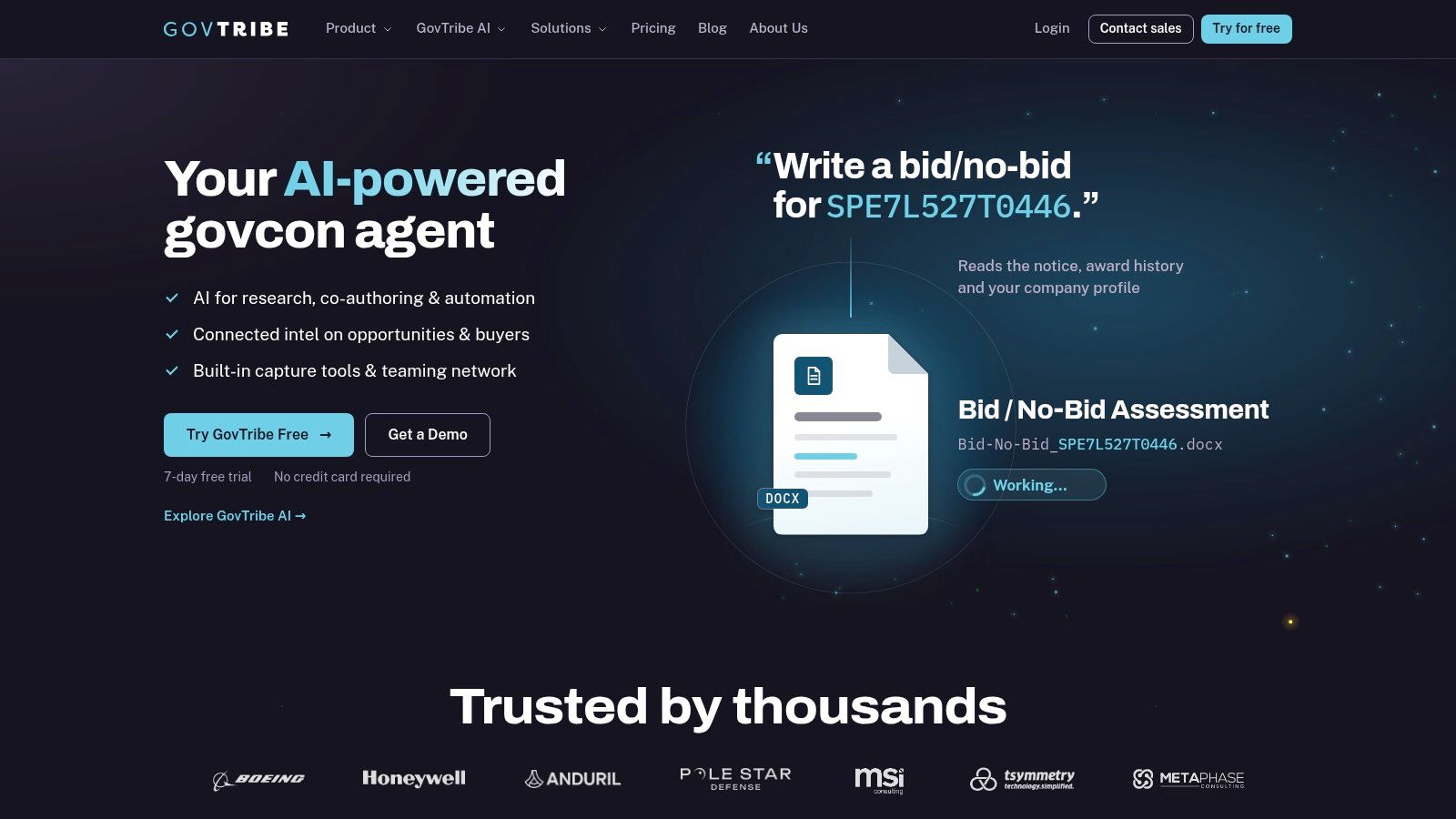
GovTribe suits a researcher or lean capture team that wants to evaluate the product without beginning with a sales-led procurement process. GovTribe publishes annual per-seat pricing and supports online signup and a trial. Its search combines federal forecasts with federal and SLED opportunities, grants, awards, and vendor research.
The practical appeal is proximity: a user can move from a planning record to an incumbent investigation and then into pursuit tracking. Saved searches, alerts, and contact research support that progression, while AI-assisted research adds another way to interrogate the information.
Test record linkage, not search-result volume
Choose a target agency and a capability area you know well. Search for forecasts, compare the results with agency publications, and verify whether related awards and contacts belong to the same requirement.
A forecast title can resemble an existing contract without describing its replacement. Watch for changes in the issuing office, place of performance, vehicle, or scope before treating a matching phrase as a recompete.
Advantage: Published pricing makes initial budget screening easier.
Cost caveat: AI features consume credits, so include normal research activity in the trial rather than testing only basic search.
Package caveat: Features such as eBuy and federal contract vehicle opportunities require the Pro tier.
Coverage caveat: Federal forecast availability doesn't establish full agency participation or analyst verification.
Use the GovTribe alternatives guide to compare workflows, not just feature labels. Before buying, verify whether the export or integration route preserves source references, timestamps, and pursuit ownership. Those fields matter more to an operational handoff than a polished summary.
4. HigherGov
An AEC business-development team may need federal forecasts and state or local opportunities in the same research session. HigherGov is a practical candidate when that mixed-market requirement matters more than analyst-led account coverage.
HigherGov combines forecast and opportunity search with awards, vendor information, labor-pricing intelligence, alerts, and pursuit-management tools. It publishes annual plans and offers API and export access, with limits that depend on the plan.
The buying question isn't merely whether an API exists. It's whether your chosen subscription can support the amount of research, exporting, and synchronization your team intends to perform.
Evaluate the downstream workload
Build a saved search around a real service line, then move relevant results into a pipeline. Export the records and check whether the fields needed by your CRM or reporting process survive intact.
For an AEC team, that might mean preserving location, agency office, anticipated timing, and the distinction between a new requirement and a possible follow-on. A missing field can force manual work even when discovery itself is fast.
What works: Public pricing and combined market coverage make initial evaluation straightforward.
What needs testing: Export allowances, API access, and plan-specific restrictions can determine whether the tool fits a shared research process.
What not to assume: A recent platform refresh doesn't necessarily mean the issuing agency recently revised its forecast.
The HigherGov alternatives comparison is useful when choosing between a research platform and a broader pursuit environment. Ask for source-publication and ingestion timestamps separately, where available. If your team needs analyst validation, test that requirement explicitly rather than inferring it from the presence of market-intelligence features.
5. Federal Compass
An expiring contract isn't automatically an open-market recompete. The agency might exercise an option, consolidate the scope, or place the follow-on work under a vehicle your company can't access.
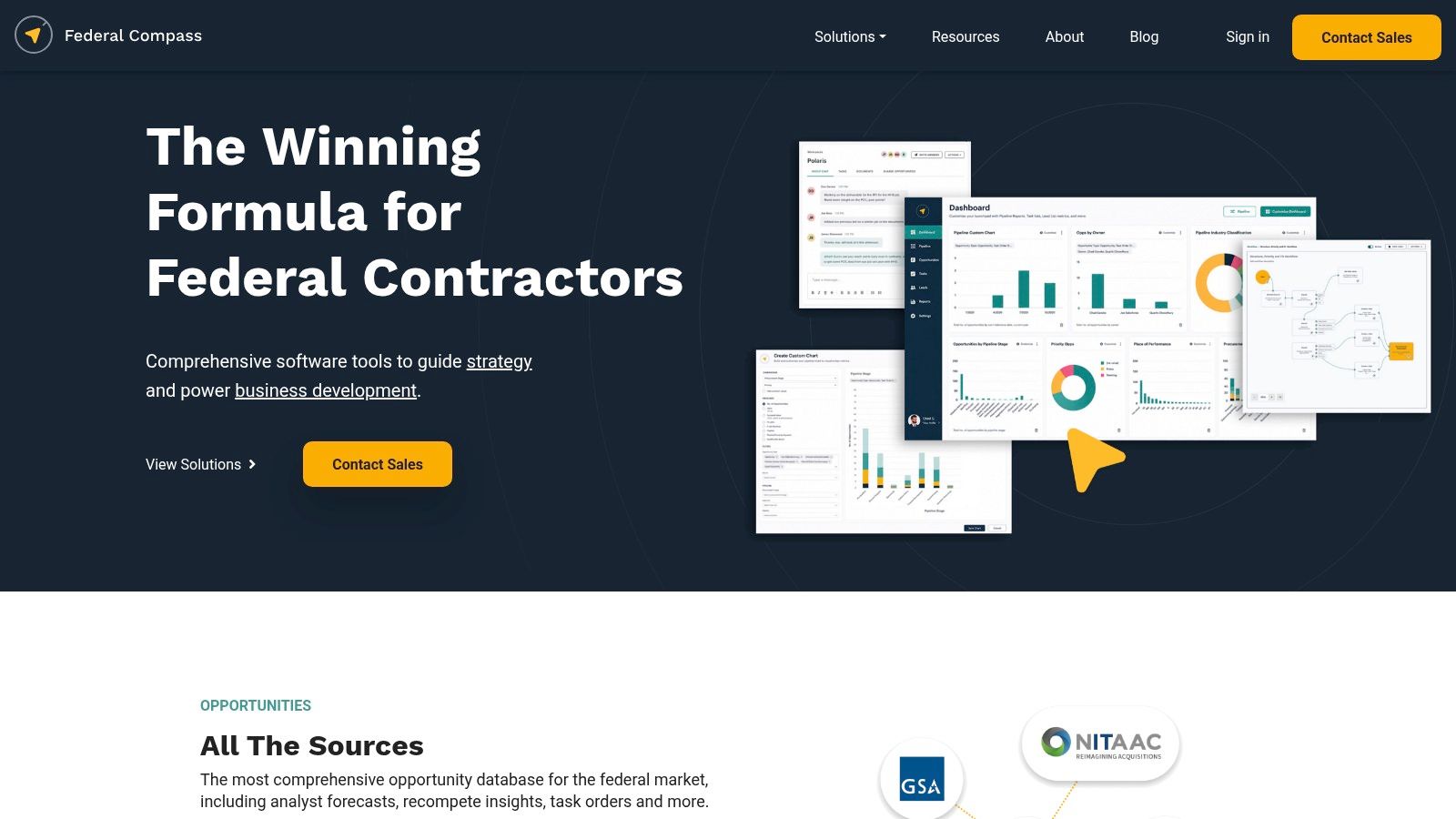
Federal Compass connects federal analyst forecasts and recompete intelligence with task-order research, contract information, market analysis, and pipeline management. It's best suited to federal-focused capture teams that need to investigate the buying route as well as the requirement.
Capture rule: Prove the path to competition before treating a projected expiration as addressable pipeline.
Separate market demand from accessible work
Start with the incumbent contract and investigate the underlying vehicle, ordering office, relevant task orders, and competitive history. Then determine whether the next action is likely to be a standalone procurement, a vehicle-based competition, or something your team can reach only through a partner.
That distinction should control pipeline stage and capture spending. A requirement can be strategically attractive while remaining inaccessible to your company as prime.
Strengths: Analyst forecasts, recompete research, competitor analysis, and partner identification support a coherent federal capture process.
Limitations: Its federal focus won't replace deep SLED research, and pricing requires direct contact.
Coverage test: Require examples from your target agencies, including the source, last substantive update, and basis for the projected procurement window.
Historical validation remains necessary regardless of the interface. USAspending's data documentation describes award information including recipients, obligation dates, awarding agencies, and places of performance. Use those realized-spending records to challenge assumptions about the incumbent and buying pattern, while keeping obligations distinct from forecast estimates or contract ceilings.
6. GSA Forecast of Contracting Opportunities (FCO)
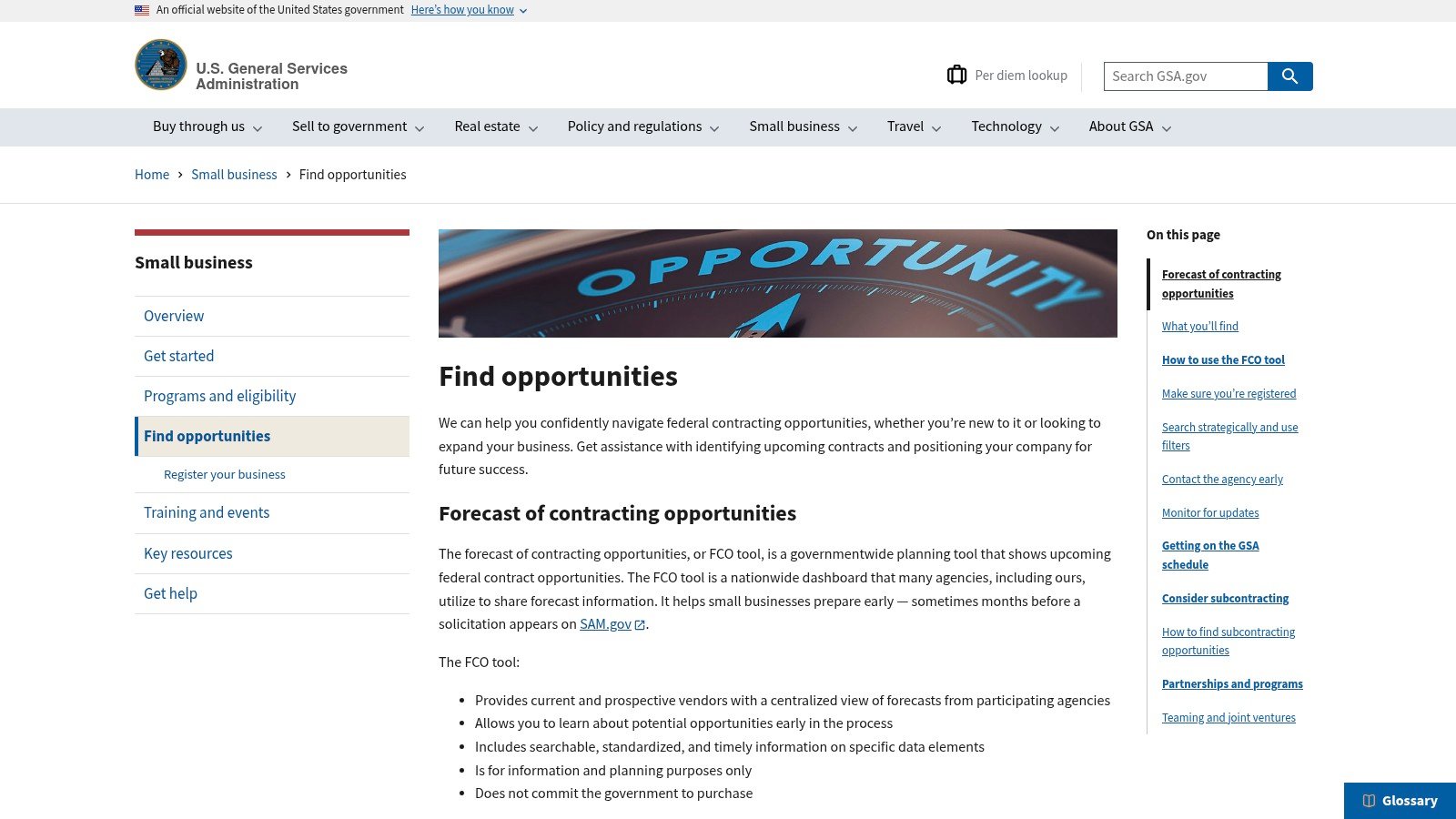
The GSA FCO is a strong free starting point for a solo researcher who wants official planning records and can supply the capture workflow manually. The GSA forecast dashboard provides centralized access to planned procurements from participating agencies without a subscription; it is not a guarantee of coverage across all federal agencies.
Records can include NAICS codes, estimated award timing, acquisition strategy, contract type, place of performance, set-aside information, and agency contacts. Field availability depends on what the agency publishes, so an empty incumbent or value field shouldn't be interpreted as evidence that none exists.
Use it as a source-validation desk
Search by both capability keywords and NAICS. Save the issuing office, source reference, expected timing, and retrieval date, then connect the record to previous awards and subsequent public notices.
The Office of Federal Procurement Policy memorandum directs agencies toward centralized access, current information, and standardized forecast submissions. That direction supports consolidation, but it doesn't establish that every agency record is equally complete.
Best use: Official-source validation and manageable federal account watchlists.
Trade-off: You supply the competitive research, ownership assignments, revision log, and pipeline discipline.
Coverage caveat: Governmentwide access means participating agencies and published records, not guaranteed coverage of every planned procurement.
Keep SAM.gov opportunity searches alongside the forecast workflow because they provide the formal public notices, including pre-solicitations and solicitations. Match agency, office, scope, and acquisition strategy rather than relying on title similarity alone.
For the capture implications of those early signals, the guide to why procurement forecasts matter in government contracting explains why early discovery still needs qualification.
7. Acquisition.gov Procurement Forecasts
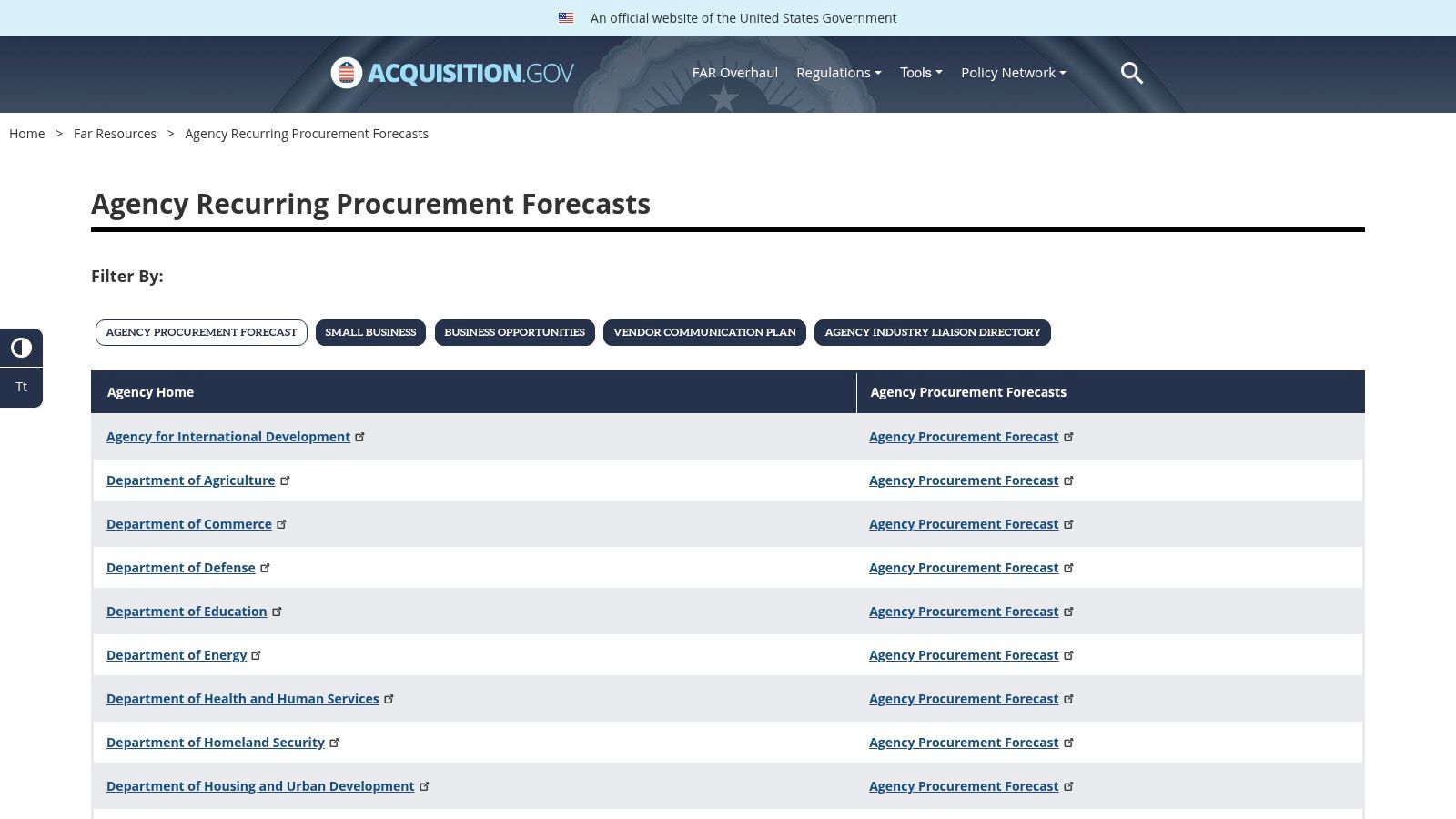
Acquisition.gov is a directory, not a unified forecast database. That's a limitation for high-volume filtering but an advantage when a researcher needs to locate the original agency resource and understand what a consolidated dashboard may omit.
The Acquisition.gov procurement forecast gateway links forecast resources for at least 23 federal departments and independent agencies, including Defense, Energy, Homeland Security, Transportation, Veterans Affairs, GSA, and NASA. Users still need to work through the linked systems and account for different publication formats.
Make it your coverage audit
An enterprise intelligence lead can use the directory to build an agency-source register. Record where each agency publishes forecasts, which fiscal years are available, whether archives exist, and how the commercial tools represent those sources.
That register helps answer a question most product demonstrations skip: Is a missing result unpublished, outside the subscription, or absent from the aggregator?
Advantage: Official, free access to agency-specific context beyond a consolidated interface.
Disadvantage: Separate searches, inconsistent fields, and document-heavy formats increase manual work.
Best buyer: A source-conscious solo researcher or an enterprise team auditing coverage, rather than a team expecting ready-made pursuit management.
The Professional Services Council's 2024 Federal Business Forecast Scorecard reviewed 70 agencies and components and identified continuing usability problems, including inconsistent fields and PDF-heavy publication. Its preference for machine-processable output matters operationally: a forecast that can't be sorted or compared requires more analyst effort.
Don't turn the directory into a daily browser-tab routine. Use it to establish source coverage, then concentrate recurring monitoring on agencies that match your account strategy.
Picking Your Stack and Positioning Before the Solicitation
Buy the workflow you need, not the largest forecast count. Solo researchers and small teams should start with GSA FCO and Acquisition.gov, then add a paid platform when monitoring volume or manual reconciliation becomes difficult. A free source plus disciplined qualification can be more useful than an expensive subscription full of unowned leads.
Growing teams should compare GovTribe and HigherGov using the same target agencies and requirements. Published pricing helps narrow the shortlist, but exports, AI consumption, source coverage, and team permissions determine practical cost. Don't mistake the existence of SLED opportunities for equivalent SLED forecasting depth.
For established capture teams, SamSearch is my pick when the requirement is an integrated discovery-to-proposal workflow. Compare it with Civio AI when AI-assisted qualification and revenue operations are the priority; Civio's description of SamSearch as an intelligence source means the comparison is about workflow, not independent data coverage. Federal Compass is more focused on task orders, recompetes, and federal account strategy.
A forecast should earn its way into the pursuit pipeline. Assigning an estimated value and close date doesn't make it qualified.
Use free-source validation → forecast discovery → fit scoring → pursuit pipeline as the operating sequence. Score capability fit, acquisition access, incumbent position, customer knowledge, and available capture capacity. Keep confidence in the forecast separate from confidence that your company can win.
Run a 30-day evaluation
Establish the baseline: Select target accounts and known requirements, then record current research effort and source coverage.
Test discovery: Compare relevant results, missing agency records, duplicate entries, and links to original publications.
Test change handling: Inspect revised timing, acquisition strategy, canceled records, and whether alerts explain what changed.
Test execution: Move a qualified lead into a shared pursuit, assign tasks, export it, and verify the CRM handoff.
Make the decision: Judge qualified pursuits advanced and manual work avoided, not raw search-result totals.
Bring a live forecast, a known incumbent contract, and an active solicitation to the demo. That makes it possible to evaluate the complete handoff from early intelligence to a controlled response.
Frequently Asked Questions
What is a government procurement forecast database? It collects or points to agency plans for possible future purchases. Forecast records are planning signals, not solicitations or commitments to buy.
Are Civio AI and SamSearch separate forecast data sources? Civio identifies SamSearch as an intelligence source. Compare their workflows, but do not treat their shared signals as independent coverage.
Where can I verify a federal forecast for free? Start with the GSA forecast dashboard for participating agencies, then use Acquisition.gov to find the agency's own publication and SAM.gov for formal notices.
For established capture teams, SamSearch connects forecast discovery with fit scoring, incumbent research, pursuit management, and proposal analysis. Visit SamSearch to request a demo using your target agencies and a live pursuit, so you can test how early planning signals become evidence-backed capture decisions.